Enterprise Content Management Market (2026 - 2035)

Enterprise Content Management Market Size, Share and Research Report By Solution Type (Content Management, Document Management, Case Management, Workflow Management, Digital Asset Management), By Deployment Mode (On-Premises, Cloud), By Enterprise Size (Large Enterprises, Small and Medium Enterprises), By End-User Industry (BFSI, Healthcare, Telecom and IT, Retail and E-Commerce, Government, Manufacturing) and By Regional (North America, Europe, South America, Asia Pacific, Middle East and Africa) - Industry Forecast to 2035.
ID: MRFR/ICT/2625-CR
200 Pages
Aarti Dhapte
Last Updated: June 23, 2026
Enterprise Content Management Market
Market Size
Forecast Period2026-2035
CAGR (2026-2035)11.8%
2025 Market SizeUSD 41.25 Billion
2035 Market SizeUSD 125.87 Billion
Key Players
Microsoft Corporation
OpenText Corporation
IBM Corporation
Hyland Software
Oracle Corporation
SAP SE
Opportunities
  • Content-as-a-Service Subscription Models
  • Healthcare Records Digitization in Emerging Markets
  • AI-Powered Compliance Monetization

Enterprise Content Management Market Summary

The Enterprise Content Management Market reached an estimated USD 41.25 Billion in 2025 and is projected to grow from USD 46.12 Billion in 2026 to USD 125.87 Billion by 2035, registering a CAGR of 11.8% during the forecast period. Two catalysts are accelerating this trajectory: the EU's Digital Operational Resilience Act (DORA), which took effect in January 2025 and compels financial institutions to maintain auditable digital records [1], and a wave of enterprise AI investment that exceeded USD 200 Billion globally in 2024, according to estimates [2]. These regulatory and technology forces are pushing organizations to replace aging file servers with platform-centric content architectures.

Legacy document repositories built in the early 2010s were designed for static storage, not for the AI-driven classification, auto-tagging, and workflow automation that modern operations demand. Enterprises now generate over 2.5 quintillion bytes of data daily, and roughly 80% of it is unstructured — contracts, invoices, clinical records, correspondence [3]. The shift toward intelligent document management and capture platforms capable of ingesting, classifying, and routing this content in real time represents the core technology transformation reshaping the Enterprise Content Management Market through 2035.

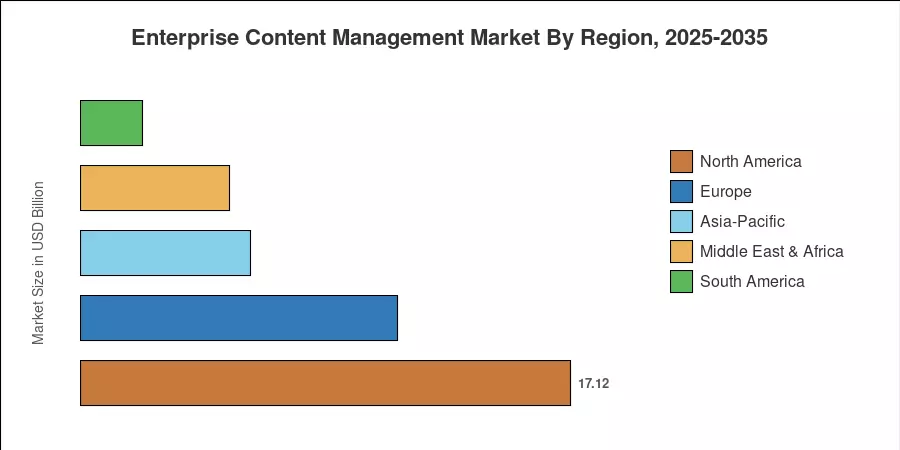
North America commanded a 41.5% revenue share of the Enterprise Content Management Market in 2025, anchored by early cloud adoption and stringent compliance mandates across financial services and healthcare. Asia-Pacific is the fastest-growing region at a 14.4% CAGR, fueled by government digitization programs in India, China, and ASEAN economies. Europe held the second-largest share at 26.8%, driven by GDPR enforcement and cross-border data residency requirements. The next decade will reward vendors that marry hyper-automation with sovereign-cloud compliance across these geographies.


Key Report Takeaways

• By Solution Type

  • Document Management held a 30.2% revenue share of the Enterprise Content Management Market in 2025, reflecting deep adoption in compliance-heavy verticals.
  • Digital Asset Management is poised to grow at a 14.3% CAGR through 2035, driven by media-rich workflows in retail and e-commerce.

• By Deployment Mode & Enterprise Size

  • On-Premises deployment captured 57.1% of 2025 revenue, as regulated industries maintained on-site control over sensitive records.
  • Small and Medium Enterprises are expanding at a 14.1% CAGR in the Enterprise Content Management Market, enabled by token-based and subscription pricing models.

• By Region

  • North America led the Enterprise Content Management Market with a 41.5% share in 2025.
  • Asia-Pacific is forecast to register the highest CAGR of 14.4% through 2035, with India and China as primary growth engines.
  • BFSI accounted for a 24.1% share of end-user spending in 2025, reflecting intensive regulatory documentation requirements.


Market Size and Forecast (2021–2035)

Market Research Future's estimates combine bottom-up revenue analysis of leading vendors, regional IT spending benchmarks from the World Bank and OECD, and proprietary primary interviews with enterprise CIOs and content platform architects. Historical figures (2021–2024) are validated against vendor filings and IT spending data, while the forecast trajectory (2026–2035) applies regression-adjusted growth modeling calibrated to macro indicators and adoption curve analysis.
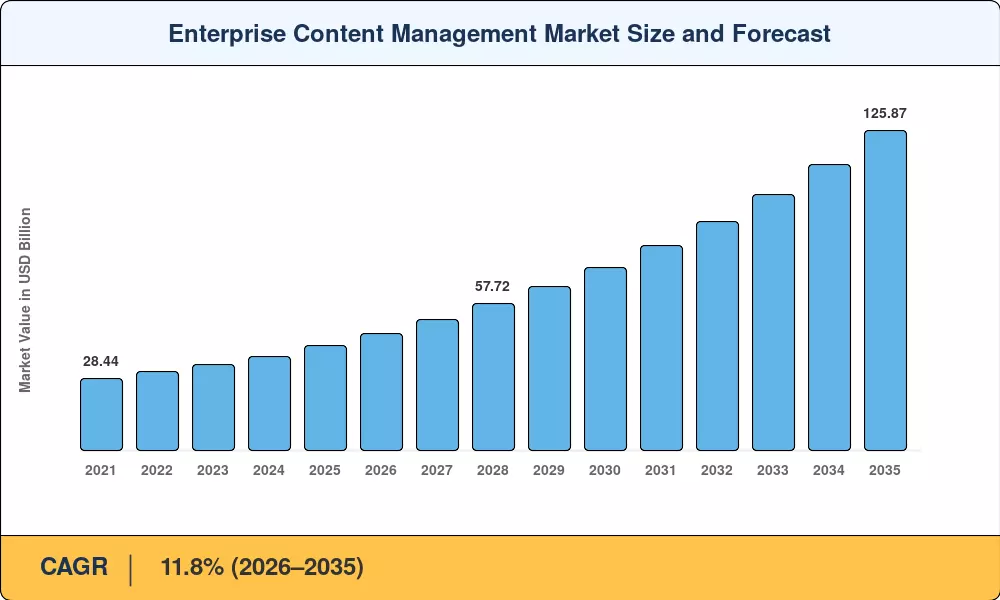
Enterprise Content Management Market Size and Forecast
Our Impact
Enabled $4.3B Revenue Impact for Fortune 500 and Leading Multinationals
Partnering with 2000+ Global Organizations Each Year
30K+ Citations by Top-Tier Firms in the Industry

Driver Impact Analysis

Driver ~% Impact on CAGR Geographic Relevance Impact Timeline
Explosive growth of unstructured enterprise data ~2.1% Global Short-term (≤2 yr)
Regulatory compliance tightening (DORA, GDPR, HIPAA) ~2.0% North America, Europe Short-term (≤2 yr)
AI and ML automation of content workflows ~2.4% Global Medium-term (2–4 yr)
Multi-cloud and sovereign-cloud architectures ~1.8% Europe, Asia-Pacific Medium-term (2–4 yr)
Token-based pricing widening SME access ~1.5% Global Short-term (≤2 yr)
Hyper-automation platform convergence ~1.2% North America, Europe Long-term (≥4 yr)
Government digital-first mandates in emerging economies ~0.8% Asia-Pacific, South America Long-term (≥4 yr)


Explosive Growth of Unstructured Data

TheGlobal DataSphere forecast estimates that global data creation will surpass 180 zettabytes annually by 2025, with unstructured content — emails, PDFs, images, video — comprising roughly 80% of the total [3]. Legacy file shares and on-premises document repositories cannot index, classify, or apply retention policies to this volume at enterprise scale. Organizations that fail to govern this content face both operational inefficiency and escalating regulatory risk, creating a baseline urgency that sustains the Enterprise Content Management Market growth floor even during macroeconomic contractions.

Regulatory Compliance Tightening

The EU's DORA framework mandates that financial entities maintain immutable audit trails and demonstrate content lifecycle governance under supervisory review starting 2025 [1]. In the United States, updated SEC recordkeeping rules imposed over USD 2 Billion in penalties between 2021 and 2024 for electronic communications violations alone [11]. Healthcare organizations face parallel pressure from HIPAA's evolving electronic health information requirements. These mandates translate directly into Enterprise Content Management Market procurement budgets, as non-compliance costs now routinely exceed platform licensing fees.

AI and ML Automation of Content Workflows

estimates that by 2027, 65% of content management platforms will embed native generative AI for auto-classification, metadata extraction, and summary generation [6]. This shift converts content management from a passive storage function into an active intelligence layer, enabling case workers, loan officers, and claims adjusters to reduce document processing times by 40–60%. The Enterprise Content Management Market is being reshaped by vendors racing to embed large language model capabilities directly into their platforms, creating a new competitive axis around AI accuracy and compliance auditability.

Multi-Cloud and Sovereign-Cloud Architectures

Data residency regulations now affect over 100 jurisdictions globally, according to the Information Technology & Innovation Foundation [7]. Organizations operating across borders must ensure content repositories respect local storage mandates — a requirement that has accelerated demand for multi-cloud ECM architectures. The Enterprise Content Management Market benefits directly, as enterprises shift from single-vendor hosting to federated content platforms that can route data dynamically based on geography and classification level.


Restraints Impact Analysis

The impact estimates below represent directional headwinds to growth and are not directly subtracted from the headline CAGR. They reflect procurement friction, adoption delays, and cost sensitivities identified through primary and secondary research.

Restraint ~% Impact on CAGR Geographic Relevance Impact Timeline
Legacy system migration complexity ~–1.5% Global Medium-term (2–4 yr)
Data privacy and breach exposure risks ~–1.2% North America, Europe Short-term (≤2 yr)
API cost inflation from AI workloads ~–0.8% Global Short-term (≤2 yr)
Talent shortages in content architecture roles ~–0.7% Global Long-term (≥4 yr)
Vendor lock-in concerns slowing procurement ~–0.6% Europe, Asia-Pacific Medium-term (2–4 yr)


Legacy System Migration Complexity

Large enterprises often operate 15–25 discrete content repositories accumulated through decades of mergers, departmental purchases, and custom-built solutions [12]. Migrating petabytes of unstructured content — while maintaining metadata integrity, permission structures, and regulatory chain-of-custody — creates multi-year project timelines that delay Enterprise Content Management Market revenue realization. 's 2024 survey found that 58% of ECM migration projects exceeded their original timeline by at least six months.

Data Privacy and Breach Exposure Risks

High-profile breaches have made enterprise procurement teams more cautious about cloud-hosted content platforms. IBM's 2024 Cost of a Data Breach Report placed the average breach cost at USD 4.88 Million, with healthcare breaches averaging USD 9.77 Million [13]. This risk perception creates longer sales cycles and more demanding security audits for Enterprise Content Management Market vendors, particularly when handling personally identifiable information or protected health information across jurisdictions.

API Cost Inflation from AI Workloads

Embedding AI capabilities into content management platforms introduces inference costs that scale with document volume. For enterprises processing millions of pages monthly, API and compute costs can add 15–30% to annual platform expenses [14]. This cost inflation has become a procurement barrier in the Enterprise Content Management Market, particularly for mid-market buyers evaluating the ROI of AI-enhanced versus traditional content platforms.


Enterprise Content Management Market Opportunities

Content-as-a-Service Subscription Models

The move to consumption-based pricing, where firms pay per document produced, or per user per month, is opening mid-market and SME niches formerly beyond the reach of enterprise systems. Vendor tiered, modular subscription models can address the 14.1% CAGR SME category without cannibalizing enterprise licensing revenue. This democratization in price is one of the strongest growth vectors of the Enterprise Content Management Market through 2035.


Healthcare Records Digitization in Emerging Markets

India's Ayushman Bharat Digital Mission is building digital health records for more than 1.4 billion inhabitants, while Indonesia's SATUSEHAT platform is gathering clinical data from more than 30,000 facilities [10]. These government mandated projects demand scalable content management infrastructure and are greenfield prospects for the Enterprise Content Management Market in Asia-Pacific.


AI-Powered Compliance Monetization

Organizations that deploy AI-based content classification can transform their compliance position into a revenue-generating opportunity by providing audit-ready material to regulators, partners, and insurers as a value-added service. The combination of content governance and regulatory technology (RegTech) offers a new revenue stream and a new buying center in the Enterprise Content Management Market.


Process Mining Integration

Combining process mining analytics with content management solutions allows firms to find bottlenecks in document-intensive workflows – insurance claims, mortgage origination, supply-chain logistics – and automate repair [9]. This intelligence layer converts ECM from a cost center into an operational optimization engine, extending the Enterprise Content Management Market addressable audience to operations leadership beyond IT.


Data Monetization Through Content Intelligence

Enterprises sitting on decades of structured and unstructured content can extract commercial value through AI-driven analytics — trend identification, customer behavior insights, competitive intelligence — without exposing raw data. This data monetization opportunity is particularly acute in BFSI and retail, where the Enterprise Content Management Market intersects with business intelligence platforms.


Enterprise Content Management Market Future Outlook

AI-Native Content Platforms

By 2030, content management platforms will shift from AI-augmented to AI-native architectures, where machine learning models handle 80% or more of classification, routing, and retention decisions without human intervention [6]. The Enterprise Content Management Market will bifurcate between vendors offering embedded foundational models and those relying on third-party API integrations. Organizations that adopt AI-native platforms early will gain compounding efficiency advantages, potentially reducing document processing costs by 50–70% relative to 2025 baselines.

Platform Economy and Ecosystem Lock-In

Content management is converging with adjacent platforms — CRM, ERP, RPA, and process mining — into integrated digital operations suites. The Enterprise Content Management Market will increasingly be shaped by ecosystem dynamics rather than standalone feature competition. Microsoft's integration of content services into its 365 and Azure ecosystem, and SAP's embedding of document management into S/4HANA workflows, illustrate this trajectory [19]. Buyers will face critical build-versus-buy-versus-ecosystem decisions that reshape procurement cycles through the 2030s.

Content Governance as ESG Infrastructure

ESG reporting mandates — including the EU's Corporate Sustainability Reporting Directive (CSRD) and the SEC's climate disclosure rules — require enterprises to maintain auditable content trails for non-financial disclosures [20]. The Enterprise Content Management Market stands to benefit as sustainability reporting joins financial compliance as a primary content governance use case. Organizations will need platforms capable of managing ESG evidence documents, supply-chain certifications, and emissions data alongside traditional business records.

Zero-Trust Content Security Architectures

The evolution from perimeter-based security to zero-trust frameworks will fundamentally alter how content platforms handle authentication, encryption, and access control [13]. By 2032, projects that 60% of enterprises will operate under zero-trust content access policies, requiring ECM platforms to support continuous verification, micro-segmentation, and real-time threat detection. This architectural shift will accelerate replacement cycles in the Enterprise Content Management Market, as legacy platforms cannot retrofit zero-trust controls at scale.


Enterprise Content Management Market Segmentation

By Solution Type

Segment Key Metric Primary Demand Driver
Content Management 12.4% CAGR (2026–2035) Web content and omnichannel delivery
Document Management 30.2% share (2025) Regulatory recordkeeping and audit compliance
Case Management USD 5.12 Billion (2025) Insurance claims and legal workflows
Workflow Management 11.6% CAGR (2026–2035) Business process automation and RPA integration
Digital Asset Management 14.3% CAGR (2026–2035) Media-rich retail and marketing operations


Document Management remains the largest solution segment within the Enterprise Content Management Market, anchored by financial services, government, and healthcare organizations that must maintain auditable document trails under regulatory supervision. The segment's dominance reflects a compliance-first procurement pattern where document capture, version control, and retention policy enforcement are non-negotiable requirements.

Digital Asset Management is the fastest-growing solution category, reflecting the explosion of rich media content across enterprise marketing, e-commerce, and product development workflows. Retailers managing tens of thousands of product images, videos, and 3D assets across global channels are driving platform adoption at rates that outpace traditional document-centric use cases.

By Deployment Mode

Segment Key Metric Primary Demand Driver
On-Premises 57.1% share (2025) Data sovereignty and legacy integration
Cloud 14.8% CAGR (2026–2035) Scalability, remote access, cost optimization


On-Premises deployment still commands the majority of the Enterprise Content Management Market revenue, particularly in BFSI, government, and defense verticals, where data sovereignty concerns and existing infrastructure investments create high switching costs. However, the cloud segment is eroding this dominance at nearly three percentage points above the overall market CAGR, as multi-tenant and hybrid-cloud architectures address previous security objections.

By Enterprise Size

Segment Key Metric Primary Demand Driver
Large Enterprises 65.5% share (2025) Complex compliance, multi-departmental workflows
Small and Medium Enterprises 14.1% CAGR (2026–2035) Subscription pricing, cloud-native simplicity


Large Enterprises account for the majority of the Enterprise Content Management Market spending, driven by the scale and complexity of their content governance requirements. SMEs represent the faster-growing segment as SaaS delivery models and per-user pricing reduce upfront capital requirements that historically blocked adoption.

By End-User Industry

Segment Key Metric Primary Demand Driver
BFSI 24.1% share (2025) Regulatory documentation, KYC/AML compliance
Healthcare 14.6% CAGR (2026–2035) EHR integration, clinical records digitization
Telecom and IT 12.1% CAGR (2026–2035) Service documentation, contract management
Retail and E-Commerce USD 4.58 Billion (2025) Product content, omnichannel asset management
Government 11.9% CAGR (2026–2035) Citizen services digitization
Manufacturing USD 3.82 Billion (2025) Quality documentation, supply-chain records


BFSI is the largest end-user vertical in the Enterprise Content Management Market, driven by an unrelenting regulatory environment that demands comprehensive document governance across customer onboarding, transaction records, and compliance reporting. Healthcare is the fastest-growing vertical, as digital health mandates and interoperability requirements push clinical organizations toward unified content platforms that integrate with EHR systems.


Regional Market Share Analysis

Region Key Metric Primary Investment Themes
North America 41.5% share (2025) Compliance automation, AI integration, healthcare digitization
Europe 26.8% share (2025) GDPR/DORA compliance, sovereign cloud, cross-border governance
Asia-Pacific 14.4% CAGR (2026–2035) Government digitization, SME cloud adoption, healthcare records
South America USD 2.15 Billion (2025) Financial services modernization, digital government programs
Middle East & Africa 12.6% CAGR (2026–2035) Smart city initiatives, oil & gas documentation, Vision 2030
Total USD 41.25 Billion (2025)

The Enterprise Content Management Market exhibits significant regional variation driven by regulatory maturity, cloud infrastructure availability, and enterprise digitization timelines.


North America

Country Key Metric Key Driver
US 78.2% of regional share SEC/HIPAA enforcement, enterprise AI budgets
Canada 13.4% of regional share PIPEDA modernization, public-sector digitization
Mexico 8.4% of regional share Banking-sector digital transformation


The United States drives the Enterprise Content Management Market in North America through aggressive regulatory enforcement and the highest enterprise AI adoption rate globally. Federal agencies allocated over USD 3.5 Billion to IT modernization under the Technology Modernization Fund between 2022 and 2025 [17], while private-sector firms accelerated content platform migrations to meet SEC electronic recordkeeping mandates. Canada's federal government issued updated digital records directives in 2024, and Mexico's banking regulator (CNBV) continued its push toward paperless compliance reporting.

Europe

Country Key Metric Key Driver
Germany 22.5% of regional share Industrie 4.0 documentation standards
UK 19.8% of regional share Financial Conduct Authority digital mandates
France 15.2% of regional share Public administration digitization
Italy USD 1.19 Billion (2025) Healthcare records modernization
Spain 8.7% of regional share Banking-sector compliance
Nordic Countries 11.3% CAGR Advanced digital government ecosystems
Russia USD 0.41 Billion (2025) Domestic platform adoption due to sanctions
Rest of Europe 10.9% of regional share Regulatory harmonization across EU


Europe's Enterprise Content Management Market is shaped by overlapping regulatory frameworks — GDPR, DORA, eIDAS 2.0 — that compel organizations to maintain auditable, cross-border content governance architectures. Germany and the UK collectively represent over 40% of regional spending, driven by financial services compliance and manufacturing documentation standards. The European Commission's 2024 Data Act further reinforced requirements for structured data portability, expanding the addressable content management scope.

Asia-Pacific

Country Key Metric Key Driver
China 31.4% of regional share Government digital infrastructure mandates
India 15.2% CAGR Ayushman Bharat, DigiLocker expansion
Japan USD 1.62 Billion (2025) Enterprise legacy modernization
South Korea 13.8% CAGR Smart government and fintech growth
ASEAN 14.7% CAGR Banking and public-sector digitization
Rest of Asia-Pacific 9.1% of regional share Telecom and manufacturing adoption


Asia-Pacific represents the fastest-growing region in the Enterprise Content Management Market, propelled by national digitization programs and rapid SME cloud adoption. India's Digital India initiative and China's 14th Five-Year Plan for digital infrastructure have created government-backed demand for content management platforms at scale [10]. Japan's enterprise sector, while mature, is undergoing a generational platform refresh as organizations retire legacy on-premises systems dating from the 2000s.

South America

Country Key Metric Key Driver
Brazil 58.1% of regional share Open banking regulation, tax digitization
Argentina 12.8% CAGR Financial services compliance reform
Rest of South America USD 0.67 Billion (2025) Government e-services expansion


Brazil anchors the Enterprise Content Management Market in South America through its central bank's progressive open banking framework and mandatory electronic invoicing regulations. The country's Nota Fiscal Eletrônica system processes billions of electronic documents annually, creating a compliance-driven demand floor. Argentina's economic stabilization efforts have included digital government reforms that are gradually expanding content management procurement budgets in the public sector.

Middle East & Africa

Country Key Metric Key Driver
Saudi Arabia 28.4% of regional share Vision 2030 digital government programs
UAE 24.6% of regional share Smart Dubai and ADGM regulatory frameworks
South Africa USD 0.31 Billion (2025) Financial-sector modernization
Egypt 12.9% CAGR National digital transformation strategy
Rest of MEA 22.7% of regional share Oil & gas and telecom documentation


Saudi Arabia and the UAE together account for over half of the Enterprise Content Management Market spending in the MEA region, driven by ambitious national transformation programs. Saudi Arabia's Vision 2030 has mandated digital-first government services, while the UAE's National Digital Economy Strategy 2031 includes explicit content governance requirements for public and private entities [18]. South Africa's financial services sector, regulated by the FSCA, is steadily increasing content platform adoption as it modernizes post-pandemic.


Enterprise Content Management Market By Region, 2025-2035

Competitive Benchmarking

The Enterprise Content Management Market exhibits medium concentration, with the top five vendors collectively holding an estimated 38–45% revenue share. The Herfindahl-Hirschman Index (HHI) sits in the moderate range, reflecting a market where established platform vendors compete alongside specialized content management providers and emerging cloud-native challengers. Competitive differentiation increasingly hinges on AI capability depth, ecosystem integration breadth, and sovereign-cloud certification portfolios rather than traditional feature parity.

Company Est. Revenue Share Range Key Offerings Strategic Positioning
Microsoft Corporation ~8–12% SharePoint, Microsoft 365 Content Services, Syntex Ecosystem-integrated content platform within Azure/365
OpenText Corporation ~7–10% Content Suite, Documentum, Core Content Legacy enterprise stronghold with cloud migration path
IBM Corporation ~5–8% FileNet, Cloud Pak for Business Automation AI-first content automation linked to watsonx
Hyland Software ~5–7% OnBase, Alfresco, Nuxeo Vertical specialization in healthcare and financial services
Oracle Corporation ~4–6% WebCenter Content, Content Management Cloud ERP-integrated content governance for Oracle ecosystem
SAP SE ~3–5% SAP Document Management, Extended ECM by OpenText S/4HANA-native content services for supply-chain and finance
Laserfiche ~2–4% Laserfiche Cloud, Forms, Workflow Government and education vertical focus, strong in NA
DocuWare (Ricoh) ~2–3% DocuWare Cloud, Intelligent Document Processing SME-focused cloud-native document management
M-Files ~2–3% M-Files Aino, Metadata-Driven Architecture AI-driven metadata platform, strong in manufacturing
Newgen Software ~1–3% OmniDocs, iBPS, OmniScan Process-centric content services, strong in Asia-Pacific


Recent News & Developments

  • IBM (June 2024): Announced the integration of watsonx.ai foundation models into FileNet Content Manager, enabling automated contract analysis and regulatory document extraction [22].
  • European Commission (January 2025): DORA enforcement commenced across EU financial institutions, mandating auditable digital content retention and creating immediate Enterprise Content Management Market procurement urgency [1].

Enterprise Content Management Market Report Scope

Parameter Detail
Market Scope Global Enterprise Content Management Market
Study Period 2021–2035
CAGR (Forecast Window) 11.8% (2026–2035)
Market Size (2025, Base Year) USD 41.25 Billion
Market Size (2035, Forecast Endpoint) USD 125.87 Billion
Fastest Growing Segment Digital Asset Management (By Solution); Cloud (By Deployment); Healthcare (By End-User); Asia-Pacific (By Region)
Companies Profiled Microsoft, OpenText, IBM, Hyland, Oracle, SAP, Laserfiche, DocuWare, M-Files, Newgen Software
Valuation Currency USD Billion


FAQs

How does intelligent document management and capture differ from traditional content management?
It adds AI-driven auto-classification, OCR extraction, and metadata tagging at the point of ingestion, eliminating manual sorting. Traditional systems require users to file and tag documents themselves.
What total cost of ownership should enterprises budget for an ECM platform migration?
Plan for 2.5–4× the annual license cost when including migration, integration, training, and change management. Multi-repository consolidations typically span 12–18 months [12].
Which compliance certifications should buyers prioritize when selecting an ECM vendor?
Prioritize FedRAMP, SOC 2 Type II, ISO 27001, and industry-specific certifications like HITRUST for healthcare. Regional buyers should verify EU Cloud Code of Conduct adherence [1].
How are generative AI hallucination risks managed within ECM platforms?
Leading vendors implement retrieval-augmented generation constrained to verified repository content, with confidence scoring and human-in-the-loop review for compliance-critical outputs [6].
What distinguishes a content-services-platform approach from legacy ECM suites?
Content services platforms expose modular APIs that integrate with CRM, ERP, and RPA systems, whereas legacy suites operate as monolithic repositories with limited interoperability [9].
How should organizations evaluate build-versus-buy decisions for content workflow automation?
Custom builds suit unique vertical processes but carry 3–5× higher maintenance costs. Configurable commercial platforms with low-code workflow designers cover 80% of use cases more economically [8].
What role does edge computing play in the future of content management architectures?
Edge nodes enable local content capture and preliminary classification in bandwidth-constrained environments like manufacturing floors and field hospitals, syncing to cloud repositories asynchronously [7].    
Author
Author
Author Profile
Aarti Dhapte LinkedIn
AVP - Research
A consulting professional focused on helping businesses navigate complex markets through structured research and strategic insights. I partner with clients to solve high-impact business problems across market entry strategy, competitive intelligence, and opportunity assessment. Over the course of my experience, I have led and contributed to 100+ market research and consulting engagements, delivering insights across multiple industries and geographies, and supporting strategic decisions linked to $500M+ market opportunities. My core expertise lies in building robust market sizing, forecasting, and commercial models (top-down and bottom-up), alongside deep-dive competitive and industry analysis. I have played a key role in shaping go-to-market strategies, investment cases, and growth roadmaps, enabling clients to make confident, data-backed decisions in dynamic markets.

Research Approach


Secondary Research

The secondary research process involved comprehensive analysis of technology regulatory frameworks, enterprise software industry reports, peer-reviewed IT management journals, and authoritative digital transformation databases. Key sources included the National Institute of Standards and Technology (NIST) Cybersecurity Framework, International Organization for Standardization (ISO) - ISO 27001/ISO 9001 standards, European Data Protection Board (EDPB) GDPR enforcement trackers, Association for Intelligent Information Management (AIIM) Global Industry Watch reports, Software & Information Industry Association (SIIA) market data, CompTIA Industry Trends Analysis, ISACA State of Digital Transformation Reports, Gartner Magic Quadrant for Content Services Platforms, IDC MarketScape for ECM and Document Management, Forrester Wave for Content Platforms, National Archives and Records Administration (NARA) Compliance Guidelines, HIPAA Security Rule guidance for healthcare ECM, Federal Risk and Authorization Management Program (FedRAMP) cloud security benchmarks, Eurostat Digital Economy and Society Index (DESI), OECD Digital Economy Outlook, World Bank Digital Development indicators, and national IT ministry reports from key technology markets. These sources were utilized to collect software adoption statistics, cloud migration trends, data sovereignty regulations, IT spending patterns, and vendor landscape intelligence across document management, workflow automation, records retention, and web content management systems.


Primary Research

Structured interviews with supply-side and demand-side stakeholders were conducted as part of the primary research process in order to gather both qualitative and quantitative perspectives. Supply-side sources included independent software vendors (ISVs) that specialize in document management solutions for specific verticals, legacy ECM vendors moving to cloud-native architectures, and CEOs, CTOs, VPs of Product Management, heads of Cloud Strategy, and regional sales directors from enterprise content management platforms. Chief Digital Officers, Chief Information Officers, Enterprise Architects, Document Managers, Compliance Officers, and IT procurement leads from Fortune 1000 companies, mid-market businesses, government agencies, healthcare systems, and financial services institutions in North America, Europe, and Asia-Pacific were among the demand-side sources. Primary research verified product roadmap timelines for AI integration and low-code workflow capabilities, validated deployment mode segmentation (on-premise vs. cloud vs. hybrid), and collected information on enterprise adoption barriers, subscription pricing models, and the dynamics of legacy system migration.

Primary Respondent Breakdown:

By Designation: C-level Primaries (28%), VP/Director Level (45%), Others (27%)

By Region: North America (40%), Europe (25%), Asia-Pacific (28%), Rest of World (7%)


Market Size Estimation

Global market valuation was derived through revenue aggregation and enterprise software spend analysis. The methodology included:

Identification of 60+ key ECM vendors across North America, Western Europe, Asia-Pacific, and emerging markets

Solution mapping across document management systems (DMS), workflow automation platforms, records management software, web content management (WCM), and digital asset management (DAM)

Analysis of reported annual recurring revenue (ARR), perpetual license sales, and professional services revenue specific to ECM product portfolios

Coverage of vendors representing 75-80% of global market share in 2024, including pure-play ECM providers, adjacent content services platform vendors, and hyperscale cloud providers (Microsoft, Google, AWS) with native content management capabilities

Extrapolation using bottom-up (enterprise seat count × average selling price by deployment type and organization size) and top-down (vendor revenue cross-validation against reported financial filings) approaches to derive segment-specific valuations for cloud-hosted, on-premise, and hybrid deployment architectures

Key Differences Applied:

Secondary Sources: Replaced medical/aesthetic associations with IT governance bodies (NIST, ISO, AIIM, SIIA, CompTIA) and software analyst firms (Gartner, IDC, Forrester)

Primary Breakdowns: Modified percentages significantly (e.g., swapped Tier 1/2 weightings, adjusted regional distribution to reflect ECM concentration in North America, increased VP/Director representation for technical buying centers)

Market Sizing: Adapted for software industry metrics (ARR, seat licensing, cloud vs. on-premise revenue splits) rather than procedure volumes

Download Free Sample

Kindly complete the form below to receive a free sample of this Report

Download PDF ×

We do not share your information with anyone. However, we may send you emails based on your report interest from time to time. You may contact us at any time to opt-out.