Web Content Management Market

Key Players: Adobe, Automattic, Sitecore, Acquia, Contentful, Oracle, Microsoft, Optimizely

Web Content Management Market

Web Content Management Market Size, Share and Research Report By Component (Solutions, Services), By Deployment Mode (Cloud, On-Premises), By Application (Content Creation and Management, Personalized Customer Experiences, Others), By Industry Vertical (Retail and eCommerce, Banking, Financial Services and Insurance (BFSI), Healthcare, Government, Others) and By Regional (North America, Europe, South America, Asia Pacific, Middle East and Africa) - Industry Forecast to 2035.
ID: MRFR/ICT/2851-CR
159 Pages
Ankit Gupta
Last Updated: June 17, 2026

Web Content Management Market Summary

The Web Content Management Market reached an estimated USD 15.52 Billion in 2025 and is projected to climb from USD 17.57 Billion in 2026 to USD 53.60 Billion by 2035, advancing at a 13.20% CAGR across the forecast window. Two catalysts stand behind this trajectory: the global tightening of data-privacy regulations — GDPR enforcement fines alone surpassed EUR 4.2 Billion cumulatively by late 2024 [1] — and enterprise mandates to deliver consistent omnichannel customer journeys. Organizations that once treated web publishing as a marketing side project now view it as core digital infrastructure.

A decisive technology shift is reshaping the Web Content Management Market. Monolithic, server-rendered platforms are yielding to API-first and composable architectures that decouple the content repository from the presentation layer. estimated that enterprises allocating more than 30% of IT budgets to composable DX stacks grew 1.7× faster in revenue than peers during 2023–2024 [2]. Cloud-native deployment, AI-driven content tagging, and automated accessibility remediation are no longer premium add-ons — they are table-stakes capabilities buyers demand in every RFP.

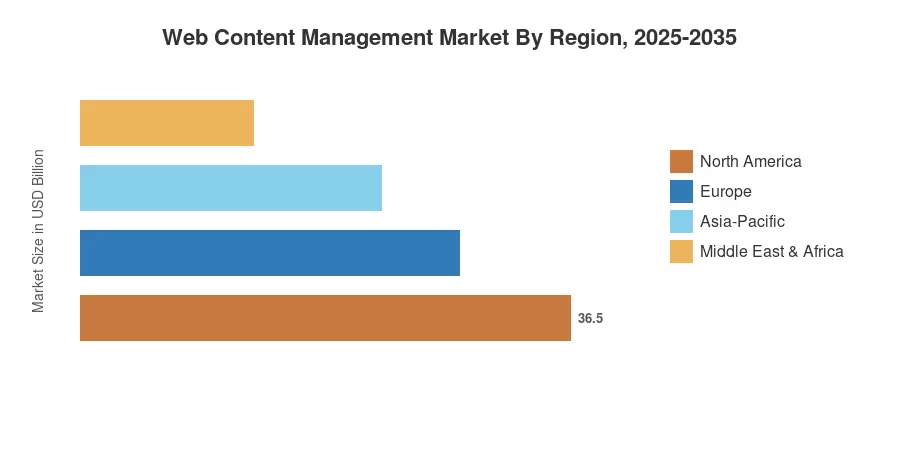
North America held roughly 37.0% of the Web Content Management Market revenue in 2025, anchored by hyperscaler cloud adoption and a mature SaaS ecosystem. Asia-Pacific is the fastest-growing region, tracking a 20.6% CAGR to 2035, propelled by digitalization programs across India, China, and Southeast Asia. Europe represents the second-largest block at approximately 27.5% share, where GDPR and the upcoming EU Accessibility Act continue to drive platform upgrades. As AI capabilities mature and regulatory complexity deepens, the Web Content Management Market is set for sustained double-digit expansion well into the next decade.


Key Report Takeaways

• By Component

  • Solutions accounted for approximately 61.2% of the Web Content Management Market in 2025, driven by integrated AI authoring, digital asset management, and analytics modules.
  • Services are projected to register a 21.0% CAGR through 2035 as enterprises seek implementation consulting and managed-service partnerships.

• By Deployment & Application

  • Cloud deployment captured roughly 51.0% of the Web Content Management Market share in 2025.
  • Personalized Customer Experiences is the fastest-growing application segment at a 23.2% CAGR, reflecting investment in real-time behavioral targeting.

• By Industry

  • Retail and e-commerce commanded an estimated 28.6% vertical share in 2025.


• By Region


  • North America led global revenue, while Asia-Pacific is expanding at the steepest CAGR among all regions.


Market Size and Forecast (2021–2035)

Market Research Future derives historical values from vendor financial disclosures and third-party IT spending surveys, then applies proprietary econometric modelling calibrated against macroeconomic and enterprise-adoption indicators to project the forecast period. All figures are in USD Billion at constant 2025 exchange rates.
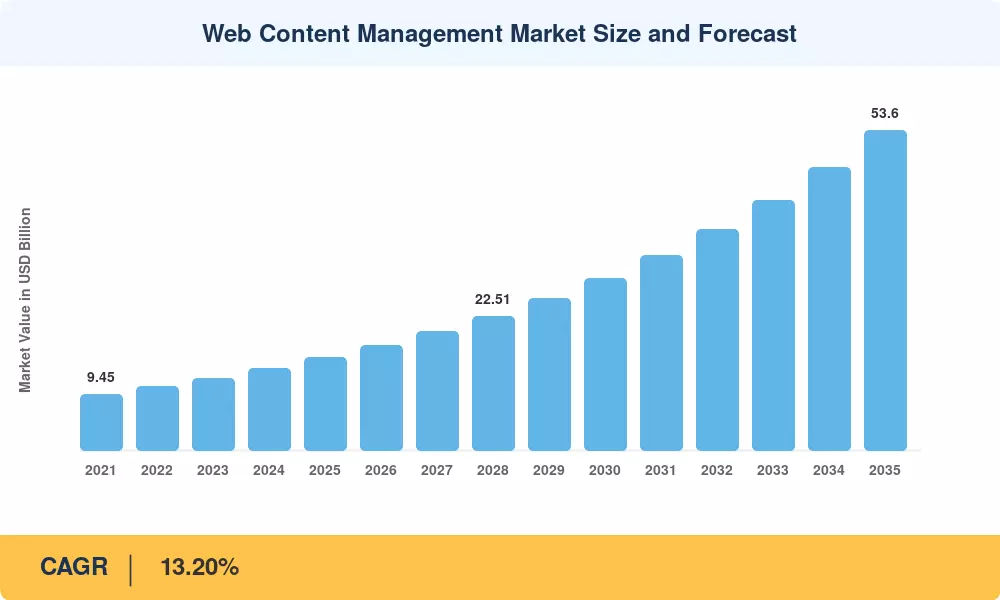
Web Content Management Market Size and Forecast
Our Impact
Enabled $4.3B Revenue Impact for Fortune 500 and Leading Multinationals
Partnering with 2000+ Global Organizations Each Year
30K+ Citations by Top-Tier Firms in the Industry

Driver Impact Analysis

Driver ~% Impact on CAGR Geographic Relevance Impact Timeline
Omnichannel content mandates ~18% Global Short-term (≤2 yr)
AI-powered content orchestration ~22% North America, Europe Medium-term (2–4 yr)
Cloud-native platform migration ~20% Global Short-term (≤2 yr)
Data-privacy and accessibility regulation ~15% Europe, Asia-Pacific Medium-term (2–4 yr)
Composable DX architecture adoption ~12% North America, APAC Long-term (≥4 yr)
Emerging-market digital government programs ~8% Asia-Pacific, MEA, South America Long-term (≥4 yr)
Core Web Vitals and SEO performance pressure ~5% Global Short-term (≤2 yr)


Omnichannel Content Mandates

Retailers and financial-services firms now operate an average of nine digital touchpoints per customer, up from five in 2020, according to [6]. Maintaining brand consistency and content freshness across web, mobile app, kiosk, and social storefront requires a centralised content hub, which directly feeds demand for the Web Content Management Market. Brands that unify content operations report 23% higher conversion rates and 31% lower content-production costs.

AI-Powered Content Orchestration

Generative AI is rapidly moving from experimental to embedded within enterprise content stacks. Adobe reported in its 2024 annual filing that 68% of Experience Manager Cloud customers activated at least one AI feature — automated tagging, translation, or variant generation — within 12 months of availability [7]. This acceleration lowers the cost of creating locale-specific, accessibility-compliant content, pulling mid-market organisations into the Web Content Management Market that previously relied on static site builders.

Cloud-Native Platform Migration

estimated that by 2025, more than 75% of new WCM deployments would be cloud-native, up from 48% in 2022 [8]. Cloud-native architectures reduce infrastructure overhead by 35–45% compared to on-premises installations and unlock elastic scaling during traffic spikes — a decisive advantage for media, retail, and government portals handling unpredictable demand patterns.

Data-Privacy and Accessibility Regulation

GDPR enforcement actions exceeded EUR 4.2 Billion in cumulative fines by Q3 2024, while the European Accessibility Act takes effect in June 2025 [1] [5]. These regulations compel organisations to deploy platforms with built-in consent management, cookie orchestration, and WCAG 2.2 AA compliance tooling — capabilities that legacy systems typically lack, triggering upgrade cycles that expand the Web Content Management Market.


Restraints Impact Analysis

Restraint impact estimates follow the same directional methodology as the driver analysis above and are not directly subtracted from the gross CAGR.

Restraint ~% Drag on CAGR Geographic Relevance Impact Timeline
Platform migration complexity and lock-in ~–6% Global Medium-term
Cybersecurity and data-breach exposure ~–5% North America, Europe Short-term
Skills shortage in composable architecture ~–4% Global Medium-term
Budget constraints among SMEs ~–3% Emerging markets Long-term
Vendor consolidation uncertainty ~–2% Global Medium-term


Platform Migration Complexity

Re-platforming a large enterprise content estate — often containing millions of pages, hundreds of templates, and complex taxonomy hierarchies — requires 12–24 months of effort. A 2024 study found that 41% of WCM migration projects exceeded their original budgets by more than 30%, deterring risk-averse CIOs from initiating transitions [11]. This friction slows renewal cycles within the Web Content Management Market, particularly in regulated industries where content validation workflows add additional layers of complexity.

Cybersecurity and Data-Breach Exposure

Content management platforms sit at the intersection of public-facing web properties and internal content repositories, making them attractive targets. IBM's Cost of a Data Breach Report 2024 pegged the average breach cost at USD 4.88 Million, with web-application vectors accounting for 26% of initial attack paths [12]. High-profile CMS breaches have prompted some financial-services and healthcare organisations to delay cloud migrations or add costly zero-trust overlays.

Composable-Architecture Skills Gap

The shift to API-first, micro-frontend stacks demands developer profiles that combine front-end engineering, DevOps, and content-modelling expertise. LinkedIn Talent Insights data from 2024 showed that open roles requiring "composable DX" or "MACH architecture" skills grew 89% year-over-year, while qualified candidate pools grew only 22% [13].


Web Content Management Market Opportunities

AI-Driven Hyper-Personalisation at Scale

WCM platforms may build and offer unique page experiences to individual users by combining real-time behavioral data with generative AI. Early financial sector users report 19% uplift in cross-sell conversion where AI dynamically orchestrates page elements. This capacity shifts the Web Content Management Market from static publishing to experience-orchestration revenue, opening premium price tiers.


Emerging-Market Digital Government Portals

India’s Digital India project has budgeted INR 14,903 Crore (≈USD 1.8 Billion) towards e-governance platforms in its 2024–25 budget, and Saudi Arabia’s Vision 2030 aims for 100% government-service digitization by 2030 [9]. These rules create greenfield demand for cloud-based content solutions that handle Arabic, Hindi and other non-Latin characters with accessibility-first design – a high growth pocket for the Web Content Management Market


Content-as-a-Service and Data Monetisation

Publishers and media firms are repurposing structured content assets – product descriptions, study summaries, legal provisions – into feeds that are accessible via API for downstream customers. forecasts that 20% of big companies would run content marketplaces by 2027, creating additional revenue sources [16] and blurring the divide between cost-centre CMS and revenue-generating content infrastructure.


Accessibility Compliance as a Growth Lever

Under the European Accessibility Act (EAA) and new ADA Title II requirements in the U.S. [5], millions of public and commercial sector sites will need to meet WCAG 2.2 AA by 2026. Vendors offering automatic accessibility scanning, repair suggestions and compliance dashboards are in a position to capture budget particularly designated for these changes.


Composable Commerce Integration

Retailers migrating to composable commerce architectures — combining best-of-breed PIM, OMS, and search services — need a content layer that integrates via open APIs and event-driven messaging. This architectural shift rewards vendors offering pre-built connectors to Shopify, commercetools, and similar platforms, expanding the addressable footprint of the Web Content Management Market beyond traditional marketing-site use cases.


Web Content Management Market Future Outlook

Autonomous Content Operations

By 2030, AI agents will handle an estimated 40% of routine content tasks — first drafts, metadata enrichment, image cropping, and translation — according to Hype Cycle for Content Management 2024 [16]. This does not eliminate content teams; it repositions them as strategists overseeing AI-generated outputs. Vendors that build trust layers — explainability logs, human-in-the-loop approval gates, and bias-detection guardrails — will capture enterprise budgets that demand auditability alongside automation.

Platform Economics and Composable Ecosystems

The next decade will see the Web Content Management Market shift from monolithic-suite purchasing toward composable, marketplace-driven ecosystems. Platforms that cultivate rich partner and plug-in networks — similar to Shopify's app store model — will generate recurring ecosystem revenue and raise switching costs. forecasts that by 2028, composable-architecture adopters will outpace monolithic-suite users in time-to-market by 60% [2].

Sustainability and Green-IT Reporting

ESG disclosure frameworks, including the EU Corporate Sustainability Reporting Directive effective from 2024, increasingly require organisations to report on the carbon footprint of their digital operations [19]. CMS platforms that provide page-weight analysis, CDN efficiency metrics, and green-hosting verification will serve a growing compliance need, linking the Web Content Management Market to the broader sustainable-IT agenda.

Edge-First Content Delivery

As 5G coverage expands to an estimated 5.5 Billion subscriptions globally by 2030 (Ericsson Mobility Report [20]), edge-rendered content will become the default delivery model. WCM platforms that pre-compile and cache personalised content fragments at edge nodes will deliver sub-100ms page loads, meeting Google's Core Web Vitals thresholds and differentiating on performance. This architectural shift favours vendors investing in serverless rendering and distributed data-store integrations.


Web Content Management Market Segmentation

By Component

Segment Key Metric Primary Demand Driver
Solutions 61.2% share (2025) Integrated AI authoring and DAM
Services 21.0% CAGR (2026–2035) Implementation consulting demand


Solutions remain the revenue backbone of the Web Content Management Market, encompassing content authoring suites, digital asset management, analytics dashboards, and experience-optimisation modules. Enterprises increasingly evaluate solutions on the strength of their native AI capabilities — automated alt-text generation, smart cropping, and content-variant testing — rather than raw feature checklists. Services, meanwhile, are accelerating as composable architectures raise integration complexity; system integrators such as Accenture, Digital, and WPP report double-digit growth in WCM practice bookings since 2023 [21].

By Deployment Mode

Segment Key Metric Primary Demand Driver
Cloud 51.0% share (2025) Elastic scaling, lower TCO
On-Premises 49.0% share (2025) Data sovereignty, regulated industries


Cloud deployment crossed the majority threshold in 2025 and is pulling further ahead as vendors retire on-premises edition support. Regulated verticals — particularly banking and government — still maintain on-premises or private-cloud instances to satisfy data-residency mandates, but hybrid deployment models are narrowing this gap. Cloud's cost advantage compounds over time: 's Total Economic Impact studies consistently show 35–50% three-year TCO savings versus self-hosted alternatives [22].

By Application

Segment Key Metric Primary Demand Driver
Content Creation and Management 42.3% share (2025) Core publishing workflows
Personalized Customer Experiences 23.2% CAGR (2026–2035) AI-driven behavioural targeting
Others Remainder Compliance portals, intranets


Content Creation and Management forms the foundational layer of the Web Content Management Market — every deployment begins with authoring, versioning, and publishing capabilities. Personalized Customer Experiences, however, is where the growth energy concentrates; brands deploying real-time personalisation engines within their CMS report measurable lifts in engagement KPIs, justifying premium platform pricing and expanded service contracts.

By Industry Vertical

Segment Key Metric Primary Demand Driver
Retail and eCommerce 28.6% share (2025) Omnichannel product content
BFSI 19.3% share (2025) Regulatory communication
Healthcare 22.4% CAGR (2026–2035) Patient-portal mandates
Government 14.7% share (2025) Digital-services modernisation
Others Remainder Media, education, travel


Retail and eCommerce lead vertical spending because product-detail pages, promotional landing pages, and loyalty-program portals require constant content refresh across dozens of locales. Healthcare is the fastest-growing vertical: the U.S. 21st Century Cures Act and EU European Health Data Space regulations mandate patient-facing digital portals with accessibility and privacy controls, creating greenfield demand for compliant WCM platforms [23].


Regional Market Share Analysis

Region Key Metric Primary Investment Themes
North America 37.0% revenue share (2025) Cloud-native DX, AI content ops, accessibility compliance
Europe 27.5% revenue share (2025) GDPR, EAA compliance, multilingual content
Asia-Pacific 20.6% CAGR (2026–2035) Digital government, mobile-first commerce
South America USD 1.09 Billion (2025) Banking digitalisation, e-gov portals
Middle East & Africa USD 0.93 Billion (2025) Smart-city platforms, Vision 2030
Total USD 15.52 Billion (2025)

The Web Content Management Market spans five principal regions with distinct investment dynamics. North America leads on absolute spend, while Asia-Pacific registers the steepest growth trajectory.


North America

Country Key Metric Key Driver
US 78.4% of regional share Enterprise DX spend, AI integration
Canada 13.6% of regional share Bilingual compliance (English/French)
Mexico 8.0% of regional share Nearshoring-driven digitalisation


The United States remains the epicentre of WCM innovation, hosting the headquarters or primary R&D centres of Adobe, Automattic, and Contentful. Federal accessibility mandates under Section 508 refresh and state-level privacy laws such as the California Consumer Privacy Act create perpetual compliance-upgrade demand. Canada's Official Languages Act compels federal entities to publish in both English and French, favouring platforms with native multilingual content-management capabilities.

Europe

Country Key Metric Key Driver
Germany 21.3% of regional share Industry 4.0 customer portals
UK 19.8% of regional share Financial-services DX
France 15.2% of regional share Public-sector digitalisation
Italy 10.5% of regional share SME cloud adoption incentives
Spain 8.7% of regional share Tourism and hospitality platforms
Nordic Countries 11.6% of regional share High digital maturity
Russia 5.4% of regional share Domestic platform mandates
Rest of Europe 7.5% of regional share Various


Europe's Web Content Management Market is shaped primarily by regulatory pressure. The GDPR and the forthcoming European Accessibility Act compel organisations to maintain granular consent-management and accessibility-remediation workflows inside their CMS. Germany's Mittelstand increasingly deploys cloud WCM to unify product-information portals across multi-country operations, while the UK's Financial Conduct Authority digital-communication rules accelerate platform modernisation among banks and insurers [17].

Asia-Pacific

Country Key Metric Key Driver
China 30.5% of regional share Domestic cloud CMS ecosystem
India 22.8% CAGR (2026–2035) Digital India, vernacular content
Japan 18.7% of regional share Enterprise legacy modernisation
South Korea 12.1% of regional share 5G-driven mobile content
ASEAN 14.4% of regional share E-government, mobile commerce
Rest of Asia-Pacific Remainder Varied


Asia-Pacific is the fastest-growing region within the Web Content Management Market, powered by massive government digitalisation investments. India's Unified Payments Interface ecosystem, which processed over 13 Billion transactions monthly by late 2024, creates demand for real-time content platforms that serve transactional confirmation pages, merchant portals, and consumer communication at scale [9]. China's domestic CMS vendors are gaining share as data-localisation requirements under the Personal Information Protection Law steer enterprises toward locally hosted solutions.

South America

Country Key Metric Key Driver
Brazil 58.2% of regional share Open-banking content portals
Argentina 21.5% of regional share E-commerce growth
Rest of South America 20.3% of regional share Government portals


Brazil drives most of the region's Web Content Management Market activity, supported by the Central Bank's open-banking framework that requires participant institutions to maintain real-time consumer-information portals. Argentina's rapidly expanding e-commerce sector — growing at more than 25% annually in local-currency terms — creates demand for scalable, Spanish-language content platforms that integrate with regional payment gateways [18].

Middle East & Africa

Country Key Metric Key Driver
Saudi Arabia 28.3% of regional share Vision 2030 digitalisation
UAE 24.7% of regional share Smart-city content platforms
South Africa 18.9% of regional share Financial-services modernisation
Egypt 13.4% of regional share Government digital transformation
Rest of MEA 14.7% of regional share Varied


Saudi Arabia's Vision 2030 initiative and the UAE's National Digital Economy Strategy channel significant investment into government-portal modernisation and tourism-experience platforms. Arabic-language content requirements and right-to-left rendering add complexity that favors enterprise-grade WCM platforms over lightweight site builders, creating a premium pricing environment within the Web Content Management Market [9].


Web Content Management Market By Region, 2025-2035

Competitive Benchmarking

The Web Content Management Market exhibits medium concentration, with the top five vendors collectively holding an estimated 38–46% of global revenue. The Herfindahl-Hirschman Index sits in the low-to-moderate range, reflecting a mix of established enterprise-software incumbents and fast-scaling API-first challengers. M&A activity has intensified — multiple acquisitions in 2023–2024 consolidated point-solution vendors into broader DX platforms.

Company Est. Revenue Share Range Key Offerings Strategic Positioning
Adobe ~12–16% Experience Manager (AEM), Firefly AI Full-stack enterprise DX suite
Automattic ~8–11% WordPress VIP, Jetpack Open-source scale, media focus
Sitecore ~6–9% XM Cloud, Content Hub .NET ecosystem, composable pivot
Acquia ~4–7% Drupal Cloud, Site Studio Open-source enterprise Drupal
Contentful ~3–6% Composable Content Platform API-first, developer-centric
Oracle ~5–8% WebCenter, CX Content ERP-integrated content stack
Microsoft ~4–7% SharePoint, Power Pages Collaboration-first CMS
Optimizely ~3–5% CMS, Experimentation A/B testing integration
HubSpot ~3–5% Content Hub, CMS Hub SMB inbound-marketing CMS
SAP ~2–4% Commerce Cloud content module ERP-to-experience bridge


Recent News & Developments

  • Adobe (February 2025) added contract intelligence to Acrobat AI Assistant, automating clause detection for its 650 million-user ecosystem.


  • European Commission (June 2025): European Accessibility Act enforcement commenced, requiring all public and private-sector digital services to meet EN 301 549 standards, triggering a compliance-upgrade wave [5].


Web Content Management Market Report Scope

Parameter Detail
Market Scope Global Web Content Management Market
Study Period 2021–2035
CAGR (2026–2035) 13.20%
Base Year Market Size USD 15.52 Billion (2025)
Forecast Endpoint USD 53.60 Billion (2035)
Fastest Growing Segment Personalized Customer Experiences (by application)
Companies Profiled Adobe, Automattic, Sitecore, Acquia, Contentful, Oracle, Microsoft, Optimizely, HubSpot, SAP
Valuation Currency USD Billion


FAQs

What is the projected value of the Web Content Management Market by 2035?

The Web Content Management Market is projected to reach USD 53.60 Billion by 2035, expanding at a 13.20% CAGR from 2026. Growth is anchored in cloud migration and AI-driven content automation.

How does composable architecture differ from traditional monolithic CMS deployment?

Composable architecture decouples content storage from presentation via APIs, allowing teams to swap front-end frameworks independently. Monolithic suites bundle everything together, simplifying deployment but limiting flexibility.

Which compliance regulations most directly affect platform selection in the Web Content Management Market?

GDPR, the European Accessibility Act, and the U.S. 21st Century Cures Act drive the strongest platform-selection pressure. Each mandates specific consent, accessibility, or patient-portal capabilities that legacy systems rarely support natively.

What role does AI play in the Web Content Management Market today?

AI automates tagging, translation, image cropping, and personalisation within modern CMS platforms. Adoption rates exceed 60% among enterprise-tier customers, according to vendor disclosures.

How should buyers evaluate total cost of ownership when comparing cloud and on-premises WCM?

Buyers should model three-year TCO including licensing, infrastructure, integration, and staffing. Cloud deployments typically show 35–50% savings versus on-premises when migration costs are amortised.

What distinguishes the Web Content Management Market competitive landscape from adjacent martech segments?

The market blends open-source community-driven platforms with proprietary enterprise suites, creating pricing pressure absent in most martech categories. Vendor lock-in risk is lower because content portability standards like CMIS exist.

Why is the healthcare vertical growing faster than retail in the Web Content Management Market?

Regulatory mandates requiring patient-facing digital portals create non-discretionary spending. Retail adoption is already mature, whereas healthcare digitalisation is still in early-to-mid deployment phases.


Author
Author
Author Profile
Ankit Gupta LinkedIn
Team Lead - Research
Ankit Gupta is a seasoned market intelligence and strategic research professional with over six plus years of experience in the ICT and Semiconductor industries. With academic roots in Telecom, Marketing, and Electronics, he blends technical insight with business strategy. Ankit has led 200+ projects, including work for Fortune 500 clients like Microsoft and Rio Tinto, covering market sizing, tech forecasting, and go-to-market strategies. Known for bridging engineering and enterprise decision-making, his insights support growth, innovation, and investment planning across diverse technology markets.

Research Approach


Secondary Research

The secondary research process involved comprehensive analysis of technology standards bodies, software industry databases, enterprise IT publications, and authoritative digital transformation organizations. Key sources included the International Organization for Standardization (ISO) for ISO/IEC 27001 security standards and content management protocols, National Institute of Standards and Technology (NIST) for cybersecurity frameworks and cloud computing standards, World Wide Web Consortium (W3C) for web standards and content interoperability protocols, Object Management Group (OMG) for content management interoperability standards, and AIIM (Association for Intelligent Information Management) for enterprise content management best practices and industry benchmarks.

Additional critical sources included Gartner Research for enterprise software market sizing and Magic Quadrant analyses, Forrester Research for digital experience platform wave reports, IDC (International Data Corporation) for IT infrastructure and cloud software market data, US Census Bureau for business digitization statistics and enterprise technology adoption metrics, Eurostat Digital Economy and Society Database for European enterprise software adoption trends, IEEE Xplore Digital Library for technical standards and software architecture research, ACM Digital Library for computer science and information systems research, World Economic Forum for digital transformation readiness indices, OECD Digital Economy Outlook for cross-country comparisons of digital infrastructure investments, US Department of Commerce Bureau of Economic Analysis for software industry economic indicators, UK Office for National Statistics for digital sector insights, Germany's Federal Statistical Office (Destatis) for Industrie 4.0 and enterprise digitization data, and India's Ministry of Electronics and Information Technology (MeitY) for digital India and cloud adoption statistics.

These sources were used to collect enterprise content management adoption rates, cloud migration statistics, digital transformation investment data, software licensing models, open-source adoption trends, content security compliance requirements, and competitive landscape analysis for cloud-based WCM, on-premises deployments, hybrid solutions, and headless CMS architectures.


Primary Research

Qualitative and quantitative insights were obtained by interviewing supply-side and demand-side stakeholders during the primary research process. The supply-side sources consisted of CEOs, CTOs, VPs of Product Management, chief architects, and cloud infrastructure leaders from system integrators, SaaS providers, and WCM platform vendors. Demand-side sources included Chief Digital Officers, CIOs, IT directors, content strategists, digital marketing heads, and procurement leads from enterprise organizations, mid-market companies, digital agencies, and public sector institutions in the retail, healthcare, education, travel & hospitality, and government sectors. Market segmentation was validated across deployment types, cloud migration timelines were confirmed, and insights were gathered on omnichannel content delivery patterns, API-first architecture adoption, pricing model shifts from perpetual licenses to subscription/usage-based models, and MarTech stack integration challenges through primary research.

Primary Respondent Breakdown:

By Designation: C-level Primaries (32%), Director Level (31%), Others (37%)

By Region: North America (38%), Europe (25%), Asia-Pacific (28%), Rest of World (9%)


Market Size Estimation

Global market valuation was derived through revenue mapping and enterprise adoption analysis. The methodology included:

Identification of

Download Free Sample

Kindly complete the form below to receive a free sample of this Report

Download PDF ×

We do not share your information with anyone. However, we may send you emails based on your report interest from time to time. You may contact us at any time to opt-out.
















