Download Free Sample
Kindly complete the form below to receive a free sample of this Report
Europe Spices Market Size, Share, Industry Trend & Analysis Research Report By Type (Garlic, Ginger, Turmeric, Cumin, Cinnamon, Pepper, Others), By Category (Organic, Conventional), By Form (Whole, Ground/Powder, Others), By End Use (Food Retail, Food Service, Food Processing) andBy Regional (Germany, UK, France, Russia, Italy, Spain, Rest of Europe)- Forecast to 2035.
As per Market Research Future analysis, the Europe spices market Size was estimated at 4195.0 USD Million in 2024. The Europe spices market is projected to grow from 4316.65 USD Million in 2025 to 5745.0 USD Million by 2035, exhibiting a compound annual growth rate (CAGR) of 2% during the forecast period 2025 - 2035
The Europe spices market is experiencing robust growth driven by health trends and e-commerce expansion.
| 2024 Market Size | 4195.0 (USD Million) |
| 2035 Market Size | 5745.0 (USD Million) |
| CAGR (2025 - 2035) | 2.9% |
The spices market in Europe is currently experiencing a dynamic evolution, driven by changing consumer preferences and an increasing interest in culinary diversity. As individuals become more adventurous in their cooking, the demand for a wide variety of spices is on the rise. This trend is further fueled by the growing awareness of the health benefits associated with various spices, which are often perceived as natural remedies. Consequently, consumers are seeking out organic and sustainably sourced options, reflecting a broader shift towards health-conscious eating habits. Additionally, the rise of e-commerce platforms has transformed the way spices are purchased, allowing consumers to access a wider range of products than ever before. Moreover, the spices market is witnessing a notable increase in the popularity of ethnic cuisines, which has led to a surge in demand for spices traditionally used in those culinary practices. This trend is particularly evident in urban areas, where diverse populations contribute to a rich tapestry of flavors and cooking styles. As a result, suppliers are adapting their offerings to cater to these evolving tastes, often introducing innovative blends and unique spice combinations. The interplay between tradition and modernity in the spices market is likely to continue shaping its trajectory in the coming years, as consumers remain eager to explore new flavors while also valuing authenticity and quality.
There is a growing trend towards health-conscious choices among consumers, who are increasingly aware of the nutritional benefits of various spices. This shift is prompting a demand for organic and natural options, as individuals seek to incorporate healthier ingredients into their diets.
The rise of e-commerce platforms is significantly impacting the spices market, providing consumers with greater access to a diverse range of products. This trend allows for convenient shopping experiences and the ability to discover unique spices from different regions.
The increasing popularity of ethnic cuisines is driving demand for spices traditionally associated with those culinary practices. As consumers become more adventurous in their cooking, suppliers are responding by offering a wider variety of spices and innovative blends.
Culinary tourism is significantly influencing the spices market in Europe. As travelers seek authentic culinary experiences, the demand for regional spices and flavors is on the rise. This trend is encouraging local producers to promote their unique spice offerings, thereby enhancing the visibility of traditional spices. In 2025, the culinary tourism sector in Europe is expected to contribute approximately €20 billion to the economy, with a notable portion directed towards local spice markets. This influence is likely to foster a greater appreciation for diverse spice profiles, ultimately benefiting the spices market.
Innovation in spice blends is emerging as a key driver in the spices market. Manufacturers are increasingly developing unique and convenient spice blends that cater to diverse culinary preferences. This trend is particularly evident in the rise of ready-to-use spice mixes, which simplify meal preparation for consumers. In 2025, the market for spice blends in Europe is expected to grow by approximately 8%, reflecting a shift towards convenience in cooking. This innovation not only attracts busy consumers but also enhances the culinary experience, thereby expanding the market reach of spice manufacturers.
The increasing consumer preference for organic products is driving the spices market in Europe. As health awareness grows, consumers are more inclined to choose organic spices, which are perceived as healthier and more environmentally friendly. In 2025, the organic food market in Europe is projected to reach approximately €45 billion, with organic spices contributing a notable share. This trend is likely to encourage producers to adopt organic farming practices, thereby enhancing the overall quality and appeal of spices. The spices market is thus witnessing a shift towards organic offerings, which may lead to higher prices and increased competition among suppliers.
Sustainability initiatives in sourcing are becoming increasingly important in the spices market. European consumers are showing a preference for sustainably sourced spices, which are produced with minimal environmental impact. This trend is prompting companies to adopt ethical sourcing practices, ensuring fair trade and environmentally friendly cultivation methods. As a result, the demand for sustainably sourced spices is likely to increase, with projections indicating a growth rate of around 10% in this segment by 2025. This shift not only aligns with consumer values but also enhances brand loyalty and market competitiveness.
The increased focus on food safety regulations is shaping the spices market in Europe. Stricter regulations regarding food safety and quality standards are prompting spice manufacturers to enhance their production processes. Compliance with these regulations is essential for maintaining consumer trust and ensuring product quality. In 2025, it is anticipated that the costs associated with compliance will rise, potentially impacting pricing strategies within the spices market. However, this focus on safety may also lead to improved product quality and a more robust market, as consumers become more discerning about the spices they purchase.
In the Europe spices market, the market share distribution is notably led by Garlic, dominating with a significant share due to its widespread culinary use. Following closely is Cumin and Pepper, which together depict strong consumer preference. Cinnamon and Turmeric hold substantial shares as well, while Ginger has emerged as a notable segment, showcasing rapid growth owing to its rising popularity in health-conscious markets. This diverse distribution highlights the varying consumer tastes across Europe.
Analysis of growth trends reveals that Garlic's established presence continues to capture market interest, whereas Ginger gains momentum as an emerging favorite among health enthusiasts. The demand for natural remedies also bolsters Ginger’s popularity, contributing to its rapid growth. Meanwhile, the increasing interest in exotic flavors propels segments like Cumin and Turmeric, indicating evolving consumer preferences towards diverse spice utilizations.
Garlic (Dominant) vs. Ginger (Emerging)
Garlic remains the dominant player in the Europe spices market, characterized by its versatile use in cuisines and its health benefits, making it a staple in households. Its widespread acceptance across various culinary applications cements its strong market position. In contrast, Ginger is an emerging segment, driven by trends in health and wellness. Its adaptability in both culinary and medicinal uses allows it to capture a new consumer base. The growth of e-commerce has further facilitated the accessibility of both spices, appealing to a broader audience. As both segments evolve, they illustrate the shift towards embracing traditional flavors while exploring new, health-oriented spice alternatives.
In the Europe spices market, the category segment reflects a diverse distribution between organic and conventional spices. Organic spices hold the largest share, driven by the increasing consumer preference for natural and clean-label products. Shoppers are increasingly gravitating towards organic options due to perceived health benefits, which has resulted in a more substantial market position compared to conventional spices.
Looking forward, the fastest-growing segment is conventional spices, which are witnessing a surge owing to demand for diverse culinary applications and competitive pricing. Market trends indicate that while organic spices may dominate in market share, conventional spices are capitalizing on innovation and accessibility, thus appealing to a broader audience within the culinary landscape.
Category: Organic (Dominant) vs. Conventional (Emerging)
Organic spices are characterized by their cultivation without synthetic pesticides or fertilizers, appealing to health-conscious consumers seeking cleaner product options. They are predominant in the market due to heightened awareness of health benefits and environmental sustainability. On the other hand, conventional spices, comparatively emerging, cater to a more cost-sensitive demographic. They offer a wide variety and expand accessibility, driven by extensive distribution networks and innovative packaging solutions. This dynamic interchange allows conventional spices to grow rapidly, positioning them as a viable option for consumers seeking quality at a lower price point.
In the Europe spices market, the distribution of market share among the form segment values reveals that whole spices hold the largest share, significantly influencing consumer preferences and culinary trends. Ground and powder forms are also notable, demonstrating their popularity among consumers seeking convenience and quick preparation in their cooking practices. These dynamics show how varying consumer demands are catered to by the differing forms of spices available in the market.
Growth trends indicate a strong upward trajectory for ground and powder spices, driven by changing consumer habits towards convenience, ease of use, and the rising trend of home cooking. Additionally, the impact of e-commerce and changes in the supply chain have led to enhanced accessibility of these products, thereby fueling their rapid growth. The diverse applications of spices across cuisines further stimulate demand, contributing to a vibrant market landscape.
Whole: Dominant vs. Ground/Powder: Emerging
Whole spices, known for their intense flavor and longevity, are dominant in the market, appealing to consumers who value authenticity and freshness in their cooking. They are often preferred by gourmet cooks and culinary enthusiasts who seek to grind spices fresh for maximum flavor. On the other hand, ground and powder spices are emerging as a growing segment due to their convenience and versatility. This form caters well to busy households and consumers focused on quick meal preparations. The evolving trends in food consumption, including the rising home cooking culture, underline the increasing relevance of ground spices, making them a vital segment in the Europe spices market.
In the segment of end use in the spices market, Food Retail holds the largest share, driven by the rising consumer demand for diverse spice options in households. Meanwhile, Food Service is emerging as a fast-growing segment, spurred by an increase in restaurant establishments and a growing inclination towards gourmet dining experiences among consumers.
The growth drivers for the Food Service segment include the trend of dining out and the rising popularity of international cuisines, leading to a greater need for quality spices. Additionally, food processing is also experiencing moderate growth, however, it remains overshadowed by the rapid expansion of the Food Service sector.
Food Retail: Dominant vs. Food Service: Emerging
Food Retail remains the dominant force in the spices market, characterized by a strong presence in supermarkets and specialty stores offering a wide range of spices to consumers. This segment caters to the increasing trend of home cooking, where consumers seek authentic and diverse flavors. On the other hand, the Food Service segment is emerging, marked by significant growth as restaurants and cafes increasingly focus on enhancing their culinary offerings. This segment is characterized by bulk purchases of high-quality spices to meet diverse culinary needs and trends, driven by an uptick in food tourism and niche dining experiences.
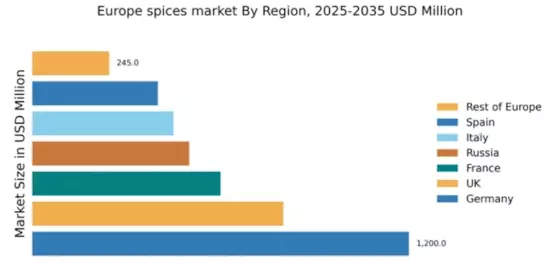
Germany holds a dominant position in the European spice market, accounting for 30% of the total market share with a value of $1,200.0 million. Key growth drivers include a rising trend towards organic and health-conscious products, alongside increasing culinary diversity. Regulatory policies favoring food safety and quality standards further bolster market growth. Infrastructure improvements in logistics and distribution networks enhance accessibility for consumers and businesses alike.
The UK spice market is valued at $800.0 million, representing 20% of the European market share. Growth is driven by the multicultural population and a growing interest in international cuisines. The demand for organic and ethically sourced spices is on the rise, supported by government initiatives promoting sustainable food practices. The UK’s robust retail sector, including supermarkets and specialty stores, plays a crucial role in distribution.
France's spice market is valued at $600.0 million, capturing 15% of the European market. The growth is fueled by a strong culinary tradition and increasing consumer interest in gourmet cooking. Regulatory frameworks emphasize quality and traceability, enhancing consumer trust. The rise of e-commerce platforms has also transformed distribution channels, making spices more accessible to consumers across the country.
The Russian spice market is valued at $500.0 million, accounting for 12.5% of the European market. Key growth drivers include a shift towards healthier eating habits and the increasing popularity of ethnic cuisines. Government policies promoting local agriculture and food production are also significant. Major cities like Moscow and St. Petersburg are central to spice distribution, with a growing number of local and international players entering the market.
Italy's spice market is valued at $450.0 million, representing 11.25% of the European market. The growth is driven by a rich culinary heritage and a rising trend towards artisanal and organic products. Regulatory policies focus on quality assurance and food safety, fostering consumer confidence. Key markets include regions like Emilia-Romagna and Tuscany, where local producers thrive alongside major players like McCormick.
Spain's spice market is valued at $400.0 million, capturing 10% of the European market. The growth is driven by a strong culinary culture and increasing interest in Mediterranean diets. Government initiatives promoting local agriculture and food quality standards support market expansion. Key cities like Barcelona and Madrid are vital for distribution, with both local and international brands competing for market share.
The Rest of Europe spice market is valued at $245.0 million, accounting for 6.125% of the total market. Growth is driven by varying consumer preferences and increasing interest in ethnic cuisines. Regulatory frameworks differ across countries, impacting market dynamics. Key markets include Scandinavia and Eastern Europe, where local players and international brands coexist, creating a competitive landscape.
The spices market exhibits a dynamic competitive landscape characterized by a blend of innovation, strategic partnerships, and regional expansion. Key players such as McCormick & Company (US), Olam International (SG), and Associated British Foods (GB) are at the forefront, each employing distinct strategies to enhance their market presence. McCormick & Company (US) focuses on product innovation and sustainability, aiming to meet the growing consumer demand for organic and ethically sourced spices. Olam International (SG) emphasizes supply chain optimization and local sourcing, which not only reduces costs but also enhances product freshness. Meanwhile, Associated British Foods (GB) leverages its extensive distribution network to penetrate emerging markets, thereby broadening its consumer base. Collectively, these strategies contribute to a competitive environment that is increasingly driven by consumer preferences for quality and sustainability.The spices market is moderately fragmented, with a mix of large multinational corporations and smaller regional players. Key business tactics include localizing manufacturing to reduce lead times and enhance responsiveness to market demands. Supply chain optimization remains a critical focus, as companies strive to ensure product availability while managing costs. The collective influence of major players shapes market dynamics, fostering a competitive atmosphere where innovation and operational efficiency are paramount.
In October McCormick & Company (US) announced a partnership with a leading technology firm to integrate AI into its supply chain management. This strategic move is poised to enhance forecasting accuracy and inventory management, thereby reducing waste and improving overall efficiency. The integration of AI reflects a broader trend within the industry towards leveraging technology to streamline operations and respond more effectively to consumer demands.
In September Olam International (SG) launched a new line of sustainably sourced spices, highlighting its commitment to environmental stewardship. This initiative not only aligns with growing consumer preferences for sustainable products but also positions Olam as a leader in responsible sourcing practices. The launch is expected to strengthen Olam's brand equity and attract environmentally conscious consumers, thereby enhancing its competitive edge.
In August Associated British Foods (GB) expanded its operations into Eastern Europe, establishing new distribution centers to better serve the region. This expansion is strategically significant as it allows the company to tap into emerging markets with increasing demand for diverse spice offerings. By enhancing its logistical capabilities, Associated British Foods aims to improve service levels and capture a larger market share in this growing region.
As of November current competitive trends in the spices market are increasingly defined by digitalization, sustainability, and the integration of advanced technologies. Strategic alliances are becoming more prevalent, enabling companies to pool resources and expertise to drive innovation. The competitive landscape is shifting from traditional price-based competition towards differentiation through technology, product quality, and supply chain reliability. This evolution suggests that companies that prioritize innovation and sustainability will likely emerge as leaders in the market.




Recent developments in the Europe Spices Market indicate a growing trend towards premium and organic spice products, with consumers increasingly seeking high-quality ingredients. Notably, Olam International has been expanding its portfolio through sustainable sourcing practices. Meanwhile, Badia Spices has seen a rise in demand for its diverse range of spice blends, leveraging its established presence in Europe. ADM is focusing on innovative spice solutions, particularly in the health and wellness segment, to cater to changing consumer preferences. In September 2023, McCormick and Company announced a strategic partnership with local European brands to expand its market presence.
Among other significant movements, Kancor Ingredients has made strides in enhancing its spice extraction technologies. The European Spices Association has also emphasized compliance with new regulations on spice imports, reinforcing quality control measures. On the merger front, in March 2023, Red Island was in discussions for a potential acquisition that would strengthen its supply chain in Europe. Lastly, Goya Foods continues to invest in expanding its European operations, highlighting the region's importance in its global strategy. The ongoing developments reflect a dynamic marketplace that is adapting to consumer demands for higher quality and sustainability.
The Spices Market in Europe is projected to grow at a 2.9% CAGR from 2025 to 2035, driven by increasing consumer demand for natural flavors and health benefits.
New opportunities lie in:
By 2035, the spices market is expected to achieve robust growth, driven by evolving consumer preferences and innovative business strategies.
| MARKET SIZE 2024 | 4195.0(USD Million) |
| MARKET SIZE 2025 | 4316.65(USD Million) |
| MARKET SIZE 2035 | 5745.0(USD Million) |
| COMPOUND ANNUAL GROWTH RATE (CAGR) | 2.9% (2025 - 2035) |
| REPORT COVERAGE | Revenue Forecast, Competitive Landscape, Growth Factors, and Trends |
| BASE YEAR | 2024 |
| Market Forecast Period | 2025 - 2035 |
| Historical Data | 2019 - 2024 |
| Market Forecast Units | USD Million |
| Key Companies Profiled | McCormick & Company (US), Olam International (SG), Kraft Heinz (US), Associated British Foods (GB), Döhler Group (DE), Spice World (US), Badia Spices (US), Frontier Co-op (US) |
| Segments Covered | Type, Category, Form, End Use |
| Key Market Opportunities | Growing demand for organic and sustainably sourced spices presents a lucrative opportunity in the spices market. |
| Key Market Dynamics | Rising consumer demand for organic spices drives innovation and competition among suppliers in the European spices market. |
| Countries Covered | Germany, UK, France, Russia, Italy, Spain, Rest of Europe |
The market valuation was $4195.0 Million in 2024.
The projected valuation for 2035 is $5745.0 Million.
The expected CAGR for the market during this period is 2.9%.
The 'Others' segment had the highest valuation at $2495.0 Million in 2024.
In 2024, organic spices were valued at $839.5 Million, while conventional spices reached $3355.5 Million.
Garlic is projected to range from $600.0 Million to $800.0 Million, while ginger is expected to be between $500.0 Million and $700.0 Million.
The ground/powder segment was valued at $2500.0 Million to $3500.0 Million in 2024.
Key players include McCormick & Company, Olam International, and Kraft Heinz, among others.
The food retail segment was valued between $1500.0 Million and $2000.0 Million in 2024.
The market is likely to experience steady growth, reaching $5745.0 Million by 2035.



Kindly complete the form below to receive a free sample of this Report

“This is really good guys. Excellent work on a tight deadline. I will continue to use you going forward and recommend you to others. Nice job”


“Thanks. It’s been a pleasure working with you, please use me as reference with any other Intel employees.”


“Thanks for sending the report it gives us a good global view of the Betaïne market.”


“Thank you, this will be very helpful for OQS.”


“We found the report very insightful! we found your research firm very helpful. I'm sending this email to secure our future business.”


“I am very pleased with how market segments have been defined in a relevant way for my purposes (such as "Portable Freezers & refrigerators" and "last-mile"). In general the report is well structured. Thanks very much for your efforts.”


“I have been reading the first document or the study, ,the Global HVAC and FP market report 2021 till 2026. Must say, good info! I have not gone in depth at all parts, but got a good indication of the data inside!”


“We got the report in time, we really thank you for your support in this process. I also thank to all of your team as they did a great job.”


“The Automotive 48V ECU Components Procurement Intelligence Study” was a complex project, but the Market Research Future (MRFR) team handled it with quality, agility, and customer-centricity. They delivered all requested data on time and within the agreed scope. The team, including Shubhendra Anand and Rahul Gotadki, was always readily available to clarify questions and swiftly implement necessary adjustments, driving the project to a successful conclusion within a very demanding timeframe.
I would also like to specifically commend Akshay Agarwal for his responsiveness and support at every stage—from our initial inquiry on May 6th through to final delivery on June 18th. His dedication made the entire process seamless.”



