×
Hero Background
English
Chinese
French
Japanese
Korean
German
Spanish

Filling Machines Market Share

ID: MRFR/PCM/10022-HCR
111 Pages
Varsha More
October 2025

Filling Machines Market Research Report Information By Product (Aseptic, Rotary, Net Weight, Volumetric, and Others), By Mode of Operation (Automatic and Semi-automatic), By Application (Beverages, Food, Chemicals, Personal Care, Pharmaceuticals, and Others), And By Region (North America, Europe, Asia-Pacific, And Rest Of The World) –Market Forecast Till 2035

Share:
Download PDF ×

We do not share your information with anyone. However, we may send you emails based on your report interest from time to time. You may contact us at any time to opt-out.

Filling Machines Market Infographic
Purchase Options

Market Share

Filling Machines Market Share Analysis

In the ever-changing landscape of the Filling Machines Market, companies use different strategies for market share positioning with a view of outperforming their rivals and widening their scope. One way to do this is by distinguishing filling machines from competitors in terms of features, technology, and quality. Additionally, cost leadership is another strategy where businesses create filling machines that are cheaper than those manufactured by their rivals. By taking advantage of economies of scale, optimizing production processes, and raw material procurement, such firms can sell their goods at competitive prices. This approach works best when entering price-sensitive markets where clients mostly consider the budget rather than additional features. For one to achieve the status of being a cost leader, then he must ensure that he continuously improves the efficiency of his operation so as to maintain an edge over his competition in pricing. An important approach to market segmentation is the one employed by companies in the Filling Machines Market. Companies can penetrate niche markets and build a dedicated customer base by identifying specific customer needs and tailoring products to meet those requirements. This strategy involves understanding the diverse requirements of different industries and adapting filling machines to suit different applications such as food and beverage, pharmaceuticals, and cosmetics. Strategic partnerships and collaborations are also key to positioning their market share within the Filling Machines Market. Companies often form alliances with suppliers, distributors, or even competitors so they can leverage their strengths, thereby making it easier for them to offer an all-inclusive solution. Suppose they engage in strategic partnerships with supply chain key players. In that case, companies can streamline operations, reduce costs, and enhance the overall value proposition for customers while, at times, improving the quality of their products. Strategic partnerships also provide opportunities for joint research development initiatives, thus enabling access to new technologies and keeping up with trends in the market. Apart from this tactic, other strategies, such as customer-centric approaches, have been increasingly taking shape within the filling machine market. In this case, companies try to understand what clients need during the long product lifecycle so that services become responsive enough during that period; it is custom-made solutions and sustainably built-in relationships with customers that make manufacturers closer to them at all times better than any other way of keeping close ties between people who are involved in selling things such as training programs or assistance provided throughout maintenance process for instance." "In addition," he continues," many producers of filling machines adopt internationalization strategy in order enlarge their respective market shares." Globalization is still pushing businesses towards emerging nations where they establish a presence globally. Adaptation means changing a product too or service so that it matches the goals of locals alongside abiding by stipulated rules relating to it: this is how organizations go about expanding geographically, opening new doors to potential buyers to diversify income streams.
Author
Varsha More
Research Analyst

Experienced business professional with a demonstrated history of working in the CFnB industry. Skilled in market research, and market estimation. Strong professional with a Masters focused in marketing management.

Leave a Comment

FAQs

What is the current valuation of the Filling Machines Market as of 2024?

The Filling Machines Market was valued at 10.06 USD Billion in 2024.

What is the projected market size for the Filling Machines Market by 2035?

The market is projected to reach 16.51 USD Billion by 2035.

What is the expected CAGR for the Filling Machines Market during the forecast period 2025 - 2035?

The expected CAGR for the Filling Machines Market during 2025 - 2035 is 4.6%.

Which product segments are expected to show growth in the Filling Machines Market?

The Aseptic and Rotary segments are expected to grow, with valuations projected at 4.05 USD Billion and 3.2 USD Billion respectively by 2035.

How do automatic and semi-automatic filling machines compare in terms of market valuation?

By 2035, automatic filling machines are projected to reach 9.8 USD Billion, while semi-automatic machines are expected to reach 6.71 USD Billion.

What applications are driving the Filling Machines Market growth?

The Beverages and Food applications are anticipated to lead growth, with projected valuations of 4.0 USD Billion and 3.0 USD Billion respectively by 2035.

Market Summary

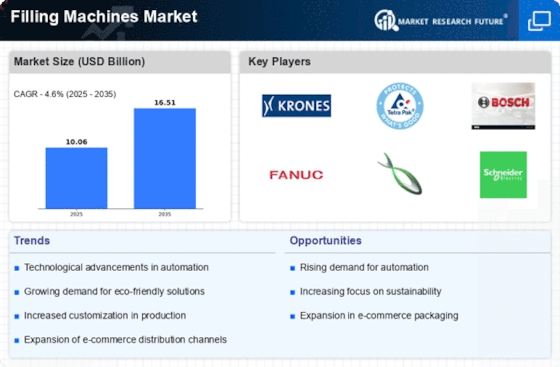
As per MRFR analysis, the Filling Machines Market Size was estimated at 10.06 USD Billion in 2024. The Filling Machines industry is projected to grow from 10.53 USD Billion in 2025 to 16.51 USD Billion by 2035, exhibiting a compound annual growth rate (CAGR) of 4.6 during the forecast period 2025 - 2035.

Key Market Trends & Highlights

The Filling Machines Market is poised for substantial growth driven by technological advancements and evolving consumer preferences.

  • Technological advancements are enhancing the efficiency and precision of filling machines, particularly in the automatic segment.
  • Sustainability initiatives are increasingly influencing manufacturers to adopt eco-friendly packaging solutions, especially in North America.
  • Customization and flexibility in filling equipment are becoming essential to meet diverse consumer demands, particularly in the aseptic segment.
  • The rising demand for packaged foods and the growth of e-commerce are significant drivers propelling market expansion in both North America and Asia-Pacific.

Market Size & Forecast

2024 Market Size 10.06 (USD Billion)
2035 Market Size 16.51 (USD Billion)
CAGR (2025 - 2035) 4.6%
Largest Regional Market Share in 2024 North America

Major Players

<p>Krones AG (DE), Tetra Pak (SE), Bosch Packaging Technology (DE), FANUC Corporation (JP), Marel (IS), Schneider Electric (FR), Sidel (FR), ProMach (US), Accutek Packaging Equipment Companies, Inc. (US)</p>

Market Trends

The Filling Machines Market is currently experiencing a dynamic evolution, driven by advancements in technology and increasing demand across various sectors. Manufacturers are focusing on enhancing efficiency and precision in filling processes, which is crucial for maintaining product quality and reducing waste. Automation and smart technologies are becoming integral, as they allow for real-time monitoring and adjustments, thereby optimizing production lines. Furthermore, the growing emphasis on sustainability is prompting companies to adopt eco-friendly practices, such as using recyclable materials and reducing energy consumption in their operations. In addition, the Filling Machines Market is witnessing a shift towards customization, as businesses seek tailored solutions to meet specific product requirements. This trend is particularly evident in industries such as food and beverage, pharmaceuticals, and cosmetics, where diverse product characteristics necessitate specialized filling equipment. As consumer preferences evolve, manufacturers are likely to invest in innovative designs and flexible machinery that can accommodate a wide range of products. Overall, the Filling Machines Market appears poised for continued growth, with technological advancements and changing consumer demands shaping its future landscape.

Technological Advancements

The Filling Machines Market is increasingly influenced by technological innovations, particularly in automation and smart technologies. These advancements enhance operational efficiency and accuracy, allowing for real-time adjustments during the filling process.

Sustainability Initiatives

A growing focus on sustainability is evident within the Filling Machines Market, as companies strive to implement eco-friendly practices. This includes the use of recyclable materials and energy-efficient machinery, reflecting a commitment to environmental responsibility.

Customization and Flexibility

The demand for customized filling solutions is rising, driven by diverse product requirements across various industries. Manufacturers are adapting their machinery to offer flexibility, enabling them to cater to specific needs in sectors like food, pharmaceuticals, and cosmetics.

Filling Machines Market Market Drivers

Rising Demand for Packaged Foods

The increasing consumer preference for convenience foods is driving the Filling Machines Market. As lifestyles become busier, the demand for ready-to-eat and packaged food products is surging. This trend is reflected in the growth of the food and beverage sector, which is projected to expand at a compound annual growth rate of approximately 5.5% over the next few years. Consequently, manufacturers are investing in advanced filling machines to enhance production efficiency and meet the rising demand. The Filling Machines Market is thus witnessing a shift towards automation and high-speed filling solutions to cater to the evolving consumer preferences.

Growth of E-commerce and Online Retail

The rapid expansion of e-commerce platforms is significantly impacting the Filling Machines Market. As more consumers turn to online shopping for their food and beverage needs, manufacturers are compelled to adapt their packaging processes to ensure product integrity during transit. This shift has led to an increased demand for filling machines that can accommodate various packaging formats and sizes. The e-commerce sector is expected to grow at a rate of around 15% annually, further propelling the need for efficient filling solutions. The Filling Machines Market must evolve to support this trend, focusing on flexibility and speed in production.

Technological Innovations in Filling Equipment

Technological advancements are reshaping the Filling Machines Market, with innovations such as smart filling systems and IoT integration becoming more prevalent. These technologies enhance operational efficiency, reduce downtime, and improve accuracy in filling processes. The market is witnessing a shift towards automated solutions that can adapt to various product types and packaging requirements. As manufacturers seek to optimize their production lines, the demand for technologically advanced filling machines is expected to rise. This trend indicates a potential for growth in the Filling Machines Market, as companies invest in cutting-edge technologies to remain competitive.

Regulatory Compliance and Food Safety Standards

Stringent regulations regarding food safety and quality are influencing the Filling Machines Market. Governments worldwide are implementing stricter guidelines to ensure consumer safety, which necessitates the adoption of advanced filling technologies. Manufacturers are increasingly required to invest in filling machines that comply with these regulations, ensuring that products are filled accurately and hygienically. The market for filling machines is projected to grow as companies seek to enhance their compliance capabilities. This trend underscores the importance of investing in high-quality filling solutions that not only meet regulatory standards but also improve overall operational efficiency.

Sustainability and Eco-friendly Packaging Solutions

The growing emphasis on sustainability is significantly influencing the Filling Machines Market. Consumers are increasingly favoring products that utilize eco-friendly packaging, prompting manufacturers to adopt sustainable practices in their filling processes. This shift is leading to the development of filling machines that can handle biodegradable and recyclable materials. The market for sustainable packaging is projected to grow at a rate of approximately 7% annually, indicating a strong potential for filling machine manufacturers to innovate. By aligning with sustainability trends, the Filling Machines Market can enhance its appeal to environmentally conscious consumers and improve brand loyalty.

Market Segment Insights

By Product: Aseptic (Largest) vs. Rotary (Fastest-Growing)

<p>In the Filling Machines Market, the product segment showcases a diverse distribution of technologies, with Aseptic filling machines commanding a significant share. This segment is popular for its ability to ensure product safety and extend shelf life, making it essential in industries like pharmaceuticals and food and beverages. Rotary filling machines, while currently representing a smaller portion of the market, are gaining traction due to their high-speed capabilities and efficiency in production processes, catering to an increasing demand for automation. As the market evolves, growth trends indicate a shift towards increased utilization of Rotary filling machines. Factors driving this change include the rising need for faster production lines and the growth of sustainable packaging solutions. The Aseptic segment remains robust, but the adoption of Rotary systems reflects the industry's push towards innovation, with manufacturers seeking improved output rates and reduced operational costs through advanced technologies.</p>

<p>Technology: Aseptic (Dominant) vs. Rotary (Emerging)</p>

<p>Aseptic filling machines are recognized for their dominance in the Filling Machines Market, primarily due to their critical role in maintaining product sterility and integrity during the packaging process. This technology is heavily favored in the food and pharmaceutical industries where minimizing contamination risk is paramount. In contrast, Rotary filling machines are noted as an emerging technology, characterized by their fast operation and efficient use of production space. These machines are becoming increasingly popular as they significantly enhance throughput and lower labor costs, appealing to manufacturers aiming to scale production while maintaining product quality. The balance between these two technologies illustrates the market's diverse needs and the ongoing evolution towards optimized production methodologies.</p>

By Mode of Operation: Automatic (Largest) vs. Semi-automatic (Fastest-Growing)

<p>In the Filling Machines Market, the automatic operation mode accounts for a significant share, highlighting its leading position due to efficiency and high output. As manufacturers aim to meet rising consumer demands and reduce costs, automatic filling machines have become the go-to choice for large-scale production environments, often dominating the market landscape. In contrast, the semi-automatic segment, while smaller in market share, is rapidly gaining traction, appealing to small-to-medium enterprises looking for flexibility and lower capital investment.</p>

<p>Filling Machines Market: Automatic (Dominant) vs. Semi-automatic (Emerging)</p>

<p>Automatic filling machines are characterized by their ability to operate without manual intervention, making them essential for large-scale operations where speed and efficiency are paramount. This mode is often preferred by industries such as pharmaceuticals, food, and beverages that prioritize consistent performance and volume. On the other hand, semi-automatic machines cater to businesses seeking a balance between automation and manual operation, providing flexibility and affordability. These machines are particularly favorable for emerging companies and small scale operations, allowing them to scale production gradually as market needs evolve.</p>

By Application: Beverages (Largest) vs. Pharmaceuticals (Fastest-Growing)

<p>The filling machines market is diversified across several applications, with the beverages segment holding the largest market share. This segment benefits from the increasing demand for packaged drinks, including soft drinks, juices, and alcoholic beverages, driven by consumer convenience and on-the-go consumption trends. Following beverages, the food and pharmaceuticals segments also showcase significant market presence, as these industries continue to evolve in their packaging needs due to strict regulations and quality standards. In terms of growth trends, the pharmaceuticals segment is the fastest-growing application for filling machines, propelled by the rising global healthcare demands and innovations in drug delivery systems. The food and chemicals segments are also expanding, influenced by rising consumer health consciousness and sustainable packaging practices. As environmental concerns grow, the market is experiencing a pivotal shift towards eco-friendly packaging solutions, further boosting growth across these segments.</p>

<p>Beverages: Dominant vs. Pharmaceuticals: Emerging</p>

<p>The beverages segment remains the dominant force in the filling machines market, characterized by high production volumes and continuous innovation in packaging techniques. Companies focus on enhancing machine efficiency and integrating smart technologies to cater to consumer preferences for varied beverage types. In contrast, the pharmaceuticals segment is regarded as an emerging leader due to the increasing complexity of drug formulations and the need for precision filling systems. This segment demands high standards of hygiene and regulatory compliance, persuading manufacturers to align their technologies with evolving pharmaceutical trends. Both segments represent a blend of traditional practices and modern advancements, underscoring the importance of adaptability in meeting market requirements.</p>

Get more detailed insights about Filling Machines Market Research Report—Global Forecast till 2035

Regional Insights

North America : Innovation and Demand Surge

North America is witnessing robust growth in the filling machines market, driven by increasing demand for automation and efficiency in manufacturing processes. The region holds the largest market share at approximately 40%, with the United States being the primary contributor. Regulatory support for advanced manufacturing technologies further fuels this growth, as companies seek to enhance productivity and reduce operational costs. The competitive landscape is dominated by key players such as ProMach and Accutek Packaging Equipment Companies, Inc., alongside international giants like Krones AG and Tetra Pak. The U.S. market is characterized by a strong emphasis on innovation, with companies investing heavily in R&D to develop cutting-edge filling solutions. This competitive environment fosters collaboration and partnerships, enhancing the overall market dynamics.

Europe : Regulatory Support and Innovation

Europe is emerging as a significant player in the filling machines market, driven by stringent regulations and a focus on sustainability. The region holds the second-largest market share at around 30%. Countries like Germany and France lead the market, supported by government initiatives promoting advanced manufacturing practices and eco-friendly technologies. The European Union's regulations on packaging waste are also catalyzing demand for efficient filling solutions. Germany is home to major manufacturers such as Bosch Packaging Technology and Krones AG, which are at the forefront of innovation in filling technologies. The competitive landscape is characterized by a mix of established players and emerging startups, all striving to meet the evolving demands of the food and beverage industry. This dynamic environment encourages continuous improvement and adaptation to market needs.

Asia-Pacific : Emerging Markets and Growth Potential

The Asia-Pacific region is rapidly expanding in the filling machines market, driven by increasing industrialization and rising consumer demand. Countries like China and India are leading this growth, with China holding a significant market share of approximately 25%. The region's growth is further supported by government initiatives aimed at boosting manufacturing capabilities and attracting foreign investment in advanced technologies. China's market is characterized by a mix of local and international players, including FANUC Corporation and Marel. The competitive landscape is evolving, with companies focusing on automation and smart technologies to enhance efficiency. As the region continues to develop, the demand for innovative filling solutions is expected to rise, creating opportunities for both established and new entrants in the market.

Middle East and Africa : Resource-Rich and Growing Demand

The Middle East and Africa (MEA) region is witnessing a gradual increase in the filling machines market, driven by growing industrial activities and a rising population. The market share in this region is currently around 5%, with countries like South Africa and the UAE showing promising growth potential. The demand for filling machines is being propelled by the food and beverage sector, which is expanding due to changing consumer preferences and increased urbanization. In the MEA region, the competitive landscape is still developing, with a mix of local and international players. Companies are increasingly focusing on adapting their products to meet regional needs, particularly in the food and beverage industry. As the market matures, there is a growing emphasis on quality and efficiency, which is expected to drive further investments in filling technologies.

Key Players and Competitive Insights

Leading market players are concentrating on expanding their international consumer base. Players are also undertaking strategic activities to expand their global footprint, with important market developments, including product line development and R&D activities. Filling Machines industry companies are utilizing strategic collaborative initiatives to expand and survive in a competitive market climate to increase their market share and profits.

Midsize and smaller businesses are expanding their market presence by securing new contracts and entering new markets in the global Filling Machines industry. Major Filling Machines Market players include Barry- Wehmiller Companies, Inc., Ronchi Mario S.P.A., KHS Group, Accutek Packaging Equipment Companies, Inc., Gea Group Ag, Tetra Laval International S.A., Krones Ag, JBT Corporation, Coesia S.P.A., and Robert Bosch GmbH.

Barry-Wehmiller Companies Inc offers packaging machinery and solutions. In addition to integrating industrial and business solutions and supplying engineering consulting and manufacturing technology solutions, the company integrates industrial and business solutions. The company offers packaging equipment, automatic labeling, label conversion, paper converting equipment, finishing systems, automated can end and product handling equipment, form, fill, seal technologies, filling, capping, can seaming, labeling, and centrifuging equipment. These technologies affect numerous industries, including the food and beverage, personal care, household, pharmaceutical, and biotechnology sectors. The company is in Asia-Pacific, Europe, and the Americas. Barry-Wehmiller is an American company with headquarters in St. Louis, Missouri.

KHS GmbH is a global enterprise with over 150 years of history. Karl Kappert and Luis Holstein founded the company in Dortmund, Germany, in 1868, with the vision of being the first to construct filling systems for the then-recent "invention" of bottled beer. KHS GmbH is one of the world's foremost producers of innovative packaging and filling systems for the beverage and liquid food industries. The corporation is a wholly-owned subsidiary of Salzgitter Klockner-Werke GmbH, a Salzgitter Group company.

Key Companies in the Filling Machines Market market include

Industry Developments

May 2020 Scholle IPN and ALLIEDFLEX, a provider of packaging machinery, have agreed to market and sell Scholle IPN filling apparatus for bag-in-box and aseptic spouted packet packaging formats in the North American market beginning. ALLIEDFLEX will market and distribute the entire line of filling equipment manufactured by Scholle IPN, including the SureFill 100P-Aseptic, the industry's first spouted pouch filler with aseptic capabilities.

March 2021 Scholle IPN, a United States-based manufacturer of bag-in-box packaging products, acquired Bossar Packaging Pvt. Ltd. for an undisclosed amount. This acquisition will utilize the combined capabilities of both companies to offer sustainable, vertically integrated solutions for the global filling machine market.

November 2021 SIG Group, a product packaging company based in Switzerland, introduced SIG NEO, a innovation in filling machine technology. It has a speed of up to 18,000 packs per hour, SIG NEO is the world's fastest equipment for filling family-size carton packs. It also has a 25% smaller carbon footprint per filled pack than SIG's current generation of filling devices for family-size packs due to reduced water and other utility consumption and low waste rates.

Future Outlook

Filling Machines Market Future Outlook

<p>The Filling Machines Market is projected to grow at a 4.6% CAGR from 2024 to 2035, driven by automation, demand for efficiency, and sustainability initiatives.</p>

New opportunities lie in:

  • <p>Integration of IoT for real-time monitoring and predictive maintenance.</p>
  • <p>Development of eco-friendly filling solutions to meet regulatory standards.</p>
  • <p>Expansion into emerging markets with tailored filling technologies.</p>

<p>By 2035, the Filling Machines Market is expected to achieve robust growth, reflecting evolving industry demands.</p>

Market Segmentation

Filling Machines Market Product Outlook

  • Aseptic
  • Rotary
  • Net Weight
  • Volumetric
  • Others

Filling Machines Market Application Outlook

  • Beverages
  • Food
  • Chemicals
  • Personal Care
  • Pharmaceuticals
  • Others

Filling Machines Market Mode of Operation Outlook

  • Automatic
  • Semi-automatic

Report Scope

MARKET SIZE 202410.06(USD Billion)
MARKET SIZE 202510.53(USD Billion)
MARKET SIZE 203516.51(USD Billion)
COMPOUND ANNUAL GROWTH RATE (CAGR)4.6% (2024 - 2035)
REPORT COVERAGERevenue Forecast, Competitive Landscape, Growth Factors, and Trends
BASE YEAR2024
Market Forecast Period2025 - 2035
Historical Data2019 - 2024
Market Forecast UnitsUSD Billion
Key Companies ProfiledMarket analysis in progress
Segments CoveredMarket segmentation analysis in progress
Key Market OpportunitiesIntegration of automation and smart technology enhances efficiency in the Filling Machines Market.
Key Market DynamicsTechnological advancements and automation drive efficiency and precision in the filling machines market, enhancing production capabilities.
Countries CoveredNorth America, Europe, APAC, South America, MEA

FAQs

What is the current valuation of the Filling Machines Market as of 2024?

The Filling Machines Market was valued at 10.06 USD Billion in 2024.

What is the projected market size for the Filling Machines Market by 2035?

The market is projected to reach 16.51 USD Billion by 2035.

What is the expected CAGR for the Filling Machines Market during the forecast period 2025 - 2035?

The expected CAGR for the Filling Machines Market during 2025 - 2035 is 4.6%.

Which product segments are expected to show growth in the Filling Machines Market?

The Aseptic and Rotary segments are expected to grow, with valuations projected at 4.05 USD Billion and 3.2 USD Billion respectively by 2035.

How do automatic and semi-automatic filling machines compare in terms of market valuation?

By 2035, automatic filling machines are projected to reach 9.8 USD Billion, while semi-automatic machines are expected to reach 6.71 USD Billion.

What applications are driving the Filling Machines Market growth?

The Beverages and Food applications are anticipated to lead growth, with projected valuations of 4.0 USD Billion and 3.0 USD Billion respectively by 2035.

  1. SECTION I: EXECUTIVE SUMMARY AND KEY HIGHLIGHTS
    1. EXECUTIVE SUMMARY
      1. Market Overview
      2. Key Findings
      3. Market Segmentation
      4. Competitive Landscape
      5. Challenges and Opportunities
      6. Future Outlook
  2. SECTION II: SCOPING, METHODOLOGY AND MARKET STRUCTURE
    1. MARKET INTRODUCTION
      1. Definition
      2. Scope of the study
    2. RESEARCH METHODOLOGY
      1. Overview
      2. Data Mining
      3. Secondary Research
      4. Primary Research
      5. Forecasting Model
      6. Market Size Estimation
      7. Data Triangulation
      8. Validation
  3. SECTION III: QUALITATIVE ANALYSIS
    1. MARKET DYNAMICS
      1. Overview
      2. Drivers
      3. Restraints
      4. Opportunities
    2. MARKET FACTOR ANALYSIS
      1. Value chain Analysis
      2. Porter's Five Forces Analysis
      3. COVID-19 Impact Analysis
  4. SECTION IV: QUANTITATIVE ANALYSIS
    1. Packaging & Transport, BY Product (USD Billion)
      1. Aseptic
      2. Rotary
      3. Net Weight
      4. Volumetric
      5. Others
    2. Packaging & Transport, BY Mode of Operation (USD Billion)
      1. Automatic
      2. Semi-automatic
    3. Packaging & Transport, BY Application (USD Billion)
      1. Beverages
      2. Food
      3. Chemicals
      4. Personal Care
      5. Pharmaceuticals
      6. Others
    4. Packaging & Transport, BY Region (USD Billion)
      1. North America
      2. Europe
      3. APAC
      4. South America
      5. MEA
  5. SECTION V: COMPETITIVE ANALYSIS
    1. Competitive Landscape
      1. Overview
      2. Competitive Analysis
      3. Market share Analysis
      4. Major Growth Strategy in the Packaging & Transport
      5. Competitive Benchmarking
      6. Leading Players in Terms of Number of Developments in the Packaging & Transport
      7. Key developments and growth strategies
      8. Major Players Financial Matrix
    2. Company Profiles
      1. Krones AG (DE)
      2. Tetra Pak (SE)
      3. Bosch Packaging Technology (DE)
      4. FANUC Corporation (JP)
      5. Marel (IS)
      6. Schneider Electric (FR)
      7. Sidel (FR)
      8. ProMach (US)
      9. Accutek Packaging Equipment Companies, Inc. (US)
    3. Appendix
      1. References
      2. Related Reports
  6. LIST OF FIGURES
    1. MARKET SYNOPSIS
    2. NORTH AMERICA MARKET ANALYSIS
    3. US MARKET ANALYSIS BY PRODUCT
    4. US MARKET ANALYSIS BY MODE OF OPERATION
    5. US MARKET ANALYSIS BY APPLICATION
    6. CANADA MARKET ANALYSIS BY PRODUCT
    7. CANADA MARKET ANALYSIS BY MODE OF OPERATION
    8. CANADA MARKET ANALYSIS BY APPLICATION
    9. EUROPE MARKET ANALYSIS
    10. GERMANY MARKET ANALYSIS BY PRODUCT
    11. GERMANY MARKET ANALYSIS BY MODE OF OPERATION
    12. GERMANY MARKET ANALYSIS BY APPLICATION
    13. UK MARKET ANALYSIS BY PRODUCT
    14. UK MARKET ANALYSIS BY MODE OF OPERATION
    15. UK MARKET ANALYSIS BY APPLICATION
    16. FRANCE MARKET ANALYSIS BY PRODUCT
    17. FRANCE MARKET ANALYSIS BY MODE OF OPERATION
    18. FRANCE MARKET ANALYSIS BY APPLICATION
    19. RUSSIA MARKET ANALYSIS BY PRODUCT
    20. RUSSIA MARKET ANALYSIS BY MODE OF OPERATION
    21. RUSSIA MARKET ANALYSIS BY APPLICATION
    22. ITALY MARKET ANALYSIS BY PRODUCT
    23. ITALY MARKET ANALYSIS BY MODE OF OPERATION
    24. ITALY MARKET ANALYSIS BY APPLICATION
    25. SPAIN MARKET ANALYSIS BY PRODUCT
    26. SPAIN MARKET ANALYSIS BY MODE OF OPERATION
    27. SPAIN MARKET ANALYSIS BY APPLICATION
    28. REST OF EUROPE MARKET ANALYSIS BY PRODUCT
    29. REST OF EUROPE MARKET ANALYSIS BY MODE OF OPERATION
    30. REST OF EUROPE MARKET ANALYSIS BY APPLICATION
    31. APAC MARKET ANALYSIS
    32. CHINA MARKET ANALYSIS BY PRODUCT
    33. CHINA MARKET ANALYSIS BY MODE OF OPERATION
    34. CHINA MARKET ANALYSIS BY APPLICATION
    35. INDIA MARKET ANALYSIS BY PRODUCT
    36. INDIA MARKET ANALYSIS BY MODE OF OPERATION
    37. INDIA MARKET ANALYSIS BY APPLICATION
    38. JAPAN MARKET ANALYSIS BY PRODUCT
    39. JAPAN MARKET ANALYSIS BY MODE OF OPERATION
    40. JAPAN MARKET ANALYSIS BY APPLICATION
    41. SOUTH KOREA MARKET ANALYSIS BY PRODUCT
    42. SOUTH KOREA MARKET ANALYSIS BY MODE OF OPERATION
    43. SOUTH KOREA MARKET ANALYSIS BY APPLICATION
    44. MALAYSIA MARKET ANALYSIS BY PRODUCT
    45. MALAYSIA MARKET ANALYSIS BY MODE OF OPERATION
    46. MALAYSIA MARKET ANALYSIS BY APPLICATION
    47. THAILAND MARKET ANALYSIS BY PRODUCT
    48. THAILAND MARKET ANALYSIS BY MODE OF OPERATION
    49. THAILAND MARKET ANALYSIS BY APPLICATION
    50. INDONESIA MARKET ANALYSIS BY PRODUCT
    51. INDONESIA MARKET ANALYSIS BY MODE OF OPERATION
    52. INDONESIA MARKET ANALYSIS BY APPLICATION
    53. REST OF APAC MARKET ANALYSIS BY PRODUCT
    54. REST OF APAC MARKET ANALYSIS BY MODE OF OPERATION
    55. REST OF APAC MARKET ANALYSIS BY APPLICATION
    56. SOUTH AMERICA MARKET ANALYSIS
    57. BRAZIL MARKET ANALYSIS BY PRODUCT
    58. BRAZIL MARKET ANALYSIS BY MODE OF OPERATION
    59. BRAZIL MARKET ANALYSIS BY APPLICATION
    60. MEXICO MARKET ANALYSIS BY PRODUCT
    61. MEXICO MARKET ANALYSIS BY MODE OF OPERATION
    62. MEXICO MARKET ANALYSIS BY APPLICATION
    63. ARGENTINA MARKET ANALYSIS BY PRODUCT
    64. ARGENTINA MARKET ANALYSIS BY MODE OF OPERATION
    65. ARGENTINA MARKET ANALYSIS BY APPLICATION
    66. REST OF SOUTH AMERICA MARKET ANALYSIS BY PRODUCT
    67. REST OF SOUTH AMERICA MARKET ANALYSIS BY MODE OF OPERATION
    68. REST OF SOUTH AMERICA MARKET ANALYSIS BY APPLICATION
    69. MEA MARKET ANALYSIS
    70. GCC COUNTRIES MARKET ANALYSIS BY PRODUCT
    71. GCC COUNTRIES MARKET ANALYSIS BY MODE OF OPERATION
    72. GCC COUNTRIES MARKET ANALYSIS BY APPLICATION
    73. SOUTH AFRICA MARKET ANALYSIS BY PRODUCT
    74. SOUTH AFRICA MARKET ANALYSIS BY MODE OF OPERATION
    75. SOUTH AFRICA MARKET ANALYSIS BY APPLICATION
    76. REST OF MEA MARKET ANALYSIS BY PRODUCT
    77. REST OF MEA MARKET ANALYSIS BY MODE OF OPERATION
    78. REST OF MEA MARKET ANALYSIS BY APPLICATION
    79. KEY BUYING CRITERIA OF PACKAGING & TRANSPORT
    80. RESEARCH PROCESS OF MRFR
    81. DRO ANALYSIS OF PACKAGING & TRANSPORT
    82. DRIVERS IMPACT ANALYSIS: PACKAGING & TRANSPORT
    83. RESTRAINTS IMPACT ANALYSIS: PACKAGING & TRANSPORT
    84. SUPPLY / VALUE CHAIN: PACKAGING & TRANSPORT
    85. PACKAGING & TRANSPORT, BY PRODUCT, 2024 (% SHARE)
    86. PACKAGING & TRANSPORT, BY PRODUCT, 2024 TO 2035 (USD Billion)
    87. PACKAGING & TRANSPORT, BY MODE OF OPERATION, 2024 (% SHARE)
    88. PACKAGING & TRANSPORT, BY MODE OF OPERATION, 2024 TO 2035 (USD Billion)
    89. PACKAGING & TRANSPORT, BY APPLICATION, 2024 (% SHARE)
    90. PACKAGING & TRANSPORT, BY APPLICATION, 2024 TO 2035 (USD Billion)
    91. BENCHMARKING OF MAJOR COMPETITORS
  7. LIST OF TABLES
    1. LIST OF ASSUMPTIONS
    2. North America MARKET SIZE ESTIMATES; FORECAST
      1. BY PRODUCT, 2025-2035 (USD Billion)
      2. BY MODE OF OPERATION, 2025-2035 (USD Billion)
      3. BY APPLICATION, 2025-2035 (USD Billion)
    3. US MARKET SIZE ESTIMATES; FORECAST
      1. BY PRODUCT, 2025-2035 (USD Billion)
      2. BY MODE OF OPERATION, 2025-2035 (USD Billion)
      3. BY APPLICATION, 2025-2035 (USD Billion)
    4. Canada MARKET SIZE ESTIMATES; FORECAST
      1. BY PRODUCT, 2025-2035 (USD Billion)
      2. BY MODE OF OPERATION, 2025-2035 (USD Billion)
      3. BY APPLICATION, 2025-2035 (USD Billion)
    5. Europe MARKET SIZE ESTIMATES; FORECAST
      1. BY PRODUCT, 2025-2035 (USD Billion)
      2. BY MODE OF OPERATION, 2025-2035 (USD Billion)
      3. BY APPLICATION, 2025-2035 (USD Billion)
    6. Germany MARKET SIZE ESTIMATES; FORECAST
      1. BY PRODUCT, 2025-2035 (USD Billion)
      2. BY MODE OF OPERATION, 2025-2035 (USD Billion)
      3. BY APPLICATION, 2025-2035 (USD Billion)
    7. UK MARKET SIZE ESTIMATES; FORECAST
      1. BY PRODUCT, 2025-2035 (USD Billion)
      2. BY MODE OF OPERATION, 2025-2035 (USD Billion)
      3. BY APPLICATION, 2025-2035 (USD Billion)
    8. France MARKET SIZE ESTIMATES; FORECAST
      1. BY PRODUCT, 2025-2035 (USD Billion)
      2. BY MODE OF OPERATION, 2025-2035 (USD Billion)
      3. BY APPLICATION, 2025-2035 (USD Billion)
    9. Russia MARKET SIZE ESTIMATES; FORECAST
      1. BY PRODUCT, 2025-2035 (USD Billion)
      2. BY MODE OF OPERATION, 2025-2035 (USD Billion)
      3. BY APPLICATION, 2025-2035 (USD Billion)
    10. Italy MARKET SIZE ESTIMATES; FORECAST
      1. BY PRODUCT, 2025-2035 (USD Billion)
      2. BY MODE OF OPERATION, 2025-2035 (USD Billion)
      3. BY APPLICATION, 2025-2035 (USD Billion)
    11. Spain MARKET SIZE ESTIMATES; FORECAST
      1. BY PRODUCT, 2025-2035 (USD Billion)
      2. BY MODE OF OPERATION, 2025-2035 (USD Billion)
      3. BY APPLICATION, 2025-2035 (USD Billion)
    12. Rest of Europe MARKET SIZE ESTIMATES; FORECAST
      1. BY PRODUCT, 2025-2035 (USD Billion)
      2. BY MODE OF OPERATION, 2025-2035 (USD Billion)
      3. BY APPLICATION, 2025-2035 (USD Billion)
    13. APAC MARKET SIZE ESTIMATES; FORECAST
      1. BY PRODUCT, 2025-2035 (USD Billion)
      2. BY MODE OF OPERATION, 2025-2035 (USD Billion)
      3. BY APPLICATION, 2025-2035 (USD Billion)
    14. China MARKET SIZE ESTIMATES; FORECAST
      1. BY PRODUCT, 2025-2035 (USD Billion)
      2. BY MODE OF OPERATION, 2025-2035 (USD Billion)
      3. BY APPLICATION, 2025-2035 (USD Billion)
    15. India MARKET SIZE ESTIMATES; FORECAST
      1. BY PRODUCT, 2025-2035 (USD Billion)
      2. BY MODE OF OPERATION, 2025-2035 (USD Billion)
      3. BY APPLICATION, 2025-2035 (USD Billion)
    16. Japan MARKET SIZE ESTIMATES; FORECAST
      1. BY PRODUCT, 2025-2035 (USD Billion)
      2. BY MODE OF OPERATION, 2025-2035 (USD Billion)
      3. BY APPLICATION, 2025-2035 (USD Billion)
    17. South Korea MARKET SIZE ESTIMATES; FORECAST
      1. BY PRODUCT, 2025-2035 (USD Billion)
      2. BY MODE OF OPERATION, 2025-2035 (USD Billion)
      3. BY APPLICATION, 2025-2035 (USD Billion)
    18. Malaysia MARKET SIZE ESTIMATES; FORECAST
      1. BY PRODUCT, 2025-2035 (USD Billion)
      2. BY MODE OF OPERATION, 2025-2035 (USD Billion)
      3. BY APPLICATION, 2025-2035 (USD Billion)
    19. Thailand MARKET SIZE ESTIMATES; FORECAST
      1. BY PRODUCT, 2025-2035 (USD Billion)
      2. BY MODE OF OPERATION, 2025-2035 (USD Billion)
      3. BY APPLICATION, 2025-2035 (USD Billion)
    20. Indonesia MARKET SIZE ESTIMATES; FORECAST
      1. BY PRODUCT, 2025-2035 (USD Billion)
      2. BY MODE OF OPERATION, 2025-2035 (USD Billion)
      3. BY APPLICATION, 2025-2035 (USD Billion)
    21. Rest of APAC MARKET SIZE ESTIMATES; FORECAST
      1. BY PRODUCT, 2025-2035 (USD Billion)
      2. BY MODE OF OPERATION, 2025-2035 (USD Billion)
      3. BY APPLICATION, 2025-2035 (USD Billion)
    22. South America MARKET SIZE ESTIMATES; FORECAST
      1. BY PRODUCT, 2025-2035 (USD Billion)
      2. BY MODE OF OPERATION, 2025-2035 (USD Billion)
      3. BY APPLICATION, 2025-2035 (USD Billion)
    23. Brazil MARKET SIZE ESTIMATES; FORECAST
      1. BY PRODUCT, 2025-2035 (USD Billion)
      2. BY MODE OF OPERATION, 2025-2035 (USD Billion)
      3. BY APPLICATION, 2025-2035 (USD Billion)
    24. Mexico MARKET SIZE ESTIMATES; FORECAST
      1. BY PRODUCT, 2025-2035 (USD Billion)
      2. BY MODE OF OPERATION, 2025-2035 (USD Billion)
      3. BY APPLICATION, 2025-2035 (USD Billion)
    25. Argentina MARKET SIZE ESTIMATES; FORECAST
      1. BY PRODUCT, 2025-2035 (USD Billion)
      2. BY MODE OF OPERATION, 2025-2035 (USD Billion)
      3. BY APPLICATION, 2025-2035 (USD Billion)
    26. Rest of South America MARKET SIZE ESTIMATES; FORECAST
      1. BY PRODUCT, 2025-2035 (USD Billion)
      2. BY MODE OF OPERATION, 2025-2035 (USD Billion)
      3. BY APPLICATION, 2025-2035 (USD Billion)
    27. MEA MARKET SIZE ESTIMATES; FORECAST
      1. BY PRODUCT, 2025-2035 (USD Billion)
      2. BY MODE OF OPERATION, 2025-2035 (USD Billion)
      3. BY APPLICATION, 2025-2035 (USD Billion)
    28. GCC Countries MARKET SIZE ESTIMATES; FORECAST
      1. BY PRODUCT, 2025-2035 (USD Billion)
      2. BY MODE OF OPERATION, 2025-2035 (USD Billion)
      3. BY APPLICATION, 2025-2035 (USD Billion)
    29. South Africa MARKET SIZE ESTIMATES; FORECAST
      1. BY PRODUCT, 2025-2035 (USD Billion)
      2. BY MODE OF OPERATION, 2025-2035 (USD Billion)
      3. BY APPLICATION, 2025-2035 (USD Billion)
    30. Rest of MEA MARKET SIZE ESTIMATES; FORECAST
      1. BY PRODUCT, 2025-2035 (USD Billion)
      2. BY MODE OF OPERATION, 2025-2035 (USD Billion)
      3. BY APPLICATION, 2025-2035 (USD Billion)
    31. PRODUCT LAUNCH/PRODUCT DEVELOPMENT/APPROVAL
    32. ACQUISITION/PARTNERSHIP

Filling Machines Market Segmentation

Filling Machines Product Outlook (USD Billion, 2018-2032)

  • Aseptic
  • Rotary
  • Net Weight
  • Volumetric
  • Others

Filling Machines Mode of Operation Outlook (USD Billion, 2018-2032)

  • Automatic
  • Semi-automatic

Filling Machines Application Outlook (USD Billion, 2018-2032)

  • Beverages
  • Food
  • Chemicals
  • Personal Care
  • Pharmaceuticals
  • Others

Filling Machines Regional Outlook (USD Billion, 2018-2032)

  • North America Outlook (USD Billion, 2018-2032)

    • North America Filling Machines by Product
      • Aseptic
      • Rotary
      • Net Weight
      • Volumetric
      • Others
    • North America Filling Machines by Mode of Operation
      • Automatic
      • Semi-automatic
    • North America Filling Machines by Application
      • Beverages
      • Food
      • Chemicals
      • Personal Care
      • Pharmaceuticals
      • Others
    • US Outlook (USD Billion, 2018-2032)

    • US Filling Machines by Product
      • Aseptic
      • Rotary
      • Net Weight
      • Volumetric
      • Others
    • US Filling Machines by Mode of Operation
      • Automatic
      • Semi-automatic
    • US Filling Machines by Application
      • Beverages
      • Food
      • Chemicals
      • Personal Care
      • Pharmaceuticals
      • Others
    • CANADA Outlook (USD Billion, 2018-2032)

    • CANADA Filling Machines by Product
      • Aseptic
      • Rotary
      • Net Weight
      • Volumetric
      • Others
    • CANADA Filling Machines by Mode of Operation
      • Automatic
      • Semi-automatic
    • CANADA Filling Machines by Application
      • Beverages
      • Food
      • Chemicals
      • Personal Care
      • Pharmaceuticals
      • Others
  • Europe Outlook (USD Billion, 2018-2032)

    • Europe Filling Machines by Product
      • Aseptic
      • Rotary
      • Net Weight
      • Volumetric
      • Others
    • Europe Filling Machines by Mode of Operation
      • Automatic
      • Semi-automatic
    • Europe Filling Machines by Application
      • Beverages
      • Food
      • Chemicals
      • Personal Care
      • Pharmaceuticals
      • Others
    • Germany Outlook (USD Billion, 2018-2032)

    • Germany Filling Machines by Product
      • Aseptic
      • Rotary
      • Net Weight
      • Volumetric
      • Others
    • Germany Filling Machines by Mode of Operation
      • Automatic
      • Semi-automatic
    • Germany Filling Machines by Application
      • Beverages
      • Food
      • Chemicals
      • Personal Care
      • Pharmaceuticals
      • Others
    • France Outlook (USD Billion, 2018-2032)

    • France Filling Machines by Product
      • Aseptic
      • Rotary
      • Net Weight
      • Volumetric
      • Others
    • France Filling Machines by Mode of Operation
      • Automatic
      • Semi-automatic
    • France Filling Machines by Application
      • Beverages
      • Food
      • Chemicals
      • Personal Care
      • Pharmaceuticals
      • Others
    • UK Outlook (USD Billion, 2018-2032)

    • UK Filling Machines by Product
      • Aseptic
      • Rotary
      • Net Weight
      • Volumetric
      • Others
    • UK Filling Machines by Mode of Operation
      • Automatic
      • Semi-automatic
    • UK Filling Machines by Application
      • Beverages
      • Food
      • Chemicals
      • Personal Care
      • Pharmaceuticals
      • Others
    • ITALY Outlook (USD Billion, 2018-2032)

    • ITALY Filling Machines by Product
      • Aseptic
      • Rotary
      • Net Weight
      • Volumetric
      • Others
    • ITALY Filling Machines by Mode of Operation
      • Automatic
      • Semi-automatic
    • ITALY Filling Machines by Application
      • Beverages
      • Food
      • Chemicals
      • Personal Care
      • Pharmaceuticals
      • Others
    • SPAIN Outlook (USD Billion, 2018-2032)

    • Spain Filling Machines by Product
      • Aseptic
      • Rotary
      • Net Weight
      • Volumetric
      • Others
    • Spain Filling Machines by Mode of Operation
      • Automatic
      • Semi-automatic
    • Spain Filling Machines by Application
      • Beverages
      • Food
      • Chemicals
      • Personal Care
      • Pharmaceuticals
      • Others
    • Rest Of Europe Outlook (USD Billion, 2018-2032)

    • Rest Of Europe Filling Machines by Product
      • Aseptic
      • Rotary
      • Net Weight
      • Volumetric
      • Others
    • REST OF EUROPE Filling Machines by Mode of Operation
      • Automatic
      • Semi-automatic
    • REST OF EUROPE Filling Machines by Application
      • Beverages
      • Food
      • Chemicals
      • Personal Care
      • Pharmaceuticals
      • Others
  • Asia-Pacific Outlook (USD Billion, 2018-2032)

    • Asia-Pacific Filling Machines by Product
      • Aseptic
      • Rotary
      • Net Weight
      • Volumetric
      • Others
    • Asia-Pacific Filling Machines by Mode of Operation
      • Automatic
      • Semi-automatic
    • Asia-Pacific Filling Machines by Application
      • Beverages
      • Food
      • Chemicals
      • Personal Care
      • Pharmaceuticals
      • Others
    • China Outlook (USD Billion, 2018-2032)

    • China Filling Machines by Product
      • Aseptic
      • Rotary
      • Net Weight
      • Volumetric
      • Others
    • China Filling Machines by Mode of Operation
      • Automatic
      • Semi-automatic
    • China Filling Machines by Application
      • Beverages
      • Food
      • Chemicals
      • Personal Care
      • Pharmaceuticals
      • Others
    • Japan Outlook (USD Billion, 2018-2032)

    • Japan Filling Machines by Product
      • Aseptic
      • Rotary
      • Net Weight
      • Volumetric
      • Others
    • Japan Filling Machines by Mode of Operation
      • Automatic
      • Semi-automatic
    • Japan Filling Machines by Application
      • Beverages
      • Food
      • Chemicals
      • Personal Care
      • Pharmaceuticals
      • Others
    • India Outlook (USD Billion, 2018-2032)

    • India Filling Machines by Product
      • Aseptic
      • Rotary
      • Net Weight
      • Volumetric
      • Others
    • India Filling Machines by Mode of Operation
      • Automatic
      • Semi-automatic
    • India Filling Machines by Application
      • Beverages
      • Food
      • Chemicals
      • Personal Care
      • Pharmaceuticals
      • Others
    • Australia Outlook (USD Billion, 2018-2032)

    • Australia Filling Machines by Product
      • Aseptic
      • Rotary
      • Net Weight
      • Volumetric
      • Others
    • Australia Filling Machines by Mode of Operation
      • Automatic
      • Semi-automatic
    • Australia Filling Machines by Application
      • Beverages
      • Food
      • Chemicals
      • Personal Care
      • Pharmaceuticals
      • Others
    • Rest of Asia-Pacific Outlook (USD Billion, 2018-2032)

    • Rest of Asia-Pacific Filling Machines by Product
      • Aseptic
      • Rotary
      • Net Weight
      • Volumetric
      • Others
    • Rest of Asia-Pacific Filling Machines by Mode of Operation
      • Automatic
      • Semi-automatic
    • Rest of Asia-Pacific Filling Machines by Application
      • Beverages
      • Food
      • Chemicals
      • Personal Care
      • Pharmaceuticals
      • Others
  • Rest of the World Outlook (USD Billion, 2018-2032)

    • Rest of the World Filling Machines by Product
      • Aseptic
      • Rotary
      • Net Weight
      • Volumetric
      • Others
    • Rest of the World Filling Machines by Mode of Operation
      • Automatic
      • Semi-automatic
    • Rest of the World Filling Machines by Application
      • Beverages
      • Food
      • Chemicals
      • Personal Care
      • Pharmaceuticals
      • Others
    • Middle East Outlook (USD Billion, 2018-2032)

    • Middle East Filling Machines by Product
      • Aseptic
      • Rotary
      • Net Weight
      • Volumetric
      • Others
    • Middle East Filling Machines by Mode of Operation
      • Automatic
      • Semi-automatic
    • Middle East Filling Machines by Application
      • Beverages
      • Food
      • Chemicals
      • Personal Care
      • Pharmaceuticals
      • Others
    • Africa Outlook (USD Billion, 2018-2032)

    • Africa Filling Machines by Product
      • Aseptic
      • Rotary
      • Net Weight
      • Volumetric
      • Others
    • Africa Filling Machines by Mode of Operation
      • Automatic
      • Semi-automatic
    • Africa Filling Machines by Application
      • Beverages
      • Food
      • Chemicals
      • Personal Care
      • Pharmaceuticals
      • Others
    • Latin America Outlook (USD Billion, 2018-2032)

    • Latin America Filling Machines by Product
      • Aseptic
      • Rotary
      • Net Weight
      • Volumetric
      • Others
    • Latin America Filling Machines by Mode of Operation
      • Automatic
      • Semi-automatic
    • Latin America Filling Machines by Application
      • Beverages
      • Food
      • Chemicals
      • Personal Care
      • Pharmaceuticals
      • Others


Infographic

Free Sample Request

Kindly complete the form below to receive a free sample of this Report

Get Free Sample

Customer Strories

Compare Licence

×
Features License Type
Single User Multiuser License Enterprise User
Price $4,950 $5,950 $7,250
Maximum User Access Limit 1 User Upto 10 Users Unrestricted Access Throughout the Organization
Free Customization
Direct Access to Analyst
Deliverable Format
Platform Access
Discount on Next Purchase 10% 15% 15%
Printable Versions