×
Hero Background
English
Chinese
French
Japanese
Korean
German
Spanish

Fire Stopping Material Market Analysis

ID: MRFR/CnM/9362-HCR
100 Pages
Priya Nagrale
October 2025

Fire Stopping Material Market Research Report Information by Type (Sealants, Mortar, Boards, Putty & Putty Pads, and Others), Application (Electrical, Mechanical, and Plumbing) and End-User (Residential, Commercial, and Industrial) and Region (North America, Europe, Asia-Pacific, and Rest of the World)—Forecast till 2035

Share:
Download PDF ×

We do not share your information with anyone. However, we may send you emails based on your report interest from time to time. You may contact us at any time to opt-out.

Fire Stopping Material Market Infographic
Purchase Options

Market Analysis

In-depth Analysis of Fire Stopping Material Market Industry Landscape

The market dynamics of fire stopping materials are influenced by various factors that impact supply, demand, pricing, and overall industry growth. One significant factor is the increasing stringency of building codes and regulations regarding fire safety. As governments and regulatory bodies implement stricter standards for construction materials and practices, there is a growing demand for effective fire stopping materials to enhance building safety and compliance.

Demand for fire-stopping materials is increasing in a wide range of sectors, including construction, oil and gas, transportation, and others. This will drive growth in the fire-stopping materials market. Also, with such factors as a growing global population and an ever-growing construction industry, it can be anticipated that the demand for more stopping materials will rise.

Furthermore, heightened awareness of the devastating consequences of fire incidents has prompted both public and private sectors to invest in fire protection measures, including fire stopping materials. This increased awareness and emphasis on fire safety have contributed to the expansion of the fire stopping material market.

Another driver of market growth is the booming construction industry, particularly in regions experiencing rapid urbanization and infrastructure development. As construction activity surges, the demand for fire stopping materials rises proportionally, as they are essential components in the construction of residential, commercial, industrial, and institutional buildings.

Additionally, technological advancements and innovations in fire stopping materials have led to the development of more efficient and cost-effective products. Manufacturers are continuously investing in research and development to enhance the performance, durability, and ease of installation of fire stopping materials, thereby driving market growth through product innovation.

On the supply side, the fire stopping material market is characterized by the presence of numerous manufacturers and suppliers competing for market share. This competitive landscape fosters innovation and drives manufacturers to differentiate their products through quality, performance, and pricing strategies.

Moreover, the distribution channels for fire stopping materials play a crucial role in market dynamics. The presence of efficient distribution networks, including wholesalers, retailers, and online platforms, facilitates the accessibility of fire stopping materials to contractors, builders, and end-users. Efficient distribution channels help in reducing lead times, minimizing inventory costs, and expanding market reach, thus fueling market growth.

However, the fire stopping material market also faces several challenges and constraints. One such challenge is the high cost associated with fire stopping materials, particularly those incorporating advanced technologies or specialized formulations. The relatively high upfront costs may deter some builders or contractors from investing in premium fire stopping solutions, especially in cost-sensitive construction projects.

Furthermore, the complexity of building codes and regulations governing fire safety standards can pose challenges for manufacturers and users of fire stopping materials. Compliance with ever-evolving regulatory requirements necessitates ongoing investment in research, testing, and certification processes, adding to the operational costs of manufacturers and potentially affecting product pricing.

Moreover, fluctuations in raw material prices, such as steel, intumescent compounds, and other chemical additives, can impact the production costs of fire stopping materials. Volatility in raw material prices may affect the pricing strategies of manufacturers and lead to fluctuations in market prices, influencing purchasing decisions and market dynamics.
Author
Priya Nagrale
Senior Research Analyst

With an experience of over five years in market research industry (Chemicals & Materials domain), I gather and analyze market data from diverse sources to produce results, which are then presented back to a client. Also, provide recommendations based on the findings. As a Senior Research Analyst, I perform quality checks (QC) for market estimations, QC for reports, and handle queries and work extensively on client customizations. Also, handle the responsibilities of client proposals, report planning, report finalization, and execution

Leave a Comment

FAQs

What is the current valuation of the Fire Stopping Material Market as of 2024?

The market valuation was 1.77 USD Billion in 2024.

What is the projected market size for the Fire Stopping Material Market in 2035?

The projected valuation for 2035 is 4.661 USD Billion.

What is the expected CAGR for the Fire Stopping Material Market during the forecast period 2025 - 2035?

The expected CAGR during this period is 9.2%.

Which companies are considered key players in the Fire Stopping Material Market?

Key players include 3M, Hilti, Owens Corning, Rockwool International, RectorSeal, BASF, Firestone Building Products, and International Fireproof Technology.

What are the main segments of the Fire Stopping Material Market?

The main segments include Type, Application, and End-User.

Market Summary

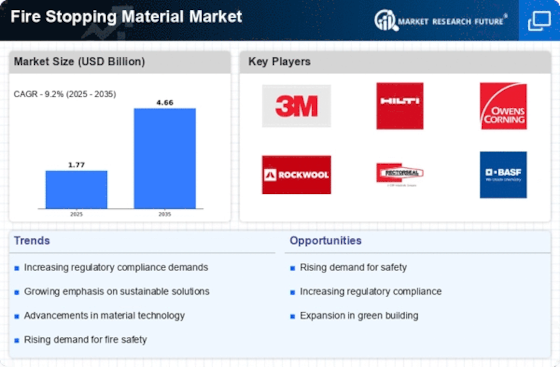
As per MRFR analysis, the Fire Stopping Material Market Size was estimated at 1.77 USD Billion in 2024. The Fire Stopping Material industry is projected to grow from 1.933 USD Billion in 2025 to 4.661 USD Billion by 2035, exhibiting a compound annual growth rate (CAGR) of 9.2 during the forecast period 2025 - 2035.

Key Market Trends & Highlights

The Fire Stopping Material Market is poised for growth driven by sustainability and technological advancements.

  • Sustainability is becoming a pivotal focus in the development of fire stopping materials, influencing product innovation.
  • Technological advancements are enhancing the performance and application of fire stopping solutions across various sectors.
  • North America remains the largest market, while the Asia-Pacific region is emerging as the fastest-growing area for fire stopping materials.
  • The increasing construction activities and rising awareness of fire safety are key drivers propelling market expansion.

Market Size & Forecast

2024 Market Size 1.77 (USD Billion)
2035 Market Size 4.661 (USD Billion)
CAGR (2025 - 2035) 9.2%
Largest Regional Market Share in 2024 North America

Major Players

<p>3M (US), Hilti (CH), Owens Corning (US), Rockwool International (DK), RectorSeal (US), BASF (DE), Firestone Building Products (US), International Fireproof Technology (US)</p>

Market Trends

The Fire Stopping Material Market is currently experiencing a notable evolution, driven by increasing awareness regarding fire safety and stringent regulations imposed by various authorities. This market encompasses a range of products designed to prevent the spread of fire and smoke through openings in walls, floors, and ceilings. As construction practices evolve, the demand for innovative fire stopping solutions appears to be on the rise, particularly in commercial and residential sectors. The integration of advanced materials and technologies is likely to enhance the effectiveness of fire stopping systems, thereby contributing to overall safety in buildings. Moreover, the growing trend towards sustainable construction practices is influencing the Fire Stopping Material Market. Manufacturers are increasingly focusing on developing eco-friendly materials that not only meet safety standards but also minimize environmental impact. This shift towards sustainability may attract a broader customer base, as stakeholders prioritize green building certifications. Additionally, the ongoing advancements in research and development are expected to yield new products that offer improved performance and ease of application, further shaping the future landscape of this market.

Sustainability in Fire Stopping Materials

There is a discernible shift towards eco-friendly fire stopping materials, as manufacturers strive to align with sustainable building practices. This trend reflects a growing recognition of the importance of minimizing environmental impact while ensuring safety. Products that incorporate recycled or low-emission components are gaining traction, appealing to environmentally conscious consumers.

Technological Advancements

The Fire Stopping Material Market is witnessing a surge in technological innovations, which enhance the performance and application of fire stopping solutions. New materials and application techniques are being developed, potentially improving the efficiency of fire barriers. This trend suggests a future where fire stopping systems are not only more effective but also easier to install.

Regulatory Compliance and Standards

As fire safety regulations become increasingly stringent, the demand for compliant fire stopping materials is likely to grow. Manufacturers are focusing on ensuring that their products meet or exceed these evolving standards. This trend indicates a proactive approach within the industry, as stakeholders seek to mitigate risks associated with fire hazards.

Fire Stopping Material Market Market Drivers

Rising Awareness of Fire Safety

The Fire Stopping Material Market is significantly influenced by the rising awareness of fire safety among consumers and businesses. As incidents of fire-related disasters continue to be reported, there is a growing emphasis on implementing effective fire protection measures. This heightened awareness is prompting organizations to invest in fire stopping materials to mitigate risks and protect lives and property. Market data indicates that the fire safety equipment market is expected to reach a valuation of over 100 billion dollars by 2026, reflecting the increasing prioritization of safety measures. Consequently, the demand for fire stopping materials is likely to rise as part of comprehensive fire safety strategies, further propelling the market forward.

Stringent Regulatory Frameworks

The Fire Stopping Material Market is heavily influenced by stringent regulatory frameworks that mandate the use of fire stopping materials in construction and renovation projects. Governments and regulatory bodies are increasingly enforcing building codes and safety standards that require the implementation of fire protection measures. This regulatory environment is compelling construction companies to adopt fire stopping solutions to ensure compliance and avoid penalties. Recent data indicates that the enforcement of these regulations is expected to tighten, leading to a projected increase in the fire stopping materials market by approximately 6% over the next five years. As compliance becomes non-negotiable, the demand for fire stopping materials is likely to rise, further solidifying the market's growth trajectory.

Increasing Construction Activities

The Fire Stopping Material Market is experiencing a surge due to the increasing construction activities across various sectors. As urbanization continues to rise, the demand for residential, commercial, and industrial buildings escalates. This growth necessitates the use of fire stopping materials to ensure safety and compliance with fire regulations. According to recent data, the construction sector is projected to grow at a compound annual growth rate of approximately 5.5% over the next few years. Consequently, this trend is likely to drive the demand for fire stopping materials, as builders and contractors prioritize fire safety in their projects. The integration of fire stopping solutions in new constructions is becoming a standard practice, thereby enhancing the overall market for fire stopping materials.

Growth in Renovation and Retrofitting Projects

The Fire Stopping Material Market is also experiencing growth due to an increase in renovation and retrofitting projects. As older buildings undergo upgrades to meet modern safety standards, the need for effective fire stopping materials becomes paramount. Renovation projects often require the installation of fire stopping solutions to address existing vulnerabilities and enhance overall safety. Market analysis suggests that the renovation sector is expected to grow at a rate of 4% annually, driven by the need for improved safety and compliance. This trend is likely to create substantial opportunities for fire stopping material manufacturers, as property owners and managers prioritize fire safety in their renovation efforts.

Technological Innovations in Fire Stopping Solutions

The Fire Stopping Material Market is benefiting from technological innovations that enhance the performance and effectiveness of fire stopping solutions. Advancements in material science have led to the development of new fire stopping products that offer superior fire resistance and ease of application. For instance, intumescent materials and advanced sealants are gaining traction due to their ability to expand and seal gaps during a fire, thereby preventing the spread of flames and smoke. The market for these innovative solutions is projected to grow, with estimates suggesting a potential increase of 7% annually. As manufacturers continue to invest in research and development, the Fire Stopping Material Market is likely to see a proliferation of advanced products that meet evolving safety standards.

Market Segment Insights

By Type: Sealants (Largest) vs. Mortar (Fastest-Growing)

<p>In the Fire Stopping Material Market, the type segment showcases a diverse distribution among various products like sealants, mortar, boards, putty and putty pads, and others. Sealants capture the largest market share due to their versatility and effectiveness in preventing the spread of fire. Meanwhile, mortar, while currently a smaller segment, is noted for its rapid growth and innovation in formulations designed to enhance fire resistance, appealing to a broad range of industries.</p>

<p>Sealants (Dominant) vs. Mortar (Emerging)</p>

<p>Sealants are the dominant force in the Fire Stopping Material Market, valued for their adaptability and ease of application in fire safety solutions. They are widely utilized in construction and refurbishment, providing essential sealing against fire, smoke, and gas. Mortar, in contrast, is emerging as a fast-growing segment driven by advancements in fire-resistant properties and regulations mandating higher protection standards. As industries evolve and safety requirements tighten, mortar is increasingly favored for new construction environments, while sealants continue to hold a critical position due to their established capabilities.</p>

By Application: Electrical (Largest) vs. Plumbing (Fastest-Growing)

<p>The Fire Stopping Material Market is segmented by application into Electrical, Mechanical, Plumbing, and Others. Among these, Electrical applications account for the largest share in the market. This is primarily due to the critical importance of protecting electrical installations from fire hazards, with heightened regulations and safety standards. Additionally, Plumbing applications are seeing significant market interest, driven by an increased focus on fire safety in residential and commercial plumbing systems. Growth trends in the Fire Stopping Material Market segment are being propelled by factors such as stricter building codes and regulations mandating fire safety measures across various applications. Furthermore, the rise in construction and renovation activities, along with heightened awareness of fire safety and the potential risks associated with inadequate fire stopping measures, are catalyzing the demand. Plumbing materials, in particular, are emerging as a vital segment due to modernization and advancements in plumbing technologies.</p>

<p>Electrical (Dominant) vs. Plumbing (Emerging)</p>

<p>Electrical fire stopping materials are recognized as the dominant segment in the Fire Stopping Material Market due to their critical role in safeguarding electrical infrastructure. These materials are specifically designed to prevent the spread of fire through cable penetrations, junction boxes, and other electrical components, ensuring compliance with stringent safety regulations. On the other hand, Plumbing fire stopping materials are emerging rapidly, reflecting the growing concerns over fire hazards in plumbing systems. The rise in modern plumbing solutions, coupled with innovations in fire-resistant materials, contribute to this segment's growth. Both segments are characterized by a focus on performance, regulatory compliance, and the necessity of integrating fire safety in building designs.</p>

By End-User: Residential (Largest) vs. Commercial (Fastest-Growing)

<p>In the Fire Stopping Material Market, the end-user segment is primarily dominated by the residential sector, which accounts for a substantial portion of the market share. This segment benefits from the increasing construction of residential properties and the growing emphasis on building safety and fire protection. In contrast, the commercial sector, while smaller in share, is witnessing rapid growth due to heightened regulatory requirements and increased investments in commercial infrastructure. The growth in the residential segment is primarily driven by rising safety awareness among homeowners, prompted by regulatory mandates and insurance norms aimed at ensuring fire safety. On the other hand, the commercial segment's fastest growth can be attributed to the expansion of businesses, particularly in urban areas, alongside an increase in commercial building projects that require compliance with stringent fire safety regulations, enhancing the demand for fire stopping materials.</p>

<p>Residential (Dominant) vs. Industrial (Emerging)</p>

<p>The residential sector stands out as the dominant end-user of fire stopping materials, largely driven by the increasing number of new housing developments and the emphasis on achieving safety standards within homes. Residential buildings are often subjected to strict fire safety regulations, necessitating the use of high-quality fire stopping solutions to protect occupants and assets. In contrast, the industrial sector is an emerging player in this market. As industries evolve and expand, there is heightened awareness regarding fire risks, leading to a growing demand for fire stopping materials to safeguard facilities. This sector is characterized by its unique challenges, such as larger spaces and specialized applications, requiring tailored fire stopping solutions to comply with safety regulations effectively.</p>

Get more detailed insights about Fire Stopping Material Market Research Report - Global Forecast till 2035

Regional Insights

North America : Market Leader in Fire Safety

North America is the largest market for fire stopping materials, holding approximately 40% of the global market share. The region's growth is driven by stringent building codes and regulations aimed at enhancing fire safety in commercial and residential buildings. The increasing demand for fire-resistant materials in construction projects, coupled with technological advancements, further propels market growth. The United States is the leading country in this region, with significant contributions from Canada. Key players such as 3M, Owens Corning, and Hilti dominate the competitive landscape, focusing on innovative solutions to meet regulatory standards. The presence of established manufacturers and a robust distribution network enhances market accessibility and growth potential.

Europe : Regulatory-Driven Market Growth

Europe is the second-largest market for fire stopping materials, accounting for approximately 30% of the global market share. The region's growth is significantly influenced by the European Union's stringent fire safety regulations and standards, which mandate the use of fire-resistant materials in construction. The increasing focus on sustainable building practices also drives demand for eco-friendly fire stopping solutions. Leading countries in this region include Germany, the UK, and France, where key players like BASF and Rockwool International are actively innovating. The competitive landscape is characterized by a mix of established companies and emerging startups, all striving to meet the evolving regulatory requirements and consumer preferences. The emphasis on safety and compliance continues to shape market dynamics.

Asia-Pacific : Rapid Growth and Development

Asia-Pacific is witnessing rapid growth in the fire stopping materials market, holding approximately 20% of the global market share. The region's expansion is driven by increasing urbanization, industrialization, and a growing awareness of fire safety regulations. Countries like China and India are investing heavily in infrastructure development, which boosts the demand for fire-resistant materials. China is the largest market in this region, followed by India and Japan. The competitive landscape features both local and international players, including Hilti and RectorSeal, who are focusing on product innovation and compliance with local regulations. The increasing number of construction projects and government initiatives to enhance fire safety standards are key factors driving market growth.

Middle East and Africa : Emerging Market with Potential

The Middle East and Africa region is gradually emerging in the fire stopping materials market, holding about 10% of the global market share. The growth is primarily driven by increasing construction activities and a rising focus on fire safety regulations in countries like the UAE and South Africa. The region's diverse climate and building styles necessitate the use of specialized fire-resistant materials, further propelling market demand. Key players in this region include International Fireproof Technology and Firestone Building Products, who are adapting their offerings to meet local needs. The competitive landscape is evolving, with both established companies and new entrants striving to capture market share. Government initiatives aimed at improving safety standards are expected to further enhance market growth in the coming years.

Key Players and Competitive Insights

The Fire Stopping Material Market is currently characterized by a dynamic competitive landscape, driven by increasing regulatory requirements and a heightened focus on fire safety across various sectors. Key players such as 3M (US), Hilti (CH), and Owens Corning (US) are strategically positioned to leverage innovation and technological advancements to enhance their product offerings. 3M (US) emphasizes a strong commitment to research and development, focusing on creating advanced fire stopping solutions that meet stringent safety standards. Meanwhile, Hilti (CH) has been actively expanding its global footprint through strategic partnerships and acquisitions, thereby enhancing its market presence and operational capabilities. Owens Corning (US) appears to be concentrating on sustainability initiatives, integrating eco-friendly materials into its fire stopping products, which aligns with the growing demand for environmentally responsible construction solutions.

The competitive structure of the Fire Stopping Material Market is moderately fragmented, with several players vying for market share. Companies are increasingly localizing manufacturing to reduce lead times and optimize supply chains, which is crucial in meeting the demands of a rapidly evolving market. This localization strategy not only enhances operational efficiency but also allows companies to respond swiftly to regional market needs. The collective influence of these key players shapes a competitive environment where innovation and responsiveness are paramount.

In August 2025, 3M (US) announced the launch of a new line of fire stopping products designed specifically for high-rise buildings, which underscores its commitment to addressing the unique challenges posed by urban construction. This strategic move is likely to enhance 3M's competitive edge by catering to a niche market that requires specialized solutions, thereby reinforcing its position as a leader in fire safety technology. Furthermore, in September 2025, Hilti (CH) expanded its partnership with a leading construction firm to provide integrated fire stopping solutions, which not only strengthens its market presence but also enhances its ability to deliver comprehensive safety solutions tailored to client needs.

In July 2025, Owens Corning (US) unveiled a new initiative aimed at incorporating recycled materials into its fire stopping products, reflecting a growing trend towards sustainability in the construction industry. This initiative not only positions Owens Corning as a forward-thinking player but also aligns with the increasing regulatory pressures for sustainable building practices. Such strategic actions are indicative of a broader industry shift towards environmentally conscious product development, which is likely to resonate well with both consumers and regulatory bodies.

As of October 2025, the Fire Stopping Material Market is witnessing significant trends such as digitalization and the integration of artificial intelligence in product development and supply chain management. Companies are increasingly forming strategic alliances to enhance their technological capabilities and market reach. This collaborative approach is reshaping the competitive landscape, moving the focus from traditional price-based competition to a more nuanced differentiation based on innovation, technology, and supply chain reliability. Looking ahead, it appears that the competitive dynamics will continue to evolve, with companies that prioritize innovation and sustainability likely to emerge as leaders in this critical market.

Key Companies in the Fire Stopping Material Market market include

Industry Developments

Future Outlook

Fire Stopping Material Market Future Outlook

<p>The Fire Stopping Material Market is projected to grow at a 9.2% CAGR from 2024 to 2035, driven by increasing safety regulations and construction activities.</p>

New opportunities lie in:

  • <p>Development of advanced intumescent coatings for enhanced fire resistance.</p>
  • <p>Integration of smart technology in fire stopping systems for real-time monitoring.</p>
  • <p>Expansion into emerging markets with tailored fire safety solutions.</p>

<p>By 2035, the market is expected to achieve substantial growth, reflecting heightened demand for fire safety solutions.</p>

Market Segmentation

Fire Stopping Material Market Type Outlook

  • Sealants
  • Mortar
  • Boards
  • Putty & Putty Pads
  • Others

Fire Stopping Material Market End-User Outlook

  • Residential
  • Commercial
  • Industrial

Fire Stopping Material Market Application Outlook

  • Electrical
  • Mechanical
  • Plumbing
  • Others

Report Scope

MARKET SIZE 20241.77(USD Billion)
MARKET SIZE 20251.933(USD Billion)
MARKET SIZE 20354.661(USD Billion)
COMPOUND ANNUAL GROWTH RATE (CAGR)9.2% (2024 - 2035)
REPORT COVERAGERevenue Forecast, Competitive Landscape, Growth Factors, and Trends
BASE YEAR2024
Market Forecast Period2025 - 2035
Historical Data2019 - 2024
Market Forecast UnitsUSD Billion
Key Companies ProfiledMarket analysis in progress
Segments CoveredMarket segmentation analysis in progress
Key Market OpportunitiesIncreasing regulatory focus on fire safety standards drives demand for innovative fire stopping materials.
Key Market DynamicsRising regulatory standards drive innovation and competition in the fire stopping material market, enhancing product performance and safety.
Countries CoveredNorth America, Europe, APAC, South America, MEA

FAQs

What is the current valuation of the Fire Stopping Material Market as of 2024?

The market valuation was 1.77 USD Billion in 2024.

What is the projected market size for the Fire Stopping Material Market in 2035?

The projected valuation for 2035 is 4.661 USD Billion.

What is the expected CAGR for the Fire Stopping Material Market during the forecast period 2025 - 2035?

The expected CAGR during this period is 9.2%.

Which companies are considered key players in the Fire Stopping Material Market?

Key players include 3M, Hilti, Owens Corning, Rockwool International, RectorSeal, BASF, Firestone Building Products, and International Fireproof Technology.

What are the main segments of the Fire Stopping Material Market?

The main segments include Type, Application, and End-User.

  1. SECTION I: EXECUTIVE SUMMARY AND KEY HIGHLIGHTS
    1. EXECUTIVE SUMMARY
      1. Market Overview
      2. Key Findings
      3. Market Segmentation
      4. Competitive Landscape
      5. Challenges and Opportunities
      6. Future Outlook
  2. SECTION II: SCOPING, METHODOLOGY AND MARKET STRUCTURE
    1. MARKET INTRODUCTION
      1. Definition
      2. Scope of the study
    2. RESEARCH METHODOLOGY
      1. Overview
      2. Data Mining
      3. Secondary Research
      4. Primary Research
      5. Forecasting Model
      6. Market Size Estimation
      7. Data Triangulation
      8. Validation
  3. SECTION III: QUALITATIVE ANALYSIS
    1. MARKET DYNAMICS
      1. Overview
      2. Drivers
      3. Restraints
      4. Opportunities
    2. MARKET FACTOR ANALYSIS
      1. Value chain Analysis
      2. Porter's Five Forces Analysis
      3. COVID-19 Impact Analysis
  4. SECTION IV: QUANTITATIVE ANALYSIS
    1. Chemicals and Materials, BY Type (USD Billion)
      1. Sealants
      2. Mortar
      3. Boards
      4. Putty & Putty Pads
      5. Others
    2. Chemicals and Materials, BY Application (USD Billion)
      1. Electrical
      2. Mechanical
      3. Plumbing
      4. Others
    3. Chemicals and Materials, BY End-User (USD Billion)
      1. Residential
      2. Commercial
      3. Industrial
    4. Chemicals and Materials, BY Region (USD Billion)
      1. North America
      2. Europe
      3. APAC
      4. South America
      5. MEA
  5. SECTION V: COMPETITIVE ANALYSIS
    1. Competitive Landscape
      1. Overview
      2. Competitive Analysis
      3. Market share Analysis
      4. Major Growth Strategy in the Chemicals and Materials
      5. Competitive Benchmarking
      6. Leading Players in Terms of Number of Developments in the Chemicals and Materials
      7. Key developments and growth strategies
      8. Major Players Financial Matrix
    2. Company Profiles
      1. 3M (US)
      2. Hilti (CH)
      3. Owens Corning (US)
      4. Rockwool International (DK)
      5. RectorSeal (US)
      6. BASF (DE)
      7. Firestone Building Products (US)
      8. International Fireproof Technology (US)
    3. Appendix
      1. References
      2. Related Reports
  6. LIST OF FIGURES
    1. MARKET SYNOPSIS
    2. NORTH AMERICA MARKET ANALYSIS
    3. US MARKET ANALYSIS BY TYPE
    4. US MARKET ANALYSIS BY APPLICATION
    5. US MARKET ANALYSIS BY END-USER
    6. CANADA MARKET ANALYSIS BY TYPE
    7. CANADA MARKET ANALYSIS BY APPLICATION
    8. CANADA MARKET ANALYSIS BY END-USER
    9. EUROPE MARKET ANALYSIS
    10. GERMANY MARKET ANALYSIS BY TYPE
    11. GERMANY MARKET ANALYSIS BY APPLICATION
    12. GERMANY MARKET ANALYSIS BY END-USER
    13. UK MARKET ANALYSIS BY TYPE
    14. UK MARKET ANALYSIS BY APPLICATION
    15. UK MARKET ANALYSIS BY END-USER
    16. FRANCE MARKET ANALYSIS BY TYPE
    17. FRANCE MARKET ANALYSIS BY APPLICATION
    18. FRANCE MARKET ANALYSIS BY END-USER
    19. RUSSIA MARKET ANALYSIS BY TYPE
    20. RUSSIA MARKET ANALYSIS BY APPLICATION
    21. RUSSIA MARKET ANALYSIS BY END-USER
    22. ITALY MARKET ANALYSIS BY TYPE
    23. ITALY MARKET ANALYSIS BY APPLICATION
    24. ITALY MARKET ANALYSIS BY END-USER
    25. SPAIN MARKET ANALYSIS BY TYPE
    26. SPAIN MARKET ANALYSIS BY APPLICATION
    27. SPAIN MARKET ANALYSIS BY END-USER
    28. REST OF EUROPE MARKET ANALYSIS BY TYPE
    29. REST OF EUROPE MARKET ANALYSIS BY APPLICATION
    30. REST OF EUROPE MARKET ANALYSIS BY END-USER
    31. APAC MARKET ANALYSIS
    32. CHINA MARKET ANALYSIS BY TYPE
    33. CHINA MARKET ANALYSIS BY APPLICATION
    34. CHINA MARKET ANALYSIS BY END-USER
    35. INDIA MARKET ANALYSIS BY TYPE
    36. INDIA MARKET ANALYSIS BY APPLICATION
    37. INDIA MARKET ANALYSIS BY END-USER
    38. JAPAN MARKET ANALYSIS BY TYPE
    39. JAPAN MARKET ANALYSIS BY APPLICATION
    40. JAPAN MARKET ANALYSIS BY END-USER
    41. SOUTH KOREA MARKET ANALYSIS BY TYPE
    42. SOUTH KOREA MARKET ANALYSIS BY APPLICATION
    43. SOUTH KOREA MARKET ANALYSIS BY END-USER
    44. MALAYSIA MARKET ANALYSIS BY TYPE
    45. MALAYSIA MARKET ANALYSIS BY APPLICATION
    46. MALAYSIA MARKET ANALYSIS BY END-USER
    47. THAILAND MARKET ANALYSIS BY TYPE
    48. THAILAND MARKET ANALYSIS BY APPLICATION
    49. THAILAND MARKET ANALYSIS BY END-USER
    50. INDONESIA MARKET ANALYSIS BY TYPE
    51. INDONESIA MARKET ANALYSIS BY APPLICATION
    52. INDONESIA MARKET ANALYSIS BY END-USER
    53. REST OF APAC MARKET ANALYSIS BY TYPE
    54. REST OF APAC MARKET ANALYSIS BY APPLICATION
    55. REST OF APAC MARKET ANALYSIS BY END-USER
    56. SOUTH AMERICA MARKET ANALYSIS
    57. BRAZIL MARKET ANALYSIS BY TYPE
    58. BRAZIL MARKET ANALYSIS BY APPLICATION
    59. BRAZIL MARKET ANALYSIS BY END-USER
    60. MEXICO MARKET ANALYSIS BY TYPE
    61. MEXICO MARKET ANALYSIS BY APPLICATION
    62. MEXICO MARKET ANALYSIS BY END-USER
    63. ARGENTINA MARKET ANALYSIS BY TYPE
    64. ARGENTINA MARKET ANALYSIS BY APPLICATION
    65. ARGENTINA MARKET ANALYSIS BY END-USER
    66. REST OF SOUTH AMERICA MARKET ANALYSIS BY TYPE
    67. REST OF SOUTH AMERICA MARKET ANALYSIS BY APPLICATION
    68. REST OF SOUTH AMERICA MARKET ANALYSIS BY END-USER
    69. MEA MARKET ANALYSIS
    70. GCC COUNTRIES MARKET ANALYSIS BY TYPE
    71. GCC COUNTRIES MARKET ANALYSIS BY APPLICATION
    72. GCC COUNTRIES MARKET ANALYSIS BY END-USER
    73. SOUTH AFRICA MARKET ANALYSIS BY TYPE
    74. SOUTH AFRICA MARKET ANALYSIS BY APPLICATION
    75. SOUTH AFRICA MARKET ANALYSIS BY END-USER
    76. REST OF MEA MARKET ANALYSIS BY TYPE
    77. REST OF MEA MARKET ANALYSIS BY APPLICATION
    78. REST OF MEA MARKET ANALYSIS BY END-USER
    79. KEY BUYING CRITERIA OF CHEMICALS AND MATERIALS
    80. RESEARCH PROCESS OF MRFR
    81. DRO ANALYSIS OF CHEMICALS AND MATERIALS
    82. DRIVERS IMPACT ANALYSIS: CHEMICALS AND MATERIALS
    83. RESTRAINTS IMPACT ANALYSIS: CHEMICALS AND MATERIALS
    84. SUPPLY / VALUE CHAIN: CHEMICALS AND MATERIALS
    85. CHEMICALS AND MATERIALS, BY TYPE, 2024 (% SHARE)
    86. CHEMICALS AND MATERIALS, BY TYPE, 2024 TO 2035 (USD Billion)
    87. CHEMICALS AND MATERIALS, BY APPLICATION, 2024 (% SHARE)
    88. CHEMICALS AND MATERIALS, BY APPLICATION, 2024 TO 2035 (USD Billion)
    89. CHEMICALS AND MATERIALS, BY END-USER, 2024 (% SHARE)
    90. CHEMICALS AND MATERIALS, BY END-USER, 2024 TO 2035 (USD Billion)
    91. BENCHMARKING OF MAJOR COMPETITORS
  7. LIST OF TABLES
    1. LIST OF ASSUMPTIONS
    2. North America MARKET SIZE ESTIMATES; FORECAST
      1. BY TYPE, 2025-2035 (USD Billion)
      2. BY APPLICATION, 2025-2035 (USD Billion)
      3. BY END-USER, 2025-2035 (USD Billion)
    3. US MARKET SIZE ESTIMATES; FORECAST
      1. BY TYPE, 2025-2035 (USD Billion)
      2. BY APPLICATION, 2025-2035 (USD Billion)
      3. BY END-USER, 2025-2035 (USD Billion)
    4. Canada MARKET SIZE ESTIMATES; FORECAST
      1. BY TYPE, 2025-2035 (USD Billion)
      2. BY APPLICATION, 2025-2035 (USD Billion)
      3. BY END-USER, 2025-2035 (USD Billion)
    5. Europe MARKET SIZE ESTIMATES; FORECAST
      1. BY TYPE, 2025-2035 (USD Billion)
      2. BY APPLICATION, 2025-2035 (USD Billion)
      3. BY END-USER, 2025-2035 (USD Billion)
    6. Germany MARKET SIZE ESTIMATES; FORECAST
      1. BY TYPE, 2025-2035 (USD Billion)
      2. BY APPLICATION, 2025-2035 (USD Billion)
      3. BY END-USER, 2025-2035 (USD Billion)
    7. UK MARKET SIZE ESTIMATES; FORECAST
      1. BY TYPE, 2025-2035 (USD Billion)
      2. BY APPLICATION, 2025-2035 (USD Billion)
      3. BY END-USER, 2025-2035 (USD Billion)
    8. France MARKET SIZE ESTIMATES; FORECAST
      1. BY TYPE, 2025-2035 (USD Billion)
      2. BY APPLICATION, 2025-2035 (USD Billion)
      3. BY END-USER, 2025-2035 (USD Billion)
    9. Russia MARKET SIZE ESTIMATES; FORECAST
      1. BY TYPE, 2025-2035 (USD Billion)
      2. BY APPLICATION, 2025-2035 (USD Billion)
      3. BY END-USER, 2025-2035 (USD Billion)
    10. Italy MARKET SIZE ESTIMATES; FORECAST
      1. BY TYPE, 2025-2035 (USD Billion)
      2. BY APPLICATION, 2025-2035 (USD Billion)
      3. BY END-USER, 2025-2035 (USD Billion)
    11. Spain MARKET SIZE ESTIMATES; FORECAST
      1. BY TYPE, 2025-2035 (USD Billion)
      2. BY APPLICATION, 2025-2035 (USD Billion)
      3. BY END-USER, 2025-2035 (USD Billion)
    12. Rest of Europe MARKET SIZE ESTIMATES; FORECAST
      1. BY TYPE, 2025-2035 (USD Billion)
      2. BY APPLICATION, 2025-2035 (USD Billion)
      3. BY END-USER, 2025-2035 (USD Billion)
    13. APAC MARKET SIZE ESTIMATES; FORECAST
      1. BY TYPE, 2025-2035 (USD Billion)
      2. BY APPLICATION, 2025-2035 (USD Billion)
      3. BY END-USER, 2025-2035 (USD Billion)
    14. China MARKET SIZE ESTIMATES; FORECAST
      1. BY TYPE, 2025-2035 (USD Billion)
      2. BY APPLICATION, 2025-2035 (USD Billion)
      3. BY END-USER, 2025-2035 (USD Billion)
    15. India MARKET SIZE ESTIMATES; FORECAST
      1. BY TYPE, 2025-2035 (USD Billion)
      2. BY APPLICATION, 2025-2035 (USD Billion)
      3. BY END-USER, 2025-2035 (USD Billion)
    16. Japan MARKET SIZE ESTIMATES; FORECAST
      1. BY TYPE, 2025-2035 (USD Billion)
      2. BY APPLICATION, 2025-2035 (USD Billion)
      3. BY END-USER, 2025-2035 (USD Billion)
    17. South Korea MARKET SIZE ESTIMATES; FORECAST
      1. BY TYPE, 2025-2035 (USD Billion)
      2. BY APPLICATION, 2025-2035 (USD Billion)
      3. BY END-USER, 2025-2035 (USD Billion)
    18. Malaysia MARKET SIZE ESTIMATES; FORECAST
      1. BY TYPE, 2025-2035 (USD Billion)
      2. BY APPLICATION, 2025-2035 (USD Billion)
      3. BY END-USER, 2025-2035 (USD Billion)
    19. Thailand MARKET SIZE ESTIMATES; FORECAST
      1. BY TYPE, 2025-2035 (USD Billion)
      2. BY APPLICATION, 2025-2035 (USD Billion)
      3. BY END-USER, 2025-2035 (USD Billion)
    20. Indonesia MARKET SIZE ESTIMATES; FORECAST
      1. BY TYPE, 2025-2035 (USD Billion)
      2. BY APPLICATION, 2025-2035 (USD Billion)
      3. BY END-USER, 2025-2035 (USD Billion)
    21. Rest of APAC MARKET SIZE ESTIMATES; FORECAST
      1. BY TYPE, 2025-2035 (USD Billion)
      2. BY APPLICATION, 2025-2035 (USD Billion)
      3. BY END-USER, 2025-2035 (USD Billion)
    22. South America MARKET SIZE ESTIMATES; FORECAST
      1. BY TYPE, 2025-2035 (USD Billion)
      2. BY APPLICATION, 2025-2035 (USD Billion)
      3. BY END-USER, 2025-2035 (USD Billion)
    23. Brazil MARKET SIZE ESTIMATES; FORECAST
      1. BY TYPE, 2025-2035 (USD Billion)
      2. BY APPLICATION, 2025-2035 (USD Billion)
      3. BY END-USER, 2025-2035 (USD Billion)
    24. Mexico MARKET SIZE ESTIMATES; FORECAST
      1. BY TYPE, 2025-2035 (USD Billion)
      2. BY APPLICATION, 2025-2035 (USD Billion)
      3. BY END-USER, 2025-2035 (USD Billion)
    25. Argentina MARKET SIZE ESTIMATES; FORECAST
      1. BY TYPE, 2025-2035 (USD Billion)
      2. BY APPLICATION, 2025-2035 (USD Billion)
      3. BY END-USER, 2025-2035 (USD Billion)
    26. Rest of South America MARKET SIZE ESTIMATES; FORECAST
      1. BY TYPE, 2025-2035 (USD Billion)
      2. BY APPLICATION, 2025-2035 (USD Billion)
      3. BY END-USER, 2025-2035 (USD Billion)
    27. MEA MARKET SIZE ESTIMATES; FORECAST
      1. BY TYPE, 2025-2035 (USD Billion)
      2. BY APPLICATION, 2025-2035 (USD Billion)
      3. BY END-USER, 2025-2035 (USD Billion)
    28. GCC Countries MARKET SIZE ESTIMATES; FORECAST
      1. BY TYPE, 2025-2035 (USD Billion)
      2. BY APPLICATION, 2025-2035 (USD Billion)
      3. BY END-USER, 2025-2035 (USD Billion)
    29. South Africa MARKET SIZE ESTIMATES; FORECAST
      1. BY TYPE, 2025-2035 (USD Billion)
      2. BY APPLICATION, 2025-2035 (USD Billion)
      3. BY END-USER, 2025-2035 (USD Billion)
    30. Rest of MEA MARKET SIZE ESTIMATES; FORECAST
      1. BY TYPE, 2025-2035 (USD Billion)
      2. BY APPLICATION, 2025-2035 (USD Billion)
      3. BY END-USER, 2025-2035 (USD Billion)
    31. PRODUCT LAUNCH/PRODUCT DEVELOPMENT/APPROVAL
    32. ACQUISITION/PARTNERSHIP

Fire Stopping Material Market Segmentation

Market Segmentation Overview

  • Detailed segmentation data will be available in the full report
  • Comprehensive analysis by multiple parameters
  • Regional and country-level breakdowns
  • Market size forecasts by segment
Infographic

Free Sample Request

Kindly complete the form below to receive a free sample of this Report

Get Free Sample

Customer Strories

Compare Licence

×
Features License Type
Single User Multiuser License Enterprise User
Price $4,950 $5,950 $7,250
Maximum User Access Limit 1 User Upto 10 Users Unrestricted Access Throughout the Organization
Free Customization
Direct Access to Analyst
Deliverable Format
Platform Access
Discount on Next Purchase 10% 15% 15%
Printable Versions