Flavored Yogurt Market
Flavored Yogurt Market Summary
As per Market Research Future analysis, the Flavored Yogurt Market Size was estimated at 10.55 USD Billion in 2024. The Flavored Yogurt industry is projected to grow from 10.89 USD Billion in 2025 to 14.98 USD Billion by 2035, exhibiting a compound annual growth rate (CAGR) of 3.24% during the forecast period 2025 - 2035
Key Market Trends & Highlights
The Flavored Yogurt Market is experiencing robust growth driven by health trends and innovative flavors.
- The North American market remains the largest, driven by a strong health and wellness focus among consumers.
- In the Asia-Pacific region, the flavored yogurt market is the fastest-growing, fueled by increasing demand for diverse flavor innovations.
- Fruits segment leads in market share, while the Mixed Berry segment is rapidly gaining traction due to evolving consumer preferences.
- Key market drivers include health consciousness and the demand for flavor variety and customization, which are shaping product offerings.
Market Size & Forecast
| 2024 Market Size | 10.55 (USD Billion) |
| 2035 Market Size | 14.98 (USD Billion) |
| CAGR (2025 - 2035) | 3.24% |
Major Players
Danone (FR), Nestle (CH), General Mills (US), Chobani (US), Fage (GR), Yoplait (FR), Stonyfield Farm (US), Müller (DE), Lactalis (FR)
Flavored Yogurt Market Trends
The flavored yogurt market is currently experiencing a dynamic evolution, characterized by shifting consumer preferences, increasing health consciousness, and growing demand for innovative flavors and functional ingredients. As health consciousness rises, consumers are gravitating towards options that not only satisfy their taste buds but also align with their nutritional goals. This trend is prompting manufacturers to explore diverse flavor profiles and incorporate functional ingredients, such as probiotics and superfoods, into their offerings. The market landscape is further influenced by the growing popularity of plant-based alternatives, which cater to a broader audience seeking dairy-free options.
In addition to flavor innovation, sustainability is becoming a pivotal factor in the Flavored Yogurt Market. Brands are increasingly focusing on eco-friendly packaging and sourcing practices, responding to consumer demand for environmentally responsible products. This shift towards sustainability is not merely a trend but appears to be a fundamental change in how companies operate. As the market continues to evolve, it is likely that the intersection of health, flavor, and sustainability will shape the future of flavored yogurt, creating opportunities for both established brands and new entrants to thrive in this competitive landscape.
Health and Wellness Focus
The emphasis on probiotics, low sugar, and functional benefits continues to strengthen the flavored yogurt market, as consumers increasingly associate yogurt consumption with overall wellness and balanced nutrition. Consumers are increasingly seeking products that offer nutritional benefits, such as probiotics and low sugar content. This trend encourages manufacturers to reformulate existing products and develop new ones that cater to health-conscious individuals.
Diverse Flavor Innovations
Innovation in taste profiles remains a defining factor in the flavored yogurt market, with fruit-based and mixed berry flavors driving both consumer engagement and product differentiation. Companies are experimenting with unique and exotic flavors to attract adventurous consumers. This diversification not only enhances the consumer experience but also helps brands differentiate themselves in a crowded marketplace.
Sustainability Initiatives
Sustainability-driven packaging and responsible sourcing practices are shaping competitive strategies within the flavored yogurt market, aligning brand offerings with environmentally conscious consumer values. Brands are adopting eco-friendly practices, from sourcing ingredients responsibly to utilizing recyclable packaging. This trend reflects a growing consumer preference for products that align with their values regarding environmental stewardship.
Flavored Yogurt Market Drivers
Health Consciousness
The rising awareness of health and wellness among consumers appears to be a pivotal driver for the Flavored Yogurt Market. As individuals increasingly prioritize nutritious diets, flavored yogurt, often perceived as a healthier alternative to traditional desserts, gains traction. According to recent data, the demand for low-fat and probiotic-rich options has surged, with a notable increase in sales of yogurts containing live cultures. This trend suggests that consumers are not only seeking indulgent flavors but also functional benefits, such as improved digestion and immune support. Consequently, manufacturers are innovating to create products that align with these health trends, thereby expanding their market reach and catering to a more health-conscious demographic.
Innovative Marketing Strategies
Innovative marketing strategies are playing a crucial role in shaping the Flavored Yogurt Market. Brands are increasingly leveraging social media platforms and influencer partnerships to engage with younger demographics, who are often more receptive to new product launches. Data indicates that targeted marketing campaigns focusing on health benefits and flavor uniqueness can significantly enhance brand visibility and consumer interest. Additionally, experiential marketing, such as yogurt tasting events and interactive promotions, is becoming more prevalent, allowing consumers to connect with brands on a personal level. This approach not only fosters brand loyalty but also encourages word-of-mouth promotion, which can be particularly effective in driving sales. As competition intensifies, the ability to effectively communicate brand values and product benefits through innovative marketing may prove essential for success in the flavored yogurt market.
Flavor Variety and Customization
The Flavored Yogurt Market is experiencing a notable shift towards diverse flavor offerings and customization options. Consumers are increasingly drawn to unique and exotic flavors, which has prompted brands to innovate beyond traditional fruit flavors. Data indicates that the introduction of flavors such as matcha, salted caramel, and even savory options has led to a significant uptick in consumer interest. This trend not only caters to adventurous palates but also allows brands to differentiate themselves in a competitive landscape. Furthermore, the rise of personalized nutrition is encouraging companies to offer customizable yogurt options, enabling consumers to select their preferred flavors and add-ins. This level of personalization may enhance customer loyalty and drive repeat purchases, thereby positively impacting the overall growth of the flavored yogurt market.
Sustainability and Ethical Sourcing
Sustainability initiatives are becoming increasingly relevant within the Flavored Yogurt Market. Consumers are now more inclined to support brands that prioritize environmentally friendly practices and ethical sourcing of ingredients. This shift is reflected in the growing demand for organic and sustainably produced yogurts, which has seen a marked increase in market share. Companies that adopt sustainable packaging and transparent sourcing practices may appeal to environmentally conscious consumers, potentially enhancing brand loyalty. Moreover, the integration of sustainability into marketing strategies can serve as a differentiator in a crowded market. As consumers continue to seek products that align with their values, the emphasis on sustainability could drive further growth in the flavored yogurt sector.
Convenience and On-the-Go Consumption
The fast-paced lifestyle of modern consumers is significantly influencing the Flavored Yogurt Market, particularly in the realm of convenience and on-the-go consumption. As individuals seek quick and nutritious snack options, single-serve flavored yogurt products are gaining popularity. Data suggests that the demand for portable packaging solutions has increased, with many consumers preferring products that can be easily consumed during commutes or at work. This trend is prompting manufacturers to innovate in packaging design, ensuring that products remain fresh and appealing while being convenient. The rise of convenience-oriented products may not only attract busy professionals but also families looking for quick meal solutions, thereby expanding the consumer base for flavored yogurt.
Market Segment Insights
By Flavor: Fruits (Largest) vs. Mixed Berry (Fastest-Growing)
In the flavored yogurt market, 'Fruits' segment dominates with the largest share, appealing greatly to health-conscious consumers. This popularity can be attributed to the fresh taste and nutritional value associated with fruit flavors. In contrast, 'Mixed Berry' has carved a niche for itself as the fastest-growing flavor, resonating particularly well with younger consumers who seek variety and excitement in their yogurt options. The growth of the flavored yogurt market is driven by changing consumer preferences and the increasing demand for healthier snack alternatives. Fruits, being a staple in this category, offer a traditional choice that remains popular. Meanwhile, 'Mixed Berry' reflects a shift towards more adventurous flavor combinations, supported by innovative marketing strategies and product diversification that cater to evolving tastes and lifestyles.
Fruits: Dominant vs. Mixed Berry: Emerging
The 'Fruits' flavor segment remains a dominant force in the flavored yogurt market, known for its appeal to a broad consumer base. From strawberry and mango to peach and raspberry, fruit flavors cater to health-conscious individuals while delivering a refreshing taste. Fruits are often marketed as a natural and nutritious option, resonating with consumers looking for wholesome snacks that contribute to their dietary goals. On the other hand, 'Mixed Berry' is emerging as a trendy choice, especially among millennials and Gen Z shoppers, who are drawn to the vibrant mix that offers a unique taste experience. With the potential for innovation in flavor combinations and packaging, 'Mixed Berry' is poised for continued growth, attracting those seeking diversity in their yogurt consumption.
By Packaging Type: Plastic Cups (Largest) vs. Pouches (Fastest-Growing)
The flavored yogurt market is witnessing a significant segmentation in packaging types, with plastic cups holding the largest market share due to their convenience and consumer preference for on-the-go options. Glass jars and Tetra packs also play notable roles in the market, catering to eco-conscious consumers and those seeking premium products. Pouches, meanwhile, are gaining traction, particularly among younger consumers who favor innovative and portable packaging solutions.
Plastic Cups (Dominant) vs. Pouches (Emerging)
Plastic cups dominate the flavored yogurt packaging segment due to their lightweight nature and ease of use, making them a popular choice for both retailers and consumers. They provide excellent product visibility and convenience, which aligns with the fast-paced lifestyle of modern consumers. In contrast, pouches, while emerging, are rapidly gaining market share attributed to their unique designs and flexibility. They appeal especially to health-conscious individuals looking for portion-controlled options. As manufacturers innovate with stand-up pouches and resealable features, their popularity in the flavored yogurt market continues to grow, reflecting evolving consumer preferences.
By Fat Content: Low-fat (Largest) vs. Full-fat (Fastest-Growing)
The Flavored Yogurt Market is significantly influenced by the fat content of the products, with the low-fat segment commanding the largest share. Consumers show a strong preference for low-fat options due to health-conscious trends, leading to greater availability and innovation in this category. On the other hand, the full-fat segment has gained momentum, appealing to consumers seeking richer flavors and creamier textures. This shift in consumer preference reflects a broader trend in healthy eating that embraces fats in moderation. Growth trends in the flavored yogurt market emphasize a bifurcation between low-fat and full-fat offerings. The low-fat segment remains favored by those focused on calorie intake and health benefits, while full-fat yogurt is seen as an indulgent option, contributing to its rapid growth. The rise of full-fat flavored yogurt is driven by increased awareness of the benefits of dietary fats, consumer willingness to explore gourmet flavors, and the influence of social media on food trends.
Low-fat (Dominant) vs. Full-fat (Emerging)
In the context of the Flavored Yogurt Market, low-fat options are positioned as the dominant segment due to strong consumer demand for healthier, guilt-free choices. These yogurts are often perceived as lighter and healthier, making them preferable for diet-conscious individuals. Meanwhile, full-fat flavored yogurt is emerging as a significant player, characterized by its richer taste and creaminess. This segment appeals to gourmet consumers who associate full-fat products with quality and indulgence. The growth of full-fat yogurt is aligned with changing dietary perceptions, as more consumers embrace the idea of healthy fats as integral to a balanced diet.
By Formulation: Probiotic (Largest) vs. Organic (Fastest-Growing)
In the flavored yogurt market, the formulation segment is prominently divided into Probiotic, Non-Probiotic, and Organic products. Among these, Probiotic yogurts dominate the market, appealing to health-conscious consumers with their potential benefits for gut health and digestion. Non-Probiotic yogurts cater to a broader audience seeking traditional flavors without added health claims. However, Organic flavored yogurts are emerging rapidly, gaining attention for their clean-label appeal and perceived natural benefits, thus capturing a significant share of the growth in this segment.
Formulation: Probiotic (Dominant) vs. Organic (Emerging)
Probiotic flavored yogurts hold a dominant position in the market due to their established health benefits, including improved gut flora and enhanced immunity. Consumers increasingly prioritize wellness in their diets, which supports the sustained popularity of this segment. In contrast, Organic flavored yogurts are classified as an emerging category, driven by the rising demand for clean and sustainable food products. The organic segment appeals specifically to environmentally conscious consumers who value ingredient transparency and sustainability. Both segments are important to the flavored yogurt landscape, yet they cater to different consumer priorities, with Probiotic products leading and Organic yogurts demonstrating rapid growth.
Regional Insights
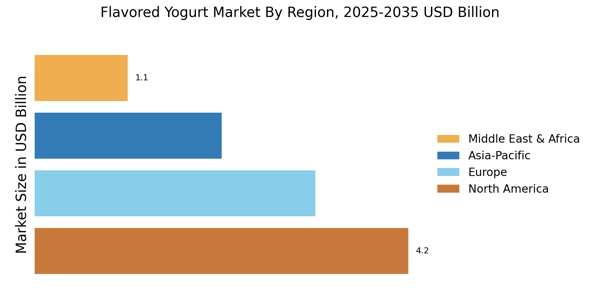
The Flavored Yogurt Market experienced notable growth across its regional segmentation, with North America holding a significant position. In 2024, North America was valued at 3.2 USD Billion, increasing to 4.7 USD Billion by 2035, indicating a robust consumer preference for flavored yogurt products.
Europe closely follows, with a valuation of 3.0 USD Billion in 2024, projected to reach 4.3 USD Billion by 2035, showcasing a strong demand driven by healthier eating trends. Asia Pacific was also a noteworthy region, showing a valuation of 2.8 USD Billion in 2024, with a rise to 3.8 USD Billion by 2035, as the region witnessed an increase in the young population and urbanization, contributing to market growth.
South America stood at 1.1 USD Billion in 2024 and is expected to rise to 1.6 USD Billion by 2035, reflecting rising disposable incomes and an expanding middle class. Meanwhile, the Middle East and Africa represented a smaller segment, valued at 0.46 USD Billion in 2024, increasing to 0.7 USD Billion by 2035, driven by changing dietary preferences.
The diversity in regional preferences and growth potentials signified a dynamic landscape in the Flavored Yogurt Market, with each region contributing uniquely to its overall expansion.
Key Players and Competitive Insights
Key Companies in the Flavored Yogurt Market include
Industry Developments
- Q4 2024: General Mills divests its large U.S. yogurt business, including the Yoplait brand, to French dairy company Lactalis General Mills completed the sale of its U.S. yogurt operations, including the popular Yoplait brand, to Lactalis, marking a significant shift in the U.S. flavored yogurt market landscape.
Future Outlook
Flavored Yogurt Market Future Outlook
The Flavored Yogurt Market is projected to grow at a 3.24% CAGR from 2025 to 2035, driven by health trends, product innovation, and increasing consumer demand for convenience.
New opportunities lie in:
- Expansion into plant-based flavored yogurt lines Development of personalized yogurt products using AI Strategic partnerships with health-focused retailers
By 2035, the Flavored Yogurt Market is expected to achieve robust growth and diversification.
Market Segmentation
Flavored Yogurt Market Flavor Outlook
- Fruits
- Vanilla
- Chocolate
- Honey
- Mixed Berry
Flavored Yogurt Market Fat Content Outlook
- Non-fat
- Low-fat
- Full-fat
Flavored Yogurt Market Formulation Outlook
- Probiotic
- Non-Probiotic
- Organic
Flavored Yogurt Market Packaging Type Outlook
- Plastic Cups
- Glass Jars
- Tetra Packs
- Pouches
Report Scope
| MARKET SIZE 2024 | 10.55(USD Billion) |
| MARKET SIZE 2025 | 10.89(USD Billion) |
| MARKET SIZE 2035 | 14.98(USD Billion) |
| COMPOUND ANNUAL GROWTH RATE (CAGR) | 3.24% (2025 - 2035) |
| REPORT COVERAGE | Revenue Forecast, Competitive Landscape, Growth Factors, and Trends |
| BASE YEAR | 2024 |
| Market Forecast Period | 2025 - 2035 |
| Historical Data | 2019 - 2024 |
| Market Forecast Units | USD Billion |
| Key Companies Profiled | Danone (FR), Nestle (CH), General Mills (US), Chobani (US), Fage (GR), Yoplait (FR), Stonyfield Farm (US), Müller (DE), Lactalis (FR) |
| Segments Covered | Flavors, Packaging Type, Fat Content, Formulation, Regional |
| Key Market Opportunities | Growing consumer demand for healthier, innovative flavors in the Flavored Yogurt Market presents significant growth opportunities. |
| Key Market Dynamics | Rising consumer preference for healthier snacks drives innovation and competition in the flavored yogurt market. |
| Countries Covered | North America, Europe, APAC, South America, MEA |
Market Highlights
FAQs
What is the current valuation of the Flavored Yogurt Market?
The Flavored Yogurt Market was valued at 10.55 USD Billion in 2024.
What is the projected market size for the Flavored Yogurt Market by 2035?
The market is projected to reach 14.98 USD Billion by 2035.
What is the expected CAGR for the Flavored Yogurt Market during the forecast period 2025 - 2035?
The expected CAGR for the Flavored Yogurt Market during 2025 - 2035 is 3.24%.
Which flavor segment is anticipated to generate the highest revenue in the Flavored Yogurt Market?
The Fruits flavor segment is expected to generate the highest revenue, with projections of 3.5 USD Billion by 2035.
How does the market for different packaging types in Flavored Yogurt compare?
Tetra Packs are projected to lead the packaging type segment, with an expected valuation of 4.0 USD Billion by 2035.
What is the projected revenue for the Full-fat segment in the Flavored Yogurt Market?
The Full-fat segment is anticipated to reach 6.18 USD Billion by 2035.
Which formulation type is expected to see the most growth in the Flavored Yogurt Market?
The Probiotic formulation is projected to grow significantly, reaching 5.0 USD Billion by 2035.
Who are the key players in the Flavored Yogurt Market?
Key players include Danone, Nestle, General Mills, Chobani, and Fage, among others.
What is the expected growth trend for the Non-Probiotic segment in the Flavored Yogurt Market?
The Non-Probiotic segment is projected to grow to 5.5 USD Billion by 2035.
How does the market performance of flavored yogurt compare across different fat content categories?
The Full-fat category is expected to dominate, with a projected valuation of 6.18 USD Billion by 2035.
Research Approach
Secondary Research
The secondary research process involved comprehensive analysis of food safety regulatory databases, peer-reviewed nutrition journals, dairy industry publications, and authoritative agricultural and health organizations. Key sources included the US Food and Drug Administration (FDA), US Department of Agriculture (USDA), European Food Safety Authority (EFSA), Codex Alimentarius Commission, Food and Agriculture Organization (FAO), International Dairy Federation (IDF), National Yogurt Association (NYA), European Dairy Association (EDA), National Dairy Council (NDC), Food Standards Australia New Zealand (FSANZ), China National Health Commission, Global Dairy Platform, Euromonitor International, NielsenIQ Retail Measurement Services, and national agricultural ministry reports from key dairy-producing markets. These sources were utilized to collect dairy consumption statistics, flavor preference trends, regulatory compliance data, nutritional research, milk production outputs, cold chain infrastructure reports, and competitive landscape analysis for conventional, fat-free, and low-fat yogurt categories across strawberry, blueberry, vanilla, mango, and raspberry flavor segments.
Primary Research
Qualitative and quantitative insights were obtained by interviewing supply-side and demand-side stakeholders during the primary research process. Supply-side sources comprised CEOs, VPs of Product Innovation, R&D directors, flavor technologists, and supply chain leaders from flavored yogurt manufacturers, dairy cooperatives, and flavor houses. Category managers and procurement directors from supermarket and hypermarket chains, convenience store operators, food service distributors, commercial dairy purchasers, and registered dieticians/nutritionists comprised demand-side sources. Flavor segmentation trends were validated, new product launch timelines were confirmed, and consumer flavor preferences, clean-label ingredient adoption, private label penetration, and cold chain logistics dynamics were gathered through primary research.
Primary Respondent Breakdown:
By Designation: C-level Primaries (40%), Director Level (32%), Others (28%)
By Region: North America (32%), Europe (30%), Asia-Pacific (33%), Rest of World (5%)
Market Size Estimation
Global market valuation was derived through revenue mapping and volume consumption analysis across flavor variants and product formulations. The methodology included:
The identification of over 50 key manufacturers and dairy cooperatives in North America, Europe, Asia-Pacific, Latin America, and the Middle East
Product mapping across vanilla, strawberry, blueberry, raspberry, mango, and other flavor variants, categorized by conventional, fat-free, and low-fat formulations
Channel analysis across store-based (supermarkets/hypermarkets, convenience stores) and non-store-based (e-commerce, direct-to-consumer) distribution networks
Analysis of reported and modeled annual revenues specific to flavored yogurt portfolios, including private label and co-manufactured volumes
Coverage of manufacturers representing 75-80% of global market share in 2024
Extrapolation using bottom-up (consumption volume × retail price by country/region) and top-down (manufacturer revenue validation and trade data reconciliation) approaches to derive segment-specific valuations for fruit-flavored and specialty yogurt categories
Kindly complete the form below to receive a free sample of this Report
Customer Stories
“This is really good guys. Excellent work on a tight deadline. I will continue to use you going forward and recommend you to others. Nice job”
“Thanks. It’s been a pleasure working with you, please use me as reference with any other Intel employees.”
“Thanks for sending the report it gives us a good global view of the Betaïne market.”
“Thank you, this will be very helpful for OQS.”
“We found the report very insightful! we found your research firm very helpful. I'm sending this email to secure our future business.”
“I am very pleased with how market segments have been defined in a relevant way for my purposes (such as "Portable Freezers & refrigerators" and "last-mile"). In general the report is well structured. Thanks very much for your efforts.”
“I have been reading the first document or the study, ,the Global HVAC and FP market report 2021 till 2026. Must say, good info! I have not gone in depth at all parts, but got a good indication of the data inside!”
“We got the report in time, we really thank you for your support in this process. I also thank to all of your team as they did a great job.”