Probiotics Market (2026 - 2035)

Probiotics Market Research Report Information By Product Type (Probiotic Foods, Dietary Supplements, Probiotic Drinks), By Function (Digestive and Gut Health, Immunity Enhancement, Mental Health and Mood, Sports and Metabolic Performance, Others), By Distribution Channel (Supermarket/Hypermarkets, Pharmacies and Drug Stores, Convenience/Grocery Stores, Online Stores, Others), By Geography (North America, Europe, Asia-Pacific, South America, Middle East & Africa) - Forecast to 2035
ID: MRFR/FnB/0460-CR
111 Pages
Snehal Singh
Last Updated: July 03, 2026
Probiotics Market
Market Size
Forecast Period2026-2035
CAGR (2026-2035)6.85%
2025 Market SizeUSD 95.10 Billion
2035 Market SizeUSD 184.44 Billion
Key Players
Danone S.A.
Nestlรฉ S.A.
Novonesis
Yakult Honsha Co., Ltd.
Kerry Group plc
PepsiCo, Inc.
Opportunities
  • Next-Generation Therapeutic Formats
  • Organic and Clean-Label Premiumization
  • Emerging-Market Expansion in Asia-Pacific and Africa

Probiotics Market Summary

The Probiotics Market reached a valuation of USD 95.10 Billion in 2025 and is projected to grow from USD 101.61 Billion in 2026 to USD 184.44 Billion by 2035, registering a CAGR of 6.85% during the forecast period (2026โ€“2035). Heightened consumer prioritization of preventive wellness, combined with the FDA's 2024 qualified health claim for yogurt and accelerating clinical research into strain-specific benefits, has pushed the Probiotics Market into a sustained expansion phase. Manufacturers are channeling capital toward precision formulation, direct-to-consumer e-commerce models, and supply-chain automation to protect premium margins as mainstream adoption deepens[2].

A structural transformation is underway across the industry. Legacy commodity-grade cultures are giving way to clinically validated, strain-specific formulations backed by randomized controlled trials. The Chr. Hansenโ€“Novozymes merger โ€” creating Novonesis with an estimated annual R&D budget exceeding USD 450 Million โ€” exemplifies how consolidation is accelerating technology diffusion and raising barriers for smaller producers [3][4]. AI-enabled personalization platforms now allow brands to tailor strain combinations to individual gut-microbiome profiles, a capability that barely existed five years ago.

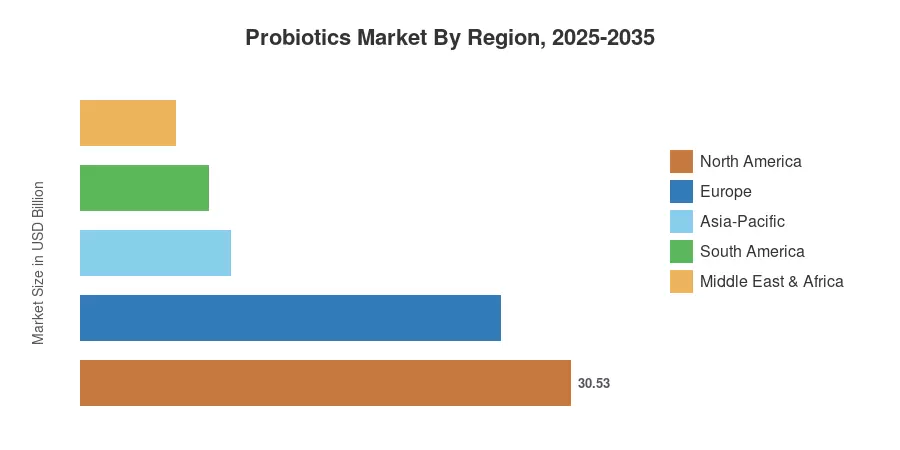
North America commands 32.10% of the Probiotics Market, anchored by progressive regulatory signals and high supplement penetration. Asia-Pacific represents the fastest-growing region at a 9.85% CAGR, driven by rising middle-class health spending across China, India, and Southeast Asia. Europe holds roughly 27.50% share, with regulatory harmonization under EFSA accelerating new product approvals. As clinical evidence mounts and distribution infrastructure matures in emerging economies, the Probiotics Market is positioned for broad-based global expansion through 2035.

ย 

Key Report Takeaways

โ€ข By Product Type

  • Probiotic Foods accounted for 49.60% of the Probiotics Market in 2025, reflecting entrenched consumer preference for functional yogurts, kefir, and cultured dairy.
  • Dietary Supplements are projected to expand at an 8.59% CAGR through 2035, propelled by capsule, gummy, and powder innovations targeting specific health outcomes.

โ€ข By Function

  • Digestive and Gut Health captured 39.82% of revenue share in the Probiotics Market during 2025, underscoring its foundational role in consumer purchasing decisions.
  • Immunity Enhancement is advancing at a 7.72% CAGR to 2035, with post-pandemic awareness sustaining demand.

โ€ข By Distribution Channel

  • Pharmacies and Drug Stores commanded 37.52% of the Probiotics Market in 2025, benefiting from pharmacist-led consumer education.
  • Online Stores are expanding at a 9.59% CAGR, as subscription models and digital health ecosystems reshape purchasing behavior.

โ€ข By Region

  • North America led the Probiotics Market with 32.10% share in 2025, supported by FDA regulatory tailwinds.
  • Asia-Pacific is forecast to accelerate at a 9.85% CAGR through 2035.

ย 

Market Size and Forecast (2021โ€“2035)

Market Research Future employs a triangulated approach combining top-down revenue estimation, bottom-up product-level tracking, and validation against trade-association shipment data and company filings. Historical figures (2021โ€“2024) reflect audited industry data, while the forecast period (2026โ€“2035) applies econometric modeling calibrated to macroeconomic health-spending indicators.
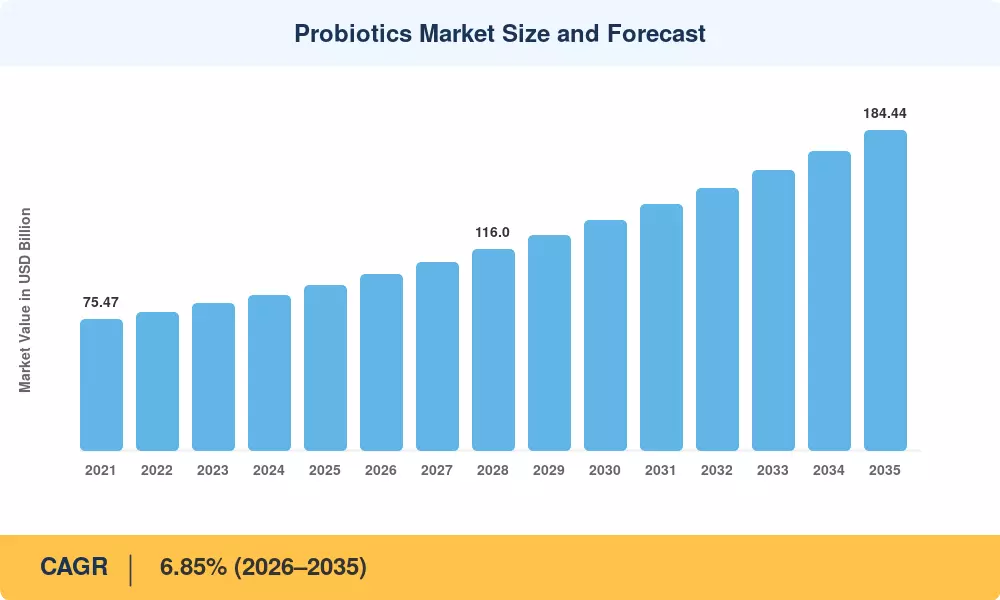
Probiotics Market Size and Forecast
Our Impact
Enabled $4.3B Revenue Impact for Fortune 500 and Leading Multinationals
Partnering with 2000+ Global Organizations Each Year
30K+ Citations by Top-Tier Firms in the Industry

Driver Impact Analysis

Driver ~% Impact on CAGR Geographic Relevance Impact Timeline
Rising preventive-health consumer spending +1.30% Global Short-term (โ‰ค2 yr)
FDA and EFSA regulatory endorsements +1.10% North America, Europe Short-term (โ‰ค2 yr)
Precision microbiome R&D breakthroughs +0.95% North America, Europe, Asia-Pacific Medium-term (2โ€“4 yr)
E-commerce and DTC distribution expansion +0.85% Global Short-term (โ‰ค2 yr)
Livestock antibiotic-reduction mandates +0.70% Europe, Asia-Pacific Medium-term (2โ€“4 yr)
AI-enabled personalization platforms +0.55% North America, Asia-Pacific Long-term (โ‰ฅ4 yr)
Organic and non-GMO certification demand +0.40% North America, Europe Medium-term (2โ€“4 yr)

ย 

Rising Preventive-Health Consumer Spending

Global out-of-pocket wellness expenditure exceeded USD 1.2 Trillion in 2024, with probiotic-adjacent categories โ€” functional foods, dietary supplements, and gut-health diagnostics โ€” growing at roughly twice the rate of conventional grocery segments [6]. The WHO's 2023 Global Action Plan on Non-Communicable Diseases explicitly cited microbiome-supportive nutrition as a preventive strategy, galvanizing government-backed health programs in 38 countries. This spending shift disproportionately benefits the Probiotics Market, as consumers increasingly treat daily probiotic intake as foundational healthcare.

Regulatory Endorsements Accelerating Adoption

The FDA's March 2024 qualified health claim linking regular yogurt consumption to reduced Type 2 diabetes risk marked a watershed for the Probiotics Market in North America, giving manufacturers a compliant marketing claim for the first time in over a decade [2]. In Europe, EFSA's updated guidance on strain-level substantiation โ€” expected to finalize by mid-2026 โ€” will streamline approvals for products containing clinically dosed strains. These regulatory tailwinds are converting skeptical mainstream consumers into repeat buyers.

Precision Microbiome R&D

The National Institutes of Health allocated USD 190 Million to human-microbiome research in fiscal year 2024, building on the Integrative Human Microbiome Project's multi-year dataset [7]. Pharmaceutical-grade strain libraries now exceed 12,000 characterized isolates, enabling targeted interventions for irritable bowel syndrome, atopic dermatitis, and metabolic disorders. This clinical pipeline is expanding the Probiotics Market beyond wellness into adjacent therapeutic segments.

E-commerce and Direct-to-Consumer Growth

Online probiotic sales grew 23% year-over-year in North America during 2024, with subscription-model brands achieving 70%+ customer retention rates [8]. Platforms such as Amazon Pharmacy and regional health marketplaces are eroding traditional pharmacy dominance in the Probiotics Market, while enabling smaller brands to reach consumers without retail shelf-space constraints.

ย 

Restraints Impact Analysis

Restraint ~% Impact on CAGR Geographic Relevance Impact Timeline
Regulatory fragmentation across jurisdictions โˆ’0.60% Global Long-term (โ‰ฅ4 yr)
Cold-chain logistics costs and shelf-life limits โˆ’0.50% Emerging markets Medium-term (2โ€“4 yr)
Consumer skepticism and misinformation โˆ’0.40% Global Short-term (โ‰ค2 yr)
Strain-stability and efficacy variability โˆ’0.35% Global Medium-term (2โ€“4 yr)
Pricing pressure from private-label competition โˆ’0.30% North America, Europe Short-term (โ‰ค2 yr)

ย 

Regulatory Fragmentation

Different regulatory systems โ€“ where probiotics can be classified as food, dietary supplements, biological products or pharmaceuticals depending on the country โ€“ create substantial compliance expenses for multinational firms. A product licensed under Japanโ€™s Foods for Specified Health Uses (FOSHU) regime may have to undergo multi-year clinical trials for European Novel Food approval, increasing go-to-market timescales and lowering cross-border income potential in the Probiotics Market [12]

ย 

Cold-Chain Logistics Constraints

Most live culture probiotics require constant refrigeration at 2ยฐCโ€“8ยฐC, and cold-chain infrastructure is poor in South Asia, Sub-Saharan Africa and parts of Latin America. In these locations, cold-chain gaps create 30-40% spoiling rates for temperature-sensitive health goods, directly reducing the addressable base of the Probiotics Market [13], according to the World Bank.

ย 

Consumer Skepticism

In 2024, a poll by the International Food Information Council revealed that 41% of adults in the United States were unable to discriminate between evidence-based probiotic claims and marketing without scientific support [14]. Low-quality companies cheat consumers with misleading labeling, eroding trust in the category, especially among first-time purchasers, considering the Probiotics Market for digestive microbiota assistance.

ย 

ย 

Probiotics Market Opportunities

Next-Generation Therapeutic Formats

Clinical-grade postbiotics and synbiotic blends are unlocking new pharmaceutical-adjacent revenue sources. In 2025, there were at least 14 active Phase II/III trials worldwide on probiotic strains for the treatment of inflammatory bowel disease, major depressive disorder, and metabolic syndrome, each of which might be a prospective entrant into the prescription channel of the Probiotics Market.

ย 

Organic and Clean-Label Premiumization

Consumer willingness to pay a 20โ€“35% premium for organic, non-GMO-certified probiotics continues to rise, particularly among millennial and Gen-Z demographics in North America and Western Europe. Brands investing in transparent supply-chain verification and third-party certifications stand to capture outsized margin growth within the Probiotics Market[11].

Emerging-Market Expansion in Asia-Pacific and Africa

Middle-class populations across India, Indonesia, and Nigeria are projected to collectively add 350 million consumers by 2030, according to the World Bank [17]. Affordable single-serve sachets and ambient-stable spore-forming strains โ€” which sidestep cold-chain requirements โ€” represent targeted product strategies for capturing these price-sensitive but fast-growing Probiotics Market segments.

AI-Driven Personalization and Data Monetization

Companies offering at-home microbiome testing paired with AI-curated supplement recommendations are establishing subscription ecosystems with high lifetime value. The global microbiome diagnostics sector exceeded USD 1.1 Billion in 2024, and data generated from these platforms creates monetizable insights for R&D pipeline prioritization within the Probiotics Market [10].

Livestock and Aquaculture Probiotics

EU regulations phasing out prophylactic antibiotic use in animal husbandry (Regulation 2019/6, fully enforced January 2022) continue to drive demand for probiotic feed additives. The animal-nutrition segment of the Probiotics Market represents a USD 7+ Billion addressable opportunity as similar policies gain traction in China, Brazil, and India [9].

ย 

Probiotics Market Future Outlook

Precision Microbiome Therapeutics

The convergence of next-generation sequencing, AI-driven strain selection, and targeted delivery systems will push probiotics beyond the supplement aisle into regulated pharmaceutical channels. By 2030, an estimated 25โ€“30 probiotic-based drugs could receive regulatory approval for conditions ranging from C. difficile infection to pediatric eczema, reshaping the revenue mix of the Probiotics Market toward higher-margin prescription products [7][23].

Platform Economics and Subscription Models

Direct-to-consumer platforms that bundle microbiome testing, personalized strain recommendations, and auto-replenishment subscriptions are redefining customer lifetime value within the Probiotics Market. Companies adopting this model report average order values 2.4x higher than traditional retail, with churn rates below 15% annually [10]. This platform shift favors digitally native brands and challenges incumbents reliant on wholesale distribution.

Sustainability and Regenerative Supply Chains

ESG mandates are increasingly shaping sourcing decisions across the Probiotics Market. Fermentation-derived ingredients carry a substantially lower carbon footprint than animal-derived alternatives, and companies reporting Scope 3 emissions under the EU Corporate Sustainability Reporting Directive (CSRD) gain preferential shelf placement with European retailers [24]. Regenerative agriculture partnerships for raw-material sourcing represent an emerging competitive differentiator.

Regulatory Convergence and Global Harmonization

The Codex Alimentarius Commission's ongoing work to establish internationally recognized probiotic guidelines โ€” expected to reach consensus framework stage by 2028 โ€” could dramatically reduce cross-border compliance costs for the Probiotics Market. Harmonized labeling standards and minimum viable-count requirements would benefit large multinationals capable of scaling standardized product lines across 50+ national markets simultaneously [12][25].

ย 

Probiotics Market Segmentation

By Product Type

Segment Key Metric Primary Demand Driver
Probiotic Foods 49.60% share (2025) Yogurt, kefir, and cultured-dairy consumption
Dietary Supplements 8.59% CAGR (2026โ€“2035) Capsule and gummy innovation
Probiotic Drinks USD 14.78 Billion (2025) Kombucha and functional-beverage trends

ย 

Probiotic Foods remain the dominant segment of the Probiotics Market, anchored by decades of consumer familiarity with yogurt and fermented dairy. Global yogurt sales alone exceeded USD 42 Billion in 2024, and the FDA's qualified health claim has injected new marketing momentum into this mature category. Manufacturers are differentiating through added functional ingredients โ€” fiber, protein, and botanical extracts โ€” to command shelf premiums.

Dietary Supplements represent the fastest-growing product type in the Probiotics Market, driven by format diversification beyond traditional capsules into gummies, powders, and effervescent tablets. The segment benefits from higher per-unit margins and direct-to-consumer distribution, with clinically validated strain-specific products โ€” particularly those targeting IBS and immune support โ€” commanding premium pricing[8].

By Function

Segment Key Metric Primary Demand Driver
Digestive and Gut Health 39.82% share (2025) Core consumer need, clinical evidence base
Immunity Enhancement 7.72% CAGR (2026โ€“2035) Post-pandemic awareness persistence
Mental Health and Mood USD 6.84 Billion (2025) Gut-brain axis research expansion
Sports and Metabolic Performance 8.15% CAGR (2026โ€“2035) Athletic-nutrition crossover
Others 7.30% share (2025) Skin health, oral health, pediatric wellness

ย 

Digestive and Gut Health is the foundational functional segment of the Probiotics Market, sustained by robust clinical evidence and universal consumer relevance. Over 350 published randomized controlled trials between 2020 and 2025 demonstrated statistically significant digestive benefits for specific strains, reinforcing physician and dietitian recommendations [7].

Immunity Enhancement has emerged as the second most dynamic functional segment, propelled by sustained post-COVID consumer interest in immune resilience. Products combining probiotic strains with vitamin D, zinc, and elderberry extract are achieving strong sell-through rates in pharmacy and online channels within the Probiotics Market [6][14].

By Distribution Channel

Segment Key Metric Primary Demand Driver
Supermarket/Hypermarkets 28.40% share (2025) Mass-market accessibility, impulse purchase
Pharmacies and Drug Stores 37.52% share (2025) Pharmacist recommendation, health trust
Convenience/Grocery Stores USD 9.22 Billion (2025) On-the-go single-serve formats
Online Stores 9.59% CAGR (2026โ€“2035) Subscription models, DTC brands
Others 5.85% CAGR (2026โ€“2035) Specialty health stores, practitioner channels

ย 

Pharmacies and Drug Stores maintain the largest channel share in the Probiotics Market, reflecting the trust consumers place in pharmacist-guided recommendations for health-related purchases. This channel also benefits from adjacency to clinical-grade supplements and prescription medications, reinforcing perceptions of product efficacy.

Online Stores represent the fastest-growing distribution channel in the Probiotics Market, propelled by subscription-first brands, personalized recommendation engines, and frictionless reordering. Amazon's health-and-wellness category reported probiotics as a top-five supplement search term in 2024, while dedicated platforms are building loyalty through bundled microbiome-testing services [8].

ย 

Regional Market Share Analysis

Region Key Metric Primary Investment Themes
North America 32.10% share (2025) FDA health claims, supplement innovation
Europe 27.50% share (2025) EFSA harmonization, organic premiumization
Asia-Pacific 9.85% CAGR (2026โ€“2035) Middle-class expansion, fermented-food traditions
South America USD 7.99 Billion (2025) Dairy-based probiotics, retail modernization
Middle East & Africa 6.20% share (2025) Healthcare infrastructure, cold-chain build-out
Total USD 95.10 Billion (2025) ย 

The Probiotics Market exhibits a mature-market-dominant structure, with North America and Europe collectively controlling nearly 60% of global revenue. Asia-Pacific's rapid trajectory is reshaping competitive dynamics, while South America and MEA remain early-stage growth frontiers.

ย 

North America

Country Key Metric Key Driver
United States 78.40% of regional share FDA regulatory endorsements, DTC e-commerce
Canada 12.80% of regional share Health Canada natural-product licensing
Mexico 8.80% of regional share Expanding modern retail, dairy culture

ย 

The United States dominates the North American Probiotics Market, buoyed by a supplement-consumption culture and the FDA's landmark 2024 yogurt health claim. Canada's natural health product framework provides a streamlined regulatory pathway, while Mexico's growing modern-trade footprint is expanding consumer access to branded probiotic products beyond traditional dairy formats [2][18].

Europe

Country Key Metric Key Driver
Germany 7.45% CAGR Pharmaceutical-grade supplement demand
United Kingdom USD 4.82 Billion (2025) Retail pharmacy channel strength
France 15.20% of regional share Fermented dairy heritage
Italy 13.50% of regional share Pharmacy-led supplement culture
Spain 6.90% CAGR Expanding health-food retail
Nordic Countries 8.10% of regional share High per-capita health expenditure
Russia 5.80% of regional share Kefir and cultured-dairy tradition
Rest of Europe 7.15% CAGR Emerging supplement adoption

ย 

Europe's Probiotics Market benefits from deep-rooted fermented-food traditions and an increasingly science-driven consumer base. EFSA's evolving health-claims framework, while historically restrictive, is anticipated to approve strain-specific benefit claims by 2027, unlocking marketing opportunities that have been constrained for over a decade [12][19].

Asia-Pacific

Country Key Metric Key Driver
China 28.70% of regional share Domestic dairy brands, government nutrition programs
India 10.25% CAGR Rising disposable income, Ayurvedic alignment
Japan USD 5.38 Billion (2025) FOSHU regulatory system, Yakult heritage
South Korea 9.90% CAGR K-beauty and wellness culture crossover
ASEAN 10.60% CAGR Young demographics, modern retail expansion
Rest of Asia-Pacific 8.75% CAGR Regulatory harmonization

ย 

Asia-Pacific's rapid expansion in the Probiotics Market is underpinned by culturally embedded consumption of fermented foods โ€” from Japanese miso to Indian curd โ€” combined with surging disposable incomes. China's "Healthy China 2030" initiative has allocated over USD 15 Billion in public-health nutrition spending, directly benefiting probiotic food manufacturers operating within government-endorsed dietary guidelines [17][20].

South America

Country Key Metric Key Driver
Brazil 58.30% of regional share Dairy industry scale, retail modernization
Argentina 7.55% CAGR Functional-food awareness campaigns
Rest of South America 18.40% of regional share Emerging supplement distribution

ย 

Brazil anchors the South American Probiotics Market through its large-scale dairy sector and expanding urban retail networks. The country's ANVISA regulatory body has progressively streamlined probiotic product registrations since 2023, reducing time-to-market from 18 months to approximately 9 months for established strain categories [21].

Middle East & Africa

Country Key Metric Key Driver
Saudi Arabia 24.50% of regional share Vision 2030 healthcare investment
UAE 8.30% CAGR Premium wellness retail, medical tourism
South Africa 19.80% of regional share Pharmaceutical retail network
Egypt 7.90% CAGR Population scale, dairy consumption patterns
Rest of MEA 30.10% of regional share Cold-chain infrastructure development

ย 

Saudi Arabia's Vision 2030 healthcare modernization is channeling investment into preventive wellness infrastructure, creating tailwinds for the Probiotics Market across the Gulf Cooperation Council. Cold-chain investment by logistics operators such as Agility and DP World is gradually addressing distribution barriers that have historically limited probiotic penetration in Sub-Saharan Africa [13][22].

ย 

Probiotics Market By Region, 2025-2035

Competitive Benchmarking

The Probiotics Market exhibits medium concentration, with the top five players commanding an estimated 30โ€“38% collective revenue share. The Herfindahl-Hirschman Index indicates a moderately competitive structure, where multinational food conglomerates compete alongside specialized biotech firms and regional dairy leaders. The Chr. Hansenโ€“Novozymes merger (forming Novonesis) has reshaped the ingredient-supply landscape, while consumer-facing brands continue to fragment across digital channels [3][4].

Company Est. Revenue Share Range Key Offerings for Probiotics Market Strategic Positioning
Danone S.A. ~8โ€“11% Activia yogurt, specialized nutrition cultures Global dairy leader with vertically integrated strain R&D
Nestlรฉ S.A. ~7โ€“10% Garden of Life, Gerber probiotic infant nutrition Portfolio diversification across life-stage nutrition
Novonesis (Chr. Hansen + Novozymes) ~5โ€“8% B2B strain libraries, enzyme-probiotic combinations Dominant ingredient supplier post-merger
Yakult Honsha Co., Ltd. ~4โ€“7% Yakult fermented milk drink, Yakult 1000 Single-product brand with global distribution depth
Kerry Group plc ~3โ€“5% ProActive Health cultures, taste and nutrition solutions B2B ingredient and co-manufacturing
PepsiCo, Inc. ~2โ€“4% Kevita kombucha, functional beverages Mass-market distribution and brand awareness
International Flavors & Fragrances (IFF) ~3โ€“5% HOWARU clinical strains, DuPont Nutrition legacy Clinical-grade strain portfolio
BioGaia AB ~2โ€“3% L. reuteri strain-based supplements Pharma-channel specialist with 200+ clinical trials
Probi AB ~1โ€“3% LP299v digestive-health strain Strain licensing and clinical documentation
Lallemand Inc. ~2โ€“4% Rosell Institute cultures, animal nutrition probiotics Dual human-nutrition and animal-feed positioning

ย 

ย 

Recent News & Developments

  • Novonesis (January 29, 2024 ): Completed the integration of Chr. Hansen and Novozymes operations, establishing a combined probiotic-and-enzyme R&D platform with over 30,000 characterized microbial strains. The merger positions the entity as the world's largest B2B biosolutions provider in the Probiotics Market [3].
  • FDA (March 2024): Issued a qualified health claim allowing yogurt manufacturers to state that regular consumption may reduce the risk of Type 2 diabetes, marking the agency's first such claim for a fermented dairy product [2].
  • Danone (June 2025) bought The Akkermansia Company to enhance its gut health portfolio with the pasteurized Akkermansia muciniphila MucT strain, which was targeted for obesity, diabetes and inflammation control.

ย 

ย 

ย 

ย 

ย 

ย 

Probiotics Market Report Scope

Parameter Detail
Market Scope Global Probiotics Market across food, supplement, beverage, and animal-nutrition segments
Study Period 2021โ€“2035
CAGR (Forecast Period) 6.85% (2026โ€“2035)
Base Year Market Size USD 95.10 Billion (2025)
Forecast Endpoint USD 184.44 Billion (2035)
Fastest Growing Segment Dietary Supplements by product type; Asia-Pacific by geography
Companies Profiled 10+ (Danone, Nestlรฉ, Novonesis, Yakult, Kerry, PepsiCo, IFF, BioGaia, Probi, Lallemand, and others)
Valuation Currency USD Billion

ย 

ย 

FAQs

How do spore-forming probiotics differ from traditional live cultures in shelf-stability requirements?
Spore-forming strains such as Bacillus coagulans survive ambient temperatures and stomach acid, eliminating cold-chain dependence. This makes them especially viable for distribution in tropical and emerging economies where refrigeration infrastructure is limited [13].
What role do postbiotics play in next-generation probiotic product development?
Postbiotics โ€” metabolic byproducts of probiotic fermentation โ€” deliver health benefits without requiring live organisms. Manufacturers are incorporating them into shelf-stable functional foods, opening formulation possibilities previously restricted by viability constraints [23].
How are contract manufacturers influencing pricing dynamics in the Probiotics Market?
Contract development and manufacturing organizations (CDMOs) have reduced minimum order quantities, enabling smaller brands to enter the Probiotics Market. This has intensified price competition while broadening consumer choice across supplement and beverage segments [16].
What intellectual-property strategies protect strain-level innovations in the Probiotics Market?
Companies patent specific strain genomes, fermentation processes, and delivery mechanisms. Strain-level IP portfolios โ€” such as BioGaia's L. reuteri library โ€” create durable competitive moats and generate licensing revenue streams [15].
How does the Probiotics Market address allergen and dietary-restriction concerns?
Manufacturers increasingly formulate with dairy-free, gluten-free, and vegan-certified strains. Third-party certifications from organizations like NSF International help brands communicate allergen safety to sensitive consumer segments [11].
What cold-chain innovations are reducing distribution losses in the Probiotics Market?
Phase-change packaging materials and IoT-enabled temperature monitors have cut transit spoilage by 25โ€“30% since 2022. These technologies are critical for expanding live-culture distribution into warm-climate regions [13].
How do reimbursement policies affect clinical probiotic adoption in the Probiotics Market?
Germany and Japan include select probiotic strains in national health-insurance formularies, covering physician-prescribed use. Reimbursement eligibility accelerates clinical adoption and positions probiotics alongside conventional therapeutics [19]. ย  ย 
Author
Author
Author Profile
Snehal Singh LinkedIn
Manager - Research
High acumen in analyzing complex macro & micro markets with more than 6 years of work experience in the field of market research. By implementing her analytical skills in forecasting and estimation into market research reports, she has expertise in Packaging, Construction, and Equipment domains. She handles a team size of 20-25 resources and ensures smooth running of the projects, associated marketing activities, and client servicing.

Research Approach

ย 

Secondary Research

The secondary research process involved comprehensive analysis of regulatory databases, peer-reviewed nutritional science journals, clinical microbiome publications, and authoritative food & health organizations. Key sources included the US Food & Drug Administration (FDA), European Food Safety Authority (EFSA), Food and Agriculture Organization (FAO), World Health Organization (WHO), US Department of Agriculture (USDA), National Institutes of Health (NIH), National Center for Biotechnology Information (NCBI/PubMed), International Scientific Association for Probiotics and Prebiotics (ISAPP), International Probiotics Association (IPA), International Dairy Federation (IDF), European Food & Feed Cultures Association (EFFCA), Council for Responsible Nutrition (CRN), Consumer Healthcare Products Association (CHPA), Health Canada, EFSA Panel on Nutrition, Novel Foods and Food Allergens, and national food safety authorities from key markets. These sources were used to collect strain-specific approval data, qualified health claim notifications, clinical efficacy studies on Lactobacillus, Bifidobacterium, and Saccharomyces strains, consumption demographics, fermentation technology trends, and regulatory landscape analysis for functional foods, dietary supplements, and animal nutrition applications.

ย 

Primary Research

To gather both qualitative and quantitative information, the primary research process involved interviewing players from both the supply and demand sides. Executives from probiotic culture companies (e.g., Chr. Hansen/Novonesis, Lallemand, Probi AB), fermented food makers, and supplement original equipment manufacturers (OEMs) were among the supply-side sources. On the demand side, we heard from people like functional food and beverage product development managers, pharmaceutical formulators, clinical and veterinary nutritionists, procurement leaders from fermented food and dairy producers, and nutraceutical company brand managers. Clinical trial timelines for next-generation probiotics (psychobiotics, live biotherapeutics) were confirmed through primary research, and insights on formulation stability challenges, pricing dynamics for multi-strain blends, and distribution channel evolution were gathered. Strain-specific market segmentation was also validated.

Primary Respondent Breakdown:

By Designation: C-level Primaries (32%), Director Level (30%), Others (38%)

By Region: North America (32%), Europe (25%), Asia-Pacific (33%), Rest of World (10%)

ย 

Market Size Estimation

Global market valuation was derived through revenue mapping and consumption volume analysis across human and animal nutrition sectors. The methodology included:

Identification of 50+ key manufacturers across North America, Europe, Asia-Pacific, and Latin America, including culture suppliers (Danone, Nestlรฉ, Yakult Honsha, Kerry Group, ADM) and finished goods producers

Product mapping across bacterial strains (Lactobacillus, Bifidobacterium, Streptococcus, Bacillus) and yeast (Saccharomyces boulardii), categorized by functional foods (yogurt, kefir, fermented beverages), dietary supplements (capsules, powders, gummies), and animal feed additives

Analysis of reported and modeled annual revenues specific to probiotic portfolios, including strain licensing fees and royalty arrangements

Coverage of manufacturers representing 65-70% of global market share in 2024, with particular emphasis on dominant Asian markets (Japan, China, South Korea) and European fermentation specialists

Extrapolation using bottom-up (consumption volume ร— average selling price by country/strain) and top-down (manufacturer revenue validation and trade data reconciliation) approaches to derive segment-specific valuations for human probiotics, animal nutrition, and emerging therapeutic applications

Download Free Sample

Kindly complete the form below to receive a free sample of this Report

Download PDF ×

We do not share your information with anyone. However, we may send you emails based on your report interest from time to time. You may contact us at any time to opt-out.