×
Hero Background
English
Chinese
French
Japanese
Korean
German
Spanish

Food Anti-Caking Agents Market Trends

ID: MRFR/FnB/3173-HCR
110 Pages
Pradeep Nandi
October 2025

Food Anti-Caking Agents Market Global Information by Type (Calcium Compounds, Sodium Compounds, Magnesium Compounds, Microcrystalline Cellulose Compounds and others), Application (Bakery Products, Dairy Products, Soups And Sauces, Seasonings and Condiments and others) and Region Forecast till 2035

Share:
Download PDF ×

We do not share your information with anyone. However, we may send you emails based on your report interest from time to time. You may contact us at any time to opt-out.

Food Anti-Caking Agents Market Infographic
Purchase Options

Market Trends

Key Emerging Trends in the Food Anti-Caking Agents Market

Food markets are continually undergoing transformation, and this is an effect of shifting customer patterns and the ever-changing technology. One of the important things called by keeping aside but has a fully impact on the quality and appearance of food substances is the employment of anticaking agents. Having these agents is the addition of what is meant to be the stopper that is designed to prevent the occurrence of lumps or clumps. In the products, the uniform and free-flowing texture is assured. It should be noted that the food anti-caking-agents market has experienced trendy tendencies recently, which not only show the adaptability of the industry but also the requirements of the customers. The other dominating part in the market of food anti-caking agents is the upsurge of the use of natural and clean label ingredients. With consumer health consciousness growing and them shrediung food products labels, regarding additives and preservatives, companies face the tremorously challenge of healthy options production and marketing. Subsequently, there is a trending style to get anti-caking agents from natural sources such as plants and minerals. Responding to this movement manufacturers are ceaselessly challenging the market with the cutting-edge formulations that maintain free-flowability despite preserving the natural and clean connotation of the final product. The aim of the growing food anti-caking agents market trends report is to emphasize the circumstances that will contribute to the growth of the market in the latter days, and thus explain the existing state affairs. Such a report provides a comprehensive analysis of what factors affect which period of years in question. Additionally, the focus is directed on the research and development to develop non caking agents which are suitable for several food processing. Among food items, there exists a vast variety of products with different preferences to the texture, maintaining the shelf life and keeping to the overall quality standards. Consequently, foodsters are engaging in technological innovation to produce anti-caking agents that overcomes the various issues that come about as a result of catering to a range of food categories. more specifically, this perspective sparks a more customer-oriented and functionality-specific approach to anti-caking agents development which is achieved in consideration of particularities of different foods.

Apart from this the segments of the food anti-caking agents market is reporting profuse demand that is fueled by the increase in the convenience and processed foods. This is a feature of this trend and you could even say that it is more pronounced in developing countries where urbanization and a move away from traditional lifestyles are increasing the normalization of processed and packaged foods.
Author
Pradeep Nandi
Senior Research Analyst

I have a bachelor's degree in mechanical engineering and an MBA. I have more than two years of expertise in the retail, food, and beverage, chemical, and material industries, and hence have developed a sound cross-domain expertise. A firm believer in lifelong learning and sharing of knowledge. Having a proclivity for hatching ideas and trying to absorb as much information as possible in a short amount of time. Introducing corporates to the data and insight, which enables them to move from probability to possibility, has been my key areas of interest. 

Leave a Comment

FAQs

What is one of the biggest growth propellers of the global food anti-caking agents market?

Consumption of packaged foods is one of the biggest growth propellers of the global food anti-caking agents market.

What are restraints faced by the global food anti-caking agents market?

Adverse effects associated with the consumption of these agents can hamper the growth of the global food anti-caking agents market.

Which application can command the highest demand in the global food anti-caking agents market?

Soups and sauces can capture the largest demand share in the global food anti-caking agents market till 2032.

Which region can dominate the global food anti-caking agents market?

Europe can dominate the global food anti-caking agents market.

Name the key players of the global food anti-caking agents market.

Agropur MSI, LLC, PPG Industries, Brenntag, Univar Inc., Solvay S., Evonik Industries, and International Media and Cultures, Inc. are major players of the global food anti-caking agents market.

Market Summary

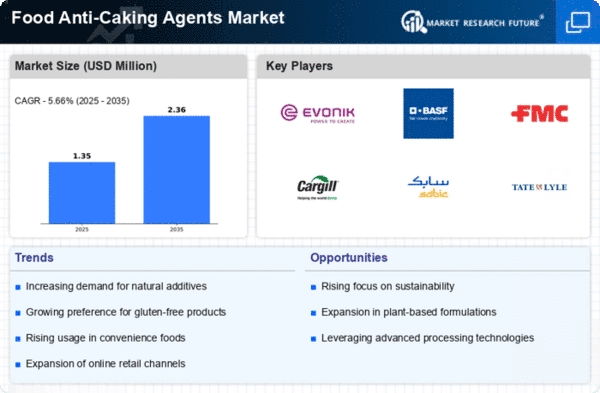
As per MRFR analysis, the Food Anti-Caking Agents Market was estimated at 1.28 USD Million in 2024. The Food Anti-Caking Agents industry is projected to grow from 1.37 in 2025 to 2.36 by 2035, exhibiting a compound annual growth rate (CAGR) of 5.66 during the forecast period 2025 - 2035.

Key Market Trends & Highlights

The Food Anti-Caking Agents Market is experiencing a dynamic shift towards natural ingredients and innovative formulations.

  • The North American region remains the largest market for food anti-caking agents, driven by high consumption of processed foods.
  • In the Asia-Pacific region, the market is witnessing rapid growth, fueled by increasing urbanization and changing dietary habits.
  • Dairy products represent the largest segment, while seasonings are emerging as the fastest-growing segment in the market.
  • Rising demand for processed foods and consumer awareness regarding health and safety regulations are key drivers influencing market dynamics.

Market Size & Forecast

2024 Market Size 1.28 (USD Million)
2035 Market Size 2.36 (USD Million)
CAGR (2025 - 2035) 5.66%
Largest Regional Market Share in 2024 North America

Major Players

<p>Evonik Industries (DE), BASF (DE), FMC Corporation (US), Cargill (US), SABIC (SA), Archer Daniels Midland Company (US), Tate & Lyle (GB), Kerry Group (IE), Ingredion Incorporated (US)</p>

Market Trends

The Food Anti-Caking Agents Market is currently experiencing notable developments driven by various factors. The increasing demand for processed foods, coupled with the need for improved shelf life and product quality, appears to be propelling the market forward. Manufacturers are focusing on enhancing the functionality of their products, which suggests a growing emphasis on innovation and the introduction of new formulations. Additionally, the rising awareness regarding food safety and quality standards is likely influencing the adoption of anti-caking agents in various food applications. As consumers become more discerning, the need for products that maintain texture and prevent clumping is becoming increasingly apparent. Moreover, the Food Anti-Caking Agents Market is witnessing a shift towards natural and organic alternatives. This trend indicates a potential change in consumer preferences, as individuals seek healthier options in their food products. The regulatory landscape is also evolving, with stricter guidelines surrounding food additives, which may impact the types of anti-caking agents utilized. Overall, the market seems poised for growth, driven by innovation, consumer demand for quality, and a shift towards more natural ingredients. The future of the Food Anti-Caking Agents Market appears promising, with opportunities for expansion and diversification in product offerings.

Shift Towards Natural Ingredients

There is a noticeable trend in the Food Anti-Caking Agents Market towards the use of natural ingredients. Consumers are increasingly favoring products that contain fewer synthetic additives, which has prompted manufacturers to explore plant-based alternatives. This shift not only aligns with health-conscious consumer preferences but also reflects a broader movement towards sustainability in food production.

Innovation in Product Formulations

The Food Anti-Caking Agents Market is characterized by ongoing innovation in product formulations. Companies are investing in research and development to create more effective anti-caking solutions that enhance the quality and shelf life of food products. This focus on innovation suggests that manufacturers are keen to meet evolving consumer demands and improve overall product performance.

Regulatory Influences on Market Dynamics

Regulatory frameworks surrounding food additives are becoming increasingly stringent, impacting the Food Anti-Caking Agents Market. As governments implement stricter guidelines, manufacturers must adapt their formulations to comply with new standards. This regulatory influence may drive innovation as companies seek to develop compliant products while maintaining efficacy and consumer appeal.

Food Anti-Caking Agents Market Market Drivers

Market Growth Projections

The Global Food Anti-Caking Agents Market Industry is projected to experience substantial growth over the next decade. With a market value expected to reach 693.6 USD Million in 2024 and further escalate to 1613.3 USD Million by 2035, the industry is poised for a robust expansion. This growth trajectory indicates a compound annual growth rate of 7.98% from 2025 to 2035, reflecting the increasing adoption of anti-caking agents across various food sectors. The market dynamics are influenced by factors such as rising consumer demand for processed foods, technological advancements, and regulatory support for food safety.

Expansion of the Food Industry

The Global Food Anti-Caking Agents Market Industry is significantly influenced by the expansion of the food industry, particularly in emerging economies. As urbanization increases, there is a notable shift towards packaged and convenience foods. This trend necessitates the use of anti-caking agents to maintain product integrity during storage and transportation. For instance, the growing popularity of instant noodles and powdered seasonings has led to a higher demand for effective anti-caking solutions. Consequently, the market is expected to grow substantially, with projections indicating a rise to 1613.3 USD Million by 2035, driven by this expansion.

Rising Demand for Processed Foods

The Global Food Anti-Caking Agents Market Industry is experiencing a surge in demand due to the increasing consumption of processed foods. As consumers seek convenience, manufacturers are incorporating anti-caking agents to enhance the texture and shelf-life of products. This trend is particularly evident in the dairy and baking sectors, where anti-caking agents prevent clumping and ensure consistent quality. The market is projected to reach 693.6 USD Million in 2024, reflecting the growing reliance on processed food products. This demand is likely to drive innovation in anti-caking formulations, further propelling market growth.

Regulatory Support for Food Safety

Regulatory support for food safety is a significant driver of the Global Food Anti-Caking Agents Market Industry. Governments worldwide are implementing stringent regulations to ensure food quality and safety, which often necessitates the use of anti-caking agents in various food products. For instance, the approval of specific anti-caking agents by food safety authorities encourages manufacturers to adopt these additives to comply with safety standards. This regulatory framework not only enhances consumer confidence but also stimulates market growth as manufacturers seek to meet compliance requirements. The ongoing evolution of food safety regulations is likely to further influence market dynamics.

Consumer Awareness and Health Trends

Consumer awareness regarding food quality and health trends is increasingly impacting the Global Food Anti-Caking Agents Market Industry. As consumers become more informed about food additives, there is a growing preference for natural and organic anti-caking agents. This shift is prompting manufacturers to reformulate products to meet consumer expectations for healthier options. The rise of health-conscious consumers is leading to a demand for transparency in ingredient sourcing and formulation. Consequently, companies are investing in research and development to create innovative anti-caking solutions that align with these health trends, thereby driving market growth.

Technological Advancements in Food Processing

Technological advancements in food processing are playing a crucial role in shaping the Global Food Anti-Caking Agents Market Industry. Innovations in food technology enable the development of more efficient and effective anti-caking agents, which can enhance product quality and safety. For example, the introduction of natural anti-caking agents derived from plant sources is gaining traction among health-conscious consumers. These advancements not only improve the performance of food products but also align with the growing trend towards clean label products. As a result, the market is likely to witness a compound annual growth rate of 7.98% from 2025 to 2035.

Market Segment Insights

By Application: Dairy Products (Largest) vs. Seasonings (Fastest-Growing)

<p>In the Food Anti-Caking Agents Market, the application segment is primarily dominated by <a href="https://www.marketresearchfuture.com/reports/dairy-market-11483" target="_blank">dairy</a> products, which capture the largest share owing to their extensive use in various dairy formulations like cheese and powdered milk. Beverages and <a href="https://www.marketresearchfuture.com/reports/bakery-products-market-1985" target="_blank">bakery products</a> also play significant roles, contributing to the overall market dynamics. The robust demand for these dairy applications is propelled by the growing consumer preference for convenience foods and health-oriented products, requiring effective anti-caking solutions for shelf-stability and product consistency. The market is witnessing notable growth trends driven by the increasing consumption of processed and convenience foods. Seasonings are emerging as the fastest-growing segment, fueled by a surge in foodservice establishments and consumer interest in flavor enhancements. The rise in ready-to-eat meal options and demand for innovative seasoning blends are expected to bolster the utilization of anti-caking agents across various food products, creating opportunities for new market entrants and existing players in the sector.</p>

<p><a href="https://www.marketresearchfuture.com/reports/dairy-market-11483" target="_blank">dairy</a> Products (Dominant) vs. Seasonings (Emerging)</p>

<p>Dairy products are a dominant application in the Food Anti-Caking Agents Market, characterized by their need for anti-caking solutions to maintain quality and freshness in items such as powdered milk and cheese. The demand here is anchored by a growing consumer base seeking convenience in dairy consumption, promoting products that are easy to store and use. On the other hand, seasonings are positioned as an emerging segment, gaining attention due to the evolving culinary landscape and increasing interest in gourmet cooking at home. This shift is driving the need for anti-caking agents that enhance the functionality and texture of seasonings, making them more appealing to both consumers and manufacturers alike.</p>

By Type: Silicates (Largest) vs. Starch (Fastest-Growing)

<p>The Food Anti-Caking Agents Market is segmented by type into silicates, phosphates, carbonates, talc, and starch. Among these, silicates hold the largest market share due to their widespread usage in diverse food applications, providing excellent anti-caking properties. Phosphates and carbonates follow, catering to different functionalities and food categories. Starch maintains a growing presence, driven by an increasing demand for natural and clean-label ingredients in food products, thus influencing its market position significantly. As the market evolves, the growth trends indicate a rising preference for clean-label products and natural ingredients, aligning with the health-conscious trends among consumers. This shift is propelling starch to become the fastest-growing segment, reflecting the demand for cleaner formulations. Silicates, while dominant, are adapting to changing regulations and consumer preferences, indicating a potential area of innovation and market adaptation in the future.</p>

<p>Silicates (Dominant) vs. Starch (Emerging)</p>

<p>Silicates have established themselves as the dominant anti-caking agent in the Food Anti-Caking Agents Market due to their effectiveness in preventing clumping and improving flowability in powdered food products. Their chemical stability and versatility in application across various food categories make them a prevalent choice among manufacturers. In contrast, starch is emerging as a significant player, fueled by a shift towards natural and organic food products. As consumers increasingly seek out clean-label options, starch is gaining traction for its biodegradable and non-toxic characteristics. This emerging segment is appealing to food producers looking to meet clean-label standards, reflecting a broadening consumer preference for ingredients considered safe and health-oriented.</p>

By Form: Powder (Largest) vs. Granules (Fastest-Growing)

<p>In the Food Anti-Caking Agents Market, the form segment is characterized by diverse options, with powders leading in market share due to their versatility and ease of use. Powders are predominantly preferred by food manufacturers for their effectiveness in preventing clumping in various food products. Granules, on the other hand, are gaining traction as they present a new alternative, appealing to specific applications requiring larger particles for desired texture and functionality. The growth trajectory for granules is notably rapid, driven by shifts in consumer preferences and advances in manufacturing technologies. As food manufacturers seek innovative solutions to enhance product quality and shelf-life, the demand for granular forms is expected to rise significantly. Factors such as increasing awareness regarding food quality and safety are also propelling this segment forward, marking granules as a key focus for future product development in the industry.</p>

<p>Powder (Dominant) vs. Tablets (Emerging)</p>

<p>Powdered anti-caking agents dominate the Food Anti-Caking Agents Market due to their extensive applicability across various food sectors, including dairy, spices, and seasonings. Their fine particle size allows for effective blending and uniform distribution, making them a preferred choice. In contrast, tablets represent an emerging form of anti-caking solutions, appealing mostly to niche markets. Tablets offer convenience and precise dosing, particularly in applications where liquid additives may not be feasible. As manufacturers adapt to changing consumer needs, there is a growing interest in tablet formulations, signifying a potential shift in how anti-caking agents are utilized in food processing.</p>

By End Use: Food Processing (Largest) vs. Food Storage (Fastest-Growing)

<p>The Food Anti-Caking Agents Market showcases a diverse distribution across its end-use segments, with Food Processing leading the pack. This segment is favored due to its crucial role in enhancing food quality and shelf life, making it an indispensable part of various culinary applications. Conversely, Food Storage is gaining momentum, presenting a promising avenue for growth as innovations in storage solutions cater to preserving food integrity. Overall, the balance of market share reflects a well-established dominance of Food Processing, while Food Storage emerges as a notable contender in the market landscape. In terms of growth trends, the Food Processing segment benefits from the relentless demand for processed foods and convenience items, propelling its expansion. On the other hand, the Food Storage sector is witnessing an increase in technology-driven advancements focused on long-term preservation of food products. As consumer behavior shifts towards longer shelf-life products amidst rising health and sustainability concerns, this segment is projected to capture an increasing share in the market, making it an area of interest for manufacturers and stakeholders alike.</p>

<p>Food Processing (Dominant) vs. Food Storage (Emerging)</p>

<p>Food Processing stands as the dominant force in the Food Anti-Caking Agents Market, wherein it plays a pivotal role in preventing clumping and ensuring smooth processing in various food items. The demand for convenient and ready-to-use products drives the need for effective anti-caking solutions, securing its market position. In contrast, Food Storage is considered an emerging segment that demonstrates potential through innovations in packaging that enhance long-term preservation. As consumers increasingly prioritize quality and longevity in food products, this segment's growth is supported by advanced techniques aimed at reducing moisture and maintaining texture, making it an appealing choice for manufacturers focusing on quality assurance and customer satisfaction.</p>

Get more detailed insights about Food Anti-Caking Agents Market Research Report- Forecast till 2035

Regional Insights

Key Players and Competitive Insights

The Food Anti-Caking Agents Market is currently characterized by a competitive landscape that is both dynamic and multifaceted. Key growth drivers include the increasing demand for processed foods, the need for improved product quality, and the rising consumer awareness regarding food safety. Major players such as Evonik Industries (DE), BASF (DE), and Cargill (US) are strategically positioned to leverage these trends. Evonik Industries (DE) focuses on innovation and sustainability, emphasizing the development of eco-friendly anti-caking agents. Meanwhile, BASF (DE) has been enhancing its product portfolio through strategic acquisitions and partnerships, aiming to strengthen its market presence. Cargill (US) is actively pursuing regional expansion and digital transformation initiatives, which collectively shape a competitive environment that is increasingly focused on sustainability and technological advancement.

In terms of business tactics, companies are localizing manufacturing to reduce costs and optimize supply chains. The market structure appears moderately fragmented, with several key players exerting considerable influence. This fragmentation allows for a diverse range of products and innovations, yet the collective strategies of these major companies create a competitive atmosphere that is both challenging and opportunistic for new entrants.

In November 2025, Evonik Industries (DE) announced the launch of a new line of bio-based anti-caking agents aimed at reducing environmental impact. This strategic move not only aligns with global sustainability trends but also positions Evonik as a leader in eco-friendly solutions, potentially attracting environmentally conscious consumers and businesses alike. The introduction of these products may enhance their competitive edge in a market increasingly driven by sustainability.

In October 2025, BASF (DE) completed the acquisition of a specialty chemicals firm that specializes in food additives, including anti-caking agents. This acquisition is likely to bolster BASF's product offerings and enhance its ability to meet the growing demand for innovative food solutions. By integrating this new expertise, BASF may strengthen its market position and expand its customer base, thereby reinforcing its competitive stance.

In September 2025, Cargill (US) launched a digital platform designed to streamline the supply chain for its food ingredients, including anti-caking agents. This initiative is indicative of a broader trend towards digitalization within the industry, as companies seek to enhance efficiency and responsiveness to market demands. By leveraging technology, Cargill may improve its operational capabilities and customer engagement, which could lead to increased market share.

As of December 2025, current competitive trends in the Food Anti-Caking Agents Market are heavily influenced by digitalization, sustainability, and the integration of artificial intelligence. Strategic alliances are becoming increasingly prevalent, as companies recognize the value of collaboration in driving innovation and enhancing product offerings. Looking ahead, competitive differentiation is likely to evolve from traditional price-based competition to a focus on innovation, technology, and supply chain reliability. This shift suggests that companies that prioritize these aspects may gain a significant advantage in the marketplace.

Key Companies in the Food Anti-Caking Agents Market market include

Industry Developments

In July 2019, Solvay reported an extension at its hydrogen peroxide plant in Jemeppe-sur-Sambre (Belgium), permitting an increment of hydrogen peroxide creation. These ventures satisfy the developing item need in Europe, in existing and new applications.

Future Outlook

Food Anti-Caking Agents Market Future Outlook

<p>The Food Anti-Caking Agents Market is projected to grow at a 5.66% CAGR from 2024 to 2035, driven by increasing demand for processed foods and innovations in food technology.</p>

New opportunities lie in:

  • <p>Development of plant-based anti-caking agents for health-conscious consumers.</p>
  • <p>Expansion into emerging markets with tailored product offerings.</p>
  • <p>Investment in R&D for sustainable and biodegradable anti-caking solutions.</p>

<p>By 2035, the market is expected to achieve robust growth, reflecting evolving consumer preferences and technological advancements.</p>

Market Segmentation

Food Anti-Caking Agents Market Form Outlook

  • Powder
  • Granules
  • Liquid
  • Tablets
  • Pellets

Food Anti-Caking Agents Market Type Outlook

  • Silicates
  • Phosphates
  • Carbonates
  • Talc
  • Starch

Food Anti-Caking Agents Market End Use Outlook

  • Food Processing
  • Food Packaging
  • Food Storage
  • Food Distribution
  • Food Retail

Food Anti-Caking Agents Market Application Outlook

  • Food Products
  • Beverages
  • Seasonings
  • Dairy Products
  • Bakery Products

Report Scope

MARKET SIZE 20241.28(USD Million)
MARKET SIZE 20251.37(USD Million)
MARKET SIZE 20352.36(USD Million)
COMPOUND ANNUAL GROWTH RATE (CAGR)5.66% (2024 - 2035)
REPORT COVERAGERevenue Forecast, Competitive Landscape, Growth Factors, and Trends
BASE YEAR2024
Market Forecast Period2025 - 2035
Historical Data2019 - 2024
Market Forecast UnitsUSD Million
Key Companies ProfiledEvonik Industries (DE), BASF (DE), FMC Corporation (US), Cargill (US), SABIC (SA), Archer Daniels Midland Company (US), Tate & Lyle (GB), Kerry Group (IE), Ingredion Incorporated (US)
Segments CoveredApplication, Type, Form, End Use
Key Market OpportunitiesGrowing demand for clean-label products drives innovation in Food Anti-Caking Agents Market formulations.
Key Market DynamicsRising demand for natural food anti-caking agents driven by consumer preference for clean label products and health consciousness.
Countries CoveredNorth America, Europe, APAC, South America, MEA

FAQs

What is one of the biggest growth propellers of the global food anti-caking agents market?

Consumption of packaged foods is one of the biggest growth propellers of the global food anti-caking agents market.

What are restraints faced by the global food anti-caking agents market?

Adverse effects associated with the consumption of these agents can hamper the growth of the global food anti-caking agents market.

Which application can command the highest demand in the global food anti-caking agents market?

Soups and sauces can capture the largest demand share in the global food anti-caking agents market till 2032.

Which region can dominate the global food anti-caking agents market?

Europe can dominate the global food anti-caking agents market.

Name the key players of the global food anti-caking agents market.

Agropur MSI, LLC, PPG Industries, Brenntag, Univar Inc., Solvay S., Evonik Industries, and International Media and Cultures, Inc. are major players of the global food anti-caking agents market.

  1. Research
  2. Initial Data Exploration
  3. Statistical Modelling
  4. Industry Insights and Validation
    1. Data Sources
    2. Food Anti-caking Agents Industry Market
      1. Business Trends
      2. Product Type Trends
    3. Industry Segmentation
    4. Industry Size and Forecast
    5. Industry Ecosystem Analysis
    6. Industry
      1. Growth Drivers
      2. Industry Pitfalls & Challenges
    7. Growth Potential Analysis
    8. Porter’s Analysis
    9. PESTEL
    10. Global Food
      1. Calcium Compounds
      2. Sodium Compounds
      3. Magnesium Compounds
      4. Microcrystalline
  5. Food Anti-caking Agents Application Insights
    1. Global Food Anti-caking
      1. Bakery Products
      2. Dairy Products
      3. Soups and Sauces
      4. Seasonings and Condiments
      5. Others
    2. Agents Market Volume Share by Application, 2024 & 2032
    3. Market Estimates & Forecast, 2024-2032
    4. Chapter 6 Food Anti-caking
    5. Agents Regional Insights
    6. Food Anti-caking Agents Market Volume Share by
    7. Region, 2024 & 2032.
    8. North America
    9. A Market Estimates &
    10. Forecast, 2024-2032
    11. B Market Estimates & Forecast, by Type, 2024-2032
    12. C Market Estimates & Forecast, by Application, 2024-2032
      1. U.S.
      2. Canada
    13. & Forecast, by Type, 2024-2032
    14. by Application, 2024-2032
    15. Forecast, 2024-2032
    16. Mexico
    17. Estimates & Forecast, by Type, 2024-2032
    18. Forecast, by Application, 2024-2032
    19. Europe
      1. Germany
    20. & Forecast, 2024-2032
  6. Market Estimates & Forecast, by Type, 2024-2032
    1. & Forecast, by Application, 2024-2032
    2. & Forecast, 2024-2032
  7. Market Estimates
  8. UK
  9. Market Estimates
  10. Market Estimates & Forecast, by Type,
  11. Market Estimates & Forecast, by Application, 2024-2032
  12. France
  13. Market Estimates & Forecast, 2024-2032
  14. Market Estimates & Forecast, by Type, 2024-2032
    1. & Forecast, by Application, 2024-2032
    2. & Forecast, 2024-2032
  15. Market Estimates
  16. Italy
  17. Market Estimates
  18. Market Estimates & Forecast, by Type,
  19. Market Estimates & Forecast, by Application, 2024-2032
    1. Asia Pacific
    2. A Market Estimates & Forecast, 2024-2032
  20. B Market Estimates & Forecast, by Type, 2024-2032
    1. C Market Estimates
      1. China
      2. India
    2. & Forecast, by Application, 2024-2032
    3. & Forecast, 2024-2032
  21. Market Estimates & Forecast, by Type, 2024-2032
    1. & Forecast, by Application, 2024-2032
    2. & Forecast, 2024-2032
  22. Market Estimates
  23. Japan
  24. Market Estimates
  25. Market Estimates & Forecast, by Type,
  26. Market Estimates & Forecast, by Application, 2024-2032
    1. RoW
    2. A Market Estimates & Forecast, 2024-2032
  27. B Market Estimates & Forecast, by Type, 2024-2032
    1. C Market Estimates
    2. & Forecast, by Application, 2024-2032
    3. Chapter 7 Competitor
    4. Profile
    5. Solvay S.A. (Belgium)
      1. Business Overview
      2. Financial
      3. Product Landscape
      4. Key Developments
      5. Business
      6. SWOT Analysis
    6. Data
    7. Strategy
    8. Evonik Industries (Germany)
      1. Financial Data
      2. Product Landscape
      3. Business Strategy
      4. SWOT Analysis
      5. Business Overview
      6. Financial Data
      7. Product Landscape
      8. Key Developments
      9. Business Strategy
      10. SWOT Analysis
    9. Business Overview
    10. Key Developments
    11. Agropur MSI, LLC (the U.S.)
    12. Univar Inc. (the U.S.)
      1. Business Overview
      2. Financial Data
      3. Product Landscape
      4. Key Developments
      5. Business Strategy
      6. SWOT Analysis
    13. Brenntag (Germany)
      1. Business Overview
      2. Financial Data
      3. Product Landscape
      4. Key Developments
      5. Business Strategy
      6. SWOT Analysis
    14. PPG Industries (the U.S.)
      1. Business Overview
      2. Financial
      3. Product Landscape
      4. Key Developments
      5. Business
      6. SWOT Analysis
    15. Data
    16. Strategy
    17. International Media and Cultures, Inc.
      1. Business Overview
      2. Financial Data
      3. Product
      4. Key Developments
      5. Business Strategy
      6. SWOT
    18. (the U.S.)
    19. Landscape
    20. Analysis
    21. Data Tables
  28. PESTLE ANALYSIS – U.S.
  29. PESTLE ANALYSIS- CANADA
  30. PESTLE ANALYSIS- CHINA
    1. TABLE
  31. PESTLE ANALYSIS- FRANCE
  32. PESTLE ANALYSIS- U.K.
  33. KEY SUPPLIERS
    1. OF FOOD ANTI-CAKING AGENTS
  34. GLOBAL MARKET FOR FOOD ANTI-CAKING AGENTS,
    1. BY TYPE, (2024-2032), USD MILLION
  35. GLOBAL MARKET FOR FOOD ANTI-CAKING
    1. AGENTS, BY APPLICATION, (2024-2032), USD MILLION
  36. GLOBAL FOOD ANTI-CAKING
    1. AGENTS SALES AND GROWTH RATE (2024-2032) USD MILLION
  37. GLOBAL MARKET
    1. FOR FOOD ANTI-CAKING AGENTS TOP 5 COUNTRIES
  38. GLOBAL MARKET FOR FOOD
    1. ANTI-CAKING AGENTS TOP COMPANIES-USD MILLION
  39. NORTH AMERICAN MARKET
    1. FOR FOOD ANTI-CAKING AGENTS, BY TYPE, (2024-2032) USD MILLION
  40. NORTH
  41. AMERICAN MARKET FOR FOOD ANTI-CAKING AGENTS, BY APPLICATION, (2024-2032), USD MILLION
  42. EUROPEAN MARKET FOR FOOD ANTI-CAKING AGENTS, BY TYPE, (2024-2032) USD
    1. MILLION
  43. EUROPEAN MARKET FOR FOOD ANTI-CAKING AGENTS, BY APPLICATION,
    1. (2024-2032), USD MILLION
  44. APAC MARKET FOR FOOD ANTI-CAKING AGENTS,
    1. BY TYPE, (2024-2032) USD MILLION
  45. APAC MARKET FOR FOOD ANTI-CAKING
    1. AGENTS, BY APPLICATION, (2024-2032), USD MILLION
  46. REST OF THE WORLD
  47. MARKET FOR FOOD ANTI-CAKING AGENTS, BY TYPE, (2024-2032) USD MILLION
    1. TABLE
  48. REST OF THE WORLD MARKET FOR FOOD ANTI-CAKING AGENTS, BY APPLICATION, (2024-2032),
    1. USD MILLION
  49. COMPETITIVE LANDSCAPING BASED ON FINACIALS DURING THE
    1. YEAR 2024 
    2. Charts & Figures
  50. LIST OF FIGURES
    1. FIGURE
  51. RESEARCH METHODOLOGY
  52. PRIMARY DATA ANALYSIS APPROACH
    1. FIGURE
  53. SECONDARY DATA ANALYSIS APPROACH
  54. TRENDS IN FOOD ANTI-CAKING AGENTS
    1. IMPORTS 2024
  55. GROWTH RATE IN FOOD ANTI-CAKING AGENTS IMPORTS 2024
  56. FOOD ANTI-CAKING AGENTS IMPORTS MARKET SHARE BY TOP 5 IMPORTERS (2024
    1. VS 2032)
  57. TRENDS IN FOOD ANTI-CAKING AGENTS EXPORTS 2024
    1. FIGURE
  58. GROWTH RATE FOOD ANTI-CAKING AGENTS EXPORTS 2024
  59. FOOD ANTI-CAKING
    1. AGENTS EXPORTS MARKET SHARE BY TOP 5 EXPORTERS (2024 VS 2032)
  60. VALUE
  61. CHAIN ANALYSIS
  62. COST ANALYSIS: FOOD ANTI-CAKING AGENTS
    1. FIGURE
  63. PORTER’S FIVE FORCES ANALYSIS
  64. GLOBAL MARKET FOR FOOD ANTI-CAKING
    1. AGENTS TRENDS BY TYPE
  65. GLOBAL MARKET FOR FOOD ANTI-CAKING AGENTS TRENDS
    1. BY APPLICATION
  66. FINANCIALS

Food Anti-Caking Agents Market Segmentation

Market Segmentation Overview

  • Detailed segmentation data will be available in the full report
  • Comprehensive analysis by multiple parameters
  • Regional and country-level breakdowns
  • Market size forecasts by segment
Infographic

Free Sample Request

Kindly complete the form below to receive a free sample of this Report

Get Free Sample

Customer Strories

Compare Licence

×
Features License Type
Single User Multiuser License Enterprise User
Price $4,950 $5,950 $7,250
Maximum User Access Limit 1 User Upto 10 Users Unrestricted Access Throughout the Organization
Free Customization
Direct Access to Analyst
Deliverable Format
Platform Access
Discount on Next Purchase 10% 15% 15%
Printable Versions