×
Hero Background
English
Chinese
French
Japanese
Korean
German
Spanish

Glycerin Market Trends

ID: MRFR/CnM/1764-HCR
125 Pages
Anshula Mandaokar
October 2025

Glycerin Market Research Report Information by Type (Synthetic and Natural), by Application (Food, Personal Care Products, Pharmaceuticals and others), and by Region - Forecast to 2035

Share:
Download PDF ×

We do not share your information with anyone. However, we may send you emails based on your report interest from time to time. You may contact us at any time to opt-out.

Glycerin Market Infographic
Purchase Options

Market Trends

Key Emerging Trends in the Glycerin Market

There are changing consumer tastes, technological advances, and efforts to be more environmentally friendly in the glycerin market, which is affecting the overall market landscape." The market for glycerin is seeing a lot of growth in the need for safe, bio-based goods. Glycerin is in high demand in the grocery store business. Using it as a medicinal ingredient and a beverage in drug production is becoming more popular. The trend is coming from the need for chemicals that are safe and steady for drugs.

Glycerin is becoming more and more important in many food and drink items over time. Many foods use glycerin to make them sweeter, break down things, and keep the wetness in the food. This style is popular because people want better and more natural materials.

One clear trend is the push to make glycerin that is very pure. Personal care and pharmaceuticals are two fields that need glycerin that is clean. Technology advances are helping to meet strict quality standards and the growing need for very pure glycerin. There are new goods on the market like specialty mixes, polyols, and esters. The stuff in all of these is glycerin. These goods help the market grow by being useful in many areas, as well as making glycerin more useful.

More and more people who work in the animal feed business use natural glycerin. Greasing animal food with glycerin makes it taste better and gives the animals more energy. Natural and eco-friendly goods are getting a lot of attention in the business world right now because of this trend.

A growing number of people are finding useful ways to use glycerin. Business are coming up with creative ways to use trash streams that contain glycerin to help the economy and have less of an impact on the earth.

Companies are always making new goods to meet the needs of customers whose tastes change. To meet the needs of the business world, the main goal is to make glycerin solutions that work better, last longer, and have new uses.

Author
Anshula Mandaokar
Team Lead - Research

Anshula Mandaokar holds an academic degree in Chemical Engineering and has been contributing to the field for more than 5 years. She has expertise in Market Research and Business Consulting and serves as a Team Lead for a reputed Market Research firm under the Chemicals and Materials domain spectrum. She has worked on multiple projects, generating explicit results in a quick turnaround time. Her understanding of data interpretation justifies her role as a leader.

Leave a Comment

FAQs

What is the current valuation of the Glycerin Market as of 2024?

The Glycerin Market was valued at 2.05 USD Billion in 2024.

What is the projected market valuation for the Glycerin Market in 2035?

The Glycerin Market is projected to reach 4.259 USD Billion by 2035.

What is the expected CAGR for the Glycerin Market during the forecast period 2025 - 2035?

The expected CAGR for the Glycerin Market during 2025 - 2035 is 6.87%.

Which companies are considered key players in the Glycerin Market?

Key players in the Glycerin Market include BASF SE, Cargill, Incorporated, and Procter & Gamble Co.

How does the valuation of refined glycerin compare to crude glycerin in 2025?

Refined glycerin is expected to be valued at 2.56 USD Billion, while crude glycerin is projected at 1.7 USD Billion in 2025.

Market Summary

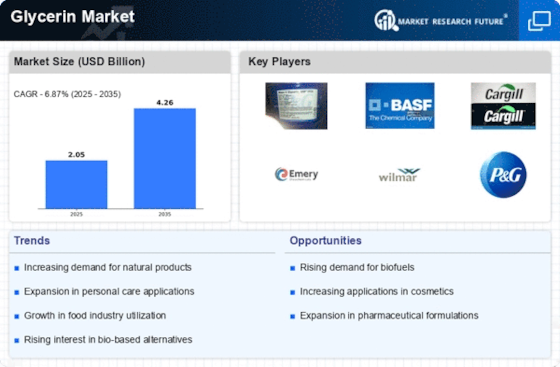
As per MRFR analysis, the Glycerin Market Size was estimated at 2.05 USD Billion in 2024. The Glycerin industry is projected to grow from 2.191 USD Billion in 2025 to 4.259 USD Billion by 2035, exhibiting a compound annual growth rate (CAGR) of 6.87% during the forecast period 2025 - 2035.

Key Market Trends & Highlights

The Glycerin Market is experiencing robust growth driven by sustainability and diverse applications across various sectors.

  • North America remains the largest market for glycerin, driven by its extensive use in personal care products. Asia-Pacific is emerging as the fastest-growing region, reflecting increasing demand in food and beverage applications. Refined glycerin holds the largest market share, while crude glycerin is witnessing rapid growth due to its cost-effectiveness. Key market drivers include rising demand in personal care products and regulatory support for glycerin use in various industries.

Market Size & Forecast

2024 Market Size 2.05 (USD Billion)
2035 Market Size 4.259 (USD Billion)
CAGR (2025 - 2035) 6.87%
Largest Regional Market Share in 2024 Asia Pacific

Major Players

<p>K glycerin (US), BASF SE (DE), Cargill, Incorporated (US), Emery Oleochemicals (MY), Wilmar International Limited (SG), Procter &amp; Gamble Co. (US), Kraton Corporation (US), Dow Chemical Company (US), Vantage Specialty Chemicals (US)</p>

Market Trends

The Glycerin Market is currently experiencing a dynamic phase characterized by evolving consumer preferences and increasing applications across various industries. The demand for glycerin, a versatile compound derived from both natural and synthetic sources, is on the rise due to its multifunctional properties. It serves as a humectant, solvent, and emollient, making it valuable in sectors such as cosmetics, food, and pharmaceuticals. As sustainability becomes a focal point for many businesses, the market is witnessing a shift towards bio-based glycerin, which is perceived as a more environmentally friendly alternative. This transition aligns with global trends emphasizing eco-conscious production and consumption practices. Moreover, the Glycerin Market is influenced by regulatory frameworks that promote the use of natural ingredients in consumer products. These regulations often encourage manufacturers to explore glycerin's potential in formulations that prioritize safety and efficacy. The increasing awareness of health and wellness among consumers further propels the market, as glycerin is recognized for its moisturizing and soothing properties. Consequently, the Glycerin Market appears poised for growth, driven by innovation and a commitment to sustainable practices, which may redefine its landscape in the coming years.

Sustainability Initiatives

The Glycerin Market is witnessing a notable shift towards sustainability, with manufacturers increasingly focusing on bio-based glycerin derived from renewable resources. This trend reflects a broader commitment to environmentally friendly practices, as companies seek to reduce their carbon footprint and appeal to eco-conscious consumers.

Diverse Applications

Glycerin Market's versatility is leading to its adoption across a wide range of industries, including personal care, food, and pharmaceuticals. This trend indicates a growing recognition of glycerin's multifunctional properties, which enhance product formulations and meet diverse consumer needs.

Regulatory Influence

The Glycerin Market is shaped by evolving regulatory standards that promote the use of natural ingredients in consumer products. These regulations encourage manufacturers to incorporate glycerin into their formulations, aligning with consumer preferences for safer and more effective products.

Glycerin Market Market Drivers

Pharmaceutical Industry Growth

The Glycerin Market is significantly influenced by the growth of the pharmaceutical sector, where glycerin is utilized as a solvent, sweetening agent, and excipient in various formulations. The increasing prevalence of chronic diseases and the subsequent rise in pharmaceutical production have created a favorable environment for glycerin consumption. In 2023, the pharmaceutical segment accounted for approximately 20% of the total glycerin market, indicating its critical role in drug formulation. As the demand for liquid formulations and syrups continues to rise, the reliance on glycerin is expected to grow. This trend suggests that the Glycerin Market will benefit from ongoing advancements in pharmaceutical research and development, further solidifying its position in this vital sector.

Regulatory Support for Glycerin Use

The Glycerin Market is positively impacted by regulatory support that promotes the safe use of glycerin across multiple applications. Regulatory bodies have recognized glycerin as a safe and effective ingredient in food, pharmaceuticals, and cosmetics, which has bolstered its market presence. In 2023, the favorable regulatory landscape contributed to a 10% increase in glycerin consumption across various sectors. This support not only enhances consumer confidence but also encourages manufacturers to incorporate glycerin into their formulations. As regulations continue to evolve, the Glycerin Market is expected to benefit from increased acceptance and utilization of glycerin, further solidifying its role in diverse applications.

Rising Demand in Personal Care Products

The Glycerin Market is experiencing a notable surge in demand, particularly within the personal care sector. Glycerin Market is widely utilized as a humectant, providing moisture retention in skincare and cosmetic formulations. The increasing consumer preference for natural and organic products has further propelled the use of glycerin, as it is derived from plant sources. In 2023, the personal care segment accounted for approximately 30% of the total glycerin consumption, indicating a robust growth trajectory. This trend is likely to continue, driven by the rising awareness of skin health and the benefits of glycerin in enhancing product efficacy. As consumers increasingly seek products that are both effective and environmentally friendly, the Glycerin Market is poised for sustained growth in this segment.

Expansion in Food and Beverage Applications

The Glycerin Market is witnessing significant expansion in the food and beverage sector, where glycerin serves multiple functions, including as a sweetener, preservative, and texturizer. The global food industry has seen a shift towards healthier alternatives, and glycerin, being a low-calorie sweetener, is gaining traction among manufacturers. In 2023, the food and beverage segment represented around 25% of the glycerin market share, reflecting a growing acceptance of glycerin as a food additive. This trend is expected to persist as consumers increasingly demand products that align with health-conscious lifestyles. Furthermore, the versatility of glycerin in various food applications, such as confectionery and baked goods, suggests that the Glycerin Market will continue to thrive in this domain.

Innovations in Bio-based Glycerin Production

The Glycerin Market is experiencing a transformative shift towards bio-based glycerin production, driven by sustainability initiatives and the demand for eco-friendly products. Innovations in production methods, such as the use of waste oils and fats, are gaining traction, allowing for a more sustainable glycerin supply chain. In 2023, bio-based glycerin accounted for approximately 15% of the total glycerin production, reflecting a growing trend towards renewable resources. This shift not only aligns with The Glycerin Market's appeal to environmentally conscious consumers. As companies increasingly adopt green chemistry practices, the Glycerin Market is likely to see a rise in bio-based glycerin applications across various sectors, including personal care and food.

Market Segment Insights

By Grade: Refined Glycerin (Largest) vs. Crude Glycerin (Fastest-Growing)

<p>The Glycerin Market is primarily segmented into Refined Glycerin and Crude Glycerin. Refined Glycerin holds the largest market share due to its extensive applications in the food, pharmaceuticals, and cosmetics sectors. This segment benefits from high purity standards that meet industry requirements, making it the preferred choice among manufacturers. Crude Glycerin, on the other hand, is gaining momentum as an emerging player in the market, primarily used in the production of biodiesel and as a cost-effective alternative in various industrial applications. As markets evolve, the distinction between these two segments becomes increasingly pivotal in understanding industry dynamics and trends. Growth trends indicate that while Refined Glycerin remains a staple within established industries, Crude Glycerin is experiencing rapid growth, driven by the rising demand for biodiesel and the search for sustainable raw materials. The increasing push toward renewable energy sources and eco-friendly materials is propelling Crude Glycerin to the forefront. Furthermore, the availability of this segment at lower costs is attracting a range of industries looking for budget-friendly alternatives without sacrificing quality. This dichotomy points towards a shifting landscape in the Glycerin Market, where both segments are likely to coexist and expand concurrently, catering to diverse market needs.</p>

<p>Refined Glycerin (Dominant) vs. Crude Glycerin (Emerging)</p>

<p>Refined Glycerin is recognized for its high purity and versatile applications across various industries such as pharmaceuticals, food, and cosmetics. Characterized by its clear, colorless liquid form, it meets stringent industry standards, thereby maintaining a dominant presence in the Glycerin Market. This segment's adaptability and quality ensure a strong foothold in sectors that prioritize safety and efficacy. Conversely, Crude Glycerin, an emerging segment, is distinguished by its less refined composition and is typically utilized in industrial applications such as biodiesel production. Although it lacks the purity of refined counterparts, its cost-effectiveness and rising demand in environmentally-friendly applications are driving notable growth. The future of the Glycerin Market hinges on how these segments leverage their unique benefits to capture and satisfy market demands.</p>

By Source: Fatty Acids (Largest) vs. Fatty Alcohols (Fastest-Growing)

<p>In the Glycerin Market, the source segment is characterized by a competitive landscape, with Fatty Acids holding the largest market share. This dominance is largely attributed to their widespread application in food, cosmetics, and pharmaceuticals, where they are favored for their biocompatibility and efficiency. Conversely, Fatty Alcohols, while smaller in share, are quickly gaining traction due to rising demand in personal care products and as feedstock for the production of surfactants, which enhances their growth potential.</p>

<p>Fatty Acids (Dominant) vs. Fatty Alcohols (Emerging)</p>

<p><a href="https://www.marketresearchfuture.com/reports/fatty-acid-market-2456">Fatty Acids</a> serve as the dominant source in the Glycerin Market, renowned for their extensive use in various industries including food processing and cosmetics. Their multifunctional properties make them integral for creating high-quality emulsifiers and stabilizers. However, the emergence of Fatty Alcohols signals a shift towards innovation within the market; these alcohols are increasingly favored for their applications in personal care products and household cleaning agents, driven by consumer preferences for natural and biodegradable ingredients. This trend is further augmented by regulatory pushes for sustainability, positioning Fatty Alcohols as a vital source in the evolving market landscape.</p>

By Application: Pharmaceuticals (Largest) vs. Food and Beverage (Fastest-Growing)

<p>In the glycerin market, the application segment is characterized by diverse uses across various industries, with Pharmaceuticals holding the largest share due to its widespread application in formulations, particularly for medications and ointments. Food and Beverage is also significant as glycerin serves as a sweetener, <a href="https://www.marketresearchfuture.com/reports/humectants-market-7881">humectant</a>, and preservative. Furthermore, sectors such as Personal Care, Tobacco Humectants, and Industrial Chemicals, while smaller in comparison, contribute to a balanced market dynamics. Each segment plays a crucial role based on unique properties of glycerin, catering to distinct consumer demands. The growth trends in the glycerin market are driven by an increasing demand for natural and effective ingredients across Pharmaceuticals and Food and Beverage applications. Consumer preferences for safe, non-toxic additives in personal care and food sectors are significantly influencing market dynamics. Moreover, the burgeoning pharmaceutical industry, alongside the rise in processed food consumption, positions these application segments for robust growth in the coming years as manufacturers seek to capitalize on the versatility of glycerin.</p>

<p>Pharmaceuticals (Dominant) vs. Personal Care and Cosmetics (Emerging)</p>

<p>Pharmaceuticals represent a dominant application in the glycerin market, leveraging its non-toxic characteristics and multifunctionality in drug formulation, acting as a solvent, humectant, and maintaining product viscosity. This segment is bolstered by stringent regulations that favor the use of safe, high-quality ingredients. On the other hand, Personal Care and Cosmetics is an emerging sector reflecting rising consumer awareness and preference for organic and naturally-derived products. Glycerin's hydrating properties make it a favored ingredient in skincare and cosmetic formulations. As trends towards sustainability and clean-label products advance, both segments witness innovative applications, enhancing their importance in the glycerin marketplace.</p>

Get more detailed insights about Glycerin Market Research Report - Global Forecast to 2035

Regional Insights

Key Companies in the Glycerin Market market include

Industry Developments

In July 2021, Ohio State University began working with a biodiesel producer in the state of Ohio towards the development of advanced glycerin technology. The goal of this partnership is to upgrade the value of crude glycerin in the form of polyurethanes, making them more usable in a range of industries.


December 2022 saw the acquisition of a Conroe, Texas blending plant by Oleon; this was, however, not without a cost, with the merger costing the oleochemical giants a hefty $50 million. Merging with Oleon’s existing capabilities, Olean is now able to better supply and meet the increasing demand for glycerin across various industries. 


At the same time, ENI and BASF were able to collaborate on projects related to the industrial chemical propanol, which can be acquired by modifying glycerin; this initiative began in July 2021 and shed value towards the glycerin byproducts by transforming it into an investment.

In the latest announcement by the American Glycerin Market Producers Association in September 2023 there, a novel glycerin production plant in Texas will be opened; with a production capacity of about 100,000 tons of glycerin metric tons, this new plant will assist in catering the increased glycerin requirements across the US.

In December 2023, ADM expanded into the global market as it missed out on becoming a pioneering agricultural processor. A capital outlay was incurred to purchase a São Paulo-based company that manufactured and sold refined glycerin. This aids in boosting the company's production capacity by 400,000 metric tons, further solidifying its strong foothold in the glycerin market.

In July 2023, the Louis Dreyfus Company launched operations to construct a refining complex that has the ability and capacity to be located in Lampung, Indonesia. The strategic decision aids the company in seamlessly expanding its services and selling value-added products. These plans revolved around increasing glycerine refining capacity as well as extending capabilities around edible oil packaging.

In December 2022, Oleochemical makers, which go by the name Oleon, allocated a staggering amount of 50 million dollars to blend in with existing Conroe facilities in Texas. This investment further strengthened the company’s reach in the U.S. market, further aiding them in expanding their operational capabilities around the production of glycerin.


Future Outlook

Glycerin Market Future Outlook

<p>The Glycerin Market is projected to grow at a 6.87% CAGR from 2024 to 2035, driven by increasing demand in pharmaceuticals, cosmetics, and food industries.</p>

New opportunities lie in:

  • <p>Expansion into bio-based glycerin production facilities.</p>
  • <p>Development of glycerin-based biodegradable packaging solutions.</p>
  • <p>Investment in glycerin derivatives for enhanced product formulations.</p>

<p>By 2035, the Glycerin Market is expected to solidify its position as a key player in multiple industries.</p>

Market Segmentation

Glycerin Market Grade Outlook

  • Refined Glycerin
  • Crude Glycerin

Glycerin Market Source Outlook

  • Fatty Acids
  • Fatty Alcohols
  • Biodiesels

Glycerin Market Application Outlook

  • Pharmaceuticals
  • Tobacco Humectants
  • Alkyd Resins
  • Industrial Chemicals
  • Food and Beverage
  • Polyether Polyols
  • Personal Care and Cosmetics

Report Scope

MARKET SIZE 2024 2.05(USD Billion)
MARKET SIZE 2025 2.191(USD Billion)
MARKET SIZE 2035 4.259(USD Billion)
COMPOUND ANNUAL GROWTH RATE (CAGR) 6.87% (2024 - 2035)
REPORT COVERAGE Revenue Forecast, Competitive Landscape, Growth Factors, and Trends
BASE YEAR 2024
Market Forecast Period 2025 - 2035
Historical Data 2019 - 2024
Market Forecast Units USD Billion
Key Companies Profiled Market analysis in progress
Segments Covered Market segmentation analysis in progress
Key Market Opportunities Growing demand for natural and sustainable glycerin in personal care and food industries presents significant opportunities.
Key Market Dynamics Rising demand for natural glycerin in cosmetics drives innovation and competition among manufacturers.
Countries Covered North America, Europe, APAC, South America, MEA

FAQs

What is the current valuation of the Glycerin Market as of 2024?

The Glycerin Market was valued at 2.05 USD Billion in 2024.

What is the projected market valuation for the Glycerin Market in 2035?

The Glycerin Market is projected to reach 4.259 USD Billion by 2035.

What is the expected CAGR for the Glycerin Market during the forecast period 2025 - 2035?

The expected CAGR for the Glycerin Market during 2025 - 2035 is 6.87%.

Which companies are considered key players in the Glycerin Market?

Key players in the Glycerin Market include BASF SE, Cargill, Incorporated, and Procter &amp; Gamble Co.

How does the valuation of refined glycerin compare to crude glycerin in 2025?

Refined glycerin is expected to be valued at 2.56 USD Billion, while crude glycerin is projected at 1.7 USD Billion in 2025.

  1. SECTION I: EXECUTIVE SUMMARY AND KEY HIGHLIGHTS
    1. EXECUTIVE SUMMARY
      1. Market Overview
      2. Key Findings
      3. Market Segmentation
      4. Competitive Landscape
      5. Challenges and Opportunities
      6. Future Outlook 2
  2. SECTION II: SCOPING, METHODOLOGY AND MARKET STRUCTURE
    1. MARKET INTRODUCTION
      1. Definition
      2. Scope of the study
    2. RESEARCH METHODOLOGY
      1. Overview
      2. Data Mining
      3. Secondary Research
      4. Primary Research
      5. Forecasting Model
      6. Market Size Estimation
      7. Data Triangulation
      8. Validation 3
  3. SECTION III: QUALITATIVE ANALYSIS
    1. MARKET DYNAMICS
      1. Overview
      2. Drivers
      3. Restraints
      4. Opportunities
    2. MARKET FACTOR ANALYSIS
      1. Value chain Analysis
      2. Porter's Five Forces Analysis
      3. COVID-19 Impact Analysis
  4. SECTION IV: QUANTITATIVE ANALYSIS
    1. Chemicals and Materials, BY Grade (USD Billion)
      1. Refined Glycerin
      2. Crude Glycerin
    2. Chemicals and Materials, BY Source (USD Billion)
      1. Fatty Acids
      2. Fatty Alcohols
      3. Biodiesels
    3. Chemicals and Materials, BY Application (USD Billion)
      1. Pharmaceuticals
      2. Tobacco Humectants
      3. Alkyd Resins
      4. Industrial Chemicals
      5. Food and Beverage
      6. Polyether Polyols
      7. Personal Care and Cosmetics
    4. Chemicals and Materials, BY Region (USD Billion)
      1. North America
      2. Europe
      3. APAC
      4. South America
      5. MEA
  5. SECTION V: COMPETITIVE ANALYSIS
    1. Competitive Landscape
      1. Overview
      2. Competitive Analysis
      3. Market share Analysis
      4. Major Growth Strategy in the Chemicals and Materials
      5. Competitive Benchmarking
      6. Leading Players in Terms of Number of Developments in the Chemicals and Materials
      7. Key developments and growth strategies
      8. Major Players Financial Matrix
    2. Company Profiles
      1. K glycerin (US)
      2. BASF SE (DE)
      3. Cargill, Incorporated (US)
      4. Emery Oleochemicals (MY)
      5. Wilmar International Limited (SG)
      6. Procter & Gamble Co. (US)
      7. Kraton Corporation (US)
      8. Dow Chemical Company (US)
      9. Vantage Specialty Chemicals (US)
    3. Appendix
      1. References
      2. Related Reports 6 LIST OF FIGURES
    4. MARKET SYNOPSIS
    5. NORTH AMERICA MARKET ANALYSIS
    6. US MARKET ANALYSIS BY GRADE
    7. US MARKET ANALYSIS BY SOURCE
    8. US MARKET ANALYSIS BY APPLICATION
    9. CANADA MARKET ANALYSIS BY GRADE
    10. CANADA MARKET ANALYSIS BY SOURCE
    11. CANADA MARKET ANALYSIS BY APPLICATION
    12. EUROPE MARKET ANALYSIS
    13. GERMANY MARKET ANALYSIS BY GRADE
    14. GERMANY MARKET ANALYSIS BY SOURCE
    15. GERMANY MARKET ANALYSIS BY APPLICATION
    16. UK MARKET ANALYSIS BY GRADE
    17. UK MARKET ANALYSIS BY SOURCE
    18. UK MARKET ANALYSIS BY APPLICATION
    19. FRANCE MARKET ANALYSIS BY GRADE
    20. FRANCE MARKET ANALYSIS BY SOURCE
    21. FRANCE MARKET ANALYSIS BY APPLICATION
    22. RUSSIA MARKET ANALYSIS BY GRADE
    23. RUSSIA MARKET ANALYSIS BY SOURCE
    24. RUSSIA MARKET ANALYSIS BY APPLICATION
    25. ITALY MARKET ANALYSIS BY GRADE
    26. ITALY MARKET ANALYSIS BY SOURCE
    27. ITALY MARKET ANALYSIS BY APPLICATION
    28. SPAIN MARKET ANALYSIS BY GRADE
    29. SPAIN MARKET ANALYSIS BY SOURCE
    30. SPAIN MARKET ANALYSIS BY APPLICATION
    31. REST OF EUROPE MARKET ANALYSIS BY GRADE
    32. REST OF EUROPE MARKET ANALYSIS BY SOURCE
    33. REST OF EUROPE MARKET ANALYSIS BY APPLICATION
    34. APAC MARKET ANALYSIS
    35. CHINA MARKET ANALYSIS BY GRADE
    36. CHINA MARKET ANALYSIS BY SOURCE
    37. CHINA MARKET ANALYSIS BY APPLICATION
    38. INDIA MARKET ANALYSIS BY GRADE
    39. INDIA MARKET ANALYSIS BY SOURCE
    40. INDIA MARKET ANALYSIS BY APPLICATION
    41. JAPAN MARKET ANALYSIS BY GRADE
    42. JAPAN MARKET ANALYSIS BY SOURCE
    43. JAPAN MARKET ANALYSIS BY APPLICATION
    44. SOUTH KOREA MARKET ANALYSIS BY GRADE
    45. SOUTH KOREA MARKET ANALYSIS BY SOURCE
    46. SOUTH KOREA MARKET ANALYSIS BY APPLICATION
    47. MALAYSIA MARKET ANALYSIS BY GRADE
    48. MALAYSIA MARKET ANALYSIS BY SOURCE
    49. MALAYSIA MARKET ANALYSIS BY APPLICATION
    50. THAILAND MARKET ANALYSIS BY GRADE
    51. THAILAND MARKET ANALYSIS BY SOURCE
    52. THAILAND MARKET ANALYSIS BY APPLICATION
    53. INDONESIA MARKET ANALYSIS BY GRADE
    54. INDONESIA MARKET ANALYSIS BY SOURCE
    55. INDONESIA MARKET ANALYSIS BY APPLICATION
    56. REST OF APAC MARKET ANALYSIS BY GRADE
    57. REST OF APAC MARKET ANALYSIS BY SOURCE
    58. REST OF APAC MARKET ANALYSIS BY APPLICATION
    59. SOUTH AMERICA MARKET ANALYSIS
    60. BRAZIL MARKET ANALYSIS BY GRADE
    61. BRAZIL MARKET ANALYSIS BY SOURCE
    62. BRAZIL MARKET ANALYSIS BY APPLICATION
    63. MEXICO MARKET ANALYSIS BY GRADE
    64. MEXICO MARKET ANALYSIS BY SOURCE
    65. MEXICO MARKET ANALYSIS BY APPLICATION
    66. ARGENTINA MARKET ANALYSIS BY GRADE
    67. ARGENTINA MARKET ANALYSIS BY SOURCE
    68. ARGENTINA MARKET ANALYSIS BY APPLICATION
    69. REST OF SOUTH AMERICA MARKET ANALYSIS BY GRADE
    70. REST OF SOUTH AMERICA MARKET ANALYSIS BY SOURCE
    71. REST OF SOUTH AMERICA MARKET ANALYSIS BY APPLICATION
    72. MEA MARKET ANALYSIS
    73. GCC COUNTRIES MARKET ANALYSIS BY GRADE
    74. GCC COUNTRIES MARKET ANALYSIS BY SOURCE
    75. GCC COUNTRIES MARKET ANALYSIS BY APPLICATION
    76. SOUTH AFRICA MARKET ANALYSIS BY GRADE
    77. SOUTH AFRICA MARKET ANALYSIS BY SOURCE
    78. SOUTH AFRICA MARKET ANALYSIS BY APPLICATION
    79. REST OF MEA MARKET ANALYSIS BY GRADE
    80. REST OF MEA MARKET ANALYSIS BY SOURCE
    81. REST OF MEA MARKET ANALYSIS BY APPLICATION
    82. KEY BUYING CRITERIA OF CHEMICALS AND MATERIALS
    83. RESEARCH PROCESS OF MRFR
    84. DRO ANALYSIS OF CHEMICALS AND MATERIALS
    85. DRIVERS IMPACT ANALYSIS: CHEMICALS AND MATERIALS
    86. RESTRAINTS IMPACT ANALYSIS: CHEMICALS AND MATERIALS
    87. SUPPLY / VALUE CHAIN: CHEMICALS AND MATERIALS
    88. CHEMICALS AND MATERIALS, BY GRADE, 2024 (% SHARE)
    89. CHEMICALS AND MATERIALS, BY GRADE, 2024 TO 2035 (USD Billion)
    90. CHEMICALS AND MATERIALS, BY SOURCE, 2024 (% SHARE)
    91. CHEMICALS AND MATERIALS, BY SOURCE, 2024 TO 2035 (USD Billion)
    92. CHEMICALS AND MATERIALS, BY APPLICATION, 2024 (% SHARE)
    93. CHEMICALS AND MATERIALS, BY APPLICATION, 2024 TO 2035 (USD Billion)
    94. BENCHMARKING OF MAJOR COMPETITORS 7 LIST OF TABLES
    95. LIST OF ASSUMPTIONS
    96. North America MARKET SIZE ESTIMATES; FORECAST
      1. BY GRADE, 2025-2035 (USD Billion)
      2. BY SOURCE, 2025-2035 (USD Billion)
      3. BY APPLICATION, 2025-2035 (USD Billion)
    97. US MARKET SIZE ESTIMATES; FORECAST
      1. BY GRADE, 2025-2035 (USD Billion)
      2. BY SOURCE, 2025-2035 (USD Billion)
      3. BY APPLICATION, 2025-2035 (USD Billion)
    98. Canada MARKET SIZE ESTIMATES; FORECAST
      1. BY GRADE, 2025-2035 (USD Billion)
      2. BY SOURCE, 2025-2035 (USD Billion)
      3. BY APPLICATION, 2025-2035 (USD Billion)
    99. Europe MARKET SIZE ESTIMATES; FORECAST
      1. BY GRADE, 2025-2035 (USD Billion)
      2. BY SOURCE, 2025-2035 (USD Billion)
      3. BY APPLICATION, 2025-2035 (USD Billion)
    100. Germany MARKET SIZE ESTIMATES; FORECAST
      1. BY GRADE, 2025-2035 (USD Billion)
      2. BY SOURCE, 2025-2035 (USD Billion)
      3. BY APPLICATION, 2025-2035 (USD Billion)
    101. UK MARKET SIZE ESTIMATES; FORECAST
      1. BY GRADE, 2025-2035 (USD Billion)
      2. BY SOURCE, 2025-2035 (USD Billion)
      3. BY APPLICATION, 2025-2035 (USD Billion)
    102. France MARKET SIZE ESTIMATES; FORECAST
      1. BY GRADE, 2025-2035 (USD Billion)
      2. BY SOURCE, 2025-2035 (USD Billion)
      3. BY APPLICATION, 2025-2035 (USD Billion)
    103. Russia MARKET SIZE ESTIMATES; FORECAST
      1. BY GRADE, 2025-2035 (USD Billion)
      2. BY SOURCE, 2025-2035 (USD Billion)
      3. BY APPLICATION, 2025-2035 (USD Billion)
    104. Italy MARKET SIZE ESTIMATES; FORECAST
      1. BY GRADE, 2025-2035 (USD Billion)
      2. BY SOURCE, 2025-2035 (USD Billion)
      3. BY APPLICATION, 2025-2035 (USD Billion)
    105. Spain MARKET SIZE ESTIMATES; FORECAST
      1. BY GRADE, 2025-2035 (USD Billion)
      2. BY SOURCE, 2025-2035 (USD Billion)
      3. BY APPLICATION, 2025-2035 (USD Billion)
    106. Rest of Europe MARKET SIZE ESTIMATES; FORECAST
      1. BY GRADE, 2025-2035 (USD Billion)
      2. BY SOURCE, 2025-2035 (USD Billion)
      3. BY APPLICATION, 2025-2035 (USD Billion)
    107. APAC MARKET SIZE ESTIMATES; FORECAST
      1. BY GRADE, 2025-2035 (USD Billion)
      2. BY SOURCE, 2025-2035 (USD Billion)
      3. BY APPLICATION, 2025-2035 (USD Billion)
    108. China MARKET SIZE ESTIMATES; FORECAST
      1. BY GRADE, 2025-2035 (USD Billion)
      2. BY SOURCE, 2025-2035 (USD Billion)
      3. BY APPLICATION, 2025-2035 (USD Billion)
    109. India MARKET SIZE ESTIMATES; FORECAST
      1. BY GRADE, 2025-2035 (USD Billion)
      2. BY SOURCE, 2025-2035 (USD Billion)
      3. BY APPLICATION, 2025-2035 (USD Billion)
    110. Japan MARKET SIZE ESTIMATES; FORECAST
      1. BY GRADE, 2025-2035 (USD Billion)
      2. BY SOURCE, 2025-2035 (USD Billion)
      3. BY APPLICATION, 2025-2035 (USD Billion)
    111. South Korea MARKET SIZE ESTIMATES; FORECAST
      1. BY GRADE, 2025-2035 (USD Billion)
      2. BY SOURCE, 2025-2035 (USD Billion)
      3. BY APPLICATION, 2025-2035 (USD Billion)
    112. Malaysia MARKET SIZE ESTIMATES; FORECAST
      1. BY GRADE, 2025-2035 (USD Billion)
      2. BY SOURCE, 2025-2035 (USD Billion)
      3. BY APPLICATION, 2025-2035 (USD Billion)
    113. Thailand MARKET SIZE ESTIMATES; FORECAST
      1. BY GRADE, 2025-2035 (USD Billion)
      2. BY SOURCE, 2025-2035 (USD Billion)
      3. BY APPLICATION, 2025-2035 (USD Billion)
    114. Indonesia MARKET SIZE ESTIMATES; FORECAST
      1. BY GRADE, 2025-2035 (USD Billion)
      2. BY SOURCE, 2025-2035 (USD Billion)
      3. BY APPLICATION, 2025-2035 (USD Billion)
    115. Rest of APAC MARKET SIZE ESTIMATES; FORECAST
      1. BY GRADE, 2025-2035 (USD Billion)
      2. BY SOURCE, 2025-2035 (USD Billion)
      3. BY APPLICATION, 2025-2035 (USD Billion)
    116. South America MARKET SIZE ESTIMATES; FORECAST
      1. BY GRADE, 2025-2035 (USD Billion)
      2. BY SOURCE, 2025-2035 (USD Billion)
      3. BY APPLICATION, 2025-2035 (USD Billion)
    117. Brazil MARKET SIZE ESTIMATES; FORECAST
      1. BY GRADE, 2025-2035 (USD Billion)
      2. BY SOURCE, 2025-2035 (USD Billion)
      3. BY APPLICATION, 2025-2035 (USD Billion)
    118. Mexico MARKET SIZE ESTIMATES; FORECAST
      1. BY GRADE, 2025-2035 (USD Billion)
      2. BY SOURCE, 2025-2035 (USD Billion)
      3. BY APPLICATION, 2025-2035 (USD Billion)
    119. Argentina MARKET SIZE ESTIMATES; FORECAST
      1. BY GRADE, 2025-2035 (USD Billion)
      2. BY SOURCE, 2025-2035 (USD Billion)
      3. BY APPLICATION, 2025-2035 (USD Billion)
    120. Rest of South America MARKET SIZE ESTIMATES; FORECAST
      1. BY GRADE, 2025-2035 (USD Billion)
      2. BY SOURCE, 2025-2035 (USD Billion)
      3. BY APPLICATION, 2025-2035 (USD Billion)
    121. MEA MARKET SIZE ESTIMATES; FORECAST
      1. BY GRADE, 2025-2035 (USD Billion)
      2. BY SOURCE, 2025-2035 (USD Billion)
      3. BY APPLICATION, 2025-2035 (USD Billion)
    122. GCC Countries MARKET SIZE ESTIMATES; FORECAST
      1. BY GRADE, 2025-2035 (USD Billion)
      2. BY SOURCE, 2025-2035 (USD Billion)
      3. BY APPLICATION, 2025-2035 (USD Billion)
    123. South Africa MARKET SIZE ESTIMATES; FORECAST
      1. BY GRADE, 2025-2035 (USD Billion)
      2. BY SOURCE, 2025-2035 (USD Billion)
      3. BY APPLICATION, 2025-2035 (USD Billion)
    124. Rest of MEA MARKET SIZE ESTIMATES; FORECAST
      1. BY GRADE, 2025-2035 (USD Billion)
      2. BY SOURCE, 2025-2035 (USD Billion)
      3. BY APPLICATION, 2025-2035 (USD Billion)
    125. PRODUCT LAUNCH/PRODUCT DEVELOPMENT/APPROVAL
    126. ACQUISITION/PARTNERSHIP

Glycerin Market Segmentation

Market Segmentation Overview

  • Detailed segmentation data will be available in the full report
  • Comprehensive analysis by multiple parameters
  • Regional and country-level breakdowns
  • Market size forecasts by segment
Infographic

Free Sample Request

Kindly complete the form below to receive a free sample of this Report

Get Free Sample

Customer Strories

Compare Licence

×
Features License Type
Single User Multiuser License Enterprise User
Price $4,950 $5,950 $7,250
Maximum User Access Limit 1 User Upto 10 Users Unrestricted Access Throughout the Organization
Free Customization
Direct Access to Analyst
Deliverable Format
Platform Access
Discount on Next Purchase 10% 15% 15%
Printable Versions