×
Hero Background
English
Chinese
French
Japanese
Korean
German
Spanish

Healthcare Security Systems Market Share

ID: MRFR/HCIT/0231-HCR
125 Pages
Kinjoll Dey
October 2025

Healthcare Security Systems Market Research Report Information By Type (CCTV System, RFID Tags), Surveillance System (Video Surveillance, Surveillance Cameras), Application (Surgical Equipment, Medical Devices), End-User (Hospital, Clinics)-Forecast 2032

Share:
Download PDF ×

We do not share your information with anyone. However, we may send you emails based on your report interest from time to time. You may contact us at any time to opt-out.

Healthcare Security Systems Market Infographic
Purchase Options

Market Share

Healthcare Security Systems Market Share Analysis

Establishing a strong market share position in the Healthcare Security Systems Market begins with the integration of advanced technologies. Companies should invest in incorporating cutting-edge technologies such as artificial intelligence (AI), machine learning, and biometrics into their security systems. These technologies enhance threat detection, improve response times, and provide a robust defense against evolving security challenges in healthcare settings. The completeness of the cybersecurity solutions is essential. In order to protect healthcare data against cyber threats, organizations must institute end-to-end cybersecurity mechanisms. This encompasses encryption protocols, firewalls, intrusion detection systems and routine security audits. Also, a comprehensive approach to cybersecurity establishes trust within healthcare organizations establishing the company as reliable security partner. Customization of healthcare environments is crucial. The security systems should be configured in accordance with the requirements and infrastructure of healthcare settings, which need to suit companies. This includes taking into account special issues in providing security for medical devices, patient records and other sensitive data; the solutions must integrate smoothly with current workflows used by healthcare providers. Interoperability with health information systems is a strategic move. Corporations need to build security systems that work interoperatively with electronic health records (EHR) and other healthcare information repositories. Integrated systems streamline the processes of security measures and allow to monitor threats in real time through the entire healthcare network. Proving mastery in regulatory compliance is a must. Corporations should pay close attention to the healthcare security laws, either in their own country or at large like Health Insurance Portability and Accountability Act (HIPAA) in USA or General Data Protection Regulation(GDRP). The fact that security systems follow these regulations makes certain credibility and trust of healthcare providers. Comprehensive incident response and recovery plans are vital. Companies should provide security solutions that not only prevent the occurrence of security incidents but also contain detailed procedures for mitigating and remedying potential breaches. Incident management that takes a broad approach minimizes the effect security incidents have on healthcare operations. Developing interfaces for medical personnel that are user-friendly is essential. The user interfaces of security systems should be easy for healthcare professionals to operate. Training programs and support services may further contribute to the development of user proficiency, ensuring that security measures are smoothly integrated into everyday activities carried out by healthcare personnel without interfering with them. Biometric access controls are strategic. Business entities ought to implement biometric authentication mechanisms that include fingerprint or retina scan systems for access control measures in hospitals. Biometrics offer an extra protective layer, allowing only authorized staff members to enter the restricted zones and gain access to confidential data. Delivering powerful cloud security solutions is mandated. Since cloud-based technologies are gaining more popularity in the health care industry, companies should develop security solutions that would protect data stored on clouds. This comprises of encryption during transmission, secured cloud storage system and continuous surveillance for possible weakness.

Author
Kinjoll Dey
Research Analyst Level I

He is an extremely curious individual currently working in Healthcare and Medical Devices Domain. Kinjoll is comfortably versed in data centric research backed by healthcare educational background. He leverages extensive data mining and analytics tools such as Primary and Secondary Research, Statistical Analysis, Machine Learning, Data Modelling. His key role also involves Technical Sales Support, Client Interaction and Project management within the Healthcare team. Lastly, he showcases extensive affinity towards learning new skills and remain fascinated in implementing them.

Leave a Comment

FAQs

At what CAGR is the healthcare security systems market expected to grow over the forecast period?

The healthcare security systems market is predicted to grow at an 12.1% CAGR between 2023-2032.

Which region is predicted to have the largest share in the healthcare security systems market?

The Americas is predicted to have lions share in the healthcare security systems market during the forecast period.

What are the key factors driving the healthcare security systems market?

Increase in healthcare security systems, increasing number of healthcare facilities, and increasing incidences of cybercrimes are boosting market growth.

Which factors may act as deterrents in the healthcare security systems market?

High cost of services and low penetration of latest technologies in underdeveloped regions may deter market growth.

Who are the different end use industries of healthcare security systems?

It is widely used in laboratories, pharmacy, diagnostic centers, clinics, and hospitals.

Market Summary

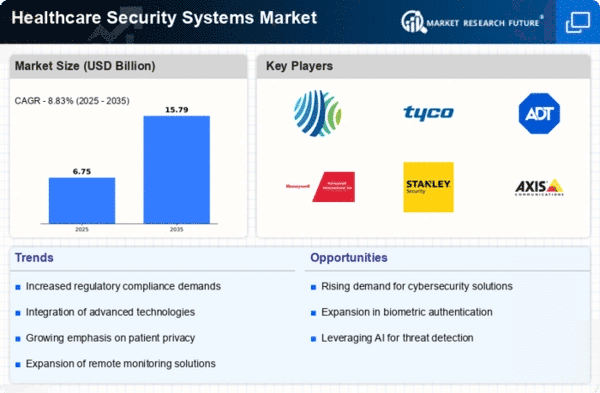
As per MRFR analysis, the Healthcare Security Systems Market was estimated at 6.2 USD Billion in 2024. The Healthcare Security Systems industry is projected to grow from 6.82 USD Billion in 2025 to 15.79 USD Billion by 2035, exhibiting a compound annual growth rate (CAGR) of 8.83 during the forecast period 2025 - 2035.

Key Market Trends & Highlights

The Healthcare Security Systems Market is experiencing robust growth driven by technological advancements and increasing security concerns.

  • The integration of advanced technologies is reshaping the landscape of healthcare security systems, particularly in North America.
  • Video surveillance remains the largest segment, while access control is emerging as the fastest-growing segment in the market.
  • Asia-Pacific is witnessing rapid growth in healthcare security systems, driven by rising investments in healthcare infrastructure.
  • Increasing cybersecurity threats and regulatory compliance requirements are key drivers propelling market expansion.

Market Size & Forecast

2024 Market Size 6.2 (USD Billion)
2035 Market Size 15.79 (USD Billion)
CAGR (2025 - 2035) 8.83%
Largest Regional Market Share in 2024 North America

Major Players

<p>Johnson Controls (US), Tyco International (US), ADT Inc. (US), Honeywell International Inc. (US), Stanley Black & Decker (US), Axis Communications (SE), Bosch Security Systems (DE), Siemens AG (DE), Genetec Inc. (CA)</p>

Market Trends

The Healthcare Security Systems Market is currently experiencing a transformative phase, driven by the increasing need for enhanced safety measures within healthcare facilities. As the complexity of healthcare environments grows, so does the demand for advanced security solutions that can protect sensitive patient data and ensure the safety of both patients and staff. This market appears to be evolving in response to various factors, including regulatory requirements, technological advancements, and the rising awareness of security threats. Consequently, healthcare organizations are investing in integrated security systems that encompass surveillance, access control, and alarm systems, thereby creating a more secure environment. Moreover, the integration of artificial intelligence and machine learning into security systems is likely to redefine the landscape of the Healthcare Security Systems Market. These technologies may facilitate real-time monitoring and predictive analytics, enabling healthcare providers to respond proactively to potential security breaches. Additionally, the growing trend of telehealth services necessitates robust security measures to protect patient information during virtual consultations. As such, the market is poised for continued growth, with stakeholders focusing on innovative solutions that address emerging security challenges while ensuring compliance with industry standards.

Integration of Advanced Technologies

The Healthcare Security Systems Market is witnessing a notable trend towards the integration of advanced technologies such as artificial intelligence and machine learning. These innovations enhance the capabilities of security systems, allowing for real-time monitoring and improved threat detection. By leveraging data analytics, healthcare facilities can better anticipate and mitigate potential security risks.

Focus on Regulatory Compliance

Another significant trend in the Healthcare Security Systems Market is the heightened emphasis on regulatory compliance. Healthcare organizations are increasingly required to adhere to stringent regulations regarding patient data protection and facility security. This focus drives the adoption of comprehensive security solutions that not only meet compliance standards but also enhance overall safety.

Rise of Integrated Security Solutions

The demand for integrated security solutions is on the rise within the Healthcare Security Systems Market. Healthcare providers are seeking systems that combine various security measures, such as surveillance, access control, and alarm systems, into a cohesive framework. This integration simplifies management and improves the overall effectiveness of security protocols.

Healthcare Security Systems Market Market Drivers

Market Growth Projections

The Global Healthcare Security Systems Market Industry is poised for substantial growth, with projections indicating a rise from 13.2 USD Billion in 2024 to 18.6 USD Billion by 2035. This growth trajectory suggests a compound annual growth rate (CAGR) of 3.16% from 2025 to 2035. Various factors contribute to this expansion, including increasing cybersecurity threats, regulatory compliance requirements, and the integration of advanced technologies. As healthcare organizations prioritize security measures, the market is likely to witness a surge in investments aimed at enhancing security frameworks. This upward trend reflects the industry's commitment to safeguarding patient information and ensuring the integrity of healthcare systems.

Expansion of Telehealth Services

The expansion of telehealth services is reshaping the Global Healthcare Security Systems Market Industry. As healthcare providers increasingly offer remote consultations and digital healthcare solutions, the need for secure communication channels becomes paramount. Telehealth platforms must incorporate robust security measures to protect patient data during virtual interactions. This trend is likely to drive investments in healthcare security systems, as organizations seek to ensure compliance with privacy regulations while delivering convenient services. The anticipated growth of the market to 13.2 USD Billion in 2024 underscores the urgency of addressing security concerns associated with telehealth. As telehealth continues to evolve, security will remain a critical focus area.

Increasing Cybersecurity Threats

The rise in cybersecurity threats poses a substantial challenge to the Global Healthcare Security Systems Market Industry. As healthcare organizations increasingly rely on digital systems for patient data management, the risk of data breaches escalates. In 2024, the market is projected to reach 13.2 USD Billion, driven by the need for robust cybersecurity measures. Healthcare facilities are investing in advanced security systems to protect sensitive information from cyberattacks. This trend is likely to continue, as the industry recognizes the importance of safeguarding patient data and maintaining trust. The potential financial repercussions of data breaches further underscore the urgency of enhancing security protocols.

Growing Demand for Patient Privacy

The growing demand for patient privacy significantly influences the Global Healthcare Security Systems Market Industry. Patients increasingly expect their personal health information to be protected, prompting healthcare organizations to prioritize security measures. This heightened awareness of privacy concerns drives investments in security systems that ensure confidentiality and data integrity. As the market evolves, healthcare providers are likely to adopt more sophisticated solutions to address these concerns. The projected growth to 18.6 USD Billion by 2035 reflects the industry's commitment to enhancing patient trust through improved security measures. Consequently, organizations are compelled to align their security strategies with patient expectations.

Regulatory Compliance Requirements

Regulatory compliance remains a critical driver for the Global Healthcare Security Systems Market Industry. Governments worldwide impose stringent regulations to ensure the protection of patient information and the integrity of healthcare systems. Compliance with standards such as HIPAA in the United States necessitates the implementation of comprehensive security measures. As healthcare organizations strive to meet these requirements, investments in security systems are expected to increase. The market's growth trajectory is supported by the anticipated rise to 18.6 USD Billion by 2035, reflecting the ongoing commitment to regulatory adherence. Failure to comply can result in severe penalties, further motivating healthcare providers to enhance their security infrastructure.

Integration of Advanced Technologies

The integration of advanced technologies is transforming the Global Healthcare Security Systems Market Industry. Innovations such as artificial intelligence, machine learning, and Internet of Things (IoT) devices are enhancing security measures within healthcare facilities. These technologies enable real-time monitoring, threat detection, and automated responses to security incidents. As healthcare providers seek to improve operational efficiency and patient safety, the adoption of these technologies is likely to accelerate. This trend contributes to the projected compound annual growth rate (CAGR) of 3.16% from 2025 to 2035, as organizations recognize the value of leveraging technology to bolster security frameworks and mitigate risks.

Market Segment Insights

By Application: Video Surveillance (Largest) vs. Access Control (Fastest-Growing)

<p>The Healthcare Security Systems Market exhibits significant diversity in its application segments, primarily comprising Access Control, Video Surveillance, Intrusion Detection, Alarm Systems, and Emergency Response. Within this landscape, Video Surveillance holds the largest share, driven by the essential need for enhanced monitoring of healthcare facilities. Meanwhile, Access Control is witnessing rapid growth, as healthcare institutions increasingly prioritize the protection of sensitive areas and patient privacy through advanced access technologies. The growth within these applications is propelled by several key trends. The rising demand for integrated security solutions in healthcare settings is leading to innovations in Video Surveillance technologies, such as AI-driven analytics. Additionally, the growing focus on health data protection is pushing more healthcare providers towards upgrading their Access Control systems, making it the fastest-growing segment. This dynamic lays the foundation for a more secure healthcare environment, tailored to evolving demands and regulatory standards.</p>

<p>Video Surveillance (Dominant) vs. Access Control (Emerging)</p>

<p>Video Surveillance has established itself as the dominant application within the Healthcare Security Systems Market, thanks to its critical role in ensuring the safety of patients and staff. With advancements in high-definition cameras and smart monitoring capabilities, this segment provides comprehensive surveillance solutions. On the other hand, Access Control is emerging as a vital segment, focusing on privacy and security. While it currently holds a smaller market share compared to Video Surveillance, it is growing rapidly as healthcare facilities seek to implement stricter security measures. The integration of biometric systems and mobile access technologies is making Access Control more appealing, indicative of a growing trend towards securing sensitive areas within healthcare environments. Together, these segments represent a progressive shift in how healthcare facilities approach security management.</p>

By End Use: Hospitals (Largest) vs. Clinics (Fastest-Growing)

<p>The Healthcare Security Systems Market exhibits a diverse distribution among its end-use segments, with hospitals occupying the largest share. They necessitate robust security measures due to the critical nature of their services, patient safety, and asset protection. Following hospitals, clinics have emerged as a significant market segment, reflecting a growing need for security solutions in outpatient services, as safety concerns among patients and staff rise. Long-term care facilities, pharmaceutical companies, and research laboratories also contribute to the market, each with unique security demands driven by their specific operational needs. Furthermore, the growth trends in the Healthcare Security Systems Market reveal a heightened focus on technological advancements and regulatory mandates. Clinics represent the fastest-growing segment as they increasingly adopt integrated security systems to safeguard sensitive patient data and comply with regulations. Innovations such as biometric access controls and cloud-based security solutions are transforming the landscape, prompting increased investments across all segments. With a rise in cyber threats and the need for real-time monitoring, security systems tailored to these end uses are becoming indispensable in enhancing overall safety and operational efficiency.</p>

<p>Hospitals: Dominant vs. Research Laboratories: Emerging</p>

<p>In the Healthcare Security Systems Market, hospitals stand as the dominant force due to their comprehensive security requirements, encompassing everything from physical security personnel to advanced surveillance technologies. These facilities must protect sensitive patient information and high-value medical equipment, making security a top priority. The scale and complexity of hospital operations necessitate a multi-faceted security approach, including access controls, alarm systems, and cybersecurity measures. In contrast, research laboratories represent an emerging segment, with increasing recognition of their need for enhanced security. As these facilities often handle sensitive research materials and confidential data, they are gradually adopting sophisticated security systems tailored to their unique challenges. This includes improved data protection measures and the implementation of stringent access protocols to safeguard intellectual property and ensure compliance with ethical regulations.</p>

By Technology: Biometric Systems (Largest) vs. Cybersecurity Solutions (Fastest-Growing)

<p>The Healthcare Security Systems Market showcases a diverse array of technologies, with Biometric Systems holding the largest market share. This segment is widely adopted for its effectiveness in enhancing patient identification and securing sensitive health information. On the other hand, Cybersecurity Solutions are rapidly gaining traction as organizations prioritize safeguarding against evolving cyber threats. The market is experiencing a notable shift towards integrating advanced technologies to ensure comprehensive security in healthcare settings.</p>

<p>Technology: Biometric Systems (Dominant) vs. Cybersecurity Solutions (Emerging)</p>

<p>Biometric Systems, as the dominant technology in the healthcare security segment, are critical for ensuring secure access to patient data and facilities. These systems leverage unique biological traits such as fingerprints and facial recognition, making unauthorized access nearly impossible. In contrast, Cybersecurity Solutions represent the emerging frontier in healthcare security, particularly as digital health records become commonplace. Organizations are investing heavily in robust cybersecurity measures to protect against data breaches and cyberattacks, focusing on data encryption, secure data transmission, and ongoing vulnerability assessments. Together, these technologies address both physical and digital security needs, enhancing overall patient trust and safety in the healthcare ecosystem.</p>

By Component: Software (Largest) vs. Services (Fastest-Growing)

<p>The healthcare security systems market is intricately segmented by components, with software holding the largest market share due to its critical role in data protection and compliance. Hardware and network infrastructure also represent substantial portions of the market, but their growth is experiencing pressure from rapid advancements in software solutions that enable more comprehensive and streamlined security processes. Monitoring systems, while important, have a smaller share as organizations prioritize integrated software solutions. In terms of growth trends, software is expected to continue dominating the market as healthcare organizations seek advanced solutions to combat evolving security threats. Services, on the other hand, are emerging rapidly as more companies look for comprehensive security strategies that include consulting and support services, driving significant investment in this area. The increasing complexity of threats necessitates a shift towards more robust service-oriented solutions, thereby marking services as the fastest-growing component in the healthcare security landscape.</p>

<p>Security Measures: Software (Dominant) vs. Services (Emerging)</p>

<p>In the healthcare security systems market, software has established itself as the dominant component, driving security measures through sophisticated algorithms, real-time monitoring, and compliance functionalities. Organizations leverage software to enhance their data protection strategies and ensure adherence to stringent regulatory requirements. Meanwhile, services are emerging as a crucial supplementary element, providing expert consultation, implementation, and ongoing support that are imperative for navigating the complexities of security in a healthcare setting. The transition from a purely technology-driven approach to incorporating comprehensive service solutions signifies a growing recognition of the need for tailored security frameworks as healthcare institutions grapple with diverse and evolving threats. Together, these two components underscore a multifaceted approach to healthcare security.</p>

Get more detailed insights about Healthcare Security Systems Market Research Report - Forecast to 2035

Regional Insights

Key Players and Competitive Insights

The Healthcare Security Systems Market is characterized by a dynamic competitive landscape, driven by the increasing need for enhanced security measures in healthcare facilities. Key players are focusing on innovation, strategic partnerships, and technological advancements to maintain their competitive edge. Companies such as Johnson Controls (US), Honeywell International Inc. (US), and Axis Communications (SE) are at the forefront, leveraging their expertise in integrated security solutions to address the unique challenges faced by healthcare providers. Their operational focus on digital transformation and the integration of advanced technologies, such as AI and IoT, is reshaping the market dynamics and fostering a more secure environment for patient care.

In terms of business tactics, companies are increasingly localizing manufacturing and optimizing supply chains to enhance operational efficiency and responsiveness to market demands. The competitive structure of the market appears moderately fragmented, with several key players exerting significant influence. This fragmentation allows for a diverse range of solutions, catering to various segments within the healthcare sector, while also fostering competition that drives innovation and service quality.

In November 2025, Johnson Controls (US) announced a strategic partnership with a leading telehealth provider to integrate advanced security features into remote patient monitoring systems. This collaboration is poised to enhance the security of sensitive patient data, thereby addressing growing concerns regarding data breaches in telehealth services. The strategic importance of this move lies in its potential to position Johnson Controls as a leader in securing digital health solutions, aligning with the broader trend of digitalization in healthcare.

In October 2025, Honeywell International Inc. (US) launched a new line of AI-driven security systems specifically designed for healthcare environments. This innovative product suite aims to streamline security operations while providing real-time analytics to healthcare administrators. The introduction of these systems underscores Honeywell's commitment to leveraging cutting-edge technology to enhance safety and operational efficiency, which is increasingly vital in today's healthcare landscape.

In September 2025, Axis Communications (SE) expanded its portfolio by acquiring a cybersecurity firm specializing in healthcare security solutions. This acquisition is expected to bolster Axis's capabilities in providing comprehensive security solutions that encompass both physical and digital security. The strategic significance of this move reflects the growing recognition of cybersecurity as a critical component of healthcare security systems, particularly as healthcare facilities become more interconnected.

As of December 2025, the competitive trends in the Healthcare Security Systems Market are increasingly defined by digitalization, sustainability, and the integration of AI technologies. Strategic alliances are playing a pivotal role in shaping the current landscape, enabling companies to pool resources and expertise to deliver more robust solutions. Looking ahead, competitive differentiation is likely to evolve from traditional price-based competition towards a focus on innovation, technological advancement, and supply chain reliability. This shift suggests that companies that prioritize these elements will be better positioned to thrive in an increasingly complex and demanding market.

Key Companies in the Healthcare Security Systems Market market include

Industry Developments

The key players of the US are establishing new partnerships to expand the surveillance segment of the market. A new range of CCT sensors and other surveillance equipment will develop. 

Future Outlook

Healthcare Security Systems Market Future Outlook

<p>The Healthcare Security Systems Market is projected to grow at an 8.83% CAGR from 2024 to 2035, driven by technological advancements, regulatory compliance, and increasing security concerns.</p>

New opportunities lie in:

  • <p>Integration of AI-driven surveillance systems for real-time threat detection.</p>
  • <p>Development of mobile security applications for remote monitoring.</p>
  • <p>Expansion of cybersecurity solutions tailored for healthcare data protection.</p>

<p>By 2035, the market is expected to be robust, reflecting substantial growth and innovation.</p>

Market Segmentation

Healthcare Security Systems Market End Use Outlook

  • Hospitals
  • Clinics
  • Long-term Care Facilities
  • Pharmaceutical Companies
  • Research Laboratories

Healthcare Security Systems Market Component Outlook

  • Hardware
  • Software
  • Services
  • Network Infrastructure
  • Monitoring Systems

Healthcare Security Systems Market Technology Outlook

  • Biometric Systems
  • RFID Systems
  • Surveillance Cameras
  • Integrated Security Systems
  • Cybersecurity Solutions

Healthcare Security Systems Market Application Outlook

  • Access Control
  • Video Surveillance
  • Intrusion Detection
  • Alarm Systems
  • Emergency Response

Report Scope

MARKET SIZE 20246.2(USD Billion)
MARKET SIZE 20256.82(USD Billion)
MARKET SIZE 203515.79(USD Billion)
COMPOUND ANNUAL GROWTH RATE (CAGR)8.83% (2024 - 2035)
REPORT COVERAGERevenue Forecast, Competitive Landscape, Growth Factors, and Trends
BASE YEAR2024
Market Forecast Period2025 - 2035
Historical Data2019 - 2024
Market Forecast UnitsUSD Billion
Key Companies ProfiledJohnson Controls (US), Tyco International (US), ADT Inc. (US), Honeywell International Inc. (US), Stanley Black & Decker (US), Axis Communications (SE), Bosch Security Systems (DE), Siemens AG (DE), Genetec Inc. (CA)
Segments CoveredApplication, End Use, Technology, Component
Key Market OpportunitiesIntegration of advanced biometric technologies enhances security in the Healthcare Security Systems Market.
Key Market DynamicsRising demand for advanced surveillance technologies drives innovation in healthcare security systems and regulatory compliance.
Countries CoveredNorth America, Europe, APAC, South America, MEA

FAQs

At what CAGR is the healthcare security systems market expected to grow over the forecast period?

The healthcare security systems market is predicted to grow at an 12.1% CAGR between 2023-2032.

Which region is predicted to have the largest share in the healthcare security systems market?

The Americas is predicted to have lions share in the healthcare security systems market during the forecast period.

What are the key factors driving the healthcare security systems market?

Increase in healthcare security systems, increasing number of healthcare facilities, and increasing incidences of cybercrimes are boosting market growth.

Which factors may act as deterrents in the healthcare security systems market?

High cost of services and low penetration of latest technologies in underdeveloped regions may deter market growth.

Who are the different end use industries of healthcare security systems?

It is widely used in laboratories, pharmacy, diagnostic centers, clinics, and hospitals.

  1. Definition
    1. Scope of the Study
      1. Research Objective
      2. Assumptions
      3. Limitations
    2. Introduction
    3. Primary Research
    4. Secondary Research
    5. Market Size Estimation
    6. Drivers
    7. Restraints
    8. Opportunities
    9. Challenges
    10. Macroeconomic Indicators
    11. Technology Trends & Assessment
    12. Porter’s Five Forces Analysis
      1. Bargaining Power of Suppliers
      2. Bargaining Power of Buyers
      3. Threat of New Entrants
      4. Threat of Substitutes
      5. Intensity of Rivalry
    13. Value Chain Analysis
    14. Investment Feasibility Analysis
    15. Pricing Analysis
  2. Chapter 6. Global Healthcare Security Systems Market, by Type
    1. Introduction
    2. CCTV System
    3. Access Control Systems
      1. Biometric systems
      2. Smart Cards
      3. Chipper locks
      4. X-Ray screening system
    4. Intrusion Detection Instruments
    5. Infant Security System
    6. Security Alarm
      1. Burglar alarms
      2. Fire Alarm
      3. Carbon monoxide alarm
      4. Others
    7. Metal and explosive Detectors
    8. RFID tags
    9. Others
  3. Chapter 7 Global Healthcare Security Systems Market, by Application
    1. Introduction
    2. Surgical Equipment Tracking
    3. Medical Devices Tracking
    4. Document and Data File Tracking
    5. Patient Tracking
    6. Monitoring
    7. Others
  4. Chapter 8 Global Healthcare Security Systems Market, by Surveillance System
    1. Introduction
    2. Video Surveillance
    3. Surveillance cameras
    4. Others
  5. Chapter 9 Global Healthcare Security Systems Market, by End-User
    1. Introduction
    2. Hospital
    3. Clinics
    4. Diagnostic Centers
    5. Pharmacy
    6. Laboratories
    7. Others
  6. Chapter 10. Global Healthcare Security Systems Market, by Region
    1. Introduction
    2. Americas
      1. North America
      2. South America
    3. Europe
      1. Western Europe
      2. Eastern Europe
    4. Asia-Pacific
      1. Japan
      2. China
      3. India
      4. Australia
      5. South Korea
      6. Rest of Asia-Pacific
    5. Middle East & Africa
      1. Middle East
      2. Africa
    6. Chapter 11. Company Landscape
    7. Introduction
    8. Market Share Analysis
    9. Key Development & Strategies
    10. Chapter 12. Company Profiles
    11. Avigilon Corporation
      1. Company Overview
      2. Product Overview
      3. Financials Overview
      4. Key Developments
      5. SWOT Analysis
    12. Schneider Electric SE
      1. Company Overview
      2. Product Overview
      3. Financial Overview
      4. Key Developments
      5. SWOT Analysis
    13. Honeywell International, Inc.
      1. Company Overview
      2. Product Overview
      3. Financial Overview
      4. Key Development
      5. SWOT Analysis
    14. ADT LLC dba ADT Security Services
      1. Company Overview
      2. Technology/Business Segment Overview
      3. Financial Overview
      4. Key Development
      5. SWOT Analysis
    15. Allied Telesis, Inc.
      1. Company Overview
      2. Product Overview
      3. Financial overview
      4. Key Developments
      5. SWOT Analysis
    16. Tyco Security Products
      1. Company Overview
      2. Product Overview
      3. Financial Overview
      4. Key Developments
      5. SWOT Analysis
    17. Bosch Security Systems
      1. Overview
      2. Product Overview
      3. Financial Overview
      4. Key Developments
      5. SWOT Analysis
    18. Nedap
      1. Overview
      2. Product/ Technology Overview
      3. Financials
      4. Key Developments
      5. SWOT Analysis
    19. STANLEY Healthcare
      1. Overview
      2. Product Overview
      3. Financials
      4. Key Developments
      5. SWOT Analysis
    20. Seico Security
      1. Overview
      2. Product Overview
      3. Financials
      4. Key Developments
      5. SWOT Analysis
    21. Cisco Systems, Inc.
      1. Overview
      2. Product Overview
      3. Financials
      4. Key Developments
      5. SWOT Analysis
    22. Atos SE
      1. Overview
      2. Product Overview
      3. Financials
      4. Key Developments
      5. SWOT Analysis
    23. Johnson Controls
      1. Overview
      2. Product Overview
      3. Financials
      4. Key Developments
      5. SWOT Analysis
    24. Siemens AG
      1. Overview
      2. Product Overview
      3. Financials
      4. Key Developments
      5. SWOT Analysis
    25. Others
    26. Chapter 13 MRFR Conclusion
    27. Key Findings
      1. From CEO’s View Point
      2. Unmet Needs of the Market
    28. Key Companies to Watch
    29. Chapter 14 Appendix
  7. LIST OF TABLES
  8. Global Healthcare Security Systems Market Synopsis, 2020–2027
  9. Global Healthcare Security Systems Market Estimates and Forecast, 2020–2027, (USD Million)
  10. Global Healthcare Security Systems Market, by Region, 2020–2027, (USD Million)
  11. Global Healthcare Security Systems Market, by Type, 2020–2027, (USD Million)
  12. Global Healthcare Security Systems Market, by Application, 2020–2027, (USD Million)
  13. Global Healthcare Security Systems Market, by Surveillance System, 2020–2027, (USD Million)
  14. Global Healthcare Security Systems Market, by End-User, 2020–2027, (USD Million)
  15. North America Healthcare Security Systems Market, by Type, 2020–2027, (USD Million)
  16. North America Healthcare Security Systems Market, by Application, 2020–2027, (USD Million)
  17. North America Healthcare Security Systems Market, by Surveillance System, 2020–2027, (USD Million)
  18. North America Healthcare Security Systems Market, by End-User, 2020–2027, (USD Million)
  19. US Healthcare Security Systems Market, by Type, 2020–2027, (USD Million)
  20. US Healthcare Security Systems Market, by Application, 2020–2027, (USD Million)
  21. US Healthcare Security Systems Market, by Surveillance System, 2020–2027, (USD Million)
  22. US Healthcare Security Systems Market, by End-User, 2020–2027, (USD Million)
  23. Canada Healthcare Security Systems Market, by Type, 2020–2027, (USD Million)
  24. Canada Healthcare Security Systems Market, by Application, 2020–2027, (USD Million)
  25. Canada Healthcare Security Systems Market, by Surveillance System, 2020–2027, (USD Million)
  26. Canada Healthcare Security Systems Market, by End-User, 2020–2027, (USD Million)
  27. South America Healthcare Security Systems Market, by Type, 2020–2027, (USD Million)
  28. South America Healthcare Security Systems Market, by Application, 2020–2027, (USD Million)
  29. South America Healthcare Security Systems Market, by Surveillance System, 2020–2027, (USD Million)
  30. South America Healthcare Security Systems Market, by End-User, 2020–2027, (USD Million)
  31. Europe Healthcare Security Systems Market, by Type, 2020–2027, (USD Million)
  32. Europe Healthcare Security Systems Market, by Application, 2020–2027, (USD Million)
  33. Europe Healthcare Security Systems Market, by Surveillance System, 2020–2027, (USD Million)
  34. Europe Healthcare Security Systems Market, by End-User, 2020–2027, (USD Million)
  35. Western Europe Healthcare Security Systems Market, by Type, 2020–2027, (USD Million)
  36. Western Europe Healthcare Security Systems Market, by Application, 2020–2027, (USD Million)
  37. Western Europe Healthcare Security Systems Market, by Surveillance System, 2020–2027, (USD Million)
  38. Western Europe Healthcare Security Systems Market, by End-User, 2020–2027, (USD Million)
  39. Eastern Europe Healthcare Security Systems Market, by Type, 2020–2027, (USD Million)
  40. Eastern Europe Healthcare Security Systems Market, by Application, 2020–2027, (USD Million)
  41. Eastern Europe Healthcare Security Systems Market, by Surveillance System, 2020–2027, (USD Million)
  42. Eastern Europe Healthcare Security Systems Market, by End-User, 2020–2027, (USD Million)
  43. Asia-Pacific Healthcare Security Systems Market, by Type, 2020–2027, (USD Million)
  44. Asia-Pacific Healthcare Security Systems Market, by Application, 2020–2027, (USD Million)
  45. Asia-Pacific Healthcare Security Systems Market, by Surveillance System, 2020–2027, (USD Million)
  46. Asia-Pacific Healthcare Security Systems Market, by End-User, 2020–2027, (USD Million)
  47. Middle East & Africa Healthcare Security Systems Market, by Type, 2020–2027, (USD Million)
  48. Middle East & Africa Healthcare Security Systems Market, by Application, 2020–2027, (USD Million)
  49. Middle East & Africa Healthcare Security Systems Market, by Surveillance System 2020–2027, (USD Million)
  50. Middle East & Africa Healthcare Security Systems Market, by End-User, 2020–2027, (USD Million)
  51. LIST OF FIGURES
  52. Research Process
  53. Segmentation for Global Healthcare Security Systems Market
  54. Segmentation Market Dynamics for Global Healthcare Security Systems Market
  55. Global Healthcare Security Systems Market Share, by Type 2020
  56. Global Healthcare Security Systems Market Share, by Application 2020
  57. Global Healthcare Security Systems Market Share, by Surveillance System 2020
  58. Global Healthcare Security Systems Market Share, by End-User 2020
  59. Global Healthcare Security Systems Market Share, by Region, 2020
  60. North America Healthcare Security Systems Market Share, by Country, 2020
  61. Europe Healthcare Security Systems Market Share, by Country, 2020
  62. Asia-Pacific Healthcare Security Systems Market Share, by Country, 2020
  63. Middle East & Africa Healthcare Security Systems Market Share, by Country, 2020
  64. Global Healthcare Security Systems Market: Company Share Analysis, 2020 (%)
  65. Avigilon Corporation: Key Financials
  66. Avigilon Corporation: Segmental Revenue
  67. Avigilon Corporation: Geographical Revenue
  68. Schneider Electric SE: Key Financials
  69. Schneider Electric SE: Segmental Revenue
  70. Schneider Electric SE: Geographical Revenue
  71. Cisco Systems, Inc.::Key Financials
  72. Cisco Systems, Inc.: Segmental Revenue
  73. Cisco Systems, Inc.: Geographical Revenue
  74. ADT Corporation: Key Financials
  75. ADT Corporation: Segmental Revenue
  76. ADT Corporation: Geographical Revenue
  77. Allied Telesis, Inc.: Key Financials
  78. Allied Telesis, Inc.: Segmental Revenue
  79. Allied Telesis, Inc. Geographical Revenue
  80. Tyco Security Products: Key Financials
  81. Tyco Security Products: Segmental Revenue
  82. Tyco Security Products: Geographical Revenue
  83. Nedap: Key Financials
  84. Nedap: Segmental Revenue
  85. Nedap: Geographical Revenue
  86. Atos SE: Key Financials
  87. Atos SE: Segmental Revenue
  88. Atos SE: Geographical Revenue

Healthcare Security Systems Market Segmentation

Market Segmentation Overview

  • Detailed segmentation data will be available in the full report
  • Comprehensive analysis by multiple parameters
  • Regional and country-level breakdowns
  • Market size forecasts by segment
Infographic

Free Sample Request

Kindly complete the form below to receive a free sample of this Report

Get Free Sample

Customer Strories

Compare Licence

×
Features License Type
Single User Multiuser License Enterprise User
Price $4,950 $5,950 $7,250
Maximum User Access Limit 1 User Upto 10 Users Unrestricted Access Throughout the Organization
Free Customization
Direct Access to Analyst
Deliverable Format
Platform Access
Discount on Next Purchase 10% 15% 15%
Printable Versions