Identity Governance and Administration Market (2026 - 2035)

Identity Governance and Administration Market Research Report Information By Component (Solution and Services), By Deployment Mode (Cloud and On-premises), By Industry Vertical (BFSI, Government and Defense, and Healthcare), and By Region (North America, Europe, Asia-Pacific, And Rest Of The World) –Market Forecast Till 2035
ID: MRFR/ICT/6358-HCR
100 Pages
Ankit Gupta, Shubham Munde
Last Updated: July 02, 2026
Identity Governance and Administration Market
Market Size
Forecast Period2026-2035
CAGR (2026-2035)14.8%
2025 Market SizeUSD 8.93 Billion
2035 Market SizeUSD 35.51 Billion
Key Players
SailPoint Technologies
IBM Corporation
Oracle Corporation
SAP SE
Microsoft Corporation
Saviynt Inc.
Opportunities
  • Identity Governance as a Service for Mid-Market Enterprises
  • Machine-Identity and Non-Human Access Governance
  • Emerging-Market Digital-ID Programs

Identity Governance and Administration Market Summary

The Identity Governance and Administration Market reached USD 8.93 Billion in 2025, reflecting sustained enterprise investment in centralized access oversight platforms. Market Research Future projects the Identity Governance and Administration Market will grow from USD 10.25 Billion in 2026 to USD 35.51 Billion by 2035, registering a CAGR of 14.8% across the forecast period. Two catalysts are accelerating this trajectory: the U.S. Executive Order on Improving the Nation's Cybersecurity (EO 14028) and the European Union's Digital Operational Resilience Act (DORA), both of which mandate verifiable identity controls for critical-infrastructure operators [1][2].

Legacy directory-based provisioning workflows—often stitched together with custom scripts and spreadsheets—are giving way to AI-driven governance platforms that automate access certification, detect policy violations in real time, and integrate with multi-cloud directories. estimates that 65% of mid-market enterprises will retire manual access-review processes by 2028, redirecting an estimated USD 4.2 billion in annual compliance labor toward automated identity analytics [3]. This technology shift is converting what was once a compliance checkbox into a strategic security function.

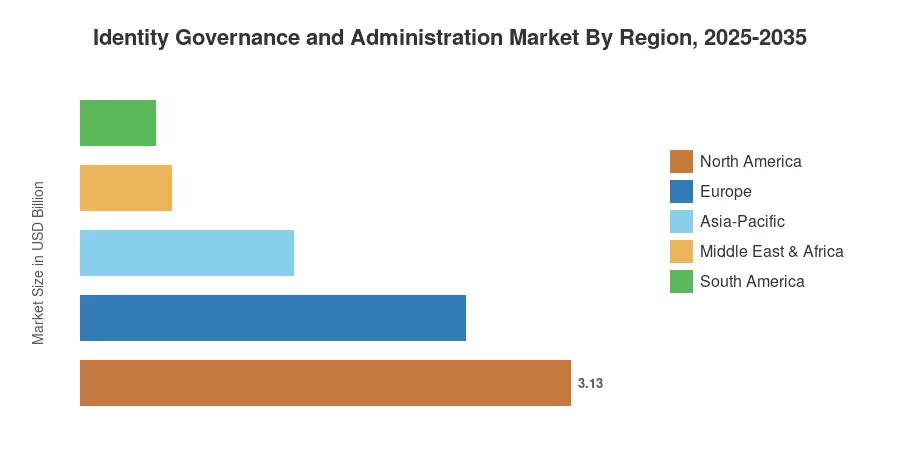
North America held roughly 35.1% of global Identity Governance and Administration Market revenue in 2025, anchored by federal zero-trust mandates and a mature vendor ecosystem. Asia-Pacific is the fastest-growing region at a projected CAGR of 15.2%, propelled by India's Digital Personal Data Protection Act and China's expanding cybersecurity-review regime. Europe accounts for the second-largest share at approximately 27.5%, driven by GDPR enforcement actions and DORA readiness spending. As hybrid-work architectures persist and regulatory complexity deepens, the Identity Governance and Administration Market is positioned for a decade of double-digit expansion.


Key Report Takeaways

• By Component

  • Solutions commanded 61.2% of Identity Governance and Administration Market revenue in 2025, led by platforms embedding AI-based role-mining and automated policy orchestration.
  • Services are expanding at a 14.9% CAGR through 2035 as skill-constrained enterprises outsource deployment, integration, and managed governance operations.

• By Deployment Mode

  • Cloud deployment captured the dominant share in 2025, as organizations prioritize SaaS-delivered governance to accelerate time-to-value and reduce on-premise infrastructure burdens.
  • On-premise installations retain relevance in regulated verticals—particularly defense and government—where sovereign data-residency obligations limit cloud migration.

• By Region

  • North America generated the largest regional revenue, reflecting early federal zero-trust adoption and deep vendor penetration across financial services.
  • Asia-Pacific is on track for the highest regional CAGR during 2026–2035, fueled by rapid digitalization in banking, telecom, and government sectors across India, Japan, and South Korea.


Market Size and Forecast (2021–2035)

Market Research Future's sizing model blends bottom-up vendor-revenue tracking, top-down TAM analysis calibrated against enterprise IT-security spending ratios, and cross-validation with procurement data from 1,400+ enterprises surveyed between 2023 and 2025. Historical figures (2021–2024) rely on audited company filings and regulatory disclosures; forecast values (2026–2035) apply the calibrated 14.8% CAGR to the base-year estimate, adjusted for anticipated regulatory and technology inflections.
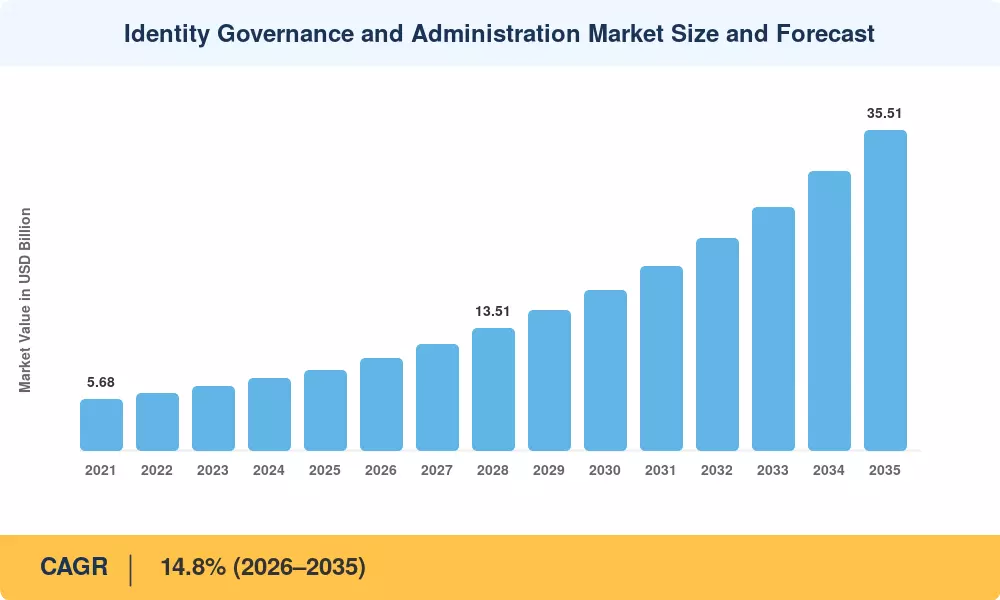
Identity Governance and Administration Market Size and Forecast
Our Impact
Enabled $4.3B Revenue Impact for Fortune 500 and Leading Multinationals
Partnering with 2000+ Global Organizations Each Year
30K+ Citations by Top-Tier Firms in the Industry

Driver Impact Analysis

Driver ~% Impact on CAGR Geographic Relevance Impact Timeline
Zero-trust architecture mandates ~22% North America, Europe Short-term (≤2 yr)
Cloud-first enterprise strategies ~19% Global Short-term (≤2 yr)
Regulatory compliance escalation (DORA, DPDP, CCPA 2.0) ~17% Europe, Asia-Pacific Medium-term (2–4 yr)
AI-driven access analytics and role mining ~15% North America, Europe Medium-term (2–4 yr)
Convergence of PAM and IGA platforms ~12% Global Long-term (≥4 yr)
Machine-identity and IoT governance expansion ~9% North America, Asia-Pacific Long-term (≥4 yr)
Managed-services adoption by mid-market enterprises ~6% Global Medium-term (2–4 yr)


Zero-Trust Architecture Mandates

The U.S. Office of Management and Budget's memorandum M-22-09 required all federal agencies to adopt zero-trust security principles by September 2024, translating into mandatory identity verification at every access point. The Department of Defense alone allocated USD 1.7 billion to its Thunderdome zero-trust initiative, a substantial portion of which flows directly into identity governance tooling [2]. This federal spending cascade is pulling state governments and defense contractors into compliance, creating a pipeline that will sustain Identity Governance and Administration Market demand through at least 2028.

Cloud-First Enterprise Strategies

SaaS-delivered governance platforms that seamlessly interface with AWS, Azure, and Google Cloud IAM services are replacing on-premise identity directories in organizations. According to a 2024 Cloud Security Alliance poll, 72% of businesses with more than 5,000 workers intend to combine identity governance onto a single cloud-native platform within three years, with the main motivator being a 35% decrease in audit preparation time [7]. In the financial services and healthcare industries, where frequent audits necessitate ongoing certification capabilities, this migratory pattern is particularly pronounced.


Regulatory Compliance Escalation

DORA, effective January 2025, mandates that EU financial entities maintain demonstrable access-governance controls with annual third-party testing. India's Digital Personal Data Protection Act (2023) similarly requires data fiduciaries to implement verifiable consent-based access restrictions, opening a market previously reliant on manual identity workflows [5]. Combined, these regulations are converting discretionary governance spending into mandatory budget line items across banking, insurance, and telecom verticals in Europe and Asia-Pacific.

AI-Driven Access Analytics

Machine-learning engines that analyze entitlement patterns, detect anomalous access accumulation, and recommend least-privilege roles are reshaping the Identity Governance and Administration Market. SailPoint's AI-powered identity-security platform reported a 40% reduction in rubber-stamped certifications among early adopters, while IBM's Verify Governance suite uses predictive analytics to flag toxic role combinations before they breach separation-of-duty policies [3][9]. These capabilities elevate IGA from a reactive audit tool to a proactive risk-reduction layer.


Restraints Impact Analysis

Restraint ~% Impact on CAGR Geographic Relevance Impact Timeline
Integration complexity with legacy IT estates ~−25% Global Short-term (≤2 yr)
Talent shortage in identity-security specializations ~−22% North America, Europe Medium-term (2–4 yr)
Data-residency fragmentation across jurisdictions ~−20% Middle East, Asia-Pacific Medium-term (2–4 yr)
High total cost of ownership for large-scale deployments ~−18% Global Long-term (≥4 yr)
Vendor lock-in concerns with proprietary connectors ~−15% Europe, North America Long-term (≥4 yr)


Integration Complexity with Legacy IT Estates

Many large enterprises operate identity infrastructure spanning mainframe-era LDAP directories, custom-built provisioning scripts, and multiple HR systems that lack standardized APIs. A 2024 Ponemon Institute study found that the average Fortune 500 firm maintains 187 disconnected identity repositories, and integration projects to unify them into a modern IGA platform take 14–22 months on average [15]. This friction delays time-to-value and inflates implementation budgets, particularly in energy, government, and manufacturing verticals where legacy systems have decades-long replacement cycles.

Talent Shortage in Identity-Security Specializations

A recent source estimates a global shortfall of 4 million cybersecurity professionals as of 2024, with identity and access management ranking among the three hardest-to-fill specialty areas [16]. Enterprises competing for certified IGA architects often face 30–40% salary premiums above general security roles, pushing mid-market buyers toward managed-service arrangements that compress vendor margins. Until low-code orchestration and AI-assisted configuration mature further, this talent bottleneck will constrain deployment velocity across the Identity Governance and Administration Market.

Data-Residency Fragmentation

Different sovereign-data-residency rules, such as Vietnam's Decree 13 and Saudi Arabia's Cloud Computing Regulatory Framework, compel multinational firms to uphold regional identity stores instead of a single worldwide governance framework [12]. In areas where regulatory clarity falls behind aspirations for digital transformation, this fragmentation slows the growth of the Identity Governance and Administration Market by raising infrastructure costs and audit complexity.


Identity Governance and Administration Market Opportunities

Identity Governance as a Service for Mid-Market Enterprises

Organizations with 500–5,000 employees represent a largely underpenetrated segment. Vendors packaging governance capabilities into subscription-based, pre-configured SaaS bundles can capture this tier by reducing deployment timelines from months to weeks. Market Research Future estimates the mid-market identity governance opportunity could reach USD 4.8 billion by 2032[8].

Machine-Identity and Non-Human Access Governance

Service accounts, API keys, robotic-process-automation bots, and IoT device credentials now outnumber human identities by a ratio of 45:1 in the average enterprise. Governance platforms that extend entitlement visibility and certification workflows to machine identities are addressing a critical blind spot, creating a greenfield expansion vector for the Identity Governance and Administration Market [13].

Emerging-Market Digital-ID Programs

Digital IDs are being issued at scale by Nigeria's National Identity Management Commission, Indonesia's IKD program, and India's Aadhaar ecosystem, but the governance layer—who may access what citizen data, under what consent framework—remains in its infancy. By localizing their platforms for these countries, vendors can benefit from early-mover advantages in governance infrastructure spending, which is expected to surpass USD 1.2 billion yearly in South Asia and Sub-Saharan Africa by 2030 [11].


Data-Monetization Through Identity Analytics

Aggregated, anonymized access-pattern data can reveal organizational bottlenecks, role-design inefficiencies, and insider-threat indicators. Vendors offering analytics dashboards that convert governance telemetry into operational intelligence are creating new recurring-revenue streams beyond core licensing, a model already proving viable in SailPoint's Identity Security Cloud platform [3].

Convergent PAM-IGA Platforms

Privileged access management and identity governance have historically operated as separate buying decisions. Vendors delivering unified platforms that combine session monitoring, just-in-time privilege elevation, and lifecycle governance in a single console are reducing total cost of ownership by 25–30% for large enterprises, according to a 2024 study [9].


Identity Governance and Administration Market Future Outlook

Autonomous Identity Lifecycle Orchestration

Leading IGA platforms will function with little human interaction by 2030, self-certifying low-risk entitlements, granting and de-provisioning access in real time, and automatically identifying job changes from HR-system signals. estimates that by 2029, 50% of access certifications will be determined by machines, potentially saving up to 60% on campaign expenses [3]. The Identity Governance and Administration Market is now positioned as a key autonomous layer in the business security architecture.


Decentralized and Self-Sovereign Identity Integration

The W3C Verifiable Credentials standard and emerging decentralized-identity frameworks (Microsoft Entra Verified ID, Hyperledger Indy) will challenge centralized governance models. Organizations that integrate decentralized-identity verification into their governance platforms can offer employees and partners credential portability while maintaining auditability. The EU's eIDAS 2.0 regulation, requiring member states to issue digital-identity wallets by 2026, will accelerate this convergence [14].

Identity Governance for Multi-Cloud and Edge Environments

As enterprises distribute workloads across three or more cloud providers and edge-computing nodes, governance platforms must extend entitlement visibility beyond traditional SaaS boundaries. Market Research Future anticipates that multi-cloud identity federation will become a baseline capability by 2028, with edge-aware governance gaining traction in manufacturing and retail verticals by 2031 [7].

ESG and Ethical AI Governance Intersection

Increasing regulatory attention to algorithmic accountability will require governance platforms to audit AI-system access to sensitive data. The EU AI Act's high-risk classification for AI systems processing biometric or personal data creates a direct interface between identity governance and AI-risk management, opening an adjacent compliance market that could add USD 2.1 billion to the addressable opportunity by 2034 [14][12].


Identity Governance and Administration Market Segmentation

By Component

Segment Key Metric Primary Demand Driver
Solutions 61.2% share (2025) Demand for integrated governance suites with embedded analytics
Services 14.9% CAGR (2026–2035) Implementation complexity and managed-service preferences


Solutions remain the revenue backbone of the Identity Governance and Administration Market, encompassing identity-analytics platforms, governance policy engines, and connector frameworks that integrate with enterprise directories and cloud-IAM services. The shift toward AI-embedded platforms—capable of automated role mining, outlier detection, and predictive access recommendations—is pushing average deal sizes upward, particularly among Fortune 1000 buyers. Professional and managed services are growing faster in percentage terms as enterprises—especially those in the 1,000–10,000 employee range—lack internal expertise to deploy, configure, and maintain governance platforms. Managed governance services that bundle ongoing access-review administration with platform hosting represent the fastest-growing services sub-segment.

By Deployment Mode

Segment Key Metric Primary Demand Driver
Cloud 62.8% share (2025) SaaS delivery model reduces infrastructure overhead and accelerates updates
On-Premise USD 3.32 Billion (2025) Sovereign-data and air-gapped-network requirements in defense and government


Cloud-deployed governance platforms dominate the Identity Governance and Administration Market because they eliminate the patching, scaling, and infrastructure-management burdens that slowed on-premise adoption cycles. Multi-tenant SaaS architectures also allow vendors to iterate on AI models using anonymized, aggregated access-pattern data—an advantage unavailable to on-premise installations. On-premise demand persists in defense, intelligence, and select healthcare environments where classified or highly sensitive data cannot traverse public cloud networks. Hybrid models—where the governance engine runs in the cloud but connectors process identity data locally—are emerging as a middle path for organizations navigating strict data-residency mandates.

By Enterprise Size

Segment Key Metric Primary Demand Driver
Large Enterprises 65.0% share (2025) Complex multi-system environments requiring enterprise-grade governance
Small and Medium Enterprises 15.1% CAGR (2026–2035) SaaS pricing models reducing barriers to entry


Large enterprises—defined as organizations with 1,000+ employees—continue to account for the majority of Identity Governance and Administration Market spending, driven by regulatory exposure across multiple jurisdictions and complex entitlement environments spanning hundreds of applications. SMEs are the fastest-growing segment by CAGR, as subscription-based SaaS platforms eliminate the capital expenditure and integration complexity that previously locked governance out of mid-market budgets.

By End-User Vertical

Segment Key Metric Primary Demand Driver
Banking, Financial Services, and Insurance 32.1% share (2025) Regulatory mandates (DORA, SOX, PCI DSS) and fraud-prevention imperatives
IT and Telecom USD 1.52 Billion (2025) Managing workforce identity across distributed DevOps and cloud environments
Energy and Utilities CAGR 14.6% (2026–2035) OT-IT convergence and NERC CIP compliance
Retail and E-Commerce 15.3% CAGR (2026–2035) Digital-commerce identity sprawl and consumer-data regulations
Healthcare USD 0.89 Billion (2025) HIPAA audit demands and EHR access governance
Government CAGR 14.9% (2026–2035) Zero-trust mandates and digital-citizen-service platforms


BFSI remains the dominant vertical in the Identity Governance and Administration Market, driven by unrelenting regulatory pressure that makes governance tooling a non-negotiable compliance cost. Financial institutions typically operate 400–800 distinct applications, each carrying role-based entitlements that must be periodically certified—a task only scalable through automated governance platforms. Retail and e-commerce represent the fastest-growing vertical CAGR, as online merchants with millions of customer accounts and expanding partner ecosystems confront identity sprawl that manual processes cannot address.


Regional Market Share Analysis

Region Key Metric Primary Investment Themes
North America 35.1% share (2025) Zero-trust mandates, federal IT modernization, financial-services compliance
Europe 27.5% share (2025) DORA readiness, GDPR enforcement, utility-sector digitalization
Asia-Pacific 15.2% CAGR (2026–2035) Digital-ID programs, banking modernization, sovereign-cloud expansion
South America 5.4% share (2025) Open-banking regulation, fintech growth
Middle East & Africa 6.5% share (2025) Sovereign-cloud mandates, Vision 2030 IT investments
Total USD 8.93 Billion (2025)

The Identity Governance and Administration Market exhibits pronounced regional variation, shaped by regulatory maturity, cloud-adoption rates, and the density of regulated verticals within each geography.


North America

Country Key Metric Key Driver
US 78.3% of regional share Federal zero-trust modernization (EO 14028)
Canada CAGR 14.1% PIPEDA amendments and financial-sector compliance
Mexico USD 0.18 Billion (2025) Fintech Law identity-verification requirements


The United States drives the bulk of North American Identity Governance and Administration Market spending, with the federal civilian market alone accounting for USD 1.1 Billion in identity-related contract obligations in FY 2024 [2]. Canadian federal agencies are aligning with the Treasury Board's updated Directive on Identity Management, while Mexico's growing fintech ecosystem—now exceeding 800 licensed entities—is generating first-time demand for structured governance platforms.

Europe

Country Key Metric Key Driver
Germany 22.4% of regional share BSI IT-Grundschutz certification requirements
UK CAGR 14.5% FCA operational-resilience mandates
France USD 0.41 Billion (2025) ANSSI SecNumCloud compliance
Italy CAGR 13.8% Banking-sector digital transformation
Spain USD 0.19 Billion (2025) Public-administration e-identity rollout
Nordic Countries 11.2% of regional share Advanced digital-government infrastructure
Russia CAGR 10.6% Domestic IT-substitution policies
Rest of Europe USD 0.32 Billion (2025) EU NIS2 Directive transposition


DORA compliance spending is reshaping the European Identity Governance and Administration Market, particularly among Tier-1 and Tier-2 banks required to demonstrate continuous access governance by January 2025. Germany's Federal Office for Information Security (BSI) has intensified certification requirements for critical-infrastructure operators, driving procurement of automated certification platforms. The UK's Financial Conduct Authority has separately embedded identity-governance controls into its operational-resilience framework, making governance spending a regulatory prerequisite rather than a discretionary project [1][5].

Asia-Pacific

Country Key Metric Key Driver
China 28.5% of regional share Multi-Level Protection Scheme (MLPS 2.0)
India CAGR 16.4% DPDP Act and Aadhaar-linked financial services
Japan USD 0.38 Billion (2025) ISMAP cloud-security requirements
South Korea CAGR 15.1% PIPA amendments and K-ISMS certification
ASEAN USD 0.27 Billion (2025) Cross-border data-flow frameworks
Rest of Asia-Pacific CAGR 14.2% Government digitalization programs


Asia-Pacific represents the fastest-growing region in the Identity Governance and Administration Market, with India and South Korea contributing the strongest individual growth trajectories. India's DPDP Act, enacted in August 2023, has compelled data fiduciaries across banking, telecom, and healthcare to implement verifiable access-governance controls, catalyzing first-time IGA procurement among hundreds of mid-tier firms [10]. China's MLPS 2.0 framework mandates identity-governance capabilities for organizations classified at protection level three and above, sustaining steady demand from state-owned enterprises and financial institutions.

South America

Country Key Metric Key Driver
Brazil 62.8% of regional share LGPD enforcement and Pix ecosystem governance
Argentina CAGR 13.2% Banking-sector modernization
Rest of South America USD 0.07 Billion (2025) Early-stage regulatory development


Brazil dominates the South American Identity Governance and Administration Market, where the LGPD enforcement agency (ANPD) has progressively increased fine thresholds and audit intensity since 2023. The proliferation of Pix-based financial services has created new identity-governance demands among fintechs handling hundreds of millions of consumer transactions monthly. Argentina's central-bank digital-transformation program is a secondary growth vector, though deployment maturity remains two to three years behind Brazil.

Middle East & Africa

Country Key Metric Key Driver
Saudi Arabia 31.4% of regional share Vision 2030 and NCA cybersecurity mandates
UAE CAGR 15.6% ADGM/DIFC data-protection frameworks
South Africa USD 0.08 Billion (2025) POPIA enforcement acceleration
Egypt CAGR 14.3% National e-governance digitalization
Rest of MEA USD 0.11 Billion (2025) Sovereign-cloud infrastructure buildouts


Saudi Arabia's National Cybersecurity Authority (NCA) mandates that critical-infrastructure entities adopt identity governance controls conforming to its Essential Cybersecurity Controls framework, making governance platforms a procurement prerequisite for public-sector IT contracts. The UAE is emerging as a regional innovation hub, with Dubai International Financial Centre operators required to maintain auditable access-governance records under DIFC Data Protection Law No. 5 of 2020. Across Sub-Saharan Africa, sovereign-cloud mandates in Kenya, Nigeria, and Ghana are creating nascent demand for governance tooling, though market maturity remains early stage [11].


Identity Governance and Administration Market By Region, 2025-2035

Competitive Benchmarking

The Identity Governance and Administration Market exhibits medium concentration, with the top five vendors collectively holding an estimated 42–48% of global revenue. The Herfindahl-Hirschman Index (HHI) is approximately 650–800, indicating a moderately competitive landscape where specialized pure-play vendors coexist with large platform providers. Consolidation activity is intensifying—SailPoint's 2023 take-private by Thoma Bravo and CyberArk's 2024 acquisition of Venafi signal a strategic push toward converged identity-security platforms.

Company Est. Revenue Share Range Key Offerings Strategic Positioning
SailPoint Technologies ~10–13% Identity Security Cloud, AI-driven role mining, SaaS governance Pure-play IGA leader; Thoma Bravo-backed R&D acceleration
IBM Corporation ~8–11% IBM Verify Governance, hybrid-cloud identity suite Enterprise integration breadth across hybrid IT estates
Oracle Corporation ~7–10% Oracle Identity Governance, ERP-integrated lifecycle management Deep ERP and database identity-governance integration
SAP SE ~5–8% SAP Cloud Identity Access Governance, GRC integration Governance embedded within ERP and HCM workflows
Microsoft Corporation ~5–7% Microsoft Entra ID Governance, Verified ID Hyperscaler ecosystem advantage; Azure AD-native governance
Saviynt Inc. ~4–6% Enterprise Identity Cloud, intelligent access governance Cloud-native architecture; strong BFSI and healthcare vertical focus
One Identity (Quest Software) ~3–5% Identity Manager, Safeguard, Starling Connect Unified identity-security portfolio with PAM convergence
CyberArk Software ~3–5% Identity Governance, Privileged Access Manager, Workforce Identity PAM-to-IGA convergence strategy; Venafi acquisition expands scope
Broadcom Inc. ~3–4% Symantec IGA, Layer7 Identity Management Legacy enterprise base with API-gateway integration
Omada A/S ~2–3% Omada Identity Cloud, connectivity framework European mid-market specialist with rapid-deployment model


Recent News & Developments


  • CyberArk Software (June 2024): Completed the USD 1.54 billion acquisition of Venafi, adding machine-identity governance to its portfolio and signaling a strategic push into IoT and workload-identity management across the Identity Governance and Administration Market [19].


  • European Commission (October 2023): Published final DORA technical standards (RTS/ITS), mandating that financial entities implement testable identity-governance controls by January 2025, catalyzing a procurement wave across EU banking and insurance sectors [1].
  • IBM Corporation (August 2023): Announced IBM Verify integration with watsonx.ai, embedding generative-AI-assisted policy recommendations into governance workflows for large-enterprise deployments [22].
  • Oracle Corporation (May 2023): Expanded Oracle Identity Governance cloud-native capabilities with Kubernetes-native connectors, reducing deployment time for multi-cloud environments by 40% according to internal benchmarks [23].


Identity Governance and Administration Market Report Scope

Parameter Detail
Market Scope Identity governance platforms, access-certification solutions, identity-lifecycle services, and managed governance offerings
Study Period 2021–2035
CAGR (Forecast Period) 14.8% (2026–2035)
Market Size (2025) USD 8.93 Billion
Market Size (2035) USD 35.51 Billion
Fastest Growing Segment Services (by component); Cloud (by deployment); SMEs (by enterprise size); Retail & E-Commerce (by vertical); Asia-Pacific (by region)
Companies Profiled SailPoint, IBM, Oracle, SAP, Microsoft, Saviynt, One Identity, CyberArk, Broadcom, Omada
Valuation Currency USD Billion


FAQs

How does identity governance differ from identity and access management (IAM)?
IAM handles authentication and authorization at the point of access. Identity governance adds policy enforcement, periodic certification campaigns, and segregation-of-duty controls that ensure entitlements remain appropriate over time.
What procurement criteria should buyers prioritize when selecting an IGA platform?
Prioritize connector breadth for existing applications, AI-driven certification automation, and native integration with your primary cloud-IAM provider. Time-to-first-value under 90 days indicates mature deployment tooling [17].
How are converged PAM-IGA platforms changing buyer economics?
Unified platforms eliminate duplicate connectors, consolidate audit dashboards, and reduce vendor-management overhead. Early adopters report 25–30% lower total cost of ownership versus maintaining separate PAM and governance tools [9].
What role does the Identity Governance and Administration Market play in zero-trust architectures?
Governance provides the continuous entitlement-verification layer that zero-trust frameworks require beyond initial authentication. Without ongoing certification, zero-trust devolves into one-time access validation [2].
How are SaaS delivery models affecting the Identity Governance and Administration Market's mid-market penetration?
SaaS eliminates capital expenditure and reduces deployment timelines from months to weeks. This accessibility has opened governance tooling to organizations with 500–2,000 employees that previously considered it cost-prohibitive [8].
What compliance risks does the Identity Governance and Administration Market address for financial institutions?
Governance platforms automate SOX access certifications, enforce DORA-mandated separation-of-duty policies, and generate audit-ready evidence packages. Automation reduces certification costs by up to 60% [1].
How will machine-identity governance shape the Identity Governance and Administration Market through 2035?
Non-human identities—service accounts, API keys, bots—already outnumber human users 45-to-1. Governance platforms extending lifecycle controls to machine credentials address a critical audit gap growing with cloud and IoT adoption [13].    
Author
Author
Author Profile
Ankit Gupta LinkedIn
Team Lead - Research
Ankit Gupta is a seasoned market intelligence and strategic research professional with over six plus years of experience in the ICT and Semiconductor industries. With academic roots in Telecom, Marketing, and Electronics, he blends technical insight with business strategy. Ankit has led 200+ projects, including work for Fortune 500 clients like Microsoft and Rio Tinto, covering market sizing, tech forecasting, and go-to-market strategies. Known for bridging engineering and enterprise decision-making, his insights support growth, innovation, and investment planning across diverse technology markets.
Co-Author
Co-Author Profile
Shubham Munde LinkedIn
Team Lead - Research
Shubham brings over 7 years of expertise in Market Intelligence and Strategic Consulting, with a strong focus on the Automotive, Aerospace, and Defense sectors. Backed by a solid foundation in semiconductors, electronics, and software, he has successfully delivered high-impact syndicated and custom research on a global scale. His core strengths include market sizing, forecasting, competitive intelligence, consumer insights, and supply chain mapping. Widely recognized for developing scalable growth strategies, Shubham empowers clients to navigate complex markets and achieve a lasting competitive edge. Trusted by start-ups and Fortune 500 companies alike, he consistently converts challenges into strategic opportunities that drive sustainable growth.

Research Approach


Secondary Research

The secondary research process involved comprehensive analysis of cybersecurity framework databases, regulatory compliance repositories, peer-reviewed IT security journals, and authoritative ICT industry publications. Key sources included the National Institute of Standards and Technology (NIST) Cybersecurity Framework, Cybersecurity and Infrastructure Security Agency (CISA) guidelines, European Union Agency for Cybersecurity (ENISA) threat landscape reports, International Organization for Standardization (ISO/IEC 27001/27017/27018) compliance databases, Information Systems Audit and Control Association (ISACA) research publications, (ISC)² Cybersecurity Workforce Studies, Gartner Magic Quadrant for Identity Governance and Administration, IDC Worldwide Identity and Access Management MarketScape, Identity Defined Security Alliance (IDSA) research, Cloud Security Alliance (CSA) guidance documents, European Data Protection Board (EDPB) GDPR enforcement trackers, U.S. Department of Health and Human Services (HHS) HIPAA breach notification database, U.S. Securities and Exchange Commission (SEC) SOX compliance filings, PCI Security Standards Council (PCI SSC) compliance reports, and national cybersecurity agency publications from key markets including Germany's BSI, UK's NCSC, Japan's NISC, and India's CERT-In. These sources were used to collect regulatory compliance statistics, data breach incident reports, enterprise IT spending patterns, cloud adoption metrics, and competitive landscape analysis for identity governance platforms, privileged access management solutions, and identity analytics technologies.


Primary Research

To gather both qualitative and quantitative insights, supply-side and demand-side stakeholders were interviewed during the primary research process. Chief Executive Officers, Chief Technology Officers, VPs of Product Management, Chief Information Security Officers, and heads of revenue operations from cloud service providers, system integrators, and identity governance software vendors were examples of supply-side suppliers. Chief Information Security Officers (CISOs), Chief Information Officers (CIOs), VPs/Directors of Identity & Access Management, IT security managers, compliance officers from Fortune 500 companies, and procurement leads from government agencies, healthcare systems, financial services institutions, and large businesses in regulated industries were among the demand-side sources. Primary research verified product roadmap timelines, validated market segmentation across cloud-native and on-premise deployments, and collected information on enterprise adoption trends, pricing models (perpetual vs. subscription), integration issues, and strategies for implementing zero-trust architectures.

Primary Respondent Breakdown:

By Designation: C-level Primaries (40%), Director Level (30%), Others (30%)

By Region: North America (40%), Europe (25%), Asia-Pacific (28%), Rest of World (7%)


Market Size Estimation

Global market valuation was derived through revenue mapping and enterprise deployment analysis. The methodology included:

Identification of 50+ key vendors across North America, Europe, Asia-Pacific, and Middle East & Africa

Product mapping across identity governance platforms, access management solutions, privileged identity management, and identity analytics tools

Analysis of reported and modeled annual revenues specific to identity governance and administration portfolios

Coverage of vendors representing 75-80% of global market share in 2024

Extrapolation using bottom-up (enterprise deployment volumes × Average Selling Price by region and industry vertical) and top-down (vendor revenue validation against Gartner/IDC reported market totals) approaches to derive segment-specific valuations

Validation against IT security spending surveys from enterprise respondents to triangulate market penetration rates across BFSI, healthcare, government, and other regulated verticals

Download Free Sample

Kindly complete the form below to receive a free sample of this Report

Download PDF ×

We do not share your information with anyone. However, we may send you emails based on your report interest from time to time. You may contact us at any time to opt-out.
















