×
Hero Background
English
Chinese
French
Japanese
Korean
German
Spanish

Industrial Minerals Market Analysis

ID: MRFR/CnM/14601-HCR
128 Pages
Anshula Mandaokar
October 2025

Industrial Minerals Market Research Report Information By Types (Red Ocher, Limestone, Silicon Dioxide (SiO2), Dolomite (CaMg(CO3)2), Others) and Applications (Building Materials, Paint, Ceramics, Glass, Plastics, Paper, Electronics, Detergents, Medications and Medical Devices, Others), And By Region (North America, Europe, Asia-Pacific, And Rest of The World) –Market Forecast Till 2035.

Share:
Download PDF ×

We do not share your information with anyone. However, we may send you emails based on your report interest from time to time. You may contact us at any time to opt-out.

Industrial Minerals Market Infographic
Purchase Options

Market Analysis

In-depth Analysis of Industrial Minerals Market Industry Landscape

The market dynamics of industrial minerals are influenced by a diverse range of factors that shape the supply, demand, and overall trends within various industrial sectors. Industrial minerals encompass a broad category of non-metallic minerals used in numerous applications, including construction, manufacturing, agriculture, and technology. Understanding the market dynamics involves examining elements such as economic conditions, technological advancements, sustainability considerations, regulatory impacts, and competitive forces.

Economic conditions play a pivotal role in the market dynamics of industrial minerals. The demand for industrial minerals is closely tied to overall economic activity, as these minerals are essential components in the production of goods and infrastructure. During periods of economic growth, there is typically increased demand for industrial minerals in construction, manufacturing, and other industries. Conversely, economic downturns can lead to reduced demand as industrial activities slow down. The cyclical nature of industrial minerals demand makes economic conditions a primary driver in shaping market dynamics.

Technological advancements are key drivers in the market dynamics of industrial minerals. Innovations in extraction techniques, processing methods, and applications contribute to increased efficiency, reduced environmental impact, and the development of new uses for industrial minerals. Advanced technologies play a role in enhancing the properties of industrial minerals, making them more suitable for specific applications. Companies that invest in and adopt cutting-edge technologies gain a competitive advantage by offering high-quality industrial minerals that meet the evolving needs of industries.

Sustainability considerations are increasingly shaping the market dynamics of industrial minerals. As industries prioritize eco-friendly practices, there is a growing demand for responsibly sourced and processed industrial minerals. Sustainable mining practices, waste reduction efforts, and the use of recycled or alternative materials contribute to the industry's ability to meet the demands of environmentally conscious consumers and comply with evolving environmental regulations. Companies that embrace sustainability practices position themselves favorably in a market that values environmental responsibility.

Regulatory impacts, including safety standards and environmental regulations, significantly influence the market dynamics of industrial minerals. Compliance with regulations related to mining operations, workplace safety, and environmental impact is essential for manufacturers to ensure product acceptance and adherence to legal requirements. Changes in regulatory standards can influence the way industrial minerals are extracted, processed, and used in various applications. Staying informed about evolving regulations is crucial for companies to navigate the complex landscape of industrial minerals.

Industry applications significantly impact the market dynamics of industrial minerals. The demand for industrial minerals is diverse, with applications ranging from construction materials to ceramics, glass, agriculture, and electronics. The growth of industries such as renewable energy, electric vehicles, and advanced manufacturing further contributes to the demand for specific industrial minerals. Manufacturers must stay attuned to industry applications and technological advancements to align their product offerings with the diverse needs of users in different sectors.

Competitive forces are a significant aspect influencing the market dynamics of industrial minerals. The industry is marked by competition among mining companies, processors, and manufacturers, each vying for market share. Differentiation through product quality, consistency, and sustainability practices becomes crucial for companies to maintain a competitive edge in the dynamic industrial minerals market. The ability to adapt to changing market conditions, emerging technologies, and customer demands is essential for success.

Global considerations, including trade dynamics and regional preferences, also impact the market for industrial minerals. Manufacturers may need to navigate varying regulations, trade agreements, and industry practices across different regions. Adapting to market dynamics in different parts of the world is crucial for companies aiming to establish a strong and sustainable presence in the global industrial minerals market.
Author
Anshula Mandaokar
Team Lead - Research

Anshula Mandaokar holds an academic degree in Chemical Engineering and has been contributing to the field for more than 5 years. She has expertise in Market Research and Business Consulting and serves as a Team Lead for a reputed Market Research firm under the Chemicals and Materials domain spectrum. She has worked on multiple projects, generating explicit results in a quick turnaround time. Her understanding of data interpretation justifies her role as a leader.

Leave a Comment

FAQs

What is the projected market valuation of the Industrial Minerals Market by 2035?

The Industrial Minerals Market is projected to reach a valuation of 11.89 USD Billion by 2035.

What was the market valuation of the Industrial Minerals Market in 2024?

In 2024, the overall market valuation of the Industrial Minerals Market was 8.14 USD Billion.

What is the expected CAGR for the Industrial Minerals Market from 2025 to 2035?

The expected CAGR for the Industrial Minerals Market during the forecast period 2025 - 2035 is 3.5%.

Which companies are considered key players in the Industrial Minerals Market?

Key players in the Industrial Minerals Market include Imerys, Minerals Technologies Inc., Sibelco, Albemarle Corporation, BASF SE, Eramet, Rio Tinto, FMC Corporation, and KMG Chemicals.

What are the projected valuations for Red Ocher in the Industrial Minerals Market?

The projected valuation for Red Ocher in the Industrial Minerals Market is expected to rise from 0.81 USD Billion in 2024 to 1.15 USD Billion by 2035.

How does the valuation of Limestone change from 2024 to 2035?

The valuation of Limestone is anticipated to increase from 2.45 USD Billion in 2024 to 3.5 USD Billion by 2035.

Market Summary

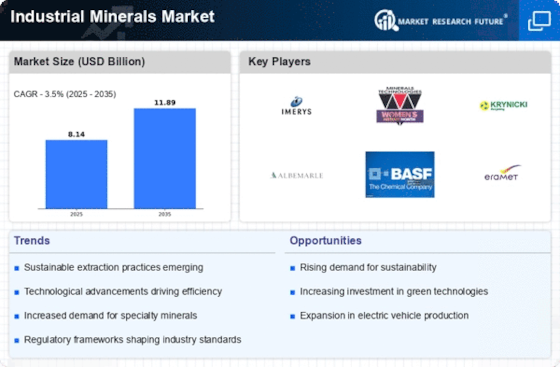
As per MRFR analysis, the Industrial Minerals Market was estimated at 8.14 USD Billion in 2024. The Industrial Minerals industry is projected to grow from 8.425 USD Billion in 2025 to 11.89 USD Billion by 2035, exhibiting a compound annual growth rate (CAGR) of 3.5 during the forecast period 2025 - 2035.

Key Market Trends & Highlights

The Industrial Minerals Market is currently experiencing a robust growth trajectory driven by sustainability and technological advancements.

  • North America remains the largest market for industrial minerals, primarily due to its extensive construction activities.
  • The Asia-Pacific region is emerging as the fastest-growing market, fueled by rapid industrialization and urbanization.
  • Limestone continues to dominate as the largest segment, while Silicon Dioxide is witnessing the fastest growth due to its diverse applications.
  • Rising demand for construction materials and technological innovations in mineral processing are key drivers propelling market expansion.

Market Size & Forecast

2024 Market Size 8.14 (USD Billion)
2035 Market Size 11.89 (USD Billion)
CAGR (2025 - 2035) 3.5%
Largest Regional Market Share in 2024 Asia Pacific

Major Players

<p>Imerys (FR), Minerals Technologies Inc. (US), Sibelco (BE), Albemarle Corporation (US), BASF SE (DE), Eramet (FR), Rio Tinto (GB), FMC Corporation (US), KMG Chemicals (US)</p>

Market Trends

The Industrial Minerals Market is currently experiencing a dynamic phase characterized by evolving demand patterns and technological advancements. Various sectors, including construction, agriculture, and manufacturing, are increasingly relying on industrial minerals for their diverse applications. This reliance is driven by the need for sustainable materials that can enhance product performance and reduce environmental impact. As industries seek to innovate and improve efficiency, the role of industrial minerals becomes more pronounced, suggesting a potential for growth in this sector. Furthermore, the market appears to be influenced by regulatory frameworks that promote the use of eco-friendly materials, which may lead to shifts in sourcing and production practices. In addition, the Industrial Minerals Market is witnessing a trend towards consolidation among suppliers, which could reshape competitive dynamics. Companies are exploring strategic partnerships and mergers to enhance their market presence and expand their product offerings. This consolidation may lead to increased efficiency and innovation, as larger entities leverage resources and expertise. Overall, the Industrial Minerals Market seems poised for transformation, driven by both demand-side factors and supply-side strategies that aim to meet the evolving needs of various industries.

Sustainability Initiatives

The Industrial Minerals Market is increasingly influenced by sustainability initiatives, as companies strive to adopt environmentally friendly practices. This trend reflects a growing awareness of the ecological impact of mineral extraction and processing. As a result, businesses are exploring alternative materials and methods that minimize environmental footprints, potentially reshaping sourcing strategies.

Technological Advancements

Technological advancements are playing a crucial role in the evolution of the Industrial Minerals Market. Innovations in extraction and processing techniques are enhancing efficiency and reducing costs. These developments may lead to improved product quality and performance, thereby attracting new applications across various industries.

Regulatory Influences

Regulatory influences are shaping the landscape of the Industrial Minerals Market, as governments implement policies aimed at promoting sustainable practices. Compliance with these regulations may drive companies to adapt their operations, potentially leading to shifts in market dynamics and competitive positioning.

Industrial Minerals Market Market Drivers

Emerging Markets and Economic Growth

Emerging markets are playing a pivotal role in the growth of the Industrial Minerals Market. Countries experiencing rapid economic development are increasing their consumption of industrial minerals, driven by infrastructure projects and industrialization. For instance, regions in Asia and Africa are witnessing significant investments in construction and manufacturing, leading to heightened demand for minerals such as gypsum, kaolin, and barite. Market analysts suggest that this trend could result in a compound annual growth rate of approximately 4% in the industrial minerals sector over the next decade. As these economies continue to expand, the Industrial Minerals Market is likely to benefit from increased exports and new market opportunities.

Environmental Regulations and Compliance

The Industrial Minerals Market is increasingly influenced by environmental regulations and compliance requirements. Governments are implementing stricter guidelines to mitigate the environmental impact of mining and mineral processing activities. This trend is prompting companies to adopt more sustainable practices, such as reducing waste and minimizing emissions. Compliance with these regulations may lead to increased operational costs; however, it also presents opportunities for innovation and differentiation. Companies that proactively embrace sustainable practices are likely to enhance their market position and appeal to environmentally conscious consumers. As the regulatory landscape continues to evolve, the Industrial Minerals Market must adapt to these changes to remain competitive and compliant.

Rising Demand for Construction Materials

The Industrial Minerals Market is experiencing a notable surge in demand for construction materials, driven by urbanization and infrastructure development. As countries invest in building projects, the need for minerals such as limestone, clay, and sand increases. According to recent data, the construction sector is projected to grow at a compound annual growth rate of approximately 5.5% over the next five years. This growth is likely to bolster the demand for industrial minerals, which are essential for producing cement, concrete, and other construction materials. Furthermore, the shift towards sustainable building practices may also influence the types of minerals utilized, as eco-friendly alternatives gain traction. Consequently, the Industrial Minerals Market is poised to benefit from this expanding construction landscape.

Growing Applications in the Electronics Sector

The Industrial Minerals Market is witnessing a growing demand for minerals used in the electronics sector. Minerals such as talc, mica, and graphite are essential components in the production of electronic devices, including smartphones, tablets, and electric vehicles. The increasing reliance on technology and the rise of smart devices are driving this trend. Market data indicates that the electronics industry is expected to grow at a rate of around 6% annually, further propelling the demand for industrial minerals. Additionally, the shift towards renewable energy technologies, such as solar panels and batteries, is likely to create new opportunities for mineral suppliers. This evolving landscape underscores the importance of the Industrial Minerals Market in supporting technological advancements.

Technological Innovations in Mineral Processing

Technological advancements in mineral processing are reshaping the Industrial Minerals Market. Innovations such as automated sorting, advanced crushing techniques, and enhanced extraction methods are improving efficiency and reducing costs. For instance, the implementation of artificial intelligence and machine learning in mineral processing has shown potential to optimize operations and increase yield. As a result, companies are likely to achieve higher profitability while minimizing environmental impact. Moreover, these technologies may facilitate the extraction of previously unviable mineral deposits, thereby expanding the resource base. The ongoing investment in research and development within the Industrial Minerals Market suggests a trend towards more sustainable and efficient practices, which could redefine competitive dynamics.

Market Segment Insights

By Type: Limestone (Largest) vs. Silicon Dioxide (Fastest-Growing)

<p>In the industrial minerals market, the 'Type' segment showcases a diverse range of products, with limestone leading in market share due to its extensive usage in construction and manufacturing. Red ocher and dolomite follow, serving niche applications in pigments and agricultural lime, respectively. Silicon dioxide is also a notable contender, reflecting a significant segment in electronics and glass production, rounding out the competitive landscape.</p>

<p>Limestone (Dominant) vs. Silicon Dioxide (Emerging)</p>

<p>Limestone is recognized as the dominant player in the 'Type' segment, primarily due to its versatility and application in various industries, such as construction and infrastructure development. It stands out for its abundance and cost-effectiveness. In contrast, silicon dioxide is emerging, driven by increased demand in the tech industry, especially in manufacturing glass and electronics. This sector is experiencing rapid growth fueled by advancements in technology and increased production rates, indicating its potential for future expansion in the industrial minerals market.</p>

By Application: Building Materials (Largest) vs. Ceramics (Fastest-Growing)

<p>The Industrial Minerals Market is significantly influenced by its application segments, with Building Materials holding the largest market share. This segment encompasses a range of products essential for construction and infrastructure, making it a critical player in the industry's growth. In contrast, Ceramics is emerging as the fastest-growing segment due to its diverse applications in industries such as electronics and medical devices, which are expanding rapidly.</p>

<p>Building Materials (Dominant) vs. Ceramics (Emerging)</p>

<p>The Building Materials segment stands out as a dominant force in the Industrial Minerals Market, fueled by the ongoing demand for construction and renovation projects. This segment includes essential products such as cement, lime, and aggregates that contribute to infrastructure development. On the other hand, the Ceramics segment has rapidly gained traction as an emerging player, driven by advancements in technology that enhance product performance and multifunctionality. Ceramics are widely utilized in innovative applications, including advanced electronics and medical devices, due to their unique properties such as thermal resistance and durability.</p>

Get more detailed insights about Industrial Minerals Market Research Report - Global Forecast by 2035

Regional Insights

North America : Innovation and Demand Growth

North America is witnessing robust growth in the industrial minerals market, driven by increasing demand from construction, automotive, and electronics sectors. The U.S. holds the largest market share at approximately 70%, followed by Canada at around 15%. Regulatory support for sustainable mining practices and environmental compliance is further catalyzing market expansion. Leading countries in this region include the United States and Canada, with key players such as Minerals Technologies Inc. and Albemarle Corporation dominating the landscape. The competitive environment is characterized by innovation in product offerings and strategic partnerships, ensuring a steady supply of high-quality industrial minerals to meet diverse industrial needs.

Europe : Sustainability and Innovation Focus

Europe's industrial minerals market is characterized by a strong emphasis on sustainability and innovation, with a market share led by Germany at 30% and France at 20%. The European Union's stringent regulations on environmental protection and resource management are driving companies to adopt sustainable practices, thereby enhancing market growth. Key players in this region include BASF SE and Sibelco, with Germany and France leading in production and consumption. The competitive landscape is marked by a focus on R&D, enabling companies to develop advanced materials that meet the evolving demands of various industries, including construction and automotive.

Asia-Pacific : Emerging Markets and Growth Potential

The Asia-Pacific region is emerging as a powerhouse in the industrial minerals market, driven by rapid industrialization and urbanization, particularly in countries like China and India. China holds the largest market share at approximately 50%, with India following at around 15%. The region's growth is further supported by government initiatives aimed at infrastructure development and mineral resource management. Leading countries include China, India, and Japan, with significant contributions from local players and multinational corporations. The competitive landscape is evolving, with companies focusing on technological advancements and sustainable practices to meet the increasing demand for industrial minerals across various sectors, including construction and electronics.

Middle East and Africa : Resource-Rich Opportunities

The Middle East and Africa region is witnessing a growing demand for industrial minerals, primarily driven by infrastructure development and mining activities. Countries like South Africa and the UAE are leading the market, with South Africa holding approximately 25% of the market share, followed by the UAE at 15%. Regulatory frameworks are evolving to support sustainable mining practices, which is crucial for long-term growth. Key players in this region include Eramet and Rio Tinto, with a competitive landscape that is increasingly attracting foreign investment. The focus on resource extraction and processing is creating opportunities for local companies to expand their operations and enhance their market presence, particularly in the construction and manufacturing sectors.

Key Players and Competitive Insights

Leading market players are investing heavily in research and development to expand their product lines, which will help the Industrial Minerals Market, grow even more. Market participants are also undertaking a variety of strategic activities to expand their footprint, with important market developments including new product launches, contractual agreements, mergers and acquisitions, higher investments, and collaboration with other organizations. To expand and survive in a more competitive and rising market climate, the Industrial Minerals industry must offer cost-effective items.

Manufacturing locally to minimize operational costs is one of the key business tactics used by manufacturers in the Industrial Minerals industry to benefit clients and increase the market sector. In recent years, the Industrial Minerals industry has offered some of the most significant advantages to the manufacturing and construction sectors, providing essential raw materials for diverse applications. Major players in the Industrial Minerals Market, include Gentor Resources Inc., Alamos Gold Inc., Koza Altin Isletmeleri, Anatolia Energy Ltd, and Stratex International.

P.l.c., Alara Resources Ltd, First Quantum Minerals Ltd., Invictus Gold Ltd., Columbus Copper Corp., Centerra Gold Inc., Eldorado Gold Corp., Diamond Fields International Ltd, Ruukki Group, Eurasian Minerals Inc., National Iranian Copper Corp are attempting to increase market demand by investing in research and development operations.

Alamos Gold Inc (Alamos) is a mining and metals company engaged in the exploration, acquisition, development, and extraction of gold. Its operations include the Young-Davidson and Island Gold mines in Canada, as well as the Mulatos mine in Sonora, Mexico. The company also possesses gold development projects like Agi Dagii and Kirazland Camyurt in Turkey, Lynn Lake in Canada, and Esperanza in Mexico. Additionally, Alamos acquired a 100% interest in the Quartz Mountain gold project in the U.S.

Through its Mexican subsidiaries, the company offers labor-related services for Minas de Oro Nacional in Hermosillo, Mexico, and Minera Santa Rita, S de R.L. de C.V., in Caborca, Mexico. Alamos Gold Inc is headquartered in Toronto, Ontario, Canada.

First Quantum Minerals Ltd (FQM) is a mining and metals company involved in the exploration, development, mining, and refining of various metals and minerals, including copper, gold, zinc, nickel, silver, and copper cathode. Its key mining operations encompass the Kansanshi copper mine, Trident copper mine, Ravensthorpe nickel, and Cobre Panama mines. FQM also possesses development projects such as Guelb Moghrein copper-gold mine, Las Cruces copper mine, Pyhasalmi copper-zinc mine, Cayeli copper-zinc mine, Taca Taca, and Haquira project. The company's mining activities span across Zambia, Mauritania, Argentina, Panama, Peru, Finland, Australia, Turkey, and Spain.

FQM has its headquarters in Toronto, Ontario, Canada.

Key Companies in the Industrial Minerals Market market include

Industry Developments

October 2022: In October 2022, KaMin LLC, a prominent supplier engaged in mining, manufacturing, and distributing a diverse range of minerals and associated solutions, completed the acquisition of BASF's kaolin business segment in the United States. This transaction encompasses four production sites, two processing facilities, and mining operations.

Future Outlook

Industrial Minerals Market Future Outlook

<p>The Industrial Minerals Market is projected to grow at a 3.5% CAGR from 2024 to 2035, driven by increasing demand in construction, technology, and environmental applications.</p>

New opportunities lie in:

  • <p>Expansion into sustainable mining technologies</p>
  • <p>Development of high-performance mineral composites</p>
  • <p>Strategic partnerships for advanced mineral processing solutions</p>

<p>By 2035, the market is expected to achieve robust growth, driven by innovation and strategic initiatives.</p>

Market Segmentation

Industrial Minerals Market Type Outlook

  • Red Ocher
  • Limestone
  • Silicon Dioxide (SiO2)
  • Dolomite (CaMg(CO3)2)
  • Others

Industrial Minerals Market Application Outlook

  • Building Materials
  • Paint
  • Ceramics
  • Glass
  • Plastics
  • Paper
  • Electronics
  • Detergents
  • Medications and Medical Devices
  • Others

Report Scope

MARKET SIZE 20248.14(USD Billion)
MARKET SIZE 20258.425(USD Billion)
MARKET SIZE 203511.89(USD Billion)
COMPOUND ANNUAL GROWTH RATE (CAGR)3.5% (2024 - 2035)
REPORT COVERAGERevenue Forecast, Competitive Landscape, Growth Factors, and Trends
BASE YEAR2024
Market Forecast Period2025 - 2035
Historical Data2019 - 2024
Market Forecast UnitsUSD Billion
Key Companies ProfiledMarket analysis in progress
Segments CoveredMarket segmentation analysis in progress
Key Market OpportunitiesGrowing demand for sustainable materials drives innovation in the Industrial Minerals Market.
Key Market DynamicsRising demand for sustainable construction materials drives innovation and competition in the industrial minerals sector.
Countries CoveredNorth America, Europe, APAC, South America, MEA

FAQs

What is the projected market valuation of the Industrial Minerals Market by 2035?

The Industrial Minerals Market is projected to reach a valuation of 11.89 USD Billion by 2035.

What was the market valuation of the Industrial Minerals Market in 2024?

In 2024, the overall market valuation of the Industrial Minerals Market was 8.14 USD Billion.

What is the expected CAGR for the Industrial Minerals Market from 2025 to 2035?

The expected CAGR for the Industrial Minerals Market during the forecast period 2025 - 2035 is 3.5%.

Which companies are considered key players in the Industrial Minerals Market?

Key players in the Industrial Minerals Market include Imerys, Minerals Technologies Inc., Sibelco, Albemarle Corporation, BASF SE, Eramet, Rio Tinto, FMC Corporation, and KMG Chemicals.

What are the projected valuations for Red Ocher in the Industrial Minerals Market?

The projected valuation for Red Ocher in the Industrial Minerals Market is expected to rise from 0.81 USD Billion in 2024 to 1.15 USD Billion by 2035.

How does the valuation of Limestone change from 2024 to 2035?

The valuation of Limestone is anticipated to increase from 2.45 USD Billion in 2024 to 3.5 USD Billion by 2035.

  1. SECTION I: EXECUTIVE SUMMARY AND KEY HIGHLIGHTS
    1. EXECUTIVE SUMMARY
      1. Market Overview
      2. Key Findings
      3. Market Segmentation
      4. Competitive Landscape
      5. Challenges and Opportunities
      6. Future Outlook
  2. SECTION II: SCOPING, METHODOLOGY AND MARKET STRUCTURE
    1. MARKET INTRODUCTION
      1. Definition
      2. Scope of the study
    2. RESEARCH METHODOLOGY
      1. Overview
      2. Data Mining
      3. Secondary Research
      4. Primary Research
      5. Forecasting Model
      6. Market Size Estimation
      7. Data Triangulation
      8. Validation
  3. SECTION III: QUALITATIVE ANALYSIS
    1. MARKET DYNAMICS
      1. Overview
      2. Drivers
      3. Restraints
      4. Opportunities
    2. MARKET FACTOR ANALYSIS
      1. Value chain Analysis
      2. Porter's Five Forces Analysis
      3. COVID-19 Impact Analysis
  4. SECTION IV: QUANTITATIVE ANALYSIS
    1. Chemicals and Materials, BY Type (USD Billion)
      1. Red Ocher
      2. Limestone
      3. Silicon Dioxide (SiO2)
      4. Dolomite (CaMg(CO3)2)
      5. Others
    2. Chemicals and Materials, BY Application (USD Billion)
      1. Building Materials
      2. Paint
      3. Ceramics
      4. Glass
      5. Plastics
      6. Paper
      7. Electronics
      8. Detergents
      9. Medications and Medical Devices
      10. Others
    3. Chemicals and Materials, BY Region (USD Billion)
      1. North America
      2. Europe
      3. APAC
      4. South America
      5. MEA
  5. SECTION V: COMPETITIVE ANALYSIS
    1. Competitive Landscape
      1. Overview
      2. Competitive Analysis
      3. Market share Analysis
      4. Major Growth Strategy in the Chemicals and Materials
      5. Competitive Benchmarking
      6. Leading Players in Terms of Number of Developments in the Chemicals and Materials
      7. Key developments and growth strategies
      8. Major Players Financial Matrix
    2. Company Profiles
      1. Imerys (FR)
      2. Minerals Technologies Inc. (US)
      3. Sibelco (BE)
      4. Albemarle Corporation (US)
      5. BASF SE (DE)
      6. Eramet (FR)
      7. Rio Tinto (GB)
      8. FMC Corporation (US)
      9. KMG Chemicals (US)
    3. Appendix
      1. References
      2. Related Reports
  6. LIST OF FIGURES
    1. MARKET SYNOPSIS
    2. NORTH AMERICA MARKET ANALYSIS
    3. US MARKET ANALYSIS BY TYPE
    4. US MARKET ANALYSIS BY APPLICATION
    5. CANADA MARKET ANALYSIS BY TYPE
    6. CANADA MARKET ANALYSIS BY APPLICATION
    7. EUROPE MARKET ANALYSIS
    8. GERMANY MARKET ANALYSIS BY TYPE
    9. GERMANY MARKET ANALYSIS BY APPLICATION
    10. UK MARKET ANALYSIS BY TYPE
    11. UK MARKET ANALYSIS BY APPLICATION
    12. FRANCE MARKET ANALYSIS BY TYPE
    13. FRANCE MARKET ANALYSIS BY APPLICATION
    14. RUSSIA MARKET ANALYSIS BY TYPE
    15. RUSSIA MARKET ANALYSIS BY APPLICATION
    16. ITALY MARKET ANALYSIS BY TYPE
    17. ITALY MARKET ANALYSIS BY APPLICATION
    18. SPAIN MARKET ANALYSIS BY TYPE
    19. SPAIN MARKET ANALYSIS BY APPLICATION
    20. REST OF EUROPE MARKET ANALYSIS BY TYPE
    21. REST OF EUROPE MARKET ANALYSIS BY APPLICATION
    22. APAC MARKET ANALYSIS
    23. CHINA MARKET ANALYSIS BY TYPE
    24. CHINA MARKET ANALYSIS BY APPLICATION
    25. INDIA MARKET ANALYSIS BY TYPE
    26. INDIA MARKET ANALYSIS BY APPLICATION
    27. JAPAN MARKET ANALYSIS BY TYPE
    28. JAPAN MARKET ANALYSIS BY APPLICATION
    29. SOUTH KOREA MARKET ANALYSIS BY TYPE
    30. SOUTH KOREA MARKET ANALYSIS BY APPLICATION
    31. MALAYSIA MARKET ANALYSIS BY TYPE
    32. MALAYSIA MARKET ANALYSIS BY APPLICATION
    33. THAILAND MARKET ANALYSIS BY TYPE
    34. THAILAND MARKET ANALYSIS BY APPLICATION
    35. INDONESIA MARKET ANALYSIS BY TYPE
    36. INDONESIA MARKET ANALYSIS BY APPLICATION
    37. REST OF APAC MARKET ANALYSIS BY TYPE
    38. REST OF APAC MARKET ANALYSIS BY APPLICATION
    39. SOUTH AMERICA MARKET ANALYSIS
    40. BRAZIL MARKET ANALYSIS BY TYPE
    41. BRAZIL MARKET ANALYSIS BY APPLICATION
    42. MEXICO MARKET ANALYSIS BY TYPE
    43. MEXICO MARKET ANALYSIS BY APPLICATION
    44. ARGENTINA MARKET ANALYSIS BY TYPE
    45. ARGENTINA MARKET ANALYSIS BY APPLICATION
    46. REST OF SOUTH AMERICA MARKET ANALYSIS BY TYPE
    47. REST OF SOUTH AMERICA MARKET ANALYSIS BY APPLICATION
    48. MEA MARKET ANALYSIS
    49. GCC COUNTRIES MARKET ANALYSIS BY TYPE
    50. GCC COUNTRIES MARKET ANALYSIS BY APPLICATION
    51. SOUTH AFRICA MARKET ANALYSIS BY TYPE
    52. SOUTH AFRICA MARKET ANALYSIS BY APPLICATION
    53. REST OF MEA MARKET ANALYSIS BY TYPE
    54. REST OF MEA MARKET ANALYSIS BY APPLICATION
    55. KEY BUYING CRITERIA OF CHEMICALS AND MATERIALS
    56. RESEARCH PROCESS OF MRFR
    57. DRO ANALYSIS OF CHEMICALS AND MATERIALS
    58. DRIVERS IMPACT ANALYSIS: CHEMICALS AND MATERIALS
    59. RESTRAINTS IMPACT ANALYSIS: CHEMICALS AND MATERIALS
    60. SUPPLY / VALUE CHAIN: CHEMICALS AND MATERIALS
    61. CHEMICALS AND MATERIALS, BY TYPE, 2024 (% SHARE)
    62. CHEMICALS AND MATERIALS, BY TYPE, 2024 TO 2035 (USD Billion)
    63. CHEMICALS AND MATERIALS, BY APPLICATION, 2024 (% SHARE)
    64. CHEMICALS AND MATERIALS, BY APPLICATION, 2024 TO 2035 (USD Billion)
    65. BENCHMARKING OF MAJOR COMPETITORS
  7. LIST OF TABLES
    1. LIST OF ASSUMPTIONS
    2. North America MARKET SIZE ESTIMATES; FORECAST
      1. BY TYPE, 2025-2035 (USD Billion)
      2. BY APPLICATION, 2025-2035 (USD Billion)
    3. US MARKET SIZE ESTIMATES; FORECAST
      1. BY TYPE, 2025-2035 (USD Billion)
      2. BY APPLICATION, 2025-2035 (USD Billion)
    4. Canada MARKET SIZE ESTIMATES; FORECAST
      1. BY TYPE, 2025-2035 (USD Billion)
      2. BY APPLICATION, 2025-2035 (USD Billion)
    5. Europe MARKET SIZE ESTIMATES; FORECAST
      1. BY TYPE, 2025-2035 (USD Billion)
      2. BY APPLICATION, 2025-2035 (USD Billion)
    6. Germany MARKET SIZE ESTIMATES; FORECAST
      1. BY TYPE, 2025-2035 (USD Billion)
      2. BY APPLICATION, 2025-2035 (USD Billion)
    7. UK MARKET SIZE ESTIMATES; FORECAST
      1. BY TYPE, 2025-2035 (USD Billion)
      2. BY APPLICATION, 2025-2035 (USD Billion)
    8. France MARKET SIZE ESTIMATES; FORECAST
      1. BY TYPE, 2025-2035 (USD Billion)
      2. BY APPLICATION, 2025-2035 (USD Billion)
    9. Russia MARKET SIZE ESTIMATES; FORECAST
      1. BY TYPE, 2025-2035 (USD Billion)
      2. BY APPLICATION, 2025-2035 (USD Billion)
    10. Italy MARKET SIZE ESTIMATES; FORECAST
      1. BY TYPE, 2025-2035 (USD Billion)
      2. BY APPLICATION, 2025-2035 (USD Billion)
    11. Spain MARKET SIZE ESTIMATES; FORECAST
      1. BY TYPE, 2025-2035 (USD Billion)
      2. BY APPLICATION, 2025-2035 (USD Billion)
    12. Rest of Europe MARKET SIZE ESTIMATES; FORECAST
      1. BY TYPE, 2025-2035 (USD Billion)
      2. BY APPLICATION, 2025-2035 (USD Billion)
    13. APAC MARKET SIZE ESTIMATES; FORECAST
      1. BY TYPE, 2025-2035 (USD Billion)
      2. BY APPLICATION, 2025-2035 (USD Billion)
    14. China MARKET SIZE ESTIMATES; FORECAST
      1. BY TYPE, 2025-2035 (USD Billion)
      2. BY APPLICATION, 2025-2035 (USD Billion)
    15. India MARKET SIZE ESTIMATES; FORECAST
      1. BY TYPE, 2025-2035 (USD Billion)
      2. BY APPLICATION, 2025-2035 (USD Billion)
    16. Japan MARKET SIZE ESTIMATES; FORECAST
      1. BY TYPE, 2025-2035 (USD Billion)
      2. BY APPLICATION, 2025-2035 (USD Billion)
    17. South Korea MARKET SIZE ESTIMATES; FORECAST
      1. BY TYPE, 2025-2035 (USD Billion)
      2. BY APPLICATION, 2025-2035 (USD Billion)
    18. Malaysia MARKET SIZE ESTIMATES; FORECAST
      1. BY TYPE, 2025-2035 (USD Billion)
      2. BY APPLICATION, 2025-2035 (USD Billion)
    19. Thailand MARKET SIZE ESTIMATES; FORECAST
      1. BY TYPE, 2025-2035 (USD Billion)
      2. BY APPLICATION, 2025-2035 (USD Billion)
    20. Indonesia MARKET SIZE ESTIMATES; FORECAST
      1. BY TYPE, 2025-2035 (USD Billion)
      2. BY APPLICATION, 2025-2035 (USD Billion)
    21. Rest of APAC MARKET SIZE ESTIMATES; FORECAST
      1. BY TYPE, 2025-2035 (USD Billion)
      2. BY APPLICATION, 2025-2035 (USD Billion)
    22. South America MARKET SIZE ESTIMATES; FORECAST
      1. BY TYPE, 2025-2035 (USD Billion)
      2. BY APPLICATION, 2025-2035 (USD Billion)
    23. Brazil MARKET SIZE ESTIMATES; FORECAST
      1. BY TYPE, 2025-2035 (USD Billion)
      2. BY APPLICATION, 2025-2035 (USD Billion)
    24. Mexico MARKET SIZE ESTIMATES; FORECAST
      1. BY TYPE, 2025-2035 (USD Billion)
      2. BY APPLICATION, 2025-2035 (USD Billion)
    25. Argentina MARKET SIZE ESTIMATES; FORECAST
      1. BY TYPE, 2025-2035 (USD Billion)
      2. BY APPLICATION, 2025-2035 (USD Billion)
    26. Rest of South America MARKET SIZE ESTIMATES; FORECAST
      1. BY TYPE, 2025-2035 (USD Billion)
      2. BY APPLICATION, 2025-2035 (USD Billion)
    27. MEA MARKET SIZE ESTIMATES; FORECAST
      1. BY TYPE, 2025-2035 (USD Billion)
      2. BY APPLICATION, 2025-2035 (USD Billion)
    28. GCC Countries MARKET SIZE ESTIMATES; FORECAST
      1. BY TYPE, 2025-2035 (USD Billion)
      2. BY APPLICATION, 2025-2035 (USD Billion)
    29. South Africa MARKET SIZE ESTIMATES; FORECAST
      1. BY TYPE, 2025-2035 (USD Billion)
      2. BY APPLICATION, 2025-2035 (USD Billion)
    30. Rest of MEA MARKET SIZE ESTIMATES; FORECAST
      1. BY TYPE, 2025-2035 (USD Billion)
      2. BY APPLICATION, 2025-2035 (USD Billion)
    31. PRODUCT LAUNCH/PRODUCT DEVELOPMENT/APPROVAL
    32. ACQUISITION/PARTNERSHIP

Market Segmentation S

Industrial Minerals Market Type Outlook (USD Billion, 2018-2032)

  • Red Ocher
  • Limestone
  • Silicon Dioxide (SiO2)
  • Dolomite (CaMg(CO3)2)
  • Others

Industrial Minerals Market Application Outlook (USD Billion, 2018-2032)

  • Building Materials
  • Paint
  • Ceramics
  • Glass
  • Plastics
  • Paper
  • Electronics
  • Detergents
  • Medications and Medical Devices
  • Others

Industrial Minerals Market Regional Outlook (USD Billion, 2018-2032)

  • North America Outlook (USD Billion, 2018-2032)

    • North America Industrial Minerals Market by Type

      • Red Ocher
      • Limestone
      • Silicon Dioxide (SiO2)
      • Dolomite (CaMg(CO3)2)
      • Others
    • North America Industrial Minerals Market by Application

      • Building Materials
      • Paint
      • Ceramics
      • Glass
      • Plastics
      • Paper
      • Electronics
      • Detergents
      • Medications and Medical Devices
      • Others
      •  
    • US Outlook (USD Billion, 2018-2032)

    • US Industrial Minerals Market by Type
      • Red Ocher
      • Limestone
      • Silicon Dioxide (SiO2)
      • Dolomite (CaMg(CO3)2)
      • Others
    • US Industrial Minerals Market by Application
      • Building Materials
      • Paint
      • Ceramics
      • Glass
      • Plastics
      • Paper
      • Electronics
      • Detergents
      • Medications and Medical Devices
      • Others
    • CANADA Outlook (USD Billion, 2018-2032)

    • CANADA Industrial Minerals Market by Type
      • Red Ocher
      • Limestone
      • Silicon Dioxide (SiO2)
      • Dolomite (CaMg(CO3)2)
      • Others
    • CANADA Industrial Minerals Market by Application

      • Building Materials
      • Paint
      • Ceramics
      • Glass
      • Plastics
      • Paper
      • Electronics
      • Detergents
      • Medications and Medical Devices
      • Others
  • Europe Outlook (USD Billion, 2018-2032)

    • Europe Industrial Minerals Market by Type
      • Red Ocher
      • Limestone
      • Silicon Dioxide (SiO2)
      • Dolomite (CaMg(CO3)2)
      • Others
    • Europe Industrial Minerals Market by Application
      • Building Materials
      • Paint
      • Ceramics
      • Glass
      • Plastics
      • Paper
      • Electronics
      • Detergents
      • Medications and Medical Devices
      • Others
    • Germany Outlook (USD Billion, 2018-2032)

    • Germany Industrial Minerals Market by Type
      • Red Ocher
      • Limestone
      • Silicon Dioxide (SiO2)
      • Dolomite (CaMg(CO3)2)
      • Others
    • Germany Industrial Minerals Market by Application
      • Building Materials
      • Paint
      • Ceramics
      • Glass
      • Plastics
      • Paper
      • Electronics
      • Detergents
      • Medications and Medical Devices
      • Others
    • France Outlook (USD Billion, 2018-2032)

    • France Industrial Minerals Market by Type
      • Red Ocher
      • Limestone
      • Silicon Dioxide (SiO2)
      • Dolomite (CaMg(CO3)2)
      • Others
    • France Industrial Minerals Market by Application
      • Building Materials
      • Paint
      • Ceramics
      • Glass
      • Plastics
      • Paper
      • Electronics
      • Detergents
      • Medications and Medical Devices
      • Others
    • UK Outlook (USD Billion, 2018-2032)

    • UK Industrial Minerals Market by Type
      • Red Ocher
      • Limestone
      • Silicon Dioxide (SiO2)
      • Dolomite (CaMg(CO3)2)
      • Others
    • UK Industrial Minerals Market by Application
      • Building Materials
      • Paint
      • Ceramics
      • Glass
      • Plastics
      • Paper
      • Electronics
      • Detergents
      • Medications and Medical Devices
      • Others
    • ITALY Outlook (USD Billion, 2018-2032)

    • ITALY Industrial Minerals Market by Type
      • Red Ocher
      • Limestone
      • Silicon Dioxide (SiO2)
      • Dolomite (CaMg(CO3)2)
      • Others
    • ITALY Industrial Minerals Market by Application
      • Building Materials
      • Paint
      • Ceramics
      • Glass
      • Plastics
      • Paper
      • Electronics
      • Detergents
      • Medications and Medical Devices
      • Others
    • SPAIN Outlook (USD Billion, 2018-2032)

    • Spain Industrial Minerals Market by Type
      • Red Ocher
      • Limestone
      • Silicon Dioxide (SiO2)
      • Dolomite (CaMg(CO3)2)
      • Others
    • Spain Industrial Minerals Market by Application
      • Building Materials
      • Paint
      • Ceramics
      • Glass
      • Plastics
      • Paper
      • Electronics
      • Detergents
      • Medications and Medical Devices
      • Others
    • Rest Of Europe Outlook (USD Billion, 2018-2032)

    • Rest Of Europe Industrial Minerals Market by Type
      • Red Ocher
      • Limestone
      • Silicon Dioxide (SiO2)
      • Dolomite (CaMg(CO3)2)
      • Others
    • Rest Of Europe Industrial Minerals Market by Application
      • Building Materials
      • Paint
      • Ceramics
      • Glass
      • Plastics
      • Paper
      • Electronics
      • Detergents
      • Medications and Medical Devices
      • Others
  • Asia-Pacific Outlook (USD Billion, 2018-2032)

    • Asia-Pacific Industrial Minerals Market by Type
      • Red Ocher
      • Limestone
      • Silicon Dioxide (SiO2)
      • Dolomite (CaMg(CO3)2)
      • Others
    • Asia-Pacific Industrial Minerals Market by Application
      • Building Materials
      • Paint
      • Ceramics
      • Glass
      • Plastics
      • Paper
      • Electronics
      • Detergents
      • Medications and Medical Devices
      • Others
    • China Outlook (USD Billion, 2018-2032)

    • China Industrial Minerals Market by Type
      • Red Ocher
      • Limestone
      • Silicon Dioxide (SiO2)
      • Dolomite (CaMg(CO3)2)
      • Others
    • China Industrial Minerals Market by Application
      • Building Materials
      • Paint
      • Ceramics
      • Glass
      • Plastics
      • Paper
      • Electronics
      • Detergents
      • Medications and Medical Devices
      • Others
    • Japan Outlook (USD Billion, 2018-2032)

    • Japan Industrial Minerals Market by Type
      • Red Ocher
      • Limestone
      • Silicon Dioxide (SiO2)
      • Dolomite (CaMg(CO3)2)
      • Others
    • Japan Industrial Minerals Market by Application
      • Building Materials
      • Paint
      • Ceramics
      • Glass
      • Plastics
      • Paper
      • Electronics
      • Detergents
      • Medications and Medical Devices
      • Others
    • India Outlook (USD Billion, 2018-2032)

    • India Industrial Minerals Market by Type
      • Red Ocher
      • Limestone
      • Silicon Dioxide (SiO2)
      • Dolomite (CaMg(CO3)2)
      • Others
    • India Industrial Minerals Market by Application
      • Building Materials
      • Paint
      • Ceramics
      • Glass
      • Plastics
      • Paper
      • Electronics
      • Detergents
      • Medications and Medical Devices
      • Others
    • Australia Outlook (USD Billion, 2018-2032)

    • Australia Industrial Minerals Market by Type
      • Red Ocher
      • Limestone
      • Silicon Dioxide (SiO2)
      • Dolomite (CaMg(CO3)2)
      • Others
    • Australia Industrial Minerals Market by Application
      • Building Materials
      • Paint
      • Ceramics
      • Glass
      • Plastics
      • Paper
      • Electronics
      • Detergents
      • Medications and Medical Devices
      • Others
    • Rest of Asia-Pacific Outlook (USD Billion, 2018-2032)

    • Rest of Asia-Pacific Industrial Minerals Market by Type
      • Red Ocher
      • Limestone
      • Silicon Dioxide (SiO2)
      • Dolomite (CaMg(CO3)2)
      • Others
    • Rest of Asia-Pacific Industrial Minerals Market by Application
      • Building Materials
      • Paint
      • Ceramics
      • Glass
      • Plastics
      • Paper
      • Electronics
      • Detergents
      • Medications and Medical Devices
      • Others
  • Rest of the World Outlook (USD Billion, 2018-2032)

    • Rest of the World Industrial Minerals Market by Type
      • Red Ocher
      • Limestone
      • Silicon Dioxide (SiO2)
      • Dolomite (CaMg(CO3)2)
      • Others
    • Rest of the World Industrial Minerals Market by Application
      • Building Materials
      • Paint
      • Ceramics
      • Glass
      • Plastics
      • Paper
      • Electronics
      • Detergents
      • Medications and Medical Devices
      • Others
    • Middle East Outlook (USD Billion, 2018-2032)

    • Middle East Industrial Minerals Market by Type
      • Red Ocher
      • Limestone
      • Silicon Dioxide (SiO2)
      • Dolomite (CaMg(CO3)2)
      • Others
    • Middle East Industrial Minerals Market by Application
      • Building Materials
      • Paint
      • Ceramics
      • Glass
      • Plastics
      • Paper
      • Electronics
      • Detergents
      • Medications and Medical Devices
      • Others
    • Africa Outlook (USD Billion, 2018-2032)

    • Africa Industrial Minerals Market by Type
      • Red Ocher
      • Limestone
      • Silicon Dioxide (SiO2)
      • Dolomite (CaMg(CO3)2)
      • Others
    • Africa Industrial Minerals Market by Application
      • Building Materials
      • Paint
      • Ceramics
      • Glass
      • Plastics
      • Paper
      • Electronics
      • Detergents
      • Medications and Medical Devices
      • Others
    • Latin America Outlook (USD Billion, 2018-2032)

    • Latin America Industrial Minerals Market by Type
      • Red Ocher
      • Limestone
      • Silicon Dioxide (SiO2)
      • Dolomite (CaMg(CO3)2)
      • Others
    • Latin America Industrial Minerals Market by Application
      • Building Materials
      • Paint
      • Ceramics
      • Glass
      • Plastics
      • Paper
      • Electronics
      • Detergents
      • Medications and Medical Devices
      • Others
Infographic

Free Sample Request

Kindly complete the form below to receive a free sample of this Report

Get Free Sample

Customer Strories

Compare Licence

×
Features License Type
Single User Multiuser License Enterprise User
Price $4,950 $5,950 $7,250
Maximum User Access Limit 1 User Upto 10 Users Unrestricted Access Throughout the Organization
Free Customization
Direct Access to Analyst
Deliverable Format
Platform Access
Discount on Next Purchase 10% 15% 15%
Printable Versions