×
Request Free Sample ×

Kindly complete the form below to receive a free sample of this Report

* Please use a valid business email

Leading companies partner with us for data-driven Insights

clients tt-cursor
Hero Background

IT Service Management Market

ID: MRFR/ICT/0427-CR
200 Pages
Aarti Dhapte
December 2024

IT Service Management Market Research Report By Service Type (Incident Management, Problem Management, Change Management, Service Request Management, Configuration Management), By Deployment Type (On-Premises, Cloud-Based, Hybrid), By Industry (IT and Telecommunications, BFSI, Healthcare, Retail, Manufacturing), By Organization Size (Small Enterprises, Medium Enterprises, Large Enterprises), and By Regional (North America, Europe, South America, Asia Pacific, Middle East and Africa) - Forecast to 2035

Share:
Download PDF ×

We do not share your information with anyone. However, we may send you emails based on your report interest from time to time. You may contact us at any time to opt-out.

IT Service Management Market Infographic
Purchase Options

IT Service Management Market Summary

As per MRFR analysis, the IT Service Management Market Size was estimated at 13943.1 USD Billion in 2024. The IT Service Management industry is projected to grow from 15730.64 USD Billion in 2025 to 52555.31 USD Billion by 2035, exhibiting a compound annual growth rate (CAGR) of 12.82 during the forecast period 2025 - 2035.

Key Market Trends & Highlights

The IT Service Management Market is experiencing robust growth driven by technological advancements and evolving customer needs.

  • The integration of Artificial Intelligence is transforming service delivery and operational efficiency in the IT Service Management Market.
  • North America remains the largest market, while the Asia-Pacific region is emerging as the fastest-growing area for IT service solutions.
  • Cloud-Based solutions dominate the market, whereas Hybrid models are rapidly gaining traction due to their flexibility.
  • Growing demand for automation and rising cybersecurity concerns are key drivers propelling the market forward.

Market Size & Forecast

2024 Market Size 13943.1 (USD Billion)
2035 Market Size 52555.31 (USD Billion)
CAGR (2025 - 2035) 12.82%

Major Players

ServiceNow (US), BMC Software (US), Atlassian (AU), Cherwell Software (US), Micro Focus (GB), IBM (US), Freshservice (IN), ManageEngine (IN), SAP (DE)

IT Service Management Market Trends

The IT Service Management Market is currently experiencing a transformative phase, driven by the increasing demand for efficient service delivery and enhanced customer experiences. Organizations are increasingly recognizing the necessity of integrating advanced technologies such as artificial intelligence and automation into their service management frameworks. This integration not only streamlines operations but also fosters a proactive approach to incident management and service requests. As businesses strive for agility and responsiveness, the IT Service Management Market appears poised for substantial growth, with a focus on aligning IT services with broader business objectives. Moreover, the shift towards cloud-based solutions is reshaping the landscape of the IT Service Management Market. Companies are gravitating towards Software as a Service (SaaS) models, which offer flexibility and scalability. This trend indicates a preference for solutions that can adapt to changing business needs while minimizing infrastructure costs. Additionally, the emphasis on data-driven decision-making is likely to enhance service quality and operational efficiency. As organizations continue to evolve, the IT Service Management Market is expected to reflect these dynamic changes, positioning itself as a critical component of overall business strategy.

Integration of Artificial Intelligence

The incorporation of artificial intelligence into IT service management is becoming increasingly prevalent. AI technologies facilitate automation of routine tasks, enabling IT teams to focus on more complex issues. This trend not only enhances efficiency but also improves the overall user experience by providing faster resolutions.

Shift to Cloud-Based Solutions

A notable trend within the IT Service Management Market is the migration towards cloud-based platforms. Organizations are adopting SaaS models to leverage the benefits of scalability and flexibility. This transition allows for more efficient resource management and reduces the burden of maintaining on-premises infrastructure.

Emphasis on Data Analytics

The growing importance of data analytics in IT service management is evident. Organizations are utilizing analytics to gain insights into service performance and user behavior. This trend supports informed decision-making, ultimately leading to improved service delivery and customer satisfaction.

IT Service Management Market Drivers

Market Growth Projections

The Global IT Service Management Market Industry is poised for substantial growth, with projections indicating a market size of 37.3 USD Billion in 2024 and an anticipated increase to 70 USD Billion by 2035. This growth reflects a compound annual growth rate (CAGR) of 5.89% from 2025 to 2035. The expansion is driven by various factors, including the rising demand for automation, cloud adoption, and the increasing focus on cybersecurity. As organizations continue to invest in IT service management solutions, the market is expected to evolve, adapting to emerging technologies and changing business needs.

Rising Demand for Automation

The Global IT Service Management Market Industry experiences a notable surge in demand for automation solutions. Organizations are increasingly adopting automated processes to enhance efficiency and reduce operational costs. Automation tools streamline service delivery, enabling IT teams to focus on strategic initiatives rather than routine tasks. For instance, the integration of AI-driven chatbots in service desks has shown to improve response times significantly. As a result, the market is projected to reach 37.3 USD Billion in 2024, reflecting a growing recognition of automation's potential to transform IT service management.

Increased Focus on Cybersecurity

In the context of the Global IT Service Management Market Industry, the heightened focus on cybersecurity is a critical driver. Organizations are prioritizing the protection of sensitive data and IT infrastructure, leading to increased investments in security-focused IT service management solutions. This trend is underscored by the fact that cyber threats have escalated, prompting businesses to adopt comprehensive security frameworks. The integration of security measures within IT service management processes not only mitigates risks but also enhances overall service quality. This growing emphasis on cybersecurity is likely to contribute to the market's robust growth trajectory.

Emergence of Remote Work Solutions

The emergence of remote work solutions significantly impacts the Global IT Service Management Market Industry. As organizations adapt to flexible work environments, the demand for IT service management tools that support remote operations has surged. Solutions that facilitate remote troubleshooting, collaboration, and service delivery are becoming essential. This shift is evidenced by a reported increase in the adoption of remote access tools, which enhance productivity and service continuity. The market's growth trajectory is likely to be influenced by this trend, as businesses seek to optimize their IT services for a distributed workforce.

Regulatory Compliance and Governance

Regulatory compliance and governance requirements are increasingly influencing the Global IT Service Management Market Industry. Organizations must adhere to various regulations, such as GDPR and HIPAA, which necessitate robust IT service management practices. Compliance-driven initiatives compel businesses to invest in IT service management solutions that ensure data integrity and security. This trend is particularly evident in industries like finance and healthcare, where regulatory scrutiny is intense. As compliance becomes a strategic priority, the market is poised for growth, reflecting the need for organizations to align their IT services with regulatory standards.

Cloud Adoption and Digital Transformation

The ongoing trend of cloud adoption and digital transformation plays a pivotal role in shaping the Global IT Service Management Market Industry. Businesses are migrating to cloud-based solutions to enhance flexibility and scalability. This shift allows for improved service delivery and better resource management. According to industry reports, organizations leveraging cloud-based IT service management solutions experience a 30% reduction in operational costs. As digital transformation accelerates, the market is expected to grow significantly, with projections indicating a rise to 70 USD Billion by 2035, driven by the need for agile IT services.

Market Segment Insights

By Deployment Type: Cloud-Based (Largest) vs. Hybrid (Fastest-Growing)

The IT Service Management Market is notably segmented into three deployment types: On-Premises, Cloud-Based, and Hybrid. Currently, Cloud-Based solutions hold the largest share of the market, driven by the increasing demand for flexibility and scalability in IT operations. On-Premises solutions, while still significant, have seen a relative decline as organizations shift towards more agile deployment options to enhance productivity and efficiency. Hybrid solutions, which combine the advantages of both cloud and on-premises systems, are also gaining traction in the market. The growth trends within this segment reveal a marked shift towards Cloud-Based and Hybrid deployments. The primary drivers for this trend include the need for operational efficiency, cost-effectiveness, and the increased reliance on remote work solutions. As businesses continue to embrace digital transformation initiatives, Hybrid models that offer a blend of both environments are becoming particularly popular due to their adaptability and security features. This growth is expected to continue as organizations strive to optimize their IT service management strategies to meet ever-evolving business needs.

Cloud-Based (Dominant) vs. Hybrid (Emerging)

Cloud-Based deployment is currently the dominant force within the IT Service Management Market, characterized by its ability to deliver services over the internet, providing organizations with unmatched flexibility and ease of access. This model allows for swift updates and reduces the burden of physical infrastructure management. In contrast, Hybrid deployment emerges as an innovative solution that encapsulates the best of both worlds, combining on-premises systems with cloud services. This emerging model caters to businesses that require a mix of control and speed, allowing for a tailored approach to IT service management. With the trend shifting towards decentralization and digital-first strategies, both Cloud-Based and Hybrid deployments are set to redefine IT service delivery in the coming years.

By Service Type: Incident Management (Largest) vs. Change Management (Fastest-Growing)

In the IT Service Management Market, Incident Management holds the largest share among service types, reflecting its critical role in maintaining operational continuity and service quality. This segment is followed closely by Change Management, which, while not as dominant, is poised for rapid growth. The demand for effective incident resolution processes continues to bolster the prominence of Incident Management, while Change Management is increasingly recognized for its ability to facilitate smooth transitions in IT environments. The growth trends within this segment indicate a significant shift towards automation and integration of advanced technologies. Organizations are investing in AI-driven solutions to enhance Incident Management efficiency and are leveraging Change Management tools to minimize disruption during service updates. As businesses increasingly emphasize agility and resilience in their IT processes, Change Management emerges as a strategic focus area, driving its rapid growth alongside the existing demand for robust incident processes.

Incident Management (Dominant) vs. Service Request Management (Emerging)

Incident Management is the dominant player in the IT Service Management market, recognized for its essential functionality in promptly addressing and resolving IT issues to ensure minimal disruption to business operations. This service type is characterized by its structured approach to incident identification, classification, and resolution, emphasizing speed and efficiency. In contrast, Service Request Management is an emerging segment that focuses on managing user requests for new services or changes to existing services. While it currently holds a smaller share, it is gaining traction as organizations strive to enhance user experience and streamline service delivery. As service automation and user-centric solutions evolve, Service Request Management's importance is expected to grow, making it an area of focus for IT departments aiming to improve service efficiency.

By End User: IT Departments (Largest) vs. Managed Service Providers (Fastest-Growing)

The IT Service Management Market has seen a varied distribution of market share among its end-user segments. IT Departments hold the largest share, leveraging their established infrastructure and the need for streamlined service operations. In contrast, Managed Service Providers are rapidly gaining ground, appealing to organizations seeking outsourced IT solutions. Their flexibility and ability to scale services quickly enhance their market presence significantly. Growth trends show a robust increase in demand for IT service management solutions among Managed Service Providers, driven by the essential need for organizations to maintain operational efficiency and responsiveness. Meanwhile, IT Departments continue to grow as they adopt more advanced ITSM tools to improve service delivery. Factors such as the rise of remote work and increased reliance on digital infrastructure play key roles in shaping these trends.

IT Departments: Dominant vs. Managed Service Providers: Emerging

IT Departments are characterized by their critical role in managing and supporting internal IT services, ensuring that infrastructure aligns with business goals. They often prioritize tools that enhance efficiency, improve incident management, and provide data analytics for informed decision-making. On the other hand, Managed Service Providers are emerging as key players in the market by offering specialized IT services that allow businesses to focus on core competencies. They are gaining traction among small and medium enterprises looking for cost-effective solutions. The flexibility, expertise, and ability to provide tailored IT services make Managed Service Providers a preferred choice for many organizations, driving their growth in the IT Service Management Market.

By Organization Size: Large Enterprises (Largest) vs. Small Enterprises (Fastest-Growing)

In the IT Service Management Market, the distribution of market share among organization sizes reveals that large enterprises hold the majority of the market. This dominance is driven by their extensive resource allocations, robust infrastructures, and complex IT environments that require comprehensive management solutions. In contrast, small enterprises, while accounting for a smaller share, are experiencing rapid growth as they increasingly adopt IT service management tools to streamline their operations and improve efficiency, driven by digital transformation efforts and the need for cost-effective solutions. The growth trends for organization size in IT service management are significant, with small enterprises emerging as the fastest-growing segment. Their drive towards digitalization, adoption of cloud-based IT services, and growing awareness of the benefits of structured IT management solutions contribute to this trend. Meanwhile, large enterprises continue to invest heavily in sophisticated IT service management tools to enhance their operational efficiencies and maintain competitiveness in a fast-evolving market. This dynamic creates a diverse landscape where both segments influence market innovations and service offerings.

Large Enterprises (Dominant) vs. Small Enterprises (Emerging)

In the realm of IT Service Management, large enterprises are recognized as the dominant players due to their substantial investments in IT infrastructure and personnel. They typically require advanced IT service management solutions to handle their intricate networks and diverse operational needs. These organizations benefit from established processes and resources, enabling them to implement comprehensive service management frameworks that support scalability and a wide range of IT services. On the other hand, small enterprises are viewed as an emerging segment, increasingly embracing IT service management as a means to foster growth and enhance operational efficiency. Their agility allows for rapid implementation of innovative solutions, often through cloud offerings, leading to increased competitiveness. As digital transformation gains momentum, small enterprises are expected to play a pivotal role in the evolution of IT service management.

By Industry Vertical: Healthcare (Largest) vs. Finance (Fastest-Growing)

In the IT Service Management Market, the segmentation by industry vertical reveals a diverse allocation of market share, with healthcare emerging as the largest segment. This sector's substantial market presence is attributed to its ongoing digital transformation and the urgent need for efficient service management solutions to enhance patient care. Following closely is the finance sector, recognized as the fastest-growing segment, driven by increasing regulatory requirements and the demand for improved operational efficiency. The growth trends within these segments illustrate a clear trajectory influenced by a combination of technological advancements and evolving consumer expectations. Healthcare continues to invest heavily in ITSM to support complex operations and data management, while the finance industry rapidly adopts innovative IT solutions to mitigate risks and streamline services. This dynamic is shaping a competitive landscape in which these segments strive to enhance performance and service delivery through ITSM solutions.

Healthcare: Largest vs. Finance: Fastest-Growing

The healthcare sector stands as a dominant force in the IT Service Management Market, marked by its commitment to leveraging technology for enhanced patient outcomes and operational efficiency. Hospitals and healthcare providers are increasingly adopting ITSM tools to manage their expansive IT infrastructure, ensuring compliance with regulations and improving service delivery. On the other hand, the finance sector is emerging rapidly, driven by digital banking innovations and the pressures of regulatory compliance. Financial institutions are focusing on integrating agile ITSM solutions to meet the demands of a fast-paced, high-stakes environment. This duality showcases the healthcare sector's robust presence while highlighting the finance sector's dynamic shift towards agile ITSM solutions.

Get more detailed insights about IT Service Management Market

Regional Insights

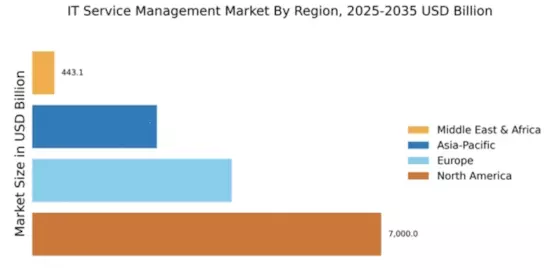
The IT Service Management Market was characterized by a diverse regional landscape, with North America emerging as a major player, valued at 15.0 USD Billion in 2024 and expected to reach 28.0 USD Billion by 2035, thus holding a significant share of the overall market.

Europe followed, valued at 10.0 USD Billion in 2024, and projected to double to 20.0 USD Billion by 2035, underlining its importance in the IT service sector. The Asia Pacific region, showing growth potential, contributed a valuation of 7.0 USD Billion in 2024, with an increase to 12.0 USD Billion anticipated by 2035.

In contrast, South America and the Middle East and Africa maintained smaller footprints, with valuations of 2.5 USD Billion and 2.78 USD Billion in 2024, growing to 5.0 USD Billion each by 2035.

North America's dominance can be attributed to its advanced technological adoption and high demand for IT solutions, while Europe's strong regulatory environment drives investment in IT service management solutions.

Additionally, the Asia Pacific market is growing due to increased digital transformation efforts, presenting ample opportunities for expansion. Overall, these regional insights reflect varied growth drivers and market trends influencing the IT Service Management Market.

Key Players and Competitive Insights

The IT Service Management Market is currently characterized by a dynamic competitive landscape, driven by the increasing demand for efficient service delivery and digital transformation across various sectors. Major players such as ServiceNow (US), BMC Software (US), and IBM (US) are strategically positioned to leverage their technological capabilities and extensive service portfolios. ServiceNow (US) focuses on innovation through its cloud-based solutions, enhancing user experience and operational efficiency. BMC Software (US) emphasizes automation and AI integration, aiming to streamline IT operations and reduce costs. Meanwhile, IBM (US) is concentrating on expanding its hybrid cloud offerings, which are pivotal in meeting the diverse needs of enterprises. Collectively, these strategies contribute to a competitive environment that is increasingly centered around technological advancement and customer-centric solutions.

In terms of business tactics, companies are adopting localized strategies to cater to regional markets, optimizing their supply chains to enhance service delivery. The market structure appears moderately fragmented, with a mix of established players and emerging startups. This fragmentation allows for a variety of service offerings, yet the influence of key players remains substantial, as they set industry standards and drive innovation.

In November 2025, ServiceNow (US) announced a strategic partnership with a leading AI firm to enhance its service automation capabilities. This collaboration is expected to bolster ServiceNow's position in the market by integrating advanced AI functionalities into its platform, thereby improving service efficiency and customer satisfaction. Such strategic moves indicate a clear trend towards leveraging AI to optimize IT service management processes.

In October 2025, BMC Software (US) launched a new suite of AI-driven tools aimed at predictive analytics for IT operations. This initiative is significant as it positions BMC at the forefront of the AI integration trend, allowing organizations to proactively manage their IT environments and reduce downtime. The introduction of these tools reflects a broader industry shift towards data-driven decision-making in IT service management.

In September 2025, IBM (US) expanded its hybrid cloud services by acquiring a cloud management platform. This acquisition is likely to enhance IBM's capabilities in providing comprehensive IT service management solutions, particularly for enterprises transitioning to hybrid cloud environments. The strategic importance of this move lies in IBM's commitment to supporting businesses in their digital transformation journeys, thereby solidifying its competitive edge.

As of December 2025, the IT Service Management Market is witnessing trends such as increased digitalization, a focus on sustainability, and the integration of AI technologies. Strategic alliances among key players are shaping the competitive landscape, fostering innovation and collaboration. Looking ahead, competitive differentiation is expected to evolve, with a shift from price-based competition to a focus on innovation, technology, and supply chain reliability. This transition underscores the importance of adaptability and forward-thinking strategies in maintaining a competitive advantage.

Key Companies in the IT Service Management Market market include

Industry Developments

BMC Software's BMC Helix Enterprise Service Management system was named a leader in the Forrester WaveTM: ESM Q4 2023 in May 2024. In November 2023, generative AI was introduced with HelixGPT, allowing conversational interfaces, low-code processes, and intelligent ticket routing.

BMC announced Helix Service Management 25.1 in April 2025, which streamlined self-service and ticket automation by including agentic AI capabilities such as Knowledge Curator, Service Collaborator, and Employee Navigator.IBM's competitive advantage in corporate ITSM software was strengthened in April 2024 when it overturned a $1.6 billion verdict against BMC regarding mainframe software deployments at AT&T.

In order to strengthen its generative AI and OT security capabilities, ServiceNow expanded its platform in May 2023 by purchasing AI-native conversation analytics provider Raytion. This was followed by Mission Secure (OT asset visibility) in November 2024, Cuein AI (gen-AI-driven analytics) in January 2025, and Moveworks (AI helpdesk) in March 2025.Oracle improved automated change-management capabilities for commercial clients and included AI-powered ticketing and incident prediction to its Cloud ITSM package in June 2024.

Future Outlook

IT Service Management Market Future Outlook

The IT Service Management Market is projected to grow at a 12.82% CAGR from 2024 to 2035, driven by digital transformation, automation, and increased demand for cloud services.

New opportunities lie in:

  • Integration of AI-driven analytics for proactive service management
  • Development of subscription-based ITSM solutions for SMEs
  • Expansion into emerging markets with tailored IT service packages

By 2035, the IT Service Management Market is expected to be robust, reflecting substantial growth and innovation.

Market Segmentation

IT Service Management Market End User Outlook

  • IT Departments
  • Business Units
  • Managed Service Providers
  • Government Agencies

IT Service Management Market Service Type Outlook

  • Incident Management
  • Problem Management
  • Change Management
  • Service Request Management

IT Service Management Market Deployment Type Outlook

  • On-Premises
  • Cloud-Based
  • Hybrid

IT Service Management Market Industry Vertical Outlook

  • Healthcare
  • Finance
  • Retail
  • Telecommunications

IT Service Management Market Organization Size Outlook

  • Small Enterprises
  • Medium Enterprises
  • Large Enterprises

Report Scope

MARKET SIZE 202413943.1(USD Billion)
MARKET SIZE 202515730.64(USD Billion)
MARKET SIZE 203552555.31(USD Billion)
COMPOUND ANNUAL GROWTH RATE (CAGR)12.82% (2024 - 2035)
REPORT COVERAGERevenue Forecast, Competitive Landscape, Growth Factors, and Trends
BASE YEAR2024
Market Forecast Period2025 - 2035
Historical Data2019 - 2024
Market Forecast UnitsUSD Billion
Key Companies ProfiledServiceNow (US), BMC Software (US), Atlassian (AU), Cherwell Software (US), Micro Focus (GB), IBM (US), Freshservice (IN), ManageEngine (IN), SAP (DE)
Segments CoveredDeployment Type, Service Type, End User, Organization Size, Industry Vertical
Key Market OpportunitiesIntegration of artificial intelligence enhances efficiency in the IT Service Management Market.
Key Market DynamicsRising demand for automation and artificial intelligence is reshaping the IT Service Management landscape.
Countries CoveredNorth America, Europe, APAC, South America, MEA

Market Highlights

Author
Aarti Dhapte
Team Lead - Research

She holds an experience of about 6+ years in Market Research and Business Consulting, working under the spectrum of Information Communication Technology, Telecommunications and Semiconductor domains. Aarti conceptualizes and implements a scalable business strategy and provides strategic leadership to the clients. Her expertise lies in market estimation, competitive intelligence, pipeline analysis, customer assessment, etc.

Leave a Comment

FAQs

What is the projected market size of the IT Service Management Market by 2035?

The IT Service Management Market is projected to reach a value of 70.0 USD Billion by the year 2035.

What is the expected CAGR for the IT Service Management Market from 2025 to 2035?

The expected compound annual growth rate for the IT Service Management Market from 2025 to 2035 is 5.9%.

Which region held the largest market share for the IT Service Management Market in 2024?

In 2024, North America held the largest market share at a value of 15.0 USD Billion.

What will be the market size of Problem Management by 2035?

By 2035, the market size for Problem Management is expected to reach 13.5 USD Billion.

Who are the major players in the IT Service Management Market?

Major players in this market include HPE, ServiceNow, Oracle, Microsoft, IBM, and BMC Software.

What was the market value of Incident Management in 2024?

The market value of Incident Management in 2024 was 10.5 USD Billion.

How will the market size for Change Management evolve from 2024 to 2035?

The market size for Change Management is expected to grow from 8.0 USD Billion in 2024 to 15.0 USD Billion by 2035.

What region is expected to see the fastest growth in the IT Service Management Market?

The Asia Pacific region is expected to experience significant growth, reaching an estimated value of 12.0 USD Billion by 2035.

What is the projected market size for Configuration Management by 2035?

The projected market size for Configuration Management is anticipated to reach 9.5 USD Billion by 2035.

What was the market size for Service Request Management in 2024?

The market size for Service Request Management in 2024 was valued at 6.5 USD Billion.

Download Free Sample

Kindly complete the form below to receive a free sample of this Report

Compare Licence

×
Features License Type
Single User Multiuser License Enterprise User
Price $4,950 $5,950 $7,250
Maximum User Access Limit 1 User Upto 10 Users Unrestricted Access Throughout the Organization
Free Customization
Direct Access to Analyst
Deliverable Format
Platform Access
Discount on Next Purchase 10% 15% 15%
Printable Versions