×
Hero Background
English
Chinese
French
Japanese
Korean
German
Spanish

Light olefin market Share

ID: MRFR/CnM/0531-CR
115 Pages
Anshula Mandaokar
February 2021

Light Olefins Market Research Report Information: By Type (Ethylene, Propylene), Derivatives (Polypropylene, Propylene Oxide, Acrylonitrile, Cumene, Acrylic Acid, Oxo Alcohols, Polyethylene), Application (Chemical Commodities, Refinery), And By Region – Forecast Till 2030

Share:
Download PDF ×

We do not share your information with anyone. However, we may send you emails based on your report interest from time to time. You may contact us at any time to opt-out.

Light olefin market Infographic
Purchase Options

Market Share

Light olefin market Share Analysis

The emergence of shale gas presents abundant opportunities as a viable alternative to oil, unlocking significant potential for countries heavily invested in shale gas development to enhance their global competitiveness. Prominent among these nations are the United States, China, and Canada, where shale gas development has become a transformative force, reshaping energy dynamics.

In particular, the United States has experienced a paradigm shift with shale gas development emerging as a game-changing phenomenon. This transformative process involves tapping into previously untapped shale gas deposits and actively developing several others. The result is a substantial addition to the fuel supply, and notably, at a comparatively lower cost. This development positions the United States strategically, providing an advantageous opportunity to engage in international trade with Asian and European countries, offering shale gas derived from ethylene.

The significance of this trade lies in its potential to establish long-term contractual agreements, fostering stable and mutually beneficial relationships. By offering shale gas at a competitive price, the U.S. can reduce its reliance on traditional crude oil exports. The competitive pricing, made possible by the abundance of shale gas, enhances the feasibility of establishing enduring trade partnerships with nations across Asia and Europe.

Reducing dependency on crude oil has far-reaching implications for the United States, offering both economic and strategic advantages. The diversification of energy sources, with a focus on shale gas, contributes to energy security by mitigating the risks associated with overreliance on a single resource. Additionally, the affordability of shale gas positions the U.S. favorably in the global energy market, creating avenues for sustained economic growth and competitiveness.

The shale gas boom, particularly in the United States, opens up unprecedented opportunities for global energy trade. By leveraging shale gas derived from ethylene, the U.S. can establish itself as a key player in the international market, offering a cost-effective and strategically valuable alternative to crude oil. This not only transforms the energy landscape but also provides a platform for long-term collaboration and reduced dependence on conventional energy sources.


Author
Anshula Mandaokar
Team Lead - Research

Anshula Mandaokar holds an academic degree in Chemical Engineering and has been contributing to the field for more than 5 years. She has expertise in Market Research and Business Consulting and serves as a Team Lead for a reputed Market Research firm under the Chemicals and Materials domain spectrum. She has worked on multiple projects, generating explicit results in a quick turnaround time. Her understanding of data interpretation justifies her role as a leader.

Leave a Comment

FAQs

What is the expected CAGR of the light olefins market?

The global light olefins market is expected to register a CAGR of 5.58% by the forecast year 2035

How is the light olefins market segmented by derivatives?

The light olefins market is segmented by derivatives as propylene oxide, cumene, acetate monomer, oxo alcohols, ethylene oxide, EDC/ VCM/ PVC, alpha-olefins, polypropylene, acrylonitrile, acrylic acid, polyethylene, glycol, and styrene.

Who is the market-dominant of the global light olefins market?

Asia-Pacific is the market-dominant of the global light olefins market.

Market Summary

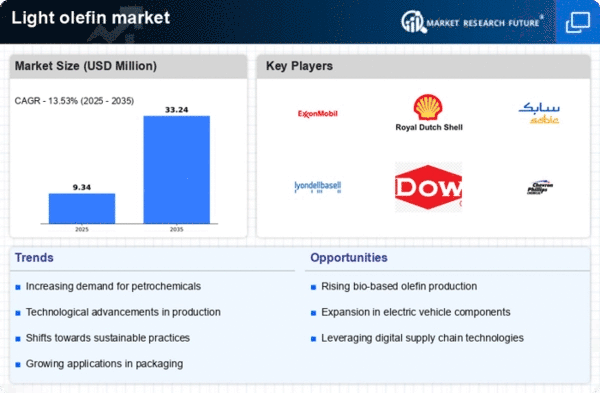
As per MRFR analysis, the Light olefin market size was estimated at 8.23 USD Million in 2024. The Light olefin industry is projected to grow from 9.34 USD Million in 2025 to 33.24 USD Million by 2035, exhibiting a compound annual growth rate (CAGR) of 13.53 during the forecast period 2025 - 2035.

Key Market Trends & Highlights

The Light olefin market is poised for robust growth driven by sustainability and technological advancements.

  • North America remains the largest market for light olefins, driven by strong demand in the petrochemical sector.
  • Asia-Pacific is emerging as the fastest-growing region, fueled by rapid industrialization and urbanization.
  • Polyethylene production continues to dominate the market, while polypropylene production is witnessing the fastest growth due to its diverse applications.
  • Rising demand for petrochemicals and innovations in production technologies are key drivers propelling market expansion.

Market Size & Forecast

2024 Market Size 8.23 (USD Million)
2035 Market Size 33.24 (USD Million)
CAGR (2025 - 2035) 13.53%
Largest Regional Market Share in 2024 Asia-Pacific

Major Players

<p>ExxonMobil (US), Royal Dutch Shell (NL), SABIC (SA), LyondellBasell Industries (US), Chevron Phillips Chemical (US), Ineos (GB), Mitsubishi Chemical (JP), Braskem (BR), TotalEnergies (FR)</p>

Market Trends

The Light olefin market is currently experiencing a dynamic phase characterized by evolving demand patterns and technological advancements. The increasing utilization of light olefins in various applications, such as plastics, chemicals, and fuels, appears to drive growth in this sector. Furthermore, the shift towards sustainable practices and the adoption of innovative production methods suggest a potential transformation in how light olefins are manufactured and utilized. As industries seek to reduce their carbon footprint, the emphasis on eco-friendly processes may reshape the competitive landscape of the Light olefin market. In addition, the geopolitical landscape and regulatory frameworks are likely influencing the Light olefin market. Trade policies and environmental regulations may create both challenges and opportunities for market participants. Companies are adapting to these changes by investing in research and development to enhance efficiency and sustainability. The interplay between market demand, technological innovation, and regulatory pressures indicates a complex environment where stakeholders must navigate carefully to capitalize on emerging opportunities.

Sustainability Initiatives

The Light olefin market is witnessing a growing emphasis on sustainability initiatives. Companies are increasingly focusing on eco-friendly production methods and materials, which may lead to a shift in consumer preferences towards greener products. This trend suggests that market players could enhance their competitive edge by adopting sustainable practices.

Technological Advancements

Technological advancements are playing a crucial role in shaping the Light olefin market. Innovations in production processes, such as catalytic cracking and steam cracking, appear to improve efficiency and reduce costs. These developments may enable manufacturers to meet rising demand while maintaining profitability.

Regulatory Influences

Regulatory influences are becoming more pronounced in the Light olefin market. Governments worldwide are implementing stricter environmental regulations, which could impact production methods and market dynamics. Companies may need to adapt to these changes to remain compliant and competitive.

Light olefin market Market Drivers

Market Growth Projections

The Global Light Olefins Market Industry is projected to experience substantial growth over the coming years. With a market value expected to reach 321.2 USD Million in 2024 and further expand to 624.2 USD Million by 2035, the industry is poised for a robust trajectory. The anticipated compound annual growth rate of 6.23% from 2025 to 2035 reflects the increasing demand for light olefins across various sectors. This growth is underpinned by technological advancements, expanding applications, and supportive regulatory frameworks that collectively enhance the market's potential.

Expansion of End-Use Industries

The expansion of end-use industries such as packaging, textiles, and consumer goods is a key driver for the Global Light Olefins Market Industry. As these sectors grow, the demand for light olefins, particularly ethylene and propylene, is expected to rise correspondingly. The versatility of light olefins in producing various materials, including films, fibers, and containers, positions them as essential raw materials in these industries. This growth trajectory is likely to be supported by increasing consumer preferences for sustainable and recyclable products, further enhancing the market's potential. The ongoing expansion of these industries is anticipated to significantly contribute to the overall market dynamics.

Rising Demand for Petrochemicals

The Global Light Olefins Market Industry is experiencing a surge in demand for petrochemicals, driven by their extensive applications in various sectors such as automotive, construction, and consumer goods. As industries increasingly rely on light olefins for the production of plastics and synthetic fibers, the market is projected to reach 321.2 USD Million in 2024. This growth is indicative of the broader trend towards lightweight materials that enhance fuel efficiency and reduce emissions, aligning with global sustainability goals. The increasing adoption of light olefins in manufacturing processes is likely to further bolster market expansion.

Technological Advancements in Production

Technological innovations in the production of light olefins are significantly influencing the Global Light Olefins Market Industry. Advanced catalytic processes and improved cracking technologies enhance yield and reduce production costs. For instance, the development of more efficient steam cracking methods allows for higher output of ethylene and propylene, which are key components in various chemical products. These advancements not only improve profitability for manufacturers but also contribute to meeting the growing global demand. As a result, the market is expected to witness a compound annual growth rate of 6.23% from 2025 to 2035, reflecting the positive impact of these technological improvements.

Growing Applications in Automotive Sector

The automotive sector is increasingly adopting light olefins for the production of lightweight materials, which are essential for enhancing fuel efficiency and reducing carbon emissions. The Global Light Olefins Market Industry benefits from this trend, as manufacturers seek to incorporate materials derived from light olefins into vehicle components. This shift is driven by stringent regulations aimed at reducing environmental impact, prompting automakers to innovate. As the automotive industry evolves, the demand for light olefins is likely to escalate, contributing to the projected market growth to 624.2 USD Million by 2035. This trend underscores the pivotal role of light olefins in sustainable automotive manufacturing.

Regulatory Support for Sustainable Practices

Regulatory frameworks promoting sustainable practices are increasingly shaping the Global Light Olefins Market Industry. Governments worldwide are implementing policies that encourage the use of environmentally friendly materials and processes, which often include light olefins. These regulations aim to reduce carbon footprints and promote recycling, thereby enhancing the appeal of light olefins in various applications. As industries adapt to these regulations, the demand for light olefins is expected to rise, aligning with global sustainability initiatives. This supportive regulatory environment is likely to drive market growth, as companies seek to comply with evolving standards and consumer expectations.

Market Segment Insights

By Application: Polyethylene Production (Largest) vs. Polypropylene Production (Fastest-Growing)

<p>The Light olefin market is primarily dominated by the polyethylene production segment, which holds the largest market share among various applications. This is due to the wide range of uses for polyethylene, including packaging, construction, and consumer goods, making it a staple in various industries. In contrast, the polypropylene production segment is recognized as the fastest-growing application, thanks to its increasing use in automotive, textiles, and packaging, driven by its lightweight and versatile nature.</p>

<p>Polyethylene Production (Dominant) vs. Polypropylene Production (Emerging)</p>

<p>Polyethylene production stands out as the dominant force in the Light olefin market, favored for its excellent mechanical properties and diverse applications. This segment benefits from continuous advancements in technology, leading to enhanced production efficiency and sustainability. Conversely, polypropylene production is rapidly emerging, fueled by rising demand in sectors such as automotive and consumer goods. Its growing popularity is attributable to features like chemical resistance and durability, positioning it well for future growth amid increasing consumption patterns.</p>

By End Use Industry: Packaging (Largest) vs. Automotive (Fastest-Growing)

<p>In the light olefin market, the end use industries exhibit varied market share distributions, with Packaging emerging as the largest segment. The essential nature of olefins in creating packaging materials heavily contributes to its significant market share. Conversely, Automotive is identified as the fastest-growing segment due to the rising demand for lightweight and fuel-efficient vehicles, which leverage olefins for manufacturing advanced composite materials. This growth is propelled by stringent regulations on emissions and a continuous push towards sustainability in automotive manufacturing. The growth trends within these end use industries indicate strong future performance, especially for Automotive, driven by technological advancements and eco-friendly innovations. As the automotive industry evolves, the adaptation of light olefins for various applications, including vehicle components and fuel systems, is expected to surge. This upward trajectory is supported by increasing consumer preference for sustainable solutions in both automotive design and packaging, ensuring a dynamic interplay between these two segments in the light olefin market.</p>

<p>Packaging: Dominant vs. Automotive: Emerging</p>

<p>In the light olefin market, Packaging stands as the dominant end use industry, primarily due to its extensive applications across food, consumer goods, and industrial sectors. Light olefins play a critical role in producing various forms of packaging, including films, bottles, and containers. The large-scale adoption of recyclable packaging materials has further solidified its market position. On the other hand, Automotive represents an emerging segment, characterized by rapid growth driven by the automotive industry's shift towards lightweight materials and innovative manufacturing processes. As this sector increasingly incorporates olefins into its design strategies for components, the demand for olefins in automotive applications is anticipated to grow significantly. This emerging profile suggests that while packaging remains the leader, automotive is on a trajectory of becoming a major competitor.</p>

By Production Process: Steam Cracking (Largest) vs. Fluid Catalytic Cracking (Fastest-Growing)

<p>In the Light olefin market, the production processes are segmented into Steam Cracking, Fluid Catalytic Cracking, Dehydrogenation, and Metathesis. Steam Cracking holds the largest share of the market due to its established technology and vast application in producing ethylene and propylene. Fluid Catalytic Cracking, while smaller, is rapidly gaining traction thanks to its efficiency and suitability for heavier feedstocks, appealing to refineries looking to optimize their operations.</p>

<p>Steam Cracking (Dominant) vs. Fluid Catalytic Cracking (Emerging)</p>

<p>Steam Crackings dominance lies in its ability to produce high yields of light olefins from hydrocarbon feedstock, making it the mainstay of ethylene production. Its reliability and established infrastructure provide a competitive advantage in meeting the consistent demand for light olefins. Conversely, Fluid Catalytic Cracking represents a growing opportunity as refiners embrace newer technologies to enhance output and adapt to changing market dynamics. This process is particularly attractive for industries seeking to maximize output from diverse feedstock, thereby leading to its recognition as the fastest growing segment in the market.</p>

By Type: Ethylene (Largest) vs. Propylene (Fastest-Growing)

<p>In the Light olefin market, Ethylene holds the largest market share, dominating the segment due to its extensive applications in producing plastics, chemicals, and synthetic fibers. Followed closely is Propylene, which has witnessed significant uptake in production capacities, largely driven by its utilization in manufacturing polypropylene and various chemicals. Despite its lower share compared to Ethylene, Propylene is expected to experience rapid growth as its applications diversify into emerging sectors such as automotive and construction materials.</p>

<p>Ethylene (Dominant) vs. Butylene (Emerging)</p>

<p>Ethylene, as the dominant player in the Light olefin market, benefits from its versatile applications that span across various industries, including packaging, automotive, and textiles. Its established production processes and robust demand contribute to its strong market position. On the other hand, Butylene is recognized as an emerging segment, focusing on niche applications such as butyl rubber and gasoline additives. Although it currently trails in market share, the rising demand for high-performance materials and environmental regulations providing impetus for Butylene's growth position it as a vital player to watch in the evolving market landscape.</p>

Get more detailed insights about Light Olefins Market Research Report – Forecast to 2035

Regional Insights

North America : Innovation and Sustainability Focus

The North American light olefin market is poised for growth, driven by increasing demand for petrochemicals and a shift towards sustainable practices. With a market size of $2.47B, the region is focusing on innovative technologies and regulatory support to enhance production efficiency. The rise in natural gas production is also a significant catalyst, providing a cost-effective feedstock for olefin production. Leading countries like the US and Canada are home to major players such as ExxonMobil and LyondellBasell, which are investing heavily in advanced manufacturing processes. The competitive landscape is characterized by a mix of established firms and emerging players, all vying for market share in a rapidly evolving industry. The focus on reducing carbon emissions and enhancing energy efficiency is shaping the future of the market.

Europe : Regulatory Support and Innovation

Europe's light olefin market, valued at $1.84B, is experiencing growth driven by stringent environmental regulations and a push for sustainable production methods. The region is focusing on reducing greenhouse gas emissions, which is catalyzing investments in cleaner technologies. The regulatory framework is supportive, encouraging innovation in production processes and the use of renewable feedstocks. Countries like Germany, the Netherlands, and France are leading the charge, with key players such as Royal Dutch Shell and TotalEnergies actively participating in the market. The competitive landscape is robust, with a mix of multinational corporations and regional firms. The emphasis on sustainability and compliance with EU regulations is shaping the strategies of these companies, ensuring a forward-looking approach to market challenges.

Asia-Pacific : Emerging Powerhouse in Production

Asia-Pacific is the largest market for light olefins, with a market size of $3.93B, driven by rapid industrialization and urbanization. The region's growth is fueled by increasing demand for plastics and chemicals, alongside favorable government policies promoting petrochemical production. Countries like China and India are at the forefront, leveraging their vast resources and labor to enhance production capabilities. The competitive landscape is dominated by major players such as SABIC and Mitsubishi Chemical, who are investing in expanding their production capacities. The region's focus on innovation and technology adoption is evident, as companies strive to meet the growing demand while adhering to environmental standards. The presence of a robust supply chain further strengthens the market position of Asia-Pacific in the global light olefin industry.

Middle East and Africa : Resource-Rich Frontier for Growth

The Middle East and Africa region, with a market size of $0.99B, is emerging as a significant player in the light olefin market, driven by abundant natural resources and strategic investments in petrochemical infrastructure. The region's growth is supported by government initiatives aimed at diversifying economies and enhancing industrial capabilities. Countries like Saudi Arabia and the UAE are leading the way, capitalizing on their oil and gas reserves to boost production. The competitive landscape is characterized by a few dominant players, including SABIC, which is investing in expanding its production facilities. The focus on developing downstream industries is crucial for the region, as it seeks to increase its share in the global market. The strategic location also provides an advantage in terms of logistics and distribution, further enhancing the region's market potential.

Key Players and Competitive Insights

The Light olefin market is characterized by a dynamic competitive landscape, driven by increasing demand for lightweight materials in various applications, including packaging, automotive, and construction. Key players such as ExxonMobil (US), Royal Dutch Shell (NL), and SABIC (SA) are strategically positioned to leverage their extensive production capabilities and technological advancements. ExxonMobil (US) focuses on innovation in production processes, aiming to enhance efficiency and reduce environmental impact. Meanwhile, Royal Dutch Shell (NL) emphasizes sustainability initiatives, aligning its operations with global climate goals. SABIC (SA) is actively pursuing regional expansion, particularly in Asia, to capitalize on the growing demand in emerging markets. Collectively, these strategies shape a competitive environment that is increasingly focused on sustainability and technological advancement.

In terms of business tactics, companies are localizing manufacturing to reduce transportation costs and enhance supply chain resilience. The market structure appears moderately fragmented, with several key players holding substantial market shares. This fragmentation allows for competitive pricing strategies, yet the influence of major companies remains significant, as they set industry standards and drive innovation.

In November 2025, LyondellBasell Industries (US) announced a strategic partnership with a leading technology firm to develop advanced catalysts for light olefin production. This collaboration is expected to enhance LyondellBasell's production efficiency and reduce operational costs, positioning the company favorably in a competitive market. The strategic importance of this partnership lies in its potential to accelerate innovation and improve sustainability metrics, aligning with industry trends.

In October 2025, Chevron Phillips Chemical (US) unveiled plans to expand its production capacity in the Gulf Coast region. This expansion is anticipated to increase output by 15%, catering to the rising demand for light olefins in North America. The strategic move underscores Chevron Phillips' commitment to meeting market needs while optimizing its supply chain operations, thereby enhancing its competitive edge.

In September 2025, Ineos (GB) launched a new line of bio-based light olefins, marking a significant step towards sustainability in its product offerings. This initiative not only diversifies Ineos' portfolio but also responds to the growing consumer demand for environmentally friendly products. The introduction of bio-based options is likely to strengthen Ineos' market position and appeal to a broader customer base.

As of December 2025, current competitive trends in the Light olefin market are increasingly defined by digitalization, sustainability, and the integration of AI technologies. Strategic alliances among key players are shaping the landscape, fostering innovation and enhancing operational efficiencies. Looking ahead, competitive differentiation is expected to evolve, with a pronounced shift from price-based competition to a focus on innovation, technology, and supply chain reliability. Companies that successfully navigate these trends will likely secure a competitive advantage in the evolving market.

Key Companies in the Light olefin market market include

Industry Developments

August 2021- Lummus Technology has disclosed that the start-up of company’s CDAlky alkylation unit located at Zhejiang Petroleum & Chemical Co. Ltd's refinery in Zhejiang Province, China. The latest facility will have a capacity of over 45 000 bpsd of alkylate product, resulting it to be the largest alkylation unit across the globe certified by Lummus.The latest alkylation unit deals with C4s from upstream refining and petrochemical units, causing an extremely high isobutylene concentration in the net olefins mixture while manufacturing a greater alkylate quality.

October 2021- Siemens Energy and Technip Energies have announced the signing of an exclusive contract to collaboratively build, commercialize, and license the Rotating Olefins Cracker (ROC) technology to make the olefin production process carbon-free. The ROC technology uses a dynamic reactor system, which replaces traditional furnaces used for pyrolysis while producing light olefins- the raw material for chemical products used in everyday materials.

November 2021- The Board of Reliance Industries Ltd (RIL) has planned to deploy a Scheme of Arrangement to turn over Gasification Enterprise into a Wholly Owned Subsidiary (WOS). The Jamnagar Gasification project was established to manufacture syngas to fulfill the needs as refinery off-gases that catered as fuel in the past were redesigned into feedstock for the Refinery Off Gas Cracker (ROGC). The company stated that this deployment allows olefins manufacturing at competitive capital and operating costs. The statement further revealed that Syngas as a fuel guarantees supply reliability and aid lower volatility in the energy costs.

In 2018, Exxon Mobil collaborated with Saudi Basic Industries Corporation (SABIC) to build the world’s largest plant for ethylene production. This collaboration was more than 1.4 billion US dollars of worth. 

In June 2018, a Cumene unit was built in Germany by a leading light olefin market player i.e. INEOS Phenol (UK) to maintain continuity between customer's demand and supply. This construction helped the company's plants in Gladbeck and Antwerp to improve the security of this supply and demand by the year 2020. 

Future Outlook

Light olefin market Future Outlook

<p>The Light olefin market is projected to grow at a 13.53% CAGR from 2024 to 2035, driven by increasing demand in petrochemicals, automotive, and packaging sectors.</p>

New opportunities lie in:

  • <p>Development of advanced catalysts for enhanced olefin production efficiency.</p>
  • <p>Expansion into emerging markets with tailored product offerings.</p>
  • <p>Investment in sustainable production technologies to meet regulatory demands.</p>

<p>By 2035, the Light olefin market is expected to achieve robust growth, solidifying its strategic importance in global industries.</p>

Market Segmentation

Light olefin market Type Outlook

  • Ethylene
  • Propylene
  • Butylene
  • Isobutylene

Light olefin market Application Outlook

  • Polyethylene Production
  • Polypropylene Production
  • Chemical Intermediates
  • Fuel Additives

Light olefin market End Use Industry Outlook

  • Automotive
  • Construction
  • Packaging
  • Textiles

Light olefin market Production Process Outlook

  • Steam Cracking
  • Fluid Catalytic Cracking
  • Dehydrogenation
  • Metathesis

Report Scope

MARKET SIZE 20248.23(USD Million)
MARKET SIZE 20259.34(USD Million)
MARKET SIZE 203533.24(USD Million)
COMPOUND ANNUAL GROWTH RATE (CAGR)13.53% (2024 - 2035)
REPORT COVERAGERevenue Forecast, Competitive Landscape, Growth Factors, and Trends
BASE YEAR2024
Market Forecast Period2025 - 2035
Historical Data2019 - 2024
Market Forecast UnitsUSD Million
Key Companies ProfiledExxonMobil (US), Royal Dutch Shell (NL), SABIC (SA), LyondellBasell Industries (US), Chevron Phillips Chemical (US), Ineos (GB), Mitsubishi Chemical (JP), Braskem (BR), TotalEnergies (FR)
Segments CoveredApplication, End Use Industry, Production Process, Type
Key Market OpportunitiesAdvancements in sustainable production methods drive growth in the Light olefin market.
Key Market DynamicsRising demand for sustainable materials drives innovation and competition in the light olefin market.
Countries CoveredNorth America, Europe, APAC, South America, MEA

FAQs

What is the expected CAGR of the light olefins market?

The global light olefins market is expected to register a CAGR of 5.58% by the forecast year 2035

How is the light olefins market segmented by derivatives?

The light olefins market is segmented by derivatives as propylene oxide, cumene, acetate monomer, oxo alcohols, ethylene oxide, EDC/ VCM/ PVC, alpha-olefins, polypropylene, acrylonitrile, acrylic acid, polyethylene, glycol, and styrene.

Who is the market-dominant of the global light olefins market?

Asia-Pacific is the market-dominant of the global light olefins market.

  1. Report Prologue
  2. Scope Of The Report
    1. Market Definition 17
    2. The Scope Of The Study 17
      1. Research Objectives 17
      2. Assumptions 17
      3. Limitations 17
    3. Market Structure 18
  3. Research Methodology
    1. Research Process 21
    2. Primary Research 21
    3. Secondary Research 21
    4. Market Size Estimation 22
    5. Forecast Model 23
  4. Market Dynamics
    1. Introduction 25
    2. Drivers 26
      1. Increasing Demand For Polymer 26
      2. Excellent Conversion Of Light Olefins From Methanol 27
    3. Restraint 28
      1. Ethylene Exposure To Air Affects The Environment 28
    4. Opportunity 29
      1. Shale Gas Development 29
    5. Trends 29
      1. Biomass Feedstock To Bio-Ethylene 29
  5. Market Impact Analysis
    1. Supply Chain Analysis 31
      1. Raw Material Suppliers 31
      2. Light Olefins Producers 31
      3. Distributors 32
      4. End User 32
    2. Porter’s Five Forces 32
      1. Threat Of New Entrants 32
      2. The Intensity Of Competitive Rivalry 32
      3. Bargaining Power Of Supplier 32
      4. Bargaining Power Of Buyer 32
      5. Threat Of Substitute 32
  6. Global Light Olefins Market, By Type
    1. Ethylene 35
    2. Propylene 36
  7. Global Light Olefins Market, By Derivatives
    1. Polypropylene 40
    2. Propylene Oxide 41
    3. Acrylonitrile 42
    4. Cumene 43
    5. Acrylic Acid 44
    6. Oxo Alcohols 45
    7. Polyethylene 46
    8. Ethylene Oxide/Glycol 47
    9. EDC/VCM/PVC 48
    10. Styrene 49
    11. Alpha Olefins 50
    12. Vinyl Acetate Monomer 51
  8. Global Light Olefins Market, By Application
    1. Chemical Commodities 54
    2. Refinery 55
  9. Global Light Olefins Market, By Region
    1. Introduction 57
    2. North America 62
      1. US 66
      2. Canada 69
    3. Europe 73
      1. Germany 78
      2. France 81
      3. UK 84
      4. Spain 87
      5. Italy 90
      6. Rest Of Europe 93
    4. Asia Pacific 97
      1. China 101
      2. Japan 104
      3. India 107
      4. Rest Of Asia Pacific 110
    5. Latin America 114
    6. Middle East & Africa 119
  10. Competitive Landscape
    1. Introduction 125
      1. Market Strategy Overview 125
    2. Key Development Analysis 126
      1. Expansion 126
      2. Acquisition 126
      3. Joint Venture 127
      4. Agreement 127
  11. Company Profile
    1. Royal Dutch Shell 129
      1. Company Overview 129
      2. Financials 129
      3. Products 129
      4. Strategy 129
      5. Key Developments 129
    2. PetroChina 130
      1. Company Overview 130
      2. Financials 130
      3. Products 130
      4. Strategy 130
      5. Key Developments 130
    3. Relience Industries Limited 131
      1. Company Overview 131
      2. Financials 131
      3. Products 131
      4. Strategy 131
      5. Key Developments 131
    4. China Petro& Chemical Corp 132
      1. Company Overview 132
      2. Financials 132
      3. Products 132
      4. Strategy 132
      5. Key Developments 132
    5. DowDuPont, Inc 133
      1. Company Overview 133
      2. Financials 133
      3. Products 133
      4. Strategy 133
      5. Key Developments 133
    6. Exxon Mobil Corporation 134
      1. Company Overview 134
      2. Financials 134
      3. Products 134
      4. Strategy 134
      5. Key Developments 134
    7. Gazprom 135
      1. Company Overview 135
      2. Financials 135
      3. Products 135
      4. Strategy 135
      5. Key Developments 135
    8. Saudi Arabian Oil Co. 136
      1. Company Overview 136
      2. Financials 136
      3. Products 136
      4. Strategy 136
      5. Key Developments 136
    9. BASF SE 137
      1. Company Overview 137
      2. Financials 137
      3. Products 137
      4. Strategy 137
      5. Key Developments 137
    10. Honeywell International Inc 138
      1. Company Overview 138
      2. Financials 138
      3. Products 138
      4. Strategy 138
      5. Key Developments 138
  12. Conclusion
  13. List Of Tables
  14. GLOBAL LIGHT OLEFINS MARKET, BY TYPE, 2020-2027 (USD BILLION) 34
  15. GLOBAL LIGHT OLEFINS MARKET, BY TYPE, 2020-2027 (MILLION TONS) 35
  16. GLOBAL LIGHT OLEFINS MARKET FOR ETHYLENE, 2020-2027 (USD BILLION) 35
  17. GLOBAL LIGHT OLEFINS MARKET FOR ETHYLENE, 2020-2027 (MILLION TONS) 35
  18. GLOBAL LIGHT OLEFINS MARKET FOR PROPYLENE, 2020-2027 (USD BILLION) 36
  19. GLOBAL LIGHT OLEFINS MARKET FOR PROPYLENE, 2020-2027 (MILLION TONS) 36
  20. GLOBAL LIGHT OLEFINS MARKET, BY DERIVATIVES, 2020-2027 (USD BILLION) 38
  21. GLOBAL LIGHT OLEFINS MARKET, BY DERIVATIVES, 2020-2027 (MILLION TONS) 39
  22. GLOBAL LIGHT OLEFINS MARKET FOR POLYPROPYLENE, 2020-2027 (USD BILLION) 40
  23. GLOBAL LIGHT OLEFINS MARKET FOR POLYPROPYLENE, 2020-2027 (MILLION TONS) 40
  24. GLOBAL LIGHT OLEFINS MARKET FOR PROPYLENE OXIDE, 2020-2027 (USD BILLION) 41
  25. GLOBAL LIGHT OLEFINS MARKET FOR PROPYLENE OXIDE, 2020-2027 (MILLION TONS) 41
  26. GLOBAL LIGHT OLEFINS MARKET FOR ACRYLONITRILE, 2020-2027 (USD BILLION) 42
  27. GLOBAL LIGHT OLEFINS MARKET FOR ACRYLONITRILE, 2020-2027 (MILLION TONS) 42
  28. GLOBAL LIGHT OLEFINS MARKET FOR CUMENE, 2020-2027 (USD BILLION) 43
  29. GLOBAL LIGHT OLEFINS MARKET FOR CUMENE, 2020-2027 (MILLION TONS) 43
  30. GLOBAL LIGHT OLEFINS MARKET FOR ACRYLIC ACID, 2020-2027 (USD BILLION) 44
  31. GLOBAL LIGHT OLEFINS MARKET FOR ACRYLIC ACID, 2020-2027 (MILLION TONS) 44
  32. GLOBAL LIGHT OLEFINS MARKET FOR OXO ALCOHOLS, 2020-2027 (USD BILLION) 45
  33. GLOBAL LIGHT OLEFINS MARKET FOR OXO ALCOHOLS, 2020-2027 (MILLION TONS) 45
  34. GLOBAL LIGHT OLEFINS MARKET FOR POLYETHYLENE, 2020-2027 (USD BILLION) 46
  35. GLOBAL LIGHT OLEFINS MARKET FOR POLYETHYLENE, 2020-2027 (MILLION TONS) 46
  36. GLOBAL LIGHT OLEFINS MARKET FOR ETHYLENE OXIDE/GLYCOL, 2020-2027 (USD BILLION) 47
  37. GLOBAL LIGHT OLEFINS MARKET FOR ETHYLENE OXIDE/GLYCOL, 2020-2027 (MILLION TONS) 47
  38. GLOBAL LIGHT OLEFINS MARKET FOR EDC/VCM/PVC, 2020-2027 (USD BILLION) 48
  39. GLOBAL LIGHT OLEFINS MARKET FOR EDC/VCM/PVC, 2020-2027 (MILLION TONS) 48
  40. GLOBAL LIGHT OLEFINS MARKET FOR STYRENE, 2020-2027 (USD BILLION) 49
  41. GLOBAL LIGHT OLEFINS MARKET FOR STYRENE, 2020-2027 (MILLION TONS) 49
  42. GLOBAL LIGHT OLEFINS MARKET FOR ALPHA OLEFINS, 2020-2027 (USD BILLION) 50
  43. GLOBAL LIGHT OLEFINS MARKET FOR ALPHA OLEFINS, 2020-2027 (MILLION TONS) 50
  44. GLOBAL LIGHT OLEFINS MARKET FOR VINYL ACETATE MONOMER, 2020-2027 (USD BILLION) 51
  45. GLOBAL LIGHT OLEFINS MARKET FOR VINYL ACETATE MONOMER, 2020-2027 (MILLION TONS) 51
  46. GLOBAL LIGHT OLEFINS MARKET, BY APPLICATION, 2020-2027 (USD BILLION) 53
  47. GLOBAL LIGHT OLEFINS MARKET, BY APPLICATION, 2020-2027 (MILLION TONS) 54
  48. GLOBAL LIGHT OLEFINS MARKET FOR CHEMICAL COMMODITIES, 2020-2027 (USD BILLION) 54
  49. GLOBAL LIGHT OLEFINS MARKET FOR CHEMICAL COMMODITIES, 2020-2027 (USD BILLION) 54
  50. GLOBAL LIGHT OLEFINS MARKET FOR REFINERY, 2020-2027 (USD BILLION) 55
  51. GLOBAL LIGHT OLEFINS MARKET FOR REFINERY, 2020-2027 (USD BILLION) 55
  52. GLOBAL LIGHT OLEFINS MARKET, BY REGION, 2020-2027 (USD BILLION) 57
  53. GLOBAL LIGHT OLEFINS MARKET, BY REGION, 2020-2027 (MILLION TONS) 58
  54. GLOBAL LIGHT OLEFINS MARKET, BY TYPE, 2020-2027 (USD BILLION) 58
  55. GLOBAL LIGHT OLEFINS MARKET, BY TYPE, 2020-2027 (MILLION TONS) 59
  56. GLOBAL LIGHT OLEFINS MARKET, BY DERIVATIVES, 2020-2027 (USD BILLION) 59
  57. GLOBAL LIGHT OLEFINS MARKET, BY DERIVATIVES, 2020-2027 (MILLION TONS) 60
  58. GLOBAL LIGHT OLEFINS MARKET, BY APPLICATION, 2020-2027 (USD BILLION) 60
  59. GLOBAL LIGHT OLEFINS MARKET, BY APPLICATION, 2020-2027 (MILLION TONS) 61
  60. NORTH AMERICA LIGHT OLEFINS MARKET, BY COUNTRY, 2020-2027 (USD BILLION) 63
  61. NORTH AMERICA LIGHT OLEFINS MARKET, BY COUNTRY, 2020-2027 (MILLION TONS) 63
  62. NORTH AMERICA LIGHT OLEFINS MARKET, BY TYPE, 2020-2027 (USD BILLION) 63
  63. NORTH AMERICA LIGHT OLEFINS MARKET, BY TYPE, 2020-2027 (MILLION TONS) 64
  64. NORTH AMERICA LIGHT OLEFINS MARKET, BY DERIVATIVES, 2020-2027 (USD BILLION) 64
  65. NORTH AMERICA LIGHT OLEFINS MARKET, BY DERIVATIVES, 2020-2027 (MILLION TONS) 65
  66. NORTH AMERICA LIGHT OLEFINS MARKET, BY APPLICATION, 2020-2027 (USD BILLION) 65
  67. NORTH AMERICA LIGHT OLEFINS MARKET, BY APPLICATION, 2020-2027 (MILLION TONS) 66
  68. US LIGHT OLEFINS MARKET, BY TYPE, 2020-2027 (USD BILLION) 66
  69. US LIGHT OLEFINS MARKET, BY TYPE, 2020-2027 (MILLION TONS) 66
  70. US LIGHT OLEFINS MARKET, BY DERIVATIVES, 2020-2027 (USD BILLION) 67
  71. US LIGHT OLEFINS MARKET, BY DERIVATIVES, 2020-2027 (MILLION TONS) 68
  72. US LIGHT OLEFINS MARKET, BY APPLICATION, 2020-2027 (USD BILLION) 68
  73. US LIGHT OLEFINS MARKET, BY APPLICATION, 2020-2027 (MILLION TONS) 69
  74. CANADA LIGHT OLEFINS MARKET, BY TYPE, 2020-2027 (USD BILLION) 69
  75. CANADA LIGHT OLEFINS MARKET, BY TYPE, 2020-2027 (MILLION TONS) 69
  76. CANADA LIGHT OLEFINS MARKET, BY DERIVATIVES, 2020-2027 (USD BILLION) 70
  77. CANADA LIGHT OLEFINS MARKET, BY DERIVATIVES, 2020-2027 (MILLION TONS) 71
  78. CANADA LIGHT OLEFINS MARKET, BY APPLICATION, 2020-2027 (USD BILLION) 71
  79. CANADA LIGHT OLEFINS MARKET, BY APPLICATION, 2020-2027 (MILLION TONS) 72
  80. EUROPE LIGHT OLEFINS MARKET, BY COUNTRY, 2020-2027 (USD BILLION) 74
  81. EUROPE LIGHT OLEFINS MARKET, BY COUNTRY, 2020-2027 (MILLION TONS) 74
  82. EUROPE LIGHT OLEFINS MARKET, BY TYPE, 2020-2027 (USD BILLION) 75
  83. EUROPE LIGHT OLEFINS MARKET, BY TYPE, 2020-2027 (MILLION TONS) 75
  84. EUROPE LIGHT OLEFINS MARKET, BY DERIVATIVES, 2020-2027 (USD BILLION) 76
  85. EUROPE LIGHT OLEFINS MARKET, BY DERIVATIVES, 2020-2027 (MILLION TONS) 77
  86. EUROPE LIGHT OLEFINS MARKET, BY APPLICATION, 2020-2027 (USD BILLION) 77
  87. EUROPE LIGHT OLEFINS MARKET, BY APPLICATION, 2020-2027 (MILLION TONS) 78
  88. GERMANY LIGHT OLEFINS MARKET, BY TYPE, 2020-2027 (USD BILLION) 78
  89. GERMANY LIGHT OLEFINS MARKET, BY TYPE, 2020-2027 (MILLION TONS) 78
  90. GERMANY LIGHT OLEFINS MARKET, BY DERIVATIVES, 2020-2027 (USD BILLION) 79
  91. GERMANY LIGHT OLEFINS MARKET, BY DERIVATIVES, 2020-2027 (MILLION TONS) 80
  92. GERMANY LIGHT OLEFINS MARKET, BY APPLICATION, 2020-2027 (USD BILLION) 80
  93. GERMANY LIGHT OLEFINS MARKET, BY APPLICATION, 2020-2027 (MILLION TONS) 81
  94. FRANCE LIGHT OLEFINS MARKET, BY TYPE, 2020-2027 (USD BILLION) 81
  95. FRANCE LIGHT OLEFINS MARKET, BY TYPE, 2020-2027 (MILLION TONS) 81
  96. FRANCE LIGHT OLEFINS MARKET, BY DERIVATIVES, 2020-2027 (USD BILLION) 82
  97. FRANCE LIGHT OLEFINS MARKET, BY DERIVATIVES, 2020-2027 (MILLION TONS) 83
  98. FRANCE LIGHT OLEFINS MARKET, BY APPLICATION, 2020-2027 (USD BILLION) 83
  99. FRANCE LIGHT OLEFINS MARKET, BY APPLICATION, 2020-2027 (MILLION TONS) 84
  100. UK LIGHT OLEFINS MARKET, BY TYPE, 2020-2027 (USD BILLION) 84
  101. UK LIGHT OLEFINS MARKET, BY TYPE, 2020-2027 (MILLION TONS) 84
  102. UK LIGHT OLEFINS MARKET, BY DERIVATIVES, 2020-2027 (USD BILLION) 85
  103. UK LIGHT OLEFINS MARKET, BY DERIVATIVES, 2020-2027 (MILLION TONS) 86
  104. UK LIGHT OLEFINS MARKET, BY APPLICATION, 2020-2027 (USD BILLION) 86
  105. UK LIGHT OLEFINS MARKET, BY APPLICATION, 2020-2027 (MILLION TONS) 87
  106. SPAIN LIGHT OLEFINS MARKET, BY TYPE, 2020-2027 (USD BILLION) 87
  107. SPAIN LIGHT OLEFINS MARKET, BY TYPE, 2020-2027 (MILLION TONS) 87
  108. SPAIN LIGHT OLEFINS MARKET, BY DERIVATIVES, 2020-2027 (USD BILLION) 88
  109. SPAIN LIGHT OLEFINS MARKET, BY DERIVATIVES, 2020-2027 (MILLION TONS) 89
  110. SPAIN LIGHT OLEFINS MARKET, BY APPLICATION, 2020-2027 (USD BILLION) 89
  111. SPAIN LIGHT OLEFINS MARKET, BY APPLICATION, 2020-2027 (MILLION TONS) 90
  112. ITALY LIGHT OLEFINS MARKET, BY TYPE, 2020-2027 (USD BILLION) 90
  113. ITALY LIGHT OLEFINS MARKET, BY TYPE, 2020-2027 (MILLION TONS) 90
  114. ITALY LIGHT OLEFINS MARKET, BY DERIVATIVES, 2020-2027 (USD BILLION) 91
  115. ITALY LIGHT OLEFINS MARKET, BY DERIVATIVES, 2020-2027 (MILLION TONS) 92
  116. ITALY LIGHT OLEFINS MARKET, BY APPLICATION, 2020-2027 (USD BILLION) 92
  117. ITALY LIGHT OLEFINS MARKET, BY APPLICATION, 2020-2027 (MILLION TONS) 93
  118. REST OF EUROPE LIGHT OLEFINS MARKET, BY TYPE, 2020-2027 (USD BILLION) 93
  119. REST OF EUROPE LIGHT OLEFINS MARKET, BY TYPE, 2020-2027 (MILLION TONS) 93
  120. REST OF EUROPE LIGHT OLEFINS MARKET, BY DERIVATIVES, 2020-2027 (USD BILLION) 94
  121. REST OF EUROPE LIGHT OLEFINS MARKET, BY DERIVATIVES, 2020-2027 (MILLION TONS) 95
  122. REST OF EUROPE LIGHT OLEFINS MARKET, BY APPLICATION, 2020-2027 (USD BILLION) 95
  123. REST OF EUROPE LIGHT OLEFINS MARKET, BY APPLICATION, 2020-2027 (MILLION TONS) 96
  124. ASIA PACIFIC LIGHT OLEFINS MARKET, BY COUNTRY, 2020-2027 (USD BILLION) 98
  125. ASIA PACIFIC LIGHT OLEFINS MARKET, BY COUNTRY, 2020-2027 (MILLION TONS) 98
  126. ASIA PACIFIC LIGHT OLEFINS MARKET, BY TYPE, 2020-2027 (USD BILLION) 98
  127. ASIA PACIFIC LIGHT OLEFINS MARKET, BY TYPE, 2020-2027 (MILLION TONS) 99
  128. ASIA PACIFIC LIGHT OLEFINS MARKET, BY DERIVATIVES, 2020-2027 (USD BILLION) 99
  129. ASIA PACIFIC LIGHT OLEFINS MARKET, BY DERIVATIVES, 2020-2027 (MILLION TONS) 100
  130. ASIA PACIFIC LIGHT OLEFINS MARKET, BY APPLICATION, 2020-2027 (USD BILLION) 100
  131. ASIA PACIFIC LIGHT OLEFINS MARKET, BY APPLICATION, 2020-2027 (MILLION TONS) 101
  132. CHINA LIGHT OLEFINS MARKET, BY TYPE, 2020-2027 (USD BILLION) 101
  133. CHINA LIGHT OLEFINS MARKET, BY TYPE, 2020-2027 (MILLION TONS) 101
  134. CHINA LIGHT OLEFINS MARKET, BY DERIVATIVES, 2020-2027 (USD BILLION) 102
  135. CHINA LIGHT OLEFINS MARKET, BY DERIVATIVES, 2020-2027 (MILLION TONS) 103
  136. CHINA LIGHT OLEFINS MARKET, BY APPLICATION, 2020-2027 (USD BILLION) 103
  137. CHINA LIGHT OLEFINS MARKET, BY APPLICATION, 2020-2027 (MILLION TONS) 104
  138. JAPAN LIGHT OLEFINS MARKET, BY TYPE, 2020-2027 (USD BILLION) 104
  139. JAPAN LIGHT OLEFINS MARKET, BY TYPE, 2020-2027 (MILLION TONS) 105
  140. JAPAN LIGHT OLEFINS MARKET, BY DERIVATIVES, 2020-2027 (USD BILLION) 106
  141. JAPAN LIGHT OLEFINS MARKET, BY DERIVATIVES, 2020-2027 (MILLION TONS) 106
  142. JAPAN LIGHT OLEFINS MARKET, BY APPLICATION, 2020-2027 (USD BILLION) 107
  143. JAPAN LIGHT OLEFINS MARKET, BY APPLICATION, 2020-2027 (MILLION TONS) 107
  144. INDIA LIGHT OLEFINS MARKET, BY TYPE, 2020-2027 (USD BILLION) 107
  145. INDIA LIGHT OLEFINS MARKET, BY TYPE, 2020-2027 (MILLION TONS) 108
  146. INDIA LIGHT OLEFINS MARKET, BY DERIVATIVES, 2020-2027 (USD BILLION) 108
  147. INDIA LIGHT OLEFINS MARKET, BY DERIVATIVES, 2020-2027 (MILLION TONS) 109
  148. INDIA LIGHT OLEFINS MARKET, BY APPLICATION, 2020-2027 (USD BILLION) 109
  149. INDIA LIGHT OLEFINS MARKET, BY APPLICATION, 2020-2027 (MILLION TONS) 110
  150. REST OF ASIA PACIFIC LIGHT OLEFINS MARKET, BY TYPE, 2020-2027 (USD BILLION) 110
  151. REST OF ASIA PACIFIC LIGHT OLEFINS MARKET, BY TYPE, 2020-2027 (MILLION TONS) 110
  152. REST OF ASIA PACIFIC LIGHT OLEFINS MARKET, BY DERIVATIVES, 2020-2027 (USD BILLION) 111
  153. REST OF ASIA PACIFIC LIGHT OLEFINS MARKET, BY DERIVATIVES, 2020-2027 (MILLION TONS) 112
  154. REST OF ASIA PACIFIC LIGHT OLEFINS MARKET, BY APPLICATION, 2020-2027 (USD BILLION) 112
  155. REST OF ASIA PACIFIC LIGHT OLEFINS MARKET, BY APPLICATION, 2020-2027 (MILLION TONS) 113
  156. LATIN AMERICA LIGHT OLEFINS MARKET, BY TYPE, 2020-2027 (USD BILLION) 115
  157. LATIN AMERICA LIGHT OLEFINS MARKET, BY TYPE, 2020-2027 (MILLION TONS) 115
  158. LATIN AMERICA LIGHT OLEFINS MARKET, BY DERIVATIVES, 2020-2027 (USD BILLION) 116
  159. LATIN AMERICA LIGHT OLEFINS MARKET, BY DERIVATIVES, 2020-2027 (MILLION TONS) 117
  160. LATIN AMERICA LIGHT OLEFINS MARKET, BY APPLICATION, 2020-2027 (USD BILLION) 117
  161. LATIN AMERICA LIGHT OLEFINS MARKET, BY APPLICATION, 2020-2027 (MILLION TONS) 118
  162. MIDDLE EAST & AFRICA LIGHT OLEFINS MARKET, BY TYPE, 2020-2027 (USD BILLION) 120
  163. MIDDLE EAST & AFRICA LIGHT OLEFINS MARKET, BY TYPE, 2020-2027 (MILLION TONS) 120
  164. MIDDLE EAST & AFRICA LIGHT OLEFINS MARKET, BY DERIVATIVES, 2020-2027 (USD BILLION) 121
  165. MIDDLE EAST & AFRICA LIGHT OLEFINS MARKET, BY DERIVATIVES, 2020-2027 (MILLION TONS) 122
  166. MIDDLE EAST & AFRICA LIGHT OLEFINS MARKET, BY APPLICATION, 2020-2027 (USD BILLION) 122
  167. MIDDLE EAST & AFRICA LIGHT OLEFINS MARKET, BY APPLICATION, 2020-2027 (MILLION TONS) 123
  168. List Of Figures
  169. TOP DOWN & BOTTOM-UP APPROACH 22
  170. FORECAST MODEL 23
  171. DRIVERS, RESTRAINT, OPPORTUNITY, AND TREND OF GLOBAL LIGHT OLEFINSMARKET 25
  172. SUPPLY CHAIN ANALYSIS 31
  173. GLOBAL LIGHT OLEFINS MARKET, BY TYPE, 2020-2027 (USD BILLION) 34
  174. GLOBAL LIGHT OLEFINS MARKET, BY TYPE, 2020-2027 (MILLION TONS) 34
  175. GLOBAL LIGHT OLEFINS MARKET, BY DERIVATIVES, 2020-2027 (USD BILLION) 38
  176. GLOBAL LIGHT OLEFINS MARKET, BY DERIVATIVES, 2020-2027 (MILLION TONS) 39
  177. GLOBAL LIGHT OLEFINS MARKET, BY APPLICATION, 2020-2027 (USD BILLION) 53
  178. GLOBAL LIGHT OLEFINS MARKET, BY APPLICATION, 2020-2027 (MILLION TONS) 53
  179. GLOBAL LIGHT OLEFINS MARKET, BY REGION, 2020-2027 (USD BILLION) 57
  180. GLOBAL LIGHT OLEFINS MARKET, BY REGION, 2020-2027 (MILLION TONS) 58

Light Olefins Market Segmentation

Market Segmentation Overview

  • Detailed segmentation data will be available in the full report
  • Comprehensive analysis by multiple parameters
  • Regional and country-level breakdowns
  • Market size forecasts by segment
Infographic

Free Sample Request

Kindly complete the form below to receive a free sample of this Report

Get Free Sample

Customer Strories

Compare Licence

×
Features License Type
Single User Multiuser License Enterprise User
Price $4,950 $5,950 $7,250
Maximum User Access Limit 1 User Upto 10 Users Unrestricted Access Throughout the Organization
Free Customization
Direct Access to Analyst
Deliverable Format
Platform Access
Discount on Next Purchase 10% 15% 15%
Printable Versions