×
Hero Background
English
Chinese
French
Japanese
Korean
German
Spanish

Membrane Microfiltration Market Trends

ID: MRFR/CnM/10029-HCR
128 Pages
Sejal Akre
October 2025

Membrane Microfiltration Market Research Report Information By Filtration Mode (Cross Flow, Direct Flow, and Others), By Material (Organic and Inorganic), By End User (Hospitals and Laboratories, Pharmaceutical and Biopharmaceutical Companies, Food and Beverage, Water and Waste Water Treatment, and Others), and By Region (North America, Europe, Asia-Pacific, And Rest Of The World) –Market Forecast Till 2035

Share:
Download PDF ×

We do not share your information with anyone. However, we may send you emails based on your report interest from time to time. You may contact us at any time to opt-out.

Membrane Microfiltration Market Infographic
Purchase Options

Market Trends

Key Emerging Trends in the Membrane Microfiltration Market

Market for the Membrane Microfiltration is undergoing aggressive growth and revolution with the advent of numerous market forces that are on the verge of changing the industry landscape. This trend has been confirmed by evolving data, which indicates the current market is flooding with demand that is caused mostly by the rapid understanding and broad use of microfiltration technologies in various industries. It is also noteworthy that one of the leading forces of this growth is the rising focus on water treatment and purification procedures. With heightened difficulties related to potable water shortage and quality around the globe, the industries and the municipalities are embracing membrane microfiltration as a solution that removes contaminants and guarantee quality and safe delivery of water.

The other influence that has been vital in market growth is the increase of addition of membrane microfiltration in food and beverage sector. Due to the food security and quality implications, manufacturers are now covertly including membrane micro-filtration systems in order to produce and process beverages, dairy products, among other consumables. It is primarily due to properly doing their job of separating and also purifying liquids, which leads to better product quality and longer shelf-life.

Furthermore, the pharmaceutical and biotechnology industries are the drivers and forms basis for the major market trends. The enactment of the strict drug manufacturing process and an increase in the demand for biopharmaceuticals great toggler has been one of the reasons why the membrane microfiltration is used in the sterile filtration and virus removal. In bringing a stable and scalable technology to ensure the quality and integrity of products which meet all stringent industry standards, the technology solution fits best to these industries.

Besides it, there is another evolving tendency in this area to promote the fabrication of new membrane materials and technologies. Manufacturers in membrane microfiltration market have made inroads into research and development spending to unveil novel membranes due to enhanced performance, durability, and selectivity qualities. Such disruptive innovation is not only responding to the ever changing nature of the user but also aids in the development and positioning of the market.

In addition to that, UK market is now witnessing a growth trend of membrane microfiltration in the healthcare sector. The application of this technology is gradually expanding into fields of medical water processing, dialysis, and other healthcare necessities. Healthcare industry putting patient safety and infection control first, there appears to be an increasing trend of acceptable and potent membrane microfiltration solutions.
Author
Sejal Akre
Senior Research Analyst

She has over 5 years of rich experience, in market research and consulting providing valuable market insights to client. Hands on expertise in management consulting, and extensive knowledge in domain including ICT, Automotive & Transportation and Aerospace & Defense. She is skilled in Go-to market strategy, industry analysis, market sizing, in depth company profiling, competitive intelligence & benchmarking and value chain amongst others.

Leave a Comment

FAQs

What is the current valuation of the Membrane Microfiltration Market?

As of 2024, the Membrane Microfiltration Market was valued at 5.028 USD Billion.

What is the projected market size for the Membrane Microfiltration Market by 2035?

The market is projected to reach 13.38 USD Billion by 2035.

What is the expected CAGR for the Membrane Microfiltration Market during the forecast period?

The expected CAGR for the Membrane Microfiltration Market from 2025 to 2035 is 9.3%.

Which companies are considered key players in the Membrane Microfiltration Market?

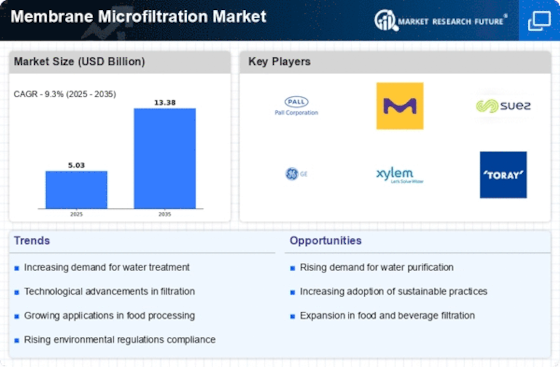
Key players include Pall Corporation, Merck KGaA, SUEZ Water Technologies & Solutions, and others.

What are the primary filtration modes in the Membrane Microfiltration Market?

The primary filtration modes are Cross Flow, Direct Flow, and Others, with Cross Flow valued at 6.88 USD Billion by 2035.

How does the market segment by material type?

The market segments into Organic and Inorganic materials, both projected to reach 6.69 USD Billion by 2035.

Market Summary

As per MRFR analysis, the Membrane Microfiltration Market Size was estimated at 5.028 USD Billion in 2024. The Membrane Microfiltration industry is projected to grow from 5.496 USD Billion in 2025 to 13.38 USD Billion by 2035, exhibiting a compound annual growth rate (CAGR) of 9.3 during the forecast period 2025 - 2035.

Key Market Trends & Highlights

The Membrane Microfiltration Market is poised for substantial growth driven by technological advancements and sustainability initiatives.

  • North America remains the largest market for membrane microfiltration, reflecting a strong demand across various industries. Asia-Pacific is identified as the fastest-growing region, indicating a surge in water purification needs and industrial applications. The Cross Flow segment dominates the market, while the Direct Flow segment is rapidly gaining traction due to its efficiency. Technological innovations and rising demand for water purification are key drivers propelling market expansion.

Market Size & Forecast

2024 Market Size 5.028 (USD Billion)
2035 Market Size 13.38 (USD Billion)
CAGR (2025 - 2035) 9.3%
Largest Regional Market Share in 2024 Asia Pacific

Major Players

<p>Pall Corporation (US), Merck KGaA (DE), SUEZ Water Technologies &amp; Solutions (US), GE Water &amp; Process Technologies (US), Evoqua Water Technologies (US), Toray Industries, Inc. (JP), Koch Membrane Systems (US), 3M Company (US)</p>

Market Trends

The Membrane Microfiltration Market is currently experiencing a notable evolution, driven by increasing demand for water treatment solutions and advancements in filtration technologies. This market segment is characterized by its ability to effectively separate particles and microorganisms from liquids, making it essential in various applications, including food and beverage processing, pharmaceuticals, and wastewater treatment. As environmental concerns continue to rise, industries are increasingly adopting membrane microfiltration systems to enhance product quality and ensure compliance with stringent regulations. Furthermore, the integration of automation and smart technologies into filtration processes appears to be reshaping operational efficiencies, potentially leading to reduced costs and improved performance. In addition to technological advancements, the Membrane Microfiltration Market is influenced by shifting consumer preferences towards sustainable practices. Companies are increasingly focusing on eco-friendly solutions, which may drive innovation in membrane materials and designs. The growing emphasis on sustainability is likely to encourage investments in research and development, fostering the emergence of novel applications and expanding the market's reach. As the global landscape evolves, the Membrane Microfiltration Market seems poised for growth, with opportunities arising from diverse sectors seeking efficient and reliable filtration methods.

Technological Advancements

Recent innovations in membrane materials and filtration techniques are enhancing the efficiency and effectiveness of microfiltration systems. These advancements may lead to improved separation capabilities and reduced operational costs, making them more attractive to various industries.

Sustainability Focus

There is a growing trend towards sustainable practices within the Membrane Microfiltration Market. Companies are increasingly prioritizing eco-friendly solutions, which could drive the development of greener membrane technologies and promote responsible water usage.

Diverse Applications

The versatility of membrane microfiltration is expanding its applications across multiple sectors, including food and beverage, pharmaceuticals, and environmental management. This trend suggests a broadening market scope as industries seek reliable filtration solutions.

Membrane Microfiltration Market Market Drivers

Focus on Sustainable Practices

The Membrane Microfiltration Market is increasingly aligned with the global focus on sustainable practices. As industries face pressure to reduce their environmental footprint, membrane microfiltration technologies offer an effective solution for water reuse and recycling. This focus on sustainability is particularly relevant in sectors such as agriculture and municipal water treatment, where efficient water management is critical. The market is projected to benefit from this trend, as companies invest in technologies that promote resource conservation and minimize waste. The growing emphasis on sustainability is likely to drive innovation and investment in membrane microfiltration solutions, further enhancing their market presence.

Growing Industrial Applications

The Membrane Microfiltration Market is expanding due to the growing range of industrial applications. Industries such as pharmaceuticals, food and beverage, and chemical processing are increasingly utilizing membrane microfiltration for various processes, including product clarification, sterilization, and concentration. This diversification of applications is driving market growth, as companies seek to improve product quality and operational efficiency. The market is anticipated to grow at a CAGR of around 7% over the next few years, reflecting the increasing adoption of membrane technologies across different sectors. As industries continue to explore innovative applications, the potential for membrane microfiltration solutions appears promising.

Rising Demand for Water Purification

The Membrane Microfiltration Market is witnessing an increasing demand for water purification solutions, driven by the growing concerns over water quality and safety. Industries such as food and beverage, pharmaceuticals, and municipal water treatment are increasingly adopting membrane microfiltration technologies to ensure compliance with health regulations. The market is projected to reach a valuation of USD 5 billion by 2026, reflecting a robust growth trajectory. This demand is further fueled by the need for efficient wastewater treatment solutions, as industries seek to minimize their environmental impact. Consequently, the adoption of membrane microfiltration technologies is becoming a critical component in achieving sustainable water management practices.

Regulatory Compliance and Environmental Standards

The Membrane Microfiltration Market is significantly influenced by stringent regulatory compliance and environmental standards. Governments and regulatory bodies are imposing stricter guidelines on water quality, necessitating the adoption of advanced filtration technologies. This trend is particularly evident in sectors such as municipal water treatment and industrial wastewater management, where compliance with environmental regulations is paramount. As industries strive to meet these standards, the demand for membrane microfiltration solutions is expected to rise. The market is likely to benefit from this trend, as companies invest in technologies that not only ensure compliance but also enhance operational efficiency and reduce costs.

Technological Innovations in Membrane Microfiltration

The Membrane Microfiltration Market is experiencing a surge in technological innovations that enhance filtration efficiency and reduce operational costs. Advanced membrane materials, such as polymeric and ceramic membranes, are being developed to improve performance and longevity. These innovations are crucial as they allow for the treatment of a wider range of feed water qualities, thus expanding the market's potential. Furthermore, the integration of automation and smart monitoring systems is streamlining operations, making it easier for industries to maintain compliance with stringent regulations. As a result, the market is projected to grow at a compound annual growth rate (CAGR) of approximately 8% over the next five years, driven by these technological advancements.

Market Segment Insights

By Filtration Mode: Cross Flow (Largest) vs. Direct Flow (Fastest-Growing)

<p>In the Membrane Microfiltration Market, the filtration mode segment is primarily dominated by cross flow filtration, which holds a significant market share due to its efficiency and effectiveness in various applications. Direct flow filtration, while smaller in comparison, is gaining traction in specific industries where ease of use and lower operational costs are crucial. The 'others' category includes various niche applications that are developing slowly yet steadily, contributing marginally to the overall market dynamics.</p>

<p>Filtration Modes: Cross Flow (Dominant) vs. Direct Flow (Emerging)</p>

<p>Cross flow filtration is the dominant mode in the Membrane Microfiltration Market, renowned for its ability to process large volumes efficiently while minimizing fouling. It is widely used in wastewater treatment, food and beverage production, and pharmaceuticals due to its high effectiveness and long service life. Conversely, direct flow filtration, although considered an emerging technology, is rapidly gaining popularity in sectors that prioritize simplicity and cost savings. Its straightforward operational mechanics and lower investment requirements make it appealing, particularly for smaller-scale applications and less complex filtration needs.</p>

By Material: Organic (Largest) vs. Inorganic (Fastest-Growing)

<p>In the Membrane Microfiltration Market, the material segment is classified into organic and inorganic materials, with organic materials holding the largest share. Organic membranes, primarily composed of polymers, are consistently preferred for their cost-effectiveness, versatility, and superior filtration performance in various applications, such as <a href="https://www.marketresearchfuture.com/reports/water-treatment-chemicals-market-1843">water treatment</a> and food processing. In contrast, inorganic membranes, made from materials like ceramics, are increasingly gaining traction due to their superior thermal and chemical stability, especially in harsher filtration environments. The growth trends within this segment reveal a robust demand for both organic and inorganic materials driven by advancements in membrane technology and increasing applications in industries such as pharmaceuticals and waste water treatment. Organic membranes are benefiting from innovations that enhance their performance, while inorganic membranes are emerging as a solution for the need for durable and long-lasting filtration options. Regulatory pressures on wastewater treatment and the drive for sustainable solutions are further propelling growth across both categories.</p>

<p>Material: Organic (Dominant) vs. Inorganic (Emerging)</p>

<p>Organic membranes dominate the Membrane Microfiltration Market due to their strong performance and cost-effectiveness offered by polymer-based materials. They are widely used in applications that require flexibility and high throughput, such as municipal water treatment and industrial processes. On the other hand, inorganic membranes, though still emerging, are becoming increasingly significant owing to their robustness and ability to withstand extreme conditions. They excel in specialized applications, including oil-water separation and food processing, where longevity and resistance to fouling are critical. The push for sustainable practices is also prompting interest in inorganic materials, as they can be more easily cleaned and reused, distinguishing them from their organic counterparts.</p>

By End User: Hospitals and Laboratories (Largest) vs. Water and Waste Water Treatment (Fastest-Growing)

<p>In the Membrane Microfiltration Market, the end-user segment is predominantly characterized by Hospitals and Laboratories, which significantly hold a large share due to the increasing demand for sterile and purified water in healthcare settings. This segment benefits from rigorous regulatory standards that necessitate advanced filtration technologies to ensure patient safety and the integrity of laboratory analyses. Other notable segments include Pharmaceutical and Biopharmaceutical Companies and Food and Beverage, though they comprise a smaller percentage of the market share compared to Hospitals and Laboratories.</p>

<p>Hospitals and Laboratories (Dominant) vs. Water and Waste Water Treatment (Emerging)</p>

<p>The Hospitals and Laboratories segment is the dominant player in the Membrane Microfiltration Market, driven by stringent hygiene requirements and technological advancements in filtration systems that ensure high-quality output essential for patient care and research. Meanwhile, the Water and Waste Water Treatment segment is emerging rapidly, spurred by increasing global concerns over water scarcity and pollution. This segment leverages innovative membrane technologies to enhance water purification processes, providing effective solutions for industrial and municipal applications. Together, these segments illustrate the diverse applications and critical importance of membrane microfiltration across various industries.</p>

Get more detailed insights about Membrane Microfiltration Market Research Report—Global Forecast till 2035

Regional Insights

North America : Innovation and Demand Surge

North America is the largest market for membrane microfiltration, holding approximately 40% of the global market share. The region's growth is driven by increasing demand for clean water, stringent environmental regulations, and advancements in membrane technology. The U.S. and Canada are the primary contributors, with a focus on wastewater treatment and industrial applications. Regulatory support from agencies like the EPA further catalyzes market expansion. The competitive landscape in North America is robust, featuring key players such as Pall Corporation, SUEZ Water Technologies, and GE Water & Process Technologies. These companies are investing in R&D to enhance membrane efficiency and sustainability. The presence of established firms and a growing number of startups fosters innovation, making North America a hub for membrane microfiltration advancements.

Europe : Regulatory-Driven Market Growth

Europe is the second-largest market for membrane microfiltration, accounting for around 30% of the global share. The region's growth is propelled by stringent EU regulations on water quality and waste management, alongside increasing investments in sustainable technologies. Countries like Germany and the UK lead in market share, driven by their advanced industrial sectors and commitment to environmental sustainability. The competitive landscape in Europe is characterized by the presence of major players such as Merck KGaA and Toray Industries. These companies are focusing on innovative solutions to meet regulatory standards and enhance operational efficiency. The European market is also witnessing collaborations between industry and academia, fostering research and development in membrane technologies.

Asia-Pacific : Emerging Market Potential

Asia-Pacific is witnessing significant growth in the membrane microfiltration market, holding approximately 20% of the global share. The region's expansion is driven by increasing industrialization, urbanization, and a rising demand for clean water. Countries like China and India are at the forefront, implementing policies to improve water quality and manage wastewater effectively, thus creating a favorable environment for market growth. The competitive landscape in Asia-Pacific is evolving, with both local and international players like Koch Membrane Systems and Evoqua Water Technologies establishing a presence. The region is characterized by a mix of established companies and emerging startups, focusing on innovative solutions tailored to local needs. Government initiatives to promote sustainable water management further enhance market opportunities.

Middle East and Africa : Resource Management Challenges

The Middle East and Africa region is increasingly recognizing the importance of membrane microfiltration, holding about 10% of the global market share. The growth is primarily driven by water scarcity issues and the need for efficient water treatment solutions. Countries like Saudi Arabia and South Africa are investing heavily in water infrastructure to address these challenges, supported by government initiatives aimed at enhancing water security. The competitive landscape in this region is marked by a mix of local and international players, with companies like 3M Company and SUEZ Water Technologies making significant inroads. The focus is on developing cost-effective and sustainable solutions to meet the unique challenges posed by the region's climate and water availability. Collaborative efforts between governments and private sectors are essential for driving innovation and market growth.

Key Players and Competitive Insights

The Membrane Microfiltration Market is currently characterized by a dynamic competitive landscape, driven by increasing demand for water treatment solutions and advancements in filtration technologies. Key players such as Pall Corporation (US), Merck KGaA (DE), and SUEZ Water Technologies & Solutions (US) are strategically positioned to leverage their technological expertise and extensive product portfolios. Pall Corporation (US) focuses on innovation in biopharmaceutical applications, while Merck KGaA (DE) emphasizes its commitment to sustainability and environmental stewardship. SUEZ Water Technologies & Solutions (US) is actively pursuing partnerships to enhance its service offerings, thereby shaping a competitive environment that prioritizes technological advancement and customer-centric solutions.

In terms of business tactics, companies are increasingly localizing manufacturing to reduce lead times and optimize supply chains. The Membrane Microfiltration Market appears moderately fragmented, with several players vying for market share. The collective influence of these key players fosters a competitive structure that encourages innovation and responsiveness to market demands, ultimately benefiting end-users through improved product offerings and services.

In August 2025, Pall Corporation (US) announced the launch of a new line of microfiltration membranes designed specifically for the food and beverage industry. This strategic move is likely to enhance their market presence in a sector that increasingly prioritizes quality and safety, thereby reinforcing Pall's commitment to innovation and customer satisfaction. The introduction of these membranes could potentially set new industry standards, further solidifying Pall's leadership position.

In September 2025, Merck KGaA (DE) unveiled a partnership with a leading technology firm to develop AI-driven filtration solutions. This collaboration is indicative of a broader trend towards digital transformation within the industry, suggesting that Merck is keen to integrate cutting-edge technology into its product offerings. Such initiatives may not only improve operational efficiency but also enhance the overall customer experience, positioning Merck as a forward-thinking leader in the market.

In July 2025, SUEZ Water Technologies & Solutions (US) expanded its operations in Asia by acquiring a local water treatment company. This acquisition is strategically significant as it allows SUEZ to tap into emerging markets with growing water treatment needs. By enhancing its regional footprint, SUEZ is likely to bolster its competitive edge and respond more effectively to local customer demands, thereby reinforcing its market position.

As of October 2025, the Membrane Microfiltration Market is witnessing trends that emphasize digitalization, sustainability, and the integration of artificial intelligence. Strategic alliances are increasingly shaping the competitive landscape, enabling companies to pool resources and expertise. The shift from price-based competition to a focus on innovation, technology, and supply chain reliability is becoming more pronounced. As companies navigate this evolving environment, differentiation through advanced technologies and sustainable practices will likely define future competitive strategies.

Key Companies in the Membrane Microfiltration Market market include

Industry Developments

January 2021 Suez purchased reverse osmosis (RO) membranes from Lanxess, a developer of specialty chemicals. Suez was able to meet the growing demand for brackish water RO membranes thanks to this acquisition.

October 2020 Guo Chu Technology has developed a brand-new generation of electrolytic membranes for the metallurgical industry's need to control corrosion.

May 2020Filtration Group acquired Oxyphen. With this acquisition, Filtration Group is now able to serve the life science, industrial, and consumer markets with a greater selection of membranes.

Future Outlook

Membrane Microfiltration Market Future Outlook

<p>The Membrane Microfiltration Market is projected to grow at a 9.3% CAGR from 2024 to 2035, driven by increasing demand for water treatment and advancements in membrane technology.</p>

New opportunities lie in:

  • <p>Development of advanced membrane materials for enhanced filtration efficiency.</p>
  • <p>Integration of IoT for real-time monitoring and predictive maintenance solutions.</p>
  • <p>Expansion into emerging markets with tailored microfiltration solutions for local industries.</p>

<p>By 2035, the Membrane Microfiltration Market is expected to achieve substantial growth and innovation.</p>

Market Segmentation

Membrane Microfiltration Market End User Outlook

  • Hospitals and Laboratories
  • Pharmaceutical and Biopharmaceutical Companies
  • Food and Beverage
  • Water and Waste Water Treatment
  • Others

Membrane Microfiltration Market Material Outlook

  • Organic
  • Inorganic

Membrane Microfiltration Market Filtration Mode Outlook

  • Cross Flow
  • Direct Flow
  • Others

Report Scope

MARKET SIZE 2024 5.028(USD Billion)
MARKET SIZE 2025 5.496(USD Billion)
MARKET SIZE 2035 13.38(USD Billion)
COMPOUND ANNUAL GROWTH RATE (CAGR) 9.3% (2024 - 2035)
REPORT COVERAGE Revenue Forecast, Competitive Landscape, Growth Factors, and Trends
BASE YEAR 2024
Market Forecast Period 2025 - 2035
Historical Data 2019 - 2024
Market Forecast Units USD Billion
Key Companies Profiled Market analysis in progress
Segments Covered Market segmentation analysis in progress
Key Market Opportunities Advancements in membrane materials enhance efficiency and sustainability in the Membrane Microfiltration Market.
Key Market Dynamics Rising demand for water treatment solutions drives innovation and competition in the membrane microfiltration market.
Countries Covered North America, Europe, APAC, South America, MEA

FAQs

What is the current valuation of the Membrane Microfiltration Market?

As of 2024, the Membrane Microfiltration Market was valued at 5.028 USD Billion.

What is the projected market size for the Membrane Microfiltration Market by 2035?

The market is projected to reach 13.38 USD Billion by 2035.

What is the expected CAGR for the Membrane Microfiltration Market during the forecast period?

The expected CAGR for the Membrane Microfiltration Market from 2025 to 2035 is 9.3%.

Which companies are considered key players in the Membrane Microfiltration Market?

Key players include Pall Corporation, Merck KGaA, SUEZ Water Technologies &amp; Solutions, and others.

What are the primary filtration modes in the Membrane Microfiltration Market?

The primary filtration modes are Cross Flow, Direct Flow, and Others, with Cross Flow valued at 6.88 USD Billion by 2035.

How does the market segment by material type?

The market segments into Organic and Inorganic materials, both projected to reach 6.69 USD Billion by 2035.

  1. SECTION I: EXECUTIVE SUMMARY AND KEY HIGHLIGHTS
    1. EXECUTIVE SUMMARY
      1. Market Overview
      2. Key Findings
      3. Market Segmentation
      4. Competitive Landscape
      5. Challenges and Opportunities
      6. Future Outlook 2
  2. SECTION II: SCOPING, METHODOLOGY AND MARKET STRUCTURE
    1. MARKET INTRODUCTION
      1. Definition
      2. Scope of the study
    2. RESEARCH METHODOLOGY
      1. Overview
      2. Data Mining
      3. Secondary Research
      4. Primary Research
      5. Forecasting Model
      6. Market Size Estimation
      7. Data Triangulation
      8. Validation 3
  3. SECTION III: QUALITATIVE ANALYSIS
    1. MARKET DYNAMICS
      1. Overview
      2. Drivers
      3. Restraints
      4. Opportunities
    2. MARKET FACTOR ANALYSIS
      1. Value chain Analysis
      2. Porter's Five Forces Analysis
      3. COVID-19 Impact Analysis
  4. SECTION IV: QUANTITATIVE ANALYSIS
    1. Chemicals and Materials, BY Filtration Mode (USD Billion)
      1. Cross Flow
      2. Direct Flow
      3. Others
    2. Chemicals and Materials, BY Material (USD Billion)
      1. Organic
      2. Inorganic
    3. Chemicals and Materials, BY End User (USD Billion)
      1. Hospitals and Laboratories
      2. Pharmaceutical and Biopharmaceutical Companies
      3. Food and Beverage
      4. Water and Waste Water Treatment
      5. Others
    4. Chemicals and Materials, BY Region (USD Billion)
      1. North America
      2. Europe
      3. APAC
      4. South America
      5. MEA
  5. SECTION V: COMPETITIVE ANALYSIS
    1. Competitive Landscape
      1. Overview
      2. Competitive Analysis
      3. Market share Analysis
      4. Major Growth Strategy in the Chemicals and Materials
      5. Competitive Benchmarking
      6. Leading Players in Terms of Number of Developments in the Chemicals and Materials
      7. Key developments and growth strategies
      8. Major Players Financial Matrix
    2. Company Profiles
      1. Pall Corporation (US)
      2. Merck KGaA (DE)
      3. SUEZ Water Technologies & Solutions (US)
      4. GE Water & Process Technologies (US)
      5. Evoqua Water Technologies (US)
      6. Toray Industries, Inc. (JP)
      7. Koch Membrane Systems (US)
      8. 3M Company (US)
    3. Appendix
      1. References
      2. Related Reports 6 LIST OF FIGURES
    4. MARKET SYNOPSIS
    5. NORTH AMERICA MARKET ANALYSIS
    6. US MARKET ANALYSIS BY FILTRATION MODE
    7. US MARKET ANALYSIS BY MATERIAL
    8. US MARKET ANALYSIS BY END USER
    9. CANADA MARKET ANALYSIS BY FILTRATION MODE
    10. CANADA MARKET ANALYSIS BY MATERIAL
    11. CANADA MARKET ANALYSIS BY END USER
    12. EUROPE MARKET ANALYSIS
    13. GERMANY MARKET ANALYSIS BY FILTRATION MODE
    14. GERMANY MARKET ANALYSIS BY MATERIAL
    15. GERMANY MARKET ANALYSIS BY END USER
    16. UK MARKET ANALYSIS BY FILTRATION MODE
    17. UK MARKET ANALYSIS BY MATERIAL
    18. UK MARKET ANALYSIS BY END USER
    19. FRANCE MARKET ANALYSIS BY FILTRATION MODE
    20. FRANCE MARKET ANALYSIS BY MATERIAL
    21. FRANCE MARKET ANALYSIS BY END USER
    22. RUSSIA MARKET ANALYSIS BY FILTRATION MODE
    23. RUSSIA MARKET ANALYSIS BY MATERIAL
    24. RUSSIA MARKET ANALYSIS BY END USER
    25. ITALY MARKET ANALYSIS BY FILTRATION MODE
    26. ITALY MARKET ANALYSIS BY MATERIAL
    27. ITALY MARKET ANALYSIS BY END USER
    28. SPAIN MARKET ANALYSIS BY FILTRATION MODE
    29. SPAIN MARKET ANALYSIS BY MATERIAL
    30. SPAIN MARKET ANALYSIS BY END USER
    31. REST OF EUROPE MARKET ANALYSIS BY FILTRATION MODE
    32. REST OF EUROPE MARKET ANALYSIS BY MATERIAL
    33. REST OF EUROPE MARKET ANALYSIS BY END USER
    34. APAC MARKET ANALYSIS
    35. CHINA MARKET ANALYSIS BY FILTRATION MODE
    36. CHINA MARKET ANALYSIS BY MATERIAL
    37. CHINA MARKET ANALYSIS BY END USER
    38. INDIA MARKET ANALYSIS BY FILTRATION MODE
    39. INDIA MARKET ANALYSIS BY MATERIAL
    40. INDIA MARKET ANALYSIS BY END USER
    41. JAPAN MARKET ANALYSIS BY FILTRATION MODE
    42. JAPAN MARKET ANALYSIS BY MATERIAL
    43. JAPAN MARKET ANALYSIS BY END USER
    44. SOUTH KOREA MARKET ANALYSIS BY FILTRATION MODE
    45. SOUTH KOREA MARKET ANALYSIS BY MATERIAL
    46. SOUTH KOREA MARKET ANALYSIS BY END USER
    47. MALAYSIA MARKET ANALYSIS BY FILTRATION MODE
    48. MALAYSIA MARKET ANALYSIS BY MATERIAL
    49. MALAYSIA MARKET ANALYSIS BY END USER
    50. THAILAND MARKET ANALYSIS BY FILTRATION MODE
    51. THAILAND MARKET ANALYSIS BY MATERIAL
    52. THAILAND MARKET ANALYSIS BY END USER
    53. INDONESIA MARKET ANALYSIS BY FILTRATION MODE
    54. INDONESIA MARKET ANALYSIS BY MATERIAL
    55. INDONESIA MARKET ANALYSIS BY END USER
    56. REST OF APAC MARKET ANALYSIS BY FILTRATION MODE
    57. REST OF APAC MARKET ANALYSIS BY MATERIAL
    58. REST OF APAC MARKET ANALYSIS BY END USER
    59. SOUTH AMERICA MARKET ANALYSIS
    60. BRAZIL MARKET ANALYSIS BY FILTRATION MODE
    61. BRAZIL MARKET ANALYSIS BY MATERIAL
    62. BRAZIL MARKET ANALYSIS BY END USER
    63. MEXICO MARKET ANALYSIS BY FILTRATION MODE
    64. MEXICO MARKET ANALYSIS BY MATERIAL
    65. MEXICO MARKET ANALYSIS BY END USER
    66. ARGENTINA MARKET ANALYSIS BY FILTRATION MODE
    67. ARGENTINA MARKET ANALYSIS BY MATERIAL
    68. ARGENTINA MARKET ANALYSIS BY END USER
    69. REST OF SOUTH AMERICA MARKET ANALYSIS BY FILTRATION MODE
    70. REST OF SOUTH AMERICA MARKET ANALYSIS BY MATERIAL
    71. REST OF SOUTH AMERICA MARKET ANALYSIS BY END USER
    72. MEA MARKET ANALYSIS
    73. GCC COUNTRIES MARKET ANALYSIS BY FILTRATION MODE
    74. GCC COUNTRIES MARKET ANALYSIS BY MATERIAL
    75. GCC COUNTRIES MARKET ANALYSIS BY END USER
    76. SOUTH AFRICA MARKET ANALYSIS BY FILTRATION MODE
    77. SOUTH AFRICA MARKET ANALYSIS BY MATERIAL
    78. SOUTH AFRICA MARKET ANALYSIS BY END USER
    79. REST OF MEA MARKET ANALYSIS BY FILTRATION MODE
    80. REST OF MEA MARKET ANALYSIS BY MATERIAL
    81. REST OF MEA MARKET ANALYSIS BY END USER
    82. KEY BUYING CRITERIA OF CHEMICALS AND MATERIALS
    83. RESEARCH PROCESS OF MRFR
    84. DRO ANALYSIS OF CHEMICALS AND MATERIALS
    85. DRIVERS IMPACT ANALYSIS: CHEMICALS AND MATERIALS
    86. RESTRAINTS IMPACT ANALYSIS: CHEMICALS AND MATERIALS
    87. SUPPLY / VALUE CHAIN: CHEMICALS AND MATERIALS
    88. CHEMICALS AND MATERIALS, BY FILTRATION MODE, 2024 (% SHARE)
    89. CHEMICALS AND MATERIALS, BY FILTRATION MODE, 2024 TO 2035 (USD Billion)
    90. CHEMICALS AND MATERIALS, BY MATERIAL, 2024 (% SHARE)
    91. CHEMICALS AND MATERIALS, BY MATERIAL, 2024 TO 2035 (USD Billion)
    92. CHEMICALS AND MATERIALS, BY END USER, 2024 (% SHARE)
    93. CHEMICALS AND MATERIALS, BY END USER, 2024 TO 2035 (USD Billion)
    94. BENCHMARKING OF MAJOR COMPETITORS 7 LIST OF TABLES
    95. LIST OF ASSUMPTIONS
    96. North America MARKET SIZE ESTIMATES; FORECAST
      1. BY FILTRATION MODE, 2025-2035 (USD Billion)
      2. BY MATERIAL, 2025-2035 (USD Billion)
      3. BY END USER, 2025-2035 (USD Billion)
    97. US MARKET SIZE ESTIMATES; FORECAST
      1. BY FILTRATION MODE, 2025-2035 (USD Billion)
      2. BY MATERIAL, 2025-2035 (USD Billion)
      3. BY END USER, 2025-2035 (USD Billion)
    98. Canada MARKET SIZE ESTIMATES; FORECAST
      1. BY FILTRATION MODE, 2025-2035 (USD Billion)
      2. BY MATERIAL, 2025-2035 (USD Billion)
      3. BY END USER, 2025-2035 (USD Billion)
    99. Europe MARKET SIZE ESTIMATES; FORECAST
      1. BY FILTRATION MODE, 2025-2035 (USD Billion)
      2. BY MATERIAL, 2025-2035 (USD Billion)
      3. BY END USER, 2025-2035 (USD Billion)
    100. Germany MARKET SIZE ESTIMATES; FORECAST
      1. BY FILTRATION MODE, 2025-2035 (USD Billion)
      2. BY MATERIAL, 2025-2035 (USD Billion)
      3. BY END USER, 2025-2035 (USD Billion)
    101. UK MARKET SIZE ESTIMATES; FORECAST
      1. BY FILTRATION MODE, 2025-2035 (USD Billion)
      2. BY MATERIAL, 2025-2035 (USD Billion)
      3. BY END USER, 2025-2035 (USD Billion)
    102. France MARKET SIZE ESTIMATES; FORECAST
      1. BY FILTRATION MODE, 2025-2035 (USD Billion)
      2. BY MATERIAL, 2025-2035 (USD Billion)
      3. BY END USER, 2025-2035 (USD Billion)
    103. Russia MARKET SIZE ESTIMATES; FORECAST
      1. BY FILTRATION MODE, 2025-2035 (USD Billion)
      2. BY MATERIAL, 2025-2035 (USD Billion)
      3. BY END USER, 2025-2035 (USD Billion)
    104. Italy MARKET SIZE ESTIMATES; FORECAST
      1. BY FILTRATION MODE, 2025-2035 (USD Billion)
      2. BY MATERIAL, 2025-2035 (USD Billion)
      3. BY END USER, 2025-2035 (USD Billion)
    105. Spain MARKET SIZE ESTIMATES; FORECAST
      1. BY FILTRATION MODE, 2025-2035 (USD Billion)
      2. BY MATERIAL, 2025-2035 (USD Billion)
      3. BY END USER, 2025-2035 (USD Billion)
    106. Rest of Europe MARKET SIZE ESTIMATES; FORECAST
      1. BY FILTRATION MODE, 2025-2035 (USD Billion)
      2. BY MATERIAL, 2025-2035 (USD Billion)
      3. BY END USER, 2025-2035 (USD Billion)
    107. APAC MARKET SIZE ESTIMATES; FORECAST
      1. BY FILTRATION MODE, 2025-2035 (USD Billion)
      2. BY MATERIAL, 2025-2035 (USD Billion)
      3. BY END USER, 2025-2035 (USD Billion)
    108. China MARKET SIZE ESTIMATES; FORECAST
      1. BY FILTRATION MODE, 2025-2035 (USD Billion)
      2. BY MATERIAL, 2025-2035 (USD Billion)
      3. BY END USER, 2025-2035 (USD Billion)
    109. India MARKET SIZE ESTIMATES; FORECAST
      1. BY FILTRATION MODE, 2025-2035 (USD Billion)
      2. BY MATERIAL, 2025-2035 (USD Billion)
      3. BY END USER, 2025-2035 (USD Billion)
    110. Japan MARKET SIZE ESTIMATES; FORECAST
      1. BY FILTRATION MODE, 2025-2035 (USD Billion)
      2. BY MATERIAL, 2025-2035 (USD Billion)
      3. BY END USER, 2025-2035 (USD Billion)
    111. South Korea MARKET SIZE ESTIMATES; FORECAST
      1. BY FILTRATION MODE, 2025-2035 (USD Billion)
      2. BY MATERIAL, 2025-2035 (USD Billion)
      3. BY END USER, 2025-2035 (USD Billion)
    112. Malaysia MARKET SIZE ESTIMATES; FORECAST
      1. BY FILTRATION MODE, 2025-2035 (USD Billion)
      2. BY MATERIAL, 2025-2035 (USD Billion)
      3. BY END USER, 2025-2035 (USD Billion)
    113. Thailand MARKET SIZE ESTIMATES; FORECAST
      1. BY FILTRATION MODE, 2025-2035 (USD Billion)
      2. BY MATERIAL, 2025-2035 (USD Billion)
      3. BY END USER, 2025-2035 (USD Billion)
    114. Indonesia MARKET SIZE ESTIMATES; FORECAST
      1. BY FILTRATION MODE, 2025-2035 (USD Billion)
      2. BY MATERIAL, 2025-2035 (USD Billion)
      3. BY END USER, 2025-2035 (USD Billion)
    115. Rest of APAC MARKET SIZE ESTIMATES; FORECAST
      1. BY FILTRATION MODE, 2025-2035 (USD Billion)
      2. BY MATERIAL, 2025-2035 (USD Billion)
      3. BY END USER, 2025-2035 (USD Billion)
    116. South America MARKET SIZE ESTIMATES; FORECAST
      1. BY FILTRATION MODE, 2025-2035 (USD Billion)
      2. BY MATERIAL, 2025-2035 (USD Billion)
      3. BY END USER, 2025-2035 (USD Billion)
    117. Brazil MARKET SIZE ESTIMATES; FORECAST
      1. BY FILTRATION MODE, 2025-2035 (USD Billion)
      2. BY MATERIAL, 2025-2035 (USD Billion)
      3. BY END USER, 2025-2035 (USD Billion)
    118. Mexico MARKET SIZE ESTIMATES; FORECAST
      1. BY FILTRATION MODE, 2025-2035 (USD Billion)
      2. BY MATERIAL, 2025-2035 (USD Billion)
      3. BY END USER, 2025-2035 (USD Billion)
    119. Argentina MARKET SIZE ESTIMATES; FORECAST
      1. BY FILTRATION MODE, 2025-2035 (USD Billion)
      2. BY MATERIAL, 2025-2035 (USD Billion)
      3. BY END USER, 2025-2035 (USD Billion)
    120. Rest of South America MARKET SIZE ESTIMATES; FORECAST
      1. BY FILTRATION MODE, 2025-2035 (USD Billion)
      2. BY MATERIAL, 2025-2035 (USD Billion)
      3. BY END USER, 2025-2035 (USD Billion)
    121. MEA MARKET SIZE ESTIMATES; FORECAST
      1. BY FILTRATION MODE, 2025-2035 (USD Billion)
      2. BY MATERIAL, 2025-2035 (USD Billion)
      3. BY END USER, 2025-2035 (USD Billion)
    122. GCC Countries MARKET SIZE ESTIMATES; FORECAST
      1. BY FILTRATION MODE, 2025-2035 (USD Billion)
      2. BY MATERIAL, 2025-2035 (USD Billion)
      3. BY END USER, 2025-2035 (USD Billion)
    123. South Africa MARKET SIZE ESTIMATES; FORECAST
      1. BY FILTRATION MODE, 2025-2035 (USD Billion)
      2. BY MATERIAL, 2025-2035 (USD Billion)
      3. BY END USER, 2025-2035 (USD Billion)
    124. Rest of MEA MARKET SIZE ESTIMATES; FORECAST
      1. BY FILTRATION MODE, 2025-2035 (USD Billion)
      2. BY MATERIAL, 2025-2035 (USD Billion)
      3. BY END USER, 2025-2035 (USD Billion)
    125. PRODUCT LAUNCH/PRODUCT DEVELOPMENT/APPROVAL
    126. ACQUISITION/PARTNERSHIP

Membrane Microfiltration Market Segmentation

Membrane Microfiltration Filtration Mode Outlook (USD Billion, 2018-2032)

  • Cross Flow
  • Direct Flow
  • Others

Membrane Microfiltration Material Outlook (USD Billion, 2018-2032)

  • Organic
  • Inorganic

Membrane Microfiltration End User Outlook (USD Billion, 2018-2032)

  • Hospitals And Laboratories
  • Pharmaceutical And Biopharmaceutical Companies
  • Food And Beverage
  • Water And Waste Water Treatment
  • Others

Membrane Microfiltration Filtration Mode Regional Outlook (USD Billion, 2018-2032)

  • North America Outlook (USD Billion, 2018-2032)

    • Membrane Microfiltration Filtration Mode by Filtration Mode
      • Cross Flow
      • Direct Flow
      • Others
    • Membrane Microfiltration Filtration Mode by Material
      • Organic
      • Inorganic
    • Membrane Microfiltration Filtration Mode by End User
      • Hospitals And Laboratories
      • Pharmaceutical And Biopharmaceutical Companies
      • Food And Beverage
      • Water And Waste Water Treatment
      • Others
    • US Outlook (USD Billion, 2018-2032)

    • Membrane Microfiltration Filtration Mode by Filtration Mode
      • Cross Flow
      • Direct Flow
      • Others
    • Membrane Microfiltration Filtration Mode by Material
      • Organic
      • Inorganic
    • Membrane Microfiltration Filtration Mode by End User
      • Hospitals And Laboratories
      • Pharmaceutical And Biopharmaceutical Companies
      • Food And Beverage
      • Water And Waste Water Treatment
      • Others
    • Canada Outlook (USD Billion, 2018-2032)

    • Membrane Microfiltration Filtration Mode by Filtration Mode
      • Cross Flow
      • Direct Flow
      • Others
    • Membrane Microfiltration Filtration Mode by Material
      • Organic
      • Inorganic
    • Membrane Microfiltration Filtration Mode by End User
      • Hospitals And Laboratories
      • Pharmaceutical And Biopharmaceutical Companies
      • Food And Beverage
      • Water And Waste Water Treatment
      • Others
  • Europe Outlook (USD Billion, 2018-2032)

    • Membrane Microfiltration Filtration Mode by Filtration Mode
      • Cross Flow
      • Direct Flow
      • Others
    • Membrane Microfiltration Filtration Mode by Material
      • Organic
      • Inorganic
    • Membrane Microfiltration Filtration Mode by End User
      • Hospitals And Laboratories
      • Pharmaceutical And Biopharmaceutical Companies
      • Food And Beverage
      • Water And Waste Water Treatment
      • Others
    • Germany Outlook (USD Billion, 2018-2032)

    • Membrane Microfiltration Filtration Mode by Filtration Mode
      • Cross Flow
      • Direct Flow
      • Others
    • Membrane Microfiltration Filtration Mode by Material
      • Organic
      • Inorganic
    • Membrane Microfiltration Filtration Mode by End User
      • Hospitals And Laboratories
      • Pharmaceutical And Biopharmaceutical Companies
      • Food And Beverage
      • Water And Waste Water Treatment
      • Others
    • France Outlook (USD Billion, 2018-2032)

    • Membrane Microfiltration Filtration Mode by Filtration Mode
      • Cross Flow
      • Direct Flow
      • Others
    • Membrane Microfiltration Filtration Mode by Material
      • Organic
      • Inorganic
    • Membrane Microfiltration Filtration Mode by End User
      • Hospitals And Laboratories
      • Pharmaceutical And Biopharmaceutical Companies
      • Food And Beverage
      • Water And Waste Water Treatment
      • Others
    • UK Outlook (USD Billion, 2018-2032)

    • Membrane Microfiltration Filtration Mode by Filtration Mode
      • Cross Flow
      • Direct Flow
      • Others
    • Membrane Microfiltration Filtration Mode by Material
      • Organic
      • Inorganic
    • Membrane Microfiltration Filtration Mode by End User
      • Hospitals And Laboratories
      • Pharmaceutical And Biopharmaceutical Companies
      • Food And Beverage
      • Water And Waste Water Treatment
      • Others
    • Italy Outlook (USD Billion, 2018-2032)

    • Membrane Microfiltration Filtration Mode by Filtration Mode
      • Cross Flow
      • Direct Flow
      • Others
    • Membrane Microfiltration Filtration Mode by Material
      • Organic
      • Inorganic
    • Membrane Microfiltration Filtration Mode by End User
      • Hospitals And Laboratories
      • Pharmaceutical And Biopharmaceutical Companies
      • Food And Beverage
      • Water And Waste Water Treatment
      • Others
    • Spain Outlook (USD Billion, 2018-2032)

    • Membrane Microfiltration Filtration Mode by Filtration Mode
      • Cross Flow
      • Direct Flow
      • Others
    • Membrane Microfiltration Filtration Mode by Material
      • Organic
      • Inorganic
    • Membrane Microfiltration Filtration Mode by End User
      • Hospitals And Laboratories
      • Pharmaceutical And Biopharmaceutical Companies
      • Food And Beverage
      • Water And Waste Water Treatment
      • Others
    • Rest Of Europe Outlook (USD Billion, 2018-2032)

    • Membrane Microfiltration Filtration Mode by Filtration Mode
      • Cross Flow
      • Direct Flow
      • Others
    • Membrane Microfiltration Filtration Mode by Material
      • Organic
      • Inorganic
    • Membrane Microfiltration Filtration Mode by End User
      • Hospitals And Laboratories
      • Pharmaceutical And Biopharmaceutical Companies
      • Food And Beverage
      • Water And Waste Water Treatment
      • Others
  • Asia-Pacific Outlook (USD Billion, 2018-2032)

    • Membrane Microfiltration Filtration Mode by Filtration Mode
      • Cross Flow
      • Direct Flow
      • Others
    • Membrane Microfiltration Filtration Mode by Material
      • Organic
      • Inorganic
    • Membrane Microfiltration Filtration Mode by End User
      • Hospitals And Laboratories
      • Pharmaceutical And Biopharmaceutical Companies
      • Food And Beverage
      • Water And Waste Water Treatment
      • Others
    • China Outlook (USD Billion, 2018-2032)

    • Membrane Microfiltration Filtration Mode by Filtration Mode
      • Cross Flow
      • Direct Flow
      • Others
    • Membrane Microfiltration Filtration Mode by Material
      • Organic
      • Inorganic
    • Membrane Microfiltration Filtration Mode by End User
      • Hospitals And Laboratories
      • Pharmaceutical And Biopharmaceutical Companies
      • Food And Beverage
      • Water And Waste Water Treatment
      • Others
    • Japan Outlook (USD Billion, 2018-2032)

    • Membrane Microfiltration Filtration Mode by Filtration Mode
      • Cross Flow
      • Direct Flow
      • Others
    • Membrane Microfiltration Filtration Mode by Material
      • Organic
      • Inorganic
    • Membrane Microfiltration Filtration Mode by End User
      • Hospitals And Laboratories
      • Pharmaceutical And Biopharmaceutical Companies
      • Food And Beverage
      • Water And Waste Water Treatment
      • Others
    • India Outlook (USD Billion, 2018-2032)

    • Membrane Microfiltration Filtration Mode by Filtration Mode
      • Cross Flow
      • Direct Flow
      • Others
    • Membrane Microfiltration Filtration Mode by Material
      • Organic
      • Inorganic
    • Membrane Microfiltration Filtration Mode by End User
      • Hospitals And Laboratories
      • Pharmaceutical And Biopharmaceutical Companies
      • Food And Beverage
      • Water And Waste Water Treatment
      • Others
    • Australia Outlook (USD Billion, 2018-2032)

    • Membrane Microfiltration Filtration Mode by Filtration Mode
      • Cross Flow
      • Direct Flow
      • Others
    • Membrane Microfiltration Filtration Mode by Material
      • Organic
      • Inorganic
    • Membrane Microfiltration Filtration Mode by End User
      • Hospitals And Laboratories
      • Pharmaceutical And Biopharmaceutical Companies
      • Food And Beverage
      • Water And Waste Water Treatment
      • Others
    • Rest of Asia-Pacific Outlook (USD Billion, 2018-2032)

    • Membrane Microfiltration Filtration Mode by Filtration Mode
      • Cross Flow
      • Direct Flow
      • Others
    • Membrane Microfiltration Filtration Mode by Material
      • Organic
      • Inorganic
    • Membrane Microfiltration Filtration Mode by End User
      • Hospitals And Laboratories
      • Pharmaceutical And Biopharmaceutical Companies
      • Food And Beverage
      • Water And Waste Water Treatment
      • Others
  • Rest of the World Outlook (USD Billion, 2018-2032)

    • Membrane Microfiltration Filtration Mode by Filtration Mode
      • Cross Flow
      • Direct Flow
      • Others
    • Membrane Microfiltration Filtration Mode by Material
      • Organic
      • Inorganic
    • Membrane Microfiltration Filtration Mode by End User
      • Hospitals And Laboratories
      • Pharmaceutical And Biopharmaceutical Companies
      • Food And Beverage
      • Water And Waste Water Treatment
      • Others
    • Middle East Outlook (USD Billion, 2018-2032)

    • Membrane Microfiltration Filtration Mode by Filtration Mode
      • Cross Flow
      • Direct Flow
      • Others
    • Membrane Microfiltration Filtration Mode by Material
      • Organic
      • Inorganic
    • Membrane Microfiltration Filtration Mode by End User
      • Hospitals And Laboratories
      • Pharmaceutical And Biopharmaceutical Companies
      • Food And Beverage
      • Water And Waste Water Treatment
      • Others
    • Africa Outlook (USD Billion, 2018-2032)

    • Membrane Microfiltration Filtration Mode by Filtration Mode
      • Cross Flow
      • Direct Flow
      • Others
    • Membrane Microfiltration Filtration Mode by Material
      • Organic
      • Inorganic
    • Membrane Microfiltration Filtration Mode by End User
      • Hospitals And Laboratories
      • Pharmaceutical And Biopharmaceutical Companies
      • Food And Beverage
      • Water And Waste Water Treatment
      • Others
    • Latin America Outlook (USD Billion, 2018-2032)

    • Membrane Microfiltration Filtration Mode by Filtration Mode
      • Cross Flow
      • Direct Flow
      • Others
    • Membrane Microfiltration Filtration Mode by Material
      • Organic
      • Inorganic
    • Membrane Microfiltration Filtration Mode by End User
      • Hospitals And Laboratories
      • Pharmaceutical And Biopharmaceutical Companies
      • Food And Beverage
      • Water And Waste Water Treatment
      • Others


Infographic

Free Sample Request

Kindly complete the form below to receive a free sample of this Report

Get Free Sample

Customer Strories

Compare Licence

×
Features License Type
Single User Multiuser License Enterprise User
Price $4,950 $5,950 $7,250
Maximum User Access Limit 1 User Upto 10 Users Unrestricted Access Throughout the Organization
Free Customization
Direct Access to Analyst
Deliverable Format
Platform Access
Discount on Next Purchase 10% 15% 15%
Printable Versions