×
Request Free Sample ×

Kindly complete the form below to receive a free sample of this Report

Leading companies partner with us for data-driven Insights

clients tt-cursor
Hero Background

Multiple Myeloma Treatment Market

ID: MRFR/Pharma/5354-HCR
200 Pages
Rahul Gotadki
October 2025

Multiple Myeloma Treatment Market Research Report By Drug Type (Chemotherapy, Immunotherapy, Targeted Therapy, Steroids), By Treatment Line (First-Line Treatment, Second-Line Treatment, Third-Line Treatment, Subsequent Treatment), By Route of Administration (Oral, Intravenous, Subcutaneous), By End User (Hospitals, Specialty Clinics, Research Institutes) and By Regional (North America, Europe, South America, Asia Pacific, Middle East and Africa)- Forecast to 2035

Share:
Download PDF ×

We do not share your information with anyone. However, we may send you emails based on your report interest from time to time. You may contact us at any time to opt-out.

Multiple Myeloma Treatment Market Infographic
Purchase Options

Multiple Myeloma Treatment Market Summary

As per MRFR analysis, the Multiple Myeloma Treatment Market Size was estimated at 11.73 USD Billion in 2024. The Multiple Myeloma Treatment industry is projected to grow from 12.31 USD Billion in 2025 to 20.0 USD Billion by 2035, exhibiting a compound annual growth rate (CAGR) of 4.97 during the forecast period 2025 - 2035.

Key Market Trends & Highlights

The Multiple Myeloma Treatment Market is experiencing a dynamic evolution driven by innovative therapies and increasing patient needs.

  • The emergence of novel therapeutics is reshaping treatment paradigms in the Multiple Myeloma Treatment Market.
  • There is a notable shift towards personalized medicine, enhancing treatment efficacy for patients.
  • North America remains the largest market, while Asia-Pacific is recognized as the fastest-growing region in this sector.
  • The rising incidence of Multiple Myeloma and advancements in treatment modalities are key drivers propelling market growth.

Market Size & Forecast

2024 Market Size 11.73 (USD Billion)
2035 Market Size 20.0 (USD Billion)
CAGR (2025 - 2035) 4.97%

Major Players

Bristol-Myers Squibb (US), Johnson & Johnson (US), Amgen (US), Roche (CH), Novartis (CH), Takeda (JP), Celgene (US), GSK (GB), AbbVie (US)

Multiple Myeloma Treatment Market Trends

The Multiple Myeloma Treatment Market is currently experiencing a dynamic evolution, driven by advancements in therapeutic options and a growing understanding of the disease's biology. Innovative treatments, including monoclonal antibodies therapy and targeted therapies, are emerging as pivotal components in managing this complex malignancy. The increasing prevalence of multiple myeloma, coupled with heightened awareness and improved diagnostic techniques, is likely to propel the demand for effective treatment solutions. Furthermore, ongoing clinical trials and research initiatives are expected to yield new therapies, enhancing patient outcomes and potentially reshaping treatment paradigms. In addition to novel therapies, the Multiple Myeloma Treatment Market is witnessing a shift towards personalized medicine. Tailoring treatment regimens based on individual patient profiles appears to be gaining traction, as it may lead to more effective management strategies. The integration of biomarkers and genetic profiling into treatment planning could further refine therapeutic approaches. As the market continues to evolve, collaboration among pharmaceutical companies, healthcare providers, and research institutions is essential to foster innovation and ensure that patients have access to the latest advancements in care.

Emergence of Novel Therapeutics

The Multiple Myeloma Treatment Market is seeing a rise in the development of new therapeutic agents, particularly monoclonal antibodies and CAR T-cell therapies. These innovative treatments are designed to target specific pathways involved in the disease, potentially leading to improved efficacy and reduced side effects.

Shift Towards Personalized Medicine

There is a noticeable trend towards personalized treatment strategies in the Multiple Myeloma Treatment Market. By utilizing genetic profiling and biomarkers, healthcare providers are increasingly able to tailor therapies to individual patient needs, which may enhance treatment effectiveness and minimize adverse reactions.

Increased Focus on Clinical Research

The Multiple Myeloma Treatment Market is characterized by a robust emphasis on clinical research and trials. Ongoing studies are crucial for discovering new treatment modalities and understanding the disease better, which could lead to breakthroughs in management and patient care.

Multiple Myeloma Treatment Market Drivers

Regulatory Support and Approvals

Regulatory support and timely approvals for new therapies are essential drivers of the Multiple Myeloma Treatment Market. Regulatory agencies are increasingly recognizing the need for expedited review processes for innovative treatments, particularly those addressing serious conditions like multiple myeloma. The implementation of programs such as Breakthrough Therapy Designation and Fast Track Designation has facilitated quicker access to promising therapies for patients. Recent approvals of novel agents have demonstrated the effectiveness of these regulatory pathways, leading to a more dynamic market environment. This supportive regulatory framework encourages pharmaceutical companies to invest in the development of new treatments, knowing that there is a pathway for expedited approval. As a result, the regulatory landscape is likely to continue fostering innovation and enhancing the availability of effective therapies in the Multiple Myeloma Treatment Market.

Increasing Awareness and Education

The rising awareness and education surrounding multiple myeloma are pivotal in driving the Multiple Myeloma Treatment Market. Initiatives aimed at educating healthcare professionals and patients about the disease, its symptoms, and treatment options are gaining momentum. Organizations and advocacy groups are actively promoting awareness campaigns, which have led to earlier diagnosis and treatment initiation. This heightened awareness is crucial, as it encourages patients to seek medical attention promptly, ultimately improving prognosis. Furthermore, educational programs for healthcare providers are enhancing their understanding of the latest treatment modalities and clinical guidelines, enabling them to make informed decisions. As awareness continues to grow, it is expected to positively impact the demand for multiple myeloma therapies, thereby contributing to the expansion of the Multiple Myeloma Treatment Market.

Advancements in Treatment Modalities

Technological advancements in treatment modalities are significantly influencing the Multiple Myeloma Treatment Market. The introduction of novel therapies, such as CAR T-cell therapy and monoclonal antibodies, has revolutionized treatment approaches, offering new hope to patients. These innovative treatments have shown promising results in clinical trials, leading to improved survival rates and quality of life for patients. For instance, the approval of therapies like daratumumab and elotuzumab has expanded the therapeutic arsenal available to clinicians. Furthermore, the integration of precision medicine into treatment protocols allows for tailored therapies based on individual patient profiles, enhancing treatment efficacy. As these advancements continue to emerge, they are expected to drive market growth by attracting investments and fostering collaborations among pharmaceutical companies, research institutions, and healthcare providers in the Multiple Myeloma Treatment Market.

Rising Incidence of Multiple Myeloma

The increasing incidence of multiple myeloma is a primary driver for the Multiple Myeloma Treatment Market. Recent statistics indicate that the prevalence of this hematological malignancy is on the rise, with an estimated 32,000 new cases diagnosed annually in certain regions. This surge in cases necessitates the development and availability of effective treatment options, thereby propelling market growth. As the population ages, the risk of developing multiple myeloma increases, further contributing to the demand for innovative therapies. The growing awareness among healthcare professionals and patients about the disease also plays a crucial role in early diagnosis and treatment initiation, which is vital for improving patient outcomes. Consequently, the rising incidence of multiple myeloma is likely to stimulate investments in research and development, enhancing the overall landscape of the Multiple Myeloma Treatment Market.

Growing Investment in Research and Development

The increasing investment in research and development (R&D) is a crucial driver for the Multiple Myeloma Treatment Market. Pharmaceutical companies are allocating substantial resources to discover and develop new therapies, aiming to address unmet medical needs in multiple myeloma treatment. In recent years, R&D spending has surged, with estimates suggesting that it could reach over $10 billion annually for hematological malignancies, including multiple myeloma. This influx of funding is facilitating the exploration of novel drug candidates, combination therapies, and innovative treatment strategies. Additionally, partnerships between academia and industry are fostering collaborative research efforts, leading to accelerated drug development timelines. As a result, the focus on R&D is likely to yield breakthroughs that enhance treatment options and improve patient outcomes, thereby propelling the growth of the Multiple Myeloma Treatment Market.
Market Segment Insights

By Type: Immunotherapy (Largest) vs. Targeted Therapy (Fastest-Growing)

In the Multiple Myeloma Treatment Market, Immunotherapy holds the largest market share due to its innovative approach to harnessing the body’s immune system to fight cancer. This modality is becoming increasingly favored over traditional treatments, as it demonstrates better efficacy and safety profiles compared to older therapies. Targeted Therapy, on the other hand, shows significant market presence as more advanced treatments emerge, focusing on specific genetic markers of Multiple Myeloma, thereby personalizing and improving treatment outcomes for patients. Looking ahead, the growth trends within this segment are driven by ongoing research and development, which is enhancing the effectiveness of both Immunotherapy and Targeted Therapy. The rise in clinical trials, coupled with an increase in the understanding of the molecular biology of Multiple Myeloma, is propelling these therapies forward. Additionally, the growing adoption of combination therapies promises to synergize treatment effects, further accelerating market growth for these innovative treatment options.

Immunotherapy (Dominant) vs. Steroids (Emerging)

Immunotherapy is currently viewed as the dominant force in the Multiple Myeloma Treatment Market, transforming the landscape with therapies such as CAR T-cell therapy and monoclonal antibodies. This approach has shown remarkable success rates, resulting in longer remission periods and improved patient outcomes. In contrast, Steroids are taking on an emerging role, primarily utilized to manage symptoms and reduce inflammation associated with Multiple Myeloma. While steroids remain a crucial component of treatment regimens, their efficacy is often surpassed by newer therapies. The ongoing advancements in Immunotherapy highlight its superiority over traditional steroid regimens, creating a paradigm shift in how Multiple Myeloma is treated.

By Treatment Line: First-Line Treatment (Largest) vs. Subsequent Treatment (Fastest-Growing)

In the Multiple Myeloma Treatment Market, the distribution of market share among the treatment lines reveals a distinct hierarchy. First-Line Treatment remains the largest segment, accounting for a significant proportion of total treatments administered. This is attributed to its critical role in initiating therapy and establishing long-term disease control. On the other hand, Subsequent Treatment, while smaller in share, is gaining traction rapidly as new therapeutic options are emerging, making it an essential focus for the industry.

First-Line Treatment (Dominant) vs. Subsequent Treatment (Emerging)

First-Line Treatment stands as the dominant approach in Multiple Myeloma management, primarily due to its effectiveness and extensive research backing it. This treatment stream usually includes novel therapies that are initiated right at diagnosis, reinforcing its significance in patient outcomes. In contrast, Subsequent Treatment represents the emerging field, encompassing treatments provided after initial therapies have failed or resulted in relapse. This segment is characterized by the introduction of innovative therapies and personalized treatment approaches, aimed at enhancing patient survival and quality of life. As the landscape evolves, the focus on tailoring treatments continues to foster growth in this area.

By Route of Administration: Oral (Largest) vs. Intravenous (Fastest-Growing)

The Multiple Myeloma Treatment Market is witnessing a diverse distribution in its Route of Administration segment, characterized prominently by the oral route, which holds the largest share due to its convenience and ease of patient compliance. Intravenous administration follows, appealing to patients requiring immediate and potent therapeutic effects, while subcutaneous approaches, though smaller in share, are gradually gaining traction. The growth trends in this segment are largely driven by advancements in drug formulations and the increasing demand for targeted therapies. Oral treatments have emerged as a patient-preferred option, contributing to its dominance, while intravenous methods are becoming the preferred choice for aggressive treatment schedules. Subcutaneous methods are predicted to grow as they minimize hospital visits and offer easier administration, enhancing patient adherence to therapy.

Oral (Dominant) vs. Intravenous (Emerging)

The oral route of administration stands as the dominant player in the Multiple Myeloma Treatment Market, primarily due to its convenience for patients and the development of effective oral therapies that allow for home treatment. This method enhances adherence to treatment regimens, leading to improved outcomes among patients. Conversely, intravenous administration is emerging as a significant option for patients who require potent therapeutic intervention, particularly in acute disease settings. IV treatments often provide faster action, ensuring immediate therapeutic effects that are critical for managing symptoms in aggressive myeloma cases. As healthcare evolves, the ongoing development in both oral and IV formulations is expected to redefine treatment protocols, steadily enhancing patient quality of life.

By End-user: Hospitals (Largest) vs. Specialty Clinics (Fastest-Growing)

In the Multiple Myeloma Treatment Market, hospitals represent the largest share among end-users due to their capacity to deliver comprehensive care, advanced treatment options, and multidisciplinary approaches. They typically cater to a broader range of patients and provide integrated services, playing a crucial role in managing complex healthcare needs associated with multiple myeloma. Meanwhile, specialty clinics are rapidly gaining traction, accounting for a significant share of the market as they focus exclusively on hematological malignancies and offer tailored treatment regimens, enhancing patient outcomes and satisfaction. The growth trends within the end-user segment highlight a shift towards specialty clinics, which are emerging as the fastest-growing sub-segment. This growth is driven by an increasing preference for personalized medicine, advancements in therapeutic technologies, and the rising number of clinical trials targeted at multiple myeloma treatments. Additionally, patients are increasingly seeking specialized care, propelling specialty clinics into the spotlight as preferred treatment centers that offer expert care through specialized healthcare professionals, thereby accelerating their market presence and influence in this therapeutic area.

Hospitals (Dominant) vs. Specialty Clinics (Emerging)

Hospitals lead the Multiple Myeloma Treatment Market as the dominant end-user segment due to their extensive resources, infrastructure, and ability to conduct complex treatments and surgeries. They provide a wide range of services, including inpatient care, chemotherapy administration, and access to multidisciplinary healthcare teams. Hospitals generally have the advantage of integrated care pathways and the latest technologies, making them critical hubs for multiple myeloma treatment. Conversely, specialty clinics are emerging as important players, focusing specifically on blood disorders and cancer treatments. Their adaptability, patient-centered approach, and emphasis on tailored treatment protocols position them as ideal alternatives for patients seeking focused expertise. These clinics often lead in adopting innovative treatment options, making them increasingly relevant in the shifting landscape of healthcare delivery.

Get more detailed insights about Multiple Myeloma Treatment Market

Regional Insights

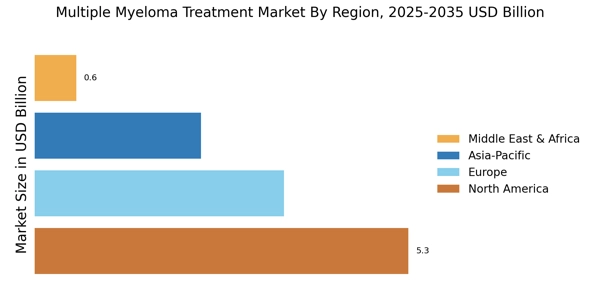
The Multiple Myeloma Treatment Market revealed a substantial regional distribution with diverse valuations. North America, holding a majorly significant position, was valued at 5.3 USD Billion in 2024 and is projected to reach 9.1 USD Billion by 2035, indicative of its majority holding in the market, driven by advanced healthcare infrastructure and ongoing Research and Development efforts.Europe was also a notable region with a valuation of 3.1 USD Billion in 2024, forecasted to grow to 5.4 USD Billion by 2035, reflecting its strong focus on innovative treatment modalities.

In South America, the market was valued at 0.8 USD Billion in 2024, growing to 1.2 USD Billion by 2035, indicating emerging opportunities despite a smaller market share.

The Asia Pacific region values at 2.0 USD Billion in 2024 and is expected to reach 3.1 USD Billion by 2035, showcasing significant growth potential owing to increasing patient populations and drive towards enhancing healthcare quality. The Middle East and Africa presented a valuation of 0.53 USD Billion in 2024, with a rise to 1.1 USD Billion by 2035.The Multiple Myeloma Treatment Market segmentation showed regional disparities driven by factors such as healthcare accessibility, population demographics, and government healthcare policies. Each region presented unique opportunities and challenges that can impact the overall market growth trajectory.

Multiple Myeloma Treatment Market Regional Image

Key Players and Competitive Insights

The Multiple Myeloma Treatment Market is characterized by a dynamic competitive landscape, driven by various pharmaceutical companies striving to advance treatment options for this complex blood cancer. As the demand for innovative therapies increases, key players are focusing on research and development to bring forth novel drugs and therapies that cater to patient-specific needs.Companies are investing in clinical trials, seeking partnerships and collaborations to enhance their product portfolios, and exploring novel therapeutic approaches such as monoclonal antibodies, CAR T-cell therapy, and immunomodulatory agents.

The market is experiencing significant growth, spurred by an increasing incidence of multiple myeloma worldwide, the introduction of new therapies, and an expanding understanding of the disease's biology, thus creating ample opportunities for companies to position themselves advantageously.Novartis holds a prominent position within the Multiple Myeloma Treatment Market, leveraging its extensive research capabilities and strong pipeline of therapeutics. The company has established a robust presence with its innovative therapies that have improved treatment outcomes for multiple myeloma patients.

Novartis's strengths lie in its commitment to cutting-edge research, which enables the development of therapies that target the underlying mechanisms of the disease. Their advanced product offerings in the multiple myeloma treatment landscape reflect the company's focus on enhancing patient care and achieving high efficacy levels while maintaining safety.Additionally, Novartis actively engages in strategic partnerships and collaborations aimed at accelerating its clinical development programs, further strengthening its position in the competitive environment.

Merck is another key player making significant strides in the Multiple Myeloma Treatment Market. The company is widely recognized for its cutting-edge therapies and its capacity to innovate. Merck’s portfolio includes several important products that are critical in the treatment of multiple myeloma, contributing to improved survival rates and patient quality of life.

The company's strength is exemplified by its strategic focus on research and clinical trials, driving the development of new treatment modalities that address unmet clinical needs. Merck is actively pursuing mergers and acquisitions to enhance its capabilities and broaden its therapeutic offerings in this field.

Such strategic moves bolster its global market presence and facilitate access to advanced technologies that can accelerate drug development processes. By staying ahead of the competition through innovation and collaboration, Merck aims to solidify its stature in the Multiple Myeloma Treatment Market and deliver superior treatment options to patients worldwide.

Key Companies in the Multiple Myeloma Treatment Market market include

Industry Developments

Sarclisa (isatuximab) was approved by China's National Medical Products Administration on January 31, 2025, for the treatment of newly diagnosed, transplant-ineligible multiple myeloma in combination with bortezomib, lenalidomide, and dexamethasone (VRd). This was the second approval in China within three weeks after its relapsed/refractory indication earlier that month, according to Sanofi.Sanofi emphasized the findings of the IMROZ Phase III study, which demonstrated that Sarclisa-VRd significantly improved progression-free survival as compared to VRd alone.

The same Sarclisa-VRd regimen was authorized by Japan's Ministry of Health, Labour, and Welfare on February 25, 2025, for newly diagnosed patients who were not eligible for transplantation based on the same IMROZ data.

On June 20, 2025, Johnson & Johnson reported that the EMA's CHMP recommended approval of subcutaneous DARZALEX (daratumumab) monotherapy for high-risk smoldering multiple myeloma, citing positive outcomes from the Phase III AQUILA study.Sanofi revealed on June 23, 2025, that CHMP had expressed a favorable view for Sarclisa-VRd as an induction treatment for newly diagnosed multiple myeloma that is transplant-eligible. This recommendation was based on the GMMG-HD7 research, which showed better progression-free survival and deeper MRD negative.

Ichnos-Glenmark Innovation reported on May 5, 2025, that their trispecific antibody ISB-2001, which targets BCMA and CD38 and is meant for patients who have relapsed or are resistant after three previous regimens, has been granted FDA Fast Track designation.Following provisional EU clearance in April, Regeneron's Lynozyfic (linvoseltamab) was finally granted FDA expedited approval for relapsed/refractory multiple myeloma on July 2, 2025.

Future Outlook

Multiple Myeloma Treatment Market Future Outlook

The Multiple Myeloma Treatment Market is projected to grow at a 4.97% CAGR from 2024 to 2035, driven by advancements in therapies, increasing patient awareness, and enhanced diagnostic techniques.

New opportunities lie in:

  • Development of personalized medicine approaches for targeted therapies.
  • Expansion of telehealth services for remote patient monitoring.
  • Investment in AI-driven drug discovery platforms to expedite treatment development.

By 2035, the market is expected to achieve substantial growth, reflecting evolving treatment paradigms and increased patient access.

Market Segmentation

Multiple Myeloma Treatment Market Type Outlook

  • Chemotherapy
  • Immunotherapy
  • Targeted Therapy
  • Steroids

Multiple Myeloma Treatment Market End-user Outlook

  • Hospitals
  • Specialty Clinics
  • Research Institutes

Multiple Myeloma Treatment Market Treatment Line Outlook

  • First-Line Treatment
  • Second-Line Treatment
  • Third-Line Treatment
  • Subsequent Treatment

Multiple Myeloma Treatment Market Route of Administration Outlook

  • Oral
  • Intravenous
  • Subcutaneous

Report Scope

MARKET SIZE 2024 11.73(USD Billion)
MARKET SIZE 2025 12.31(USD Billion)
MARKET SIZE 2035 20.0(USD Billion)
COMPOUND ANNUAL GROWTH RATE (CAGR) 4.97% (2024 - 2035)
REPORT COVERAGE Revenue Forecast, Competitive Landscape, Growth Factors, and Trends
BASE YEAR 2024
Market Forecast Period 2025 - 2035
Historical Data 2019 - 2024
Market Forecast Units USD Billion
Key Companies Profiled Market analysis in progress
Segments Covered Market segmentation analysis in progress
Key Market Opportunities Emergence of novel therapies and personalized medicine enhances treatment options in the Multiple Myeloma Treatment Market.
Key Market Dynamics Rising demand for innovative therapies drives competition and regulatory scrutiny in the Multiple Myeloma Treatment Market.
Countries Covered North America, Europe, APAC, South America, MEA

Market Highlights

Author
Rahul Gotadki
Assistant Manager

He holds an experience of about 7+ years in Market Research and Business Consulting, working under the spectrum of Life Sciences and Healthcare domains. Rahul conceptualizes and implements a scalable business strategy and provides strategic leadership to the clients. His expertise lies in market estimation, competitive intelligence, pipeline analysis, customer assessment, etc. In addition to the above, his other responsibility includes strategic tracking of high growth markets & advising clients on the potential areas of focus they could direct their business initiatives

Leave a Comment

FAQs

What is the projected market valuation of the Multiple Myeloma Treatment Market by 2035?

The Multiple Myeloma Treatment Market is projected to reach a valuation of 20.0 USD Billion by 2035.

What was the market valuation of the Multiple Myeloma Treatment Market in 2024?

In 2024, the overall market valuation was 11.73 USD Billion.

What is the expected CAGR for the Multiple Myeloma Treatment Market from 2025 to 2035?

The expected CAGR for the Multiple Myeloma Treatment Market during the forecast period 2025 - 2035 is 4.97%.

Which companies are considered key players in the Multiple Myeloma Treatment Market?

Key players in the market include Bristol-Myers Squibb, Johnson & Johnson, Amgen, Roche, Novartis, Takeda, Celgene, GSK, and AbbVie.

What are the projected revenues for chemotherapy in the Multiple Myeloma Treatment Market by 2035?

Chemotherapy is projected to generate revenues between 5.0 and 6.0 USD Billion by 2035.

How does the revenue from immunotherapy compare to that of targeted therapy in 2035?

By 2035, immunotherapy is expected to generate revenues between 4.0 and 5.0 USD Billion, while targeted therapy may reach between 6.0 and 7.0 USD Billion.

What is the anticipated revenue range for first-line treatment in the Multiple Myeloma Treatment Market by 2035?

First-line treatment is anticipated to generate revenues between 8.5 and 9.5 USD Billion by 2035.

What revenue is expected from intravenous administration in the Multiple Myeloma Treatment Market by 2035?

Intravenous administration is expected to generate revenues between 9.0 and 10.0 USD Billion by 2035.

Which end-user segment is projected to have the highest revenue by 2035?

Hospitals are projected to have the highest revenue, expected to range between 8.0 and 9.0 USD Billion by 2035.

What is the revenue expectation for specialty clinics in the Multiple Myeloma Treatment Market by 2035?

Specialty clinics are expected to generate revenues between 5.5 and 6.5 USD Billion by 2035.

Download Free Sample

Kindly complete the form below to receive a free sample of this Report

Compare Licence

×
Features License Type
Single User Multiuser License Enterprise User
Price $4,950 $5,950 $7,250
Maximum User Access Limit 1 User Upto 10 Users Unrestricted Access Throughout the Organization
Free Customization
Direct Access to Analyst
Deliverable Format
Platform Access
Discount on Next Purchase 10% 15% 15%
Printable Versions