×
Hero Background
English
Chinese
French
Japanese
Korean
German
Spanish

Natural Organic Cosmetics Market Share

ID: MRFR/CG/5790-CR
128 Pages
Pradeep Nandi
March 2023

Natural and Organic Cosmetics Market Research Report Information By Product Type (Skin Care, Hair Care, Oral Care, Make-Up Cosmetic, and Others), By End-User (Male, Female, and Unisex), By Distribution Channel (Store-Based And Non-Store-Based) And By Region (North America, Europe, Asia-Pacific, And Rest Of The World) –Market Forecast Till 2035

Share:
Download PDF ×

We do not share your information with anyone. However, we may send you emails based on your report interest from time to time. You may contact us at any time to opt-out.

Natural Organic Cosmetics Market Infographic
Purchase Options

Market Share

Natural Organic Cosmetics Market Share Analysis

Regulations governing the natural and organic cosmetics sector stand as formidable pillars shaping consumer confidence. By setting rigorous standards that limit the presence of harmful substances in products labeled as "natural" or "organic," these directives instill trust among consumers. Collaborative efforts between governments and industry associations further fortify this confidence through certification schemes, ensuring purchased products adhere to stringent quality and safety benchmarks. These regulatory measures not only benefit consumers but also provide producers with a structured framework, fostering accountability and compliance within their operations.

Critical government support extends beyond regulations, encompassing strategic investment in research and development for this burgeoning sector. This financial backing serves as a catalyst for innovation, driving advancements in ingredients, formulations, and manufacturing processes. These innovations, in turn, enable businesses to create compelling, high-quality products that align with evolving consumer preferences for natural and organic cosmetics.

Moreover, governments play a pivotal role in facilitating global trade by promoting the export and import of these eco-conscious cosmetics through trade agreements. This international perspective not only broadens market horizons but also encourages companies to expand their reach globally. As a result, the natural and organic cosmetics industry experiences an upsurge driven by consumer demand and augmented market accessibility, leading to a positive impact on the environment through sustainable practices.

The market landscape is witnessing a profound shift catalyzed by consumers' heightened consciousness about environmental concerns. The surge in the sub-zero waste trend epitomizes this transformation, with consumers demanding cosmetics that are not only free from chemicals but also packaged sustainably. Leading brands are strategically pivoting towards this paradigm shift, reimagining product packaging to achieve zero waste and environmental sustainability. The rise in consumer preference for reusable, recyclable, and minimal packaging signals a decisive move towards more sustainable practices in the industry.

This shift in consumer behavior is underpinned by a discerning approach towards personal care products, including a preference for natural and organic cosmetics. Consumers are increasingly attentive to the chemicals, potential side effects, and overall benefits associated with the products they use. Notable industry figures, such as Tata Harper, have played a role in this change by founding businesses rooted in their firsthand experiences of the adverse effects of synthetic chemicals. Consequently, natural ingredients are now perceived as safer for both the environment and human health, leading cosmetics manufacturing companies to pivot towards natural and organic ingredients in lieu of synthetic ones.

The convergence of these factors, among others, is expected to propel substantial growth in the global market for natural and organic cosmetics. Consumer-driven demand, regulatory support, industry innovation, and an evolving market landscape all contribute to an optimistic forecast for the industry's expansion. As consumers increasingly prioritize environmentally friendly and chemical-free products, the natural and organic cosmetics sector stands poised for remarkable growth in the foreseeable future.

Author
Pradeep Nandi
Senior Research Analyst

I have a bachelor's degree in mechanical engineering and an MBA. I have more than two years of expertise in the retail, food, and beverage, chemical, and material industries, and hence have developed a sound cross-domain expertise. A firm believer in lifelong learning and sharing of knowledge. Having a proclivity for hatching ideas and trying to absorb as much information as possible in a short amount of time. Introducing corporates to the data and insight, which enables them to move from probability to possibility, has been my key areas of interest. 

Leave a Comment

FAQs

How much is the natural and organic cosmetics market?

The natural and organic cosmetics market size was valued at USD 45.32 Billion in 2023.

What is the growth rate of the natural and organic cosmetics market?

The market is projected to grow at a CAGR of 9.5% during the forecast period, 2025-2034.

Which region held the largest market share in the natural and organic cosmetics market?

North America had the largest share of the market

Who are the key players in the natural and organic cosmetics market?

The key players in the market are L'Occitane International SA (France), FANCL Corp. (Japan), The Clorox Co. (US), Jurlique International Pty. Limited (Australia), LaboratoireNuxe (France), Bare Escentuals, Inc. (US), Aubrey Organics, Inc. (US), and Nature's Gate (US).

Which product type led the natural and organic cosmetics market?

The skin care category dominated the market in 2023.

Which end-user had the largest market share in the natural and organic cosmetics market?

The female had the largest share of the market.

Which distribution channel had the largest market share in the natural and organic cosmetics market?

The non-store-based had the largest share in the market.

Market Summary

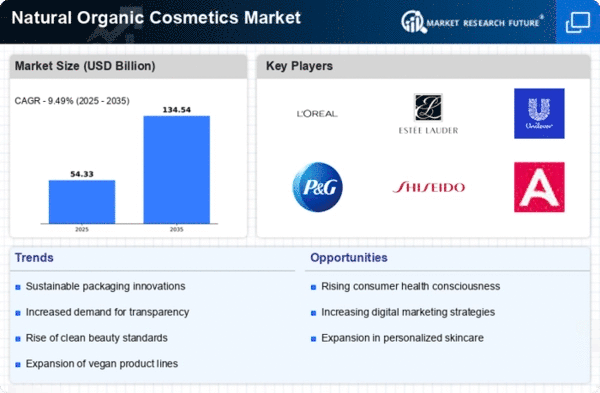
As per MRFR analysis, the Natural Organic Cosmetics Market was estimated at 49.62 USD Billion in 2024. The Natural Organic Cosmetics industry is projected to grow from 54.33 USD Billion in 2025 to 134.54 USD Billion by 2035, exhibiting a compound annual growth rate (CAGR) of 9.49 during the forecast period 2025 - 2035.

Key Market Trends & Highlights

The Natural Organic Cosmetics Market is experiencing robust growth driven by sustainability and consumer demand for transparency.

  • The market is increasingly characterized by a strong focus on sustainability and eco-friendly practices.
  • Ingredient transparency is becoming a critical factor influencing consumer purchasing decisions in North America.
  • Personalization and customization are gaining traction, particularly in the skin care segment, which remains the largest.
  • Rising consumer awareness and the influence of social media are key drivers propelling growth in the hair care segment, especially cleansers.

Market Size & Forecast

2024 Market Size 49.62 (USD Billion)
2035 Market Size 134.54 (USD Billion)
CAGR (2025 - 2035) 9.49%
Largest Regional Market Share in 2024 North America

Major Players

<p>L'Oreal (FR), Estée Lauder (US), Unilever (GB), Procter & Gamble (US), Shiseido (JP), Avon (GB), Weleda (DE), Dr. Hauschka (DE), Burt's Bees (US), Aveda (US)</p>

Market Trends

The Natural Organic Cosmetics Market is currently experiencing a notable transformation, driven by a growing consumer preference for products that are perceived as safe, environmentally friendly, and ethically sourced. This shift appears to be influenced by an increasing awareness of the potential harmful effects of synthetic ingredients commonly found in traditional cosmetics. As consumers become more educated about the benefits of natural and organic formulations, brands are responding by reformulating existing products and launching new lines that emphasize transparency in ingredient sourcing and production processes. Furthermore, the rise of social media and influencer marketing has played a pivotal role in shaping consumer perceptions, leading to a heightened demand for authenticity and sustainability in beauty products. In addition to changing consumer preferences, the Natural Organic Cosmetics Market is also witnessing a surge in innovation. Companies are exploring novel ingredients derived from plants, minerals, and other natural sources, which not only cater to the demand for organic products but also enhance product efficacy. This trend suggests that brands are not merely focusing on the organic label but are also committed to delivering high-performance solutions that meet the evolving needs of consumers. As the market continues to expand, it is likely that regulatory frameworks will adapt to ensure the integrity of organic claims, further influencing the competitive landscape and consumer trust in the Natural Organic Cosmetics Market.

Sustainability Focus

There is a growing emphasis on sustainability within the Natural Organic Cosmetics Market. Brands are increasingly adopting eco-friendly packaging and sourcing practices, reflecting a commitment to reducing environmental impact. This trend indicates that consumers are not only interested in the products themselves but also in the broader implications of their purchases.

Ingredient Transparency

Consumers are demanding greater transparency regarding product ingredients. The Natural Organic Cosmetics Market is responding by providing detailed information about sourcing, formulation, and potential benefits of ingredients. This trend suggests that brands that prioritize clear communication may foster stronger consumer loyalty.

Personalization and Customization

The trend towards personalization is becoming more pronounced in the Natural Organic Cosmetics Market. Brands are exploring ways to offer tailored solutions that cater to individual skin types and preferences. This approach indicates a shift towards a more consumer-centric model, where unique needs are prioritized.

Natural Organic Cosmetics Market Market Drivers

Regulatory Support

Government regulations promoting the use of natural and organic ingredients bolster the Global Natural and Organic Cosmetics Industry. Regulatory bodies are increasingly establishing guidelines that encourage the formulation of cosmetics with safer, non-toxic ingredients. This regulatory support not only enhances consumer trust but also incentivizes manufacturers to innovate and develop products that align with these standards. As a result, the market is likely to experience a compound annual growth rate of 9.49% from 2025 to 2035, as companies adapt to these evolving regulations and consumer expectations.

Sustainability Trends

The growing emphasis on sustainability and eco-friendly practices significantly influences the Global Natural and Organic Cosmetics Industry. Consumers increasingly prefer brands that adopt sustainable sourcing, packaging, and production methods. This shift is not merely a trend but appears to be a fundamental change in consumer behavior, as evidenced by the rise of brands that prioritize biodegradable packaging and ethically sourced ingredients. As a result, the market is expected to witness substantial growth, with projections indicating a rise to 134.6 USD Billion by 2035. This reflects a broader societal movement towards sustainability that is reshaping the cosmetics landscape.

Diverse Product Offerings

The expansion of diverse product offerings within the Global Natural and Organic Cosmetics Industry caters to a wide range of consumer needs and preferences. Brands are increasingly developing specialized products, including vegan, cruelty-free, and gender-neutral cosmetics, which appeal to various demographics. This diversification not only attracts a broader consumer base but also enhances market competitiveness. As the industry evolves, the availability of innovative formulations and unique product lines is likely to contribute to sustained market growth, further solidifying the position of natural and organic cosmetics in the global beauty landscape.

Influence of Social Media

The impact of social media on consumer purchasing behavior is a notable driver of the Global Natural and Organic Cosmetics Industry. Platforms such as Instagram and TikTok have become vital channels for beauty brands to engage with consumers, showcasing natural and organic products through influencer partnerships and user-generated content. This digital engagement fosters a sense of community and trust among consumers, leading to increased brand loyalty and sales. As social media continues to shape consumer preferences, the market is poised for growth, with an increasing number of brands leveraging these platforms to promote their natural offerings.

Rising Consumer Awareness

Increasing consumer awareness regarding the harmful effects of synthetic chemicals in personal care products drives the Global Natural and Organic Cosmetics Industry. As consumers become more educated about ingredients and their potential health impacts, there is a notable shift towards products that are perceived as safer and more environmentally friendly. This trend is reflected in the growing demand for natural and organic alternatives, which are often marketed as free from harmful additives. Consequently, the Global Natural and Organic Cosmetics Market is projected to reach 49.6 USD Billion in 2024, indicating a robust consumer preference for transparency and sustainability in cosmetic formulations.

Market Segment Insights

By Application: Skin Care (Largest) vs. Hair Care (Fastest-Growing)

<p>In the Natural Organic Cosmetics Market, the application segment is characterized by a diverse range of categories, with Skin Care holding the largest market share. This segment benefits from increasing consumer awareness about skincare ingredients and a shift toward natural products. Skin Care includes moisturizers, lotions, and treatments, driving significant demand among health-conscious customers. Following closely is Hair Care, showcasing itself as the fastest-growing segment. As more consumers seek eco-friendly and organic options, the demand for natural shampoos, conditioners, and treatments rises, reflecting a broader trend towards sustainability in personal care routines.</p>

<p>Skin Care (Dominant) vs. Hair Care (Emerging)</p>

<p>The Skin Care segment stands as a dominant force within the Natural Organic Cosmetics Market, characterized by its wide array of products that cater to varied skin types and issues. This segment emphasizes the use of natural ingredients, appealing to consumers looking for safer alternatives devoid of harmful chemicals. On the other hand, Hair Care is emerging rapidly, driven by the increasing trend of organic hair treatments and styling products. Consumers are becoming more informed about the negative impacts of synthetic additives in hair products, igniting interest in natural formulations. This shift is bolstered by the rise of influencer-led marketing, raising awareness and preferences for organic products in hair care routines. The emerging Hair Care segment is thus positioned for accelerated growth, capturing the attention of environmentally-conscious consumers.</p>

By Product Type: Moisturizers (Largest) vs. Cleansers (Fastest-Growing)

<p>In the Natural Organic Cosmetics Market, the distribution of market share among various product types demonstrates distinct dynamics. Moisturizers lead the category as the largest segment, favored by consumers for their hydrating properties and natural formulations. Cleansers, however, have been gaining traction rapidly, appealing to an eco-conscious demographic that seeks gentle yet effective ways to maintain skin health. This competitive landscape indicates a diverse consumer preference for clean beauty products, focusing on efficacy and sustainability. Growth trends in this segment are influenced by several factors, particularly the increasing demand for organic and natural ingredients. Consumers are becoming more informed about the benefits of these products, leading to a significant shift towards purchasing moisturizers and cleansers that promote skin health without harmful chemicals. The rising interest in self-care and skincare routines is also driving the growth of serums and sunscreens, as these items complement the cleansing and moisturizing processes, presenting a more holistic approach to beauty.</p>

<p>Moisturizers (Dominant) vs. Sunscreens (Emerging)</p>

<p>Moisturizers constitute the dominant segment in the Natural Organic Cosmetics Market, celebrated for their extensive range of formulations catering to various skin types. Their appeal lies in their ability to provide hydration using organic ingredients, which align with consumer preferences for clean and sustainable beauty. As consumers increasingly prioritize skincare routines, moisturizers are perceived as essential in achieving and maintaining youthful, healthy skin. Meanwhile, sunscreens are emerging rapidly as consumers become more aware of UV protection and its significance in skincare. The shift towards natural, chemical-free sunscreens indicates a growing market segment that emphasizes conscientious consumer choices, further enriching the diversity within product offerings in the organic cosmetics landscape.</p>

By Distribution Channel: Online Retail (Largest) vs. Specialty Stores (Fastest-Growing)

<p>The distribution of natural organic cosmetics through various channels reveals significant insights into consumer preferences. Online retail has emerged as the largest channel, capturing a substantial share due to the increasing trend of e-commerce and digital shopping behaviors. In contrast, specialty stores, while smaller in market share, are experiencing rapid growth as consumers seek curated product experiences and specialized knowledge.</p>

<p>Specialty Stores: Dominant vs. Online Retail: Emerging</p>

<p>Online retail is distinguished by its convenience, allowing customers to explore a wide array of natural organic cosmetics from the comfort of their homes. This channel benefits from effective online marketing strategies and personalized shopping experiences. Conversely, specialty stores are emerging as key players by providing expert advice and an experiential in-store environment. These stores cater to a niche market that values quality and authenticity, driving their rapid growth and potential to capture a more significant market share.</p>

Get more detailed insights about Natural and Organic Cosmetics Market Research Report - Forecast to 2035

Regional Insights

North America : Market Leader in Organic Beauty

North America continues to lead the Natural Organic Cosmetics Market, holding a significant market share of 24.81% as of 2024. The growth is driven by increasing consumer awareness regarding the benefits of organic ingredients, coupled with a rising demand for sustainable and eco-friendly products. Regulatory support for organic labeling and safety standards further catalyzes market expansion, making it a vibrant hub for innovation in cosmetics. The competitive landscape is characterized by major players such as Estée Lauder, Procter & Gamble, and Burt's Bees, who are investing heavily in research and development. The U.S. remains the largest market, with Canada also showing promising growth. The presence of established brands and a strong retail network enhances market accessibility, ensuring a steady supply of natural cosmetics to consumers.

Europe : Emerging Hub for Organic Products

Europe is witnessing a robust growth trajectory in the Natural Organic Cosmetics Market, with a market size of €15.0 million. The region's growth is fueled by stringent regulations promoting organic standards and increasing consumer demand for transparency in product ingredients. The European Union's commitment to sustainability and eco-friendly practices is a significant driver, encouraging brands to innovate and adapt to changing consumer preferences. Leading countries such as Germany, France, and the UK are at the forefront of this market, with key players like L'Oreal and Weleda leading the charge. The competitive landscape is vibrant, with numerous small and medium enterprises emerging alongside established brands. This dynamic environment fosters innovation and ensures a diverse range of products for consumers, enhancing market growth.

Asia-Pacific : Rapid Growth in Emerging Markets

The Asia-Pacific region is experiencing a notable increase in the Natural Organic Cosmetics Market, with a market size of $7.5 million. This growth is primarily driven by rising disposable incomes, urbanization, and a growing awareness of the benefits of natural ingredients. Consumers are increasingly seeking products that align with their health and wellness goals, leading to a surge in demand for organic cosmetics across countries like Japan, China, and Australia. Japan stands out as a key player in this market, with Shiseido leading the charge in innovation and product development. The competitive landscape is evolving, with both international and local brands vying for market share. The presence of established companies alongside emerging startups creates a dynamic environment, fostering competition and driving product diversity in the region.

Middle East and Africa : Emerging Market with Potential

The Middle East and Africa region is gradually emerging in the Natural Organic Cosmetics Market, with a market size of $2.31 million. The growth is driven by increasing consumer interest in organic products and a shift towards healthier lifestyle choices. Regulatory frameworks are beginning to support organic labeling, which is expected to enhance consumer trust and drive market growth in the coming years. Countries like South Africa and the UAE are leading the way, with a growing number of local brands entering the market. The competitive landscape is still developing, but the presence of international players is beginning to shape the market dynamics. As awareness of natural cosmetics increases, the region is poised for significant growth, presenting opportunities for both established and new entrants.

Key Players and Competitive Insights

The Natural Organic Cosmetics Market is currently characterized by a dynamic competitive landscape, driven by increasing consumer demand for sustainable and ethically sourced products. Major players such as L'Oreal (FR), Estée Lauder (US), and Unilever (GB) are strategically positioning themselves through innovation and digital transformation. L'Oreal (FR) has focused on enhancing its product lines with natural ingredients, while Estée Lauder (US) emphasizes sustainability in its packaging and sourcing. Unilever (GB) has adopted a multi-brand strategy, integrating organic offerings across its extensive portfolio, which collectively shapes a competitive environment that is increasingly focused on sustainability and consumer engagement.

Key business tactics within this market include localizing manufacturing and optimizing supply chains to enhance responsiveness to consumer preferences. The competitive structure appears moderately fragmented, with a mix of established brands and emerging players vying for market share. The collective influence of key players is significant, as they leverage their brand equity and distribution networks to capture a larger segment of the market.

In November 2025, L'Oreal (FR) announced a partnership with a leading biotechnology firm to develop bio-based ingredients for its organic cosmetics line. This strategic move is likely to enhance L'Oreal's product offerings, aligning with the growing consumer preference for sustainable and innovative solutions. The collaboration may also position L'Oreal as a frontrunner in the bio-cosmetics segment, potentially increasing its market share.

In October 2025, Estée Lauder (US) launched a new initiative aimed at reducing its carbon footprint by 50% by 2030. This ambitious goal underscores the company's commitment to sustainability and may resonate well with environmentally conscious consumers. By prioritizing eco-friendly practices, Estée Lauder could strengthen its brand loyalty and attract a broader customer base, thereby enhancing its competitive edge.

In September 2025, Unilever (GB) expanded its organic product range by acquiring a niche brand known for its commitment to natural ingredients. This acquisition not only diversifies Unilever's portfolio but also allows the company to tap into the growing demand for organic cosmetics. The strategic importance of this move lies in Unilever's ability to leverage its extensive distribution channels to promote the newly acquired brand, potentially increasing its market penetration.

As of December 2025, current competitive trends in the Natural Organic Cosmetics Market are heavily influenced by digitalization, sustainability, and the integration of AI technologies. Strategic alliances are increasingly shaping the landscape, as companies collaborate to enhance their product offerings and operational efficiencies. Looking ahead, competitive differentiation is expected to evolve, with a notable shift from price-based competition to a focus on innovation, technology, and supply chain reliability. This transition may redefine market dynamics, compelling companies to invest in research and development to meet the evolving expectations of consumers.

Key Companies in the Natural Organic Cosmetics Market market include

Industry Developments

November 2022: Avon partnered with Perfect Corp., a leading Al-based beauty tech solutions provider, to improve the virtual makeup technology system and help consumers choose suitable product types.

September 2022: Naturals Skincare Products launched its new beauty care product, ' Pearl.' The Pearl company launched 18 new chemical-free organic beauty products for skin and hair care.

Future Outlook

Natural Organic Cosmetics Market Future Outlook

<p>The Natural Organic Cosmetics Market is projected to grow at a 9.49% CAGR from 2024 to 2035, driven by increasing consumer demand for sustainable and eco-friendly products.</p>

New opportunities lie in:

  • <p>Expansion of e-commerce platforms for organic cosmetics</p>
  • <p>Development of personalized skincare solutions using AI</p>
  • <p>Partnerships with eco-conscious influencers for brand promotion</p>

<p>By 2035, the market is expected to solidify its position as a leader in sustainable beauty.</p>

Market Segmentation

Natural Organic Cosmetics Market Application Outlook

  • Skin Care
  • Hair Care
  • Makeup
  • Fragrance
  • Personal Care

Natural Organic Cosmetics Market Product Type Outlook

  • Moisturizers
  • Cleansers
  • Sunscreens
  • Serums
  • Makeup Removers

Natural Organic Cosmetics Market Distribution Channel Outlook

  • Online Retail
  • Specialty Stores
  • Supermarkets
  • Pharmacies
  • Direct Sales

Report Scope

MARKET SIZE 202449.62(USD Billion)
MARKET SIZE 202554.33(USD Billion)
MARKET SIZE 2035134.54(USD Billion)
COMPOUND ANNUAL GROWTH RATE (CAGR)9.49% (2024 - 2035)
REPORT COVERAGERevenue Forecast, Competitive Landscape, Growth Factors, and Trends
BASE YEAR2024
Market Forecast Period2025 - 2035
Historical Data2019 - 2024
Market Forecast UnitsUSD Billion
Key Companies ProfiledL'Oreal (FR), Estée Lauder (US), Unilever (GB), Procter & Gamble (US), Shiseido (JP), Avon (GB), Weleda (DE), Dr. Hauschka (DE), Burt's Bees (US), Aveda (US)
Segments CoveredApplication, Product Type, Distribution Channel
Key Market OpportunitiesGrowing consumer demand for sustainable and ethically sourced ingredients in the Natural Organic Cosmetics Market.
Key Market DynamicsRising consumer demand for sustainable ingredients drives innovation and competition in the Natural Organic Cosmetics Market.
Countries CoveredNorth America, Europe, APAC, South America, MEA

FAQs

How much is the natural and organic cosmetics market?

The natural and organic cosmetics market size was valued at USD 45.32 Billion in 2023.

What is the growth rate of the natural and organic cosmetics market?

The market is projected to grow at a CAGR of 9.5% during the forecast period, 2025-2034.

Which region held the largest market share in the natural and organic cosmetics market?

North America had the largest share of the market

Who are the key players in the natural and organic cosmetics market?

The key players in the market are L'Occitane International SA (France), FANCL Corp. (Japan), The Clorox Co. (US), Jurlique International Pty. Limited (Australia), LaboratoireNuxe (France), Bare Escentuals, Inc. (US), Aubrey Organics, Inc. (US), and Nature's Gate (US).

Which product type led the natural and organic cosmetics market?

The skin care category dominated the market in 2023.

Which end-user had the largest market share in the natural and organic cosmetics market?

The female had the largest share of the market.

Which distribution channel had the largest market share in the natural and organic cosmetics market?

The non-store-based had the largest share in the market.

  1. EXECUTIVE SUMMARY 14
    1. MARKET ATTRACTIVENESS ANALYSIS 16
      1. GLOBAL NATURAL AND ORGANIC COSMETICS MARKET, BY PRODUCT TYPE 17
      2. GLOBAL NATURAL AND ORGANIC COSMETICS MARKET, BY END USER 18
      3. GLOBAL NATURAL AND ORGANIC COSMETICS MARKET, BY DISTRIBUTION CHANNEL 19
      4. GLOBAL NATURAL AND ORGANIC COSMETICS MARKET, BY REGION 20
  2. MARKET INTRODUCTION 21
    1. DEFINITION 21
    2. SCOPE OF THE STUDY 21
    3. MARKET STRUCTURE 21
  3. RESEARCH METHODOLOGY 22
    1. RESEARCH PROCESS 22
    2. PRIMARY RESEARCH 23
    3. SECONDARY RESEARCH 24
    4. MARKET SIZE ESTIMATION 24
    5. TOP-DOWN AND BOTTOM-UP APPROACH 25
    6. FORECAST MODEL 26
    7. LIST OF ASSUMPTIONS & LIMITATIONS 27
  4. MARKET DYNAMICS 28
    1. INTRODUCTION 28
    2. DRIVERS 29
      1. GROWING PREFERENCE FOR NATURAL & ORGANIC INGREDIENTS IN THE COSMETICS BY THE CONSUMERS 29
      2. POSITIVE IMPACT OF SOCIAL MEDIA ON THE GROWTH OF THE NATURAL & ORGANIC COSMETICS MARKET 29
    3. RESTRAINTS 31
      1. SHORT SHELF LIFE OF THE NATURAL & ORGANIC COSMETICS 31
      2. BRANDING ISSUES 31
    4. OPPORTUNITIES 32
      1. PRODUCT CERTIFICATION 32
      2. GOVERNMENT SUPPORT FOR NATURAL & ORGANIC COSMETICS 32
    5. TRENDS 33
      1. GROWING FOCUS ON ORGANIC GROWTH STRATEGIES 33
      2. INCREASING AFFINITY TOWARD SKIN LIGHTENING & COLOUR COSMETIC PRODUCTS 33
  5. MARKET FACTOR ANALYSIS 34
    1. VALUE CHAIN ANALYSIS 34
      1. RESEARCH & PRODUCT DEVELOPMENT 34
      2. RAW MATERIAL PROCUREMENT 34
      3. PROCESSING 35
      4. PACKAGING 35
    2. SUPPLY CHAIN ANALYSIS 35
      1. RAW MATERIAL SUPPLIERS 36
      2. NATURAL AND ORGANIC COSMETICS MANUFACTURERS 36
      3. DISTRIBUTION CHANNELS 36
      4. END-USER 36
    3. PORTER’S FIVE FORCES MODEL 37
      1. THREAT OF NEW ENTRANTS 37
      2. THREAT OF SUBSTITUTES 38
      3. BARGAINING POWER OF BUYERS 38
      4. BARGAINING POWER OF SUPPLIERS 38
      5. RIVALRY 38
    4. IMPACT OF COVID-19 ON THE GLOBAL NATURAL AND ORGANIC COSMETICS MARKET 39
      1. IMPACT ON PRODUCTION 39
      2. IMPACT ON CONSUMER BUYING BEHAVIOUR 39
      3. IMPACT OF COVID-19 ON SUPPLY CHAIN 39
      4. IMPACT ON PRICING 39
      5. IMPACT ON STORE-BASED VS NON-STORE BASED SALES 40
      6. OTHERS 40
  6. GLOBAL NATURAL AND ORGANIC COSMETICS MARKET, BY PRODUCT TYPE 41
    1. OVERVIEW 41
      1. NATURAL AND ORGANIC COSMETICS: MARKET ESTIMATES & FORECAST BY PRODUCT TYPE, 2025–2034 42
    2. SKIN CARE 42
      1. SKIN CARE: MARKET ESTIMATES & FORECAST BY REGION,2025–2034 42
    3. HAIR CARE 43
      1. HAIR CARE: MARKET ESTIMATES & FORECAST BY REGION,2025–2034 43
    4. ORAL CARE 44
      1. ORAL CARE: MARKET ESTIMATES & FORECAST BY REGION,2025–2034 44
    5. MAKE UP COSMETICS 45
      1. MAKE UP COSMETICS: MARKET ESTIMATES & FORECAST BY REGION,2025–2034 45
    6. OTHERS 45
      1. OTHERS: MARKET ESTIMATES & FORECAST BY REGION,2025–2034 45
  7. GLOBAL NATURAL AND ORGANIC COSMETICS MARKET, BY END USER 46
    1. OVERVIEW 46
      1. NATURAL AND ORGANIC COSMETICS: MARKET ESTIMATES & FORECAST BY END USER, 2025–2034 47
    2. MALE 47
      1. MALE: MARKET ESTIMATES & FORECAST BY REGION,2025–2034 47
    3. FEMALE 48
      1. FEMALE: MARKET ESTIMATES & FORECAST BY REGION,2025–2034 48
    4. UNISEX 49
      1. UNISEX: MARKET ESTIMATES & FORECAST BY REGION,2025–2034 49
  8. GLOBAL NATURAL AND ORGANIC COSMETICS MARKET, BY DISTRIBUTION CHANNEL 50
    1. OVERVIEW 50
      1. NATURAL AND ORGANIC COSMETICS: MARKET ESTIMATES & FORECAST BY DISTRIBUTION CHANNEL,
    2. STORED-BASED 51
      1. STORED-BASED: MARKET ESTIMATES & FORECAST BY REGION,2025–2034 51
      2. NATURAL AND ORGANIC COSMETICS: MARKET ESTIMATES & FORECAST BY STORE-BASED,2025–2034 52
    3. NON-STORE BASED 52
      1. NON-STORE BASED: MARKET ESTIMATES & FORECAST BY REGION,2025–2034 52
  9. GLOBAL NATURAL AND ORGANIC COSMETICS MARKET, BY REGION 53
    1. OVERVIEW 53
    2. NORTH AMERICA 55
      1. US 58
      2. CANADA 60
      3. MEXICO 62
    3. EUROPE 64
      1. GERMANY 66
      2. FRANCE 68
      3. UK 70
      4. ITALY 72
      5. SPAIN 74
      6. NETHERLANDS 76
      7. REST OF EUROPE 78
    4. ASIA-PACIFIC 80
      1. CHINA 83
      2. JAPAN 84
      3. INDIA 86
      4. AUSTRALIA & NEW ZEALAND 88
      5. REST OF ASIA-PACIFIC 90
    5. REST OF THE WORLD 92
      1. SOUTH AMERICA 95
      2. MIDDLE EAST 97
      3. AFRICA 99
  10. COMPETITIVE LANDSCAPE 101
    1. INTRODUCTION 101
    2. COMPETITIVE BENCHMARKING 102
    3. DEVELOPMENT SHARE ANALYSIS 103
    4. KEY DEVELOPMENTS & GROWTH STRATEGIES 103
  11. COMPANY PROFILES 105
    1. ESTÉE LAUDER COMPANIES INC. 105
      1. COMPANY OVERVIEW 105
      2. FINANCIAL OVERVIEW 106
      3. PRODUCTS OFFERED 107
      4. KEY DEVELOPMENTS 107
      5. SWOT ANALYSIS 108
      6. KEY STRATEGIES 108
    2. L'ORÉAL S.A. 109
      1. COMPANY OVERVIEW 109
      2. FINANCIAL OVERVIEW 110
      3. PRODUCTS OFFERED 110
      4. KEY DEVELOPMENTS 111
      5. SWOT ANALYSIS 111
      6. KEY STRATEGIES 112
    3. L'OCCITANE INTERNATIONAL SA 113
      1. COMPANY OVERVIEW 113
      2. FINANCIAL OVERVIEW 114
      3. PRODUCTS OFFERED 115
      4. KEY DEVELOPMENTS 116
      5. SWOT ANALYSIS 116
      6. KEY STRATEGIES 117
    4. FANCL CORP. 118
      1. COMPANY OVERVIEW 118
      2. FINANCIAL OVERVIEW 118
      3. PRODUCTS OFFERED 119
      4. KEY DEVELOPMENTS 119
      5. SWOT ANALYSIS 119
      6. KEY STRATEGIES 120
    5. THE CLOROX CO. 121
      1. COMPANY OVERVIEW 121
      2. FINANCIAL OVERVIEW 121
      3. PRODUCTS OFFERED 122
      4. KEY DEVELOPMENTS 122
      5. SWOT ANALYSIS 123
      6. KEY STRATEGIES 123
    6. JURLIQUE INTERNATIONAL PTY. LIMITED 124
      1. COMPANY OVERVIEW 124
      2. FINANCIAL OVERVIEW 124
      3. PRODUCTS OFFERED 124
      4. KEY DEVELOPMENTS 125
      5. KEY STRATEGIES 125
    7. LABORATOIRE NUXE 126
      1. COMPANY OVERVIEW 126
      2. FINANCIAL OVERVIEW 126
      3. PRODUCTS OFFERED 126
      4. KEY DEVELOPMENTS 127
      5. KEY STRATEGIES 127
    8. BARE ESCENTUALS, INC. 128
      1. COMPANY OVERVIEW 128
      2. FINANCIAL OVERVIEW 128
      3. PRODUCTS OFFERED 128
      4. KEY DEVELOPMENTS 128
      5. KEY STRATEGIES 128
    9. AUBREY ORGANICS, INC. 129
      1. COMPANY OVERVIEW 129
      2. FINANCIAL OVERVIEW 129
      3. PRODUCTS OFFERED 129
      4. KEY DEVELOPMENTS 130
      5. KEY STRATEGIES 130
    10. NATURE'S GATE 131
      1. COMPANY OVERVIEW 131
      2. FINANCIAL OVERVIEW 131
      3. PRODUCTS OFFERED 131
      4. KEY DEVELOPMENTS 132
      5. KEY STRATEGIES 132
  12. APPENDIX 133
    1. REFERENCES 133
    2. RELATED REPORTS 133
    3. "

Natural and Organic Cosmetics Product Type Outlook (USD Billion, 2025-2034)

Skin Care

Hair Care

Oral Care

Make-Up Cosmetic

Others

Natural and Organic Cosmetics End-User Outlook (USD Billion, 2025-2034)

Male

Female

Unisex

Natural and Organic Cosmetics Distribution Channel Outlook (USD Billion, 2025-2034)

Store-Based

Non-Store-Based

Natural and Organic Cosmetics Regional Outlook (USD Billion, 2025-2034)

North America Outlook (USD Billion, 2025-2034)

North America Natural and Organic Cosmetics by Product Type

Skin Care

Hair Care

Oral Care

Make-Up Cosmetic

Others

North America Natural and Organic Cosmetics by End-User

Male

Female

Unisex

North America Natural and Organic Cosmetics by Distribution Channel

Store-Based

Non-Store-Based

US Outlook (USD Billion, 2025-2034)

US Natural and Organic Cosmetics by Product Type

Skin Care

Hair Care

Oral Care

Make-Up Cosmetic

Others

US Natural and Organic Cosmetics by End-User

Male

Female

Unisex

US Natural and Organic Cosmetics by Distribution Channel

Store-Based

Non-Store-Based

CANADA Outlook (USD Billion, 2025-2034)

CANADA Natural and Organic Cosmetics by Product Type

Skin Care

Hair Care

Oral Care

Make-Up Cosmetic

Others

CANADA Natural and Organic Cosmetics by End-User

Male

Female

Unisex

CANADA Natural and Organic Cosmetics by Distribution Channel

Store-Based

Non-Store-Based

Europe Outlook (USD Billion, 2025-2034)

Europe Natural and Organic Cosmetics by Product Type

Skin Care

Hair Care

Oral Care

Make-Up Cosmetic

Others

Europe Natural and Organic Cosmetics by End-User

Male

Female

Unisex

Europe Natural and Organic Cosmetics by Distribution Channel

Store-Based

Non-Store-Based

Germany Outlook (USD Billion, 2025-2034)

Germany Natural and Organic Cosmetics by Product Type

Skin Care

Hair Care

Oral Care

Make-Up Cosmetic

Others

Germany Natural and Organic Cosmetics by End-User

Male

Female

Unisex

Germany Natural and Organic Cosmetics by Distribution Channel

Store-Based

Non-Store-Based

France Outlook (USD Billion, 2025-2034)

France Natural and Organic Cosmetics by Product Type

Skin Care

Hair Care

Oral Care

Make-Up Cosmetic

Others

France Natural and Organic Cosmetics by Distribution Channel

Store-Based

Non-Store-Based

France Natural and Organic Cosmetics by End-User

Male

Female

Unisex

UK Outlook (USD Billion, 2025-2034)

UK Natural and Organic Cosmetics by Product Type

Skin Care

Hair Care

Oral Care

Make-Up Cosmetic

Others

UK Natural and Organic Cosmetics by End-User

Male

Female

Unisex

UK Natural and Organic Cosmetics by Distribution Channel

Store-Based

Non-Store-Based

ITALY Outlook (USD Billion, 2025-2034)

ITALY Natural and Organic Cosmetics by Product Type

Skin Care

Hair Care

Oral Care

Make-Up Cosmetic

Others

ITALY Natural and Organic Cosmetics by End-User

Male

Female

Unisex

ITALY Natural and Organic Cosmetics by Distribution Channel

Store-Based

Non-Store-Based

SPAIN Outlook (USD Billion, 2025-2034)

Spain Natural and Organic Cosmetics by Product Type

Skin Care

Hair Care

Oral Care

Make-Up Cosmetic

Others

Spain Natural and Organic Cosmetics by End-User

Male

Female

Unisex

Spain Natural and Organic Cosmetics by Distribution Channel

Store-Based

Non-Store-Based

Rest Of Europe Outlook (USD Billion, 2025-2034)

Rest Of Europe Natural and Organic Cosmetics by Product Type

Skin Care

Hair Care

Oral Care

Make-Up Cosmetic

Others

REST OF EUROPE Natural and Organic Cosmetics by End-User

Male

Female

Unisex

Rest Of Europe Natural and Organic Cosmetics by Distribution Channel

Store-Based

Non-Store-Based

Asia-Pacific Outlook (USD Billion, 2025-2034)

Asia-Pacific Natural and Organic Cosmetics by Product Type

Skin Care

Hair Care

Oral Care

Make-Up Cosmetic

Others

Asia-Pacific Natural and Organic Cosmetics by End-User

Male

Female

Unisex

Asia-Pacific Natural and Organic Cosmetics by Distribution Channel

Store-Based

Non-Store-Based

China Outlook (USD Billion, 2025-2034)

China Natural and Organic Cosmetics by Product Type

Skin Care

Hair Care

Oral Care

Make-Up Cosmetic

Others

China Natural and Organic Cosmetics by End-User

Male

Female

Unisex

China Natural and Organic Cosmetics by Distribution Channel

Store-Based

Non-Store-Based

Japan Outlook (USD Billion, 2025-2034)

Japan Natural and Organic Cosmetics by Product Type

Skin Care

Hair Care

Oral Care

Make-Up Cosmetic

Others

Japan Natural and Organic Cosmetics by Distribution Channel

Store-Based

Non-Store-Based

Japan Natural and Organic Cosmetics by End-User

Male

Female

Unisex

India Outlook (USD Billion, 2025-2034)

India Natural and Organic Cosmetics by Product Type

Skin Care

Hair Care

Oral Care

Make-Up Cosmetic

Others

India Natural and Organic Cosmetics by End-User

Male

Female

Unisex

India Natural and Organic Cosmetics by Distribution Channel

Store-Based

Non-Store-Based

Australia Outlook (USD Billion, 2025-2034)

Australia Natural and Organic Cosmetics by Product Type

Skin Care

Hair Care

Oral Care

Make-Up Cosmetic

Others

Australia Natural and Organic Cosmetics by Distribution Channel

Store-Based

Non-Store-Based

Australia Natural and Organic Cosmetics by End-User

Male

Female

Unisex

Rest of Asia-Pacific Outlook (USD Billion, 2025-2034)

Rest of Asia-Pacific Natural and Organic Cosmetics by Product Type

Skin Care

Hair Care

Oral Care

Make-Up Cosmetic

Others

Rest of Asia-Pacific Natural and Organic Cosmetics by Distribution Channel

Store-Based

Non-Store-Based

Rest of Asia-Pacific Natural and Organic Cosmetics by End-User

Male

Female

Unisex

Rest of the World Outlook (USD Billion, 2025-2034)

Rest of the World Natural and Organic Cosmetics by Product Type

Skin Care

Hair Care

Oral Care

Make-Up Cosmetic

Others

Rest of the World Natural and Organic Cosmetics by Distribution Channel

Store-Based

Non-Store-Based

Rest of the World Natural and Organic Cosmetics by End-User

Male

Female

Unisex

Middle East Outlook (USD Billion, 2025-2034)

Middle East Natural and Organic Cosmetics by Product Type

Skin Care

Hair Care

Oral Care

Make-Up Cosmetic

Others

Middle East Natural and Organic Cosmetics by End-User

Male

Female

Unisex

Middle East Natural and Organic Cosmetics by Distribution Channel

Store-Based

Non-Store-Based

Africa Outlook (USD Billion, 2025-2034)

Africa Natural and Organic Cosmetics by Product Type

Skin Care

Hair Care

Oral Care

Make-Up Cosmetic

Others

Africa Natural and Organic Cosmetics by End-User

Male

Female

Unisex

Africa Natural and Organic Cosmetics by Distribution Channel

Store-Based

Non-Store-Based

Latin America Outlook (USD Billion, 2025-2034)

Latin America Natural and Organic Cosmetics by Product Type

Skin Care

Hair Care

Oral Care

Make-Up Cosmetic

Others

Latin America Natural and Organic Cosmetics by End-User

Male

Female

Unisex

Latin America Natural and Organic Cosmetics by Distribution Channel

Store-Based

Non-Store-Based


Infographic

Free Sample Request

Kindly complete the form below to receive a free sample of this Report

Get Free Sample

Customer Strories

Compare Licence

×
Features License Type
Single User Multiuser License Enterprise User
Price $4,950 $5,950 $7,250
Maximum User Access Limit 1 User Upto 10 Users Unrestricted Access Throughout the Organization
Free Customization
Direct Access to Analyst
Deliverable Format
Platform Access
Discount on Next Purchase 10% 15% 15%
Printable Versions