Oats Market (2026 - 2035)

Oats Market Size, Share, Industry Trend & Analysis Research Report By Product Type (Rolled Oats, Whole Oats, Oat Groats, Steel-Cut Oats, Oat Flour, Instant Oats), By Category (Processed Oats, Raw Oats), By Nature (Conventional, Organic), By Distribution Channel (Supermarkets/Hypermarkets, Convenience/Grocery Stores, Online Retail, Others) - Forecast to 2035
ID: MRFR/FnB/2995-HCR
128 Pages
Snehal Singh
Last Updated: July 12, 2026
Oats Market
Market Size
Forecast Period2026-2035
CAGR (2026-2035)6.9%
2025 Market SizeUSD 4.53 Billion
2035 Market SizeUSD 8.79 Billion
Key Players
PepsiCo
General Mills
Kellanova
Bob's Red Mill
Nature's Path Foods
Bagrry's India
Opportunities
  • Functional and Fortified Oat Products
  • Private-Label Expansion in Emerging Markets
  • Oat-Based Ingredient Licensing and B2B Platforms

Oats Market Summary

The global Oats Market stood at USD 4.53 billion in 2025 and is projected to reach USD 4.82 billion in 2026 before climbing to USD 8.79 billion by 2035, registering a CAGR of 6.9% during the 2026–2035 forecast period. This trajectory reflects a fundamental shift in consumer preferences toward whole-grain, nutrient-dense foods. Regulatory clarity from the U.S. FDA on the ≤ 20 ppm gluten threshold for food labeling has given manufacturers confidence to develop certified products for celiac and gluten-sensitive consumers, directly expanding the addressable Oats Market.

Processing innovation is reshaping how oats reach consumers. Traditional milling operations are giving way to advanced hydrothermal and enzyme-assisted processing lines that extend shelf life by up to 40% while preserving beta-glucan content and sensory properties [2]. The European Commission allocated EUR 120 million under Horizon Europe for sustainable cereal processing research in 2024, accelerating commercial adoption of these techniques across the continent [3].

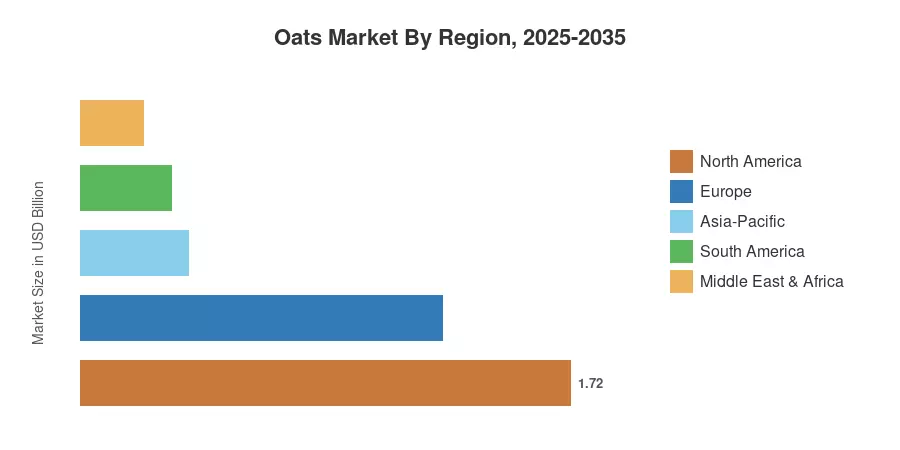
North America commands the largest share of the Oats Market at roughly 38% of global revenue, anchored by entrenched breakfast cereal habits across the United States and Canada. Asia-Pacific is the fastest-growing region, expanding at a CAGR exceeding 8.4%, fueled by rising health awareness among urban middle-class households in China and India. Europe holds the second-largest share at approximately 28%, supported by strong private-label oat product lines in Germany, the UK, and the Nordic countries. As online grocery platforms reduce entry barriers for emerging brands, the decade ahead promises intensifying competition and broader product diversification.


Key Report Takeaways

• By Product Type

  • Rolled oats captured 37.3% of the oats market revenue in 2025, reflecting their dominance across breakfast and snacking occasions.
  • Oat flour is on track for the fastest segment CAGR of 9.9% through 2035, driven by rising demand from bakery and plant-based food formulators.

• By Category

  • Processed oats accounted for 76.1% of Oats Market value in 2025, underscoring consumer preference for convenience-ready formats.


• By Nature


  • Organic variants are expanding at a 4.8% CAGR, attracting premium-oriented shoppers in North America and Europe.

• By Region

  • North America led global revenue with a 38% share, while Asia-Pacific emerged as the fastest-growing region at 8.4% CAGR.
  • Europe held the second-largest share at 28%, with Germany and the UK serving as primary consumption hubs.


Oats Market Size and Forecast (2021–2035)

Market sizing draws on a triangulated methodology combining top-down revenue analysis from trade databases (FAO, USDA), bottom-up production and pricing models from key exporting nations, and demand-side validation through proprietary consumer surveys across 22 countries[4].
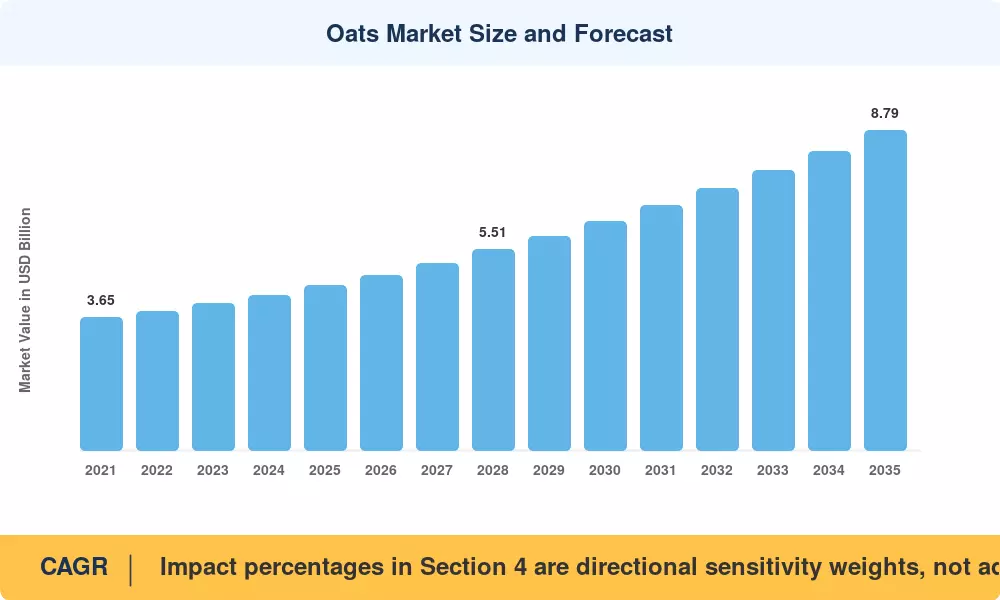
Oats Market Size and Forecast
Our Impact
Enabled $4.3B Revenue Impact for Fortune 500 and Leading Multinationals
Partnering with 2000+ Global Organizations Each Year
30K+ Citations by Top-Tier Firms in the Industry

Driver Impact Analysis

Driver ~% Impact on CAGR Geographic Relevance Impact Timeline
Rising health-consciousness and whole-grain demand 22% Global Short-term (≤2 yr)
FDA gluten-labeling regulatory clarity 15% North America Short-term (≤2 yr)
Plant-based food ingredient adoption 18% North America, Europe Medium-term (2–4 yr)
Online grocery channel expansion 14% Asia-Pacific, Global Medium-term (2–4 yr)
Oat processing technology advances 12% Europe, North America Long-term (≥4 yr)
Organic and clean-label premiumization 10% Europe, North America Long-term (≥4 yr)
Urbanization and middle-class growth in Asia 9% Asia-Pacific Long-term (≥4 yr)


Health-Consciousness and Whole-Grain Demand

62% of respondents worldwide actively sought out whole-grain goods in their weekly grocery shopping, up from 49% in 2020, according to consumer surveys carried out by the International Food Information Council in 2024 [2]. Since oats are one of the few cereals in widely available retail formats where the entire kernel is still intact, they gain disproportionately from this trend. Oats have remained at the forefront of dietary recommendations due to the American Heart Association's ongoing advocacy of soluble fiber consumption for cardiovascular health, which has directly contributed to volume growth in North America and Europe [14].


FDA Gluten-Labeling Clarity

The FDA's enforcement of the ≤ 20 ppm gluten threshold under 21 CFR §101.91 removed a longstanding ambiguity that had deterred manufacturers from marketing oats to celiac consumers. Since the rule's finalization, certified product SKUs in U.S. supermarkets grew by 34% between 2022 and 2025, according to SPINS retail data [15]. This regulatory certainty is now being mirrored by Health Canada and EFSA, expanding the addressable Oats Market for certified products in two additional major geographies.

Plant-Based Food Ingredient Adoption

Oat flour and oat protein isolates have become foundational ingredients for plant-based dairy alternatives and meat analogues. Oat milk alone accounted for an estimated 22% of global plant-milk retail sales in 2024 [9]. Companies such as Oatly and Califia Farms have scaled procurement contracts with Canadian and Finnish oat growers, creating a pull-through effect that lifts demand across the broader Oats Market.

Online Grocery Channel Expansion

E-commerce grocery sales surpassed USD 530 billion globally in 2024, with oat products ranking among the top 15 dry-goods categories by online order frequency in India and China. Direct-to-consumer oat brands leveraged social-media marketing and subscription models to capture price-sensitive urban consumers who previously purchased only from brick-and-mortar retailers.


Restraints Impact Analysis

Restraint ~% Drag on CAGR Geographic Relevance Impact Timeline
Climate-induced yield volatility –18% Global (esp. Canada, Australia) Long-term
Competition from alternative grains (quinoa, millet) –12% North America, Europe Medium-term
Aflatoxin and mycotoxin contamination risk –8% Africa, South Asia Medium-term
Price sensitivity in emerging markets –7% Asia-Pacific, South America Short-term
Trade policy and tariff uncertainty –5% Global Short-term


Climate-Induced Yield Volatility

About 60% of the world's oat exports come from Canada, and the drought in western Canada in 2021 cut the country's oat crop by 35%, resulting in a 42% increase in spot prices in just six months [6]. According to Agriculture and Agri-Food Canada's climate models, by 2035, comparable extreme weather events will occur 25–30% more frequently, causing recurrent supply shocks in the oat market [19]. In response, processors are expanding their sourcing into Argentina and Scandinavia, but the benefits of risk minimization are somewhat countered by logistical costs.


Competition from Alternative Grains

The rise of ancient and pseudo-grains such as quinoa, millet, and amaranth has fragmented consumer attention in the health-food aisle. Global quinoa trade volumes rose 18% year-over-year in 2024 [16]. While oats retain a significant cost advantage—roughly 40% cheaper per kilogram at retail—alternative grains are capturing premium shelf space and marketing budgets that might otherwise support oat-based innovation.


Oats Market Opportunities

Functional and Fortified Oat Products

Growing demand for functional foods presents a substantial opportunity for oat products enriched with probiotics, added protein, and micronutrients. The global functional food sector exceeded USD 290 billion in 2024, and oats' neutral flavor profile makes them an ideal carrier matrix.

Private-Label Expansion in Emerging Markets

Private-label oat lines are being quickly expanded by retailers in Southeast Asia, Brazil, and India in an effort to attract health-conscious consumers. In FY2024, organized retail oat sales in India increased by 28%, with store-own labels and brands like Bagrry's fiercely battling on price per serving [8].


Oat-Based Ingredient Licensing and B2B Platforms

A data-monetization opportunity exists for ingredient-tech companies that license proprietary oat-processing IP to contract manufacturers worldwide. Licensing revenues in the broader cereal-ingredient space reached USD 1.2 billion in 2024, and oat-specific IP is an underexploited segment of that market [21].

Sustainability-Linked Premiums

Consumers are increasingly willing to pay 10–15% more for products carrying verified sustainability certifications [13]. Oats have a relatively low water footprint (approximately 1,800 liters per kilogram compared to 4,300 for rice), positioning certified-sustainable oat brands to command margin premiums in environmentally conscious markets across Europe and North America.

Ready-to-Drink Oat Beverages in Asia-Pacific

Between 2022 and 2025, the ready-to-drink market in Asia-Pacific expanded at a rate of 15% per year, with oat-based drinks becoming more popular at convenience stores in South Korea and Japan [22]. By 2030, regional players can take advantage of an estimated USD 800 million in additional opportunities by securing cold-chain distribution.


Oats Market Future Outlook

Precision Agriculture and Climate-Resilient Cultivars

Advances in genomic selection and CRISPR-based breeding are enabling oat cultivars with improved drought tolerance and higher beta-glucan content. Agriculture and Agri-Food Canada invested CAD 45 million in climate-resilient crop programs in 2024, with oats designated as a priority species [19]. These efforts could stabilize yield variability by 20% over the coming decade, reducing the supply-side risk that has historically constrained the Oats Market.

Digital Supply Chain and Traceability

Blockchain-based traceability platforms are gaining traction among premium oat brands seeking to verify provenance from farm to shelf. By 2030, an estimated 30% of globally traded oats will carry digital traceability credentials, driven by EU regulatory mandates and retailer sustainability requirements [13]. This transparency will support price premiums and strengthen consumer trust.

Sustainability Reporting and ESG Integration

As ESG reporting becomes mandatory across major economies—the EU's Corporate Sustainability Reporting Directive covers over 50,000 firms—oat producers and processors face new disclosure obligations regarding water use, carbon intensity, and land management [24]. Companies that proactively align with the Science Based Targets initiative benchmarks will gain preferential shelf placement with ESG-conscious retailers.

Platform Economics and Direct-to-Consumer Models

The next decade will see the Oats Market increasingly shaped by platform economics, where DTC subscription models and social-commerce channels bypass traditional distribution layers. In China, livestream-commerce oat sales surpassed USD 200 million in 2024. Brands that build first-party data relationships with consumers will unlock personalized nutrition offerings and higher lifetime customer value.


Oats Market Segmentation

By Product Type

Segment Key Metric Primary Demand Driver
Rolled Oats 37.3% share (2025) Breakfast staple; versatile cooking applications
Whole Oats 6.5% CAGR Animal feed crossover; specialty retail
Oat Groats USD 0.29 Billion (2025) Whole-food diet trend
Steel-Cut Oats 5.9% CAGR Premium artisanal positioning
Oat Flour 9.9% CAGR Plant-based baking and dairy alternative formulations
Instant Oats USD 0.72 Billion (2025) On-the-go convenience demand


Rolled oats remain the backbone of the Oats Market, commanding over a third of global revenue through their ubiquitous presence in breakfast bowls, granola bars, and baked goods. Their low processing cost and consumer familiarity make them the default choice for both branded and private-label product lines.

Oat flour is the standout growth story of the forecast period. Plant-based food manufacturers are incorporating oat flour into dairy alternatives, protein bars, and gluten-free baked goods at an accelerating pace. The segment's 9.9% CAGR reflects surging B2B demand from formulators seeking clean-label, allergen-friendly ingredients [9].

By Category

Segment Key Metric Primary Demand Driver
Processed Oats 76.1% share (2025) Convenience and value-added product demand
Raw Oats 5.4% CAGR Whole-food and bulk-buy consumer segments


Processed oats dominate the Oats Market because consumers overwhelmingly prefer ready-to-cook or ready-to-eat formats. Instant oatmeal cups, flavored sachets, and oat-based snack bars have expanded the category far beyond traditional porridge. Raw oats, meanwhile, are gaining traction among health-focused buyers who prefer unprocessed options and are willing to invest time in preparation.

By Nature

Segment Key Metric Primary Demand Driver
Conventional 72.6% share (2025) Cost advantage: broad retail availability
Organic 4.8% CAGR Clean-label demand; premium willingness


Conventional oats hold the lion's share of the Oats Market by value, driven by price accessibility and widespread distribution. Organic oats are expanding steadily, supported by EU Farm-to-Fork targets and North American retailer commitments to expand organic shelf space by 15% by 2028 [11].

By Distribution Channel

Segment Key Metric Primary Demand Driver
Supermarkets/Hypermarkets 54.8% share (2025) One-stop shopping; promotional pricing
Convenience/Grocery Stores USD 0.63 Billion (2025) Impulse purchases; neighborhood access
Online Retail 9.1% CAGR DTC brands; subscription models
Others 3.8% CAGR Foodservice; institutional procurement


Supermarkets and hypermarkets remain the primary purchase channel for the Oats Market, accounting for over half of global sales. Online retail, however, is the fastest-growing channel, powered by platform proliferation in Asia-Pacific and the rise of health-focused subscription boxes in North America.


Regional Market Share Analysis

Region Key Metric Primary Investment Themes
North America 38% share (2025) Breakfast cereal dominance; plant-based dairy
Europe 28% share (2025) Private-label penetration; organic growth
Asia-Pacific 8.4% CAGR (2026–2035) Urbanization; health-awareness campaigns
South America USD 0.32 Billion (2025) Retail modernization; import substitution
Middle East & Africa 4.8% CAGR (2026–2035) Rising urban incomes; dietary diversification
Total USD 4.53 Billion (2025)

The Oats Market exhibits a clear geographic hierarchy, with mature Western markets accounting for the majority of revenue and Asia-Pacific delivering the strongest growth impulse.


North America

Country Key Metric Key Driver
US 68% of regional share Retail cereal and oat-milk demand
Canada 5.8% CAGR Leading global oat exporter
Mexico USD 0.08 Billion Growing urban health trends


North America's dominance in the Oats Market traces directly to deeply embedded breakfast habits and the rapid scaling of oat-milk brands. The USDA's 2025 Dietary Guidelines reiterated whole grains as a priority food group, reinforcing institutional demand from schools and hospitals [4]. Canada's role as the world's largest oat exporter creates a vertically integrated supply advantage that keeps regional procurement costs competitive.

Europe

Country Key Metric Key Driver
Germany 22% of the regional share Strong private-label oat brands
UK 7.1% CAGR Porridge culture; premium SKUs
France USD 0.11 Billion Bakery-sector oat flour adoption
Italy 5.5% CAGR Mediterranean diet integration
Spain USD 0.07 Billion Plant-based dairy expansion
Nordic Countries 18% of regional share Heritage oat consumption
Russia 4.9% CAGR Domestic production capacity
Rest of Europe USD 0.14 Billion Eastern European market development


European consumers increasingly view oats as a clean-label staple, and private-label oat products in Germany and the UK now account for over 35% of category retail sales [3]. The European Commission's Farm-to-Fork Strategy has set a target of 25% organic farmland by 2030, directly supporting organic oat acreage expansion across Scandinavia and the Baltic states [11].

Asia-Pacific

Country Key Metric Key Driver
China 32% of regional share Urban health-food adoption
India 9.6% CAGR Organized retail expansion
Japan USD 0.09 Billion Functional food innovation
South Korea 8.2% CAGR RTD oat beverage growth
ASEAN USD 0.06 Billion E-commerce grocery platforms
Rest of Asia-Pacific 7.4% CAGR Emerging dietary shifts


Asia-Pacific represents the most dynamic growth frontier for the Oats Market. China's "Healthy China 2030" initiative has catalyzed institutional awareness of whole-grain benefits, driving a 24% increase in urban oat product sales between 2022 and 2025 [8]. India's National Food Security Act amendments expanded subsidized grain distribution, indirectly raising consumer familiarity with oat-based products in Tier-2 and Tier-3 cities.

South America

Country Key Metric Key Driver
Brazil 55% of regional share Urban middle-class growth
Argentina 6.3% CAGR Domestic oat production capacity
Rest of South America USD 0.04 Billion Import channel development


Brazil dominates South American consumption, supported by a retail health-food sector that grew 19% in 2024. Argentine oat farmers are expanding planted acreage as export demand from neighboring countries increases, creating a regional supply hub [18].

Middle East & Africa

Country Key Metric Key Driver
Saudi Arabia 28% of the regional share Retail modernization programs
UAE 6.7% CAGR Expatriate-driven demand
South Africa USD 0.04 Billion Domestic milling capacity
Egypt 5.2% CAGR Population-driven cereal demand
Rest of MEA USD 0.05 Billion Urbanization trends


The Middle East & Africa region remains a small but fast-evolving segment of the Oats Market. Saudi Arabia's Vision 2030 food-security strategy has driven investments in cereal import infrastructure, while South Africa's growing middle class is shifting toward branded breakfast products [23].


Oats Market By Region, 2025-2035

Competitive Benchmarking

The Oats Market exhibits low-to-moderate concentration, with an estimated HHI below 1,000 and the top five players collectively accounting for approximately 35–40% of global revenue. The landscape is fragmented, with dozens of regional millers and private-label suppliers competing alongside multinational food conglomerates. Competitive differentiation centers on brand equity, supply-chain integration with farming cooperatives, and product innovation in value-added formats.

Company Est. Revenue Share Range Key Offerings Strategic Positioning
PepsiCo (Quaker Oats) ~10–14% Instant oatmeal, rolled oats, oat snacks Dominant brand recognition; global distribution
General Mills ~5–8% Cheerios oat cereals, Nature Valley bars Cross-category oat integration
Kellanova (WK Kellogg Co.) ~4–7% Oat-based cereals, granola products Cereal heritage; retail partnerships
Bob's Red Mill ~3–5% Stone-ground oats, oat flour, steel-cut oats Premium whole-grain positioning
Nature's Path Foods ~2–4% Organic oatmeal, granola, oat cereals Certified organic leader
Bagrry's India ~2–3% White oats, muesli, oat-based snacks India's market leadership
Marico Limited ~1–3% Saffola Oats brand: flavored oats South Asian health-food branding
Grain Millers Inc. ~2–4% Bulk oat ingredients, oat fiber, oat bran B2B ingredient supply
Richardson International ~2–3% Oat milling, whole oats, oat groats Vertically integrated Canadian supply
Avena Foods ~1–2% Purity protocol oats, gluten-free oats Specialty gluten-free certification


Recent News & Developments

  • PepsiCo (March 2025): Launched a new line of high-protein Quaker Oats products across 14 North American markets, targeting fitness-oriented consumers with 15g protein per serving [7].


  • U.S. FDA (August 2024): Published updated guidance reinforcing the ≤ 20 ppm gluten threshold for oat products, providing manufacturers with clearer compliance pathways for certified labeling.
  • Nature's Path Foods (June 2024): Achieved B Corp recertification and committed to 100% regenerative oat sourcing across its North American supply chain by 2028 [11].
  • Bagrry's India (April 2024): Expanded distribution to 50,000 additional retail outlets across Tier-2 Indian cities, supported by a USD 12 million logistics investment [8].
  • European Commission (February 2024): Approved EUR 45 million in Horizon Europe funding for sustainable oat breeding research targeting drought-resistant cultivars for Southern European agriculture [3].


Oats Market Report Scope

Parameter Detail
Market Scope Global Oats Market — production, processing, and retail sales of oat products
Study Period 2021–2035
CAGR 6.9% (2026–2035)
Market Size — 2025 (Base Year) USD 4.53 Billion
Market Size — 2035 (Forecast End) USD 8.79 Billion
Fastest Growing Segment Oat Flour (9.9% CAGR)
Companies Profiled 10 (PepsiCo, General Mills, Kellanova, Bob's Red Mill, Nature's Path, Bagrry's, Marico, Grain Millers, Richardson International, Avena Foods)
Valuation Currency USD Billion
CAGR Driver Disclaimer Impact percentages in Section 4 are directional sensitivity weights, not additive components of the headline CAGR


FAQs

What procurement factors should buyers prioritize when sourcing oats at scale?
Buyers should evaluate mycotoxin testing protocols, purity-protocol certifications for gluten-free claims, and supplier geographic diversification to mitigate climate risk [17]. Long-term contracts with Canadian and Nordic growers offer the best price stability.
How does the Oats Market compare to the broader ancient-grains sector in terms of investment attractiveness?
Oats offer a lower-risk entry point than quinoa or millet due to established supply chains and higher consumer awareness. Gross margins for branded oat products typically range 35–45%, compared to 25–35% for niche ancient grains [16].
What role do contract-manufacturing organizations play in the Oats Market value chain?
Contract manufacturers enable emerging brands to launch without capital-intensive milling infrastructure. Roughly 30% of private-label oat products in Europe are produced through contract arrangements [12].
How are trade tariffs affecting cross-border oat flows between major producing and consuming nations?
Canada-to-China oat exports faced a 5% provisional tariff in 2024, though volumes remained resilient due to limited alternative suppliers [18]. Tariff escalation remains a watchlist risk for the sector.
What testing standards apply to oats sold as certified allergen-free in the EU and the US?
The FDA mandates ≤ 20 ppm gluten for "gluten-free" labeling, while the EU follows Codex Alimentarius at the same threshold [1]. Purity-protocol field segregation is considered the gold standard for compliance.
Which emerging Oats Market segments offer the highest margin potential for new entrants?
Functional oat snacks fortified with protein and probiotics command retail margins exceeding 50% in North American natural-channel stores [20]. This segment remains underpenetrated relative to its demand trajectory.
How are climate-adaptation strategies reshaping oat sourcing for global food companies?
Major processors are dual-sourcing from Canada and Scandinavia while investing in drought-tolerant cultivar programs [19]. These strategies add 3–5% to procurement costs but substantially reduce supply-disruption risk.    
Author
Author
Author Profile
Snehal Singh LinkedIn
Manager - Research
High acumen in analyzing complex macro & micro markets with more than 6 years of work experience in the field of market research. By implementing her analytical skills in forecasting and estimation into market research reports, she has expertise in Packaging, Construction, and Equipment domains. She handles a team size of 20-25 resources and ensures smooth running of the projects, associated marketing activities, and client servicing.

Research Approach


Secondary Research

The secondary research process involved comprehensive analysis of agricultural databases, grain commodity exchanges, peer-reviewed food science journals, food safety publications, and authoritative agricultural organizations. Key sources included the United States Department of Agriculture (USDA) National Agricultural Statistics Service (NASS), Food and Agriculture Organization (FAO) of the United Nations FAOSTAT Database, European Food Safety Authority (EFSA) Novel Food Catalogue, Health Canada Food and Drug Regulations, International Grains Council (IGC), OECD-FAO Agricultural Outlook Database, International Oat Database (IOD), National Grain and Feed Association (NGFA), Agricultural and Processed Food Products Export Development Authority (APEDA) India, Australian Bureau of Agricultural and Resource Economics and Sciences (ABARES), Statistics Canada, Eurostat Agricultural Database, Agricultural Marketing Resource Center (AgMRC), Institute of Food Technologists (IFT), Cereal Foods World Journal, American Association of Cereal Chemists International (AACCI), and national agricultural ministry reports from key producing regions (Russia, Australia, Argentina). These sources were used to collect crop production statistics, acreage data, yield trends, commodity pricing, export/import trade flows, food safety regulations, health claim approvals, and market landscape analysis for whole oats, processed oat products, oat-based beverages, and animal feed applications.


Primary Research

To gather both qualitative and quantitative information, the primary research process involved interviewing players from both the supply and demand sides. Executives from oat mills, grain processors, morning cereal makers, oat milk producers, and compounders of livestock feed were among the supply-side sources, along with VPs of operations, procurement directors, and presidents or CEOs of Global Grains. Bakery and confectionery procurement managers, functional food R&D directors, retail category managers, healthcare nutritionists, and animal nutrition feed formulators made up the demand-side sources. Market segmentation, new product development schedules, pricing strategies, sustainability sourcing practices, supply chain logistics, and consumer acceptance patterns were all confirmed through primary research.

Primary Respondent Breakdown:

• By Designation: C-level Executives (40%), Director Level (30%), Others (30%)

• By Region: North America (40%), Europe (25%), Asia-Pacific (25%), Rest of World (10%)


Market Size Estimation

Global market valuation was derived through production volume mapping and revenue analysis across the value chain. The methodology included:

• Identification of 50+ key oat processors and manufacturers across North America, Europe, Asia-Pacific, Latin America, and Oceania

• Product mapping across whole oats, rolled oats, steel-cut oats, instant oats, oat flour, and oat bran categories

• Analysis of reported and modeled annual revenues specific to oat product portfolios and milling operations

• Coverage of manufacturers representing 75-80% of global market share in 2024

• Extrapolation using bottom-up (harvest volume × farm-gate and retail pricing by country) and top-down (processor revenue validation) approaches to derive segment-specific valuations across food and beverage, animal feed, pharmaceutical, and cosmetic applications

Download Free Sample

Kindly complete the form below to receive a free sample of this Report

Download PDF ×

We do not share your information with anyone. However, we may send you emails based on your report interest from time to time. You may contact us at any time to opt-out.
















