Download Free Sample
Kindly complete the form below to receive a free sample of this Report
Operational Risk Management Consulting Services in Manufacturing Market Size, Share and Research Report By Service Type (Risk Assessment, Compliance Management, Incident Management, Business Continuity Planning, Risk Mitigation Strategies), By Industry Vertical (Automotive, Aerospace, Electronics, Pharmaceuticals, Food and Beverage), By Consulting Engagement Type (Project-Based Consulting, Retainer-Based Consulting, Advisory Services, Implementation Support), By Client Size (Small Enterprises, Medium Enterprises, Large Enterprises) and By Regional (North America, Europe, South America, Asia Pacific, Middle East and Africa) - Industry Forecast Till 2035
As per Market Research Future analysis, the Operational Risk Management Consulting Services in Manufacturing Market Size was estimated at 6.754 Billion USD in 2024. The Operational Risk Management Consulting Services industry is projected to grow from 6.968 Billion USD in 2025 to 9.522 Billion USD by 2035, exhibiting a compound annual growth rate (CAGR) of 3.17% during the forecast period 2025 - 2035
The Operational Risk Management Consulting Services in Manufacturing Market is evolving towards greater integration of advanced technologies and sustainability practices.
| 2024 Market Size | 6.754 (USD Billion) |
| 2035 Market Size | 9.522 (USD Billion) |
| CAGR (2025 - 2035) | 3.17% |
The landscape of Operational Risk Management Consulting Services in Manufacturing Market is evolving, driven by the increasing complexity of global supply chains and the need for enhanced resilience. Organizations are recognizing the necessity of identifying, assessing, and mitigating risks that could disrupt operations. This shift is prompting a greater emphasis on proactive risk management strategies, which are becoming integral to maintaining competitive advantage. As manufacturers face diverse challenges, including regulatory compliance and technological advancements, the demand for specialized consulting services is likely to grow. Furthermore, the integration of advanced analytics and data-driven decision-making is reshaping how risks are managed, allowing firms to respond more effectively to potential threats. In addition, the focus on sustainability and corporate social responsibility is influencing the operational risk management landscape. Companies are increasingly held accountable for their environmental and social impacts, which necessitates a comprehensive approach to risk management. This trend suggests that consulting services must adapt to address these emerging concerns, ensuring that manufacturers not only comply with regulations but also align with stakeholder expectations. As the industry continues to navigate these complexities, the role of Operational Risk Management Consulting Services in Manufacturing Market will likely expand, providing essential support for organizations striving to achieve resilience and sustainability in their operations.
The adoption of advanced technologies, such as artificial intelligence and machine learning, is transforming the approach to risk management. These tools enable manufacturers to analyze vast amounts of data, identify patterns, and predict potential risks more accurately.
With the increasing complexity of regulations, manufacturers are prioritizing compliance as a critical aspect of operational risk management. Consulting services are adapting to help organizations navigate these challenges effectively.
The growing importance of sustainability is reshaping operational risk management strategies. Manufacturers are seeking consulting services that can assist in integrating sustainable practices while managing associated risks.
Supply chain resilience is a critical driver for Operational Risk Management Consulting Services in Manufacturing Industry. Recent disruptions in global supply chains have highlighted vulnerabilities that manufacturers must address to maintain operational continuity. The need for robust risk management strategies has become paramount, as companies seek to mitigate risks associated with supplier reliability, geopolitical tensions, and natural disasters. In 2025, it is anticipated that 70% of manufacturers will prioritize supply chain resilience in their operational strategies. Consulting services are essential in developing comprehensive risk assessments, contingency plans, and diversification strategies to enhance supply chain robustness. This focus on resilience not only safeguards operations but also fosters competitive advantage.
The emphasis on sustainability is emerging as a crucial driver for Operational Risk Management Consulting Services in Manufacturing Industry. As stakeholders increasingly demand environmentally responsible practices, manufacturers are compelled to integrate sustainability into their operational frameworks. This shift not only addresses regulatory pressures but also aligns with consumer preferences for sustainable products. In 2025, it is projected that companies prioritizing sustainability will experience a 20% increase in market share. Consulting services play a vital role in helping manufacturers identify and mitigate risks associated with sustainable practices, such as supply chain disruptions and resource scarcity. By adopting sustainable operational strategies, manufacturers can enhance their reputation and ensure long-term viability.
Workforce safety and training represent a vital driver for Operational Risk Management Consulting Services in Manufacturing Industry. As manufacturers strive to create safer work environments, the emphasis on employee training and safety protocols has intensified. In 2025, it is estimated that companies investing in safety training will reduce workplace incidents by 40%. This reduction not only protects employees but also minimizes operational disruptions and associated costs. Consulting services are instrumental in developing tailored training programs, conducting safety audits, and implementing best practices to enhance workplace safety. By prioritizing workforce safety, manufacturers can cultivate a culture of risk awareness and compliance, ultimately leading to improved operational performance.
The focus on regulatory compliance is a significant driver for Operational Risk Management Consulting Services in Manufacturing Industry. With the increasing complexity of regulations across various sectors, manufacturers face heightened scrutiny regarding compliance with safety, environmental, and quality standards. Non-compliance can lead to severe penalties, operational disruptions, and reputational damage. In 2023, it was reported that compliance-related costs accounted for approximately 10% of total operational expenses in the manufacturing sector. Consequently, manufacturers are turning to consulting services to ensure adherence to regulations, implement robust compliance frameworks, and conduct regular audits. This trend underscores the necessity for specialized expertise in navigating the regulatory landscape, thereby enhancing operational resilience.
The integration of advanced technologies is a pivotal driver for Operational Risk Management Consulting Services in Manufacturing Industry. As manufacturers increasingly adopt automation, artificial intelligence, and data analytics, the complexity of operational risks escalates. These technologies can enhance predictive capabilities, allowing firms to identify potential risks before they materialize. For instance, the use of AI in predictive maintenance can reduce downtime by up to 30%, thereby minimizing operational disruptions. Furthermore, the implementation of IoT devices enables real-time monitoring of equipment, which is crucial for risk assessment. This technological shift necessitates specialized consulting services to navigate the associated risks effectively, ensuring that manufacturers can leverage these advancements while maintaining operational integrity.
In the Operational Risk Management Consulting Services for Manufacturing, 'Risk Assessment' holds the largest market share, reflecting a crucial focus on identifying and managing operational risks. This service ensures that manufacturing entities can proactively address potential vulnerabilities, making it a foundational aspect of risk management strategies. Meanwhile, 'Compliance Management' is rapidly gaining traction, driven by increasing regulatory demands and the necessity for organizations to adhere to evolving standards. This growing emphasis on regulatory compliance reflects a significant trend within the industry, as businesses seek to mitigate risks associated with non-compliance.
Risk Assessment (Dominant) vs. Compliance Management (Emerging)
'Risk Assessment' is a dominant force in the Operational Risk Management Consulting Services in Manufacturing Market, providing essential evaluations of potential risks that could impact production and operational efficiency. It encompasses various methodologies to analyze risks and prioritize them based on their potential impact. In contrast, 'Compliance Management' is emerging as a critical component due to the ever-evolving regulatory landscape that manufacturers must navigate. This service focuses on ensuring that companies follow industry standards and regulations, which is becoming increasingly vital as global markets demand higher transparency and accountability. Together, these services underscore the importance of a comprehensive approach to operational risk management.
In the landscape of operational risk management consulting services in manufacturing, the automotive industry takes the lead, showcasing significant market share compared to other segments. This industry benefits from its established frameworks, regulatory compliance demands, and the need for continuous improvement in production processes. In contrast, while the pharmaceuticals sector holds a smaller share, it is rapidly gaining traction due to the increasing focus on quality assurance, regulatory changes, and supply chain resilience in the face of global challenges. The growth trends in these segments illustrate how the automotive industry is focused on integrating advanced technologies and data analytics to enhance operational risk management practices. On the other hand, the pharmaceuticals sector is experiencing a surge in demand for consulting services to navigate complex regulations, manage inherent production risks, and innovate supply chains. Together, these trends highlight the dynamic nature of operational risk management in manufacturing, driven by technological advancements and evolving regulatory landscapes.
Automotive: Dominant vs. Pharmaceuticals: Emerging
The automotive sector remains dominant in the operational risk management consulting landscape, characterized by a strong emphasis on quality control, compliance with safety regulations, and efficiency improvements. As manufacturers adopt Industry 4.0 technologies, operational risk management services are evolving to encompass predictive analytics and real-time monitoring. In contrast, the pharmaceuticals sector is emerging rapidly, propelled by stringent regulatory frameworks and heightened focus on patient safety. This segment is increasingly adopting risk management consulting to address challenges such as supply chain disruptions and product recalls. As these industries continue to advance, the interplay of technological integration and regulatory demands will profoundly shape their operational risk management strategies.
In the Operational Risk Management Consulting Services for Manufacturing, Project-Based Consulting holds the largest market share due to its tailored solutions for specific issues faced by manufacturers. This type of engagement allows clients to address immediate concerns, thus appealing to organizations aiming for quick problem resolution and effective risk mitigation. Retainer-Based Consulting is rapidly gaining traction as companies recognize the need for continual guidance in managing operational risks in a constantly evolving technological landscape.
Project-Based Consulting: Dominant vs. Retainer-Based Consulting: Emerging
Project-Based Consulting is characterized by its focus on specific, time-limited projects that require in-depth expertise and customized solutions. This segment dominates the market as manufacturers prioritize clear, actionable insights for immediate operational challenges, fostering stronger partnerships with consultants. On the other hand, Retainer-Based Consulting is emerging due to its benefit of ongoing support and regular check-ins, which are increasingly recognized as essential for strategic risk management. This model provides clients with consistent access to expertise, enabling them to adapt to new risks and compliance demands in real-time, thus enhancing their operational resilience.
The Operational Risk Management Consulting Services in Manufacturing Market reveals a diverse distribution among client sizes. Medium Enterprises hold the largest share, leveraging their relatively more significant budgets and willingness to invest in risk management solutions. Meanwhile, Large Enterprises are rapidly expanding their consulting services, reflecting a strategic shift towards enhancing operational resilience and navigation through complex regulatory environments. Small Enterprises, while vital, occupy a smaller market share, often due to limited resources and lower demand for comprehensive consulting services. Growth in this segment is driven by increasing awareness of operational risks, as industries face evolving threats from economic shifts, technological advancements, and global disruptions. The rising complexity of manufacturing operations necessitates robust risk management strategies, particularly for Large Enterprises seeking to optimize efficiencies and mitigate risks. Meanwhile, Medium Enterprises are increasingly recognizing the need for expert guidance to navigate these challenges, positioning them as a key player in this expanding market.
Medium Enterprises (Dominant) vs. Large Enterprises (Emerging)
Medium Enterprises are characterized by their advantageous positioning as the largest segment within Operational Risk Management Consulting Services. They typically possess sufficient capital and flexibility, allowing for investment in comprehensive risk management solutions. Their ability to adapt quickly to market changes and innovations further enhances their competitive edge. In contrast, Large Enterprises are emerging as a fast-growing segment, reflecting a significant shift in focus towards sophisticated risk management practices. This segment tends to prioritize the integration of advanced technologies and compliance measures, ensuring that they can effectively mitigate risks associated with large-scale operations. Their growth is propelled by the increasing complexity of their operational landscapes, demanding innovative risk management strategies to safeguard their expansive manufacturing processes.
North America leads the operational risk management consulting services market, holding approximately 45% of the global share. The region's growth is driven by stringent regulatory requirements and a heightened focus on compliance, particularly in sectors like manufacturing. The demand for advanced risk management solutions is further fueled by technological advancements and the increasing complexity of supply chains. The United States is the largest market, followed by Canada, both showcasing a robust competitive landscape with key players like Deloitte, PwC, and EY. These firms are leveraging their expertise to address the unique challenges faced by manufacturers, including cybersecurity threats and operational disruptions. The presence of these major consulting firms enhances the region's capability to provide tailored risk management solutions.
Europe is witnessing significant growth in operational risk management consulting services, driven by evolving regulations and a focus on sustainability. The region holds approximately 30% of the global market share, with Germany and the UK being the largest contributors. Regulatory frameworks such as GDPR and industry-specific guidelines are catalyzing demand for comprehensive risk management solutions in manufacturing. Germany leads the market, followed closely by the UK, with a competitive landscape featuring major players like KPMG and Accenture. These firms are adapting to the regulatory environment by offering innovative solutions that address both compliance and operational efficiency. The emphasis on sustainability and digital transformation is reshaping the consulting landscape, making it essential for firms to stay ahead of regulatory changes.
Asia-Pacific is rapidly emerging as a key player in the operational risk management consulting services market, holding about 20% of the global share. The region's growth is driven by increasing industrialization, regulatory reforms, and a growing awareness of risk management practices among manufacturers. Countries like China and India are at the forefront, with significant investments in technology and infrastructure enhancing their risk management capabilities. China is the largest market in the region, followed by India, both experiencing a surge in demand for consulting services. The competitive landscape is characterized by a mix of local and international firms, including McKinsey and Protiviti, which are focusing on tailored solutions to meet the unique challenges faced by manufacturers in these emerging markets. The region's dynamic environment presents ample opportunities for growth and innovation in risk management.
The Middle East and Africa region is gradually developing its operational risk management consulting services market, accounting for approximately 5% of the global share. The growth is primarily driven by the need for enhanced risk management frameworks in the manufacturing sector, spurred by economic diversification efforts and regulatory initiatives. Countries like South Africa and the UAE are leading the charge, focusing on improving operational resilience and compliance standards. South Africa is the largest market in the region, with the UAE following closely. The competitive landscape includes both local firms and international players, which are increasingly collaborating to provide comprehensive risk management solutions. The region's unique challenges, such as geopolitical risks and economic fluctuations, necessitate innovative approaches to operational risk management, creating opportunities for consulting firms to expand their services.
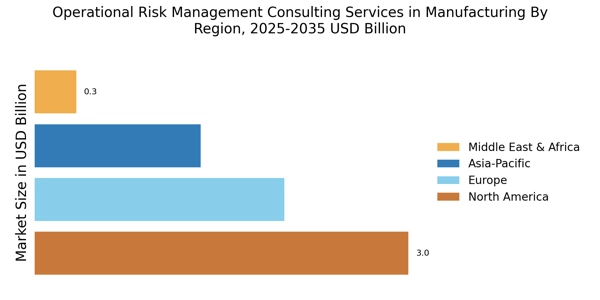
The Operational Risk Management Consulting Services in Manufacturing Market is characterized by an evolving landscape shaped by the need for enhanced risk mitigation strategies. With manufacturing firms becoming increasingly vulnerable to disruptions arising from technological shifts, regulatory changes, and global supply chain vulnerabilities, the demand for specialized consulting services has surged. This market encompasses a variety of players offering analytical tools, strategic advisory, and consultancy that focuses on identifying, assessing, and mitigating operational risks.
Competitors in this sector are leveraging advanced technologies, data analytics, and industry-specific expertise to enhance the resilience of manufacturing operations, thereby fostering a robust environment for innovation and growth.SAS Institute stands out in the Operational Risk Management Consulting Services in Manufacturing Market due to its strong emphasis on data analytics and software capabilities. The company utilizes its expertise in predictive analytics and data intelligence to help manufacturing clients identify and manage operational risks effectively. SAS Institute's offerings are characterized by innovative solutions that can model complex scenarios and provide actionable insights, which are vital in decision-making processes.
This capability positions SAS Institute as a leader in fostering risk awareness among clients, enabling them to proactively address potential disruptions and regulatory challenges. Their established presence in this sector is further enhanced by a robust network of partnerships and a commitment to continuous improvement in operational processes, leading to a competitive advantage in the market. PwC is renowned for its comprehensive approach to operational risk management consulting in the manufacturing sector, offering a broad array of solutions that cater to the distinct needs of manufacturers.
With a global footprint, PwC brings a wealth of industry knowledge and best practices to help clients navigate the complexities of operational risks. Their strengths lie in the ability to integrate technology with human insight, providing tailored solutions that encompass risk assessment, governance, compliance, and internal controls. PwC’s investment in research and development allows for the continual refinement of their methodologies, ensuring that clients benefit from state-of-the-art risk management strategies. This combination of deep sector expertise and innovative service delivery enhances PwC's profile, ensuring its competitive edge in the operational risk management consulting services landscape within the manufacturing market.





Recent developments in the Operational Risk Management Consulting Services in Manufacturing Market highlight a surge in demand driven by increasing regulatory requirements and the need for comprehensive risk management strategies. Companies like PwC and Deloitte are focusing on enhancing their consulting services to better address emerging risks, particularly related to cybersecurity and supply chain disruptions. Notably, Accenture has been expanding its portfolio through strategic acquisitions to bolster its capabilities in risk management solutions. Furthermore, KPMG and EY are investing in technological advancements to integrate advanced analytics into their advisory services, creating more robust offerings for clients.
In regard to mergers and acquisitions, SAS Institute's integration with other tech firms has garnered attention as it enhances operational risk analytics. The market is also witnessing growth in valuation, with firms like McKinsey and Company and Bain & Company recognizing increased revenues due to heightened client engagement in risk management discussions. This evolution in the market is indicative of the ongoing transformation in the operational risk landscape, as firms adapt to changing market dynamics while striving to optimize their risk frameworks.
The Operational Risk Management Consulting Services in Manufacturing Market is projected to grow at a 3.17% CAGR from 2025 to 2035, driven by technological advancements and regulatory compliance demands.
New opportunities lie in:
By 2035, the market is expected to be robust, reflecting sustained growth and innovation.
| MARKET SIZE 2024 | 6.754(USD Billion) |
| MARKET SIZE 2025 | 6.968(USD Billion) |
| MARKET SIZE 2035 | 9.522(USD Billion) |
| COMPOUND ANNUAL GROWTH RATE (CAGR) | 3.17% for 2024 - 2035 |
| REPORT COVERAGE | Revenue Forecast, Competitive Landscape, Growth Factors, and Trends |
| BASE YEAR | 2024 |
| Market Forecast Period | 2025 - 2035 |
| Historical Data | 2019 - 2024 |
| Market Forecast Units | USD Billion |
| Key Companies Profiled | Deloitte (US), PwC (US), KPMG (GB), EY (US), Accenture (IE), Bain & Company (US), McKinsey & Company (US), Protiviti (US) |
| Segments Covered | Service Type, Industry Vertical, Consulting Engagement Type, Client Size, Regional |
| Key Market Opportunities | Integration of advanced analytics and artificial intelligence in Operational Risk Management Consulting Services in Manufacturing. |
| Key Market Dynamics | Rising regulatory scrutiny and technological advancements drive demand for Operational Risk Management Consulting Services in Manufacturing. |
| Countries Covered | North America, Europe, APAC, South America, MEA |
The projected market valuation for Operational Risk Management Consulting Services in Manufacturing is expected to reach 9.522 USD Billion by 2035.
The market valuation for Operational Risk Management Consulting Services in Manufacturing was 6.754 USD Billion in 2024.
The expected CAGR for the Operational Risk Management Consulting Services in Manufacturing during the forecast period 2025 - 2035 is 3.17%.
Key players in the market include Deloitte, PwC, KPMG, EY, Accenture, Bain & Company, McKinsey & Company, and Protiviti.
The segment of Risk Mitigation Strategies had the highest valuation at 1.854 USD Billion in 2024.
The Business Continuity Planning segment is projected to grow from 1.2 USD Billion in 2024 to 1.7 USD Billion by 2035.
The valuation of the Project-Based Consulting segment was 2.025 USD Billion in 2024.
The Food and Beverage industry vertical is expected to grow from 1.554 USD Billion in 2024 to 2.422 USD Billion by 2035.
The projected valuation for Medium Enterprises in the Operational Risk Management Consulting Services market is expected to reach 3.5 USD Billion by 2035.
The valuation of the Compliance Management segment was 1.2 USD Billion in 2024.


Kindly complete the form below to receive a free sample of this Report

“This is really good guys. Excellent work on a tight deadline. I will continue to use you going forward and recommend you to others. Nice job”


“Thanks. It’s been a pleasure working with you, please use me as reference with any other Intel employees.”


“Thanks for sending the report it gives us a good global view of the Betaïne market.”


“Thank you, this will be very helpful for OQS.”


“We found the report very insightful! we found your research firm very helpful. I'm sending this email to secure our future business.”


“I am very pleased with how market segments have been defined in a relevant way for my purposes (such as "Portable Freezers & refrigerators" and "last-mile"). In general the report is well structured. Thanks very much for your efforts.”


“I have been reading the first document or the study, ,the Global HVAC and FP market report 2021 till 2026. Must say, good info! I have not gone in depth at all parts, but got a good indication of the data inside!”


“We got the report in time, we really thank you for your support in this process. I also thank to all of your team as they did a great job.”


“The Automotive 48V ECU Components Procurement Intelligence Study” was a complex project, but the Market Research Future (MRFR) team handled it with quality, agility, and customer-centricity. They delivered all requested data on time and within the agreed scope. The team, including Shubhendra Anand and Rahul Gotadki, was always readily available to clarify questions and swiftly implement necessary adjustments, driving the project to a successful conclusion within a very demanding timeframe.
I would also like to specifically commend Akshay Agarwal for his responsiveness and support at every stage—from our initial inquiry on May 6th through to final delivery on June 18th. His dedication made the entire process seamless.”



