Industry 4.0 Market Summary
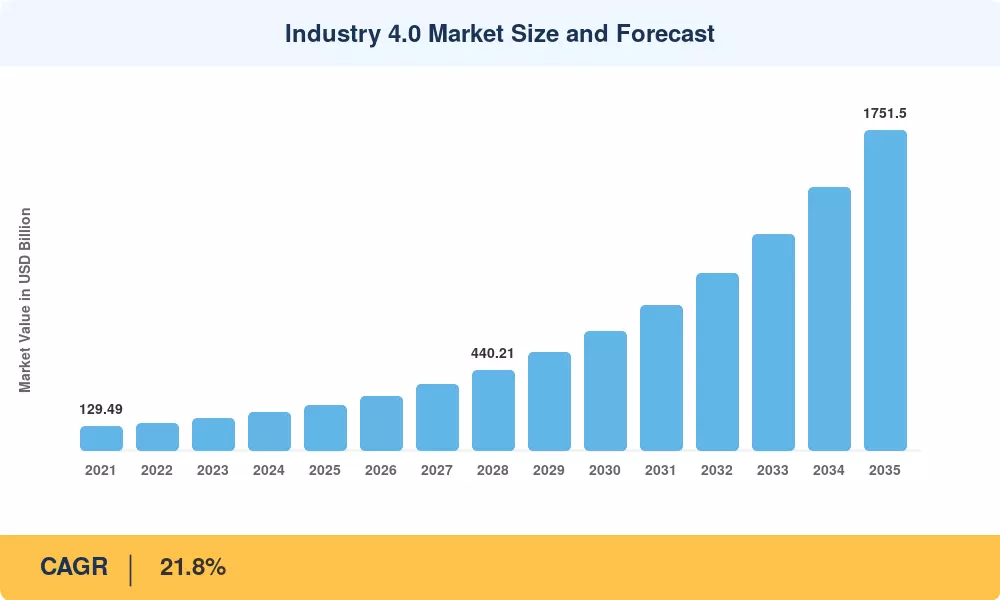
The Industry 4.0 Market reached an estimated USD 243.62 billion in 2025 and is projected to climb from USD 296.73 billion in 2026 to USD 1,751.50 billion by 2035, registering a CAGR of 21.8% over the forecast window. Two catalysts are pushing adoption past the inflection point: government-backed smart factory programs — including the EU's EUR 1.3 billion Digital Europe Programme and the U.S. CHIPS and Science Act allocating over USD 52 billion toward semiconductor and advanced manufacturing capacity — and a wave of private-sector capital targeting connected production lines [1][2].
What is actually changing on the factory floor is a wholesale swap of isolated programmable logic controllers and proprietary SCADA stacks for open, IP-based architectures built around edge computing, industrial cloud platforms, and machine-learning inference at the sensor level. estimates that full-scale deployment of these next-generation architectures can unlock USD 3.7 trillion in annual value globally by 2030, explaining why capex commitments from discrete and process manufacturers alike have accelerated since 2023 [3].
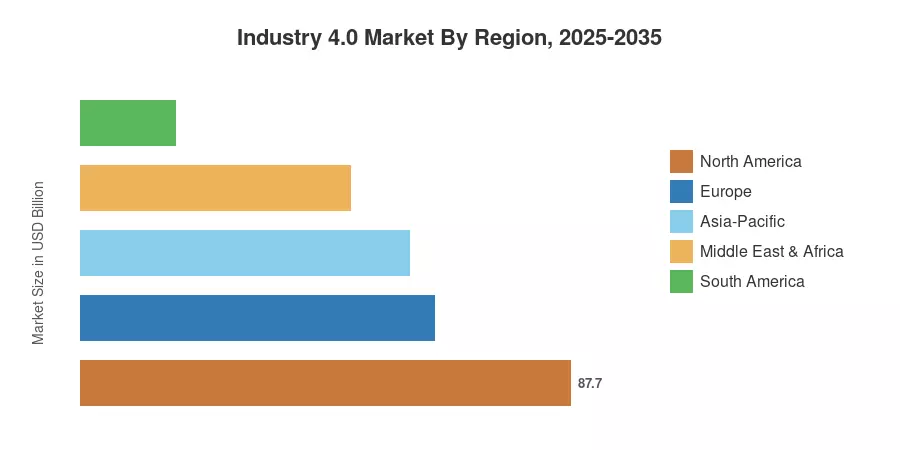
North America commands the largest share of the Industry 4.0 Market at roughly 36%, driven by aggressive automation spend across automotive and aerospace OEMs. Asia-Pacific is the fastest-growing region, posting CAGRs above 24%, fueled by China's "Made in China 2025" continuation programs and India's Production Linked Incentive (PLI) schemes. Europe holds the second-largest position at approximately 26%, anchored by Germany's longstanding Industrie 4.0 national initiative. As AI-driven process optimization matures, the next decade will see the Industry 4.0 Market expand well beyond traditional manufacturing strongholds into pharmaceuticals, food processing, and utilities.
Key Report Takeaways
• By Technology
- Industrial Internet of Things (IIoT) platforms account for the largest technology share of the Industry 4.0 Market at an estimated 28% in 2025, reflecting the foundational role of connected sensors and edge gateways.
- Industrial robotics ranks as the fastest-growing technology segment, posting a CAGR of approximately 24.3% through 2035 as collaborative robots gain traction in mixed human–machine work cells.
- AI and machine-learning solutions are forecast to surpass USD 310 billion in segment value by 2035, driven by predictive maintenance and real-time quality inspection demand.
• By Sector
- Discrete manufacturing holds the dominant end-user position within the Industry 4.0 Market, contributing roughly 31% of total revenue in 2025.
- The automotive vertical is expanding at a CAGR near 23.1%, as EV production lines demand tighter digital thread integration from design through final assembly.
• By Region
- North America leads the Industry 4.0 Market with approximately 36% global share, underpinned by advanced semiconductor and defense-industrial base investments.
- Asia-Pacific is expected to grow at the highest regional CAGR of 24.2%, supported by national digitization mandates across China, India, and South Korea.
Industry 4.0 Market Size and Forecast (2021–2035)
Market sizing combines bottom-up revenue analysis across technology vendors, platform providers, and system integrators with top-down cross-validation against macroeconomic manufacturing output indicators published by UNIDO and national statistical agencies. Historical figures (2021–2024) are reconciled against audited company filings; forecast values (2026–2035) apply segment-level growth assumptions benchmarked to industrial capex pipelines and policy commitments [4].





















.webp?v=1787579603)
