×
Hero Background
English
Chinese
French
Japanese
Korean
German
Spanish

Oral Cancer Diagnostics Market Share

ID: MRFR/MED/6614-CR
121 Pages
Rahul Gotadki
July 2019

Oral Cancer Diagnostics Market Research Report Information by Indication (Oral Squamous Cell Carcinoma, Oral Verrucous Carcinoma, Mucoepidermoid Carcinoma, Oral Cavity Lymphomas), Diagnosis Type (Endoscopy, Biopsy, X-Ray and Computed Tomography (CT), Positron Emission Tomography (PET), Magnetic Resonance Imaging (MRI), Ultrasonography, Fluorescence Imaging), End User (Hospitals and Clinics, Research and Academic Institutes) - Forecast till 2035

Share:
Download PDF ×

We do not share your information with anyone. However, we may send you emails based on your report interest from time to time. You may contact us at any time to opt-out.

Oral Cancer Diagnostics Market Infographic
Purchase Options

Market Share

Oral Cancer Diagnostics Market Share Analysis

In the year 2018, the Americas emerged as the front-runner in the market, securing the largest share at 42.38%, valued at USD 1,852.35 million. The market is set for growth, with an expected rise at a rate of 7.13% during the forecast period. Following closely, Europe took the position of the second-largest market in 2018, with a value of USD 1,230.08 million, and is anticipated to grow at a rate of 6.40%. The Asia-Pacific market is poised for the highest growth rate, projected to experience an expected Compound Annual Growth Rate (CAGR) of 8.03%.

Now, let's explore the specifics of Mucoepidermoid Carcinoma (MEC), a distinct type of tumor commonly found in the minor salivary gland in adults. This tumor may also occur in the thyroid gland, bronchi, and lacrimal sac. While it is less common in the submandibular glands or minor salivary glands inside the mouth, certain factors like old age, exposure to radiation, and workplace contact with substances such as asbestos mining, plumbing, and rubber manufacturing increase the risk of salivary gland tumors. According to the Oral Cancer Foundation, MEC accounts for approximately 35% of all malignancies affecting major and minor salivary glands globally.

The growing prevalence of salivary gland cancers worldwide is expected to drive the demand for diagnostics, contributing to market growth during the forecast period. Information from the American Cancer Society in September 2017 indicates that salivary gland cancer constitutes less than 1% of cancers in the US, occurring at a rate of about 1 case per 100,000 individuals per year. The diagnosis of MEC involves various methods such as X-ray, computed tomography, magnetic resonance imaging, positron emission tomography, and biopsy. These diagnostic tools play a crucial role in identifying and understanding the characteristics of Mucoepidermoid Carcinoma, enabling healthcare professionals to make informed decisions about treatment strategies. The ongoing advancements in diagnostic technologies further contribute to enhancing the accuracy and efficiency of MEC diagnosis.

In conclusion, the regional market dynamics and the specific case of Mucoepidermoid Carcinoma highlight the complexities and nuances in the field of oral cancer diagnostics. As the market continues to evolve, propelled by technological innovations and increasing awareness, it is poised for sustained growth, particularly in the context of addressing specific types of oral cancers like Mucoepidermoid Carcinoma.
Author
Rahul Gotadki
Assistant Manager

He holds an experience of about 7+ years in Market Research and Business Consulting, working under the spectrum of Life Sciences and Healthcare domains. Rahul conceptualizes and implements a scalable business strategy and provides strategic leadership to the clients. His expertise lies in market estimation, competitive intelligence, pipeline analysis, customer assessment, etc. In addition to the above, his other responsibility includes strategic tracking of high growth markets & advising clients on the potential areas of focus they could direct their business initiatives

Leave a Comment

FAQs

What is the projected market CAGR for the forecast period of 2022-2030?

The projected CAGR is 4.8% during the forecast period.

What would be the end valuation by 2032?

The valuation would be USD 2.98 Billion.

What are the end users included in the report?

The report has discussions of hospitals & clinics, research & academic institutes, and others.

What is the diagnosis type discussed in the report?

The discussion has a biopsy, endoscopy, computed tomography (CT), X-ray, magnetic resonance imaging (MRI), positron emission tomography (PET), fluorescence imaging, ultrasonography, and others.

Which region would dominate the market?

The American Oral Cancer Diagnostics Market would dominate the global market.

Market Summary

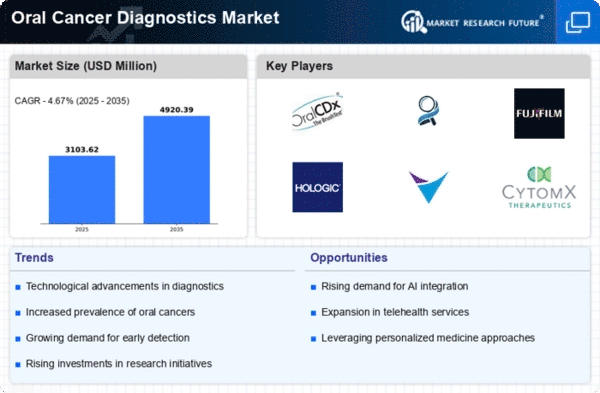
As per MRFR analysis, the Oral Cancer Diagnostics Market Size was estimated at 2965.15 USD Million in 2024. The Oral Cancer Diagnostics industry is projected to grow from 3137.59 USD Million in 2025 to 4920.39 USD Million by 2035, exhibiting a compound annual growth rate (CAGR) of 4.67 during the forecast period 2025 - 2035.

Key Market Trends & Highlights

The Oral Cancer Diagnostics Market is experiencing robust growth driven by technological advancements and increasing awareness.

  • Technological advancements are enhancing the accuracy and efficiency of oral cancer diagnostics, particularly in North America. Increased awareness and education about oral cancer are contributing to higher screening rates, especially in the Asia-Pacific region. The biopsy segment remains the largest in the market, while molecular diagnostics is emerging as the fastest-growing segment. Rising incidence of oral cancer and government initiatives are key drivers propelling market expansion.

Market Size & Forecast

2024 Market Size 2965.15 (USD Million)
2035 Market Size 4920.39 (USD Million)
CAGR (2025 - 2035) 4.67%
Largest Regional Market Share in 2024 North America

Major Players

<p>OralCDx (US), MediSpectra (US), Fujifilm (JP), Hologic (US), Veracyte (US), CytomX Therapeutics (US), GSK (GB), Abbott Laboratories (US), Roche (CH)</p>

Market Trends

The Oral Cancer Diagnostics Market is currently experiencing a transformative phase, driven by advancements in technology and an increasing awareness of oral health. The integration of innovative diagnostic tools, such as molecular imaging and artificial intelligence, appears to enhance the accuracy and efficiency of early detection. This shift is crucial, as early diagnosis significantly improves treatment outcomes and patient survival rates. Furthermore, the rising prevalence of oral cancer, coupled with a growing geriatric population, suggests a heightened demand for effective diagnostic solutions. As healthcare systems evolve, the focus on preventive care and early intervention is likely to shape the future landscape of this market. In addition, the Oral Cancer Diagnostics Market is witnessing a surge in research and development activities aimed at discovering novel biomarkers and diagnostic techniques. Collaborations between academic institutions and industry players seem to foster innovation, leading to the emergence of new products that could potentially revolutionize the diagnostic process. Moreover, the increasing adoption of telemedicine and remote diagnostics may further expand access to oral cancer screening, particularly in underserved regions. Overall, the market appears poised for growth, driven by technological advancements and a commitment to improving patient outcomes.

Technological Advancements

The Oral Cancer Diagnostics Market is significantly influenced by the rapid development of advanced technologies. Innovations such as artificial intelligence and machine learning are being integrated into diagnostic tools, enhancing their precision and speed. These technologies facilitate the analysis of complex data, allowing for more accurate identification of oral cancer at earlier stages.

Increased Awareness and Education

There is a growing emphasis on public awareness regarding oral health and cancer prevention. Educational campaigns and initiatives by health organizations are likely to contribute to higher screening rates. This increased awareness may lead to more individuals seeking diagnostic services, thereby expanding the market.

Research and Development Initiatives

Ongoing research efforts are crucial in the Oral Cancer Diagnostics Market, focusing on the discovery of new biomarkers and diagnostic methods. Collaborations between research institutions and industry stakeholders appear to drive innovation, resulting in the development of novel diagnostic solutions that could enhance early detection and treatment efficacy.

Oral Cancer Diagnostics Market Market Drivers

Increase in Risk Factors

The increase in risk factors associated with oral cancer, such as tobacco use, alcohol consumption, and poor oral hygiene, is a notable driver for the Global Oral Cancer Diagnostics Market Industry. As lifestyles evolve, the prevalence of these risk factors continues to rise, leading to a higher incidence of oral cancer. This trend necessitates the development and implementation of effective diagnostic tools to identify the disease at an early stage. Consequently, the market is poised for growth, as healthcare providers and patients alike recognize the importance of early detection and intervention.

Market Growth Projections

The Global Oral Cancer Diagnostics Market Industry is projected to experience substantial growth in the coming years. With a market size of 0.86 USD Billion in 2024, it is expected to expand to 3.43 USD Billion by 2035, reflecting a robust CAGR of 13.39% from 2025 to 2035. This growth is driven by various factors, including technological advancements, increasing awareness, and government support. As the market evolves, the demand for innovative diagnostic solutions will likely continue to rise, positioning the industry for a promising future.

Growing Awareness and Education

The rising awareness and education regarding oral cancer significantly impact the Global Oral Cancer Diagnostics Market Industry. Health campaigns and educational programs aimed at informing the public about the risks and symptoms of oral cancer have led to increased screening and early diagnosis. This heightened awareness encourages individuals to seek medical advice sooner, thereby improving survival rates. As educational initiatives continue to expand globally, the demand for effective diagnostic solutions is expected to rise, contributing to the overall growth of the market in the coming years.

Rising Incidence of Oral Cancer

The increasing prevalence of oral cancer globally is a primary driver for the Global Oral Cancer Diagnostics Market Industry. According to health statistics, the incidence of oral cancer is projected to rise, with estimates suggesting that by 2024, the market could reach 0.86 USD Billion. This alarming trend necessitates enhanced diagnostic methods and technologies, prompting healthcare providers to invest in advanced diagnostic tools. The growing awareness of oral cancer symptoms and the importance of early detection further contribute to market growth, as patients seek timely diagnosis and treatment options.

Government Initiatives and Funding

Government initiatives aimed at combating oral cancer play a crucial role in the Global Oral Cancer Diagnostics Market Industry. Various health organizations and government bodies are increasingly allocating funds for research and development in oral cancer diagnostics. These initiatives often include public awareness campaigns, screening programs, and subsidies for diagnostic technologies. Such support not only enhances the availability of diagnostic tools but also encourages innovation within the industry. As a result, the market is likely to experience robust growth, with a projected CAGR of 13.39% from 2025 to 2035.

Technological Advancements in Diagnostic Tools

Technological innovations in diagnostic tools significantly influence the Global Oral Cancer Diagnostics Market Industry. The introduction of advanced imaging techniques, such as fluorescence imaging and molecular diagnostics, enhances the accuracy of oral cancer detection. These technologies facilitate earlier diagnosis, which is crucial for effective treatment. As the market evolves, it is anticipated that the integration of artificial intelligence and machine learning will further refine diagnostic processes. This shift towards more sophisticated diagnostic solutions is expected to drive market growth, with projections indicating a market size of 3.43 USD Billion by 2035.

Market Segment Insights

By Application: Biopsy (Largest) vs. Molecular Diagnostics (Fastest-Growing)

<p>In the Oral Cancer Diagnostics Market, Biopsy holds the largest market share and is a preferred method among healthcare professionals due to its accuracy and reliability in diagnosing oral cancer. The traditional yet effective nature of these tests continually maintains strong demand, thereby securing a significant portion of the market. Meanwhile, Molecular Diagnostics, characterized by rapid advancements in technology and precision, is quickly gaining traction, appealing due to its ability to provide detailed insights at a molecular level.</p>

<p>Biopsy (Dominant) vs. Molecular Diagnostics (Emerging)</p>

<p>Biopsy is widely regarded as the dominant technique in the Oral Cancer Diagnostics Market, serving as the gold standard for tissue analysis. Its reliability makes it a critical diagnostic tool, providing conclusive results by examining cellular samples. Conversely, Molecular Diagnostics is emerging as a powerful alternative, utilizing advanced technologies like next-generation sequencing to identify specific genetic markers. This segment's growth is fueled by increasing awareness of personalized medicine and the demand for non-invasive testing options. As both segment values evolve, they complement each other; while biopsy remains essential for definitive diagnosis, molecular diagnostics pave the way for early detection and tailored treatment options.</p>

By Technology: Imaging Techniques (Largest) vs. Biomarkers (Fastest-Growing)

<p>The Oral Cancer Diagnostics Market exhibits a diverse array of technological approaches, with imaging techniques holding the largest market share. Techniques such as MRI, CT, and PET scans are widely adopted due to their efficiency in visualizing cancerous lesions. Conversely, biomarkers are emerging rapidly, driven by advancements in molecular diagnostics and personalized medicine, attracting attention for their potential in early detection and treatment monitoring. Growth trends in this segment are significantly influenced by an increasing prevalence of oral cancer and rising awareness among healthcare professionals about early detection methods. Innovations in imaging technologies and biomarker discovery are propelled by increased research funding and collaborations between academic institutions and healthcare companies. This dynamic fosters an environment conducive to developing next-generation diagnostics, addressing the critical need for timely and accurate oral cancer detection.</p>

<p>Imaging Techniques: Dominant vs. Salivary Diagnostics: Emerging</p>

<p>Imaging techniques represent the dominant value in the Oral Cancer Diagnostics Market, characterized by their established methodologies and high accuracy in diagnosing cancerous tissues. Techniques such as MRI, CT scanning, and PET scans are integral for comprehensive assessment and staging of oral cancers. On the other hand, salivary diagnostics are gaining traction as an emerging value offering the potential for non-invasive testing. These methods analyze saliva for specific biomarkers, providing a simpler, patient-friendly alternative for monitoring cancer. The appeal of salivary diagnostics lies in their ease of use and ability to deliver rapid results, positioning them as a complementary approach to traditional imaging techniques in the evolving landscape of oral cancer diagnostics.</p>

By End User: Hospitals (Largest) vs. Diagnostic Laboratories (Fastest-Growing)

<p>In the Oral Cancer Diagnostics Market, hospitals hold the largest share among the end user segments, leveraged by their comprehensive resources, advanced diagnostic technologies, and the prevalence of oncology departments. This segment is followed by diagnostic laboratories, which play a crucial role in providing precise diagnostic tests and facilitating early detection of oral cancer, making them an essential component of the overall healthcare system. Other segments like research institutions, dental clinics, and oncology centers contribute significantly but cater to more specialized or localized demands.</p>

<p>Hospitals (Dominant) vs. Diagnostic Laboratories (Emerging)</p>

<p>Hospitals are the dominant end users in the Oral Cancer Diagnostics Market, equipped with multifaceted diagnostic facilities offering a range of services including imaging, biopsy, and molecular diagnostics. Their holistic approach to patient care and access to cutting-edge technology enables them to deliver timely and accurate diagnoses, which is vital for effective treatment planning. On the other hand, diagnostic laboratories are emerging as key players in this market due to their specialized expertise in laboratory tests and their ability to incorporate innovative technologies. This segment's growth is spurred by increasing demand for precise diagnostic solutions, advancements in molecular testing, and a growing emphasis on preventive care.</p>

Get more detailed insights about Oral Cancer Diagnostics Market Research Report - Forecast till 2035

Regional Insights

North America : Market Leader in Diagnostics

North America is poised to maintain its leadership in the Oral Cancer Diagnostics Market, holding a significant market share of $1480.0M in 2024. The region's growth is driven by increasing awareness of oral cancer, advancements in diagnostic technologies, and supportive regulatory frameworks. The demand for early detection methods is rising, fueled by initiatives from health organizations promoting regular screenings and preventive care. The competitive landscape in North America is robust, featuring key players such as OralCDx, Hologic, and Abbott Laboratories. The U.S. is the leading country, supported by a strong healthcare infrastructure and significant investments in research and development. The presence of innovative companies and a focus on improving diagnostic accuracy further enhance the region's market position.

Europe : Emerging Market Potential

Europe is witnessing a growing interest in the Oral Cancer Diagnostics Market, with a market size of $850.0M in 2024. Factors such as an aging population, increased prevalence of oral cancer, and advancements in diagnostic technologies are driving this growth. Regulatory bodies are also emphasizing the importance of early detection, leading to increased funding for research and development in this field. Leading countries in Europe include Germany, the UK, and France, where healthcare systems are increasingly adopting innovative diagnostic solutions. Key players like GSK and Roche are actively involved in the market, contributing to advancements in diagnostic methodologies. The competitive landscape is characterized by collaborations between public and private sectors to enhance diagnostic capabilities and improve patient outcomes.

Asia-Pacific : Rapidly Growing Market

The Asia-Pacific region is emerging as a significant player in the Oral Cancer Diagnostics Market, with a market size of $500.0M in 2024. The growth is driven by increasing awareness of oral health, rising disposable incomes, and government initiatives aimed at cancer prevention. The demand for advanced diagnostic tools is on the rise, supported by a growing population and urbanization trends. Countries like Japan, China, and India are leading the market, with a focus on enhancing healthcare infrastructure and access to diagnostic services. Key players such as Fujifilm are investing in innovative technologies to cater to the growing demand. The competitive landscape is evolving, with local companies entering the market, further driving innovation and accessibility in oral cancer diagnostics.

Middle East and Africa : Developing Market Landscape

The Middle East and Africa region is gradually developing its Oral Cancer Diagnostics Market, with a market size of $135.15M in 2024. The growth is primarily driven by increasing awareness of oral health issues, rising healthcare expenditures, and government initiatives aimed at improving cancer detection rates. The region is witnessing a shift towards advanced diagnostic technologies, supported by international collaborations and funding. Leading countries in this region include South Africa and the UAE, where healthcare systems are increasingly adopting innovative diagnostic solutions. The presence of key players is growing, with companies focusing on expanding their market reach. The competitive landscape is characterized by partnerships and collaborations aimed at enhancing diagnostic capabilities and improving patient outcomes.

Key Players and Competitive Insights

The Oral Cancer Diagnostics Market is currently characterized by a dynamic competitive landscape, driven by technological advancements and an increasing emphasis on early detection. Key players such as OralCDx (US), Hologic (US), and Fujifilm (JP) are strategically positioned to leverage innovation and partnerships to enhance their market presence. OralCDx (US) focuses on its proprietary oral brush biopsy technology, which allows for non-invasive sampling and rapid results, thereby appealing to both healthcare providers and patients. Hologic (US) has been investing in digital transformation, integrating AI into its diagnostic platforms to improve accuracy and efficiency. Meanwhile, Fujifilm (JP) emphasizes regional expansion, particularly in emerging markets, to capitalize on the growing demand for oral cancer diagnostics.

The market structure appears moderately fragmented, with several players vying for market share. Key business tactics include localizing manufacturing to reduce costs and optimize supply chains, which is crucial in maintaining competitive pricing. The collective influence of these major players shapes the market dynamics, as they continuously innovate and adapt to changing healthcare needs.

In November 2025, Hologic (US) announced a strategic partnership with a leading telehealth provider to enhance remote diagnostic capabilities. This move is significant as it aligns with the growing trend of telemedicine, allowing for broader access to oral cancer screening and diagnostics, particularly in underserved areas. By integrating their diagnostic tools with telehealth services, Hologic (US) is likely to improve patient outcomes and expand its market reach.

In October 2025, OralCDx (US) launched a new version of its oral brush biopsy kit, which includes enhanced features for better sample collection and analysis. This product innovation is crucial as it not only strengthens their product portfolio but also addresses the increasing demand for user-friendly diagnostic tools. The introduction of this advanced kit may position OralCDx (US) as a leader in the non-invasive diagnostics segment, potentially increasing its market share.

In September 2025, Fujifilm (JP) expanded its manufacturing capabilities in Southeast Asia, aiming to meet the rising demand for oral cancer diagnostics in the region. This strategic move is indicative of Fujifilm's commitment to regional growth and its recognition of the emerging markets' potential. By localizing production, Fujifilm (JP) can enhance supply chain efficiency and reduce lead times, thereby improving its competitive edge.

As of December 2025, the competitive trends in the Oral Cancer Diagnostics Market are increasingly defined by digitalization, sustainability, and the integration of AI technologies. Strategic alliances are becoming more prevalent, as companies recognize the value of collaboration in enhancing their technological capabilities. The shift from price-based competition to a focus on innovation and technology is evident, with companies prioritizing reliable supply chains and advanced diagnostic solutions. Looking ahead, competitive differentiation will likely evolve as firms invest in cutting-edge technologies and sustainable practices, positioning themselves as leaders in the market.

Key Companies in the Oral Cancer Diagnostics Market market include

Industry Developments

In 2018, G.E. Healthcare announced its business expansion by partnering with F. Hoffman La Roche to develop an integrated diagnostics platform for oncology.

In 2019, Hitachi announced the approval from Food and Drug Administration (FDA) for its new technology Lumina 3 Tesla (3T) MRI scanner.

Future Outlook

Oral Cancer Diagnostics Market Future Outlook

<p>The Oral Cancer Diagnostics Market is projected to grow at a 4.67% CAGR from 2024 to 2035, driven by technological advancements, increasing awareness, and rising incidence rates.</p>

New opportunities lie in:

  • <p>Development of AI-driven diagnostic tools for early detection</p>
  • <p>Expansion of telehealth services for remote consultations</p>
  • <p>Partnerships with dental clinics for integrated screening programs</p>

<p>By 2035, the market is expected to be robust, driven by innovation and strategic partnerships.</p>

Market Segmentation

Oral Cancer Diagnostics Market End User Outlook

  • Hospitals
  • Diagnostic Laboratories
  • Research Institutions
  • Dental Clinics
  • Oncology Centers

Oral Cancer Diagnostics Market Technology Outlook

  • Imaging Techniques
  • Biomarkers
  • Genetic Testing
  • Optical Coherence Tomography
  • Salivary Diagnostics

Oral Cancer Diagnostics Market Application Outlook

  • Diagnostic Imaging
  • Biopsy
  • Molecular Diagnostics
  • Endoscopy
  • Histopathology

Report Scope

MARKET SIZE 2024 2965.15(USD Million)
MARKET SIZE 2025 3137.59(USD Million)
MARKET SIZE 2035 4920.39(USD Million)
COMPOUND ANNUAL GROWTH RATE (CAGR) 4.67% (2024 - 2035)
REPORT COVERAGE Revenue Forecast, Competitive Landscape, Growth Factors, and Trends
BASE YEAR 2024
Market Forecast Period 2025 - 2035
Historical Data 2019 - 2024
Market Forecast Units USD Million
Key Companies Profiled OralCDx (US), MediSpectra (US), Fujifilm (JP), Hologic (US), Veracyte (US), CytomX Therapeutics (US), GSK (GB), Abbott Laboratories (US), Roche (CH)
Segments Covered Application, Technology, End User
Key Market Opportunities Integration of artificial intelligence in Oral Cancer Diagnostics enhances early detection and personalized treatment strategies.
Key Market Dynamics Technological advancements in diagnostic tools are reshaping competitive dynamics in the Oral Cancer Diagnostics Market.
Countries Covered North America, Europe, APAC, South America, MEA

FAQs

What is the projected market CAGR for the forecast period of 2022-2030?

The projected CAGR is 4.8% during the forecast period.

What would be the end valuation by 2032?

The valuation would be USD 2.98 Billion.

What are the end users included in the report?

The report has discussions of hospitals &amp; clinics, research &amp; academic institutes, and others.

What is the diagnosis type discussed in the report?

The discussion has a biopsy, endoscopy, computed tomography (CT), X-ray, magnetic resonance imaging (MRI), positron emission tomography (PET), fluorescence imaging, ultrasonography, and others.

Which region would dominate the market?

The American Oral Cancer Diagnostics Market would dominate the global market.

  1. ASIA-PACIFIC: ORAL CANCER DIAGNOSTICS MARKET, BY INDICATION, 2020–2027 (USD MILLION) 78
  2. ASIA-PACIFIC: ORAL CANCER DIAGNOSTICS MARKET, BY DIAGNOSIS TYPE, 2020–2027 (USD MILLION) 79
  3. ASIA-PACIFIC: ORAL CANCER DIAGNOSTICS MARKET, BY END USER, 2020–2027 (USD MILLION) 79
  4. INDIA: ORAL CANCER DIAGNOSTICS MARKET, BY INDICATION, 2020–2027 (USD MILLION) 80
  5. INDIA: ORAL CANCER DIAGNOSTICS MARKET, BY DIAGNOSIS TYPE, 2020–2027 (USD MILLION) 80
  6. INDIA: ORAL CANCER DIAGNOSTICS MARKET, BY END USER, 2020–2027 (USD MILLION) 81
  7. CHINA: ORAL CANCER DIAGNOSTICS MARKET, BY INDICATION, 2020–2027 (USD MILLION) 81
  8. CHINA: ORAL CANCER DIAGNOSTICS MARKET, BY DIAGNOSIS TYPE, 2020–2027 (USD MILLION) 82
  9. CHINA: ORAL CANCER DIAGNOSTICS MARKET, BY END USER, 2020–2027 (USD MILLION) 82
  10. JAPAN: ORAL CANCER DIAGNOSTICS MARKET, BY INDICATION, 2020–2027 (USD MILLION) 83
  11. JAPAN: ORAL CANCER DIAGNOSTICS MARKET, BY DIAGNOSIS TYPE, 2020–2027 (USD MILLION) 83
  12. JAPAN: ORAL CANCER DIAGNOSTICS MARKET, BY END USER, 2020–2027 (USD MILLION) 84
  13. AUSTRALIA: ORAL CANCER DIAGNOSTICS MARKET, BY INDICATION, 2020–2027 (USD MILLION) 84
  14. AUSTRALIA: ORAL CANCER DIAGNOSTICS MARKET, BY DIAGNOSIS TYPE, 2020–2027 (USD MILLION) 85
  15. AUSTRALIA: ORAL CANCER DIAGNOSTICS MARKET, BY END USER, 2020–2027 (USD MILLION) 85
  16. SOUTH KOREA: ORAL CANCER DIAGNOSTICS MARKET, BY INDICATION, 2020–2027 (USD MILLION) 86
  17. SOUTH KOREA: ORAL CANCER DIAGNOSTICS MARKET, BY DIAGNOSIS TYPE, 2020–2027 (USD MILLION) 86
  18. SOUTH KOREA: ORAL CANCER DIAGNOSTICS MARKET, BY END USER, 2020–2027 (USD MILLION) 87
  19. REST OF ASIA-PACIFIC: ORAL CANCER DIAGNOSTICS MARKET, BY INDICATION, 2020–2027 (USD MILLION) 87
  20. REST OF ASIA-PACIFIC: ORAL CANCER DIAGNOSTICS MARKET, BY DIAGNOSIS TYPE, 2020–2027 (USD MILLION) 88
  21. REST OF ASIA-PACIFIC: ORAL CANCER DIAGNOSTICS MARKET, BY END USER, 2020–2027 (USD MILLION) 88
  22. MIDDLE EAST & AFRICA: ORAL CANCER DIAGNOSTICS MARKET, BY REGION, 2020 AND 2027 89
  23. MIDDLE EAST & AFRICA: ORAL CANCER DIAGNOSTICS MARKET, BY REGION, 2020–2027 (USD MILLION) 90
  24. MIDDLE EAST & AFRICA: ORAL CANCER DIAGNOSTICS MARKET, BY INDICATION, 2020–2027 (USD MILLION) 90
  25. MIDDLE EAST & AFRICA: ORAL CANCER DIAGNOSTICS MARKET, BY DIAGNOSIS TYPE, 2020–2027 (USD MILLION) 91
  26. MIDDLE EAST & AFRICA: ORAL CANCER DIAGNOSTICS MARKET, BY END USER, 2020–2027 (USD MILLION) 91
  27. MIDDLE EAST: ORAL CANCER DIAGNOSTICS MARKET, BY INDICATION, 2020–2027 (USD MILLION) 92
  28. MIDDLE EAST: ORAL CANCER DIAGNOSTICS MARKET, BY DIAGNOSIS TYPE, 2020–2027 (USD MILLION) 92
  29. MIDDLE EAST: ORAL CANCER DIAGNOSTICS MARKET, BY END USER, 2020–2027 (USD MILLION) 93
  30. AFRICA: ORAL CANCER DIAGNOSTICS MARKET, BY INDICATION, 2020–2027 (USD MILLION) 93
  31. AFRICA: ORAL CANCER DIAGNOSTICS MARKET, BY DIAGNOSIS TYPE, 2020–2027 (USD MILLION) 94
  32. AFRICA: ORAL CANCER DIAGNOSTICS MARKET, BY END USER, 2020–2027 (USD MILLION) 94
  33. GLOBAL ORAL CANCER DIAGNOSTICS MARKET: COMPANY SHARE ANALYSIS, 2020 (%) 95
  34. List Of Figures
  35. MARKET SYNOPSIS 14
  36. MARKET ATTRACTIVENESS ANALYSIS: GLOBAL ORAL CANCER DIAGNOSTICS MARKET 15
  37. GLOBAL ORAL CANCER DIAGNOSTICS MARKET SHARE, BY INDICATION, 2020 (%) 15
  38. GLOBAL ORAL CANCER DIAGNOSTICS MARKET, BY INDICATION, 2020–2027 (USD MILLION) 16
  39. GLOBAL ORAL CANCER DIAGNOSTICS MARKET SHARE, BY DIAGNOSIS TYPE, 2020 (%) 16
  40. GLOBAL ORAL CANCER DIAGNOSTICS MARKET, BY DIAGNOSIS TYPE, 2020–2027 (USD MILLION) 17
  41. GLOBAL ORAL CANCER DIAGNOSTICS MARKET SHARE, BY END USER, 2020 (%) 17
  42. GLOBAL ORAL CANCER DIAGNOSTICS MARKET, BY END USER, 2020–2027 (USD MILLION) 17
  43. GLOBAL ORAL CANCER DIAGNOSTICS MARKET: MARKET STRUCTURE 18
  44. RESEARCH PROCESS OF MRFR 19
  45. TOP-DOWN & BOTTOM-UP APPROACH 22
  46. MARKET DYNAMICS: ANALYSIS OF THE GLOBAL ORAL CANCER DIAGNOSTICS MARKET 23
  47. DRIVERS IMPACT ANALYSIS: GLOBAL ORAL CANCER DIAGNOSTICS MARKET 25
  48. RESTRAINTS IMPACT ANALYSIS: GLOBAL ORAL CANCER DIAGNOSTICS MARKET 26
  49. GLOBAL ORAL CANCER DIAGNOSTICS MARKET SHARE, BY INDICATION, 2020 (%) 30
  50. GLOBAL ORAL CANCER DIAGNOSTICS MARKET, BY INDICATION, 2020 AND 2027 (USD MILLION) 31
  51. GLOBAL ORAL CANCER DIAGNOSTICS MARKET SHARE, BY DIAGNOSIS TYPE, 2020 (%) 36
  52. GLOBAL ORAL CANCER DIAGNOSTICS MARKET, BY DIAGNOSIS TYPE, 2020 AND 2027 (USD MILLION) 36
  53. GLOBAL ORAL CANCER DIAGNOSTICS MARKET SHARE, BY END USER, 2020 (%) 46
  54. GLOBAL ORAL CANCER DIAGNOSTICS MARKET, BY END USER, 2020 AND 2027 (USD MILLION) 46
  55. GLOBAL ORAL CANCER DIAGNOSTICS MARKET SHARE, BY REGION, 2020 (%) 49
  56. GLOBAL ORAL CANCER DIAGNOSTICS MARKET, BY REGION, 2020 AND 2027 (USD MILLION) 50
  57. AMERICAS: ORAL CANCER DIAGNOSTICS MARKET, BY REGION, 2020 AND 2027 (USD MILLION) 51
  58. NORTH AMERICA: ORAL CANCER DIAGNOSTICS MARKET, BY COUNTRY, 2020 AND 2027 (USD MILLION) 54
  59. EUROPE: ORAL CANCER DIAGNOSTICS MARKET, BY REGION, 2020 AND 2027 61
  60. WESTERN EUROPE: ORAL CANCER DIAGNOSTICS MARKET, BY COUNTRY, 2020 AND 2027 64
  61. ASIA-PACIFIC: ORAL CANCER DIAGNOSTICS MARKET, BY COUNTRY, 2020 AND 2027 77

Oral Cancer Diagnostics Market Segmentation

Market Segmentation Overview

  • Detailed segmentation data will be available in the full report
  • Comprehensive analysis by multiple parameters
  • Regional and country-level breakdowns
  • Market size forecasts by segment
Infographic

Free Sample Request

Kindly complete the form below to receive a free sample of this Report

Get Free Sample

Customer Strories

Compare Licence

×
Features License Type
Single User Multiuser License Enterprise User
Price $4,950 $5,950 $7,250
Maximum User Access Limit 1 User Upto 10 Users Unrestricted Access Throughout the Organization
Free Customization
Direct Access to Analyst
Deliverable Format
Platform Access
Discount on Next Purchase 10% 15% 15%
Printable Versions