Parking Management Market (2026 - 2035)

Parking Management Market Size, Share and Trends Analysis Report By Application (Parking Guidance System, Parking Reservation System, Parking Meter Management), By Parking Type (On-Street Parking, Off-Street Parking, Multi-Level Parking), By Deployment Type (Cloud Based, On-Premises, Hybrid), By End User (Government, Commercial, Residential) and By Regional (North America, Europe, South America, Asia Pacific, Middle East and Africa) - Forecast to 2035
ID: MRFR/ICT/2341-CR
100 Pages
Aarti Dhapte
Last Updated: July 02, 2026
Parking Management Market
Market Size
Forecast Period2026-2035
CAGR (2026-2035)9.7%
2025 Market SizeUSD 6.01 Billion
Key Players
Siemens Mobility
SWARCO
Flowbird
T2 Systems
IPS Group
Cubic Transportation Systems
Opportunities
  • Emerging Market Curb Digitization
  • Data Monetization and MaaS APIs
  • EV-Integrated Parking Hubs

Parking Management Market Summary

The Parking Management Market reached an estimated USD 6.01 billion in 2025 and is set to open the forecast window at roughly USD 6.59 billion in 2026, climbing to USD 15.16 billion by 2035 at a 9.7% CAGR. Two catalysts anchor this trajectory: municipal curb-digitization mandates spreading across North American and European cities, and a wave of national smart-city funding programs in Asia-Pacific that bundle parking sensors into broader mobility budgets. Cities that once treated parking as a static asset are now budgeting for it as a recurring data stream.

Legacy ticket-and-gate infrastructure is being replaced by cloud-native platforms that use license-plate recognition in conjunction with dynamic pricing algorithms. Several transportation agencies have committed nine-figure investments in curb-management overhauls, part of a broader shift away from one-off hardware purchases to subscription-based software and managed services. Networks of cameras and sensors that once merely counted automobiles now feed occupancy data into traffic-management and emissions-reporting systems.

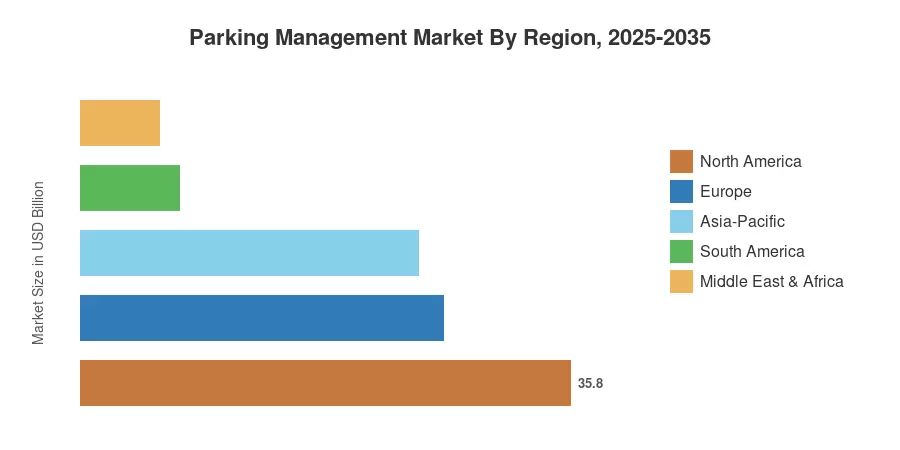
North America continues to be the largest area for the Parking Management Market and will generate revenue of around 35.8% by 2025, owing to the dense urban deployments and airport upgrade plans. Asia-Pacific is the fastest growing region, growing at an estimated 10.6% CAGR as Chinese and Indian cities digitize their inventory at scale. Sustainability standards related to low emission zones make Europe the second largest position. The next decade will favour operators who can turn parking infrastructure into a software-defined asset.

Key Report Takeaways

• By Technology

  • Camera and license-plate-recognition systems held an estimated 39.5% share of the Parking Management Market in 2025, anchoring most municipal deployments.
  • Mobile-app and Bluetooth-based solutions are forecast to expand at a 10.7% CAGR through 2035 as contactless payment habits solidify.
  • Sensor-based single-space detection continues to underpin off-street facility upgrades across mature markets.

• By Sector

  • Municipal and government operators accounted for an estimated 33.8% share of Parking Management Market revenue in 2025.
  • Commercial off-street operators, including malls and mixed-use developments, are scaling fastest in secondary cities.
  • Transit and airport operators are projected to grow at a 10.4% CAGR as terminal expansions bundle in digital parking.

• By Geography

  • North America commanded an estimated 35.8% share of the Parking Management Market in 2025.
  • Asia-Pacific is advancing at a 10.6% CAGR through 2035, the fastest of any region tracked.
  • Europe's growth is increasingly tied to low-emission-zone enforcement budgets rather than new construction.

Market Size and Forecast (2021–2035)

Figures below aggregate triangulated procurement data from municipal tenders, vendor shipment estimates and operator revenue declarations. Historical years show a gradual recovery from pre-pandemic levels, while the forecast timeframe shows an acceleration of cloud-platform usage from 2026 onwards.
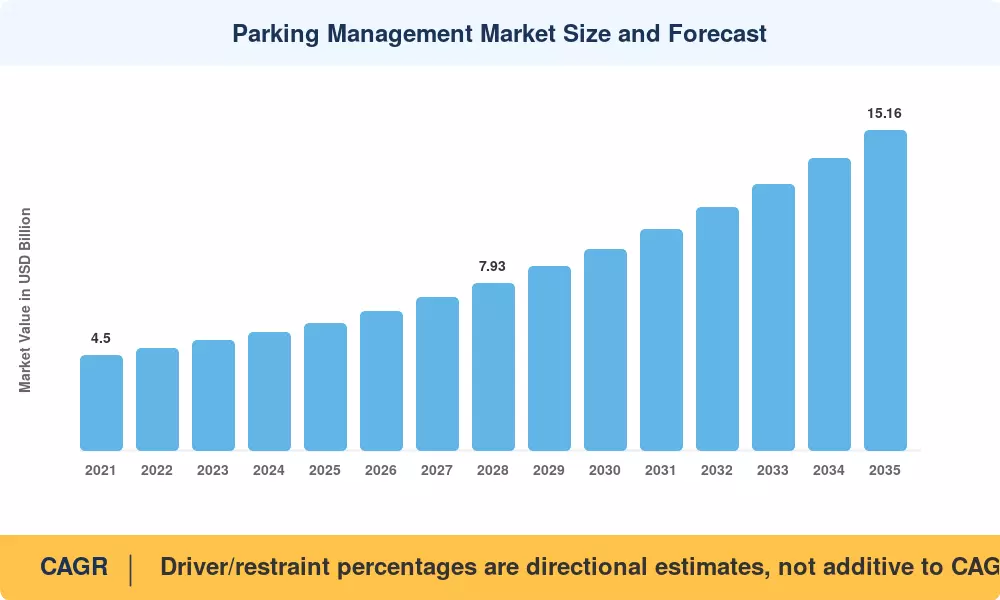
Parking Management Market Size and Forecast
Our Impact
Enabled $4.3B Revenue Impact for Fortune 500 and Leading Multinationals
Partnering with 2000+ Global Organizations Each Year
30K+ Citations by Top-Tier Firms in the Industry

Driver Impact Analysis

Driver ~% Impact on CAGR Geographic Relevance Impact Timeline
Smart-city curb digitization mandates ~180 bps North America, Europe Medium-term (2–4 yr)
AI-powered license-plate recognition adoption ~150 bps Global Short-term (≤2 yr)
EV charging-parking convergence ~120 bps Europe, North America Medium-term
Airport and transit hub capacity expansion ~110 bps Asia-Pacific, North America Long-term (≥4 yr)
Cloud-based SaaS platform migration ~140 bps Global Short-term
Government parking-revenue digitization programs ~100 bps Asia-Pacific Medium-term
Mobile and contactless payment adoption ~95 bps Global Short-term


Curb Digitization Mandates

Several North American transit authorities have tied federal infrastructure grants to curb-data reporting requirements, pushing cities to replace manual enforcement with connected sensor grids. A 2024 municipal technology survey found that over 40% of mid-sized US cities had budgeted for curb-management upgrades within two fiscal years [1].

License-Plate Recognition and AI

Camera-based recognition accuracy improvements have cut false-read rates below 2% in pilot deployments, making automated enforcement commercially viable for smaller municipalities that previously relied on manual patrols [2].

Cloud Platform Migration

Vendors report that cloud-hosted parking platforms now account for a growing share of new contract value, as operators favor subscription pricing over capital-intensive on-premise installs, easing budget approval cycles for cash-constrained municipalities [5].

Restraints Impact Analysis

Restraint ~% Impact on CAGR Geographic Relevance Impact Timeline
High upfront sensor and camera installation costs ~-90 bps Emerging markets Medium-term
Data-privacy and surveillance regulation ~-70 bps Europe Short-term
Legacy municipal procurement cycles ~-60 bps North America Medium-term
Interoperability gaps across platforms ~-50 bps Global Long-term
Cybersecurity vulnerabilities in connected systems ~-55 bps Global Short-term


Installation Cost Barriers

Single-space sensor retrofits in older parking structures often require trenching and conduit work that can double the headline hardware cost, deterring budget-constrained operators in secondary markets [8].

Privacy and Surveillance Pushback

Several European municipalities have delayed camera-based enforcement rollouts pending data-retention reviews, with at least one regional regulator requiring anonymization of license-plate data within 24 hours of capture [9].

Parking Management Market Opportunities

Emerging Market Curb Digitization

Southeast Asian and Latin American cities are still largely cash-and-gate operations, leaving substantial whitespace for first-mover platform vendors as municipal budgets modernize.

Data Monetization and MaaS APIs

Operators that expose occupancy data through mobility-as-a-service APIs can unlock secondary revenue from navigation apps and fleet operators, turning parking infrastructure into a recurring data product.

EV-Integrated Parking Hubs

Bundling EV charging bays with smart parking management lets operators capture both parking and energy-dispensing revenue from the same physical footprint, a model gaining traction in dense European city centers.

Subscription-Based Business Models

Parking-as-a-service contracts that bundle hardware, software, and maintenance into a single monthly fee are reducing adoption friction for cash-strapped municipal buyers.

Predictive Demand and Dynamic Pricing

Machine-learning models that forecast occupancy by time of day allow operators to flex pricing in real time, a capability increasingly demanded by airport and stadium operators managing peak-event surges.

Parking Management Market Future Outlook

AI and Autonomous Operations

Predictive analytics are shifting parking enforcement from reactive patrols to automated, camera-driven workflows, with several operators reporting double-digit reductions in enforcement labor costs after AI rollouts.

Platform Economics

As more operators expose occupancy and pricing data through open APIs, the competitive battleground is shifting from hardware specifications to ecosystem partnerships with navigation and mobility apps.

Electrification Convergence

The IEA's Global EV Outlook projects continued double-digit annual growth in public charging infrastructure through the early 2030s, a trend directly increasing demand for parking bays that combine occupancy sensing with charging-session management [3].

ESG and Sustainability Reporting

City sustainability disclosures increasingly require traffic-circulation and emissions data that parking platforms can supply, turning compliance reporting into a secondary revenue justification for digitization budgets.

Parking Management Market Segmentation

By Deployment Model

Segment Share (2025) Primary Demand Driver
On-Premises 54.5% Legacy municipal IT requirements
Cloud-Based 45.5% Lower upfront cost, faster deployment


On-premises systems still dominate the Parking Management Market, particularly among municipalities with strict data-residency rules. Cloud-based platforms are closing the gap quickly, favored by operators seeking faster rollout timelines and reduced capital expenditure.

By Parking Site

Segment Share (2025) Primary Demand Driver
Off-Street 57.3% Structured facility modernization
On-Street 42.7% Curb-management digitization


Off-street facilities such as garages and structured lots remain the largest segment of the Parking Management Market, while on-street deployments are scaling fastest as cities digitize curb inventory for enforcement and EV-charging co-location.

By Solution Component

Segment Share (2025) Primary Demand Driver
Hardware 42.4% Sensor and camera installation base
Software Platform 31.8% Cloud subscription growth
Services 25.8% Managed-services bundling


Hardware still captures the largest revenue share, but services are growing fastest as vendors bundle installation, maintenance, and analytics into long-term contracts.

By End-User Vertical

Segment Share (2025) Primary Demand Driver
Municipal and Government 33.8% Public-budget digitization mandates
Commercial Off-Street Operators 28.9% Mixed-use development growth
Transit and Airports 21.5% Terminal expansion projects
Other (Retail, Healthcare) 15.8% Customer-experience initiatives


By Technology

Segment Share (2025) Primary Demand Driver
Camera/LPR-Based 39.5% Automated enforcement adoption
Sensor-Based 33.2% Single-space occupancy detection
Mobile-App/Bluetooth 27.3% Contactless payment growth


Camera and license-plate-recognition technology anchors most large-scale municipal deployments, while mobile-app and Bluetooth-based solutions are the fastest-growing technology category as drivers favor app-based payment over physical kiosks.

Regional Market Share Analysis

Region Share (2025) Primary Investment Themes
North America 35.8% Municipal curb digitization, airport modernization
Europe 26.5% Low-emission-zone enforcement, EV-parking convergence
Asia-Pacific 24.7% National smart-city programs, transit expansion
South America 7.2% Cash-to-digital migration in metro centers
Middle East & Africa 5.8% Tourism-linked infrastructure, airport hubs
Total 100.0%


North America

Country Share of Region Key Driver
United States 78.4% Federal curb-data reporting mandates
Canada 14.9% Provincial transit modernization
Mexico 6.7% Cross-border logistics hub expansion


The United States anchors regional demand as cities tie federal grant eligibility to digital curb-management reporting, while Canadian provinces are piloting integrated transit-parking payment apps [1].

Europe

Country Share of Region Key Driver
Germany 21.3% Low-emission-zone enforcement
UK 18.6% Local authority outsourcing
France 14.2% Municipal concession renewals
Italy 9.8% Tourism-zone digitization
Spain 8.5% Smart-city pilot expansion
Nordic Countries 9.1% EV-parking convergence
Russia 6.0% Metro-area enforcement upgrades
Rest of Europe 12.5% Gradual platform adoption


Germany's low-emission-zone enforcement requirements have pushed several cities toward camera-based systems capable of real-time vehicle classification, a pattern now spreading to neighboring Benelux markets [9].

Asia-Pacific

Country Share of Region Key Driver
China 34.1% National smart-city funding
India 19.7% Metro and airport expansion
Japan 16.4% Aging infrastructure replacement
South Korea 11.8% Connected-vehicle integration
ASEAN 10.5% Cash-to-digital migration
Rest of Asia-Pacific 7.5% Early-stage pilots


China's national smart-city funding tranches continue to bundle parking sensors with broader traffic-management upgrades, while India's metro-rail expansion projects are driving co-located parking digitization at transit hubs [4].

South America

Country Share of Region Key Driver
Brazil 58.2% Metro-area enforcement modernization
Argentina 22.4% Municipal concession reform
Rest of South America 19.4% Early-stage adoption


Brazilian metro authorities are replacing manual ticketing in central business districts with app-based payment systems as part of broader traffic-congestion initiatives.

Middle East & Africa

Country Share of Region Key Driver
Saudi Arabia 31.6% Giga-project infrastructure buildout
UAE 28.9% Tourism and airport hub expansion
South Africa 15.2% Municipal revenue digitization
Egypt 12.8% Urban transit modernization
Rest of MEA 11.5% Early-stage pilots


Gulf-state giga-projects are embedding parking management directly into smart-district master plans, positioning the region as a proving ground for fully integrated mobility platforms.

Parking Management Market By Region, 2025-2035

Competitive Benchmarking

The Parking Management Market is somewhat concentrated, with the top five vendors anticipated to account for 35-42% of revenues and an HHI consistent with a moderately fragmented vendor base ranging from traditional infrastructure vendors to AI-native newcomers.

Company Est. Revenue Share Range Key Offerings for Parking Management Market Strategic Positioning
Siemens Mobility ~8–11% Integrated traffic and parking guidance systems Infrastructure incumbent
SWARCO ~6–9% Sensor networks, dynamic signage European municipal focus
Flowbird ~6–8% Pay stations, mobile payment apps On-street payment specialist
T2 Systems ~5–8% Cloud parking management software North American campus/municipal
IPS Group ~4–7% Smart meters, sensor analytics Single-space sensor leader
Cubic Transportation Systems ~5–7% Transit-integrated fare and parking Transit-airport convergence
Conduent ~4–6% Enforcement and citation processing Municipal services bundling
Indigo Group ~5–7% Off-street facility operations Facility-operator scale
Nedap ~3–5% Vehicle identification sensors Hardware-software hybrid
Q-Free ~3–5% Tolling-adjacent parking analytics Nordic and emerging-market push


Recent News & Developments


  • T2 Systems (September 2023): Completed acquisition of a regional enforcement software provider to broaden its municipal footprint [10].


  • IEC (October 2024): IEC approved OCPP as International Standard IEC 63584, formalizing EV-charger interoperability adopted by parking operators.
  • Flash Parking (September 2024): Flash Parking secured USD 85 million to finance EV-ready system upgrades, easing capital hurdles for garage owners.

Parking Management Market Report Scope

Item Detail
Market Scope Global Parking Management Market by deployment model, parking site, solution component, end-user, technology, and geography
Study Period 2021–2035
CAGR 9.7% (2026–2035)
Market Size Checkpoints USD 6.01B (2025), USD 6.59B (2026), USD 15.16B (2035)
Fastest Growing Segments Cloud-based deployment, on-street sites, services, transit/airports, mobile-app technology
Companies Profiled 10+
Valuation Currency USD Billion
CAGR Driver Disclaimer Driver/restraint percentages are directional estimates, not additive to CAGR


FAQs

What should municipal buyers weigh before choosing camera-based versus sensor-based systems?
Camera systems suit high-traffic on-street enforcement; sensors fit structured garages needing per-space accuracy. Buyers should weigh installation disruption against ongoing maintenance costs before committing [8].
How does single-space sensor ROI compare with computer-vision systems?
Sensors offer lower per-space accuracy variance but higher per-unit hardware cost. Computer-vision systems scale cheaper across large lots but need stable lighting and connectivity [2].
What integration challenges arise connecting parking platforms to MaaS apps?
Data-format mismatches and inconsistent occupancy refresh rates are common. Operators often need middleware layers to normalize feeds before MaaS partners can consume them reliably [11].
How does privacy regulation affect license-plate recognition rollouts?
Regulators increasingly require short data-retention windows and anonymization. This raises compliance overhead but hasn't slowed adoption, since vendors now build retention controls in by default [9].
What financing models reduce upfront sensor costs for buyers?
Parking-as-a-service contracts shift hardware costs into monthly subscriptions. This lowers capital barriers for budget-constrained municipalities and accelerates approval timelines [8].
How do airport parking investments differ from municipal programs?
Airports prioritize throughput and premium-tier pricing tied to flight schedules, while municipalities focus on enforcement and curb turnover. Airport contracts also tend to run longer and bundle more services [4].
What competitive risk do legacy hardware vendors face from AI-native entrants?
Cloud-native challengers can undercut on subscription pricing and faster deployment. Legacy vendors are responding by acquiring software-analytics firms to defend installed hardware bases [10].  
Author
Author
Author Profile
Aarti Dhapte LinkedIn
AVP - Research
A consulting professional focused on helping businesses navigate complex markets through structured research and strategic insights. I partner with clients to solve high-impact business problems across market entry strategy, competitive intelligence, and opportunity assessment. Over the course of my experience, I have led and contributed to 100+ market research and consulting engagements, delivering insights across multiple industries and geographies, and supporting strategic decisions linked to $500M+ market opportunities. My core expertise lies in building robust market sizing, forecasting, and commercial models (top-down and bottom-up), alongside deep-dive competitive and industry analysis. I have played a key role in shaping go-to-market strategies, investment cases, and growth roadmaps, enabling clients to make confident, data-backed decisions in dynamic markets.

Research Approach


Secondary Research

The secondary research process involved comprehensive analysis of government transportation databases, municipal planning reports, smart city initiatives, parking industry publications, and authoritative urban mobility organizations. Key sources included the US Department of Transportation (USDOT), Federal Highway Administration (FHWA), European Commission Directorate-General for Mobility and Transport (DG MOVE), International Parking & Mobility Institute (IPMI), British Parking Association (BPA), Parking Network, National League of Cities (NLC), US Census Bureau Transportation Statistics, Eurostat Urban Transport Database, Organisation for Economic Co-operation and Development (OECD) Urban Policy Reviews, World Bank Urban Development reports, International Transport Forum (ITF), Institute of Transportation Engineers (ITE), Smart Cities Council, and national transport ministry reports from key markets. These sources were used to collect parking infrastructure statistics, smart city investment data, traffic congestion metrics, urbanization trends, IoT deployment figures, and market landscape analysis for parking guidance systems, parking reservation systems, parking meter management solutions, on-street parking, off-street parking, and multi-level parking facilities.


Primary Research

Qualitative and quantitative insights were obtained by interviewing supply-side and demand-side stakeholders during the primary research process. CEOs, CTOs, VPs of Product Development, smart city solution architects, and commercial directors from OEMs, technology vendors, and parking management system providers comprised the supply-side sources. Municipal transportation planners, parking facility managers, urban development authorities, procurement leads from government agencies, commercial real estate developers, airport authorities, and facility management directors from shopping centers, hospitals, and universities were all included in the demand-side sources. The primary research validated market segmentation, confirmed technology adoption timelines, and collected insights on implementation challenges, pricing models, public-private partnership dynamics, and preferences for cloud versus on-premises deployment.

Primary Respondent Breakdown:

By Designation: C-level Primaries (32%), Director Level (30%), Others (38%)

By Region: North America (33%), Europe (29%), Asia-Pacific (28%), Rest of World (10%)


Market Size Estimation

Global market valuation was derived through revenue mapping and installation volume analysis. The methodology included:

Identification of 50+ key solution providers across North America, Europe, Asia-Pacific, Latin America, and Middle East & Africa

Product mapping across parking guidance systems, parking reservation systems, parking meter management, on-street parking solutions, off-street parking management, and multi-level parking automation

Analysis of reported and modeled annual revenues specific to parking management solution portfolios

Coverage of providers representing 70-75% of global market share in 2024

Extrapolation using bottom-up (installation volume × ASP by country/region) and top-down (provider revenue validation) approaches to derive segment-specific valuations for cloud-based, on-premises, and hybrid deployment models across government, commercial, and residential end-user segments

Download Free Sample

Kindly complete the form below to receive a free sample of this Report

Download PDF ×

We do not share your information with anyone. However, we may send you emails based on your report interest from time to time. You may contact us at any time to opt-out.