×
Hero Background
English
Chinese
French
Japanese
Korean
German
Spanish

Phenolic Antioxidant Market Share

ID: MRFR/CnM/2635-CR
123 Pages
Priya Nagrale
September 2017

Phenolic Antioxidant Market Research Report Information: by Source (Natural and Synthetic), By Application (Food, Plastics & Rubber, Pharmaceutical, Cosmetic, Fuel & Lubricant and Other), and by Region (Asia Pacific, Europe, North America, Latin America, and Middle East &Africa,) - Forecast till 2035

Share:
Download PDF ×

We do not share your information with anyone. However, we may send you emails based on your report interest from time to time. You may contact us at any time to opt-out.

Phenolic Antioxidant Market Infographic
Purchase Options

Market Share

Phenolic Antioxidant Market Share Analysis

There are numerous ways in which the phenolic antioxidant market can create an effective positioning and thus improve its share in the global market. Product differentiation is one of the fundamental strategies used by firms to make their phenolic antioxidants stand out from those offered by competitors. This involves coming up with distinct formulations, enhancing antioxidant properties, or creating specialized products that suit a particular industrial use. Pricing decisions are central in determining how Phenolic Antioxidants will be positioned within the market. Companies may decide on pricing competitively, targeting cost-sensitive customers with affordable solutions, hence capturing larger markets. On the other hand, they may employ premium prices, considering them high quality or conforming to tough industry requirements, thus attracting customers who would want to spend more for value. Striking a balance between price and value is critical for successful brand positioning within a market, leading to substantial shares being taken. Distribution networks are crucial in the market share placement of phenolic antioxidants. This is because it ensures that the antioxidants are available in many places by establishing strong ties with chemical manufacturers, distributors, and end-users. As a result, potential buyers can easily find where to buy phenolic antioxidants, thereby increasing their market share. Brand recognition and marketing strategies are some of the key factors that affect market share within the Phenolic Antioxidants industry. An enormous influence has been made by building a unique brand image and making several positive associations with these oxidants, as it can significantly alter customer preferences. To ensure an increased market share, companies have to invest in focused marketing initiatives such as advertising specific to this sector and participating in trade shows on the Internet. Innovation and adaptability are vital concepts in ever-changing markets for phenolic antioxidants. Staying up-to-date with emerging technologies and movements in the industry positions companies as frontrunners, providing cutting-edge solutions. Collaboration and strategic partnerships also play a vital role in market share positioning in the Phenolic Antioxidants industry. These include alliances with raw material suppliers, research institutions, or other players within this line of business, which may lead to synergies that would improve product quality and promote production flow processes while creating a more formidable market presence. Market Share Positioning for Phenolic Antioxidants: Global Market Dynamics and Regional Considerations Different regions have unique demands based on their preferences; thus, they need to develop strategies tailored towards those particular markets.
Author
Priya Nagrale
Senior Research Analyst

With an experience of over five years in market research industry (Chemicals & Materials domain), I gather and analyze market data from diverse sources to produce results, which are then presented back to a client. Also, provide recommendations based on the findings. As a Senior Research Analyst, I perform quality checks (QC) for market estimations, QC for reports, and handle queries and work extensively on client customizations. Also, handle the responsibilities of client proposals, report planning, report finalization, and execution

Leave a Comment

FAQs

What is the valuation that the global phenolic antioxidant market is estimated to create over the review period?

The global phenolic antioxidant market is estimated to create a valuation of USD 1830.05 MN by 2025, registering 5.10% CAGR throughout the assessment period (2025-2035).

Which is the largest region in global phenolic antioxidant market?

Asia Pacific is the largest region in the global phenolic antioxidant market. The region is estimated to retain its leading position throughout the assessment period (2025-2035), holding the largest share.

What are the key driving forces behind the growth of the global phenolic antioxidant market?

Rising demand as an additive in plastic & rubber and fuel & lubricant manufacturing industry

Which is the largest segment in the global phenolic antioxidant market?

The sub segment – Food by applications is the largest segment in the in the global phenolic antioxidant market. The sub segment is projected to reach a valuation of USD significant by the end of 2035.

Who are the top players in the global phenolic antioxidant market?

BASF SE (Germany), DSM (Netherlands), Oxiris Chemicals S A (Spain), Chitec Technology Co., Ltd. (Taiwan), Sumitomo Chemical Company (Japan), Mayzo Inc. (US), Double Bond Chemical Ind., Co., Ltd. (Taiwan), Addivant (US), Emerald Performance Materials LLC (US), and Kumho Petrochemical Co., Ltd. (South Korea), are some of the leading players in the global phenolic antioxidant market.

Market Summary

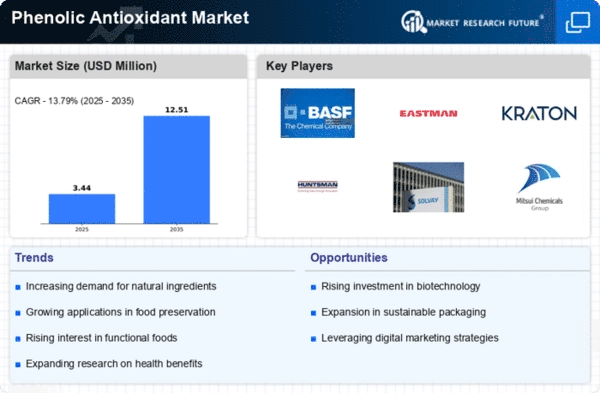
As per MRFR analysis, the Phenolic Antioxidant Market Size was estimated at 3.02 USD Million in 2024. The Phenolic Antioxidant industry is projected to grow from 3.44 in 2025 to 12.51 by 2035, exhibiting a compound annual growth rate (CAGR) of 13.79 during the forecast period 2025 - 2035.

Key Market Trends & Highlights

The Phenolic Antioxidant Market is experiencing robust growth driven by increasing demand for natural ingredients and health awareness.

  • The market is witnessing a rising demand for natural ingredients, particularly in North America, which remains the largest market.
  • Technological innovations in extraction methods are enhancing the efficiency and quality of phenolic antioxidants.
  • Growing awareness of health benefits is propelling the use of phenolic antioxidants in food preservation, the largest segment.
  • The increasing application in the food and beverage industry and rising demand in pharmaceuticals are key drivers of market expansion.

Market Size & Forecast

2024 Market Size 3.02 (USD Million)
2035 Market Size 12.51 (USD Million)
CAGR (2025 - 2035) 13.79%
Largest Regional Market Share in 2024 North America

Major Players

<p>BASF SE (DE), Eastman Chemical Company (US), Kraton Corporation (US), Huntsman Corporation (US), Solvay SA (BE), Addivant USA LLC (US), Siemens AG (DE), Mitsui Chemicals Inc. (JP), SABIC (SA)</p>

Market Trends

The Phenolic Antioxidant Market is currently experiencing a notable evolution, driven by increasing consumer awareness regarding health and wellness. This market encompasses a diverse range of applications, including food preservation, cosmetics, and pharmaceuticals. The growing inclination towards natural and organic products has led to a heightened demand for phenolic antioxidants, which are recognized for their ability to combat oxidative stress and enhance product stability. As industries strive to meet consumer preferences, the integration of these antioxidants into formulations appears to be a strategic move to ensure product efficacy and longevity. Moreover, the Phenolic Antioxidant Market is likely to witness advancements in extraction and processing technologies, which may enhance the yield and purity of these compounds. This trend suggests a potential shift towards more sustainable practices, as manufacturers seek to optimize resource utilization while minimizing environmental impact. The ongoing research into the health benefits of phenolic compounds could further bolster market growth, as new applications emerge across various sectors. Overall, the Phenolic Antioxidant Market seems poised for continued expansion, reflecting broader trends in health consciousness and sustainability.

Rising Demand for Natural Ingredients

There is an increasing preference for natural ingredients in various sectors, particularly in food and cosmetics. Consumers are becoming more discerning, seeking products that are free from synthetic additives. This trend is likely to drive the demand for phenolic antioxidants, which are derived from natural sources and offer health benefits.

Technological Innovations in Extraction

Advancements in extraction technologies are enhancing the efficiency and quality of phenolic antioxidants. Techniques such as supercritical fluid extraction and enzymatic methods are being explored to improve yield and purity. This innovation may lead to a more sustainable production process, aligning with environmental concerns.

Growing Awareness of Health Benefits

The health benefits associated with phenolic antioxidants are gaining recognition among consumers and industries alike. Research continues to unveil their potential in reducing the risk of chronic diseases. This growing awareness is likely to stimulate demand across various applications, including dietary supplements and functional foods.

Phenolic Antioxidant Market Market Drivers

Rising Health Consciousness

The increasing awareness of health and wellness among consumers is driving the Global Phenolic Antioxidant Market Industry. As individuals become more informed about the benefits of antioxidants in combating oxidative stress and chronic diseases, the demand for phenolic antioxidants is likely to surge. This trend is particularly evident in the food and beverage sector, where manufacturers are incorporating these compounds into products to enhance nutritional value. The market is projected to reach 1250 USD Million in 2024, reflecting a growing consumer preference for natural and functional ingredients that promote health and longevity.

Growing Demand in Pharmaceuticals

The pharmaceutical sector is increasingly recognizing the potential of phenolic antioxidants, contributing to the growth of the Global Phenolic Antioxidant Market Industry. These compounds are being studied for their therapeutic properties, including anti-inflammatory and anticancer effects. As research continues to unveil the health benefits associated with phenolic antioxidants, pharmaceutical companies are likely to incorporate these ingredients into their formulations. This trend suggests a promising future for the market, with a compound annual growth rate (CAGR) of 7.43% anticipated from 2025 to 2035, reflecting the rising interest in natural compounds for health applications.

Expansion in Food and Beverage Applications

The Global Phenolic Antioxidant Market Industry is experiencing significant growth due to the expanding applications of phenolic antioxidants in the food and beverage sector. These compounds are utilized to prevent oxidation in various products, thereby extending shelf life and maintaining quality. For instance, the incorporation of phenolic antioxidants in oils and fats has become a common practice to enhance stability. As the global food industry continues to evolve, the market for phenolic antioxidants is expected to grow, with projections indicating a rise to 2750 USD Million by 2035, driven by the increasing demand for processed and packaged foods.

Regulatory Support for Natural Antioxidants

The Global Phenolic Antioxidant Market Industry is benefiting from favorable regulatory frameworks that promote the use of natural antioxidants in various applications. Governments and health organizations are increasingly endorsing the incorporation of natural compounds in food, cosmetics, and pharmaceuticals, recognizing their potential health benefits. This regulatory support encourages manufacturers to explore and invest in phenolic antioxidants, leading to a broader acceptance and integration of these ingredients in consumer products. As a result, the market is poised for growth, driven by the alignment of regulatory policies with consumer preferences for natural and safe ingredients.

Technological Advancements in Extraction Methods

Innovations in extraction technologies are playing a pivotal role in the Global Phenolic Antioxidant Market Industry. Advanced methods such as supercritical fluid extraction and enzymatic extraction are enhancing the efficiency and yield of phenolic compounds from natural sources. These improvements not only increase the availability of high-quality antioxidants but also reduce production costs, making them more accessible to manufacturers. As technology continues to advance, the market is likely to benefit from improved extraction techniques, which could further stimulate growth and innovation in product development.

Market Segment Insights

By Application: Food Preservation (Largest) vs. Pharmaceuticals (Fastest-Growing)

<p>In the Phenolic Antioxidant Market, the application segments reveal a diverse landscape, with food preservation holding the largest market share. This application thrives as consumers increasingly prioritize food safety and quality, driving manufacturers to integrate more phenolic antioxidants to enhance shelf life. Conversely, the pharmaceuticals sector is emerging as the fastest-growing application, spurred by rising awareness of health benefits and the role of antioxidants in combating oxidative stress. As industries evolve, the significance of these segments is becoming increasingly pronounced. The growth trends within these segments reflect broader societal changes, especially the heightened demand for natural food preservatives and health-conscious products. Technological advancements in the formulation of phenolic antioxidants also contribute to their rising adoption in pharmaceuticals. Moving forward, innovations in product development and regulatory support are likely to stimulate growth across all applications, particularly in areas like natural health supplements and food technology.</p>

<p>Food Preservation: Dominant vs. Pharmaceuticals: Emerging</p>

<p>Food preservation is characterized by its established position and critical importance in maintaining nutritional quality and extending shelf life of edible products. The widespread adoption of phenolic antioxidants in this sector stems from their efficacy in inhibiting oxidative rancidity, making them essential in the formulation of various food products. Meanwhile, the pharmaceuticals sector showcases a rapid expansion as trends lean toward preventative healthcare and dietary supplements featuring natural compounds. This segment is perceived as emerging due to advancements in research highlighting the benefits of antioxidants in disease prevention and health enhancement, making it a promising area for future growth. Each application holds unique market potential, reflecting the ongoing demand for innovative solutions in health and safety.</p>

By Source: Natural (Largest) vs. Synthetic (Fastest-Growing)

<p>The Phenolic Antioxidant Market exhibits a diverse distribution in its source segment, primarily categorized into natural, synthetic, and semi-synthetic sources. Among these, natural phenolic antioxidants hold the largest share, driven by increasing consumer preferences for natural ingredients in food and cosmetics. This trend is reflective of a broader shift towards healthier, more organic product offerings in various industries, indicating a strong market positioning for natural sources in the upcoming years. Conversely, synthetic phenolic antioxidants are witnessing rapid growth, becoming the fastest-growing segment in the market. This growth is primarily fueled by advancements in chemical formulations and the increasing demand for performance-driven additives in industries such as food preservation and rubber manufacturing. The flexibility and effectiveness of synthetic options continue to attract a wide range of applications, thereby enhancing their market presence, even as the natural segment retains its dominance.</p>

<p>Natural (Dominant) vs. Synthetic (Emerging)</p>

<p>In the context of the Phenolic Antioxidant Market, natural phenolic antioxidants are characterized by their origin from plant-based sources, offering a clean label appeal to consumers. They provide not only antioxidant benefits but also contribute to the overall health perception of products. This segment has gained traction in food industries, where natural ingredients are favored for their perceived safety. On the other hand, synthetic phenolic antioxidants, though viewed with skepticism in some circles, are emerging rapidly due to their reliability and efficacy in preventing oxidation. Their chemical consistency allows for enhanced performance in a variety of applications, making them a preferred choice in sectors demanding high-performance and cost-effective solutions. As both segments evolve, they cater to different market needs and consumer preferences, ensuring a diverse market landscape.</p>

By End Use: Food and Beverages (Largest) vs. Personal Care Products (Fastest-Growing)

<p>The phenolic antioxidant market is significantly shaped by its end use across various sectors, namely Food and Beverages, Personal Care Products, Healthcare Products, and Industrial Applications. Among these, the Food and Beverages segment holds the largest share, driven by rising consumer demand for shelf-stable products and healthier food options. This is complemented by increasing concerns over food spoilage and quality enhancement, establishing this segment as the vital cornerstone of the phenolic antioxidant market.</p>

<p>Food and Beverages (Dominant) vs. Healthcare Products (Emerging)</p>

<p>The Food and Beverages segment plays a dominant role in the phenolic antioxidant market, focusing primarily on extending the shelf life of products while maintaining flavor and nutritional value. This segment leverages natural and synthetic phenolic antioxidants to prevent oxidative damage in a variety of food products. In contrast, the Healthcare Products segment is emerging as a key player, driven by the integration of phenolic antioxidants into dietary supplements and pharmaceuticals aimed at enhancing wellness and combating oxidative stress. The growth of health-conscious consumer behavior is pushing this segment's expansion, presenting lucrative opportunities for innovation and product development.</p>

Get more detailed insights about Phenolic Antioxidant Market Research Report - Forecast to 2035

Regional Insights

North America : Market Leader in Antioxidants

North America is poised to maintain its leadership in the Phenolic Antioxidant Market, holding a significant market share of 1.21 in 2024. The region's growth is driven by increasing demand from industries such as plastics, rubber, and food packaging, where phenolic antioxidants are essential for enhancing product longevity. Regulatory support for sustainable practices further fuels market expansion, as companies seek to comply with environmental standards. The competitive landscape in North America is robust, featuring key players like BASF SE, Eastman Chemical Company, and Huntsman Corporation. These companies are investing in R&D to innovate and improve product offerings, ensuring they meet the evolving needs of various sectors. The presence of advanced manufacturing facilities and a strong distribution network also contribute to the region's dominance in the global market.

Europe : Emerging Market with Growth Potential

Europe's Phenolic Antioxidant Market is characterized by a market size of 0.91, reflecting a growing demand driven by stringent regulations on product safety and environmental impact. The European Union's commitment to sustainability and circular economy principles encourages the adoption of phenolic antioxidants in various applications, including automotive and consumer goods. This regulatory landscape acts as a catalyst for innovation and market growth. Leading countries in this region include Germany, France, and the UK, where major players like Solvay SA and BASF SE are actively engaged. The competitive environment is marked by collaborations and partnerships aimed at enhancing product performance and sustainability. As companies adapt to regulatory changes, the market is expected to witness significant advancements in technology and product development.

Asia-Pacific : Rapidly Growing Market Segment

The Asia-Pacific region, with a market size of 0.7, is witnessing rapid growth in the Phenolic Antioxidant Market, driven by increasing industrialization and urbanization. Countries like China and India are experiencing heightened demand for phenolic antioxidants in sectors such as automotive, packaging, and electronics. The region's growth is further supported by favorable government policies aimed at boosting manufacturing and exports, creating a conducive environment for market expansion. Key players in the Asia-Pacific market include Mitsui Chemicals Inc. and SABIC, who are focusing on expanding their production capacities to meet the rising demand. The competitive landscape is evolving, with local manufacturers emerging alongside established global players. This dynamic environment is expected to foster innovation and enhance product offerings, positioning the region as a significant player in the global market.

Middle East and Africa : Emerging Market with Challenges

The Middle East and Africa (MEA) region, with a market size of 0.2, presents unique challenges and opportunities in the Phenolic Antioxidant Market. The growth is primarily driven by increasing industrial activities and a rising awareness of product quality in sectors like food and cosmetics. However, the market faces hurdles such as limited local production capabilities and reliance on imports, which can affect pricing and availability. Countries like South Africa and the UAE are leading the way in adopting phenolic antioxidants, with local players beginning to emerge. The competitive landscape is gradually evolving, with international companies exploring partnerships to enhance their market presence. As the region continues to develop its industrial base, the demand for phenolic antioxidants is expected to grow, albeit at a slower pace compared to other regions.

Key Players and Competitive Insights

The Phenolic Antioxidant Market is currently characterized by a dynamic competitive landscape, driven by increasing demand for high-performance materials across various industries, including plastics, rubber, and food preservation. Key players such as BASF SE (Germany), Eastman Chemical Company (US), and Huntsman Corporation (US) are strategically positioned to leverage their extensive research and development capabilities. These companies focus on innovation and sustainability, which are becoming critical factors in maintaining competitive advantage. Their operational strategies, including mergers and acquisitions, regional expansions, and partnerships, collectively shape a market that is increasingly oriented towards high-value applications and environmentally friendly solutions.

In terms of business tactics, companies are increasingly localizing manufacturing to enhance supply chain efficiency and reduce operational costs. The market structure appears moderately fragmented, with several players vying for market share. However, the influence of major companies is significant, as they often set industry standards and drive technological advancements. This competitive structure suggests that while there is room for smaller players, the dominance of established firms is likely to persist, particularly as they continue to innovate and optimize their operations.

In November 2025, BASF SE (Germany) announced the launch of a new line of bio-based phenolic antioxidants aimed at reducing environmental impact. This strategic move not only aligns with global sustainability trends but also positions BASF to capture a growing segment of environmentally conscious consumers. The introduction of these products is expected to enhance their market share and reinforce their commitment to sustainable practices.

In October 2025, Eastman Chemical Company (US) expanded its production capacity for phenolic antioxidants in response to rising global demand. This expansion is indicative of Eastman's proactive approach to market dynamics, allowing the company to better serve its customers and strengthen its supply chain resilience. By increasing capacity, Eastman is likely to improve its competitive positioning and meet the needs of various industries more effectively.

In September 2025, Huntsman Corporation (US) entered into a strategic partnership with a leading technology firm to develop advanced phenolic antioxidant formulations utilizing AI-driven analytics. This collaboration is expected to enhance product performance and accelerate innovation cycles. By integrating AI into their R&D processes, Huntsman aims to differentiate its offerings and respond more swiftly to market demands, thereby solidifying its competitive edge.

As of December 2025, the competitive trends in the Phenolic Antioxidant Market are increasingly defined by digitalization, sustainability, and technological integration. Strategic alliances are becoming more prevalent, enabling companies to pool resources and expertise to drive innovation. The shift from price-based competition to a focus on technological advancement and supply chain reliability is evident. Moving forward, competitive differentiation will likely hinge on the ability to innovate and adapt to changing market conditions, with a strong emphasis on sustainable practices and advanced technologies.

Key Companies in the Phenolic Antioxidant Market market include

Industry Developments

Future Outlook

Phenolic Antioxidant Market Future Outlook

<p>The Phenolic Antioxidant Market is projected to grow at a 13.79% CAGR from 2024 to 2035, driven by increasing demand in food preservation, cosmetics, and pharmaceuticals.</p>

New opportunities lie in:

  • <p>Development of bio-based phenolic antioxidants for sustainable products.</p>
  • <p>Expansion into emerging markets with tailored formulations.</p>
  • <p>Strategic partnerships with food and beverage companies for product integration.</p>

<p>By 2035, the Phenolic Antioxidant Market is expected to achieve substantial growth and innovation.</p>

Market Segmentation

Phenolic Antioxidant Market Source Outlook

  • Natural
  • Synthetic
  • Semi-Synthetic

Phenolic Antioxidant Market End Use Outlook

  • Food and Beverages
  • Personal Care Products
  • Healthcare Products
  • Industrial Applications

Phenolic Antioxidant Market Application Outlook

  • Food Preservation
  • Pharmaceuticals
  • Cosmetics
  • Plastics
  • Agriculture

Report Scope

MARKET SIZE 20243.02(USD Million)
MARKET SIZE 20253.44(USD Million)
MARKET SIZE 203512.51(USD Million)
COMPOUND ANNUAL GROWTH RATE (CAGR)13.79% (2024 - 2035)
REPORT COVERAGERevenue Forecast, Competitive Landscape, Growth Factors, and Trends
BASE YEAR2024
Market Forecast Period2025 - 2035
Historical Data2019 - 2024
Market Forecast UnitsUSD Million
Key Companies ProfiledBASF SE (DE), Eastman Chemical Company (US), Kraton Corporation (US), Huntsman Corporation (US), Solvay SA (BE), Addivant USA LLC (US), Siemens AG (DE), Mitsui Chemicals Inc. (JP), SABIC (SA)
Segments CoveredApplication, Source, End Use
Key Market OpportunitiesGrowing demand for natural preservatives in food and cosmetics drives Phenolic Antioxidant Market expansion.
Key Market DynamicsRising demand for natural phenolic antioxidants driven by consumer preference for clean label products and health benefits.
Countries CoveredNorth America, Europe, APAC, South America, MEA

FAQs

What is the valuation that the global phenolic antioxidant market is estimated to create over the review period?

The global phenolic antioxidant market is estimated to create a valuation of USD 1830.05 MN by 2025, registering 5.10% CAGR throughout the assessment period (2025-2035).

Which is the largest region in global phenolic antioxidant market?

Asia Pacific is the largest region in the global phenolic antioxidant market. The region is estimated to retain its leading position throughout the assessment period (2025-2035), holding the largest share.

What are the key driving forces behind the growth of the global phenolic antioxidant market?

Rising demand as an additive in plastic &amp; rubber and fuel &amp; lubricant manufacturing industry

Which is the largest segment in the global phenolic antioxidant market?

The sub segment – Food by applications is the largest segment in the in the global phenolic antioxidant market. The sub segment is projected to reach a valuation of USD significant by the end of 2035.

Who are the top players in the global phenolic antioxidant market?

BASF SE (Germany), DSM (Netherlands), Oxiris Chemicals S A (Spain), Chitec Technology Co., Ltd. (Taiwan), Sumitomo Chemical Company (Japan), Mayzo Inc. (US), Double Bond Chemical Ind., Co., Ltd. (Taiwan), Addivant (US), Emerald Performance Materials LLC (US), and Kumho Petrochemical Co., Ltd. (South Korea), are some of the leading players in the global phenolic antioxidant market.

  1. Executive Summary
  2. Scope
    1. Of The Report
    2. Market Definition
    3. Scope Of The Study
      1. Assumptions &
    4. Research Objectives
    5. Limitations
    6. Markets Structure
  3. Market
    1. Research Methodology
    2. Research Process
    3. Secondary Research
    4. Primary Research
    5. Forecast Model
  4. Market
    1. Landscape
    2. Five Forces Analysis
    3. Threat Of New Entrants
    4. Bargaining Power Of Buyers
    5. Threat Of Substitutes
    6. Segment Rivalry
    7. Value Chain/Supply
    8. Chain Of Global Phenolic Antioxidants Market
  5. Industry
    1. Overview Of Global Phenolic Antioxidants Market
    2. Introduction
    3. Growth Drivers
    4. Impact Analysis
    5. Market Challenges
    6. Impact Analysis
  6. Market Trends
    1. Introduction
    2. Growth Trends
    3. Impact Analysis
  7. Global Phenolic Antioxidants Market By Type
    1. Introduction
    2. Natural
    3. Synthetic
  8. Global Phenolic Antioxidants Market By Phenolic Group
    1. Introduction
    2. Mono- Functional Phenols
    3. Bi- Functional Phenols
    4. Multi-Functional Phenols
  9. Global Phenolic Antioxidants Market By End Use
    1. Introduction
    2. Food & Feed
    3. Plastic
    4. Fuel & Lubricants
    5. Rubber
    6. Cosmetic & Personal
    7. Care
    8. Other
  10. Global
    1. Phenolic Antioxidants Market By Region
    2. Introduction
    3. North America
      1. Canada
      2. Germany
      3. Italy
      4. UK
      5. China
      6. Japan
      7. New Zealand
    4. US
    5. Europe
    6. France
    7. Spain
    8. Asia Pacific
    9. India
    10. Australia
    11. Rest Of Asia-Pacific
    12. Middle East &
      1. Turkey
      2. North Africa
      3. Rest Of Middle East
    13. Africa
    14. Israel
    15. GCC
    16. & Africa
    17. Latin America
      1. Argentina
    18. Brazil
    19. Rest Of Latin America
  11. Company Landscape
  12. Company
    1. Profiles
    2. Mayzo Inc
      1. Product/Business
      2. Financial Updates
      3. Company Overview
      4. Key Developments
      5. Product/Business
      6. Financial Updates
    3. Company Overview
    4. Segment Overview
    5. Key Developments
    6. BASF SE
    7. Product/Business Segment Overview
    8. Financial Updates
    9. Archer Daniels Midland Company
    10. Company Overview
    11. Segment Overview
    12. Key Developments
    13. Evonik Industries
      1. Product/Business
      2. Financial Updates
    14. Company Overview
    15. Segment Overview
    16. Key Developments
    17. DSM
      1. Product/Business
      2. Financial Updates
    18. Company Overview
    19. Segment Overview
    20. Key Developments
    21. OXIRIS
      1. Product/Business
      2. Financial Updates
    22. Company Overview
    23. Segment Overview
    24. Key Developments
    25. VDH CHEM TECH PVT.
      1. Company Overview
      2. Key Developments
      3. Company Overview
      4. Key Developments
      5. Product/Business
      6. Financial Updates
    26. LTD
    27. Product/Business Segment Overview
    28. Financial Updates
    29. Akrochem Corporation
    30. Product/Business Segment Overview
    31. Financial Updates
    32. Chitec Technology Co. Ltd
    33. Company Overview
    34. Segment Overview
    35. Key Developments
    36. Addivant.
      1. Product/Business
      2. Financial Updates
    37. Company Overview
    38. Segment Overview
    39. Key Developments
  13. Conclusion
  14. List
    1. Of Tables
  15. World Population
    1. By Major Regions (2020 To 2027)
    2. Table
  16. Global Phenolic Antioxidants Market: By Region, 2020-2027
    1. Table
  17. North America Phenolic Antioxidants Market: By Country, 2020-2027
    1. Table
  18. Europe Phenolic Antioxidants Market: By Country, 2020-2027
    1. Table
  19. Asia-Pacific Phenolic Antioxidants Market: By Country, 2020-2027
    1. Table
  20. Middle East & Africa Phenolic Antioxidants Market: By Country, 2020-2027
    1. Table
  21. Latin America Phenolic Antioxidants Market: By Country, 2020-2027
    1. Table
  22. Global Phenolic Antioxidants By Type Market: By Regions, 2020-2027
    1. Table
  23. North America Phenolic Antioxidants By Type Market: By Country, 2020-2027
    1. Table
  24. Europe Phenolic Antioxidants By Type Market: By Country, 2020-2027
    1. Table
  25. Asia-Pacific Phenolic Antioxidants By Type Market: By Country, 2020-2027
    1. Table
  26. Middle East & Africa Phenolic Antioxidants By Type Market: By Country, 2020-2027
    1. Table
  27. Latin America Phenolic Antioxidants By Type Market: By Country, 2020-2027
    1. Table
  28. Global Phenolic Antioxidants By Phenolic Group Market: By Regions, 2020-2027
    1. Table
  29. North America Phenolic Antioxidants By Phenolic Group Market: By Country, 2020-2027
    1. Table
  30. Europe Phenolic Antioxidants By Phenolic Group Market: By Country, 2020-2027
    1. Table
  31. Asia-Pacific Phenolic Antioxidants By Phenolic Group Market: By Country, 2020-2027
    1. Table
  32. Middle East & Africa Phenolic Antioxidants By Phenolic Group Market: By Country,
  33. Latin America
    1. Phenolic Antioxidants By Phenolic Group Market: By Country, 2020-2027
    2. Table
  34. North America Phenolic Antioxidants For End-Use Market: By Country, 2020-2027
    1. Table
  35. Europe Phenolic Antioxidants For End-Use Market: By Country, 2020-2027
    1. Table
  36. Asia-Pacific Phenolic Antioxidants For End-Use Market: By Country, 2020-2027
    1. Table
  37. Middle East & Africa Phenolic Antioxidants For End-Use Market: By Country,
  38. Latin America
    1. Phenolic Antioxidants For End-Use Market: By Country, 2020-2027
    2. Table
  39. Global Type Market: By Region, 2020-2027
    1. Table
  40. Global End Uses Market: By Region, 2020-2027
    1. Table
  41. Global End-Use Market: By Region, 2020-2027
    1. Table
  42. North America Phenolic Antioxidants Market, By Country
    1. Table
  43. North America Phenolic Antioxidants Market, By Type
    1. Table
  44. North America Phenolic Antioxidants Market, By Phenolic Group
    1. Table
  45. North America Phenolic Antioxidants Market, By End-Use
    1. Table
  46. Europe: Phenolic Antioxidants Market, By Country
    1. Table
  47. Europe: Phenolic Antioxidants Market, By Type
    1. Table
  48. Europe: Phenolic Antioxidants Market, By Phenolic Group
    1. Table
  49. Europe: Phenolic Antioxidants Market, By End-Use
    1. Table
  50. Asia-Pacific: Phenolic Antioxidants Market, By Country
    1. Table
  51. Asia-Pacific: Phenolic Antioxidants Market, By Type
    1. Table
  52. Asia-Pacific: Phenolic Antioxidants Market, By Phenolic Group
    1. Table
  53. Asia-Pacific: Phenolic Antioxidants Market, By End-Use
    1. Table
  54. Middle East & Africa: Phenolic Antioxidants Market, By Country
    1. Table
  55. Middle East & Africa Phenolic Antioxidants Market, By Type
    1. Table
  56. Middle East & Africa Phenolic Antioxidants Market, By Phenolic Group
    1. Table
  57. Middle East & Africa: Phenolic Antioxidants Market, By End-Use
    1. Table
  58. Latin America: Phenolic Antioxidants Market, By Country
    1. Table
  59. Latin America Phenolic Antioxidants Market, By Type
    1. Table
  60. Latin America Phenolic Antioxidants Market, By Phenolic Group
    1. Table
  61. Latin America: Phenolic Antioxidants Market, By End-Use
  62. List
    1. Of Figures
  63. Global Phenolic
    1. Antioxidants Market Segmentation
    2. FIGURE
  64. Forecast Methodology
    1. FIGURE
  65. Five Forces Analysis Of Global Phenolic Antioxidants Market
    1. FIGURE
  66. Value Chain Of Global Phenolic Antioxidants Market
    1. FIGURE
  67. Share Of Global Phenolic Antioxidants Market In 2020, By Country (In %)
    1. FIGURE
  68. Global Phenolic Antioxidants Market, 2020-2027,
    1. FIGURE
  69. Sub-Segments Of End Uses
    1. FIGURE
  70. Global Phenolic Antioxidants Market Size By End Use, 2020
    1. FIGURE
  71. Share Of Global Phenolic Antioxidants Market By End Use, 2020 To 2027
    1. FIGURE
  72. Global Phenolic Antioxidants Market Size By Phenolic Group, 2020
    1. FIGURE
  73. Share Of Global Phenolic Antioxidants Market By Phenolic Group, 2020 To 2027
    1. FIGURE
  74. Global Phenolic Antioxidants Market Size By Type, 2020
    1. FIGURE
  75. Share Of Global Phenolic Antioxidants Market By Type, 2020 To 2027

Phenolic Antioxidant Market Segmentation

Market Segmentation Overview

  • Detailed segmentation data will be available in the full report
  • Comprehensive analysis by multiple parameters
  • Regional and country-level breakdowns
  • Market size forecasts by segment
Infographic

Free Sample Request

Kindly complete the form below to receive a free sample of this Report

Get Free Sample

Customer Strories

Compare Licence

×
Features License Type
Single User Multiuser License Enterprise User
Price $4,950 $5,950 $7,250
Maximum User Access Limit 1 User Upto 10 Users Unrestricted Access Throughout the Organization
Free Customization
Direct Access to Analyst
Deliverable Format
Platform Access
Discount on Next Purchase 10% 15% 15%
Printable Versions