×
Hero Background
English
Chinese
French
Japanese
Korean
German
Spanish

Plastic Stabilizer Market Analysis

ID: MRFR/CnM/3031-CR
123 Pages
Chitranshi Jaiswal
September 2017

Plastic Stabilizer Market Research Report Information: Type (Heat Stabilizer, Antioxidant, Light Stabilizer and Others), Material (Thermoplastic, Thermosetting and Elastomers) and by End-Use Industry (Packaging, Building & Construction, Automotive, Consumer Goods, Electrical & Electronics, Agriculture and Others) - Forecast till 2035

Share:
Download PDF ×

We do not share your information with anyone. However, we may send you emails based on your report interest from time to time. You may contact us at any time to opt-out.

Plastic Stabilizer Market Infographic
Purchase Options

Market Analysis

In-depth Analysis of Plastic Stabilizer Market Industry Landscape

Plastics play a colossal role in our daily lives, dominating various essential applications like packaging films, containers, fibers, PVC pipes, automotive design, agricultural films, and more. At the core of this pervasive plastic use lies the crucial component known as plastic stabilizer.

In the realm of packaging, the transition from traditional materials like papers and leaves to plastics has been a game-changer. The convenience and practicality that plastics offer have led consumers to prefer plastic packaging, altering age-old practices. Agriculture, too, has witnessed a shift with the aggressive integration of plastic stabilizers. Greenhouse films and mulches, made possible by these stabilizers, have become integral components in modern agricultural practices. Furthermore, the widespread use of plastics in everyday items, consumer goods, electrical appliances, and construction materials has spurred a growing demand for plastic stabilizers.

The epicenter of this surge in demand is the Asia Pacific region, which stands as the largest and fastest-growing market for plastic stabilizers. Notably, the robust demand from developing powerhouses like China and India has propelled the global market for plastic stabilizers. Projections indicate that the Asia Pacific region will contribute to over 40% of the global plastic stabilizer market in the next five years. This unprecedented growth is notably witnessed in countries like China, Japan, South Korea, and Taiwan, where the electrical and electronic industry has undergone significant advancements. The upswing in plastic stabilizer consumption is intricately linked to the remarkable strides made in infrastructure development, particularly in China and India, fueled by substantial investments.

The allure of plastic stabilizers lies in their ability to enhance the durability and performance of plastics, making them more suitable for diverse applications. These stabilizers act as guardians, ensuring that the integrity of plastics is maintained, especially when subjected to external factors such as heat, light, and other environmental conditions.

As industries continue to rely heavily on plastics for their varied needs, the demand for plastic stabilizers is poised to escalate further. The reliance on plastic packaging, the agricultural shift towards plastic-based solutions, and the persistent use of plastics in sectors like electronics and construction underscore the indispensability of plastic stabilizers in our modern, plastic-dominated world.

The widespread consumption of plastics in our daily lives has placed plastic stabilizers at the forefront of ensuring the resilience and adaptability of plastic materials. The escalating demand, particularly in the dynamic Asia Pacific region, signifies the pivotal role that plastic stabilizers play in sustaining and advancing our plastic-dependent way of life.
Author
Chitranshi Jaiswal
Research Analyst Level I

In her 3 years of experience in the market research field, she has handled critical cross-domain projects. She has an in-depth knowledge of market estimation & analysis, problem-solving, primary as well as secondary research, and team management.She holds an engineering degree and is an MBA professional from a well-known university, capable of evaluating the market and competitive conditions. An exceptional strategist with excellent communication skills and a passion for delivering cutting-edge & practical insights for the market. Proficient in multi-tasking, and can successfully deal with competing demands, while maintaining complete confidentiality. Generated business through active client and project development, networking, and high-quality responses. Her knowledge and skills have helped in making solid business decisions, securing funding from investors, and avoiding business failures.

Leave a Comment

FAQs

At what CAGR is the Plastic Stabilizer Market predicted to grow during the forecast period?

Plastic Stabilizer Market is predicted to grow at 4.5% through forecast period of 2025-2035.

What is the forecast period of Plastic Stabilizer Market research report?

The forecast period for Plastic Stabilizer Market research report is 2025-2035.

Who are the key players in the Plastic Stabilizer Market?

The prominent players operating in the Plastic Stabilizer Market include BASF SE (Germany),Songwon Industrial Co., Ltd. (South Korea),Clariant AG (Switzerland),Akzo Nobel N.V. (The Netherlands), Evonik Industries AG (Germany),ADEKA CORPORATION (Japan),Solvay SA (Belgium),INDOFIL INDUSTRIES LIMITED (India),Bruggemann Group (Germany),Baerlocher GmbH (Germany)

Market Summary

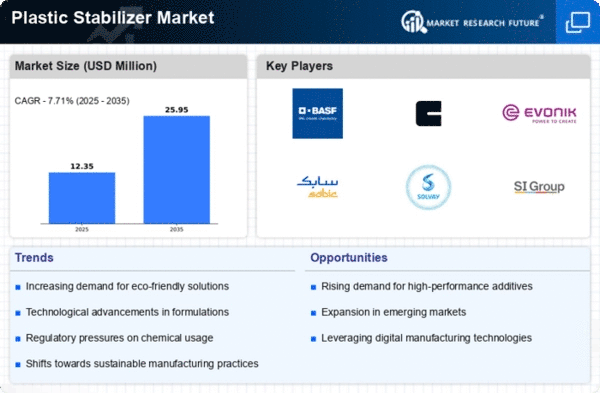
As per MRFR analysis, the Plastic Stabilizer Market Size was estimated at 11.47 USD Million in 2024. The Plastic Stabilizer industry is projected to grow from 12.35 USD Million in 2025 to 25.95 USD Million by 2035, exhibiting a compound annual growth rate (CAGR) of 7.71 during the forecast period 2025 - 2035.

Key Market Trends & Highlights

The Plastic Stabilizer Market is poised for growth driven by sustainability and technological advancements.

  • North America remains the largest market for plastic stabilizers, reflecting robust demand across various industries.
  • Asia-Pacific is emerging as the fastest-growing region, fueled by rapid industrialization and urbanization.
  • Polyvinyl Chloride continues to dominate the market, while Polyurethane is gaining traction as the fastest-growing segment.
  • Rising demand for durable plastics and increased focus on sustainability are key drivers propelling market expansion.

Market Size & Forecast

2024 Market Size 11.47 (USD Million)
2035 Market Size 25.95 (USD Million)
CAGR (2025 - 2035) 7.71%
Largest Regional Market Share in 2024 Asia-Pacific

Major Players

<p>BASF SE (DE), Clariant AG (CH), Evonik Industries AG (DE), SABIC (SA), Solvay SA (BE), Adeka Corporation (JP), Songwon Industrial Co., Ltd. (KR), Chemtura Corporation (US), Kraton Corporation (US)</p>

Market Trends

The Plastic Stabilizer Market is currently experiencing a dynamic evolution, driven by various factors that influence its growth trajectory. The increasing demand for durable and high-performance plastics across multiple industries, including automotive, construction, and packaging, appears to be a primary catalyst. As manufacturers seek to enhance the longevity and stability of their products, the incorporation of advanced stabilizers becomes essential. Furthermore, the growing emphasis on sustainability and eco-friendly materials is prompting a shift towards bio-based stabilizers, which may reshape the competitive landscape of the market. This transition indicates a potential for innovation and adaptation within the industry, as stakeholders strive to meet both regulatory requirements and consumer preferences. In addition, the Plastic Stabilizer Market is likely to witness a surge in research and development activities aimed at creating more efficient and effective stabilizing agents. This focus on innovation could lead to the introduction of novel formulations that offer improved performance characteristics. Moreover, the expansion of emerging economies is expected to contribute to the market's growth, as these regions increasingly adopt plastic materials for various applications. Overall, the Plastic Stabilizer Market seems poised for a transformative phase, characterized by technological advancements and evolving consumer demands.

Sustainability Initiatives

The trend towards sustainability is becoming increasingly prominent within the Plastic Stabilizer Market. Manufacturers are exploring eco-friendly alternatives to traditional stabilizers, which may reduce environmental impact. This shift is likely driven by consumer preferences for greener products and regulatory pressures aimed at minimizing plastic waste.

Technological Advancements

Innovations in polymer chemistry are influencing the development of new stabilizers that enhance the performance of plastics. These advancements could lead to the creation of stabilizers that offer superior thermal and UV resistance, thereby extending the lifespan of plastic products. Such technological progress may redefine industry standards.

Emerging Market Growth

The expansion of emerging markets is expected to play a crucial role in the evolution of the Plastic Stabilizer Market. As industrialization accelerates in these regions, the demand for plastic products is likely to increase, subsequently driving the need for effective stabilizers. This trend may open new avenues for market participants.

Plastic Stabilizer Market Market Drivers

Market Growth Projections

The Global Plastic Stabilizer Market Industry is poised for substantial growth, with projections indicating a market value of 6.33 USD Billion in 2024 and an anticipated increase to 11.5 USD Billion by 2035. This growth trajectory reflects a compound annual growth rate of 5.58% from 2025 to 2035. The expansion is driven by various factors, including rising demand for durable plastics, technological advancements in stabilizer formulations, and increasing regulatory compliance. As industries continue to evolve and prioritize sustainability, the market for plastic stabilizers is expected to flourish, presenting opportunities for innovation and investment.

Growth in End-Use Industries

The expansion of end-use industries such as packaging, electronics, and construction significantly impacts the Global Plastic Stabilizer Market Industry. As these sectors grow, the demand for high-performance plastics that require stabilizers increases correspondingly. For example, the packaging industry is witnessing a surge in the use of flexible and rigid plastics, necessitating effective stabilizers to enhance product performance and shelf life. This growth trajectory is expected to propel the market, with analysts forecasting a valuation of 6.33 USD Billion in 2024. The interplay between industry growth and the need for advanced stabilizers creates a robust environment for market expansion.

Rising Demand for Durable Plastics

The Global Plastic Stabilizer Market Industry experiences a notable increase in demand for durable plastics across various sectors, including automotive, construction, and consumer goods. As industries prioritize longevity and performance, the need for effective stabilizers becomes paramount. For instance, the automotive sector is increasingly utilizing high-performance plastics that require stabilizers to withstand environmental stressors. This trend is projected to contribute to the market's growth, with the industry valued at 6.33 USD Billion in 2024. The emphasis on sustainability and recyclability further drives the demand for advanced stabilizers, which enhance the lifespan of plastic products.

Regulatory Compliance and Environmental Concerns

The Global Plastic Stabilizer Market Industry is increasingly shaped by stringent regulatory frameworks aimed at reducing environmental impact. Governments worldwide are implementing regulations that mandate the use of eco-friendly stabilizers, prompting manufacturers to adapt their formulations accordingly. This shift towards sustainable practices is not only a response to regulatory pressures but also aligns with consumer demand for environmentally responsible products. For instance, the European Union's REACH regulations have led to the development of safer stabilizers that comply with health and safety standards. Consequently, this regulatory landscape is likely to drive innovation and growth within the market.

Technological Advancements in Stabilizer Formulations

Innovations in the formulation of plastic stabilizers significantly influence the Global Plastic Stabilizer Market Industry. The development of new additives and compounds enhances the performance of plastics, making them more resistant to degradation and environmental factors. For example, advancements in UV stabilizers and antioxidants have led to improved durability and color retention in outdoor applications. These technological enhancements not only meet regulatory standards but also cater to consumer preferences for high-quality products. As a result, the market is expected to grow, with projections indicating a rise to 11.5 USD Billion by 2035, reflecting a compound annual growth rate of 5.58% from 2025 to 2035.

Consumer Awareness and Preference for Quality Products

There is a growing consumer awareness regarding the quality and safety of plastic products, which influences the Global Plastic Stabilizer Market Industry. Consumers are increasingly seeking products that not only meet functional requirements but also adhere to safety standards. This trend is prompting manufacturers to invest in high-quality stabilizers that enhance the performance and safety of their products. For instance, the demand for non-toxic and environmentally friendly stabilizers is on the rise, reflecting a shift in consumer preferences. As a result, this heightened awareness is likely to drive market growth, contributing to the projected increase in market value to 11.5 USD Billion by 2035.

Market Segment Insights

By Application: Polyvinyl Chloride (Largest) vs. Polyurethane (Fastest-Growing)

<p>In the Plastic Stabilizer Market, Polyvinyl Chloride (PVC) stands out as the dominant player, capturing the largest share among various applications. This is attributed to PVC's extensive use in construction, automotive, and consumer goods, giving it a significant edge over competitors. Polyethylene, Polypropylene, and Polystyrene also contribute to the market but hold comparatively smaller shares. Their applications in packaging and consumer products solidify their presence but lack the scale of PVC's dominance. The growth trends in the application segment are driven by increasing demand for durable and sustainable plastics. As the construction sector expands and technological innovations elevate the performance of materials, the demand for PVC stabilizers surges. Meanwhile, Polyurethane is emerging rapidly, being favored for its versatility and performance in insulating applications. This trend signifies a shift towards more innovative and adaptive materials within the plastic production landscape.</p>

<p>Polyvinyl Chloride (Dominant) vs. Polyurethane (Emerging)</p>

<p>Polyvinyl Chloride (PVC) is recognized as the dominant segment in the plastic stabilizer market due to its versatility, cost-effectiveness, and superior performance in various applications. It is extensively used in construction materials, electrical cable insulation, and packaging, positioning PVC as a pivotal choice for manufacturers seeking reliability and durability. In contrast, Polyurethane represents an emerging segment characterized by its exceptional flexibility and resilience. Its rapid growth can be attributed to rising applications in foam products and coatings, especially in insulation materials. As industries shift towards efficient energy-saving solutions, Polyurethane's adaptability allows it to meet evolving market needs, making it an attractive option for future investments.</p>

By End Use: Construction (Largest) vs. Automotive (Fastest-Growing)

<p>In the Plastic Stabilizer Market, the end-use segment is primarily dominated by construction, which accounts for a significant portion of the market's share. This is driven by the rising infrastructure developments across various regions, leading to an increased demand for plastic materials in construction applications. Following closely are the automotive and consumer goods sectors, which also contribute notably but with a smaller share compared to construction.</p>

<p>Construction (Dominant) vs. Automotive (Emerging)</p>

<p>The construction sector remains the dominant end-use category for plastic stabilizers, primarily due to its extensive utilization in materials such as pipes, roofing sheets, and insulation materials. The demand in this segment is fueled by urbanization and the necessity for durable building materials. On the other hand, the automotive industry is emerging as a significant player, primarily driven by the increasing production of lightweight vehicles and the incorporation of advanced plastics to improve fuel efficiency. As electric vehicles gain traction, the demand for specific stabilizers tailored for automotive applications is expected to grow rapidly.</p>

By Type: Calcium-Based Stabilizers (Largest) vs. Lead-Based Stabilizers (Fastest-Growing)

<p>The Plastic Stabilizer Market comprises various types, with Calcium-Based Stabilizers taking the lead in market share due to their cost-effectiveness and superior performance in enhancing the stability of plastics. On the other hand, Lead-Based Stabilizers have traditionally dominated this market segment; however, growing regulatory constraints and the shift towards safer alternatives are causing their share to decline while leading to a surge in demand for safer stabilizing agents. As eco-conscious preferences rise and regulations tighten globally, the market is witnessing an increasing inclination towards Calcium-Based Stabilizers, which offer environmental benefits and compliance with new standards. Meanwhile, Lead-Based Stabilizers are being phased out in many regions due to health concerns, thus pushing manufacturers to innovate and seek out new solutions, making them the fastest-growing segment in the push for stabilization alternatives.</p>

<p>Calcium-Based Stabilizers (Dominant) vs. Lead-Based Stabilizers (Emerging)</p>

<p>Calcium-Based Stabilizers are recognized as the dominant force in the Plastic Stabilizer Market, favored for their eco-friendly properties and effectiveness in preventing degradation in plastics. Their growing preference aligns with the global trend towards sustainability, allowing manufacturers to meet compliance requirements while ensuring product stability. In contrast, Lead-Based Stabilizers, while once prevalent due to their efficiency, are now seen as an emerging segment. This shift is driven by increasing regulatory scrutiny and a market pivot towards safer, non-toxic alternatives. As a result, manufacturers are increasingly exploring innovative formulations that can replace lead while still delivering effective stabilization, thus making Lead-Based Stabilizers a critical focus in market evolution.</p>

By Formulation: Liquid Stabilizers (Largest) vs. Powder Stabilizers (Fastest-Growing)

<p>The Plastic Stabilizer Market showcases a diverse formulation segment, with Liquid Stabilizers leading the market due to their versatility and adaptability in various applications. Liquid stabilizers are extensively utilized in processes requiring homogeneous mixing, thus holding a substantial market share. In contrast, Powder Stabilizers, while currently smaller in share, have shown remarkable growth due to the rising demand for more efficient and sustainable plastic formulations. This has made the powder form a preferred option for many manufacturers, enhancing its market presence.</p>

<p>Liquid Stabilizers (Dominant) vs. Powder Stabilizers (Emerging)</p>

<p>Liquid Stabilizers are characterized by their ease of blending and the ability to uniformly distribute across plastic resins, making them the dominant choice in the industry. Their applicability in a wide range of processes, such as injection molding and extrusion, ensures they remain favored among manufacturers. On the other hand, Powder Stabilizers are emerging rapidly, driven by their cost-effectiveness and suitability for high-temperature applications. The rising trend towards eco-friendly products is fostering innovation in powder formulations, enabling manufacturers to meet regulatory demands while enhancing product performance. As sustainability becomes a priority, both segments are set to evolve, with Liquid Stabilizers maintaining dominance due to their established presence and versatility.</p>

By Functionality: Heat Stabilizers (Largest) vs. UV Stabilizers (Fastest-Growing)

<p>In the Plastic Stabilizer Market, heat stabilizers hold the largest market share, primarily due to their widespread application in PVC formulations and the demand from various end-user industries. UV stabilizers, while smaller in terms of market share, have been gaining traction as a result of increasing awareness regarding product longevity under UV exposure. Antioxidants and processing aids also contribute to the segment, yet they remain secondary in terms of overall market size and influence. The growth trends for the functionality segment are being driven by technological advancements and the rising need for durable plastic materials. Innovations in formulation chemistry are enhancing the effectiveness of heat and UV stabilizers, which, in turn, is creating new opportunities in applications like construction and automotive. Moreover, sustainability trends are pushing manufacturers to adopt performance-oriented stabilizers that minimize degradation, further propelling the demand for this segment.</p>

<p>Heat Stabilizers (Dominant) vs. UV Stabilizers (Emerging)</p>

<p>Heat stabilizers are pivotal in the plastic industry, predominantly used in the processing of rigid PVC to maintain performance characteristics during high-temperature applications. Their ability to prevent discoloration and degradation makes them essential across various sectors such as construction, electrical, and automotive. Conversely, UV stabilizers, classified as emerging products, focus on protecting plastics from UV light degradation, thus enhancing the longevity of outdoor applications. As consumers and manufacturers are more inclined toward utilizing materials that exhibit durability against environmental factors, UV stabilizers are witnessing rapid growth. Both segments play crucial roles in ensuring the performance and sustainability of plastic products, driving innovations and market expansions.</p>

Get more detailed insights about Plastic Stabilizer Market Research Report- Forecast to 2035

Regional Insights

North America : Mature Market with Steady Growth

The North American plastic stabilizer market is projected to reach $2.29 billion by 2025, driven by increasing demand in the automotive and construction sectors. Regulatory frameworks promoting sustainable materials are also catalyzing growth, as manufacturers seek eco-friendly alternatives. The region's focus on innovation and technology further enhances market dynamics, with a shift towards high-performance stabilizers that meet stringent environmental standards. Leading countries like the US and Canada dominate the market, supported by key players such as BASF SE and Chemtura Corporation. The competitive landscape is characterized by strategic partnerships and mergers aimed at expanding product portfolios. As companies invest in R&D, the market is expected to witness the introduction of advanced stabilizers that cater to diverse applications, ensuring sustained growth in the coming years.

Europe : Innovation and Sustainability Focus

Europe's plastic stabilizer market is anticipated to reach €3.44 billion by 2025, fueled by stringent regulations and a strong emphasis on sustainability. The European Union's commitment to reducing plastic waste and promoting recycling initiatives is driving demand for innovative stabilizers that enhance the longevity and performance of plastic products. This regulatory environment encourages manufacturers to invest in eco-friendly solutions, aligning with consumer preferences for sustainable materials. Germany, France, and the UK are key players in this market, with companies like Clariant AG and Evonik Industries leading the charge. The competitive landscape is marked by a focus on R&D and collaboration among industry stakeholders to develop advanced stabilizers. As the market evolves, the presence of established players and new entrants will foster innovation, ensuring that Europe remains at the forefront of the plastic stabilizer industry.

Asia-Pacific : Emerging Powerhouse in Stabilizers

The Asia-Pacific region is projected to dominate the plastic stabilizer market, reaching $5.74 billion by 2025. Rapid industrialization, urbanization, and a growing middle class are driving demand across various sectors, including packaging, automotive, and construction. Additionally, government initiatives promoting infrastructure development and manufacturing are acting as catalysts for market growth. The region's focus on adopting advanced technologies further enhances the demand for high-performance stabilizers. China, Japan, and India are leading countries in this market, with significant contributions from key players like SABIC and Adeka Corporation. The competitive landscape is characterized by a mix of established companies and emerging players, fostering innovation and product diversification. As the market matures, the presence of strong local manufacturers will continue to shape the dynamics of the plastic stabilizer industry in Asia-Pacific.

Middle East and Africa : Resource-Rich Frontier for Growth

The Middle East and Africa (MEA) plastic stabilizer market is expected to reach $0.7 billion by 2025, driven by increasing demand in the construction and packaging sectors. The region's rich natural resources and growing industrial base are key growth drivers. Additionally, government initiatives aimed at diversifying economies and enhancing manufacturing capabilities are expected to boost market growth. The rising awareness of environmental sustainability is also influencing demand for eco-friendly stabilizers. Countries like South Africa and the UAE are at the forefront of this market, with a growing presence of key players such as Songwon Industrial Co., Ltd. and Kraton Corporation. The competitive landscape is evolving, with both local and international companies vying for market share. As the region continues to develop, the plastic stabilizer market is poised for significant growth, driven by innovation and investment in sustainable solutions.

Key Players and Competitive Insights

The Plastic Stabilizer Market is currently characterized by a dynamic competitive landscape, driven by increasing demand for high-performance plastics across various industries, including automotive, construction, and packaging. Key players such as BASF SE (Germany), Clariant AG (Switzerland), and Evonik Industries AG (Germany) are strategically positioned to leverage their extensive product portfolios and innovative capabilities. These companies are focusing on enhancing their operational efficiencies through digital transformation and sustainability initiatives, which collectively shape a competitive environment that emphasizes not only product quality but also environmental responsibility.

In terms of business tactics, companies are increasingly localizing manufacturing to reduce lead times and optimize supply chains. The market appears moderately fragmented, with a mix of large multinational corporations and smaller regional players. This structure allows for a diverse range of products and services, but the influence of key players remains significant, as they set industry standards and drive technological advancements.

In November 2025, BASF SE (Germany) announced the launch of a new line of bio-based stabilizers aimed at reducing the environmental impact of plastic production. This strategic move underscores BASF's commitment to sustainability and positions the company as a leader in eco-friendly solutions within the market. The introduction of these products is likely to attract environmentally conscious customers and enhance BASF's competitive edge.

In October 2025, Clariant AG (Switzerland) expanded its partnership with a leading automotive manufacturer to develop advanced stabilizers tailored for electric vehicle applications. This collaboration not only highlights Clariant's focus on innovation but also reflects the growing trend towards electrification in the automotive sector. By aligning its product offerings with industry needs, Clariant is poised to capture a larger share of the market.

In September 2025, Evonik Industries AG (Germany) completed the acquisition of a specialty chemicals firm that specializes in high-performance stabilizers. This acquisition is expected to bolster Evonik's product portfolio and enhance its capabilities in providing customized solutions. The strategic importance of this move lies in Evonik's ability to integrate new technologies and expand its market reach, thereby strengthening its competitive position.

As of December 2025, the Plastic Stabilizer Market is witnessing trends such as digitalization, sustainability, and the integration of AI technologies. Strategic alliances among key players are increasingly shaping the competitive landscape, fostering innovation and collaboration. The shift from price-based competition to a focus on technological advancements and supply chain reliability is evident, suggesting that future differentiation will hinge on the ability to innovate and respond to evolving market demands.

Key Companies in the Plastic Stabilizer Market market include

Industry Developments

    • Owing to the increasing usage of hindered amine light stabilizers (HALS) for the increasing use of energy-efficient plastic mostly in the construction industry, the packaging industry is increasing at a very high pace and hence drives the market during the forecasted period.
    • Owing to the capacity of survival in extreme conditions like heat, humidity, and light the packaged products like food packaged items and bottles are increasing in the global market as it reduces the premature failure during the life of the product because of the presence of various stabilizers.
    • With the growing technology now plastic stabilizers are entering the agriculture sector as well by providing agriculture packaging services which are specifically designed for protection from extreme temperatures, chemicals, and heat, and owing to this advantage it is commonly used in mulches, tunnels, and irrigation system.
    • Owing the increasing demand in the United States for the retail market leads to growth of the packaging industry during the forecasted period.
    • Owing to the highly effective and cost-efficient, PVC flooring is trending for about 50 years and used in various private and public sectors like schools, hotels, and other commercial places as it is durable.

December 15, 2021 – Reagens and Evans Chemetics, a wholly owned subsidiary of Bruno Bock, have reached the final agreement under which Reagens USA is acquiring Evans Chemetics’ Thioester Business comprising the Evanstab® family of secondary antioxidants products.

Future Outlook

Plastic Stabilizer Market Future Outlook

<p>The Plastic Stabilizer Market is projected to grow at a 7.71% CAGR from 2024 to 2035, driven by increasing demand for durable plastics and regulatory standards.</p>

New opportunities lie in:

  • <p>Development of bio-based stabilizers for eco-friendly applications.</p>
  • <p>Expansion into emerging markets with tailored product offerings.</p>
  • <p>Investment in advanced manufacturing technologies to enhance production efficiency.</p>

<p>By 2035, the market is expected to achieve robust growth, positioning itself as a leader in sustainable plastic solutions.</p>

Market Segmentation

Plastic Stabilizer Market Type Outlook

  • Calcium-Based Stabilizers
  • Lead-Based Stabilizers
  • Tin-Based Stabilizers
  • Barium-Based Stabilizers
  • Zinc-Based Stabilizers

Plastic Stabilizer Market End Use Outlook

  • Construction
  • Automotive
  • Consumer Goods
  • Electrical and Electronics
  • Packaging

Plastic Stabilizer Market Application Outlook

  • Polyvinyl Chloride
  • Polyethylene
  • Polypropylene
  • Polystyrene
  • Polyurethane

Plastic Stabilizer Market Formulation Outlook

  • Liquid Stabilizers
  • Powder Stabilizers
  • Granular Stabilizers
  • Masterbatch Stabilizers

Plastic Stabilizer Market Functionality Outlook

  • Heat Stabilizers
  • UV Stabilizers
  • Antioxidants
  • Processing Aids

Report Scope

MARKET SIZE 202411.47(USD Million)
MARKET SIZE 202512.35(USD Million)
MARKET SIZE 203525.95(USD Million)
COMPOUND ANNUAL GROWTH RATE (CAGR)7.71% (2024 - 2035)
REPORT COVERAGERevenue Forecast, Competitive Landscape, Growth Factors, and Trends
BASE YEAR2024
Market Forecast Period2025 - 2035
Historical Data2019 - 2024
Market Forecast UnitsUSD Million
Key Companies ProfiledBASF SE (DE), Clariant AG (CH), Evonik Industries AG (DE), SABIC (SA), Solvay SA (BE), Adeka Corporation (JP), Songwon Industrial Co., Ltd. (KR), Chemtura Corporation (US), Kraton Corporation (US)
Segments CoveredApplication, End Use, Type, Formulation, Functionality
Key Market OpportunitiesGrowing demand for eco-friendly additives in the Plastic Stabilizer Market presents significant opportunities.
Key Market DynamicsRising demand for eco-friendly plastic stabilizers drives innovation and regulatory compliance in the industry.
Countries CoveredNorth America, Europe, APAC, South America, MEA

FAQs

At what CAGR is the Plastic Stabilizer Market predicted to grow during the forecast period?

Plastic Stabilizer Market is predicted to grow at 4.5% through forecast period of 2025-2035.

What is the forecast period of Plastic Stabilizer Market research report?

The forecast period for Plastic Stabilizer Market research report is 2025-2035.

Who are the key players in the Plastic Stabilizer Market?

The prominent players operating in the Plastic Stabilizer Market include BASF SE (Germany),Songwon Industrial Co., Ltd. (South Korea),Clariant AG (Switzerland),Akzo Nobel N.V. (The Netherlands), Evonik Industries AG (Germany),ADEKA CORPORATION (Japan),Solvay SA (Belgium),INDOFIL INDUSTRIES LIMITED (India),Bruggemann Group (Germany),Baerlocher GmbH (Germany)

  1. Report Prologue
  2. Market Introduction
    1. Market Definition
    2. Scope of the Study 16
      1. Research Objectives 16
      2. Limitations 17
    3. Assumptions 16
    4. Markets Structure 17
    5. Research Methodology
    6. Research Process 18
    7. Primary Research 19
    8. Secondary Research 19
    9. Market Size Estimation 19
    10. Forecast
    11. Model 21
  3. Market Dynamics
    1. Introduction 22
    2. Drivers 24
      1. Growing demand of plastics in automotive industry to replace conventional
      2. Huge consumption of plastics in day-to-day life 25
    3. material 24
    4. Rising demand of plastics in Asia Pacific 25
    5. Restraints 26
      1. Untapped opportunities in packaging and automotive industry
    6. Stringent government regulation to phase out the lead-based stabilizer 26
    7. Opportunity 27
    8. Trends 28
      1. Key players in this market are focusing on R
      2. Changes
      3. Plastic stabilizer
      4. Distribution Channel 30
      5. End-Use Industry
    9. & D for increasing application scope for plastic stabilizer 28
    10. in global economies with new market demand 28 5 Market Factor Analysis 5.1 Supply
    11. Chain Analysis 29 5.1.1 Raw Material Suppliers 29
    12. Manufacturers 30
    1. Porter’s 5 force Analysis 30
      1. Threat of New
      2. Threat of Rivalry 31
      3. Threat of Substitute 31
      4. Bargaining Power of Supplier 31
      5. Bargaining Power of Buyer
    2. Entrants 30
  4. Global Plastic Stabilizer Market, By Type
    1. Introduction 32
    2. Heat stabilizer 34
    3. Antioxidant 36
    4. Light stabilizer 38
    5. Others 40
  5. Global Plastic Stabilizer Markets, By Material
    1. Introduction 42
    2. Thermoplastic 44
    3. Thermosetting 45
    4. Elastomers 46
  6. Global Plastic Stabilizer Markets, By End Use Industry
    1. Introduction 47
    2. Packaging 50
    3. Building & Construction
    4. Automotive 52
    5. Consumer Goods 53
    6. Electricals &
    7. Electronics 54
    8. Agriculture 55
    9. Others 56
  7. Global Plastic
  8. Stabilizer Market, By Region
    1. Introduction 57
    2. North America 59
      1. U.S 63
      2. Mexico 66
      3. Canada 69
    3. Europe
      1. Germany 76
      2. U.K 79
      3. Spain 82
      4. Italy
      5. France 88
      6. Rest of Europe 91
    4. Asia Pacific 95
      1. China 99
      2. Japan 102
      3. India 105
      4. South
    5. Korea
  9. 9.4.5 Australia & New Zealand 111
    1. East & Africa 131
    2. Argentina 141
  10. Indonesia 114
  11. Rest of Asia Pacific 117
    1. Middle East & Africa 121
      1. South Africa 125
      2. Saudi Arabia 128
      3. Rest of Middle
    2. South America 134
      1. Brazil 138
      2. Rest of South America 144
  12. Competitive Landscape
    1. Introduction 148
    2. Market Share Analysis 149
  13. Company
    1. Profiles
    2. BASF SE 150
      1. Business Overview 150
      2. Financial Update 151
    3. Product/Business Segment Overview 150
    4. Key Developments
  14. 11.2 Songwon Industrial Co., Ltd. 152
    1. Overview 152
    2. Update 153
    3. Business Overview 154
    4. Financial Update 155
    5. Product/Business Segment Overview 158
    6. Key Developments 159
  15. Business
  16. Product/Business Segment Overview 152
  17. Financial
  18. Key Developments 153
    1. Clariant AG 154
      1. Product/Business Segment Overview 154
      2. Key Developments 155
    2. Akzo Nobel N.V
      1. Business Overview 156
      2. Product/Business Segment Overview
      3. Financial Update 157
      4. Key Developments 157  
    3. Evonik Industries AG 158
      1. Business Overview 158
      2. Financial Update 159
    4. Adeka Corporation 160
      1. Business Overview
      2. Product/Business Segment Overview 160
      3. Financial Update
      4. Key Developments 161
    5. Solvay SA 162
      1. Overview
      2. Product/Business Segment Overview 162
      3. Financial Updates
  19. 11.7.4 Key Developments
  20. 11.8 Indofil Industries Limited
  21. 11.8.1 Business Overview 164
    1. Bruggemann Group 166
    2. Segment Overview 166
  22. Product/Business Segment Overview
  23. Financial Updates 164
  24. Key Developments 165
  25. Business Overview 166
  26. Product/Business
  27. Financial Updates 166
  28. Key Developments
    1. Baerlocher GmbH 167
      1. Business Overview
  29. 11.10.2
    1. Product/Business Segment Overview 167
    2. Key Developments 167
  30. Financial Updates 167
  31. Conclusion
  32. List of Tables TABLE 1 MARKET
    1. DRIVERS: IMPACT ANALYSIS
  33. TABLE 2 RESTRAINT: IMPACT ANALYSIS
  34. TABLE
  35. OPPORTUNITY: IMPACT ANALYSIS
  36. TABLE 4 TRENDS: IMPACT ANALYSIS
  37. GLOBAL PLASTIC STABILIZER MARKET, BY TYPE, (2015-2023) (USD MILLION)
  38. TABLE 6 GLOBAL PLASTIC STABILIZER MARKET, BY TYPE, (2015-2023) (KILOTONS)
  39. TABLE 7 GLOBAL HEAT STABILIZER MARKET FOR PLASTIC STABILIZER MARKET, BY REGION,
    1. (2015-2023) (USD MILLION)
  40. TABLE 8 GLOBAL HEAT STABILIZER MARKET FOR PLASTIC
  41. STABILIZER MARKET, BY REGION, (2015-2023) (KILOTONS)
  42. TABLE 9 GLOBAL ANTIOXIDANT
  43. MARKET FOR PLASTIC STABILIZER MARKET, BY REGION, (2015-2023) (USD MILLION)
  44. GLOBAL ANTIOXIDANT MARKET FOR PLASTIC STABILIZER MARKET, BY REGION, (2015-2023)
    1. (KILOTONS)
  45. TABLE 11 GLOBAL LIGHT STABILIZER MARKET FOR PLASTIC STABILIZER
  46. MARKET, BY REGION, (2015-2023) (USD MILLION)
  47. TABLE 12 GLOBAL LIGHT STABILIZER
  48. MARKET FOR PLASTIC STABILIZER MARKET, BY REGION, (2015-2023) (KILOTONS)
  49. GLOBAL OTHERS PLASTIC STABILIZER MARKET FOR PLASTIC STABILIZER MARKET,
    1. BY REGION, (2015-2023) (USD MILLION) 40 TABLE 14 GLOBAL OTHERS PLASTIC STABILIZER
  50. MARKET FOR PLASTIC STABILIZER MARKET, BY REGION, (2015-2023) (KILOTONS) 41 TABLE
  51. GLOBAL PLASTIC STABILIZER MARKET, BY MATERIAL, (2015-2023) (USD MILLION)
  52. TABLE 16 GLOBAL PLASTIC STABILIZER MARKET, BY MATERIAL, (2015-2023) (KILOTONS)
  53. TABLE 17 GLOBAL THERMOPLASTIC MARKET FOR PLASTIC STABILIZER MARKET, BY REGION,
    1. (2015-2023) (USD MILLION)
  54. TABLE 18 GLOBAL THERMOPLASTIC MARKET FOR PLASTIC
  55. STABILIZER MARKET, BY REGION, (2015-2023) (KILOTONS) 44 TABLE 19 GLOBAL THERMOSETTING
  56. MARKET FOR PLASTIC STABILIZER MARKET, BY REGION, (2015-2023) (USD MILLION)
  57. GLOBAL THERMOSETTING MARKET FOR PLASTIC STABILIZER MARKET, BY REGION, (2015-2023)
    1. (KILOTONS)
  58. TABLE 21 GLOBAL ELASTOMERS MARKET FOR PLASTIC STABILIZER MARKET,
    1. BY REGION, (2015-2023) (USD MILLION)
  59. TABLE 22 GLOBAL ELASTOMERS MARKET
  60. FOR PLASTIC STABILIZER MARKET, BY REGION, (2015-2023) (KILOTONS)
  61. TABLE
  62. GLOBAL PLASTIC STABILIZER MARKET, BY END-USE INDUSTRY, (2015-2023) (USD MILLION)
  63. TABLE 24 GLOBAL PLASTIC STABILIZER MARKET, BY END-USE INDUSTRY, (2015-2023)
    1. (KILOTONS)
  64. TABLE 25 GLOBAL PACKAGING MARKET FOR PLASTIC STABILIZER MARKET,
    1. BY REGION, (2015-2023) (USD MILLION)
  65. TABLE
  66. GLOBAL PACKAGING MARKET
  67. FOR PLASTIC STABILIZER MARKET, BY REGION, (2015-2023) (KILOTONS)
  68. TABLE
  69. GLOBAL BUILDING & CONSTRUCTION MARKET FOR PLASTIC STABILIZER MARKET, BY REGION,
    1. (2015-2023) (USD MILLION) 51   TABLE
  70. GLOBAL BUILDING & CONSTRUCTION
  71. MARKET FOR PLASTIC STABILIZER MARKET, BY REGION, (2015-2023) (KILOTONS)
    1. TABLE
  72. GLOBAL AUTOMOTIVE MARKET FOR PLASTIC STABILIZER MARKET, BY REGION,
    1. (2015-2023) (USD MILLION)
  73. TABLE
  74. GLOBAL AUTOMOTIVE MARKET FOR PLASTIC
  75. STABILIZER MARKET, BY REGION, (2015-2023) (KILOTONS)
  76. TABLE 31 GLOBAL CONSUMER
  77. GOODS MARKET FOR PLASTIC STABILIZER MARKET, BY REGION, (2015-2023) (USD MILLION)
  78. TABLE 32 GLOBAL CONSUMER GOODS MARKET FOR PLASTIC STABILIZER MARKET, BY
    1. REGION, (2015-2023) (KILOTONS)
  79. GLOBAL ELECTRICALS & ELECTRONICS MARKET
  80. FOR PLASTIC STABILIZER MARKET, BY REGION, (2015-2023) (USD MILLION)
  81. TABLE
  82. GLOBAL ELECTRICALS & ELECTRONICS MARKET FOR PLASTIC STABILIZER MARKET, BY
    1. REGION, (2015-2023) (KILOTONS)
  83. TABLE 35 GLOBAL AGRICULTURE MARKET FOR PLASTIC
  84. STABILIZER MARKET, BY REGION, (2015-2023) (USD MILLION) 55 TABLE 36 GLOBAL AGRICULTURE
  85. MARKET FOR PLASTIC STABILIZER MARKET, BY REGION, (2015-2023) (KILOTONS) 55 TABLE
  86. GLOBAL OTHERS MARKET FOR PLASTIC STABILIZER MARKET, BY REGION, (2015-2023) (USD
  87. MILLION) 56 TABLE 38 GLOBAL OTHERS MARKET FOR PLASTIC STABILIZER MARKET, BY REGION,
  88. (2015-2023) (KILOTONS) 56 TABLE 39 GLOBAL PLASTIC STABILIZER MARKET, BY REGION,
  89. (2015-2023) (USD MILLION) 58 TABLE 40 GLOBAL PLASTIC STABILIZER MARKET, BY REGION,
  90. (2015-2023) (KILOTONS) 58 TABLE 41 NORTH AMERICA PLASTIC STABILIZER MARKET, BY REGION,
    1. (2015-2023) (USD MILLION)
  91. TABLE 42 NORTH AMERICA PLASTIC STABILIZER MARKET,
    1. BY REGION, (2015-2023) (KILOTONS)
  92. TABLE 43 NORTH AMERICA PLASTIC STABILIZER
  93. MARKET, BY TYPE, (2015-2023) (USD MILLION)
  94. TABLE 44 NORTH AMERICA PLASTIC
  95. STABILIZER MARKET, BY TYPE, (2015-2023) (KILOTONS)
  96. TABLE 45 NORTH AMERICA
  97. PLASTIC STABILIZER MARKET, BY MATERIAL, (2015-2023) (USD MILLION)
  98. TABLE
  99. NORTH AMERICA PLASTIC STABILIZER MARKET, BY MATERIAL, (2015-2023) (KILOTONS)
  100. TABLE 47 NORTH AMERICA PLASTIC STABILIZER MARKET, BY END-USE INDUSTRY,
    1. (2015-2023) (USD MILLION)
  101. TABLE 48 NORTH AMERICA PLASTIC STABILIZER MARKET,
    1. BY END-USE INDUSTRY, (2015-2023) (KILOTONS)
  102. TABLE 49 U.S PLASTIC STABILIZER
  103. MARKET, BY TYPE, (2015-2023) (USD MILLION)
  104. TABLE 50 U.S PLASTIC STABILIZER
  105. MARKET, BY TYPE, (2015-2023) (KILOTONS)
  106. TABLE 51 U.S PLASTIC STABILIZER
  107. MARKET, BY MATERIAL, (2015-2023) (USD MILLION) 64 TABLE 52 U.S PLASTIC STABILIZER
  108. MARKET, BY MATERIAL, (2015-2023) (KILOTONS) 64 TABLE 53 U.S PLASTIC STABILIZER MARKET,
    1. BY END-USE INDUSTRY, (2015-2023) (USD MILLION) 65 TABLE 54 U.S PLASTIC STABILIZER
  109. MARKET, BY END-USE INDUSTRY, (2015-2023) (KILOTONS) 65 TABLE 55 MEXICO PLASTIC STABILIZER
  110. MARKET, BY TYPE, (2015-2023) (USD MILLION)
  111. TABLE 56 MEXICO PLASTIC STABILIZER
  112. MARKET, BY TYPE, (2015-2023) (KILOTONS)
  113. TABLE 57 MEXICO PLASTIC STABILIZER
  114. MARKET, BY MATERIAL, (2015-2023) (USD MILLION)
  115. TABLE 58 MEXICO PLASTIC
  116. STABILIZER MARKET, BY MATERIAL, (2015-2023) (KILOTONS)
  117. TABLE 59 MEXICO
  118. PLASTIC STABILIZER MARKET, BY END-USE INDUSTRY, (2015-2023) (USD MILLION)
  119. MEXICO PLASTIC STABILIZER MARKET, BY END-USE INDUSTRY, (2015-2023) (KILOTONS)
  120. TABLE 61 CANADA PLASTIC STABILIZER MARKET, BY TYPE, (2015-2023) (USD MILLION)
  121.   TABLE 62 CANADA PLASTIC STABILIZER MARKET, BY TYPE, (2015-2023)
    1. (KILOTONS)
  122. TABLE 63 CANADA PLASTIC STABILIZER MARKET, BY MATERIAL, (2015-2023)
    1. (USD MILLION)
  123. TABLE 64 CANADA PLASTIC STABILIZER MARKET, BY MATERIAL, (2015-2023)
    1. (KILOTONS)
  124. TABLE 65 CANADA PLASTIC STABILIZER MARKET, BY END-USE INDUSTRY,
    1. (2015-2023) (USD MILLION)
  125. TABLE 66 CANADA PLASTIC STABILIZER MARKET, BY
    1. END-USE INDUSTRY, (2015-2023) (KILOTONS)
  126. TABLE
  127. EUROPE PLASTIC
  128. STABILIZER MARKET, BY REGION, (2015-2023) (USD MILLION)
  129. TABLE 68 EUROPE
  130. PLASTIC STABILIZER MARKET, BY REGION, (2015-2023) (KILOTONS)
  131. TABLE 69 EUROPE
  132. PLASTIC STABILIZER MARKET, BY TYPE, (2015-2023) (USD MILLION)
  133. TABLE 70
  134. EUROPE PLASTIC STABILIZER MARKET, BY TYPE, (2015-2023) (KILOTONS)
  135. TABLE
  136. EUROPE PLASTIC STABILIZER MARKET, BY MATERIAL, (2015-2023) (USD MILLION)
  137. TABLE 72 EUROPE PLASTIC STABILIZER MARKET, BY MATERIAL, (2015-2023) (KILOTONS)
  138. TABLE 73 EUROPE PLASTIC STABILIZER MARKET, BY END-USE INDUSTRY, (2015-2023)
    1. (USD MILLION)
  139. TABLE 74 EUROPE PLASTIC STABILIZER MARKET, BY END-USE INDUSTRY,
  140. (2015-2023) (KILOTONS) 76 TABLE 75 GERMANY PLASTIC STABILIZER MARKET, BY TYPE, (2015-2023)
    1. (USD MILLION)
  141. TABLE 76 GERMANY PLASTIC STABILIZER MARKET, BY TYPE, (2015-2023)
    1. (KILOTONS)
  142. TABLE 77 GERMANY PLASTIC STABILIZER MARKET, BY MATERIAL, (2015-2023)
    1. (USD MILLION)
  143. TABLE 78 GERMANY PLASTIC STABILIZER MARKET, BY MATERIAL,
    1. (2015-2023) (KILOTONS) 78 TABLE
  144. GERMANY PLASTIC STABILIZER MARKET, BY END-USE
    1. INDUSTRY, (2015-2023) (USD MILLION)
  145. TABLE 80 GERMANY PLASTIC STABILIZER
  146. MARKET, BY END-USE INDUSTRY, (2015-2023) (KILOTONS)
  147. TABLE 81 U.K PLASTIC
  148. STABILIZER MARKET, BY TYPE, (2015-2023) (USD MILLION)
  149. TABLE 82 U.K PLASTIC
  150. STABILIZER MARKET, BY TYPE, (2015-2023) (KILOTONS) 80 TABLE 83 U.K PLASTIC STABILIZER
  151. MARKET, BY MATERIAL, (2015-2023) (USD MILLION)
  152. TABLE 84 U.K PLASTIC STABILIZER
  153. MARKET, BY MATERIAL, (2015-2023) (KILOTONS)
  154. TABLE 85 U.K PLASTIC STABILIZER
  155. MARKET, BY END-USE INDUSTRY, (2015-2023) (USD MILLION) 81 TABLE 86 U.K PLASTIC STABILIZER
  156. MARKET, BY END-USE INDUSTRY, (2015-2023) (KILOTONS)
  157. TABLE 87 SPAIN PLASTIC
  158. STABILIZER MARKET, BY TYPE, (2015-2023) (USD MILLION)
  159. TABLE 88 SPAIN PLASTIC
  160. STABILIZER MARKET, BY TYPE, (2015-2023) (KILOTONS)
  161. TABLE 89 SPAIN PLASTIC
  162. STABILIZER MARKET, BY MATERIAL, (2015-2023) (USD MILLION)
  163. TABLE 90 SPAIN
  164. PLASTIC STABILIZER MARKET, BY MATERIAL, (2015-2023) (KILOTONS)
  165. TABLE 91
  166. SPAIN PLASTIC STABILIZER MARKET, BY END-USE INDUSTRY, (2015-2023) (USD MILLION)
  167. TABLE 92 SPAIN PLASTIC STABILIZER MARKET, BY END-USE INDUSTRY, (2015-2023)
    1. (KILOTONS)
  168. TABLE 93 ITALY PLASTIC STABILIZER MARKET, BY TYPE, (2015-2023)
    1. (USD MILLION)
  169. TABLE 94 ITALY PLASTIC STABILIZER MARKET, BY TYPE, (2015-2023)
    1. (KILOTONS)
  170. TABLE 95 ITALY PLASTIC STABILIZER MARKET, BY MATERIAL, (2015-2023)
    1. (USD MILLION)
  171. TABLE 96 ITALY PLASTIC STABILIZER MARKET, BY MATERIAL, (2015-2023)
    1. (KILOTONS)
  172. TABLE 97 ITALY PLASTIC STABILIZER MARKET, BY END-USE INDUSTRY,
    1. (2015-2023) (USD MILLION)
  173. TABLE 98 ITALY PLASTIC STABILIZER MARKET, BY
    1. END-USE INDUSTRY, (2015-2023) (KILOTONS)
  174. TABLE 99 FRANCE PLASTIC STABILIZER
  175. MARKET, BY TYPE, (2015-2023) (USD MILLION)
  176. TABLE 100 FRANCE PLASTIC STABILIZER
  177. MARKET, BY TYPE, (2015-2023) (KILOTONS)
  178. TABLE 101 FRANCE PLASTIC STABILIZER
  179. MARKET, BY MATERIAL, (2015-2023) (USD MILLION)
  180. TABLE 102 FRANCE PLASTIC
  181. STABILIZER MARKET, BY MATERIAL, (2015-2023) (KILOTONS)
  182. TABLE 103 FRANCE
  183. PLASTIC STABILIZER MARKET, BY END-USE INDUSTRY, (2015-2023) (USD MILLION)
  184. FRANCE PLASTIC STABILIZER MARKET, BY END-USE INDUSTRY, (2015-2023) (KILOTONS)
  185. TABLE 105 REST OF EUROPE PLASTIC STABILIZER MARKET, BY TYPE, (2015-2023)
    1. (USD MILLION)
  186. TABLE 106 REST OF EUROPE PLASTIC STABILIZER MARKET, BY TYPE,
    1. (2015-2023) (KILOTONS)
  187. TABLE 107 REST OF EUROPE PLASTIC STABILIZER MARKET,
    1. BY MATERIAL, (2015-2023) (USD MILLION)
  188. TABLE 108 REST OF EUROPE PLASTIC
  189. STABILIZER MARKET, BY MATERIAL, (2015-2023) (KILOTONS)
  190. TABLE 109 REST OF
  191. EUROPE PLASTIC STABILIZER MARKET, BY END-USE INDUSTRY, (2015-2023) (USD MILLION)
  192. TABLE 110 REST OF EUROPE PLASTIC STABILIZER MARKET, BY END-USE INDUSTRY,
    1. (2015-2023) (KILOTONS)
  193. TABLE 111 ASIA PACIFIC PLASTIC STABILIZER MARKET,
    1. BY REGION, (2015-2023) (USD MILLION)
  194. TABLE 112 ASIA PACIFIC PLASTIC STABILIZER
  195. MARKET, BY REGION, (2015-2023) (KILOTONS)
  196. TABLE 113 ASIA PACIFIC PLASTIC
  197. STABILIZER MARKET, BY TYPE, (2015-2023) (USD MILLION)
  198. TABLE 114 ASIA PACIFIC
  199. PLASTIC STABILIZER MARKET, BY TYPE, (2015-2023) (KILOTONS)
  200. TABLE 115 ASIA
  201. PACIFIC PLASTIC STABILIZER MARKET, BY MATERIAL, (2015-2023) (USD MILLION)
  202. ASIA PACIFIC PLASTIC STABILIZER MARKET, BY MATERIAL, (2015-2023) (KILOTONS)
  203. TABLE 117 ASIA PACIFIC PLASTIC STABILIZER MARKET, BY END-USE INDUSTRY,
    1. (2015-2023) (USD MILLION)
  204. TABLE 118 ASIA PACIFIC PLASTIC STABILIZER MARKET,
    1. BY END-USE INDUSTRY, (2015-2023) (KILOTONS)
  205. TABLE 119 CHINA PLASTIC STABILIZER
  206. MARKET, BY TYPE, (2015-2023) (USD MILLION)
  207. TABLE 120 CHINA PLASTIC STABILIZER
  208. MARKET, BY TYPE, (2015-2023) (KILOTONS)
  209. TABLE 121 CHINA PLASTIC STABILIZER
  210. MARKET, BY MATERIAL, (2015-2023) (USD MILLION)
  211. TABLE 122 CHINA PLASTIC
  212. STABILIZER MARKET, BY MATERIAL, (2015-2023) (KILOTONS)
  213. TABLE 123 CHINA
  214. PLASTIC STABILIZER MARKET, BY END-USE INDUSTRY, (2015-2023) (USD MILLION)
  215. CHINA PLASTIC STABILIZER MARKET, BY END-USE INDUSTRY, (2015-2023) (KILOTONS)
  216. TABLE 125 JAPAN PLASTIC STABILIZER MARKET, BY TYPE, (2015-2023) (USD MILLION)
  217. TABLE 126 JAPAN PLASTIC STABILIZER MARKET, BY TYPE, (2015-2023) (KILOTONS)
  218. TABLE 127 JAPAN PLASTIC STABILIZER MARKET, BY MATERIAL, (2015-2023) (USD
    1. MILLION)
  219. TABLE 128 JAPAN PLASTIC STABILIZER MARKET, BY MATERIAL, (2015-2023)
    1. (KILOTONS)
  220. TABLE 129 JAPAN PLASTIC STABILIZER MARKET, BY END-USE INDUSTRY,
    1. (2015-2023) (USD MILLION)
  221. TABLE 130 JAPAN PLASTIC STABILIZER MARKET, BY
    1. END-USE INDUSTRY, (2015-2023) (KILOTONS)
  222. TABLE 131 INDIA PLASTIC STABILIZER
  223. MARKET, BY TYPE, (2015-2023) (USD MILLION)
  224. TABLE 132 INDIA PLASTIC STABILIZER
  225. MARKET, BY TYPE, (2015-2023) (KILOTONS)
  226. TABLE 133 INDIA PLASTIC STABILIZER
  227. MARKET, BY MATERIAL, (2015-2023) (USD MILLION)
  228. TABLE 134 INDIA PLASTIC
  229. STABILIZER MARKET, BY MATERIAL, (2015-2023) (KILOTONS)
  230. TABLE 135 INDIA
  231. PLASTIC STABILIZER MARKET, BY END-USE INDUSTRY, (2015-2023) (USD MILLION)
  232. INDIA PLASTIC STABILIZER MARKET, BY END-USE INDUSTRY, (2015-2023) (KILOTONS)
  233. TABLE 137 SOUTH KOREA PLASTIC STABILIZER MARKET, BY TYPE, (2015-2023)
    1. (USD MILLION)
  234. TABLE 138 SOUTH KOREA PLASTIC STABILIZER MARKET, BY TYPE,
    1. (2015-2023) (KILOTONS)
  235. TABLE 139 SOUTH KOREA PLASTIC STABILIZER MARKET,
    1. BY MATERIAL, (2015-2023) (USD MILLION)
  236.   TABLE 140 SOUTH KOREA PLASTIC
  237. STABILIZER MARKET, BY MATERIAL, (2015-2023) (KILOTONS)
  238. TABLE 141 SOUTH
  239. KOREA PLASTIC STABILIZER MARKET, BY END-USE INDUSTRY, (2015-2023) (USD MILLION)
  240. TABLE 142 SOUTH KOREA PLASTIC STABILIZER MARKET, BY END-USE INDUSTRY,
    1. (2015-2023) (KILOTONS)
  241. TABLE 143 AUSTRALIA & NEW ZEALAND PLASTIC STABILIZER
  242. MARKET, BY TYPE, (2015-2023) (USD MILLION)
  243. TABLE 144 AUSTRALIA & NEW
  244. ZEALAND PLASTIC STABILIZER MARKET, BY TYPE, (2015-2023) (KILOTONS)
  245. TABLE
  246. AUSTRALIA & NEW ZEALAND PLASTIC STABILIZER MARKET, BY MATERIAL, (2015-2023)
    1. (USD MILLION)
  247. TABLE 146 AUSTRALIA & NEW ZEALAND PLASTIC STABILIZER
  248. MARKET, BY MATERIAL, (2015-2023) (KILOTONS)
  249. TABLE 147 AUSTRALIA &
  250. NEW ZEALAND PLASTIC STABILIZER MARKET, BY END-USE INDUSTRY, (2015-2023) (USD MILLION)
  251. TABLE 148 AUSTRALIA & NEW ZEALAND PLASTIC STABILIZER MARKET, BY END-USE
    1. INDUSTRY, (2015-2023) (KILOTONS)
  252. TABLE 149 INDONESIA PLASTIC STABILIZER
  253. MARKET, BY TYPE, (2015-2023) (USD MILLION)
  254. TABLE 150 INDONESIA PLASTIC
  255. STABILIZER MARKET, BY TYPE, (2015-2023) (KILOTONS)
  256. TABLE 151 INDONESIA
  257. PLASTIC STABILIZER MARKET, BY MATERIAL, (2015-2023) (USD MILLION)
  258. TABLE
  259. INDONESIA PLASTIC STABILIZER MARKET, BY MATERIAL, (2015-2023) (KILOTONS)
  260. TABLE 153 INDONESIA PLASTIC STABILIZER MARKET, BY END-USE INDUSTRY, (2015-2023)
    1. (USD MILLION)
  261. TABLE 154 INDONESIA PLASTIC STABILIZER MARKET, BY END-USE
    1. INDUSTRY, (2015-2023) (KILOTONS)
  262. TABLE 155 REST OF ASIA PACIFIC PLASTIC
  263. STABILIZER MARKET, BY TYPE, (2015-2023) (USD MILLION)
  264. TABLE 156 REST OF
  265. ASIA PACIFIC PLASTIC STABILIZER MARKET, BY TYPE, (2015-2023) (KILOTONS)
  266. REST OF ASIA PACIFIC PLASTIC STABILIZER MARKET, BY MATERIAL, (2015-2023)
    1. (USD MILLION)
  267. TABLE 158 REST OF ASIA PACIFIC PLASTIC STABILIZER MARKET,
    1. BY MATERIAL, (2015-2023) (KILOTONS)
  268. TABLE 159 REST OF ASIA PACIFIC PLASTIC
  269. STABILIZER MARKET, BY END-USE INDUSTRY, (2015-2023) (USD MILLION)
  270. TABLE
  271. REST OF ASIA PACIFIC PLASTIC STABILIZER MARKET, BY END-USE INDUSTRY, (2015-2023)
    1. (KILOTONS)
  272. TABLE 161 MIDDLE EAST & AFRICA PLASTIC STABILIZER MARKET,
    1. BY REGION, (2015-2023) (USD MILLION) 121 TABLE
  273. MIDDLE EAST & AFRICA
  274. PLASTIC STABILIZER MARKET, BY REGION, (2015-2023) (KILOTONS) 121 TABLE
  275. MIDDLE EAST & AFRICA PLASTIC STABILIZER MARKET, BY TYPE, (2015-2023) (USD MILLION)
  276. TABLE
  277. MIDDLE EAST & AFRICA PLASTIC STABILIZER MARKET, BY TYPE,
    1. (2015-2023) (KILOTONS) 122 TABLE
  278. MIDDLE EAST & AFRICA PLASTIC STABILIZER
  279. MARKET, BY MATERIAL, (2015-2023) (USD MILLION) 123 TABLE
  280. MIDDLE EAST &
  281. AFRICA PLASTIC STABILIZER MARKET, BY MATERIAL, (2015-2023) (KILOTONS) 123 TABLE
  282. MIDDLE EAST & AFRICA PLASTIC STABILIZER MARKET, BY END-USE INDUSTRY,
    1. (2015-2023) (USD MILLION) 124 TABLE
  283. MIDDLE EAST & AFRICA PLASTIC STABILIZER
  284. MARKET, BY END-USE INDUSTRY, (2015-2023) (KILOTONS) 124 TABLE
  285. SOUTH AFRICA
  286. PLASTIC STABILIZER MARKET, BY TYPE, (2015-2023) (USD MILLION) 125 TABLE
  287. SOUTH AFRICA PLASTIC STABILIZER MARKET, BY TYPE, (2015-2023) (KILOTONS) 125 TABLE
  288. SOUTH AFRICA PLASTIC STABILIZER MARKET, BY MATERIAL, (2015-2023) (USD
    1. MILLION) 126 TABLE
  289. SOUTH AFRICA PLASTIC STABILIZER MARKET, BY MATERIAL,
    1. (2015-2023) (KILOTONS) 126 TABLE
  290. SOUTH AFRICA PLASTIC STABILIZER MARKET,
    1. BY END-USE INDUSTRY, (2015-2023) (USD MILLION) 127 TABLE
  291. SOUTH AFRICA
  292. PLASTIC STABILIZER MARKET, BY END-USE INDUSTRY, (2015-2023) (KILOTONS) 127 TABLE
  293. SAUDI ARABIA PLASTIC STABILIZER MARKET, BY TYPE, (2015-2023) (USD MILLION)
  294. TABLE
  295. SAUDI ARABIAPLASTIC STABILIZER MARKET, BY TYPE, (2015-2023) (KILOTONS)
  296. TABLE
  297. SAUDI ARABIA PLASTIC STABILIZER MARKET, BY MATERIAL, (2015-2023)
    1. (USD MILLION) 129   TABLE
  298. SAUDI ARABIA PLASTIC STABILIZER MARKET,
    1. BY MATERIAL, (2015-2023) (KILOTONS) 129 TABLE
  299. SAUDI ARABIA PLASTIC STABILIZER
  300. MARKET, BY END-USE INDUSTRY, (2015-2023) (USD MILLION) 130 TABLE
  301. SAUDI
  302. ARABIA PLASTIC STABILIZER MARKET, BY END-USE INDUSTRY, (2015-2023) (KILOTONS) 130
  303. REST OF MIDDLE EAST & AFRICA PLASTIC STABILIZER MARKET, BY TYPE, (2015-2023)
    1. (USD MILLION) 131 TABLE
  304. REST OF MIDDLE EAST & AFRICA PLASTIC STABILIZER
  305. MARKET, BY TYPE, (2015-2023) (KILOTONS) 131 TABLE
  306. REST OF MIDDLE EAST
  307. & AFRICA PLASTIC STABILIZER MARKET, BY MATERIAL, (2015-2023) (USD MILLION) 132
    1. TABLE
  308. REST OF MIDDLE EAST & AFRICA PLASTIC STABILIZER MARKET, BY MATERIAL,
    1. (2015-2023) (KILOTONS) 132 TABLE
  309. REST OF MIDDLE EAST & AFRICA PLASTIC
  310. STABILIZER MARKET, BY END-USE INDUSTRY, (2015-2023) (USD MILLION) 133 TABLE
  311. REST OF MIDDLE EAST & AFRICA PLASTIC STABILIZER MARKET, BY END-USE INDUSTRY,
    1. (2015-2023) (KILOTONS) 133 TABLE
  312. SOUTH AMERICA PLASTIC STABILIZER MARKET,
    1. BY REGION, (2015-2023) (USD MILLION) 134 TABLE 188 SOUTH AMERICA PLASTIC STABILIZER
  313. MARKET, BY REGION, (2015-2023) (KILOTONS) 134 TABLE
  314. SOUTH AMERICA PLASTIC
  315. STABILIZER MARKET, BY TYPE, (2015-2023) (USD MILLION) 135 TABLE
  316. SOUTH
  317. AMERICA PLASTIC STABILIZER MARKET, BY TYPE, (2015-2023) (KILOTONS) 135 TABLE
  318. SOUTH AMERICA PLASTIC STABILIZER MARKET, BY MATERIAL, (2015-2023) (USD MILLION)
  319. TABLE
  320. SOUTH AMERICA PLASTIC STABILIZER MARKET, BY MATERIAL, (2015-2023)
    1. (KILOTONS) 136 TABLE
  321. SOUTH AMERICA PLASTIC STABILIZER MARKET, BY END-USE
    1. INDUSTRY, (2015-2023) (USD MILLION) 137 TABLE
  322. SOUTH AMERICA PLASTIC STABILIZER
  323. MARKET, BY END-USE INDUSTRY, (2015-2023) (KILOTONS) 137 TABLE
  324. BRAZIL PLASTIC
  325. STABILIZER MARKET, BY TYPE, (2015-2023) (USD MILLION) 138 TABLE
  326. BRAZIL
  327. PLASTIC STABILIZER MARKET, BY TYPE, (2015-2023) (KILOTONS) 138 TABLE
  328. BRAZIL
  329. PLASTIC STABILIZER MARKET, BY MATERIAL, (2015-2023) (USD MILLION) 139 TABLE
  330. BRAZIL PLASTIC STABILIZER MARKET, BY MATERIAL, (2015-2023) (KILOTONS) 139
    1. TABLE
  331. BRAZIL PLASTIC STABILIZER MARKET, BY END-USE INDUSTRY, (2015-2023)
    1. (USD MILLION)
  332. TABLE 200 BRAZIL PLASTIC STABILIZER MARKET, BY END-USE INDUSTRY,
    1. (2015-2023) (KILOTONS)
  333. TABLE 201 ARGENTINA PLASTIC STABILIZER MARKET,
    1. BY TYPE, (2015-2023) (USD MILLION) 141 TABLE 202 ARGENTINA PLASTIC STABILIZER MARKET,
    2. BY TYPE, (2015-2023) (KILOTONS)
  334. TABLE 203 ARGENTINA PLASTIC STABILIZER
  335. MARKET, BY MATERIAL, (2015-2023) (USD MILLION)
  336. TABLE 204 ARGENTINA PLASTIC
  337. STABILIZER MARKET, BY MATERIAL, (2015-2023) (KILOTONS)
  338. TABLE 205 ARGENTINA
  339. PLASTIC STABILIZER MARKET, BY END-USE INDUSTRY, (2015-2023) (USD MILLION)
  340. ARGENTINA PLASTIC STABILIZER MARKET, BY END-USE INDUSTRY, (2015-2023)
    1. (KILOTONS)
  341. TABLE 207 REST OF SOUTH AMERICA PLASTIC STABILIZER MARKET,
    1. BY TYPE, (2015-2023) (USD MILLION)
  342. TABLE 208 REST OF SOUTH AMERICA PLASTIC
  343. STABILIZER MARKET, BY TYPE, (2015-2023) (KILOTONS)
  344. TABLE 209 REST OF SOUTH
  345. AMERICA PLASTIC STABILIZER MARKET, BY MATERIAL, (2015-2023) (USD MILLION)
  346. REST OF SOUTH AMERICA PLASTIC STABILIZER MARKET, BY MATERIAL, (2015-2023)
    1. (KILOTONS)
  347. TABLE 211 REST OF SOUTH AMERICA PLASTIC STABILIZER MARKET,
    1. BY END-USE INDUSTRY, (2015-2023) (USD MILLION)
  348. TABLE 212 REST OF SOUTH
  349. AMERICA PLASTIC STABILIZER MARKET, BY END-USE INDUSTRY, (2015-2023) (KILOTONS)
  350. TABLE 213 BASF SE: SEGMENT OVERVIEW
  351. TABLE 214 SONGWON INDUSTRIAL
    1. CO., LTD.: SEGMENT OVERVIEW
  352.   TABLE 215 CLARIANT AG: SEGMENT OVERVIEW
  353. TABLE 216 AKZO NOBEL NV, LTD: SEGMENT OVERVIEW
  354. TABLE 217 EVONIK
    1. INDUSTRIES AG: SEGMENT OVERVIEW
  355. TABLE 218 ADEKA CORPORATION: SEGMENT OVERVIEW
  356. TABLE 219 SOLVAY SA: SEGMENT OVERVIEW
  357. TABLE 220 INDOFIL INDUSTRIES
    1. LIMITED: SEGMENT OVERVIEW
  358. TABLE 221 BRUGGEMANN GROUP: SEGMENT OVERVIEW
  359. TABLE 222 BAERLOCHER GMBH: SEGMENT OVERVIEW
  360.   14 List of
    1. Figures FIGURE 1 TOP DOWN & BOTTOM UP APPROACH
  361. FIGURE 2 FORECAST MODEL
  362. FIGURE 3 DRIVERS, RESTRAINTS, OPPORTUNITIES, AND TRENDS OF GLOBAL PLASTIC
  363. STABILIZER MARKET
  364. FIGURE 4 SUPPLY CHAIN DIAGRAM
  365. FIGURE 5 GLOBAL
  366. PLASTIC STABILIZER MARKET SHARE, BY TYPE, 2016-2023 (USD MILLION)
  367. FIGURE
  368. GLOBAL PLASTIC STABILIZER MARKET VOLUME, BY TYPE, 2016-2023 (KILOTONS)
  369. GLOBAL PLASTIC STABILIZER MARKET, BY MATERIAL, 2016-2023 (USD MILLION)
  370. FIGURE 8 GLOBAL PLASTIC STABILIZER MARKET, BY END-USE INDUSTRY, 2016-2023
    1. (KILOTONS)
  371. FIGURE 9 GLOBAL PLASTIC STABILIZER MARKET, BY END-USE INDUSTRY,
  372. FIGURE 10 GLOBAL PLASTIC STABILIZER MARKET, BY
    1. END-USE INDUSTRY, 2016-2023 (KILOTONS)
  373. FIGURE 11 GLOBAL PLASTIC STABILIZER
  374. MARKET SHARE, BY REGION, 2016 (%)
  375. FIGURE 12 BASF SE:RECENT FINANCIALS
  376. FIGURE 13 SONGWON INDUSTRIAL CO., LTD.: RECENT FINANCIALS
  377. FIGURE
  378. CLARIANT AG: FINANCIAL UPDATES
  379. FIGURE 15 AKZO NOBEL NV, LTD: FINANCIAL
    1. UPDATES
  380. FIGURE 16 EVONIK INDUSTRIES AG: RECENT FINANCIALS
  381. FIGURE
  382. ADEKA CORPORATION: FINANCIAL UPDATES
  383. FIGURE 18 GLOBAL PLASTIC STABILIZER
    1. MARKET SHARE AND CAGR % (2017-2023)

Plastic Stabilizer Market Segmentation

Market Segmentation Overview

  • Detailed segmentation data will be available in the full report
  • Comprehensive analysis by multiple parameters
  • Regional and country-level breakdowns
  • Market size forecasts by segment
Infographic

Free Sample Request

Kindly complete the form below to receive a free sample of this Report

Get Free Sample

Customer Strories

Compare Licence

×
Features License Type
Single User Multiuser License Enterprise User
Price $4,950 $5,950 $7,250
Maximum User Access Limit 1 User Upto 10 Users Unrestricted Access Throughout the Organization
Free Customization
Direct Access to Analyst
Deliverable Format
Platform Access
Discount on Next Purchase 10% 15% 15%
Printable Versions