×
Hero Background
English
Chinese
French
Japanese
Korean
German
Spanish

Prestressed Steel Wire Strands Market Trends

ID: MRFR/CnM/9472-CR
110 Pages
Anshula Mandaokar
October 2022

Prestressed Steel Wire And Strands Market Research Report Information By Product (Wire, Strand) Coating Type (Uncoated, Galvanized, Epoxy Coated, HDPE Coated, Others) Application (Railroad Industry, Construction Equipment, Bridges & Flyovers, Energy, Others) Forecast 2030

Share:
Download PDF ×

We do not share your information with anyone. However, we may send you emails based on your report interest from time to time. You may contact us at any time to opt-out.

Prestressed Steel Wire Strands Market Infographic
Purchase Options

Market Trends

Key Emerging Trends in the Prestressed Steel Wire Strands Market

The global issue of global warming is wreaking havoc on the environment, making it imperative to adopt measures that can effectively mitigate its impact. One highly effective strategy in this regard is enhancing energy efficiency in the construction sector. By reducing the consumption of natural resources, land, raw materials, and energy in the construction of buildings, a substantial decrease in greenhouse gas (GHG) emissions can be achieved. This approach aligns with the broader goal of creating structures that are not only high-performing but also environmentally friendly. Among the materials contributing to this cause is prestressing steel strand coated with epoxy, recognized for its cost-effectiveness and time-saving attributes in concrete projects.

The significance of energy efficiency is underscored by the achievements of programs such as the Energy Star Programme. In 2020, approximately 6,500 commercial buildings earned the ENERGY STAR label, resulting in savings of USD 1.6 billion and the prevention of more than 5 million metric tons of GHG emissions. ENERGY STAR certified buildings, on average, consume 35% less energy compared to typical buildings nationwide. Over 800 companies have partnered with the EPA's Energy Star program, representing a diverse range of industrial sectors, including food industries, bakeries, steel mills, petroleum refineries, and pharmaceutical plants. Notably, studies reveal that Energy Star certified buildings command a premium of up to 16% for both sales and rental rates.

The impact of energy-efficient construction practices is not limited to developed nations. In India, where buildings account for over 30% of electricity consumption, there is a growing realization of the importance of adopting energy-efficient measures. Moreover, considering that two-thirds of the buildings that will exist in India by 2030 are yet to be constructed, the opportunity to incorporate energy-efficient technologies is substantial. The rapid pace of urbanization in recent years has led to a significant expansion of urban building floor area, thereby increasing the demand for prestressing steel.

The demand for prestressing steel wire and strands is expected to surge in the coming decades, driven by the ongoing trend of urbanization and the pressing need to address energy security and GHG emissions. The construction industry's reliance on prestressing steel underscores its role not only in ensuring structural integrity but also in contributing to sustainable and environmentally conscious building practices. As the world grapples with the challenges posed by climate change, the adoption of energy-efficient construction materials like prestressing steel emerges as a crucial step toward creating a more sustainable and resilient future. By embracing these technologies, the construction industry can play a pivotal role in mitigating the environmental impact of global warming and fostering a more sustainable built environment for future generations.

Author
Anshula Mandaokar
Team Lead - Research

Anshula Mandaokar holds an academic degree in Chemical Engineering and has been contributing to the field for more than 5 years. She has expertise in Market Research and Business Consulting and serves as a Team Lead for a reputed Market Research firm under the Chemicals and Materials domain spectrum. She has worked on multiple projects, generating explicit results in a quick turnaround time. Her understanding of data interpretation justifies her role as a leader.

Leave a Comment

FAQs

What growth rate global prestressed steel wire and strands market would register in the future?

The global prestressed steel wire and strands market would register a growth of 4.79%.

Which industry will play a crucial role in taking the prestressed steel wire and strands market ahead?

Construction Equipment, will play a crucial role in taking the prestressed steel wire and strands market ahead

What is the key restraining factor for the global prestressed steel wire and strands market?

Fluctuating prices of raw materials and related regulations.

Which Asia-Pacific country would set the trend in the prestressed steel wire and strands market?

Yes, North America country would set the trend in the prestressed steel wire and strands market

Market Summary

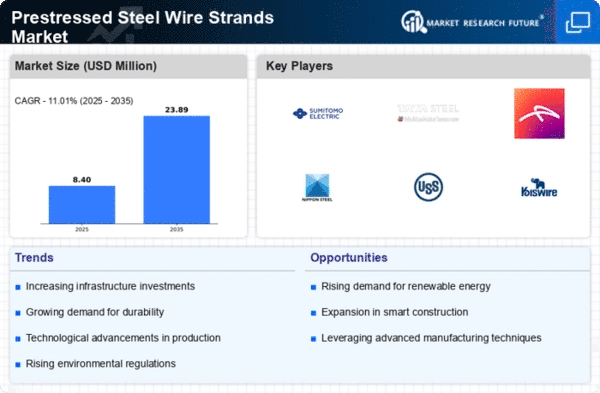
As per MRFR analysis, the Prestressed Steel Wire Strands Market Size was estimated at 7.57 USD Million in 2024. The Prestressed Steel Wire Strands industry is projected to grow from 8.41 in 2025 to 23.89 by 2035, exhibiting a compound annual growth rate (CAGR) of 11.01 during the forecast period 2025 - 2035.

Key Market Trends & Highlights

The Prestressed Steel Wire Strands Market is poised for growth driven by sustainability and infrastructure demands.

  • North America remains the largest market for prestressed steel wire strands, driven by robust construction activities.
  • Asia-Pacific is emerging as the fastest-growing region, fueled by rapid urbanization and infrastructure development.
  • The construction segment dominates the market, while the infrastructure segment is witnessing the highest growth rates.
  • Key market drivers include significant infrastructure investment and a growing demand for high-performance materials.

Market Size & Forecast

2024 Market Size 7.57 (USD Million)
2035 Market Size 23.89 (USD Million)
CAGR (2025 - 2035) 11.01%
Largest Regional Market Share in 2024 Asia-Pacific

Major Players

<p>Sumitomo Metal Industries (JP), Tata Steel (IN), ArcelorMittal (LU), Nippon Steel Corporation (JP), U.S. Steel (US), Kiswire Ltd. (KR), Saarstahl AG (DE), Bekaert (BE), Jiangsu Shagang Group (CN)</p>

Market Trends

The Prestressed Steel Wire Strands Market is currently experiencing a notable evolution, driven by various factors that influence construction and infrastructure development. The demand for high-strength materials in civil engineering applications appears to be on the rise, as stakeholders seek to enhance the durability and longevity of structures. This trend is likely fueled by the increasing focus on sustainability and efficiency in construction practices. Furthermore, advancements in manufacturing technologies may contribute to improved product quality and performance, thereby attracting a broader customer base. In addition, The Prestressed Steel Wire Strands. Governments and private entities are investing in large-scale projects, which could lead to heightened demand for prestressed steel solutions. As urbanization continues to accelerate, the need for robust and reliable construction materials becomes increasingly critical. Overall, the market appears poised for growth, with various dynamics shaping its trajectory in the coming years.

Sustainability Initiatives

The emphasis on sustainable construction practices is gaining traction within the Prestressed Steel Wire Strands Market. Stakeholders are increasingly prioritizing eco-friendly materials and processes, which may lead to a shift in product offerings and manufacturing techniques.

Technological Advancements

Innovations in production methods are likely to enhance the quality and performance of prestressed steel wire strands. These advancements could result in more efficient manufacturing processes, potentially lowering costs and improving product reliability.

Infrastructure Development

The ongoing global focus on infrastructure development appears to drive demand for prestressed steel wire strands. As nations invest in upgrading and expanding their infrastructure, the need for durable and high-performance materials is expected to rise.

Prestressed Steel Wire Strands Market Market Drivers

Market Growth Projections

The Global Prestressed Steel Wire And Strands Market Industry is poised for substantial growth, with projections indicating a market size of 3.88 USD Billion in 2024 and an anticipated increase to 6.47 USD Billion by 2035. This growth trajectory, characterized by a CAGR of 4.75% from 2025 to 2035, underscores the increasing reliance on prestressed materials in construction and infrastructure projects. The market dynamics reflect a convergence of factors, including technological advancements, regulatory support, and rising demand across various sectors, suggesting a robust future for prestressed steel wire and strands.

Global Urbanization Trends

The ongoing trend of urbanization is a significant factor propelling the Global Prestressed Steel Wire And Strands Market Industry. As populations migrate towards urban areas, the demand for housing, transportation, and public facilities escalates. Prestressed steel wire and strands are essential in meeting these demands due to their strength and versatility. The increasing urban population necessitates the construction of high-rise buildings and expansive infrastructure projects, thereby driving the market forward. This trend is expected to contribute to the projected growth of the market, aligning with the broader global economic development objectives.

Infrastructure Development

The Global Prestressed Steel Wire And Strands Market Industry is experiencing a surge in demand driven by extensive infrastructure development projects worldwide. Governments are increasingly investing in transportation networks, bridges, and high-rise buildings, which require robust materials like prestressed steel wire and strands. For instance, the global market is projected to reach 3.88 USD Billion in 2024, reflecting the rising need for durable construction materials. This trend is likely to continue as urbanization accelerates, particularly in emerging economies, where infrastructure projects are pivotal for economic growth. The emphasis on sustainable construction practices further enhances the relevance of prestressed steel solutions.

Technological Advancements

Technological innovations in the manufacturing processes of prestressed steel wire and strands are significantly influencing the Global Prestressed Steel Wire And Strands Market Industry. Enhanced production techniques, including advanced heat treatment and surface coating methods, improve the performance and longevity of these materials. Such advancements not only increase the efficiency of production but also reduce costs, making prestressed steel solutions more accessible to a broader range of applications. As a result, the market is expected to grow at a CAGR of 4.75% from 2025 to 2035, indicating a strong future trajectory driven by ongoing technological improvements.

Rising Demand in Construction Sector

The construction sector's robust growth is a primary driver for the Global Prestressed Steel Wire And Strands Market Industry. With the increasing number of residential and commercial projects, the demand for high-strength materials is on the rise. Prestressed steel wire and strands are favored for their ability to enhance structural integrity and reduce material usage. As the market evolves, it is anticipated to expand to 6.47 USD Billion by 2035, reflecting the sustained interest in innovative construction solutions. This growth is further fueled by the global push for energy-efficient buildings, where prestressed materials play a crucial role in achieving sustainability goals.

Regulatory Support for Infrastructure Projects

Government policies and regulations that support infrastructure development are pivotal for the Global Prestressed Steel Wire And Strands Market Industry. Many countries are implementing frameworks that prioritize the construction of resilient infrastructure, which inherently requires high-quality materials like prestressed steel. For example, initiatives aimed at enhancing transportation systems and public utilities create a favorable environment for the adoption of prestressed solutions. This regulatory backing not only stimulates market growth but also encourages investments in research and development, ensuring that the industry remains competitive and innovative in meeting future demands.

Market Segment Insights

By Application: Construction (Largest) vs. Infrastructure (Fastest-Growing)

<p>The Prestressed Steel Wire Strands Market is primarily segmented into Construction, Infrastructure, Mining, and Transportation applications. Among these, the Construction sector holds the largest market share due to the prevalent use of prestressed steel wire strands in various structures, including buildings and bridges. Infrastructure is gaining traction as a significant application owing to increased government spending and urbanization efforts that necessitate robust support systems for public works, enhancing safety and longevity of structures.</p>

<p>Construction (Dominant) vs. Infrastructure (Emerging)</p>

<p>In the Prestressed Steel Wire Strands Market, the Construction application is the dominant segment, primarily used in creating reinforced structures such as high-rise buildings, highways, and bridges, where durability and load-bearing capacity are critical. This segment benefits from comprehensive regulations mandating high safety standards, driving steady demand. Conversely, the Infrastructure application represents an emerging segment fueled by rapid urbanization and increased investment in public infrastructure projects. This influx highlights the strategic significance of prestressed steel wire strands in ensuring structural integrity throughout large-scale projects, leading to heightened growth potential as governments continue prioritizing infrastructure development.</p>

By End Use: Residential (Largest) vs. Industrial (Fastest-Growing)

<p>In the Prestressed Steel Wire Strands Market, the end-use segment is prominently divided into Residential, Commercial, and Industrial categories. The Residential segment holds the largest market share, fueled by the continuous demand for housing and infrastructure projects that require robust construction materials. Meanwhile, the Commercial segment is witnessing stable growth due to increasing investments in commercial real estate, while the Industrial segment, though smaller in share, is rapidly expanding driven by advancements in technology and manufacturing processes.</p>

<p>Residential (Dominant) vs. Industrial (Emerging)</p>

<p>The Residential segment is characterized by its essential role in providing the necessary strength and durability to construction projects such as homes, apartments, and community buildings. Its dominance in the market stems from an ongoing emphasis on safety and longevity in residential construction, which advocates for the use of high-performance materials like prestressed steel wire strands. On the other hand, the Industrial segment is emerging due to the growing application of these materials in infrastructure projects, such as bridges and tunnels, coupled with the rising trend of industrial automation. This segment's rapid growth is supported by technological innovations and sustainability initiatives, appealing to sectors looking for efficient and environmentally friendly solutions.</p>

By Material Type: High Carbon Steel (Largest) vs. Low Carbon Steel (Fastest-Growing)

<p>In the Prestressed Steel Wire Strands Market, High Carbon Steel holds the largest share due to its superior tensile strength and adaptability in various applications. This material is favored in construction and infrastructure projects, where durability and reliability are paramount. Conversely, Low Carbon Steel is gaining traction as a cost-effective alternative, appealing to budget-sensitive projects, and is projected to increase its market presence rapidly. The growth trend for Low Carbon Steel is primarily driven by its application in emerging markets and sectors that demand affordable yet effective construction solutions. Innovations in manufacturing processes are further enhancing the quality of Low Carbon Steel strands, making them increasingly attractive compared to traditional high carbon variants. This duality of stability from High Carbon Steel and the versatility of Low Carbon Steel illustrates the dynamic nature of the material type segment.</p>

<p>High Carbon Steel (Dominant) vs. Stainless Steel (Emerging)</p>

<p>High Carbon Steel remains the dominant player in the Prestressed Steel Wire Strands Market, recognized for its high yield strength and performance in high-stress environments. It has established a strong market position due to its extensive use in major infrastructure projects, ensuring structural integrity and longevity. On the other hand, Stainless Steel is an emerging material in this segment, gaining attention for its resistance to corrosion and aesthetic appeal, making it a suitable choice for architectural applications. While still a smaller segment, advancements in production technology and increased awareness of long-term cost savings associated with corrosion resistance are propelling its adoption. This comparative analysis highlights the established strength of High Carbon Steel against the rising significance of Stainless Steel as market demand evolves.</p>

By Manufacturing Process: Hot Rolling (Largest) vs. Cold Drawing (Fastest-Growing)

<p>In the Prestressed Steel Wire Strands Market, the manufacturing process segment is primarily dominated by Hot Rolling, which holds the largest share among its counterparts. This method is widely used due to its efficiency in producing high-strength wires suitable for various applications, particularly in construction and infrastructure. Cold Drawing follows, capturing a significant market share as well, attributed to its ability to produce finer, higher-diameter wires that cater to specialized applications.</p>

<p>Manufacturing Process: Hot Rolling (Dominant) vs. Cold Drawing (Emerging)</p>

<p>Hot Rolling is a dominant manufacturing process in the Prestressed Steel Wire Strands Market, recognized for its high production rates and effectiveness in achieving desired mechanical properties in steel strands. This process is particularly suitable for producing large volumes of wire with consistent quality, making it the preferred choice for many manufacturers. On the other hand, Cold Drawing is emerging as a critical process due to its capability to produce wires with increased strength and improved surface finish. Emerging as the fastest-growing segment, Cold Drawing is increasingly favored for applications that require precise dimensions and enhanced mechanical characteristics, thus driving innovation in product offerings.</p>

By Product Type: Uncoated Wire Strands (Largest) vs. Coated Wire Strands (Fastest-Growing)

<p>In the Prestressed Steel Wire Strands Market, the Uncoated Wire Strands segment holds the largest market share due to their extensive usage in various construction projects. These strands are favored for their superior tensile strength and ability to withstand significant stress, making them ideal for bridges, high-rise buildings, and other infrastructure. On the other hand, the Coated Wire Strands segment is emerging rapidly, driven by increasing demand for corrosion-resistant materials in harsh environments, highlighting its potential for market expansion.</p>

<p>Uncoated Wire Strands (Dominant) vs. Coated Wire Strands (Emerging)</p>

<p>Uncoated Wire Strands are recognized for their prevalent application in the construction and civil engineering sectors, primarily due to their mechanical properties and adaptability in diverse applications. They are often preferred in situations requiring high reliability and performance. In contrast, Coated Wire Strands are gaining traction as a viable alternative due to their enhanced durability and resistance to environmental factors such as moisture and chemicals. This shift towards coated variants reflects a growing trend where stakeholders prioritize longevity and maintenance reduction in their projects, positioning coated strands as a strong competitor in the market.</p>

Get more detailed insights about Prestressed Steel Wire And Strands Market Research Report—Global Forecast till 2035

Regional Insights

North America : Established Market with Growth Potential

The North American prestressed steel wire strands market is projected to reach $1.52 billion by 2025, driven by increasing infrastructure projects and a growing demand for high-strength materials. Regulatory support for construction standards and sustainability initiatives further catalyze market growth. The region's focus on modernizing transportation and utility infrastructure is expected to enhance demand for prestressed steel wire strands, contributing to a robust market outlook. Leading countries in this region include the U.S. and Canada, where major players like U.S. Steel and Tata Steel are actively involved. The competitive landscape is characterized by a mix of established companies and emerging players, all vying for market share. The presence of advanced manufacturing facilities and a skilled workforce positions North America as a key player in the global market for prestressed steel wire strands.

Europe : Innovative Solutions and Sustainability

Europe's prestressed steel wire strands market is anticipated to reach $1.9 billion by 2025, fueled by stringent regulations promoting sustainable construction practices and innovative engineering solutions. The region's commitment to reducing carbon emissions and enhancing infrastructure resilience drives demand for high-quality prestressed steel products. Additionally, the increasing focus on renewable energy projects is expected to further boost market growth in the coming years. Germany, France, and the UK are leading countries in this market, with key players like ArcelorMittal and Bekaert dominating the landscape. The competitive environment is marked by a strong emphasis on research and development, enabling companies to introduce advanced products that meet evolving market needs. The presence of established manufacturers and a growing number of startups enhances the region's competitive edge in the global market.

Asia-Pacific : Dominant Market with High Demand

The Asia-Pacific region is projected to dominate the prestressed steel wire strands market, reaching $3.8 billion by 2025. This growth is driven by rapid urbanization, increasing infrastructure investments, and a rising demand for high-strength materials in construction. Countries like China and India are at the forefront, with government initiatives aimed at enhancing infrastructure development and promoting sustainable construction practices, further propelling market growth. China is the largest market, supported by major players like Jiangsu Shagang Group and Nippon Steel Corporation. The competitive landscape is characterized by a mix of domestic and international companies, all striving to capture market share. The region's focus on innovation and technology adoption in manufacturing processes positions it as a leader in The Prestressed Steel Wire Strands, catering to both domestic and export demands.

Middle East and Africa : Emerging Market with Growth Opportunities

The Middle East and Africa's prestressed steel wire strands market is expected to reach $0.35 billion by 2025, driven by increasing construction activities and infrastructure development projects. The region's growing population and urbanization trends are significant factors contributing to the rising demand for prestressed steel products. Additionally, government initiatives aimed at enhancing infrastructure are expected to further stimulate market growth in the coming years. Leading countries in this region include the UAE and South Africa, where key players are beginning to establish a foothold. The competitive landscape is evolving, with both local and international companies entering the market to capitalize on growth opportunities. As the region continues to invest in infrastructure, the demand for prestressed steel wire strands is likely to increase, positioning it as a promising market for future investments.

Key Players and Competitive Insights

The Prestressed Steel Wire Strands Market is characterized by a competitive landscape that is increasingly shaped by innovation, strategic partnerships, and regional expansions. Key players such as Sumitomo Metal Industries (Japan), Tata Steel (India), and Bekaert (Belgium) are actively pursuing strategies that enhance their market positioning. For instance, Sumitomo Metal Industries (Japan) has focused on technological advancements in manufacturing processes, which not only improve product quality but also reduce production costs. Meanwhile, Tata Steel (India) has been expanding its footprint in emerging markets, leveraging its strong brand reputation to capture new customer segments. Bekaert (Belgium) appears to be concentrating on sustainability initiatives, aligning its operations with global environmental standards, which is becoming increasingly vital in the current market dynamics.

The market structure is moderately fragmented, with a mix of established players and emerging companies vying for market share. Key business tactics such as localizing manufacturing and optimizing supply chains are prevalent among these companies. This approach not only enhances operational efficiency but also allows for better responsiveness to regional market demands. The collective influence of these major players contributes to a competitive environment where innovation and strategic positioning are paramount.

In November 2025, Nippon Steel Corporation (Japan) announced a strategic partnership with a leading construction firm to develop advanced prestressed concrete solutions. This collaboration is expected to enhance Nippon Steel's product offerings and expand its market reach, particularly in infrastructure projects. The strategic importance of this partnership lies in its potential to leverage both companies' strengths, thereby creating a more robust product portfolio that meets the evolving needs of the construction industry.

In October 2025, ArcelorMittal (Luxembourg) launched a new line of eco-friendly prestressed steel wire strands, which are produced using a lower carbon footprint process. This initiative not only aligns with global sustainability trends but also positions ArcelorMittal as a leader in environmentally responsible manufacturing. The introduction of these products is likely to attract environmentally conscious clients and enhance the company's competitive edge in the market.

In September 2025, U.S. Steel (United States) completed a significant investment in its manufacturing facilities to incorporate advanced automation technologies. This move is anticipated to increase production efficiency and reduce operational costs, allowing U.S. Steel to offer competitive pricing while maintaining high-quality standards. The strategic importance of this investment is underscored by the growing demand for efficiency in manufacturing processes, which is critical for sustaining profitability in a competitive market.

As of December 2025, the competitive trends in the Prestressed Steel Wire Strands Market are increasingly defined by digitalization, sustainability, and the integration of advanced technologies such as AI. Strategic alliances are playing a crucial role in shaping the current landscape, enabling companies to pool resources and expertise. Looking ahead, competitive differentiation is likely to evolve from traditional price-based competition to a focus on innovation, technological advancements, and supply chain reliability. This shift underscores the importance of adaptability and forward-thinking strategies in navigating the complexities of the market.

Key Companies in the Prestressed Steel Wire Strands Market market include

Industry Developments

Future Outlook

Prestressed Steel Wire Strands Market Future Outlook

<p>The Prestressed Steel Wire Strands Market is projected to grow at 11.01% CAGR from 2024 to 2035, driven by infrastructure development, urbanization, and technological advancements.</p>

New opportunities lie in:

  • <p>Expansion into renewable energy sector projects</p>
  • <p>Development of high-performance, corrosion-resistant strands</p>
  • <p>Implementation of automated manufacturing processes for efficiency</p>

<p>By 2035, the market is poised for robust growth, reflecting increased demand and innovation.</p>

Market Segmentation

Prestressed Steel Wire Strands Market End Use Outlook

  • Residential
  • Commercial
  • Industrial

Prestressed Steel Wire Strands Market Application Outlook

  • Construction
  • Infrastructure
  • Mining
  • Transportation

Prestressed Steel Wire Strands Market Product Type Outlook

  • Uncoated Wire Strands
  • Coated Wire Strands
  • Galvanized Wire Strands

Prestressed Steel Wire Strands Market Material Type Outlook

  • High Carbon Steel
  • Low Carbon Steel
  • Stainless Steel

Prestressed Steel Wire Strands Market Manufacturing Process Outlook

  • Hot Rolling
  • Cold Drawing
  • Wire Drawing

Report Scope

MARKET SIZE 20247.57(USD Million)
MARKET SIZE 20258.41(USD Million)
MARKET SIZE 203523.89(USD Million)
COMPOUND ANNUAL GROWTH RATE (CAGR)11.01% (2024 - 2035)
REPORT COVERAGERevenue Forecast, Competitive Landscape, Growth Factors, and Trends
BASE YEAR2024
Market Forecast Period2025 - 2035
Historical Data2019 - 2024
Market Forecast UnitsUSD Million
Key Companies ProfiledSumitomo Metal Industries (JP), Tata Steel (IN), ArcelorMittal (LU), Nippon Steel Corporation (JP), U.S. Steel (US), Kiswire Ltd. (KR), Saarstahl AG (DE), Bekaert (BE), Jiangsu Shagang Group (CN)
Segments CoveredApplication, End Use, Material Type, Manufacturing Process, Product Type
Key Market OpportunitiesGrowing demand for sustainable construction materials drives innovation in the Prestressed Steel Wire Strands Market.
Key Market DynamicsRising demand for durable construction materials drives innovation and competition in the Prestressed Steel Wire Strands market.
Countries CoveredNorth America, Europe, APAC, South America, MEA

FAQs

What growth rate global prestressed steel wire and strands market would register in the future?

The global prestressed steel wire and strands market would register a growth of 4.79%.

Which industry will play a crucial role in taking the prestressed steel wire and strands market ahead?

Construction Equipment, will play a crucial role in taking the prestressed steel wire and strands market ahead

What is the key restraining factor for the global prestressed steel wire and strands market?

Fluctuating prices of raw materials and related regulations.

Which Asia-Pacific country would set the trend in the prestressed steel wire and strands market?

Yes, North America country would set the trend in the prestressed steel wire and strands market

  1. EXECUTIVE SUMMARY 22
    1. MARKET ATTRACTIVENESS
    2. ANALYSIS 24
  2. GLOBAL PRESTRESSED STEEL WIRE AND STRANDS MARKET, BY PRODUCT 25
  3. GLOBAL PRESTRESSED STEEL
  4. WIRE AND STRANDS MARKET, BY COATING TYPE 26
    1. BY APPLICATION 27
  5. GLOBAL PRESTRESSED STEEL WIRE AND STRANDS MARKET,
  6. GLOBAL PRESTRESSED STEEL WIRE AND STRANDS MARKET, BY REGION 28
  7. MARKET INTRODUCTION 29
    1. DEFINITION 29
    2. SCOPE OF THE STUDY
    3. MARKET
    4. STRUCTURE 30
    5. RESEARCH METHODOLOGY 31
    6. RESEARCH PROCESS 31
    7. PRIMARY RESEARCH 32
    8. SECONDARY RESEARCH 33
    9. MARKET SIZE ESTIMATION 34
    10. TOP-DOWN AND BOTTOM-UP APPROACH 34
    11. FORECAST MODEL 35
    12. LIST OF ASSUMPTIONS
      1. INCREASING DEMAND FOR EPOXY-COATED PRESTRESSING
    13. & LIMITATIONS 36
    14. MARKET DYNAMICS 37
    15. INTRODUCTION 37
    16. DRIVERS 38
    17. DEMAND FOR PRESTRESSED STEEL IN THE CONSTRUCTION PROJECTS 38
    18. STEEL STRAND 39
    19. RESTRAINTS 40
    20. FLUCTUATING PRICES OF RAW MATERIALS AND RELATED REGULATIONS 40
    21. OPPORTUNITIES 41
      1. USE OF PRESTRESSED
    22. STEEL STRANDS FOR ENERGY PURPOSES 41
    23. TRENDS 42
      1. GROWING DEMAND FOR ENERGY-EFFICIENT BUILDINGS 42
  8. MARKET FACTOR ANALYSIS
    1. SUPPLY
      1. PRESTRESSED STEEL WIRE AND STRANDS PRODUCERS 44
      2. DISTRIBUTION & SALES
      3. THREAT OF NEW ENTRANTS 46
      4. BARGAINING POWER OF SUPPLIERS 46
      5. THREAT OF SUBSTITUTES
      6. BARGAINING
    2. CHAIN ANALYSIS 43
    3. RAW MATERIAL SUPPLIERS 43
    4. CHANNEL 44
    5. APPLICATION 44
    6. PORTER''S FIVE FORCES ANALYSIS 45
    7. POWER OF BUYERS 46
    8. INTENSITY OF RIVALRY 46
    9. PRICING OVERVIEW, 2019-2021 (USD/TONS) 47
    10. PEST ANLYSIS 47
    11. REGULATORY FRAMEWORK 48
    12. STEEL PRODUCTION ANALYSIS 48
    13. TRADE DATA ANALYSIS (HS CODE
  9. 49
    1. IMPORT DATA ANALYSIS, (USD) 49
    2. STEEL WIRE AND STRANDS MARKET 50
    3. ON CHANGE IN DEMAND FOR PRESTRESSED STEEL WIRE AND STRANDS INDUSTRY DUE TO COVID-19
  10. EXPORT DATA ANALYSIS, (USD) 49
    1. IMPACT OF COVID 19 OUTBREAK ON GLOBAL PRESTRESSED
      1. OVERVIEW 50
      2. QUALITATIVE ANALYSIS ON CHANGES IN SUPPLY CHAIN 50
      3. QUALITATIVE ANALYSIS
  11. GLOBAL
  12. PRESTRESSED STEEL WIRE & STRAND MARKET, BY PRODUCT 51
    1. INTRODUCTION 51
    2. WIRE 52
    3. STRANDS 53
  13. GLOBAL PRESTRESSED STEEL WIRE & STRAND MARKET,
    1. BY COATING TYPE 54
    2. INTRODUCTION 54
    3. UNCOATED 55
    4. GALVANIZED 56
    5. EPOXY COATED 56
    6. HDPE COATED 56
    7. OTHER 56
  14. GLOBAL PRESTRESSED STEEL WIRE & STRAND MARKET, BY APPLICATION 57
    1. INTRODUCTION 57
    2. RAILROAD INDUSTRY
    3. CONSTRUCTION
    4. EQUIPMENT 58
    5. BRIDGES & FLYOVERS 59
    6. ENERGY 59
    7. OTHERS 59
  15. GLOBAL PRESTRESSED STEEL WIRE & STRAND MARKET, BY REGION 60
    1. INTRODUCTION 60
    2. NORTH AMERICA 63
      1. US 67
      2. CANADA 70
    3. EUROPE 73
      1. GERMANY 78
      2. RUSSIA 81
      3. UK 84
      4. ITALY 87
      5. FRANCE 90
      6. SPAIN 93
      7. AUSTRIA 96
      8. HUNGARY 99
      9. NORWAY 102
      10. POLAND 105
      11. ROMANIA 108
      12. CZECH REPUBLIC
      13. GCC 156
      14. SOUTH AFRICA 159
      15. MAGHREB 162
      16. EGYPT 165
      17. ROMEA 168
    4. ROE 114
    5. ASIA PACIFIC 117
    6. CHINA 120
    7. JAPAN 124
    8. INDIA 127
    9. SOUTH KOREA 130
    10. ROAPAC 133
    11. LATIN AMERICA 136
    12. BRAZIL 140
    13. MEXICO 143
    14. ARGENTINA 146
    15. ROLA 149
    16. MIDDLE EAST & AFRICA 152
  16. COMPETITIVE LANDSCAPE 171
    1. COMPETITIVE OVERVIEW 171
    2. GLOBAL MARKET STRATEGY ANALYSIS 171
    3. RECENT DEVELOPMENTS
    4. COMPETITIVE
    5. BENCHMARKING 173
    6. MARKET SHARE ANALYSIS, 2020 (%) 175
  17. COMPANY PROFILES 176
    1. BEKAERT 176
      1. COMPANY OVERVIEW 176
      2. FINANCIAL OVERVIEW 177
      3. PRODUCTS OFFERED 178
      4. KEY DEVELOPMENTS 178
      5. SWOT ANALYSIS 179
      6. KEY STRATEGIES 179
    2. ÇELİK HALAT VE TEL SANAYII A.Ş 180
      1. COMPANY OVERVIEW
      2. COMPANY OVERVIEW 185
      3. FINANCIAL OVERVIEW 185
      4. PRODUCTS OFFERED 186
      5. KEY DEVELOPMENTS 186
      6. SWOT ANALYSIS 186
      7. KEY STRATEGIES 186
    3. FINANCIAL OVERVIEW 181
    4. PRODUCTS OFFERED 181
    5. KEY DEVELOPMENTS 182
    6. SWOT ANALYSIS 182
    7. KEY STRATEGIES 182
    8. DNA PC STRAND 183
    9. COMPANY OVERVIEW 183
    10. FINANCIAL OVERVIEW 183
    11. PRODUCTS OFFERED 183
    12. KEY DEVELOPMENTS 183
    13. SWOT ANALYSIS 184
    14. KEY STRATEGIES 184
    15. DWK DRAHTWERKE KÖLN GMBH 185
    16. FAPRICELA - INDÚSTRIA DE TREFILARIA,
      1. COMPANY OVERVIEW 189
      2. FINANCIAL OVERVIEW 189
      3. PRODUCTS OFFERED 189
      4. KEY DEVELOPMENT 189
      5. SWOT ANALYSIS 190
      6. KEY STRATEGIES 190
    17. S.A. 187
    18. COMPANY OVERVIEW 187
    19. FINANCIAL OVERVIEW 187
    20. PRODUCTS OFFERED 187
    21. KEY DEVELOPMENTS 187
    22. SWOT ANALYSIS 188
    23. KEY STRATEGIES 188
    24. HENAN HENGXING SCIENCE & TECHNOLOGY CO., LTD 189
    25. HJULSBRO STEEL AB 191
      1. COMPANY OVERVIEW 191
      2. FINANCIAL OVERVIEW 191
      3. PRODUCTS OFFERED 191
      4. KEY DEVELOPMENT 191
      5. SWOT ANALYSIS 192
      6. KEY STRATEGIES 192
    26. HUBEI FUXING NEW MATERIAL TECHNOLOGY CO., LTD
      1. COMPANY OVERVIEW 195
      2. FINANCIAL OVERVIEW 196
      3. PRODUCTS OFFERED 197
      4. KEY DEVELOPMENTS 197
      5. SWOT ANALYSIS 198
      6. KEY STRATEGIES 198
    27. COMPANY OVERVIEW 193
    28. FINANCIAL OVERVIEW 193
    29. PRODUCTS OFFERED 193
    30. KEY DEVELOPMENTS 193
    31. SWOT ANALYSIS 194
    32. KEY STRATEGIES 194
    33. INSTEEL INDUSTRIES, INC. 195
    34. KISWIRE LTD. 199
      1. COMPANY OVERVIEW 199
      2. FINANCIAL OVERVIEW 199
      3. PRODUCTS OFFERED 199
      4. KEY DEVELOPMENTS
      5. COMPANY OVERVIEW 207
      6. FINANCIAL OVERVIEW 207
      7. PRODUCTS OFFERED 207
      8. KEY DEVELOPMENTS
      9. COMPANY OVERVIEW 209
      10. FINANCIAL OVERVIEW 209
      11. PRODUCTS OFFERED 209
      12. KEY DEVELOPMENTS
      13. COMPANY OVERVIEW 211
      14. FINANCIAL OVERVIEW 211
      15. PRODUCTS OFFERED 211
      16. KEY DEVELOPMENTS
      17. COMPANY OVERVIEW 213
      18. FINANCIAL OVERVIEW 213
      19. PRODUCTS OFFERED 213
      20. KEY DEVELOPMENTS
      21. COMPANY OVERVIEW 221
      22. FINANCIAL OVERVIEW 222
      23. PRODUCTS OFFERED 223
      24. KEY DEVELOPMENTS
      25. COMPANY OVERVIEW 229
      26. FINANCIAL OVERVIEW 229
      27. PRODUCTS OFFERED 230
      28. KEY DEVELOPMENTS
      29. COMPANY OVERVIEW 233
      30. FINANCIAL OVERVIEW 233
      31. PRODUCTS OFFERED 233
      32. KEY DEVELOPMENTS
      33. COMPANY OVERVIEW 238
      34. FINANCIAL OVERVIEW 238
      35. PRODUCTS OFFERED 239
      36. KEY DEVELOPMENTS
    35. SWOT ANALYSIS 200
    36. KEY STRATEGIES 200
    37. MAKLADA 201
    38. COMPANY OVERVIEW 201
    39. FINANCIAL OVERVIEW 201
    40. PRODUCTS OFFERED 201
    41. KEY DEVELOPMENTS 201
    42. SWOT ANALYSIS 202
    43. KEY STRATEGIES 202
    44. NEDRI SPANSTAAL BV 203
    45. COMPANY OVERVIEW 203
    46. FINANCIAL OVERVIEW 203
    47. PRODUCTS OFFERED 203
    48. KEY DEVELOPMENTS 203
    49. SWOT ANALYSIS 204
    50. KEY STRATEGIES 204
    51. ORI MARTIN GROUP 205
    52. COMPANY OVERVIEW 205
    53. FINANCIAL OVERVIEW 205
    54. PRODUCTS OFFERED 206
    55. KEY DEVELOPMENTS 206
    56. SWOT ANALYSIS 206
    57. KEY STRATEGIES 206
    58. PRETENSADOS DEL NORTE SL 207
    59. SWOT ANALYSIS 208
    60. KEY STRATEGIES 208
    61. SBN RUNOWO SP. Z O.O. 209
    62. SWOT ANALYSIS 210
    63. KEY STRATEGIES 210
    64. ZHANGJIAGANG XINHUA PRESTRESSING STEEL STRAND CO., LTD 211
    65. SWOT ANALYSIS 212
    66. KEY STRATEGIES 212
    67. CB TRAFILATI ACCIAI S.P.A. 213
    68. SWOT ANALYSIS 214
    69. KEY STRATEGIES 214
    70. SUMIDEN WIRE 215
    71. COMPANY OVERVIEW 215
    72. FINANCIAL OVERVIEW 215
    73. PRODUCTS OFFERED 215
    74. KEY DEVELOPMENTS 216
    75. SWOT ANALYSIS 216
    76. KEY STRATEGIES 216
    77. TREFIL UNION 217
    78. COMPANY OVERVIEW 217
    79. FINANCIAL OVERVIEW 217
    80. PRODUCTS OFFERED 217
    81. KEY DEVELOPMENTS 217
    82. SWOT ANALYSIS 218
    83. KEY STRATEGIES 218
    84. TYCSA PSC 219
    85. COMPANY OVERVIEW 219
    86. FINANCIAL OVERVIEW 219
    87. PRODUCTS OFFERED 219
    88. KEY DEVELOPMENTS 219
    89. SWOT ANALYSIS 220
    90. KEY STRATEGIES 220
    91. USHA MARTIN LIMITED 221
    92. SWOT ANALYSIS 224
    93. KEY STRATEGIES 224
    94. VOESTALPINE GROUP 225
    95. COMPANY OVERVIEW 225
    96. FINANCIAL OVERVIEW 226
    97. PRODUCTS OFFERED 227
    98. KEY DEVELOPMENTS 227
    99. SWOT ANALYSIS 228
    100. KEY STRATEGIES 228
    101. SOUTHERN STEEL BERHAD GROUP 229
    102. SWOT ANALYSIS 230
    103. KEY STRATEGIES 230
    104. MECHEL 231
    105. COMPANY OVERVIEW 231
    106. FINANCIAL OVERVIEW 231
    107. PRODUCTS OFFERED 232
    108. KEY DEVELOPMENTS 232
    109. SWOT ANALYSIS 232
    110. KEY STRATEGIES 232
    111. AL ITTEFAQ STEEL PRODUCTS CO. 233
    112. SWOT ANALYSIS 234
    113. KEY STRATEGIES 234
    114. ARCELORMITTAL 235
    115. COMPANY OVERVIEW 235
    116. FINANCIAL OVERVIEW 236
    117. PRODUCTS OFFERED 236
    118. KEY DEVELOPMENTS 237
    119. SWOT ANALYSIS 237
    120. KEY STRATEGIES 237
    121. THE SIAM INDUSTRIAL WIRE COMPANY LIMITED 238
    122. SWOT ANALYSIS 240
    123. KEY STRATEGIES 240
    124. APPENDIX 241
    125. REFERENCES 241
    126. RELATED REPORTS 242
  18. LIST OF TABLES
  19. LIST OF ASSUMPTIONS
    1. & LIMITATIONS 36
    2. TABLE
  20. LIST OF POTENTIAL BUYERS, BY APPLICATION 44
  21. PRICING OVERVIEW, BY REGION 47
  22. STEEL PRODUCTION
    1. ANALYSIS, BY KEY COUNTRIES, (2020 & 2022) METRICS TONS 48
  23. STEEL IMPORT STATISTICS,
    1. BY KEY COUNTRIES 49
    2. TABLE
  24. STEEL EXPORT STATISTICS, BY KEY COUNTRIES 49
  25. GLOBAL PRESTRESSED STEEL WIRE & STRAND
  26. MARKET, BY PRODUCT, 2019–2030 (USD MILLION) 51
  27. GLOBAL PRESTRESSED STEEL WIRE & STRAND
  28. MARKET, BY PRODUCT, 2019–2030 (KILOTONS) 52
  29. GLOBAL PRESTRESSED STEEL WIRE & STRAND
  30. MARKET, BY COATING TYPE, 2019–2030 (USD MILLION) 54
  31. GLOBAL PRESTRESSED STEEL WIRE & STRAND
  32. MARKET, BY COATING TYPE, 2019–2030 (KILOTONS) 55
  33. GLOBAL PRESTRESSED STEEL WIRE & STRAND
  34. MARKET, BY APPLICATION, 2019–2030 (USD MILLION) 57
  35. GLOBAL PRESTRESSED STEEL WIRE & STRAND
  36. MARKET, BY APPLICATION, 2019–2030 (KILOTONS) 58
  37. GLOBAL PRESTRESSED STEEL WIRE & STRAND
  38. MARKET, BY REGION, 2019 - 2030 (USD MILLION) 61
  39. GLOBAL PRESTRESSED STEEL WIRE & STRAND
  40. MARKET, BY REGION, 2019 - 2030 (KILOTONS) 62
  41. NORTH AMERICA PRESTRESSED STEEL WIRE &
  42. STRAND MARKET, BY COUNTRY, 2019 - 2030 (USD MILLION) 63
  43. NORTH AMERICA PRESTRESSED STEEL WIRE &
  44. STRAND MARKET, BY COUNTRY, 2019 - 2030 (KILOTONS) 63

Prestressed Steel Wire And Strands Market Segmentation

Market Segmentation Overview

  • Detailed segmentation data will be available in the full report
  • Comprehensive analysis by multiple parameters
  • Regional and country-level breakdowns
  • Market size forecasts by segment
Infographic

Free Sample Request

Kindly complete the form below to receive a free sample of this Report

Get Free Sample

Customer Strories

Compare Licence

×
Features License Type
Single User Multiuser License Enterprise User
Price $4,950 $5,950 $7,250
Maximum User Access Limit 1 User Upto 10 Users Unrestricted Access Throughout the Organization
Free Customization
Direct Access to Analyst
Deliverable Format
Platform Access
Discount on Next Purchase 10% 15% 15%
Printable Versions