×
Hero Background
English
Chinese
French
Japanese
Korean
German
Spanish

Refrigerated Truck Market Size

ID: MRFR/PCM/8515-HCR
100 Pages
Snehal Singh
October 2025

Refrigerated Truck Market Research Report Information By Type (Light Commercial Vehicle (LCV), Medium Commercial Vehicle (MCV), and Heavy Commercial Vehicle (HCV)), By Tonnage Capacity (Less than 10 tons, 10-20 tons, and More than 20 tons), By Application (Food and Beverages, Pharmaceuticals, Chemicals, and Others), and By Region (North America, Europe, Asia-Pacific, and Rest Of The World) – Market Forecast Till 2035.

Share:
Download PDF ×

We do not share your information with anyone. However, we may send you emails based on your report interest from time to time. You may contact us at any time to opt-out.

Refrigerated Truck Market Infographic
Purchase Options

Refrigerated Truck Size

Refrigerated Truck Market Growth Projections and Opportunities

The refrigerated truck market is influenced by various factors that shape its dynamics and growth. One significant factor is the increasing demand for temperature-controlled transportation solutions across industries such as food and beverage, pharmaceuticals, and healthcare. Refrigerated trucks, also known as reefer trucks, play a crucial role in transporting perishable goods, fresh produce, and temperature-sensitive products from production facilities to distribution centers and retail locations. With the rise of global trade, e-commerce, and urbanization, there is a growing need for reliable and efficient refrigerated transportation to ensure the integrity and safety of goods throughout the supply chain. This trend is driven by consumer preferences for fresh and high-quality products, as well as regulatory requirements governing food safety and cold chain management.

Moreover, technological advancements and innovations play a crucial role in shaping market dynamics within the refrigerated truck industry. Manufacturers are investing in research and development to improve the performance, efficiency, and sustainability of refrigerated truck systems. Advanced insulation materials, refrigeration units, and temperature monitoring systems enable the production of refrigerated trucks with precise temperature control, energy efficiency, and real-time monitoring capabilities. Additionally, innovations in vehicle design, aerodynamics, and powertrain technologies contribute to reducing fuel consumption, emissions, and operating costs of refrigerated trucks. These technological advancements drive product innovation, enabling manufacturers to offer a diverse range of refrigerated truck solutions tailored to specific industry requirements and application needs.

Furthermore, regulatory requirements and quality standards influence market factors in the refrigerated truck industry. The transportation of perishable goods is subject to stringent regulations governing food safety, temperature control, and cold chain management to ensure product integrity and consumer protection. Refrigerated trucks must comply with regulatory standards such as FDA (Food and Drug Administration) regulations, HACCP (Hazard Analysis and Critical Control Points) guidelines, and ATP (Agreement on the International Carriage of Perishable Foodstuffs) certification to be suitable for transporting food products. Additionally, manufacturers of refrigerated trucks must adhere to industry standards such as ISO (International Organization for Standardization) certifications and TAPA (Transported Asset Protection Association) guidelines to ensure product quality, safety, and reliability. These regulatory requirements create barriers to entry for new players and reinforce the importance of established manufacturers with a track record of compliance and quality assurance.

Moreover, market factors such as fuel prices, vehicle costs, and economic conditions influence the pricing and availability of refrigerated trucks. Fluctuations in fuel prices impact the operating costs and profitability of refrigerated truck operators, as fuel consumption represents a significant portion of the total operating expenses. Additionally, the cost of refrigerated trucks, including vehicle acquisition, maintenance, and insurance, influences purchasing decisions and fleet investments by transportation companies. Economic conditions such as GDP growth, consumer spending, and industrial activity also influence demand for refrigerated transportation services and, consequently, the refrigerated truck market. During periods of economic expansion, there is typically increased demand for refrigerated goods and temperature-controlled logistics, driving the growth of the refrigerated truck market. One of the major driving forces behind the refrigerated truck market growth is consumer demand. For the past several years there has been a steady growth in per capita consumer spending in major industrial countries. Based on that parameter, there is a significant boost in the food and beverages industry

Furthermore, changing industry trends and customer preferences influence market dynamics within the refrigerated truck industry. Customers are increasingly seeking transportation solutions that offer reliability, efficiency, and sustainability. Refrigerated trucks are favored for their ability to maintain precise temperature control, ensure product freshness, and comply with food safety regulations. Additionally, industry trends such as cold chain logistics, online grocery delivery, and pharmaceutical distribution drive the adoption of refrigerated trucks for transporting perishable goods and temperature-sensitive products. As industries evolve and adapt to changing market dynamics, the demand for refrigerated trucks continues to grow, creating opportunities for manufacturers to innovate and expand their product offerings to meet evolving customer needs.
Refrigerated Truck Market Size Graph
Author
Snehal Singh
Assistant Manager - Research

High acumen in analyzing complex macro & micro markets with more than 6 years of work experience in the field of market research. By implementing her analytical skills in forecasting and estimation into market research reports, she has expertise in Packaging, Construction, and Equipment domains. She handles a team size of 20-25 resources and ensures smooth running of the projects, associated marketing activities, and client servicing.

Leave a Comment

FAQs

How much is the Refrigerated Truck market?

The Refrigerated Truck market Application was valued at USD 3.5 Billion in 2022

What is the growth rate of the Refrigerated Truck market?

The market is projected to grow at a CAGR of 6.90% during the forecast period, 2025-2035

Which region held the largest market share in the Refrigerated Truck market?

North America had the largest share in the market

Who are the key players in the Refrigerated Truck market?

The key players in the market Kögel Trailer GmbH & Co.KG, Hyundai Translead. Inc., Wabash National, Fahrzeugwert Bernard Krone Gmbh & Co.KG, China International Marine Containers (Group) Ltd., GRW Tankers and Trailers, Lamberet SAS, Great Dane LLC, Chereau, and Schmitz Cargobull AG

Which Type led the Refrigerated Truck market?

The Light Commercial Vehicle (LCV) Type dominated the market in 2022

Which Tonnage Capacity had the largest market share in the Refrigerated Truck market?

The 10-20 tons Tonnage Capacity had the largest share in the market

Market Summary

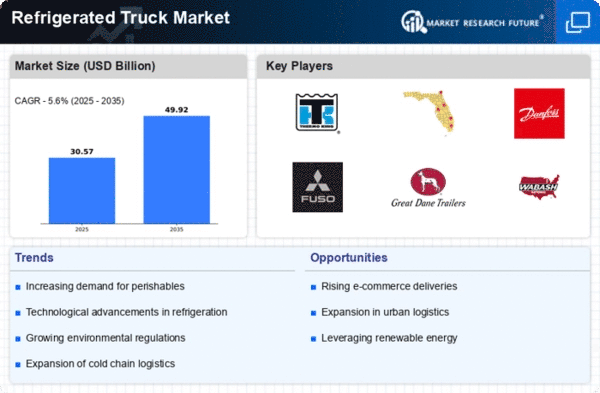
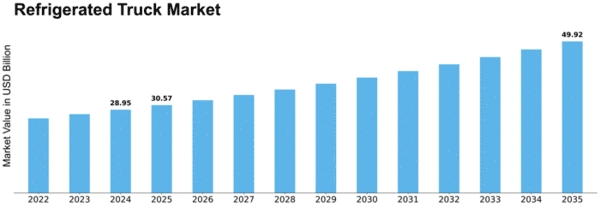
As per MRFR analysis, the Refrigerated Truck Market Size was estimated at 28.95 USD Billion in 2024. The Refrigerated Truck industry is projected to grow from 30.57 USD Billion in 2025 to 49.92 USD Billion by 2035, exhibiting a compound annual growth rate (CAGR) of 5.6 during the forecast period 2025 - 2035.

Key Market Trends & Highlights

The Refrigerated Truck Market is poised for substantial growth driven by technological advancements and increasing demand for perishable goods.

  • Technological advancements in refrigeration systems are enhancing efficiency and reliability in refrigerated trucks.
  • Sustainability initiatives are becoming increasingly important, influencing manufacturers to adopt eco-friendly practices.
  • The e-commerce growth, particularly in online grocery delivery services, is significantly impacting the demand for refrigerated transportation.
  • Rising demand for perishable goods and regulatory compliance are key drivers propelling the market, especially in North America and the fast-growing Asia-Pacific region.

Market Size & Forecast

2024 Market Size 28.95 (USD Billion)
2035 Market Size 49.92 (USD Billion)
CAGR (2025 - 2035) 5.6%
Largest Regional Market Share in 2024 North America

Major Players

<p>Thermo King (US), Carrier Transicold (US), Danfoss (DK), Mitsubishi Heavy Industries (JP), Kühne + Nagel (DE), Wabash National Corporation (US), Great Dane Trailers (US), Utility Trailer Manufacturing Company (US), Frigoblock (BE)</p>

Market Trends

The Refrigerated Truck Market is currently experiencing a notable transformation, driven by various factors that influence logistics and transportation. The increasing demand for perishable goods, such as food and pharmaceuticals, necessitates efficient and reliable transportation solutions. As consumers become more health-conscious and seek fresh products, the need for refrigerated transport solutions appears to be on the rise. Furthermore, advancements in technology, including temperature monitoring systems and energy-efficient refrigeration units, are enhancing the operational efficiency of refrigerated trucks. This evolution suggests a shift towards more sustainable practices within the industry, as companies strive to reduce their carbon footprints while maintaining product integrity. In addition, regulatory frameworks are evolving, with governments implementing stricter guidelines regarding food safety and transportation standards. This regulatory environment may compel businesses to invest in modern refrigerated vehicles that comply with these requirements. Moreover, the growing trend of e-commerce is reshaping the logistics landscape, as online grocery shopping becomes increasingly prevalent. Consequently, the Refrigerated Truck Market is poised for growth, as it adapts to meet the changing demands of consumers and regulatory bodies alike. The interplay of these factors indicates a dynamic market landscape that could present both challenges and opportunities for stakeholders in the coming years.

Technological Advancements

The Refrigerated Truck Market is witnessing a surge in technological innovations that enhance operational efficiency. Developments in temperature control systems, GPS tracking, and real-time monitoring are becoming increasingly prevalent. These advancements not only improve the reliability of temperature-sensitive goods but also optimize route planning and reduce fuel consumption.

Sustainability Initiatives

There is a growing emphasis on sustainability within the Refrigerated Truck Market. Companies are increasingly adopting eco-friendly practices, such as utilizing alternative fuels and energy-efficient refrigeration systems. This trend reflects a broader commitment to reducing environmental impact while meeting the demands of consumers for responsibly sourced products.

E-commerce Growth

The rise of e-commerce is significantly influencing the Refrigerated Truck Market. As online grocery shopping continues to expand, the demand for efficient refrigerated logistics solutions is likely to increase. This trend necessitates the development of specialized refrigerated transport services that cater to the unique needs of e-commerce businesses.

Refrigerated Truck Market Market Drivers

Rising Demand for Perishable Goods

The increasing global demand for perishable goods, such as fruits, vegetables, dairy, and pharmaceuticals, drives the Global Refrigerated Truck Market Industry. As consumers become more health-conscious and seek fresh produce, the need for efficient transportation solutions rises. This trend is particularly evident in regions with growing populations and urbanization, where access to fresh food is essential. The market is projected to reach 3.9 USD Billion in 2024, reflecting the urgency for refrigerated transport solutions. Companies are investing in advanced refrigerated trucks to ensure the integrity of temperature-sensitive products during transit, thereby enhancing supply chain efficiency.

Technological Advancements in Refrigeration

Technological innovations in refrigeration systems are significantly influencing the Global Refrigerated Truck Market Industry. The introduction of energy-efficient cooling technologies and IoT-enabled temperature monitoring systems enhances the reliability and efficiency of refrigerated transport. These advancements not only reduce operational costs but also minimize environmental impact, aligning with global sustainability goals. As the market evolves, companies are increasingly adopting these technologies to maintain compliance with stringent regulations regarding food safety and quality. This trend is expected to contribute to the market's growth, with projections indicating a CAGR of 6.53% from 2025 to 2035.

Regulatory Compliance and Food Safety Standards

Stringent regulatory compliance and food safety standards are pivotal drivers of the Global Refrigerated Truck Market Industry. Governments worldwide are implementing rigorous regulations to ensure the safe transportation of perishable goods, which necessitates the use of specialized refrigerated vehicles. Compliance with these regulations not only protects consumers but also enhances the reputation of logistics companies. As a result, there is a growing emphasis on investing in advanced refrigerated trucks equipped with temperature control systems and monitoring technologies. This trend is likely to propel market growth as companies strive to meet regulatory requirements and maintain high standards of food safety.

Expansion of E-commerce and Online Grocery Delivery

The rapid expansion of e-commerce and online grocery delivery services is reshaping the Global Refrigerated Truck Market Industry. As consumers increasingly prefer the convenience of online shopping for perishable goods, logistics companies are compelled to enhance their refrigerated transport capabilities. This shift is particularly pronounced in urban areas where demand for quick delivery of fresh products is high. Companies are investing in refrigerated fleets to meet these consumer expectations, thereby driving market growth. The market is anticipated to reach 7.82 USD Billion by 2035, underscoring the importance of efficient refrigerated logistics in the evolving retail landscape.

Increasing Global Trade and Cross-Border Transportation

The growth of global trade and cross-border transportation is a significant factor influencing the Global Refrigerated Truck Market Industry. As international trade agreements facilitate the movement of goods across borders, the demand for refrigerated trucks to transport perishable items increases. This trend is particularly evident in regions where agricultural exports are vital to the economy. Companies are adapting their logistics strategies to accommodate the complexities of cross-border transportation, ensuring that temperature-sensitive products reach their destinations in optimal condition. This dynamic is expected to contribute to the overall growth of the market, reflecting the interconnectedness of global supply chains.

Market Segment Insights

By Application: Food Transportation (Largest) vs. Pharmaceutical Transportation (Fastest-Growing)

<p>In the Refrigerated Truck Market, the application segment is primarily driven by Food Transportation, which captures a significant share due to the consistent demand for perishable goods. This segment benefits from the growing trends in e-commerce and online grocery shopping, pushing the demand for refrigerated logistics to allow for fresh deliverables directly to consumers. Pharmaceutical Transportation follows closely, showcasing its importance but with a smaller footprint in market share as it specializes in transporting temperature-sensitive medications and vaccines. The growth trends indicate a robust expansion in the Pharmaceutical Transportation sector, attributed to the rising need for safe and effective drug distribution, particularly in the wake of the global pandemic that heightened awareness around pharmaceutical supply chains. Consequently, advancements in cold chain technologies and regulatory requirements are driving investments in refrigerated transportation, promoting innovative solutions to ensure product integrity across various applications, which helps sustain growth in both Food and Pharmaceutical segments.</p>

<p>Food Transportation (Dominant) vs. Chemical Transportation (Emerging)</p>

<p>Food Transportation remains a dominant force within the Refrigerated Truck Market, characterized by its extensive reliance on strict temperature control to maintain the quality of perishable items. The infrastructure supporting this segment is highly developed, featuring sophisticated logistics networks that ensure compliance with health and safety regulations. On the other hand, Chemical Transportation is emerging as a noteworthy player, requiring adaptable solutions to transport sensitive chemical compounds safely. While traditionally less prioritized, recent advancements and regulations in the chemical sector have prompted investments in temperature-controlled transportation, addressing the growing need for transporting chemicals that require specific thermal conditions. As both segments evolve, they demonstrate distinct operational approaches, emphasizing food safety in one and chemical integrity in the other.</p>

By Vehicle Type: Light Duty (Largest) vs. Heavy Duty (Fastest-Growing)

<p>In the Refrigerated Truck Market, the Light Duty Refrigerated Trucks dominate the segment with significant market share, attributed to their versatility and suitability for urban distribution. These trucks are ideal for small to medium-sized businesses requiring efficient refrigeration capabilities while navigating city streets. Meanwhile, Medium Duty Refrigerated Trucks also hold a noteworthy share, perfectly balancing load capacity and efficiency for varied applications. Heavy Duty Refrigerated Trucks, while currently smaller in market share, are witnessing rapid demand growth due to expanding cold supply chains and increasing consumer expectations for product quality.</p>

<p>Medium Duty (Dominant) vs. Heavy Duty (Emerging)</p>

<p>Medium Duty Refrigerated Trucks serve as the cornerstone of the refrigerated transport sector, blending substantial payload capacity with operational flexibility. These trucks are designed to handle a variety of products, making them a popular choice for businesses ranging from regional food distributors to grocery stores. In contrast, Heavy Duty Refrigerated Trucks are emerging as an increasingly vital component of long-haul cold logistics. Their robust construction and larger storage capacities make them ideal for transporting temperature-sensitive goods over long distances. As e-commerce continues to grow, the need for Heavy Duty Trucks is accelerating, making them a key player in the evolving landscape of refrigerated transportation.</p>

By Temperature Control: Multi-Temperature Control (Largest) vs. Single Temperature Control (Fastest-Growing)

<p>In the Refrigerated Truck Market, Multi-Temperature Control holds a significant share, showcasing its importance in transporting goods that require different temperature zones. On the other hand, Single Temperature Control has emerged as a crucial player, particularly for goods that need a consistent temperature, highlighting its unique position in the market. Both segments are vital in meeting diverse transportation needs and ensuring quality during the logistics process.</p>

<p>Multi-Temperature Control (Dominant) vs. Single Temperature Control (Emerging)</p>

<p>Multi-Temperature Control systems enable the transportation of various perishable goods simultaneously at different temperatures, making them essential for logistics companies catering to a diverse clientele. This adaptability positions Multi-Temperature Control as the dominant force in the market. Conversely, Single Temperature Control is rapidly gaining momentum, especially among small to medium enterprises that focus on transport efficiency for uniform temperature-sensitive products. Its simplicity and cost-effectiveness make it appealing, thus establishing itself as an emerging trend within the Refrigerated Truck Market.</p>

By Fuel Type: Internal Combustion Engine (Largest) vs. Electric (Fastest-Growing)

<p>In the Refrigerated Truck Market, the Internal Combustion Engine (ICE) segment currently holds the largest market share, driven by established infrastructure and widespread usage. However, the Electric segment is gaining significant traction, capturing an increasing proportion of the market as more companies prioritize sustainability and regulatory compliance. Growth in electric refrigeration solutions reflects a shift towards cleaner alternatives, appealing to environmentally-conscious consumers and businesses alike.</p>

<p>Internal Combustion Engine (Dominant) vs. Electric (Emerging)</p>

<p>The Internal Combustion Engine remains the dominant fuel type in the Refrigerated Truck Market due to its robust performance and reliability in various conditions. This segment benefits from an extensive network of service and distribution points, which ensures minimal downtime. On the other hand, the Electric segment is rapidly emerging, fueled by technological advancements and supportive governmental policies aimed at reducing carbon emissions. Increased battery efficiency and charging infrastructure are enhancing the competitiveness of electric refrigerated trucks, making them a favorable choice for companies focused on sustainability. As this segment grows, its adaptability to urban logistics and regulatory frameworks will likely redefine market dynamics.</p>

By End Use: Retail (Largest) vs. Food Service (Fastest-Growing)

<p>The Refrigerated Truck Market showcases distinct dynamics across its end-use segments, particularly among Retail, Wholesale, and Food Service. Retail holds a dominant position, benefiting from a well-established distribution system that facilitates efficient transportation of perishable goods to various outlets. Its substantial share is driven by increasing consumer demand for fresh and frozen products. In contrast, the Wholesale segment, while notable, reflects slower growth as it consolidates its operational efficiencies, carving out a stable but lesser market presence compared to Retail.</p>

<p>Retail (Dominant) vs. Food Service (Emerging)</p>

<p>Retail remains the dominant player in the Refrigerated Truck Market, characterized by a structured supply chain that caters to grocery stores, supermarkets, and convenience stores. This segment prioritizes consistency and reliability in temperature control, crucial for maintaining product quality. On the other hand, Food Service has emerged rapidly, supported by the growing trend of meal delivery services and the rise in consumer dining experiences. This segment demands flexible logistics solutions, adapting to fluctuations in order sizes and rapid changes in menu offerings, thus driving innovation in refrigerated transport solutions.</p>

Get more detailed insights about Refrigerated Truck Market Research Report—Global Forecast till 2035

Regional Insights

By region, the study provides market insights into North America, Europe, Asia-Pacific and Rest of the World. The North America Refrigerated Truck Market dominated this market in 2022 (45.80%). The need for frozen food, snacks, and fresh vegetables is growing, which is fueling the regional refrigerated truck industry. These factors include changing lifestyles, the expansion of e-commerce, rising income levels, and the desire for convenience. Further, the U.S. Refrigerated Truck Market held the largest market share, and the Canada Refrigerated Truck Market was the fastest-growing market in the North America region.

Further, the major countries studied in the market report are The US, Canada, German, France, the UK, Italy, Spain, China, Japan, India, Australia, South Korea, and Brazil.

Europe Refrigerated Truck Market accounted for the healthy market share in 2022. The market is expanding as a result of increased expenditures being made in the food service industries of nations like Germany and the United Kingdom to upgrade their cold storage facilities in order to reduce food waste. Further, the German Refrigerated Truck Market held the largest market share, and the U.K Refrigerated Truck Market was the fastest-growing market in the European region.

The Asia Pacific Refrigerated Truck Market is expected to register significant growth from 2023 to 2032. This is because emerging economies like China and India are present in the area. China, the top exporter of food items worldwide, is anticipated to contribute to the expansion of the APAC refrigerated transport industry. Additionally, increasing government spending in Asian nations to develop the logistics and transportation sector, together with an increase in the region's population that consumes frozen foods and an increase in disposable income, are all anticipated to have a significant impact on the market's expansion in APAC.

The APAC food industry's growing e-commerce penetration is anticipated to have a beneficial impact on the refrigerated transport market. Moreover, China’s Refrigerated Truck Market held the largest market share and the Indian Refrigerated Truck Market was the fastest growing market in the Asia-Pacific region.

Key Players and Competitive Insights

The Refrigerated Truck Market is currently characterized by a dynamic competitive landscape, driven by increasing demand for temperature-sensitive goods and the need for efficient logistics solutions. Key players such as Thermo King (US), Carrier Transicold (US), and Wabash National Corporation (US) are at the forefront, each adopting distinct strategies to enhance their market positioning. For instance, Thermo King (US) focuses on innovation in energy-efficient refrigeration technologies, while Carrier Transicold (US) emphasizes digital transformation through IoT-enabled solutions. These strategies collectively contribute to a competitive environment that is increasingly shaped by technological advancements and sustainability initiatives.

In terms of business tactics, companies are localizing manufacturing to reduce lead times and optimize supply chains. The market structure appears moderately fragmented, with several key players exerting influence over various segments. This fragmentation allows for niche players to thrive, while larger companies leverage their scale to implement cost-effective solutions. The collective influence of these key players fosters a competitive atmosphere where innovation and operational efficiency are paramount.

In November 2025, Wabash National Corporation (US) announced the launch of a new line of eco-friendly refrigerated trailers designed to reduce carbon emissions by 30%. This strategic move not only aligns with global sustainability goals but also positions Wabash as a leader in environmentally conscious logistics solutions. The introduction of these trailers is likely to attract customers who prioritize sustainability in their supply chain operations.

In October 2025, Carrier Transicold (US) unveiled a new telematics platform that integrates real-time monitoring of refrigerated units. This platform enhances operational efficiency by providing fleet managers with critical data on temperature control and energy consumption. The strategic importance of this development lies in its potential to reduce operational costs and improve compliance with stringent food safety regulations, thereby strengthening Carrier's competitive edge.

In September 2025, Thermo King (US) expanded its partnership with Kühne + Nagel (DE) to enhance cold chain logistics across Europe. This collaboration aims to leverage Thermo King's advanced refrigeration technologies alongside Kühne + Nagel's extensive logistics network. The strategic significance of this partnership is evident in its potential to streamline operations and improve service delivery in a highly competitive market.

As of December 2025, current trends in the Refrigerated Truck Market are increasingly defined by digitalization, sustainability, and the integration of AI technologies. Strategic alliances, such as those between manufacturers and logistics providers, are shaping the competitive landscape by fostering innovation and enhancing service offerings. Looking ahead, it is anticipated that competitive differentiation will evolve from traditional price-based competition to a focus on innovation, technology, and supply chain reliability. This shift underscores the importance of adapting to changing market demands and leveraging technological advancements to maintain a competitive advantage.

Key Companies in the Refrigerated Truck Market market include

Industry Developments

October 2021: Krone, a producer of trailers, and Trailer Dynamics GmbH have established a strategic alliance. The creation of an electrified trailer that is production-ready and considerably reduces the diesel and CO2 emissions of diesel semitrailer tractors while extending the range of BEV semitrailer tractors is the shared objective.

February 2021: Small to medium-sized vans and lorries could use fully electric refrigeration units made by Ingersoll Rand.

Future Outlook

Refrigerated Truck Market Future Outlook

<p>The Refrigerated Truck Market is projected to grow at a 5.6% CAGR from 2024 to 2035, driven by increasing demand for temperature-sensitive goods and advancements in refrigeration technology.</p>

New opportunities lie in:

  • <p>Integration of IoT for real-time temperature monitoring</p>
  • <p>Development of electric refrigerated trucks for sustainability</p>
  • <p>Expansion of cold chain logistics partnerships for enhanced distribution</p>

<p>By 2035, the market is expected to be robust, driven by innovation and strategic partnerships.</p>

Market Segmentation

Refrigerated Truck Market End Use Outlook

  • Retail
  • Wholesale
  • Food Service

Refrigerated Truck Market Fuel Type Outlook

  • Internal Combustion Engine
  • Electric
  • Hybrid

Refrigerated Truck Market Application Outlook

  • Food Transportation
  • Pharmaceutical Transportation
  • Floral Transportation
  • Chemical Transportation

Refrigerated Truck Market Vehicle Type Outlook

  • Light Duty Refrigerated Truck
  • Medium Duty Refrigerated Truck
  • Heavy Duty Refrigerated Truck

Refrigerated Truck Market Temperature Control Outlook

  • Single Temperature Control
  • Multi-Temperature Control
  • Thermal Insulation

Report Scope

MARKET SIZE 202428.95(USD Billion)
MARKET SIZE 202530.57(USD Billion)
MARKET SIZE 203549.92(USD Billion)
COMPOUND ANNUAL GROWTH RATE (CAGR)5.6% (2024 - 2035)
REPORT COVERAGERevenue Forecast, Competitive Landscape, Growth Factors, and Trends
BASE YEAR2024
Market Forecast Period2025 - 2035
Historical Data2019 - 2024
Market Forecast UnitsUSD Billion
Key Companies ProfiledThermo King (US), Carrier Transicold (US), Danfoss (DK), Mitsubishi Heavy Industries (JP), Kühne + Nagel (DE), Wabash National Corporation (US), Great Dane Trailers (US), Utility Trailer Manufacturing Company (US), Frigoblock (BE)
Segments CoveredApplication, Vehicle Type, Temperature Control, Fuel Type, End Use
Key Market OpportunitiesIntegration of advanced telematics and IoT for enhanced fleet management in the Refrigerated Truck Market.
Key Market DynamicsRising demand for temperature-sensitive goods drives innovation and competition in the refrigerated truck market.
Countries CoveredNorth America, Europe, APAC, South America, MEA

FAQs

How much is the Refrigerated Truck market?

The Refrigerated Truck market Application was valued at USD 3.5 Billion in 2022

What is the growth rate of the Refrigerated Truck market?

The market is projected to grow at a CAGR of 6.90% during the forecast period, 2025-2035

Which region held the largest market share in the Refrigerated Truck market?

North America had the largest share in the market

Who are the key players in the Refrigerated Truck market?

The key players in the market Kögel Trailer GmbH &amp; Co.KG, Hyundai Translead. Inc., Wabash National, Fahrzeugwert Bernard Krone Gmbh &amp; Co.KG, China International Marine Containers (Group) Ltd., GRW Tankers and Trailers, Lamberet SAS, Great Dane LLC, Chereau, and Schmitz Cargobull AG

Which Type led the Refrigerated Truck market?

The Light Commercial Vehicle (LCV) Type dominated the market in 2022

Which Tonnage Capacity had the largest market share in the Refrigerated Truck market?

The 10-20 tons Tonnage Capacity had the largest share in the market

  1. Executive Summary
  2. Market Introduction
    1. Market Definition
    2. Scope of the Study
    3. Market Structure
  3. Research Methodology
    1. Primary Research
    2. Secondary Research
    3. Market Capacity Estimation
    4. Forecast Model
    5. List of Assumptions
    6. Limitations of the Study
  4. Market Insights
  5. Market Dynamics
    1. Introduction
    2. Market Drivers
    3. Market Restraints
    4. Market Opportunities
    5. Porter’s Five Forces Analysis
      1. Threat of New Entrants
      2. Bargaining Power of Buyers
      3. Bargaining Power of Suppliers
      4. Threat of Substitutes
      5. Intensity of Rivalry
    6. Value Chain/Supply Chain Analysis
  6. Global Refrigerated Truck Market, by Type
    1. Introduction
    2. Light Commercial Vehicle
      1. Market Estimates & Forecast, 2023-2032
      2. Market Estimates & Forecast, by Region, 2023-2032
    3. Medium Commercial Vehicle
      1. Market Estimates & Forecast, 2023-2032
      2. Market Estimates & Forecast, by Region, 2023-2032
    4. Heavy Commercial Vehicle
      1. Market Estimates & Forecast, 2023-2032
      2. Market Estimates & Forecast, by Region, 2023-2032
  7. Global Refrigerated Truck Market, by Tonnage Capacity
    1. Introduction
    2. Less than 10 Tons
      1. Market Estimates & Forecast, 2023-2032
      2. Market Estimates & Forecast, by Region, 2023-2032
    3. 10-20 Tons
      1. Market Estimates & Forecast, 2023-2032
      2. Market Estimates & Forecast, by Region, 2023-2032
    4. More than 20 Tons
      1. Market Estimates & Forecast, 2023-2032
      2. Market Estimates & Forecast, by Region, 2023-2032
  8. Global Refrigerated Truck Market, by Application
    1. Introduction
    2. Food and Beverages
      1. Market Estimates & Forecast, 2023-2032
      2. Market Estimates & Forecast, by Region, 2023-2032
    3. Pharmaceuticals
      1. Market Estimates & Forecast, 2023-2032
      2. Market Estimates & Forecast, by Region, 2023-2032
    4. Chemicals
      1. Market Estimates & Forecast, 2023-2032
      2. Market Estimates & Forecast, by Region, 2023-2032
    5. Others
      1. Market Estimates & Forecast, 2023-2032
      2. Market Estimates & Forecast, by Region, 2023-2032
  9. Global Refrigerated Truck Market, by Region
    1. Introduction
    2. North America
      1. Market Estimates & Forecast, by Type, 2023-2032
      2. Market Estimates & Forecast, by Tonnage Capacity, 2023-2032
      3. Market Estimates & Forecast, by Application, 2023-2032
      4. Market Estimates & Forecast, by Country, 2023-2032
      5. US
      6. Canada
      7. Mexico
    3. Europe
      1. Market Estimates & Forecast, by Type, 2023-2032
      2. Market Estimates & Forecast, by Tonnage Capacity, 2023-2032
      3. Market Estimates & Forecast, by Application, 2023-2032
      4. Market Estimates & Forecast, by Country, 2023-2032
      5. Germany
      6. UK
      7. France
      8. Italy
      9. Rest of Europe
    4. Asia-Pacific
      1. Market Estimates & Forecast, by Type, 2023-2032
      2. Market Estimates & Forecast, by Tonnage Capacity, 2023-2032
      3. Market Estimates & Forecast, by Application, 2023-2032
      4. Market Estimates & Forecast, by Country, 2023-2032
      5. China
      6. Japan
      7. India
      8. Rest of Asia-Pacific
    5. Middle East & Africa
      1. Market Estimates & Forecast, by Type, 2023-2032
      2. Market Estimates & Forecast, by Tonnage Capacity, 2023-2032
      3. Market Estimates & Forecast, by Application, 2023-2032
      4. Market Estimates & Forecast, by Country, 2023-2032
      5. Saudi Arabia
      6. UAE
      7. South Africa
      8. Rest of Middle East & Africa
    6. South America
      1. Market Estimates & Forecast, by Type, 2023-2032
      2. Market Estimates & Forecast, by Tonnage Capacity, 2023-2032
      3. Market Estimates & Forecast, by Application, 2023-2032
      4. Market Estimates & Forecast, by Country, 2023-2032
      5. Brazil
      6. Argentina
      7. Rest of South America
  10. Competitive Landscape
    1. Competitive Scenario
    2. Competitive Benchmarking of theGlobal Refrigerated Truck Market
    3. Major Growth Key Strategies in theGlobal Refrigerated Truck Market
    4. Market Share Analysis: Global Refrigerated Truck Market
    5. Product Development in Global Refrigerated Truck Market
    6. Mergers and Acquisitions in Global Refrigerated Truck Market
    7. Contracts and Agreements in Global Refrigerated Truck Market
    8. Expansions and Investments in Global Refrigerated Truck Market
  11. Company Profile
    1. Kögel Trailer GmbH & Co.KG (Germany)
      1. Company Overview
      2. Products/Services Offered
      3. Financial Overview
      4. Key Developments
      5. Key Strategies
      6. SWOT Analysis
    2. HYUNDAI Translead, Inc. (US)
      1. Company Overview
      2. Products/Services Offered
      3. Financial Overview
      4. Key Developments
      5. Key Strategies
      6. SWOT Analysis
    3. Wabash National (US)
      1. Company Overview
      2. Products/Services Offered
      3. Financial Overview
      4. Key Developments
      5. Key Strategies
      6. SWOT Analysis
    4. Fahrzeugwerk Bernard Krone Gmbh & Co. Kg (Germany)
      1. Company Overview
      2. Products/Services Offered
      3. Financial Overview
      4. Key Developments
      5. Key Strategies
      6. SWOT Analysis
    5. GRW Tankers and Trailers (US)
      1. Company Overview
      2. Products/Services Offered
      3. Financial Overview
      4. Key Developments
      5. Key Strategies
      6. SWOT Analysis
    6. Schmitz Cargobull AG (Germany)
      1. Company Overview
      2. Products/Services Offered
      3. Financial Overview
      4. Key Developments
      5. Key Strategies
      6. SWOT Analysis
    7. Great Dane LLC (US)
      1. Company Overview
      2. Products/Services Offered
      3. Financial Overview
      4. Key Developments
      5. Key Strategies
      6. SWOT Analysis
    8. Chereau (France)
      1. Company Overview
      2. Products/Services Offered
      3. Financial Overview
      4. Key Developments
      5. Key Strategies
      6. SWOT Analysis
    9. Lamberet SAS (France)
      1. Company Overview
      2. Products/Services Offered
      3. Financial Overview
      4. Key Developments
      5. Key Strategies
      6. SWOT Analysis
    10. Sveza-Les LLC (Russia)
      1. Company Overview
      2. Products/Services Offered
      3. Financial Overview
      4. Key Developments
      5. Key Strategies
      6. SWOT Analysis
    11. List of Tables
  12. Global Refrigerated Truck Market, by Region, 2023-2032 (USD Billion)
  13. North America Refrigerated Truck Market, by Country, 2023-2032 (USD Billion)
  14. Europe Refrigerated Truck Market, by Country, 2023-2032 (USD Billion)
  15. Asia-Pacific Refrigerated Truck Market, by Country, 2023-2032 (USD Billion)
  16. Middle East & Africa Refrigerated Truck Market, by Country, 2023-2032 (USD Billion)
  17. South America Refrigerated Truck Market, by Country, 2023-2032 (USD Billion)
  18. Global Refrigerated Truck Market, by Type, 2023-2032 (USD Billion)
  19. North America Refrigerated Truck Market, by Type, 2023-2032 (USD Billion)
  20. Europe Refrigerated Truck Market, by Type, 2023-2032 (USD Billion)
  21. Asia-Pacific Refrigerated Truck Market, by Type, 2023-2032 (USD Billion)
  22. Middle East & Africa Refrigerated Truck Market, by Type, 2023-2032 (USD Billion)
  23. South America Refrigerated Truck Market, by Type, 2023-2032 (USD Billion)
  24. Global Refrigerated Truck Market, by Tonnage Capacity, 2023-2032 (USD Billion)
  25. North America Refrigerated Truck Market, by Tonnage Capacity, 2023-2032 (USD Billion)
  26. Europe Refrigerated Truck Market, by Tonnage Capacity, 2023-2032 (USD Billion)
  27. Asia-Pacific Refrigerated Truck Market, by Tonnage Capacity, 2023-2032 (USD Billion)
  28. Middle East & Africa Refrigerated Truck Market, by Tonnage Capacity, 2023-2032 (USD Billion)
  29. South America Refrigerated Truck Market, by Tonnage Capacity, 2023-2032 (USD Billion)
  30. Global Refrigerated Truck Market, by Application, 2023-2032 (USD Billion)
  31. North America Refrigerated Truck Market, by Application, 2023-2032 (USD Billion)
  32. Europe Refrigerated Truck Market, by Application, 2023-2032 (USD Billion)
  33. Asia-Pacific Refrigerated Truck Market, by Application, 2023-2032 (USD Billion)
  34. Middle East & Africa Refrigerated Truck Market, by Application, 2023-2032 (USD Billion)
  35. South America Refrigerated Truck Market, by Application, 2023-2032 (USD Billion)
  36. Global Refrigerated Truck Market: by Region, 2023-2032 (USD Billion)
  37. North America Refrigerated Truck Market, by Country, 2023-2032 (USD Billion)
  38. North America Refrigerated Truck Market, by Type, 2023-2032 (USD Billion)
  39. North America Refrigerated Truck Market, by Tonnage Capacity, 2023-2032 (USD Billion)
  40. North America Refrigerated Truck Market, by Application, 2023-2032 (USD Billion)
  41. US Refrigerated Truck Market, by Type, 2023-2032 (USD Billion)
  42. US Refrigerated Truck Market, by Tonnage Capacity, 2023-2032 (USD Billion)
  43. US Refrigerated Truck Market, by Application, 2023-2032 (USD Billion)
  44. Canada Refrigerated Truck Market, by Type, 2023-2032 (USD Billion)
  45. Canada Refrigerated Truck Market, by Tonnage Capacity, 2023-2032 (USD Billion)
  46. Canada Refrigerated Truck Market, by Application, 2023-2032 (USD Billion)
  47. Mexico Refrigerated Truck Market, by Type, 2023-2032 (USD Billion)
  48. Mexico Refrigerated Truck Market, by Tonnage Capacity, 2023-2032 (USD Billion)
  49. Mexico Refrigerated Truck Market, by Application, 2023-2032 (USD Billion)
  50. Europe Refrigerated Truck Market, by Country, 2023-2032 (USD Billion)
  51. Europe Refrigerated Truck Market, by Type, 2023-2032 (USD Billion)
  52. Europe Refrigerated Truck Market, by Tonnage Capacity, 2023-2032 (USD Billion)
  53. Europe Refrigerated Truck Market, by Application, 2023-2032 (USD Billion)
  54. Germany Refrigerated Truck Market, by Type, 2023-2032 (USD Billion)
  55. Germany Refrigerated Truck Market, by Tonnage Capacity, 2023-2032 (USD Billion)
  56. Germany Refrigerated Truck Market, by Application, 2023-2032 (USD Billion)
  57. UK Refrigerated Truck Market, by Type, 2023-2032 (USD Billion)
  58. UK Refrigerated Truck Market, by Tonnage Capacity, 2023-2032 (USD Billion)
  59. UK Refrigerated Truck Market, by Application, 2023-2032 (USD Billion)
  60. France Refrigerated Truck Market, by Type, 2023-2032 (USD Billion)
  61. France Refrigerated Truck Market, by Tonnage Capacity, 2023-2032 (USD Billion)
  62. France Refrigerated Truck Market, by Application, 2023-2032 (USD Billion)
  63. Italy Refrigerated Truck Market, by Type, 2023-2032 (USD Billion)
  64. Italy Refrigerated Truck Market, by Tonnage Capacity, 2023-2032 (USD Billion)
  65. Italy Refrigerated Truck Market, by Application, 2023-2032 (USD Billion)
  66. Rest of Europe Refrigerated Truck Market, by Type, 2023-2032 (USD Billion)
  67. Rest of Europe Refrigerated Truck Market, by Tonnage Capacity, 2023-2032 (USD Billion)
  68. Rest of Europe Refrigerated Truck Market, by Application, 2023-2032 (USD Billion)
  69. Asia-Pacific Refrigerated Truck Market, by Country, 2023-2032 (USD Billion)
  70. Asia-Pacific Refrigerated Truck Market, by Type, 2023-2032 (USD Billion)
  71. Asia-Pacific Refrigerated Truck Market, by Tonnage Capacity, 2023-2032 (USD Billion)
  72. Asia-Pacific Refrigerated Truck Market, by Application, 2023-2032 (USD Billion)
  73. China Refrigerated Truck Market, by Type, 2023-2032 (USD Billion)
  74. China Refrigerated Truck Market, by Tonnage Capacity, 2023-2032 (USD Billion)
  75. China Refrigerated Truck Market, by Application, 2023-2032 (USD Billion)
  76. Japan Refrigerated Truck Market, by Type, 2023-2032 (USD Billion)
  77. Japan Refrigerated Truck Market, by Tonnage Capacity, 2023-2032 (USD Billion)
  78. Japan Refrigerated Truck Market, by Application, 2023-2032 (USD Billion)
  79. India Refrigerated Truck Market, by Type, 2023-2032 (USD Billion)
  80. India Refrigerated Truck Market, by Tonnage Capacity, 2023-2032 (USD Billion)
  81. India Refrigerated Truck Market, by Application, 2023-2032 (USD Billion)
  82. Middle East & Africa Refrigerated Truck Market, by Country, 2023-2032 (USD Billion)
  83. Middle East & Africa Refrigerated Truck Market, by Type, 2023-2032 (USD Billion)
  84. Middle East & Africa Refrigerated Truck Market, by Tonnage Capacity, 2023-2032 (USD Billion)
  85. Middle East & Africa Refrigerated Truck Market, by Application, 2023-2032 (USD Billion)
  86. Saudi Arabia Refrigerated Truck Market, by Type, 2023-2032 (USD Billion)
  87. Saudi Arabia Refrigerated Truck Market, by Tonnage Capacity, 2023-2032 (USD Billion)
  88. Saudi Arabia Refrigerated Truck Market, by Application, 2023-2032 (USD Billion)
  89. UAE Refrigerated Truck Market, by Type, 2023-2032 (USD Billion)
  90. UAE Refrigerated Truck Market, by Tonnage Capacity, 2023-2032 (USD Billion)
  91. UAE Refrigerated Truck Market, by Application, 2023-2032 (USD Billion)
  92. South Africa Refrigerated Truck Market, by Type, 2023-2032 (USD Billion)
  93. South Africa Refrigerated Truck Market, by Tonnage Capacity, 2023-2032 (USD Billion)
  94. South Africa Refrigerated Truck Market, by Application, 2023-2032 (USD Billion)
  95. Rest of Middle East & Africa Refrigerated Truck Market, by Type, 2023-2032 (USD Billion)
  96. Rest of Middle East & Africa Refrigerated Truck Market, by Tonnage Capacity, 2023-2032 (USD Billion)
  97. Rest of Middle East & Africa Refrigerated Truck Market, by Application, 2023-2032 (USD Billion)
  98. South America Refrigerated Truck Market, by Country, 2023-2032 (USD Billion)
  99. South America Refrigerated Truck Market, by Type, 2023-2032 (USD Billion)
  100. South America Refrigerated Truck Market, by Tonnage Capacity, 2023-2032 (USD Billion)
  101. South America Refrigerated Truck Market, by Application, 2023-2032 (USD Billion)
  102. Brazil Refrigerated Truck Market, by Type, 2023-2032 (USD Billion)
  103. Brazil Refrigerated Truck Market, by Tonnage Capacity, 2023-2032 (USD Billion)
  104. Brazil Refrigerated Truck Market, by Application, 2023-2032 (USD Billion)
  105. Argentina Refrigerated Truck Market, by Type, 2023-2032 (USD Billion)
  106. Argentina Refrigerated Truck Market, by Tonnage Capacity, 2023-2032 (USD Billion)
  107. Argentina Refrigerated Truck Market, by Application, 2023-2032 (USD Billion)
  108. Rest of South America Refrigerated Truck Market, by Type, 2023-2032 (USD Billion)
  109. Rest of South America Refrigerated Truck Market, by Tonnage Capacity, 2023-2032 (USD Billion)
  110. Rest of South America Refrigerated Truck Market, by Application, 2023-2032 (USD Billion)
    1. List of Figures
  111. Research Process of MRFR
  112. Top-Down and Bottom-Up Approach
  113. Market Dynamics
  114. Impact Analysis: Market Drivers
  115. Impact Analysis: Market Restraints
  116. Porter’s Five Forces Analysis
  117. Value Chain Analysis
  118. Global Refrigerated Truck Market Share, by Type, 2022 (%)
  119. Global Refrigerated Truck Market, by Type, 2023-2032 (USD Billion)
  120. Global Refrigerated Truck Market Share, by Tonnage Capacity, 2022 (%)
  121. Global Refrigerated Truck Market, by Tonnage Capacity, 2023-2032 (USD Billion)
  122. Global Refrigerated Truck Market Share, by Application, 2022 (%)
  123. Global Refrigerated Truck Market, by Application, 2023-2032 (USD Billion)
  124. North America Refrigerated Truck Market Share (%), 2022
  125. North America Refrigerated Truck Market, by Country, 2023-2032 (USD Billion)
  126. Europe Refrigerated Truck Market Share (%), 2022
  127. Europe Refrigerated Truck Market, by Country, 2023-2032 (USD Billion)
  128. Asia-Pacific Refrigerated Truck Market Share (%), 2022
  129. Asia-Pacific Refrigerated Truck Market, by Country, 2023-2032 (USD Billion)
  130. Middle East & Africa Refrigerated Truck Market Share (%), 2022
  131. Middle East & Africa Refrigerated Truck Market, by Country, 2023-2032 (USD Billion)
  132. South America Refrigerated Truck Market Share (%), 2022
  133. Middle East & Africa Refrigerated Truck Market, by Country, 2023-2032 (USD Billion)

Refrigerated Truck Market Segmentation

Refrigerated Truck Market Type Outlook (USD Billion, 2018-2032)

Light Commercial Vehicle (LCV)

Medium Commercial Vehicle (MCV)

Heavy Commercial Vehicle (HCV)

Refrigerated Truck Market Tonnage Capacity Outlook (USD Billion, 2018-2032)

Less than 10 tons

10-20 tons

More than 20 tons

Refrigerated Truck Market Application Outlook (USD Billion, 2018-2032)

Food and Beverages

Pharmaceuticals

Chemicals

Others

Refrigerated Truck Market Regional Outlook (USD Billion, 2018-2032)

North America Outlook (USD Billion, 2018-2032)

Refrigerated Truck Market by Type

Light Commercial Vehicle (LCV)

Medium Commercial Vehicle (MCV)

Heavy Commercial Vehicle (HCV)

Refrigerated Truck Market by Tonnage Capacity

Less than 10 tons

10-20 tons

More than 20 tons

Refrigerated Truck Market by Application

Food and Beverages

Pharmaceuticals

Chemicals

Others

US Outlook (USD Billion, 2018-2032)

Refrigerated Truck Market by Type

Light Commercial Vehicle (LCV)

Medium Commercial Vehicle (MCV)

Heavy Commercial Vehicle (HCV)

Refrigerated Truck Market by Tonnage Capacity

Less than 10 tons

10-20 tons

More than 20 tons

Refrigerated Truck Market by Application

Food and Beverages

Pharmaceuticals

Chemicals

Others

Canada Outlook (USD Billion, 2018-2032)

Refrigerated Truck Market by Type

Light Commercial Vehicle (LCV)

Medium Commercial Vehicle (MCV)

Heavy Commercial Vehicle (HCV)

Refrigerated Truck Market by Tonnage Capacity

Less than 10 tons

10-20 tons

More than 20 tons

Refrigerated Truck Market by Application

Food and Beverages

Pharmaceuticals

Chemicals

Others

Europe Outlook (USD Billion, 2018-2032)

Refrigerated Truck Market by Type

Light Commercial Vehicle (LCV)

Medium Commercial Vehicle (MCV)

Heavy Commercial Vehicle (HCV)

Refrigerated Truck Market by Tonnage Capacity

Less than 10 tons

10-20 tons

More than 20 tons

Refrigerated Truck Market by Application

Food and Beverages

Pharmaceuticals

Chemicals

Others

Germany Outlook (USD Billion, 2018-2032)

Refrigerated Truck Market by Type

Light Commercial Vehicle (LCV)

Medium Commercial Vehicle (MCV)

Heavy Commercial Vehicle (HCV)

Refrigerated Truck Market by Tonnage Capacity

Less than 10 tons

10-20 tons

More than 20 tons

Refrigerated Truck Market by Application

Food and Beverages

Pharmaceuticals

Chemicals

Others

France Outlook (USD Billion, 2018-2032)

Refrigerated Truck Market by Type

Light Commercial Vehicle (LCV)

Medium Commercial Vehicle (MCV)

Heavy Commercial Vehicle (HCV)

Refrigerated Truck Market by Tonnage Capacity

Less than 10 tons

10-20 tons

More than 20 tons

Refrigerated Truck Market by Application

Food and Beverages

Pharmaceuticals

Chemicals

Others

UK Outlook (USD Billion, 2018-2032)

Refrigerated Truck Market by Type

Light Commercial Vehicle (LCV)

Medium Commercial Vehicle (MCV)

Heavy Commercial Vehicle (HCV)

Refrigerated Truck Market by Tonnage Capacity

Less than 10 tons

10-20 tons

More than 20 tons

Refrigerated Truck Market by Application

Food and Beverages

Pharmaceuticals

Chemicals

Others

Italy Outlook (USD Billion, 2018-2032)

Refrigerated Truck Market by Type

Light Commercial Vehicle (LCV)

Medium Commercial Vehicle (MCV)

Heavy Commercial Vehicle (HCV)

Refrigerated Truck Market by Tonnage Capacity

Less than 10 tons

10-20 tons

More than 20 tons

Refrigerated Truck Market by Application

Food and Beverages

Pharmaceuticals

Chemicals

Others

Spain Outlook (USD Billion, 2018-2032)

Refrigerated Truck Market by Type

Light Commercial Vehicle (LCV)

Medium Commercial Vehicle (MCV)

Heavy Commercial Vehicle (HCV)

Refrigerated Truck Market by Tonnage Capacity

Less than 10 tons

10-20 tons

More than 20 tons

Refrigerated Truck Market by Application

Food and Beverages

Pharmaceuticals

Chemicals

Others

Rest Of Europe Outlook (USD Billion, 2018-2032)

Refrigerated Truck Market by Type

Light Commercial Vehicle (LCV)

Medium Commercial Vehicle (MCV)

Heavy Commercial Vehicle (HCV)

Refrigerated Truck Market by Tonnage Capacity

Less than 10 tons

10-20 tons

More than 20 tons

Refrigerated Truck Market by Application

Food and Beverages

Pharmaceuticals

Chemicals

Others

Asia-Pacific Outlook (USD Billion, 2018-2032)

Refrigerated Truck Market by Type

Light Commercial Vehicle (LCV)

Medium Commercial Vehicle (MCV)

Heavy Commercial Vehicle (HCV)

Refrigerated Truck Market by Tonnage Capacity

Less than 10 tons

10-20 tons

More than 20 tons

Refrigerated Truck Market by Application

Food and Beverages

Pharmaceuticals

Chemicals

Others

China Outlook (USD Billion, 2018-2032)

Refrigerated Truck Market by Type

Light Commercial Vehicle (LCV)

Medium Commercial Vehicle (MCV)

Heavy Commercial Vehicle (HCV)

Refrigerated Truck Market by Tonnage Capacity

Less than 10 tons

10-20 tons

More than 20 tons

Refrigerated Truck Market by Application

Food and Beverages

Pharmaceuticals

Chemicals

Others

Japan Outlook (USD Billion, 2018-2032)

Refrigerated Truck Market by Type

Light Commercial Vehicle (LCV)

Medium Commercial Vehicle (MCV)

Heavy Commercial Vehicle (HCV)

Refrigerated Truck Market by Tonnage Capacity

Less than 10 tons

10-20 tons

More than 20 tons

Refrigerated Truck Market by Application

Food and Beverages

Pharmaceuticals

Chemicals

Others

India Outlook (USD Billion, 2018-2032)

Refrigerated Truck Market by Type

Light Commercial Vehicle (LCV)

Medium Commercial Vehicle (MCV)

Heavy Commercial Vehicle (HCV)

Refrigerated Truck Market by Tonnage Capacity

Less than 10 tons

10-20 tons

More than 20 tons

Refrigerated Truck Market by Application

Food and Beverages

Pharmaceuticals

Chemicals

Others

Australia Outlook (USD Billion, 2018-2032)

Refrigerated Truck Market by Type

Light Commercial Vehicle (LCV)

Medium Commercial Vehicle (MCV)

Heavy Commercial Vehicle (HCV)

Refrigerated Truck Market by Tonnage Capacity

Less than 10 tons

10-20 tons

More than 20 tons

Refrigerated Truck Market by Application

Food and Beverages

Pharmaceuticals

Chemicals

Others

Rest of Asia-Pacific Outlook (USD Billion, 2018-2032)

Refrigerated Truck Market by Type

Light Commercial Vehicle (LCV)

Medium Commercial Vehicle (MCV)

Heavy Commercial Vehicle (HCV)

Refrigerated Truck Market by Tonnage Capacity

Less than 10 tons

10-20 tons

More than 20 tons

Refrigerated Truck Market by Application

Food and Beverages

Pharmaceuticals

Chemicals

Others

Rest of the World Outlook (USD Billion, 2018-2032)

Refrigerated Truck Market by Type

Light Commercial Vehicle (LCV)

Medium Commercial Vehicle (MCV)

Heavy Commercial Vehicle (HCV)

Refrigerated Truck Market by Tonnage Capacity

Less than 10 tons

10-20 tons

More than 20 tons

Refrigerated Truck Market by Application

Food and Beverages

Pharmaceuticals

Chemicals

Others

Middle East Outlook (USD Billion, 2018-2032)

Refrigerated Truck Market by Type

Light Commercial Vehicle (LCV)

Medium Commercial Vehicle (MCV)

Heavy Commercial Vehicle (HCV)

Refrigerated Truck Market by Tonnage Capacity

Less than 10 tons

10-20 tons

More than 20 tons

Refrigerated Truck Market by Application

Food and Beverages

Pharmaceuticals

Chemicals

Others

Africa Outlook (USD Billion, 2018-2032)

Refrigerated Truck Market by Type

Light Commercial Vehicle (LCV)

Medium Commercial Vehicle (MCV)

Heavy Commercial Vehicle (HCV)

Refrigerated Truck Market by Tonnage Capacity

Less than 10 tons

10-20 tons

More than 20 tons

Refrigerated Truck Market by Application

Food and Beverages

Pharmaceuticals

Chemicals

Others

Latin America Outlook (USD Billion, 2018-2032)

Refrigerated Truck Market by Type

Light Commercial Vehicle (LCV)

Medium Commercial Vehicle (MCV)

Heavy Commercial Vehicle (HCV)

Refrigerated Truck Market by Tonnage Capacity

Less than 10 tons

10-20 tons

More than 20 tons

Refrigerated Truck Market by Application

Food and Beverages

Pharmaceuticals

Chemicals

Others


Infographic

Free Sample Request

Kindly complete the form below to receive a free sample of this Report

Get Free Sample

Customer Strories

Compare Licence

×
Features License Type
Single User Multiuser License Enterprise User
Price $4,950 $5,950 $7,250
Maximum User Access Limit 1 User Upto 10 Users Unrestricted Access Throughout the Organization
Free Customization
Direct Access to Analyst
Deliverable Format
Platform Access
Discount on Next Purchase 10% 15% 15%
Printable Versions