×
Hero Background
English
Chinese
French
Japanese
Korean
German
Spanish

Rubber Vulcanization Market Analysis

ID: MRFR/CnM/6422-CR
275 Pages
Chitranshi Jaiswal
May 2019

Global Rubber Vulcanization Market Research Report Information By Type {[Vulcanizing Agent (Sulfur, Tellurium, Selenium, Metallic Oxides), By Accelerators (Dithiocarbamate, Dithiophosphate, Sulfenamides, Xanthates), Activators, Others]}, Technique (Sulfur Vulcanization, Other Curing Techniques), By End-Use Industry (Automotive & Transportation, Industrial, Consumer Goods, Healthcare, others) - Forecast till 2035

Share:
Download PDF ×

We do not share your information with anyone. However, we may send you emails based on your report interest from time to time. You may contact us at any time to opt-out.

Rubber Vulcanization Market Infographic
Purchase Options

Market Analysis

In-depth Analysis of Rubber Vulcanization Market Industry Landscape

Aircraft tires are predominantly made from natural rubber due to its superior heat resistance. The strength and resilience of natural rubber are enhanced by combining it with sulfur, carbon black, and other chemicals. The mixture is then processed into sheets and shaped into aircraft tire treads using an extruder. The aerospace industry's growth significantly contributes to the demand for these natural rubber-based tires, particularly with the rising need for lightweight and fuel-efficient military aircraft for security purposes. Projections from the US Geological Survey indicate a doubling of the global aircraft fleet in the next two decades. Additionally, the healthcare sector extensively employs rubber for various applications, including injection parts, gloves, tubing, and medical devices. Silicone, natural, and polyurethane rubbers are commonly used in healthcare due to their biocompatibility, durability, sterilizability, and mechanical properties. The increasing prevalence of heart disease and related health concerns is anticipated to drive the demand for medical applications like cardiac pacemaker leads and mammary prostheses, further influencing the global rubber vulcanization market. The oil and gas industry plays a significant role in driving the demand for rubber vulcanization. Rubber products like seals, gaskets, O-rings, hoses, and connectors are extensively used in the industry for applications involving drilling equipment, pipelines, pumps, and valves. These rubber components are crucial for preventing leaks, ensuring operational integrity, and safeguarding against harsh operating conditions such as high pressure and temperature. As the global demand for energy continues to rise, the oil and gas sector requires reliable sealing solutions to maintain the efficiency and safety of its operations. The growth of this industry contributes substantially to the overall demand for rubber vulcanization, creating opportunities for market players in the production of high-performance seals tailored for oil and gas applications.

The automotive industry is a major consumer of vulcanized rubber products, utilizing them in various applications essential for vehicle performance. Seals, gaskets, O-rings, hoses, and other rubber components are crucial for maintaining the integrity of automotive systems such as engines, transmissions, braking systems, and fuel systems. As the automotive sector evolves with the introduction of electric vehicles, hybrid technologies, and stringent emission regulations, the demand for high-performance rubber products becomes more pronounced. The industry's focus on fuel efficiency, reduced emissions, and innovative technologies underscores the importance of reliable rubber components, thereby driving the demand for rubber vulcanization. Additionally, the expanding global population and rising disposable incomes contribute to the growth of the automotive market, further fueling the demand for rubber products and, consequently, rubber vulcanization.

Author
Chitranshi Jaiswal
Research Analyst Level I

In her 3 years of experience in the market research field, she has handled critical cross-domain projects. She has an in-depth knowledge of market estimation & analysis, problem-solving, primary as well as secondary research, and team management.She holds an engineering degree and is an MBA professional from a well-known university, capable of evaluating the market and competitive conditions. An exceptional strategist with excellent communication skills and a passion for delivering cutting-edge & practical insights for the market. Proficient in multi-tasking, and can successfully deal with competing demands, while maintaining complete confidentiality. Generated business through active client and project development, networking, and high-quality responses. Her knowledge and skills have helped in making solid business decisions, securing funding from investors, and avoiding business failures.

Leave a Comment

Market Summary

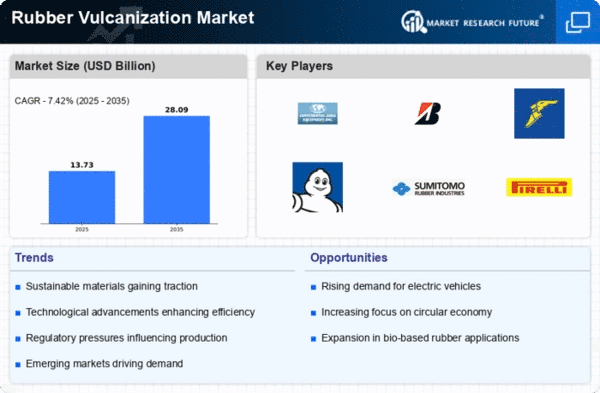
As per MRFR analysis, the Rubber Vulcanization Market Size was estimated at 12.78 USD Billion in 2024. The Rubber Vulcanization industry is projected to grow from 13.73 in 2025 to 28.09 by 2035, exhibiting a compound annual growth rate (CAGR) of 7.42 during the forecast period 2025 - 2035.

Key Market Trends & Highlights

The Rubber Vulcanization Market is poised for growth driven by sustainability and technological advancements.

  • North America remains the largest market for rubber vulcanization, primarily due to its robust automotive sector.
  • The Asia-Pacific region is emerging as the fastest-growing market, fueled by increasing industrialization and urbanization.
  • The automotive segment dominates the market, while the consumer goods segment is experiencing rapid growth.
  • Key market drivers include the rising demand for automotive tires and regulatory support for sustainable practices.

Market Size & Forecast

2024 Market Size 12.78 (USD Billion)
2035 Market Size 28.09 (USD Billion)
CAGR (2025 - 2035) 7.42%
Largest Regional Market Share in 2024 Asia-Pacific

Major Players

<p>Continental AG (DE), Bridgestone Corporation (JP), Goodyear Tire & Rubber Company (US), Michelin (FR), Sumitomo Rubber Industries (JP), Pirelli & C. S.p.A. (IT), Hankook Tire & Technology Co., Ltd. (KR), Trelleborg AB (SE), Cooper Tire & Rubber Company (US)</p>

Market Trends

The Rubber Vulcanization Market is currently experiencing a transformative phase, driven by advancements in technology and increasing demand for high-performance materials. This process, which enhances the durability and elasticity of rubber, is becoming increasingly vital across various industries, including automotive, construction, and consumer goods. As manufacturers seek to improve product longevity and performance, the adoption of innovative vulcanization techniques is on the rise. Furthermore, the growing emphasis on sustainability is prompting companies to explore eco-friendly alternatives in rubber production, which may reshape traditional practices in the market. In addition, the Rubber Vulcanization Market is witnessing a shift towards automation and digitalization. This trend is likely to enhance production efficiency and reduce operational costs, thereby attracting new players to the industry. The integration of smart technologies into manufacturing processes appears to be a key driver for future growth. As the market evolves, stakeholders must remain vigilant to emerging trends and adapt their strategies accordingly to maintain competitiveness in this dynamic landscape.

Sustainability Initiatives

The Rubber Vulcanization Market is increasingly influenced by sustainability initiatives. Companies are exploring eco-friendly materials and processes to reduce environmental impact. This shift not only aligns with global sustainability goals but also meets consumer demand for greener products.

Technological Advancements

Technological advancements are reshaping the Rubber Vulcanization Market. Innovations in vulcanization techniques and equipment are enhancing product quality and production efficiency. These developments are likely to drive competitiveness and open new avenues for growth.

Automation and Digitalization

The trend towards automation and digitalization is gaining momentum within the Rubber Vulcanization Market. By integrating smart technologies, manufacturers can optimize operations, reduce costs, and improve overall productivity, positioning themselves favorably for future challenges.

Rubber Vulcanization Market Market Drivers

Rising Demand for Automotive Tires

The Global Rubber Vulcanization Market Industry experiences a notable surge in demand for automotive tires, driven by the increasing production of vehicles worldwide. As of 2024, the market is valued at approximately 2661.4 USD Billion, reflecting the automotive sector's pivotal role in rubber consumption. The vulcanization process enhances tire durability and performance, making it essential for manufacturers. With the automotive industry projected to grow, the demand for high-quality, vulcanized rubber tires is expected to rise, thereby propelling the overall market. This trend indicates a robust future for the Global Rubber Vulcanization Market, as tire manufacturers seek innovative solutions to meet consumer expectations.

Growth of the Construction Industry

The Global Rubber Vulcanization Market Industry is poised for growth, largely due to the expansion of the construction sector. The increasing demand for durable and resilient materials in construction applications drives the need for vulcanized rubber products, such as seals, gaskets, and flooring. As urbanization accelerates globally, the construction industry is expected to flourish, thereby enhancing the demand for rubber materials. This growth is reflected in the projected market value of 4367.3 USD Billion by 2035, indicating a sustained interest in high-performance rubber solutions. Consequently, the vulcanization process becomes crucial in meeting the rigorous demands of the construction sector.

Emerging Markets and Economic Growth

Emerging markets are playing a pivotal role in shaping the Global Rubber Vulcanization Market Industry. Countries in Asia-Pacific and Latin America are experiencing rapid economic growth, leading to increased industrialization and urbanization. This growth drives the demand for rubber products across various sectors, including automotive, construction, and consumer goods. As these economies expand, the market is expected to grow at a compound annual growth rate (CAGR) of 4.61% from 2025 to 2035. This trend indicates a robust potential for the vulcanization industry as manufacturers seek to establish a presence in these burgeoning markets, capitalizing on the rising demand for high-quality rubber products.

Technological Advancements in Rubber Processing

Technological advancements in rubber processing techniques are significantly influencing the Global Rubber Vulcanization Market Industry. Innovations such as improved mixing technologies and advanced curing methods enhance the efficiency and quality of vulcanized rubber products. These advancements not only reduce production costs but also improve the performance characteristics of rubber, making it more appealing to various industries. As manufacturers adopt these technologies, they can produce higher-quality products that meet stringent regulatory standards. This trend suggests a promising growth trajectory for the market, as companies leverage technology to gain a competitive edge and cater to evolving consumer demands.

Environmental Regulations and Sustainability Initiatives

The Global Rubber Vulcanization Market Industry is increasingly influenced by stringent environmental regulations and sustainability initiatives. Governments worldwide are implementing policies aimed at reducing carbon footprints and promoting eco-friendly materials. As a result, manufacturers are compelled to adopt sustainable practices in rubber production, including the use of recycled materials and eco-friendly vulcanization processes. This shift not only aligns with regulatory requirements but also caters to the growing consumer preference for sustainable products. Consequently, the market is likely to witness a transformation as companies innovate to meet these environmental standards, thereby enhancing their market position.

Market Segment Insights

By Application: Automotive (Largest) vs. Consumer Goods (Fastest-Growing)

<p>In the Rubber Vulcanization Market, the application segment displays a varied distribution of market share among several key sectors. The automotive industry stands out as the largest segment, driven by the continual demand for high-performance tires and durable rubber components in vehicles. Following this, the industrial and construction sectors also hold significant portions of the market, each benefiting from a wide array of rubber applications, from machinery components to construction materials. The growth trends within the rubber vulcanization application segment are influenced by several key drivers. The automotive sector's demand is propelled by innovations in vehicle design and the increasing prevalence of electric vehicles, which utilize advanced rubber materials for efficiency. Meanwhile, the consumer goods sector is identified as the fastest-growing segment, buoyed by rising consumer preferences for durable rubber products in everyday goods. Additionally, the growing emphasis on sustainability is encouraging the adoption of eco-friendly vulcanization methods across various applications, further enhancing growth prospects.</p>

<p>Automotive: Largest vs. Consumer Goods: Emerging</p>

<p>The automotive application in the Rubber Vulcanization Market is characterized by its robust demand for high-quality rubber materials, essential for tire production, seals, gaskets, and various vehicle components. This segment is currently the largest, owing to the ongoing advancements in automotive technology that require resilient materials capable of withstanding extreme temperatures and pressures. On the other hand, the consumer goods sector represents an emerging opportunity, driven by growing consumer demand for durable, high-performance products. Rubber's versatility allows it to be utilized in a wide array of consumer goods ranging from household items to sports equipment. This segment is witnessing rapid innovation and adaptation, particularly as manufacturers prioritize sustainability and eco-friendly alternatives, thus establishing a vibrant space within the rubber vulcanization market.</p>

By End Use: Tires (Largest) vs. Seals (Fastest-Growing)

<p>In the Rubber Vulcanization Market, the end use segment is primarily dominated by tires, representing the largest share due to the robust demand from the automotive industry. Tires are essential for various vehicles, including passenger cars, trucks, and motorcycles, contributing significantly to the overall consumption of rubber materials. Other end uses such as seals, hoses, belts, and gaskets also contribute to the market, but they hold a smaller share in comparison to tires. Seals are gaining traction and are often regarded as the fastest-growing segment in this market. Innovations in seal designs and materials have increased their application across various industries, including automotive, aerospace, and consumer goods. The demand for more efficient and durable seals, driven by the need for energy efficiency and low maintenance, is expected to propel this segment's growth in the upcoming years, amplifying competition with traditional markets such as tires.</p>

<p>Tires (Dominant) vs. Hoses (Emerging)</p>

<p>Tires represent the dominant force in the Rubber Vulcanization Market, driven by continuous advancements in performance and safety standards. With consumers increasingly demanding high-performance tires for better fuel efficiency and durability, manufacturers are focusing on enhancing rubber formulations to meet these expectations. In contrast, hoses are regarded as an emerging segment, finding new opportunities in various industrial applications. Innovations in hose materials, which enhance flexibility and resistance to heat and chemicals, have broadened their applicability. As industries adopt more automated systems and require reliable fluid transfer solutions, the hose segment is anticipated to see considerable growth, marking its transition from a traditional market player to a critical component in various operations.</p>

By Type of Rubber: Natural Rubber (Largest) vs. Synthetic Rubber (Fastest-Growing)

<p>In the Rubber Vulcanization Market, the segment of Natural Rubber holds the largest market share, driven by its inherent properties and wide applicability across various industries such as automotive and consumer goods. On the other hand, Synthetic Rubber has emerged as a significant player, accounting for a growing proportion of the market due to its versatility and enhanced performance in demanding applications. Together, these segments shape the landscape of rubber vulcanization, reflecting the diverse needs of end-users.</p>

<p>Natural Rubber (Dominant) vs. Synthetic Rubber (Emerging)</p>

<p>Natural Rubber is characterized by its exceptional elasticity, strength, and resistance to wear and aging, making it the preferred choice for many applications in tires and industrial products. Its dominant position in the market is bolstered by consistent demand from various sectors. In contrast, Synthetic Rubber, which offers superior durability and chemical resistance, is rapidly gaining traction, particularly in high-performance applications. As industries seek more sustainable and efficient materials, the emerging significance of Synthetic Rubber is evident, particularly in sectors like automotive manufacturing where innovation and performance are paramount.</p>

By Vulcanization Method: Heat Vulcanization (Largest) vs. Cold Vulcanization (Fastest-Growing)

<p>The Rubber Vulcanization Market exhibits a diverse landscape with various vulcanization methods that cater to different applications. Among these methods, Heat Vulcanization holds the largest market share, driven by its widespread application in manufacturing durable products. Cold Vulcanization, while smaller in share, is rapidly gaining traction due to increasing demand for environment-friendly processes that avoid high energy consumption associated with heat. The growth trends indicate a significant shift towards Green Technologies, pushing Cold Vulcanization to the forefront as manufacturers seek sustainable practices in production. The need for high-performance rubber products in automotive, construction, and consumer goods is also driving the exploration of Chemical Vulcanization and Radiation Vulcanization as emerging alternatives. As these factors evolve, the market is likely to witness dynamic shifts in preference and adoption rates among the different vulcanization methods.</p>

<p>Vulcanization Methods: Heat (Dominant) vs. Cold (Emerging)</p>

<p>Heat Vulcanization remains the dominant method in the Rubber Vulcanization Market due to its proven effectiveness in enhancing the elasticity and strength of rubber products. This method utilizes heat to promote the cross-linking of polymer chains, resulting in outstanding durability and performance characteristics that are essential for automotive tires and industrial applications. On the other hand, Cold Vulcanization, although still in the emerging phase, is notable for its ability to deliver consistent quality with lower energy inputs, making it appealing to manufacturers aiming for cost efficiency and environmental sustainability. This technique is growing in popularity, particularly in automotive repair and maintenance segments where the speed and ease of application are critical. As technology advances, Cold Vulcanization is poised to expand its market presence, challenging traditional methods.</p>

Get more detailed insights about Rubber Vulcanization Market Research Report - Global Forecast till 2035

Regional Insights

North America : Established Market with Innovation

The North American rubber vulcanization market is projected to reach $3.84 billion by December 2025, driven by increasing demand for high-performance tires and automotive components. Regulatory support for sustainable practices and advancements in manufacturing technologies are key growth catalysts. The region's focus on innovation and quality standards further enhances market potential, with a growing emphasis on eco-friendly materials and processes. Leading countries in this region include the US and Canada, where major players like Goodyear Tire & Rubber Company and Cooper Tire & Rubber Company dominate the landscape. The competitive environment is characterized by significant investments in R&D and strategic partnerships aimed at enhancing product offerings. The presence of established companies ensures a robust supply chain and distribution network, facilitating market growth.

Europe : Sustainable Practices Driving Growth

The European rubber vulcanization market is expected to reach $2.56 billion by December 2025, fueled by stringent regulations promoting sustainability and innovation. The region is witnessing a shift towards eco-friendly materials and processes, driven by consumer demand for greener products. Additionally, the automotive sector's recovery post-pandemic is contributing to increased demand for high-quality rubber products, enhancing market dynamics. Germany, France, and Italy are leading countries in this market, with key players like Continental AG and Michelin playing pivotal roles. The competitive landscape is marked by a focus on technological advancements and collaborations among manufacturers to meet evolving consumer needs. The presence of regulatory bodies ensures compliance with environmental standards, further supporting market growth. "The European Union aims to reduce carbon emissions by 55% by 2030, impacting the rubber industry significantly."

Asia-Pacific : Dominant Market with High Demand

The Asia-Pacific rubber vulcanization market is projected to dominate with a market size of $6.39 billion by December 2025, driven by rapid industrialization and urbanization. The region's growing automotive sector, particularly in countries like China and Japan, is a significant demand driver. Additionally, favorable government policies and investments in infrastructure are catalyzing market growth, making it a key player in the global landscape. China, Japan, and India are the leading countries in this market, with major companies like Bridgestone Corporation and Sumitomo Rubber Industries leading the charge. The competitive landscape is characterized by a mix of local and international players, fostering innovation and competitive pricing. The presence of a robust supply chain and increasing consumer awareness about quality further enhances the market's potential.

Middle East and Africa : Emerging Market with Potential

The Middle East and Africa rubber vulcanization market is expected to reach $0.99 billion by December 2025, driven by increasing industrial activities and infrastructure development. The region is witnessing a gradual shift towards adopting advanced manufacturing technologies, which is expected to enhance product quality and performance. Additionally, government initiatives aimed at boosting local manufacturing are contributing to market growth. Countries like South Africa and the UAE are emerging as key players in this market, with a growing presence of international companies. The competitive landscape is evolving, with local manufacturers focusing on quality and innovation to capture market share. The increasing demand for automotive and industrial applications is expected to drive further growth in this region.

Key Players and Competitive Insights

The Rubber Vulcanization Market is currently characterized by a dynamic competitive landscape, driven by innovation, sustainability, and strategic partnerships. Major players such as Continental AG (DE), Bridgestone Corporation (JP), and Goodyear Tire & Rubber Company (US) are actively shaping the market through their distinct operational focuses. For instance, Continental AG (DE) emphasizes technological advancements in tire performance, while Bridgestone Corporation (JP) is heavily investing in sustainable materials to enhance its product offerings. Goodyear Tire & Rubber Company (US) appears to be concentrating on digital transformation initiatives, which may bolster its market position by improving customer engagement and operational efficiency. Collectively, these strategies contribute to a competitive environment that is increasingly focused on innovation and sustainability.

In terms of business tactics, companies are localizing manufacturing and optimizing supply chains to enhance responsiveness to market demands. The competitive structure of the Rubber Vulcanization Market is moderately fragmented, with key players exerting considerable influence. This fragmentation allows for niche players to thrive, while larger corporations leverage their scale to drive efficiencies and innovation.

In November 2025, Bridgestone Corporation (JP) announced a partnership with a leading tech firm to develop AI-driven tire monitoring systems. This strategic move is likely to enhance the company's product offerings by integrating advanced technology into its tire solutions, thereby improving safety and performance for consumers. Such innovations may position Bridgestone as a leader in the smart tire segment, reflecting a broader trend towards digitalization in the industry.

In October 2025, Goodyear Tire & Rubber Company (US) launched a new line of eco-friendly tires made from sustainable materials. This initiative not only aligns with global sustainability goals but also caters to the growing consumer demand for environmentally responsible products. By prioritizing sustainability, Goodyear may strengthen its brand loyalty and appeal to a more environmentally conscious customer base.

In September 2025, Continental AG (DE) expanded its manufacturing capabilities in North America by investing €100 million in a new facility. This expansion is indicative of the company's strategy to enhance its production capacity and meet the increasing demand for high-performance tires in the region. Such investments may provide Continental with a competitive edge by ensuring supply chain reliability and responsiveness to market trends.

As of December 2025, the Rubber Vulcanization Market is witnessing trends that emphasize digitalization, sustainability, and AI integration. Strategic alliances are becoming increasingly pivotal, as companies collaborate to leverage complementary strengths and enhance their market positions. The competitive differentiation is likely to evolve from traditional price-based competition to a focus on innovation, technology, and supply chain reliability. This shift suggests that companies that prioritize these aspects may be better positioned to thrive in the future.

Key Companies in the Rubber Vulcanization Market market include

Industry Developments

In March 2018,

The Kumho Petrochemical Company back in the day had announced the latest collaborations with the Chinese firms' Sh and ong Chemical Company in order to increase their market production by financing the same to the most. This ensured a smooth marketing of the entire department, making sure of the production and retailing of the consumer good in a satisfactory manner.

The research partners of Laxness also had merged with small firms in the Asia Pacific countries to ensure the proper supply of the raw materials and professional assistance.

Key Players Listed in the Report

    • BASF SE (Germany)
    • Arkema SA (France)
    • Kumho Petrochemical (South Korea)
    • Sumitomo Chemical Co., Ltd. (Japan)
    • Duslo, a.s. (Slovakia)
    • Shandong Stair Chemical & Technology Co., Ltd (China)
    • Willing New Materials Technology Co., Ltd (China)
    • King Industries, Inc (US)

Future Outlook

Rubber Vulcanization Market Future Outlook

<p>The Rubber Vulcanization Market is projected to grow at a 7.42% CAGR from 2024 to 2035, driven by increasing automotive production, demand for durable materials, and advancements in processing technologies.</p>

New opportunities lie in:

  • <p>Development of eco-friendly vulcanization agents for sustainable production.</p>
  • <p>Expansion into emerging markets with rising automotive industries.</p>
  • <p>Investment in automation technologies for enhanced production efficiency.</p>

<p>By 2035, the Rubber Vulcanization Market is expected to achieve robust growth and innovation.</p>

Market Segmentation

Rubber Vulcanization Market End Use Outlook

  • Tires
  • Seals
  • Hoses
  • Belts
  • Gaskets

Rubber Vulcanization Market Application Outlook

  • Automotive
  • Industrial
  • Consumer Goods
  • Construction
  • Medical

Rubber Vulcanization Market Type of Rubber Outlook

  • Natural Rubber
  • Synthetic Rubber
  • Thermoplastic Elastomers
  • Silicone Rubber
  • Butyl Rubber

Rubber Vulcanization Market Vulcanization Method Outlook

  • Heat Vulcanization
  • Cold Vulcanization
  • Radiation Vulcanization
  • Chemical Vulcanization
  • Steam Vulcanization

Report Scope

MARKET SIZE 202412.78(USD Billion)
MARKET SIZE 202513.73(USD Billion)
MARKET SIZE 203528.09(USD Billion)
COMPOUND ANNUAL GROWTH RATE (CAGR)7.42% (2024 - 2035)
REPORT COVERAGERevenue Forecast, Competitive Landscape, Growth Factors, and Trends
BASE YEAR2024
Market Forecast Period2025 - 2035
Historical Data2019 - 2024
Market Forecast UnitsUSD Billion
Key Companies ProfiledContinental AG (DE), Bridgestone Corporation (JP), Goodyear Tire & Rubber Company (US), Michelin (FR), Sumitomo Rubber Industries (JP), Pirelli & C. S.p.A. (IT), Hankook Tire & Technology Co., Ltd. (KR), Trelleborg AB (SE), Cooper Tire & Rubber Company (US)
Segments CoveredApplication, End Use, Type of Rubber, Vulcanization Method
Key Market OpportunitiesAdoption of sustainable materials and processes in the Rubber Vulcanization Market presents significant growth opportunities.
Key Market DynamicsTechnological advancements in rubber vulcanization processes enhance efficiency and sustainability, driving market evolution.
Countries CoveredNorth America, Europe, APAC, South America, MEA

FAQs

  1. Executive Summary
  2. Market Introduction
    1. Definition 24
    2. Scope Of The Study 24
    3. Market Structure
  3. Market Insights
  4. Research Methodology
    1. Research Process 28
    2. Primary Research 29
    3. Secondary Research 30
    4. Market Size Estimation 30
    5. Forecast
    6. Model 31
    7. List Of Assumptions 32
  5. Market Dynamics
    1. Introduction 33
    2. Drivers 34
      1. Growth Of The Automotive
      2. Increasing Demand For Rubber-Based
      3. Growing Use Of Rubber In Industrial
    3. & Transportation Industry 34
    4. Products In The Healthcare Sector 35
    5. And Consumer Goods Applications 36
    6. Restraints 37
    7. Stringent Regulations And Adverse Effects Associated With Rubber Production 37
    8. Opportunities 38
      1. Growing Adoption In The Oil &
    9. Gas Industry 38
    10. Trend 39
      1. Adoption Of Devulcanization
    11. Technology 39
  6. Market Factor Analysis
    1. Supply Chain Analysis
      1. Raw Materials 40
      2. Vulcanization Process 41
      3. End-Use Industry 41
    2. Porter’s
      1. Threat Of New Entrants 42
      2. Threat Of Substitutes 43
      3. Bargaining Power Of Buyers 43
    3. Five Forces Analysis 42
    4. Threat Of Rivalry 42
    5. Bargaining Power Of Suppliers 43
    6. Pricing Analysis (2020–2020) 43
  7. Global Rubber Vulcanization
  8. Market, By Type
    1. Introduction 45
    2. Vulcanizing Agent
      1. Sulphur 48
      2. Tellurium 50
      3. Selenium
      4. Metallic Oxides 52
      5. Others 53
      6. Dithiocarbamate 55
      7. Dithiophosphate
      8. Sulfenamides 57
      9. Xanthates 58
    3. Accelerators 54
    4. Others 59
    5. Activators 60
    6. Others 62
  9. Global
  10. Rubber Vulcanization Market, By Technique
    1. Introduction 63
    2. Sulfur Vulcanization 64
    3. Other Curing Technique 66
  11. Global Rubber Vulcanization Market, By End-Use Industry
    1. Introduction
    2. Automotive & Transportation 70
    3. Industrial 71
    4. Consumer Goods 72
    5. Healthcare 73
    6. Others
  12. Global Rubber Vulcanization Market, By Region
    1. Introduction
    2. North America 82
      1. US 87
      2. Canada
    3. Europe 96
      1. Germany 103
      2. France
      3. UK 112
      4. Italy 116
      5. Russia
      6. Spain 125
      7. The Netherlands 130
      8. Poland 139
      9. Rest Of Europe 143
    4. Belgium 134
    5. Asia-Pacific 148
      1. China 154
      2. Japan
      3. India 163
      4. South Korea 167
      5. Thailand 176
      6. Malaysia
      7. Indonesia 185
      8. Rest Of Asia-Pacific 190
    6. Australia And New Zealand 172
    7. Latin America 194
      1. Mexico 200
      2. Brazil
      3. Argentina 209
      4. Rest Of Latin America 214
    8. Middle East And Africa 218
      1. Turkey 224
      2. Saudi Arabia 233
      3. Israel 238
      4. North Africa 242
      5. Rest Of Middle East And Africa 247
    9. UAE 229
  13. Competitive Landscape
    1. Introduction 253
    2. Market Strategy Analysis 253
  14. Company Profiles
    1. LANXESS
      1. Company Overview 255
      2. Financial Overview
      3. Products Offered 256
      4. Key Developments 256
      5. SWOT Analysis 256
      6. Key Strategies 256
      7. Company Overview 257
      8. Products Offered 258
      9. SWOT Analysis 258
      10. Key Strategies
    2. Eastman Chemical Company 257
    3. Financial Overview 257
    4. Key Developments 258
    5. Arkema SA_x005F_x000B_ 259
      1. Company Overview
      2. Financial Overview 259
      3. Products Offered
      4. Key Developments 260
      5. SWOT Analysis 260
      6. Key Strategies 260
    6. BASF SE 261
      1. Financial Overview 261
      2. Key Developments 262
      3. SWOT
      4. Key Strategies 262
    7. Company Overview 261
    8. Products Offered 262
    9. Analysis 262
    10. Kumho Petrochemical
      1. Company Overview 263
      2. Financial Overview
      3. Products Offered 264
      4. Key Developments 264
      5. SWOT Analysis 264
      6. Key Strategies 264
      7. Company Overview 265
      8. Financial Overview 265
      9. Products Offered 266
      10. Key Developments 266
      11. SWOT Analysis 266
    11. Sumitomo Chemical Co., Ltd. 265
    12. Key Strategies 266
    13. Duslo, A.S. 267
      1. Company Overview
      2. Financial Overview 267
      3. Products Offered
      4. Key Developments 267
      5. SWOT Analysis 268
      6. Key Strategies 268
    14. Shandong Stair Chemical &
      1. Company Overview 269
      2. Products Offered 269
      3. SWOT Analysis 269
      4. Key Strategies
    15. Technology Co., Ltd. 269
    16. Financial Overview 269
    17. Key Developments 269
    18. Willing New Materials Technology Co., Ltd 271
      1. Financial Overview 271
      2. Key Developments 271
      3. SWOT
      4. Key Strategies 272
    19. Company Overview 271
    20. Products Offered 271
    21. Analysis 272
    22. King Industries,
      1. Company Overview 273
      2. Financial Overview
      3. Products Offered 273
      4. Key Developments
      5. SWOT Analysis 273
      6. Key Strategies 273
    23. Inc 273
  15. Conclusion
    1. Key Findings 274
  16. List Of Tables
  17. MARKET SYNOPSIS 23
  18. LIST OF ASSUMPTIONS 32
  19. GLOBAL RUBBER VULCANIZATION MARKET PRICING (USD/TON) (2020–2020)
  20. GLOBAL RUBBER VULCANIZATION MARKET, BY TYPE, 2020‒2027 (USD
    1. MILLION) 45
  21. GLOBAL RUBBER VULCANIZATION MARKET, BY TYPE, 2020‒2027
    1. (KILO TONS) 46
  22. GLOBAL RUBBER VULCANIZATION MARKET, BY VULCANIZING
    1. AGENT, 2020‒2027 (USD MILLION) 47
  23. GLOBAL RUBBER VULCANIZATION
  24. MARKET, BY VULCANIZING AGENT, 2020‒2027 (KILO TONS) 47
  25. VULCANIZING
  26. AGENT: GLOBAL RUBBER VULCANIZATION MARKET, BY REGION, 2020‒2027 (USD MILLION) 48
  27. VULCANIZING AGENT: GLOBAL RUBBER VULCANIZATION MARKET, BY REGION,
  28. SULPHUR: GLOBAL RUBBER VULCANIZATION
  29. MARKET, BY REGION, 2020‒2027 (USD MILLION) 49
  30. SULPHUR: GLOBAL
  31. RUBBER VULCANIZATION MARKET, BY REGION, 2020‒2027 (KILO TONS) 49
    1. TABLE
  32. TELLURIUM: GLOBAL RUBBER VULCANIZATION MARKET, BY REGION, 2020‒2027 (USD MILLION)
  33. TELLURIUM: GLOBAL RUBBER VULCANIZATION MARKET, BY REGION,
  34. SELENIUM: GLOBAL RUBBER VULCANIZATION
  35. MARKET, BY REGION, 2020‒2027 (USD MILLION) 51
  36. SELENIUM: GLOBAL
  37. RUBBER VULCANIZATION MARKET, BY REGION, 2020‒2027 (KILO TONS) 51
    1. TABLE
  38. METALLIC OXIDES: GLOBAL RUBBER VULCANIZATION MARKET, BY REGION, 2020‒2027 (USD
    1. MILLION) 52
  39. METALLIC OXIDES: GLOBAL RUBBER VULCANIZATION MARKET,
    1. BY REGION, 2020‒2027 (KILO TONS) 52
  40. OTHERS: GLOBAL RUBBER VULCANIZATION
  41. MARKET, BY REGION, 2020‒2027 (USD MILLION) 53
  42. OTHERS: GLOBAL
  43. RUBBER VULCANIZATION MARKET, BY REGION, 2020‒2027 (KILO TONS) 53
    1. TABLE
  44. GLOBAL RUBBER VULCANIZATION MARKET, BY ACCELERATORS, 2020‒2027 (USD MILLION)
  45. GLOBAL RUBBER VULCANIZATION MARKET, BY ACCELERATORS, 2020‒2027
    1. (KILO TONS) 54
  46. ACCELERATORS: GLOBAL RUBBER VULCANIZATION MARKET,
    1. BY REGION, 2020‒2027 (USD MILLION) 55
  47. ACCELERATORS: GLOBAL RUBBER
  48. VULCANIZATION MARKET, BY REGION, 2020‒2027 (KILO TONS) 55
  49. DITHIOCARBAMATE:
  50. GLOBAL RUBBER VULCANIZATION MARKET, BY REGION, 2020‒2027 (USD MILLION) 56
  51. DITHIOCARBAMATE: GLOBAL RUBBER VULCANIZATION MARKET, BY REGION, 2020‒2027
    1. (KILO TONS) 56
  52. DITHIOPHOSPHATE: GLOBAL RUBBER VULCANIZATION
  53. MARKET, BY REGION, 2020‒2027 (USD MILLION) 57
  54. DITHIOPHOSPHATE:
  55. GLOBAL RUBBER VULCANIZATION MARKET, BY REGION, 2020‒2027 (KILO TONS) 57
  56. SULFENAMIDES: GLOBAL RUBBER VULCANIZATION MARKET, BY REGION, 2020‒2027
    1. (USD MILLION) 58
  57. SULFENAMIDES: GLOBAL RUBBER VULCANIZATION MARKET,
    1. BY REGION, 2020‒2027 (KILO TONS) 58
  58. XANTHATES: GLOBAL RUBBER
  59. VULCANIZATION MARKET, BY REGION, 2020‒2027 (USD MILLION) 59
    1. TABLE 31
  60. XANTHATES: GLOBAL RUBBER VULCANIZATION MARKET, BY REGION, 2020‒2027 (KILO TONS)
  61. OTHERS: GLOBAL RUBBER VULCANIZATION MARKET, BY REGION, 2020‒2027
    1. (USD MILLION) 60
  62. OTHERS: GLOBAL RUBBER VULCANIZATION MARKET,
    1. BY REGION, 2020‒2027 (KILO TONS) 60
  63. ACTIVATORS: GLOBAL RUBBER
  64. VULCANIZATION MARKET, BY REGION, 2020‒2027 (USD MILLION) 61
    1. TABLE 35
  65. ACTIVATORS: GLOBAL RUBBER VULCANIZATION MARKET, BY REGION, 2020‒2027 (KILO TONS)
  66. OTHERS: GLOBAL RUBBER VULCANIZATION MARKET, BY REGION, 2020‒2027
    1. (USD MILLION) 62
  67. OTHERS: GLOBAL RUBBER VULCANIZATION MARKET,
    1. BY REGION, 2020‒2027 (KILO TONS) 62
  68. GLOBAL RUBBER VULCANIZATION
  69. MARKET, BY TECHNIQUE, 2020‒2027 (USD MILLION) 63
  70. GLOBAL RUBBER
  71. VULCANIZATION MARKET, BY TECHNIQUE, 2020‒2027 (KILO TONS) 64
    1. TABLE 40
  72. SULFUR VULCANIZATION: GLOBAL RUBBER VULCANIZATION MARKET, BY REGION, 2020‒2027 (USD
    1. MILLION) 65
  73. SULFUR VULCANIZATION: GLOBAL RUBBER VULCANIZATION
  74. MARKET, BY REGION, 2020‒2027 (KILO TONS) 65
  75. OTHER CURING TECHNIQUE:
  76. GLOBAL RUBBER VULCANIZATION MARKET, BY REGION, 2020‒2027 (USD MILLION) 66
  77. OTHER CURING TECHNIQUE: GLOBAL RUBBER VULCANIZATION MARKET, BY REGION,
  78. GLOBAL RUBBER VULCANIZATION MARKET,
    1. BY END-USE INDUSTRY, 2020‒2027 (USD MILLION) 68
  79. GLOBAL RUBBER
  80. VULCANIZATION MARKET, BY END-USE INDUSTRY, 2020‒2027 (KILO TONS) 69
    1. TABLE
  81. AUTOMOTIVE & TRANSPORTATION: GLOBAL RUBBER VULCANIZATION MARKET, BY REGION,
  82. AUTOMOTIVE & TRANSPORTATION:
  83. GLOBAL RUBBER VULCANIZATION MARKET, BY REGION, 2020‒2027 (KILO TONS) 70
  84. INDUSTRIAL: GLOBAL RUBBER VULCANIZATION MARKET, BY REGION, 2020‒2027
    1. (USD MILLION) 71
  85. INDUSTRIAL: GLOBAL RUBBER VULCANIZATION MARKET,
    1. BY REGION, 2020‒2027 (KILO TONS) 71
  86. CONSUMER GOODS: GLOBAL RUBBER
  87. VULCANIZATION MARKET, BY REGION, 2020‒2027 (USD MILLION) 72
    1. TABLE 51
  88. CONSUMER GOODS: GLOBAL RUBBER VULCANIZATION MARKET, BY REGION, 2020‒2027 (KILO TONS)
  89. HEALTHCARE: GLOBAL RUBBER VULCANIZATION MARKET, BY REGION,
  90. HEALTHCARE: GLOBAL RUBBER VULCANIZATION
  91. MARKET, BY REGION, 2020‒2027 (KILO TONS) 73
  92. OTHERS: GLOBAL RUBBER
  93. VULCANIZATION MARKET, BY REGION, 2020‒2027 (USD MILLION) 74
    1. TABLE 55
  94. OTHERS: GLOBAL RUBBER VULCANIZATION MARKET, BY REGION, 2020‒2027 (KILO TONS) 75
  95. GLOBAL RUBBER VULCANIZATION MARKET, BY REGION, 2020‒2027 (USD MILLION)
  96. GLOBAL RUBBER VULCANIZATION MARKET, BY REGION, 2020‒2027
    1. (KILO TONS) 77
  97. GLOBAL RUBBER VULCANIZATION MARKET, BY TYPE,
  98. GLOBAL RUBBER VULCANIZATION MARKET,
    1. BY TYPE, 2020‒2027 (KILO TONS) 78
  99. GLOBAL RUBBER VULCANIZATION
  100. MARKET, BY VULCANIZING AGENT, 2020‒2027 (USD MILLION) 79
  101. GLOBAL
  102. RUBBER VULCANIZATION MARKET, BY VULCANIZING AGENT, 2020‒2027 (KILO TONS) 79
  103. GLOBAL RUBBER VULCANIZATION MARKET, BY ACCELERATORS, 2020‒2027 (USD MILLION)
  104. GLOBAL RUBBER VULCANIZATION MARKET, BY ACCELERATORS, 2020‒2027
    1. (KILO TONS) 80
  105. GLOBAL RUBBER VULCANIZATION MARKET, BY TECHNIQUE,
  106. GLOBAL RUBBER VULCANIZATION MARKET,
    1. BY TECHNIQUE, 2020‒2027 (KILO TONS) 81
  107. GLOBAL RUBBER VULCANIZATION
  108. MARKET, BY END-USE INDUSTRY, 2020‒2027 (USD MILLION) 81
  109. GLOBAL
  110. RUBBER VULCANIZATION MARKET, BY END-USE INDUSTRY, 2020‒2027 (KILO TONS) 82
  111. NORTH AMERICA: RUBBER VULCANIZATION MARKET, BY COUNTRY, 2020‒2027 (USD
    1. MILLION) 82
  112. NORTH AMERICA: RUBBER VULCANIZATION MARKET, BY COUNTRY,
  113. NORTH AMERICA: RUBBER VULCANIZATION
  114. MARKET, BY TYPE, 2020‒2027 (USD MILLION) 83
  115. NORTH AMERICA: RUBBER
  116. VULCANIZATION MARKET, BY TYPE, 2020‒2027 (KILO TONS) 83
  117. NORTH
  118. AMERICA: RUBBER VULCANIZATION MARKET, BY VULCANIZING AGENT, 2020‒2027 (USD MILLION)
  119. NORTH AMERICA: RUBBER VULCANIZATION MARKET, BY VULCANIZING
    1. AGENT, 2020‒2027 (KILO TONS) 84
  120. NORTH AMERICA: RUBBER VULCANIZATION
  121. MARKET, BY ACCELERATORS, 2020‒2027 (USD MILLION) 85
  122. NORTH AMERICA:
  123. RUBBER VULCANIZATION MARKET, BY ACCELERATORS, 2020‒2027 (KILO TONS) 85
  124. NORTH AMERICA: RUBBER VULCANIZATION MARKET, BY TECHNIQUE, 2020‒2027 (USD
    1. MILLION) 85
  125. NORTH AMERICA: RUBBER VULCANIZATION MARKET, BY TECHNIQUE,
  126. NORTH AMERICA: RUBBER VULCANIZATION
  127. MARKET, BY END-USE INDUSTRY, 2020‒2027 (USD MILLION) 86
  128. NORTH
  129. AMERICA: RUBBER VULCANIZATION MARKET, BY END-USE INDUSTRY, 2020‒2027 (KILO TONS)
  130. US: RUBBER VULCANIZATION MARKET, BY TYPE, 2020‒2027 (USD
    1. MILLION) 87
  131. US: RUBBER VULCANIZATION MARKET, BY TYPE, 2020‒2027
    1. (KILO TONS) 88
  132. US: RUBBER VULCANIZATION MARKET, BY VULCANIZING
    1. AGENT, 2020‒2027 (USD MILLION) 88
  133. US: RUBBER VULCANIZATION MARKET,
    1. BY VULCANIZING AGENT, 2020‒2027 (KILO TONS) 89
  134. US: RUBBER VULCANIZATION
  135. MARKET, BY ACCELERATORS, 2020‒2027 (USD MILLION) 89
  136. US: RUBBER
  137. VULCANIZATION MARKET, BY ACCELERATORS, 2020‒2027 (KILO TONS) 90
    1. TABLE
  138. US: RUBBER VULCANIZATION MARKET, BY TECHNIQUE, 2020‒2027 (USD MILLION) 90
  139. US: RUBBER VULCANIZATION MARKET, BY TECHNIQUE, 2020‒2027 (KILO
    1. TONS) 90
  140. US: RUBBER VULCANIZATION MARKET, BY END-USE INDUSTRY,
  141. US: RUBBER VULCANIZATION MARKET,
    1. BY END-USE INDUSTRY, 2020‒2027 (KILO TONS) 91
  142. CANADA: RUBBER
  143. VULCANIZATION MARKET, BY TYPE, 2020‒2027 (USD MILLION) 92
  144. CANADA:
  145. RUBBER VULCANIZATION MARKET, BY TYPE, 2020‒2027 (KILO TONS) 92
    1. TABLE
  146. US: RUBBER VULCANIZATION MARKET, BY VULCANIZING AGENT, 2020‒2027 (USD MILLION)
  147. US: RUBBER VULCANIZATION MARKET, BY VULCANIZING AGENT, 2020‒2027
    1. (KILO TONS) 93
  148. US: RUBBER VULCANIZATION MARKET, BY ACCELERATORS,
  149. US: RUBBER VULCANIZATION MARKET,
    1. BY ACCELERATORS, 2020‒2027 (KILO TONS) 94
  150. CANADA: RUBBER VULCANIZATION
  151. MARKET, BY TECHNIQUE, 2020‒2027 (USD MILLION) 94
  152. CANADA: RUBBER
  153. VULCANIZATION MARKET, BY TECHNIQUE, 2020‒2027 (KILO TONS) 95
    1. TABLE 98
  154. CANADA: RUBBER VULCANIZATION MARKET, BY END-USE INDUSTRY, 2020‒2027 (USD MILLION)
  155. CANADA: RUBBER VULCANIZATION MARKET, BY END-USE INDUSTRY,
  156. EUROPE: RUBBER VULCANIZATION MARKET,
    1. BY COUNTRY, 2020‒2027 (USD MILLION) 97
  157. EUROPE: RUBBER VULCANIZATION
  158. MARKET, BY COUNTRY, 2020‒2027 (KILO TONS) 98
  159. EUROPE: RUBBER
  160. VULCANIZATION MARKET, BY TYPE, 2020‒2027 (USD MILLION) 98
  161. EUROPE:
  162. RUBBER VULCANIZATION MARKET, BY TYPE, 2020‒2027 (KILO TONS) 99
    1. TABLE
  163. EUROPE: RUBBER VULCANIZATION MARKET, BY VULCANIZING AGENT, 2020‒2027 (USD MILLION)
  164. EUROPE: RUBBER VULCANIZATION MARKET, BY VULCANIZING AGENT,
  165. EUROPE: RUBBER VULCANIZATION MARKET,
    1. BY ACCELERATORS, 2020‒2027 (USD MILLION) 100
  166. EUROPE: RUBBER
  167. VULCANIZATION MARKET, BY ACCELERATORS, 2020‒2027 (KILO TONS) 101
    1. TABLE
  168. EUROPE: RUBBER VULCANIZATION MARKET, BY TECHNIQUE, 2020‒2027 (USD MILLION) 101
  169. EUROPE: RUBBER VULCANIZATION MARKET, BY TECHNIQUE, 2020‒2027 (KILO
    1. TONS) 101
  170. EUROPE: RUBBER VULCANIZATION MARKET, BY END-USE INDUSTRY,
  171. EUROPE: RUBBER VULCANIZATION MARKET,
    1. BY END-USE INDUSTRY, 2020‒2027 (KILO TONS) 102
  172. GERMANY: RUBBER
  173. VULCANIZATION MARKET, BY TYPE, 2020‒2027 (USD MILLION) 103
    1. TABLE 113
  174. GERMANY: RUBBER VULCANIZATION MARKET, BY TYPE, 2020‒2027 (KILO TONS) 103
  175. GERMANY: RUBBER VULCANIZATION MARKET, BY VULCANIZING AGENT, 2020‒2027
    1. (USD MILLION) 104
  176. GERMANY: RUBBER VULCANIZATION MARKET, BY
    1. VULCANIZING AGENT, 2020‒2027 (KILO TONS) 104
  177. GERMANY: RUBBER
  178. VULCANIZATION MARKET, BY ACCELERATORS, 2020‒2027 (USD MILLION) 105
    1. TABLE
  179. GERMANY: RUBBER VULCANIZATION MARKET, BY ACCELERATORS, 2020‒2027 (KILO TONS)
  180. GERMANY: RUBBER VULCANIZATION MARKET, BY TECHNIQUE, 2020‒2027
    1. (USD MILLION) 106
  181. GERMANY: RUBBER VULCANIZATION MARKET, BY
    1. TECHNIQUE, 2020‒2027 (KILO TONS) 106
  182. GERMANY: RUBBER VULCANIZATION
  183. MARKET, BY END-USE INDUSTRY, 2020‒2027 (USD MILLION) 106
  184. GERMANY:
  185. RUBBER VULCANIZATION MARKET, BY END-USE INDUSTRY, 2020‒2027 (KILO TONS) 107
  186. FRANCE: RUBBER VULCANIZATION MARKET, BY TYPE, 2020‒2027 (USD MILLION)
  187. FRANCE: RUBBER VULCANIZATION MARKET, BY TYPE, 2020‒2027
    1. (KILO TONS) 108
  188. FRANCE: RUBBER VULCANIZATION MARKET, BY VULCANIZING
    1. AGENT, 2020‒2027 (USD MILLION) 108
  189. FRANCE: RUBBER VULCANIZATION
  190. MARKET, BY VULCANIZING AGENT, 2020‒2027 (KILO TONS) 109
  191. FRANCE:
  192. RUBBER VULCANIZATION MARKET, BY ACCELERATORS, 2020‒2027 (USD MILLION) 109
  193. FRANCE: RUBBER VULCANIZATION MARKET, BY ACCELERATORS, 2020‒2027 (KILO
    1. TONS) 110
  194. FRANCE: RUBBER VULCANIZATION MARKET, BY TECHNIQUE,
  195. FRANCE: RUBBER VULCANIZATION MARKET,
    1. BY TECHNIQUE, 2020‒2027 (KILO TONS) 110
  196. FRANCE: RUBBER VULCANIZATION
  197. MARKET, BY END-USE INDUSTRY, 2020‒2027 (USD MILLION) 111
  198. FRANCE:
  199. RUBBER VULCANIZATION MARKET, BY END-USE INDUSTRY, 2020‒2027 (KILO TONS) 111
  200. UK: RUBBER VULCANIZATION MARKET, BY TYPE, 2020‒2027 (USD MILLION) 112
  201. UK: RUBBER VULCANIZATION MARKET, BY TYPE, 2020‒2027 (KILO TONS)
  202. UK: RUBBER VULCANIZATION MARKET, BY VULCANIZING AGENT,
  203. UK: RUBBER VULCANIZATION MARKET,
    1. BY VULCANIZING AGENT, 2020‒2027 (KILO TONS) 113
  204. UK: RUBBER
  205. VULCANIZATION MARKET, BY ACCELERATORS, 2020‒2027 (USD MILLION) 114
    1. TABLE
  206. UK: RUBBER VULCANIZATION MARKET, BY ACCELERATORS, 2020‒2027 (KILO TONS) 114
  207. UK: RUBBER VULCANIZATION MARKET, BY TECHNIQUE, 2020‒2027 (USD
    1. MILLION) 115
  208. UK: RUBBER VULCANIZATION MARKET, BY TECHNIQUE,
  209. UK: RUBBER VULCANIZATION MARKET,
    1. BY END-USE INDUSTRY, 2020‒2027 (USD MILLION) 115
  210. UK: RUBBER
  211. VULCANIZATION MARKET, BY END-USE INDUSTRY, 2020‒2027 (KILO TONS) 116
    1. TABLE
  212. ITALY: RUBBER VULCANIZATION MARKET, BY TYPE, 2020‒2027 (USD MILLION) 116
  213. ITALY: RUBBER VULCANIZATION MARKET, BY TYPE, 2020‒2027 (KILO TONS)
  214. ITALY: RUBBER VULCANIZATION MARKET, BY VULCANIZING AGENT,
  215. ITALY: RUBBER VULCANIZATION MARKET,
    1. BY VULCANIZING AGENT, 2020‒2027 (KILO TONS) 118
  216. ITALY: RUBBER
  217. VULCANIZATION MARKET, BY ACCELERATORS, 2020‒2027 (USD MILLION) 118
    1. TABLE
  218. ITALY: RUBBER VULCANIZATION MARKET, BY ACCELERATORS, 2020‒2027 (KILO TONS) 119
  219. ITALY: RUBBER VULCANIZATION MARKET, BY TECHNIQUE, 2020‒2027 (USD
    1. MILLION) 119
  220. ITALY: RUBBER VULCANIZATION MARKET, BY TECHNIQUE,
  221. ITALY: RUBBER VULCANIZATION MARKET,
    1. BY END-USE INDUSTRY, 2020‒2027 (USD MILLION) 120
  222. ITALY: RUBBER
  223. VULCANIZATION MARKET, BY END-USE INDUSTRY, 2020‒2027 (KILO TONS) 120
    1. TABLE
  224. RUSSIA: RUBBER VULCANIZATION MARKET, BY TYPE, 2020‒2027 (USD MILLION) 121
  225. RUSSIA: RUBBER VULCANIZATION MARKET, BY TYPE, 2020‒2027 (KILO
    1. TONS) 121
  226. RUSSIA: RUBBER VULCANIZATION MARKET, BY VULCANIZING
    1. AGENT, 2020‒2027 (USD MILLION) 122
  227. RUSSIA: RUBBER VULCANIZATION
  228. MARKET, BY VULCANIZING AGENT, 2020‒2027 (KILO TONS) 122
  229. RUSSIA:
  230. RUBBER VULCANIZATION MARKET, BY ACCELERATORS, 2020‒2027 (USD MILLION) 123
  231. RUSSIA: RUBBER VULCANIZATION MARKET, BY ACCELERATORS, 2020‒2027 (KILO
    1. TONS) 123
  232. RUSSIA: RUBBER VULCANIZATION MARKET, BY TECHNIQUE,
  233. RUSSIA: RUBBER VULCANIZATION MARKET,
    1. BY TECHNIQUE, 2020‒2027 (KILO TONS) 124
  234. RUSSIA: RUBBER VULCANIZATION
  235. MARKET, BY END-USE INDUSTRY, 2020‒2027 (USD MILLION) 124
  236. RUSSIA:
  237. RUBBER VULCANIZATION MARKET, BY END-USE INDUSTRY, 2020‒2027 (KILO TONS) 125
  238. SPAIN: RUBBER VULCANIZATION MARKET, BY TYPE, 2020‒2027 (USD MILLION)
  239. SPAIN: RUBBER VULCANIZATION MARKET, BY TYPE, 2020‒2027
    1. (KILO TONS) 126
  240. SPAIN: RUBBER VULCANIZATION MARKET, BY VULCANIZING
    1. AGENT, 2020‒2027 (USD MILLION) 126
  241. SPAIN: RUBBER VULCANIZATION
  242. MARKET, BY VULCANIZING AGENT, 2020‒2027 (KILO TONS) 127
  243. SPAIN:
  244. RUBBER VULCANIZATION MARKET, BY ACCELERATORS, 2020‒2027 (USD MILLION) 127
  245. SPAIN: RUBBER VULCANIZATION MARKET, BY ACCELERATORS, 2020‒2027 (KILO
    1. TONS) 128
  246. SPAIN: RUBBER VULCANIZATION MARKET, BY TECHNIQUE,
  247. SPAIN: RUBBER VULCANIZATION MARKET,
    1. BY TECHNIQUE, 2020‒2027 (KILO TONS) 128
  248. SPAIN: RUBBER VULCANIZATION
  249. MARKET, BY END-USE INDUSTRY, 2020‒2027 (USD MILLION) 129
  250. SPAIN:
  251. RUBBER VULCANIZATION MARKET, BY END-USE INDUSTRY, 2020‒2027 (KILO TONS) 129
  252. THE NETHERLANDS: RUBBER VULCANIZATION MARKET, BY TYPE, 2020‒2027 (USD
    1. MILLION) 130
  253. THE NETHERLANDS: RUBBER VULCANIZATION MARKET,
    1. BY TYPE, 2020‒2027 (KILO TONS) 130
  254. THE NETHERLANDS: RUBBER
  255. VULCANIZATION MARKET, BY VULCANIZING AGENT, 2020‒2027 (USD MILLION) 131
  256. THE NETHERLANDS: RUBBER VULCANIZATION MARKET, BY VULCANIZING AGENT,
  257. THE NETHERLANDS: RUBBER VULCANIZATION
  258. MARKET, BY ACCELERATORS, 2020‒2027 (USD MILLION) 132
  259. THE NETHERLANDS:
  260. RUBBER VULCANIZATION MARKET, BY ACCELERATORS, 2020‒2027 (KILO TONS) 132
  261. THE NETHERLANDS: RUBBER VULCANIZATION MARKET, BY TECHNIQUE, 2020‒2027
    1. (USD MILLION) 133
  262. THE NETHERLANDS: RUBBER VULCANIZATION MARKET,
    1. BY TECHNIQUE, 2020‒2027 (KILO TONS) 133
  263. THE NETHERLANDS: RUBBER
  264. VULCANIZATION MARKET, BY END-USE INDUSTRY, 2020‒2027 (USD MILLION) 133
  265. THE NETHERLANDS: RUBBER VULCANIZATION MARKET, BY END-USE INDUSTRY, 2020‒2027
    1. (KILO TONS) 134
  266. BELGIUM: RUBBER VULCANIZATION MARKET, BY TYPE,
  267. BELGIUM: RUBBER VULCANIZATION MARKET,
    1. BY TYPE, 2020‒2027 (KILO TONS) 135
  268. BELGIUM: RUBBER VULCANIZATION
  269. MARKET, BY VULCANIZING AGENT, 2020‒2027 (USD MILLION) 135
  270. BELGIUM:
  271. RUBBER VULCANIZATION MARKET, BY VULCANIZING AGENT, 2020‒2027 (KILO TONS) 136
  272. BELGIUM: RUBBER VULCANIZATION MARKET, BY ACCELERATORS, 2020‒2027
    1. (USD MILLION) 136
  273. BELGIUM: RUBBER VULCANIZATION MARKET, BY
    1. ACCELERATORS, 2020‒2027 (KILO TONS) 137
  274. BELGIUM: RUBBER VULCANIZATION
  275. MARKET, BY TECHNIQUE, 2020‒2027 (USD MILLION) 137
  276. BELGIUM:
  277. RUBBER VULCANIZATION MARKET, BY TECHNIQUE, 2020‒2027 (KILO TONS) 137
    1. TABLE
  278. BELGIUM: RUBBER VULCANIZATION MARKET, BY END-USE INDUSTRY, 2020‒2027 (USD MILLION)
  279. BELGIUM: RUBBER VULCANIZATION MARKET, BY END-USE INDUSTRY,
  280. POLAND: RUBBER VULCANIZATION MARKET,
    1. BY TYPE, 2020‒2027 (USD MILLION) 139
  281. POLAND: RUBBER VULCANIZATION
  282. MARKET, BY TYPE, 2020‒2027 (KILO TONS) 139
  283. POLAND: RUBBER VULCANIZATION
  284. MARKET, BY VULCANIZING AGENT, 2020‒2027 (USD MILLION) 140
  285. POLAND:
  286. RUBBER VULCANIZATION MARKET, BY VULCANIZING AGENT, 2020‒2027 (KILO TONS) 140
  287. POLAND: RUBBER VULCANIZATION MARKET, BY ACCELERATORS, 2020‒2027
    1. (USD MILLION) 141
  288. POLAND: RUBBER VULCANIZATION MARKET, BY ACCELERATORS,
  289. POLAND: RUBBER VULCANIZATION MARKET,
    1. BY TECHNIQUE, 2020‒2027 (USD MILLION) 142
  290. POLAND: RUBBER VULCANIZATION
  291. MARKET, BY TECHNIQUE, 2020‒2027 (KILO TONS) 142
  292. POLAND: RUBBER
  293. VULCANIZATION MARKET, BY END-USE INDUSTRY, 2020‒2027 (USD MILLION) 142
  294. POLAND: RUBBER VULCANIZATION MARKET, BY END-USE INDUSTRY, 2020‒2027
    1. (KILO TONS) 143
  295. REST OF EUROPE: RUBBER VULCANIZATION MARKET,
    1. BY TYPE, 2020‒2027 (USD MILLION) 143
  296. REST OF EUROPE: RUBBER
  297. VULCANIZATION MARKET, BY TYPE, 2020‒2027 (KILO TONS) 144
  298. REST
  299. OF EUROPE: RUBBER VULCANIZATION MARKET, BY VULCANIZING AGENT, 2020‒2027 (USD MILLION)
  300. REST OF EUROPE: RUBBER VULCANIZATION MARKET, BY VULCANIZING
    1. AGENT, 2020‒2027 (KILO TONS) 145
  301. REST OF EUROPE: RUBBER VULCANIZATION
  302. MARKET, BY ACCELERATORS, 2020‒2027 (USD MILLION) 145
  303. REST OF
  304. EUROPE: RUBBER VULCANIZATION MARKET, BY ACCELERATORS, 2020‒2027 (KILO TONS) 146
  305. REST OF EUROPE: RUBBER VULCANIZATION MARKET, BY TECHNIQUE, 2020‒2027
    1. (USD MILLION) 146
  306. REST OF EUROPE: RUBBER VULCANIZATION MARKET,
    1. BY TECHNIQUE, 2020‒2027 (KILO TONS) 146
  307. REST OF EUROPE: RUBBER
  308. VULCANIZATION MARKET, BY END-USE INDUSTRY, 2020‒2027 (USD MILLION) 147
  309. REST OF EUROPE: RUBBER VULCANIZATION MARKET, BY END-USE INDUSTRY, 2020‒2027
    1. (KILO TONS) 147
  310. ASIA-PACIFIC: RUBBER VULCANIZATION MARKET,
    1. BY COUNTRY, 2020‒2027 (USD MILLION) 148
  311. ASIA-PACIFIC: RUBBER
  312. VULCANIZATION MARKET, BY COUNTRY, 2020‒2027 (KILO TONS) 149
    1. TABLE 214
  313. ASIA-PACIFIC: RUBBER VULCANIZATION MARKET, BY TYPE, 2020‒2027 (USD MILLION) 149
  314. ASIA-PACIFIC: RUBBER VULCANIZATION MARKET, BY TYPE, 2020‒2027 (KILO TONS)
  315. ASIA-PACIFIC: RUBBER VULCANIZATION MARKET, BY VULCANIZING
    1. AGENT, 2020‒2027 (USD MILLION) 150
  316. ASIA-PACIFIC: RUBBER VULCANIZATION
  317. MARKET, BY VULCANIZING AGENT, 2020‒2027 (KILO TONS) 151
  318. ASIA-PACIFIC:
  319. RUBBER VULCANIZATION MARKET, BY ACCELERATORS, 2020‒2027 (USD MILLION) 151
  320. ASIA-PACIFIC: RUBBER VULCANIZATION MARKET, BY ACCELERATORS, 2020‒2027
    1. (KILO TONS) 152
  321. ASIA-PACIFIC: RUBBER VULCANIZATION MARKET,
    1. BY TECHNIQUE, 2020‒2027 (USD MILLION) 152
  322. ASIA-PACIFIC: RUBBER
  323. VULCANIZATION MARKET, BY TECHNIQUE, 2020‒2027 (KILO TONS) 152
    1. TABLE 221
  324. ASIA-PACIFIC: RUBBER VULCANIZATION MARKET, BY END-USE INDUSTRY, 2020‒2027 (USD MILLION)
  325. ASIA-PACIFIC: RUBBER VULCANIZATION MARKET, BY END-USE INDUSTRY,
  326. CHINA: RUBBER VULCANIZATION MARKET,
    1. BY TYPE, 2020‒2027 (USD MILLION) 154
  327. CHINA: RUBBER VULCANIZATION
  328. MARKET, BY TYPE, 2020‒2027 (KILO TONS) 154
  329. CHINA: RUBBER VULCANIZATION
  330. MARKET, BY VULCANIZING AGENT, 2020‒2027 (USD MILLION) 155
  331. CHINA:
  332. RUBBER VULCANIZATION MARKET, BY VULCANIZING AGENT, 2020‒2027 (KILO TONS) 155
  333. CHINA: RUBBER VULCANIZATION MARKET, BY ACCELERATORS, 2020‒2027
    1. (USD MILLION) 156
  334. CHINA: RUBBER VULCANIZATION MARKET, BY ACCELERATORS,
  335. CHINA: RUBBER VULCANIZATION MARKET,
    1. BY TECHNIQUE, 2020‒2027 (USD MILLION) 156
  336. CHINA: RUBBER VULCANIZATION
  337. MARKET, BY TECHNIQUE, 2020‒2027 (KILO TONS) 157
  338. CHINA: RUBBER
  339. VULCANIZATION MARKET, BY END-USE INDUSTRY, 2020‒2027 (USD MILLION) 157
  340. CHINA: RUBBER VULCANIZATION MARKET, BY END-USE INDUSTRY, 2020‒2027 (KILO
    1. TONS) 158
  341. JAPAN: RUBBER VULCANIZATION MARKET, BY TYPE, 2020‒2027
    1. (USD MILLION) 158
  342. JAPAN: RUBBER VULCANIZATION MARKET, BY TYPE,
  343. JAPAN: RUBBER VULCANIZATION MARKET,
    1. BY VULCANIZING AGENT, 2020‒2027 (USD MILLION) 159
  344. JAPAN: RUBBER
  345. VULCANIZATION MARKET, BY VULCANIZING AGENT, 2020‒2027 (KILO TONS) 160
    1. TABLE
  346. JAPAN: RUBBER VULCANIZATION MARKET, BY ACCELERATORS, 2020‒2027 (USD MILLION)
  347. JAPAN: RUBBER VULCANIZATION MARKET, BY ACCELERATORS, 2020‒2027
    1. (KILO TONS) 161
  348. JAPAN: RUBBER VULCANIZATION MARKET, BY TECHNIQUE,
  349. JAPAN: RUBBER VULCANIZATION MARKET,
    1. BY TECHNIQUE, 2020‒2027 (KILO TONS) 161
  350. JAPAN: RUBBER VULCANIZATION
  351. MARKET, BY END-USE INDUSTRY, 2020‒2027 (USD MILLION) 162
  352. JAPAN:
  353. RUBBER VULCANIZATION MARKET, BY END-USE INDUSTRY, 2020‒2027 (KILO TONS) 162
  354. INDIA: RUBBER VULCANIZATION MARKET, BY TYPE, 2020‒2027 (USD MILLION)
  355. INDIA: RUBBER VULCANIZATION MARKET, BY TYPE, 2020‒2027
    1. (KILO TONS) 163
  356. INDIA: RUBBER VULCANIZATION MARKET, BY VULCANIZING
    1. AGENT, 2020‒2027 (USD MILLION) 164
  357. INDIA: RUBBER VULCANIZATION
  358. MARKET, BY VULCANIZING AGENT, 2020‒2027 (KILO TONS) 164
  359. INDIA:
  360. RUBBER VULCANIZATION MARKET, BY ACCELERATORS, 2020‒2027 (USD MILLION) 165
  361. INDIA: RUBBER VULCANIZATION MARKET, BY ACCELERATORS, 2020‒2027 (KILO
    1. TONS) 165
  362. INDIA: RUBBER VULCANIZATION MARKET, BY TECHNIQUE,
  363. INDIA: RUBBER VULCANIZATION MARKET,
    1. BY TECHNIQUE, 2020‒2027 (KILO TONS) 166
  364. INDIA: RUBBER VULCANIZATION
  365. MARKET, BY END-USE INDUSTRY, 2020‒2027 (USD MILLION) 166
  366. INDIA:
  367. RUBBER VULCANIZATION MARKET, BY END-USE INDUSTRY, 2020‒2027 (KILO TONS) 167
  368. SOUTH KOREA: RUBBER VULCANIZATION MARKET, BY TYPE, 2020‒2027 (USD MILLION)
    1. 167<

Rubber Vulcanization Market Segmentation

Market Segmentation Overview

  • Detailed segmentation data will be available in the full report
  • Comprehensive analysis by multiple parameters
  • Regional and country-level breakdowns
  • Market size forecasts by segment
Infographic

Free Sample Request

Kindly complete the form below to receive a free sample of this Report

Get Free Sample

Customer Strories

Compare Licence

×
Features License Type
Single User Multiuser License Enterprise User
Price $4,950 $5,950 $7,250
Maximum User Access Limit 1 User Upto 10 Users Unrestricted Access Throughout the Organization
Free Customization
Direct Access to Analyst
Deliverable Format
Platform Access
Discount on Next Purchase 10% 15% 15%
Printable Versions