×
Hero Background
English
Chinese
French
Japanese
Korean
German
Spanish

Semiconductor in Military Aerospace Market Share

ID: MRFR/AD/7325-CR
168 Pages
Sejal Akre
November 2023

Semiconductor in Military and Aerospace Market Research Report By Component (Sensors & Actuators, Optical, Memory, Microcontrollers, Logic & Discrete Power Devices ), By Packaging Type (Plastics and Ceramics), By Technology (Surface-Mount Technology (SMT),Through-Hole Technology (THT)), By Application (Ruggedized Communications, Imaging and Radar, Smart Munitions, Space),By End users (Defense {Communication and Navigation Systems, Integrated Vehicle Systems, High Precision Systems, Military Vehicles },Aerospace and By Region -Forecas... read more

Share:
Download PDF ×

We do not share your information with anyone. However, we may send you emails based on your report interest from time to time. You may contact us at any time to opt-out.

Semiconductor in Military Aerospace Market Infographic
Purchase Options

Market Share

Semiconductor in Military Aerospace Market Share Analysis

The aviation industry is undergoing a significant transformation, moving away from old-fashioned, heavy, and unreliable cathode ray tubes (CRT) towards more modern, lightweight, and dependable liquid crystal display (LCD) panels. This shift in screen technology is bringing about positive changes for aircraft owners, providing better situational awareness, increased reliability, and a flight deck that is ready for the future. This change is driving an increased demand for semiconductors in the military and aerospace market. An example of this progress is seen in Honeywell's introduction of the DU-875 display.

Upgrading to advanced displays, such as the DU-875, brings several benefits. It leads to lower operational expenses, provides high-definition visuals for pilots, allows for quick one-day installations to minimize downtime, and offers the flexibility to change displays either individually or all at once. This transition to more advanced display technology is not only improving the efficiency of aircraft but is also shaping the future demand for semiconductors in the military and aerospace sector.

Semiconductor devices play a crucial role in various components of modern military and aerospace equipment, including computers, data processing units, data display systems, and aircraft guidance-control assemblies. The increasing investment in research and development (R&D) is creating numerous opportunities for the global industry. Moreover, there is a growing necessity to update airplane display screens as older cathode ray tubes become less practical.

As the aviation industry seeks significant fuel savings and emissions reductions, the demand for lighter and more sophisticated display panels is on the rise. This demand for advanced display technology is propelling the market for semiconductors used in airplane electronics systems. The need for more efficient and environmentally friendly solutions is pushing manufacturers to adopt the latest semiconductor technologies to enhance the capabilities of military and aerospace equipment.

The ongoing R&D efforts in the sector are contributing to the development of innovative semiconductor solutions that cater to the specific needs of aviation technology. These advancements not only address the limitations of outdated cathode ray tubes but also align with the broader goal of making aircraft more fuel-efficient and environmentally sustainable.

In conclusion, the aviation industry's transition from traditional cathode ray tubes to modern liquid crystal display panels is driving a surge in demand for semiconductors in the military and aerospace market. The benefits of this shift include improved situational awareness, enhanced reliability, and a future-ready flight deck. As aircraft owners seek to optimize operational efficiency and reduce environmental impact, the need for advanced semiconductor solutions in airplane electronics systems continues to grow.

Author
Sejal Akre
Senior Research Analyst

She has over 5 years of rich experience, in market research and consulting providing valuable market insights to client. Hands on expertise in management consulting, and extensive knowledge in domain including ICT, Automotive & Transportation and Aerospace & Defense. She is skilled in Go-to market strategy, industry analysis, market sizing, in depth company profiling, competitive intelligence & benchmarking and value chain amongst others.

Leave a Comment

FAQs

What is the projected market valuation for the Semiconductor in Military and Aerospace Market by 2035?

The projected market valuation for the Semiconductor in Military and Aerospace Market is expected to reach 17926.2 USD Million by 2035.

What was the market valuation for the Semiconductor in Military and Aerospace Market in 2024?

The overall market valuation for the Semiconductor in Military and Aerospace Market was 6605.92 USD Million in 2024.

What is the expected CAGR for the Semiconductor in Military and Aerospace Market during the forecast period 2025 - 2035?

The expected CAGR for the Semiconductor in Military and Aerospace Market during the forecast period 2025 - 2035 is 9.5%.

Which companies are considered key players in the Semiconductor in Military and Aerospace Market?

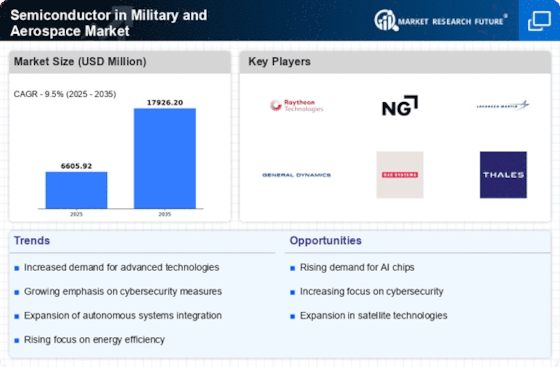
Key players in the Semiconductor in Military and Aerospace Market include Raytheon Technologies, Northrop Grumman, Lockheed Martin, and General Dynamics.

What are the main segments of the Semiconductor in Military and Aerospace Market?

The main segments of the Semiconductor in Military and Aerospace Market include Components, Packaging Type, Technology, Application, and End User.

What was the valuation of the Sensors & Actuators segment in 2024?

The Sensors & Actuators segment was valued at 990.88 USD Million in 2024.

Market Summary

As per MRFR analysis, the Semiconductor in Military and Aerospace Market was estimated at 6605.92 USD Million in 2024. The semiconductor industry is projected to grow from 7233.48 USD Million in 2025 to 17926.2 USD Million by 2035, exhibiting a compound annual growth rate (CAGR) of 9.5 during the forecast period 2025 - 2035.

Key Market Trends & Highlights

The Semiconductor in Military and Aerospace Market is poised for robust growth driven by technological advancements and increasing defense budgets.

  • North America remains the largest market for semiconductors in military and aerospace applications, reflecting its substantial defense investments.
  • The Asia-Pacific region is emerging as the fastest-growing market, propelled by rising demand for advanced military technologies.
  • Sensors and actuators dominate the market, while microcontrollers are experiencing the fastest growth due to their critical role in modern systems.
  • Rising defense budgets and the need for enhanced cybersecurity solutions are key drivers fueling market expansion.

Market Size & Forecast

2024 Market Size 6605.92 (USD Million)
2035 Market Size 17926.2 (USD Million)
CAGR (2025 - 2035) 9.5%
Largest Regional Market Share in 2024 North America

Major Players

<p>Raytheon Technologies (US), Northrop Grumman (US), Lockheed Martin (US), General Dynamics (US), BAE Systems (GB), Thales Group (FR), Leonardo S.p.A. (IT), L3Harris Technologies (US), Honeywell International Inc. (US)</p>

Market Trends

The Semiconductor in Military and Aerospace Market is currently experiencing a transformative phase, driven by advancements in technology and increasing demand for sophisticated defense systems. The integration of semiconductors into military applications is becoming more prevalent, as these components are essential for enhancing the performance and reliability of various systems, including communication, navigation, and weaponry. As nations prioritize modernization and the development of next-generation military capabilities, the role of semiconductors is likely to expand significantly. Furthermore, the aerospace sector is also witnessing a surge in the adoption of semiconductor technologies, particularly in avionics and satellite systems, which are crucial for ensuring operational efficiency and safety. In addition to technological advancements, geopolitical factors are influencing the Semiconductor in Military and Aerospace Market. Countries are investing heavily in domestic semiconductor production to reduce reliance on foreign suppliers, thereby enhancing national security. This trend is accompanied by a growing emphasis on research and development, as stakeholders seek to innovate and create cutting-edge solutions tailored to military and aerospace needs. The convergence of these factors suggests a dynamic market landscape, where the demand for high-performance semiconductors is poised to grow, driven by both defense and aerospace applications. As the market evolves, collaboration between industry players and government entities will likely play a pivotal role in shaping future developments.

Increased Focus on Cybersecurity

The Semiconductor in Military and Aerospace Market is witnessing a heightened emphasis on cybersecurity measures. As military and aerospace systems become more interconnected, the potential for cyber threats increases. This trend indicates that semiconductor manufacturers are prioritizing the development of secure components that can withstand cyberattacks, ensuring the integrity of critical systems.

Advancements in Miniaturization

Miniaturization of semiconductor components is a prominent trend within the Semiconductor in Military and Aerospace Market. Smaller, more efficient chips are enabling the development of compact and lightweight systems, which are essential for modern military and aerospace applications. This trend suggests a shift towards more agile and versatile platforms that can operate in diverse environments.

Sustainability Initiatives

Sustainability is emerging as a key consideration in the Semiconductor in Military and Aerospace Market. Manufacturers are increasingly adopting eco-friendly practices and materials in semiconductor production. This trend reflects a broader commitment to reducing environmental impact while meeting the rigorous demands of military and aerospace applications.

Semiconductor in Military Aerospace Market Market Drivers

Rising Defense Budgets

The increasing defense budgets across various nations appears to be a primary driver for the Semiconductor in Military and Aerospace Market. Countries are allocating substantial resources to enhance their military capabilities, which includes investing in advanced semiconductor technologies. For instance, the United States has proposed a defense budget exceeding 700 billion dollars for the upcoming fiscal year, emphasizing modernization and technological superiority. This trend is mirrored in other nations, where the focus on upgrading military infrastructure necessitates the integration of sophisticated semiconductor solutions. As a result, the demand for high-performance semiconductors is likely to surge, supporting the growth of the industry.

Focus on Autonomous Systems

The focus on autonomous systems is emerging as a significant driver in the Semiconductor in Military and Aerospace Market. Military applications are increasingly incorporating autonomous technologies, such as drones and robotic systems, which rely heavily on advanced semiconductor solutions for navigation, control, and data processing. The market for autonomous military systems is projected to grow substantially, with estimates suggesting a compound annual growth rate of around 10% over the next five years. This growth is likely to create a robust demand for semiconductors that can support the complex functionalities required in autonomous operations, thereby propelling the industry forward.

Technological Advancements in Aerospace

Technological advancements in aerospace are significantly influencing the Semiconductor in Military and Aerospace Market. Innovations such as the development of unmanned aerial vehicles (UAVs) and advanced avionics systems require cutting-edge semiconductor components. The aerospace sector is increasingly adopting systems that rely on high-speed data processing and communication, which necessitates the use of advanced semiconductors. According to industry reports, the aerospace sector is projected to grow at a compound annual growth rate of approximately 4.5% over the next decade. This growth is likely to drive demand for semiconductors that can withstand harsh environments while providing reliable performance.

Emerging Threats and Cybersecurity Needs

Emerging threats in the military domain, particularly in cybersecurity, are reshaping the Semiconductor in Military and Aerospace Market. As military operations become more reliant on digital technologies, the need for robust cybersecurity measures has intensified. Semiconductors play a crucial role in developing secure communication systems and protecting sensitive data. The military is increasingly investing in technologies that enhance cybersecurity, which in turn drives demand for specialized semiconductor solutions. Reports indicate that the cybersecurity market within defense is expected to reach over 30 billion dollars by 2026, highlighting the critical role semiconductors will play in safeguarding military assets.

Increased Demand for Satellite Technologies

The growing demand for satellite technologies is a notable driver of the Semiconductor in Military and Aerospace Market. As nations seek to enhance their communication, surveillance, and reconnaissance capabilities, the reliance on satellite systems has escalated. This trend is evident in the increasing number of satellite launches, with projections indicating that over 1,000 satellites will be launched annually in the coming years. Each satellite requires advanced semiconductor components for functionality, including power management, signal processing, and data transmission. Consequently, the semiconductor industry is likely to experience heightened demand as military applications for satellite technologies expand.

Market Segment Insights

Semiconductor in Military and Aerospace Components Insights

<p>Semiconductor in Military and Aerospace Components Insights</p>

<p>The Semiconductor in Military and Aerospace Market segmentation, based on components, sensors &amp; actuators, optical, memory, microcontrollers, logic &amp; discrete power devices and others. The memory segment held the majority share in 2022 in the Semiconductor in Military and Aerospace Market data. Memory components are a critical part of the Semiconductor in Military and Aerospace Market. These components are used to store and retrieve data in various systems, such as navigation, communication, and sensor systems. Military and aerospace applications require high-reliability memory components that can withstand extreme environmental conditions, including temperature, radiation, and shock.</p>

<p>Semiconductor manufacturers develop specialized memory solutions to meet these requirements, including non-volatile memories such as flash memory, EEPROM, and MRAM. As the demand for data storage and processing continues to grow in the military and aerospace sectors, memory components will continue to be a key area of focus for semiconductor manufacturers.</p>

Semiconductor in Military and Aerospace Packaging Type Insights

<p>Semiconductor in Military and Aerospace Packaging Type Insights</p>

<p>The Semiconductor in Military and Aerospace Market segmentation, based on packaging type, plastics, and ceramics. The ceramics segment held the majority share in 2022 in the Semiconductor in Military and Aerospace Market data. Ceramics packaging is a type of packaging used in the global semiconductor market in military and aerospace. This packaging segment comprises various types of ceramic materials, such as aluminum oxide, beryllium oxide, and silicon carbide. Ceramic packaging offers several advantages over other packaging types, including high thermal conductivity, excellent electrical insulation, and superior mechanical strength.</p>

<p>These characteristics make ceramics packaging ideal for high-temperature and high-power applications, making it a popular choice for military and aerospace systems. The ceramics packaging segment is driven by the increasing demand for miniaturization, higher levels of integration, and the need for reliable and robust packaging solutions. The market for ceramics packaging is expected to continue growing in the coming years due to the increasing adoption of advanced electronics in military and aerospace applications.</p>

Semiconductor in Military and Aerospace Technology Insights

<p>Semiconductor in Military and Aerospace Technology Insights</p>

<p>The Semiconductor in Military and Aerospace Market data, based on Technology, Surface-Mount Technology (SMT) and Through-Hole Technology (THT). The Surface-Mount Technology (SMT) segment held the majority share in 2022 in the Semiconductor in Military and Aerospace Market data. Surface mount technology (SMT) is a type of technology used in the global semiconductor market in military and aerospace. This technology segment comprises various types of components, including resistors, capacitors, diodes, and transistors, which are mounted directly onto the surface of a printed circuit board (PCB).</p>

<p>SMT technology offers several advantages over traditional through-hole technology, including higher component density, better electrical performance, and lower manufacturing costs. These characteristics make SMT technology an ideal choice for military and aerospace applications, where space and weight are critical considerations. The SMT technology segment is driven by the increasing demand for smaller and lighter electronic devices, and the need for improved performance and reliability in harsh environments. The market for SMT technology is expected to continue growing in the coming years due to the increasing adoption of advanced electronics in military and aerospace technology.</p>

Semiconductor in Military and Aerospace Application Insights

<p>Semiconductor in Military and Aerospace Application Insights</p>

<p>The Semiconductor in Military and Aerospace Market data, based on application, Ruggedized Communications, Imaging and Radar, Smart Munitions, Space and Others. The Imaging and Radar segment dominated in the Semiconductor in Military and Aerospace market revenue in 2023 and is projected to be the faster-growing segment during the forecast period, 2023-2030. Imaging and radar are critical applications in the global semiconductor market for military and aerospace.</p>

<p>These applications involve the use of sensors and other electronic components to capture and process images and radar signals for use in a wide range of military and aerospace systems, including surveillance, target acquisition, and navigation. Imaging and radar systems must be able to operate reliably in harsh environments, including low-light and high-temperature conditions, and be resistant to electromagnetic interference. These systems are essential for providing real-time situational awareness and enhancing the effectiveness of military and aerospace operations. As imaging and radar technology continues to advance, the demand for high-performance and reliable semiconductor components will continue to grow.</p>

Semiconductor in Military and Aerospace End Users Insights

<p>Semiconductor in Military and Aerospace End Users Insights</p>

<p>The Semiconductor in Military and Aerospace Market data, based on end users, aerospace and defense. The defense segment dominated in the Semiconductor in Military and Aerospace market revenue in 2022 and is projected to be the faster-growing segment during the forecast period, 2023-2030. The defense end-user is a critical part of the global semiconductor market for military and aerospace applications. Defense end-users include government agencies, military organizations, and defense contractors who purchase and use semiconductor components in a wide range of military and aerospace systems.</p>

<p>These end-users have stringent requirements for the performance, reliability, and safety of semiconductor components, and they often work closely with semiconductor manufacturers to ensure that these requirements are met. As the demand for advanced military and aerospace systems continues to grow, defense end-users will continue to be a driving force in the semiconductor market, pushing for the development of new and innovative semiconductor technologies to meet their needs.</p>

Semiconductor in Military and Aerospace Defense End Users Insights

<p>Semiconductor in Military and Aerospace Defense End Users Insights</p>

<p>The Semiconductor in Military and Aerospace Market data, based on defense end user, communication and navigation systems, integrated vehicle systems, high precision systems, military vehicles and others. The Military Vehicles defense segments dominated in the Semiconductor in Military and Aerospace market revenue in 2022 and is projected to be the faster-growing segment during the forecast period, 2023-2030. Military vehicles are critical components used in defense applications, including transport, logistics, and combat operations. These vehicles require advanced electronics, communication, and navigation systems to operate effectively in challenging environments.</p>

<p>Defense end-users, including government agencies and military organizations, rely on military vehicles to achieve their missions effectively. Semiconductor components play a critical role in enabling these systems, providing the performance and reliability needed for military operations. As the demand for advanced military vehicles continues to grow, defense end-users will continue to be a driving force in the semiconductor market, pushing for the development of new and innovative semiconductor technologies to meet their needs.</p>

Semiconductor in Military and Aerospace, Aerospace End Users Insights

<p>Semiconductor in Military and Aerospace, Aerospace End Users Insights</p>

<p>The Semiconductor in Military and Aerospace Market data, based on aerospace end user, power payload, power management, RF systems, avionics, aircraft, and others. The RF systems aerospace segments dominated in the Semiconductor in Military and Aerospace market revenue in 2023 and is projected to be the faster-growing segment during the forecast period, 2023-2030. RF systems are an essential for military and aerospace systems, enabling secure communication, radar detection, and tracking of targets. The Semiconductor in Military and Aerospace Market caters to end user segments in the aerospace and defense industries, including defense contractors, government agencies, and commercial aerospace companies.</p>

<p>The demand for RF systems in aerospace applications is driven by the need for reliable and secure communication, advanced navigation and guidance systems, and sophisticated radar systems that can detect and track potential threats. The market for RF systems in military and aerospace is expected to grow in the coming years, driven by the increasing demand for unmanned aerial vehicles (UAVs), advanced missile defense systems, and other critical military and aerospace applications that rely on high-performance semiconductor technologies.</p>

Get more detailed insights about Semiconductor in Military and Aerospace Market Research Report - Global Forecast till 2035

Regional Insights

North America : Defense Innovation Leader

North America is the largest market for semiconductors in the military and aerospace sector, holding approximately 45% of the global market share. The region benefits from significant defense budgets, technological advancements, and a strong focus on R&D. Regulatory support, such as the National Defense Authorization Act, further catalyzes growth by ensuring funding for advanced military technologies. The United States is the primary player, with key companies like Raytheon Technologies, Northrop Grumman, and Lockheed Martin leading the charge. The competitive landscape is characterized by continuous innovation and partnerships with government agencies. This region's focus on next-generation technologies, including AI and quantum computing, positions it as a formidable force in the global market.

Europe : Emerging Defense Technology Hub

Europe is witnessing a significant increase in demand for military and aerospace semiconductors, holding around 30% of the global market share. The region's growth is driven by rising defense expenditures, collaborative projects like the European Defence Fund, and a focus on enhancing military capabilities. Regulatory frameworks are evolving to support innovation and integration of advanced technologies in defense systems. Leading countries include the United Kingdom, France, and Germany, with key players such as BAE Systems and Thales Group. The competitive landscape is marked by strategic alliances and joint ventures aimed at developing cutting-edge solutions. Europe's emphasis on sustainability and dual-use technologies further enhances its position in The Semiconductor in Military and Aerospace.

Asia-Pacific : Rapidly Growing Defense Sector

Asia-Pacific is rapidly emerging as a significant player in the military and aerospace semiconductor market, accounting for approximately 20% of the global share. The region's growth is fueled by increasing defense budgets, geopolitical tensions, and a focus on modernization of military capabilities. Countries like India and Japan are enhancing their defense technologies, supported by government initiatives and investments in R&D. China, Japan, and India are the leading countries in this region, with a competitive landscape that includes both state-owned and private enterprises. Companies are increasingly collaborating with international partners to enhance their technological capabilities. The region's focus on indigenous production and self-reliance in defense technologies is shaping its future in the semiconductor market.

Middle East and Africa : Strategic Defense Investments

The Middle East and Africa region is gradually increasing its share in the military and aerospace semiconductor market, currently holding about 5% of the global market. The growth is driven by rising defense budgets, regional conflicts, and a push for modernization of military equipment. Countries are investing in advanced technologies to enhance their defense capabilities, supported by various government initiatives and partnerships with global firms. Leading countries include the UAE and South Africa, with a competitive landscape that features both local and international players. The presence of key companies is growing, as nations seek to develop indigenous capabilities. The region's strategic investments in defense technology are expected to drive future growth in the semiconductor market.

Key Players and Competitive Insights

The Semiconductor in Military and Aerospace Market is characterized by a dynamic competitive landscape, driven by technological advancements and increasing defense budgets globally. Key players such as Raytheon Technologies (US), Northrop Grumman (US), and Lockheed Martin (US) are at the forefront, focusing on innovation and strategic partnerships to enhance their operational capabilities. Raytheon Technologies (US) emphasizes the integration of advanced semiconductor technologies into its defense systems, while Northrop Grumman (US) is actively pursuing mergers and acquisitions to bolster its technological portfolio. Lockheed Martin (US) is concentrating on regional expansion, particularly in Asia-Pacific, to tap into emerging markets. Collectively, these strategies not only enhance their competitive positioning but also shape the market dynamics by fostering a culture of innovation and collaboration.

In terms of business tactics, companies are increasingly localizing manufacturing to mitigate supply chain disruptions and optimize operational efficiency. The market structure appears moderately fragmented, with several players vying for dominance. However, the collective influence of major companies like BAE Systems (GB) and Thales Group (FR) is significant, as they leverage their technological expertise and The Semiconductor in Military and Aerospace. This competitive structure encourages innovation and drives companies to continuously improve their offerings to meet the evolving demands of military and aerospace applications.

In August 2025, Raytheon Technologies (US) announced a strategic partnership with a leading semiconductor manufacturer to develop next-generation microelectronics for defense applications. This collaboration is poised to enhance the performance and reliability of military systems, reflecting Raytheon's commitment to integrating cutting-edge technology into its products. The partnership underscores the importance of innovation in maintaining a competitive edge in the rapidly evolving semiconductor landscape.

In September 2025, Northrop Grumman (US) completed the acquisition of a specialized semiconductor firm, which is expected to significantly enhance its capabilities in developing advanced radar and sensor systems. This acquisition not only strengthens Northrop Grumman's technological foundation but also positions the company to better meet the increasing demand for sophisticated military applications. The move illustrates a broader trend of consolidation within the industry, as companies seek to acquire niche technologies that can provide a competitive advantage.

In October 2025, Lockheed Martin (US) unveiled a new initiative aimed at integrating artificial intelligence into its semiconductor manufacturing processes. This initiative is anticipated to streamline production and improve quality control, thereby enhancing overall operational efficiency. The focus on AI integration reflects a growing trend within the industry, where companies are leveraging digital technologies to optimize their operations and reduce costs.

As of October 2025, the competitive trends in the Semiconductor in Military and Aerospace Market are increasingly defined by digitalization, sustainability, and the integration of artificial intelligence. Strategic alliances are becoming more prevalent, as companies recognize the need to collaborate to drive innovation and address complex challenges. Looking ahead, competitive differentiation is likely to evolve from traditional price-based competition to a focus on technological innovation, supply chain reliability, and the ability to deliver advanced solutions that meet the specific needs of military and aerospace clients.

Key Companies in the Semiconductor in Military Aerospace Market market include

Industry Developments

For Instance, April 2023 TSMC is partnering with Bosch and other European manufacturers to build a 28nm fab in Saxony, Germany, for the automotive industry, despite concerns about national security. The new plant will help address the automotive chip shortage but won't meet the advanced chip needs of the defense industry. Germany lacks a clear semiconductor strategy, and there could be pushback on changing the fab to produce more advanced nodes. However, the global supply chain allows defense contractors in Germany to purchase advanced components from a diversified supplier with a large e-commerce platform.

For Instance, April 2023 Brazil began to establish a relationship with China's technology industry, despite efforts from the United States to discourage Brazil from partnering with China. During a meeting between Chinese Premier Xi Jinping and Brazilian President Luiz Inácio Lula da Silva, they agreed to form a working group to pursue semiconductor production in South America. They also signed 15 agreements to promote joint research and development in various technologies, including satellite rainforest monitoring, 5G communication, internet, and security services.

For Instance, In March 2023 Infineon Technologies, a global technology company that designs and manufactures semiconductors and system solutions, has announced that it has reached a definitive agreement to acquire GaN Systems, a company that specializes in the production of gallium nitride (GaN) power semiconductors. The acquisition will be executed through a cash payment of $830 million.

For Instance, December 2022 L3Harris, a company that works in defense and aerospace, has purchased Aerojet Rocketdyne, a manufacturer that produces propulsion systems and rocket engines for military weapons, ballistic missiles, and space vehicles. This acquisition involves the merging of two companies that operate in related but distinct industries, which is known as a horizontal integration.

For Instance, In October 2022 The American Semiconductor Innovation Coalition (ASIC) plans to present its proposal for the $11 billion investment in semiconductor manufacturing. The plan involves utilizing existing resources, such as the Albany NanoTech Complex and SUNY Poly’s College of Nanoscale Science and Engineering, with the involvement of semiconductor partners, including IBM and Samsung. U.S. military researchers are also seeking radiation-tolerant high-voltage transistors for the space industry. The Space Power Conversion Electronics (SPCE) project has been announced by the U.S. Defense Advanced Research Projects Agency (DARPA) to investigate alternatives like gallium nitride (GaN) and silicon carbide (SiC).

For Instance, August 2022 The Defense Advanced Research Projects Agency (DARPA) had awarded BAE Systems' FAST Labs research and development organization a $17.5 million contract for the Generating RF with Photonic Oscillators for Low Noise (GRYPHON) program. The breakthrough technology developed through the program could enable an unprecedented combination of low noise, compact size, and frequency agility for next-generation airborne sensing and communications capabilities.

For Instance, June 2022 Infineon Technologies AG launched the fully programmable motor controllers MOTIX IMD700A and IMD701A. They come in 9 x 9 mm 2 64-pin VQFN packaging, offering the desired integration and higher power density needed in cordless power tools, gardening products, drones, e-bikes, and automated guided vehicles.

For Instance, January 2022 China will form a committee of chipmakers and universities to boost its chipmaking capabilities and cultivate its digital sovereignty, with the involvement of SMIC and Xiaomi. The committee aims to cooperate with companies such as Intel, AMD, Infineon Technologies, and ASML. Meanwhile, Bosch will spend €205 million ($283 million) to expand the production capacity of its Reutlingen fab in Germany to address the global chip shortage and meet growing demand for SiC microelectronics related to vehicle electrification.

For Instance, In September 2021 Intel launched a new range of 11th Gen Intel Core processors, specifically designed for use in military and aerospace applications, with improved performance and power efficiency.

For Instance, In August 2021 Analog Devices completed its acquisition of Maxim Integrated, creating a combined company with a comprehensive portfolio of high-performance analog and mixed-signal products for use in the military, aerospace, and other industries.

For Instance, In July 2021 STMicroelectronics announced that it had launched a new range of radiation-hardened power MOSFETs designed for use in space and other high-reliability applications.

For Instance, In May 2021 Marvell Technology announced that it had acquired Innovium, a provider of high-performance switch silicon solutions for cloud and edge data centers, including military and aerospace applications. The acquisition will enhance Marvell's capabilities in providing high-speed networking solutions for these markets.

Future Outlook

Semiconductor in Military Aerospace Market Future Outlook

<p>The Semiconductor in Military and Aerospace Market is projected to grow at a 9.5% CAGR from 2024 to 2035, driven by advancements in technology, increased defense budgets, and rising demand for advanced systems.</p>

New opportunities lie in:

  • <p>Development of AI-driven semiconductor solutions for autonomous military systems.</p>
  • <p>Expansion of secure supply chains for critical semiconductor components.</p>
  • <p>Investment in next-generation semiconductor fabrication facilities for aerospace applications.</p>

<p>By 2035, the market is expected to be robust, reflecting substantial growth and innovation.</p>

Market Segmentation

Semiconductor in Military Aerospace Market End User Outlook

  • Defense
  • Communication and Navigation Systems
  • Integrated Vehicle Systems
  • High Precision Systems
  • Military Vehicles
  • Others
  • Aerospace
  • Power Payload
  • Power Management
  • RF Systems
  • Avionics
  • Aircraft
  • Others

Semiconductor in Military Aerospace Market Components Outlook

  • Sensors & Actuators
  • Optical
  • Memory
  • Microcontrollers
  • Logic & Discrete Power Devices
  • Others

Semiconductor in Military Aerospace Market Technology Outlook

  • Surface-Mount Technology (SMT)
  • Through-Hole Technology (THT)

Semiconductor in Military Aerospace Market Application Outlook

  • Ruggedized Communications
  • Imaging and Radar
  • Smart Munitions
  • Space
  • Others

Semiconductor in Military Aerospace Market Packaging Type Outlook

  • Plastics
  • Ceramics

Report Scope

MARKET SIZE 20246605.92(USD Million)
MARKET SIZE 20257233.48(USD Million)
MARKET SIZE 203517926.2(USD Million)
COMPOUND ANNUAL GROWTH RATE (CAGR)9.5% (2024 - 2035)
REPORT COVERAGERevenue Forecast, Competitive Landscape, Growth Factors, and Trends
BASE YEAR2024
Market Forecast Period2025 - 2035
Historical Data2019 - 2024
Market Forecast UnitsUSD Million
Key Companies ProfiledMarket analysis in progress
Segments CoveredMarket segmentation analysis in progress
Key Market OpportunitiesAdvancements in artificial intelligence and machine learning drive demand for innovative semiconductor solutions in military applications.
Key Market DynamicsTechnological advancements drive demand for semiconductors in military and aerospace applications, enhancing operational capabilities and efficiency.
Countries CoveredNorth America, Europe, APAC, South America, MEA

FAQs

What is the projected market valuation for the Semiconductor in Military and Aerospace Market by 2035?

The projected market valuation for the Semiconductor in Military and Aerospace Market is expected to reach 17926.2 USD Million by 2035.

What was the market valuation for the Semiconductor in Military and Aerospace Market in 2024?

The overall market valuation for the Semiconductor in Military and Aerospace Market was 6605.92 USD Million in 2024.

What is the expected CAGR for the Semiconductor in Military and Aerospace Market during the forecast period 2025 - 2035?

The expected CAGR for the Semiconductor in Military and Aerospace Market during the forecast period 2025 - 2035 is 9.5%.

Which companies are considered key players in the Semiconductor in Military and Aerospace Market?

Key players in the Semiconductor in Military and Aerospace Market include Raytheon Technologies, Northrop Grumman, Lockheed Martin, and General Dynamics.

What are the main segments of the Semiconductor in Military and Aerospace Market?

The main segments of the Semiconductor in Military and Aerospace Market include Components, Packaging Type, Technology, Application, and End User.

What was the valuation of the Sensors & Actuators segment in 2024?

The Sensors & Actuators segment was valued at 990.88 USD Million in 2024.

  1. Executive Summary
    1. Market Attractiveness Analysis
      1. Global Semiconductor in Military and Aerospace Market, by Component
      2. Global Semiconductor in Military and Aerospace Market, by Technology
      3. Global Semiconductor in Military and Aerospace Market, by End Use
      4. Global Semiconductor in Military and Aerospace Market, by Packaging Type
      5. Global Semiconductor in Military and Aerospace Market, by Application
      6. Global Semiconductor in Military and Aerospace Market, by Region
  2. Market Introduction
    1. Market Definition
    2. Scope of the Study
    3. Market Structure
    4. Key Buying Criteria
    5. Market Factor Indicator Analysis
  3. Research Methodology
    1. Research Process
    2. Primary Research
    3. Secondary Research
    4. Market Size Estimation
    5. Forecast Model
    6. List of Assumptions
  4. Market Insights
  5. Market Dynamics
    1. Introduction
    2. Drivers
      1. Increasing Military Expenditure
      2. Growing Aircraft Upgradation and Modernization Programs
      3. Rising Demand for Lighter and Advanced Display Screens
      4. Drivers Impact Analysis
    3. Restraints
      1. High Cost of Development
      2. Stringent Government Regulations
      3. Restraints Impact Analysis
    4. Opportunities
    5. Market/Technological Trends
    6. Patent Trends
    7. Regulatory Landscape/Standards
  6. Market Factor Analysis
    1. Supply Chain Analysis
      1. R&D
      2. Manufacturing
      3. Distribution & Sales
      4. Post-Sales Monitoring
    2. Porter’s Five Forces Analysis
      1. Threat of New Entrants
      2. Bargaining Power of Suppliers
      3. Bargaining Power of Buyers
      4. Threat of Substitutes
      5. Intensity of Rivalry
  7. Global Semiconductor in Military and Aerospace Market, by Component
    1. Introduction
    2. Sensors & Actuators
    3. Optical
    4. Memory
    5. Microcontroller
    6. Analog ICs
    7. Logic & Discrete Power Devices
    8. Others
  8. Global Semiconductor in Military and Aerospace Market, by Packaging Type
    1. Introduction
    2. Plastics
    3. Ceramic
  9. Global Semiconductor in Military and Aerospace Market, by Technology
    1. Introduction
    2. Surface Mount Technology (SMT)
    3. Through-Hole Technology (THT)
  10. Global Semiconductor in Military and Aerospace Market, by End Use
    1. Introduction
    2. Aerospace
      1. Power Payload
      2. Power Management
      3. RF Systems
      4. Avionics
      5. Aircraft
      6. Others
    3. Defense
      1. Communication & Navigation Systems
      2. Integrated Vehicle Systems
      3. High Precision Systems
      4. Military Vehicles
      5. Others
  11. Global Semiconductor in Military and Aerospace Market, by Application
    1. Introduction
    2. Ruggedized Communications
    3. Imaging and Radar
    4. Smart Munitions
    5. Space
    6. Others
  12. Global Semiconductor in Military and Aerospace Market, by Region
    1. Introduction
    2. North America
      1. US
      2. Canada
    3. Europe
      1. UK
      2. Germany
      3. France
      4. Italy
      5. Russia
      6. Switzerland
      7. Rest of Europe
    4. Asia-Pacific
      1. China
      2. India
      3. Australia
      4. Japan
      5. South Korea
      6. Rest of Asia-Pacific
    5. Middle East & Africa
      1. UAE
      2. Saudi Arabia
      3. Israel
      4. Rest of the Middle East & Africa
    6. Latin America
      1. Brazil
      2. Rest of Latin America
  13. Competitive Landscape
    1. Competitive Overview
    2. Competitor Dashboard
    3. Major Growth Strategies in the Global Semiconductor in Military and Aerospace Market
    4. Competitive Benchmarking
    5. Market Share Analysis
    6. Leading Player in Terms of Number of Developments in the Global Semiconductor in Military and Aerospace Market
    7. Key Developments & Growth Strategies
      1. Product Launches/Service Deployments
      2. Mergers & Acquisitions
      3. Joint Ventures
  14. Company Profiles
    1. Key Market Players
    2. (Company overview, products & services offered, financial overview, key developments, SWOT analysis, and key strategies to be covered for public companies)
    3. BAE Systems
    4. Airbus SAS
    5. General Dynamics Corporation
    6. Lockheed Martin Corporation
    7. Northrop Grumman Corporation
    8. Raytheon Company
    9. Infineon Technologies AG
    10. Intel Corporation
    11. Texas Instruments Incorporated
    12. Microchip Technology Inc.
  15. Other Prominent Players
    1. Digitron Semiconductors
    2. Skyworks Solutions, Inc.
    3. Semtech Corporation
    4. Mouser Electronics, Inc.
    5. NEC Corporation
    6. Teledyne Technologies Inc.
    7. ON Semiconductor
    8. Aerospace Semiconductor, Inc.
    9. Linear Systems
    10. Honeywell International Inc.
    11. STMicroelectronics
    12. KCB Solutions
    13. XTREME Semiconductor
    14. GLOBALFOUNDRIES
  16. Appendix
    1. References
    2. Related Reports
    3. List of Abbreviations
    4. List of Tables
  17. List of Assumptions
  18. Major Patents Granted for Semiconductor in Military and Aerospace (2014–2019)
  19. Global Semiconductor in Military and Aerospace Market, by Component, 2018–2030 (USD Million)
  20. Global Semiconductor in Military and Aerospace Market, by End Use, 2018–2030 (USD Million)
  21. Global Semiconductor in Military and Aerospace Market, by Packaging Type, 2018–2030 (USD Million)
  22. Global Semiconductor in Military and Aerospace Market, By Technology, 2018–2030 (USD Million)
  23. GLOBAL Semiconductor in Military and Aerospace Market, By Application, 2018–2030 (USD Million)
  24. Global Semiconductor in Military and Aerospace Market, by Region, 2018–2030 (USD Million)
  25. North America: Semiconductor in Military and Aerospace Market, by Country, 2018–2030 (USD Million)
  26. North America: Semiconductor in Military and Aerospace Market, by Component, 2018–2030 (USD Million)
  27. North America: Semiconductor in Military and Aerospace Market, by End Use, 2018–2030 (USD Million)
  28. North America: Semiconductor in Military and Aerospace Market, by Packaging Type, 2018–2030 (USD Million)
  29. North America: Semiconductor in Military and Aerospace Market, By Technology, 2018–2030 (USD Million)
  30. North America: Semiconductor in Military and Aerospace Market, By Application, 2018–2030 (USD Million)
  31. US: Semiconductor in Military and Aerospace Market, by Component, 2018–2030 (USD Million)
  32. US: Semiconductor in Military and Aerospace Market, by End Use, 2018–2030 (USD Million)
  33. US: Semiconductor in Military and Aerospace Market, by Packaging Type, 2018–2030 (USD Million)
  34. US: Semiconductor in Military and Aerospace Market, by Technology, 2018–2030 (USD Million)
  35. US: Semiconductor in Military and Aerospace Market, by Application, 2018–2030 (USD Million)
  36. Canada: Semiconductor in Military and Aerospace Market, by Component, 2018–2030 (USD Million)
  37. Canada: Semiconductor in Military and Aerospace Market, by End Use, 2018–2030 (USD Million)
  38. Canada: Semiconductor in Military and Aerospace Market, by Packaging Type, 2018–2030 (USD Million)
  39. Canada: Semiconductor in Military and Aerospace Market, by Technology, 2018–2030 (USD Million)
  40. Canada: Semiconductor in Military and Aerospace Market, by Application, 2018–2030 (USD Million)
  41. Europe: Semiconductor in Military and Aerospace Market, by Country, 2018–2030 (USD Million)
  42. Europe: Semiconductor in Military and Aerospace Market, by Component, 2018–2030 (USD Million)
  43. Europe: Semiconductor in Military and Aerospace Market, by End Use, 2018–2030 (USD Million)
  44. Europe: Semiconductor in Military and Aerospace Market, by Packaging Type, 2018–2030 (USD Million)
  45. Europe: Semiconductor in Military and Aerospace Market, by Technology, 2018–2030 (USD Million)
  46. Europe: Semiconductor in Military and Aerospace Market, by Application, 2018–2030 (USD Million)
  47. UK: Semiconductor in Military and Aerospace Market, by Component, 2018–2030 (USD Million)
  48. UK: Semiconductor in Military and Aerospace Market, by End Use, 2018–2030 (USD Million)
  49. UK: Semiconductor in Military and Aerospace Market, by Packaging Type, 2018–2030 (USD Million)
  50. UK: Semiconductor in Military and Aerospace Market, by Technology, 2018–2030 (USD Million)
  51. UK: Semiconductor in Military and Aerospace Market, by Application, 2018–2030 (USD Million)
  52. Germany: Semiconductor in Military and Aerospace Market, by Component, 2018–2030 (USD Million)
  53. Germany: Semiconductor in Military and Aerospace Market, by End Use, 2018–2030 (USD Million)
  54. Germany: Semiconductor in Military and Aerospace Market, by Packaging Type, 2018–2030 (USD Million)
  55. Germany: Semiconductor in Military and Aerospace Market, by Technology, 2018–2030 (USD Million)
  56. Germany: Semiconductor in Military and Aerospace Market, by Application, 2018–2030 (USD Million)
  57. France: Semiconductor in Military and Aerospace Market, by Component, 2018–2030 (USD Million)
  58. France: Semiconductor in Military and Aerospace Market, by End Use, 2018–2030 (USD Million)
  59. France: Semiconductor in Military and Aerospace Market, by Packaging Type, 2018–2030 (USD Million)
  60. France: Semiconductor in Military and Aerospace Market, by Technology, 2018–2030 (USD Million)
  61. France: Semiconductor in Military and Aerospace Market, by Application, 2018–2030 (USD Million)
  62. Italy: Semiconductor in Military and Aerospace Market, by Component, 2018–2030 (USD Million)
  63. Italy: Semiconductor in Military and Aerospace Market, by End Use, 2018–2030 (USD Million)
  64. Italy: Semiconductor in Military and Aerospace Market, by Packaging Type, 2018–2030 (USD Million)
  65. Italy: Semiconductor in Military and Aerospace Market, by Technology, 2018–2030 (USD Million)
  66. Italy: Semiconductor in Military and Aerospace Market, by Application, 2018–2030 (USD Million)
  67. Switzerland: Semiconductor in Military and Aerospace Market, by Component, 2018–2030 (USD Million)
  68. Switzerland: Semiconductor in Military and Aerospace Market, by End Use, 2018–2030 (USD Million)
  69. Switzerland: Semiconductor in Military and Aerospace Market, by Packaging Type, 2018–2030 (USD Million)
  70. Switzerland: Semiconductor in Military and Aerospace Market, by Technology, 2018–2030 (USD Million)
  71. Switzerland: Semiconductor in Military and Aerospace Market, by Application, 2018–2030 (USD Million)
  72. Russia: Semiconductor in Military and Aerospace Market, by Component, 2018–2030 (USD Million)
  73. Russia: Semiconductor in Military and Aerospace Market, by End Use, 2018–2030 (USD Million)
  74. Russia: Semiconductor in Military and Aerospace Market, by Packaging Type, 2018–2030 (USD Million)
  75. Russia: Semiconductor in Military and Aerospace Market, by Technology, 2018–2030 (USD Million)
  76. Russia: Semiconductor in Military and Aerospace Market, by Application, 2018–2030 (USD Million)
  77. Rest of Europe: Semiconductor in Military and Aerospace Market, by Component, 2018–2030 (USD Million)
  78. Rest of Europe: Semiconductor in Military and Aerospace Market, by End Use, 2018–2030 (USD Million)
  79. Rest of Europe: Semiconductor in Military and Aerospace Market, by Packaging Type, 2018–2030 (USD Million)
  80. Rest of Europe: Semiconductor in Military and Aerospace Market, by Technology, 2018–2030 (USD Million)
  81. Rest of Europe: Semiconductor in Military and Aerospace Market, by Application, 2018–2030 (USD Million)
  82. Asia-Pacific: Semiconductor in Military and Aerospace Market, by Country, 2018–2030 (USD Million)
  83. Asia-Pacific: Semiconductor in Military and Aerospace Market, by Component, 2018–2030 (USD Million)
  84. Asia-Pacific: Semiconductor in Military and Aerospace Market, by End Use, 2018–2030 (USD Million)
  85. Asia-Pacific: Semiconductor in Military and Aerospace Market, by Packaging Ty

Semiconductor in Military and Aerospace Market Segmentation

Semiconductor in Military and Aerospace Components Outlook (USD Million, 2018-2030)

Sensors & Actuators

Optical

Memory

Microcontrollers

Logic & Discrete Power Devices

Others

Semiconductor in Military and Aerospace Packaging Type Outlook (USD Million, 2018-2030)

Plastics

Ceramics

Semiconductor in Military and Aerospace Technology Outlook (USD Million, 2018-2030)

Surface-Mount Technology (SMT)

Through-Hole Technology (THT)

Semiconductor in Military and Aerospace Application Outlook (USD Million, 2018-2030)

Ruggedized Communications

Imaging and Radar

Smart Munitions

Space

Others

Semiconductor in Military and Aerospace End user Outlook (USD Million, 2018-2030)

Defense

Communication and Navigation Systems

Integrated Vehicle Systems

High Precision Systems

Military Vehicles

Other

Aerospace

Power Payload

Power Management

RF Systems

Avionics

Aircraft

Others

Semiconductor in Military and Aerospace Regional Outlook (USD Million, 2018-2030)

North America Outlook (USD Million, 2018-2030)

North America Semiconductor in Military and Aerospace by Components

Sensors & Actuators

Optical

Memory

Microcontrollers

Logic & Discrete Power Devices

Others

North America Semiconductor in Military and Aerospace by Packaging Type

Plastics

Ceramics

North America Semiconductor in Military and Aerospace by Technology

Surface-Mount Technology (SMT)

Through-Hole Technology (THT)

North America Semiconductor in Military and Aerospace by Application

Ruggedized Communications

Imaging and Radar

Smart Munitions

Space

Others

North America Semiconductor in Military and Aerospace by End User

Defense

Communication and Navigation System

Integrated Vehicle Systems

High Precision Systems

Military Vehicles

Others

Aerospace

Power Payload

Power Management

RF Systems

Avionics

Aircraft

Others

US Outlook (USD Million, 2018-2030)

US Semiconductor in Military and Aerospace by Components

Sensors & Actuators

Optical

Memory

Microcontrollers

Logic & Discrete Power Devices

Others

US Semiconductor in Military and Aerospace by Packaging Type

Plastics

Ceramics


US Semiconductor in Military and Aerospace by Technology

Surface-Mount Technology (SMT)

Through-Hole Technology (THT)

US Semiconductor in Military and Aerospace by Application

Ruggedized Communications

Imaging and Radar

Smart Munitions

Space

Others

US Semiconductor in Military and Aerospace by End User

Defense

Communication and Navigation System

Integrated Vehicle Systems

High Precision Systems

Military Vehicles

Others

Aerospace

Power Payload

Power Management

RF Systems

Avionics

Aircraft

Others

 

Canada Outlook (USD Million, 2018-2030)

Canada Semiconductor in Military and Aerospace by Components

Sensors & Actuators

Optical

Memory

Microcontrollers

Logic & Discrete Power Devices

Others

Canada Semiconductor in Military and Aerospace by Packaging Type

Plastics

Ceramics

Canada Semiconductor in Military and Aerospace by Technology

Surface-Mount Technology (SMT)

Through-Hole Technology (THT)

Canada Semiconductor in Military and Aerospace by Application

Ruggedized Communications

Imaging and Radar

Smart Munitions

Space

Others

Canada Semiconductor in Military and Aerospace by End User

Defense

Communication and Navigation System

Integrated Vehicle Systems

High Precision Systems

Military Vehicles

Others

Aerospace

Power Payload

Power Management

RF Systems

Avionics

Aircraft

Others
 

Europe Outlook (USD Million, 2018-2030)

Europe Semiconductor in Military and Aerospace by Components

Sensors & Actuators

Optical

Memory

Microcontrollers

Logic & Discrete Power Devices

Others

Europe Semiconductor in Military and Aerospace by Packaging Type

Plastics

Ceramics

Europe Semiconductor in Military and Aerospace by Technology

Surface-Mount Technology (SMT)

Through-Hole Technology (THT)

Europe Semiconductor in Military and Aerospace by Application

Ruggedized Communications

Imaging and Radar

Smart Munitions

Space

Others

Europe Semiconductor in Military and Aerospace by End User

Defense

Communication and Navigation System

Integrated Vehicle Systems

High Precision Systems

Military Vehicles

Others

Aerospace

Power Payload

Power Management

RF Systems

Avionics

Aircraft

Others
Germany Outlook (USD Million, 2018-2030)

Germany Semiconductor in Military and Aerospace by Components

Sensors & Actuators

Optical

Memory

Microcontrollers

Logic & Discrete Power Devices

Others

Germany Semiconductor in Military and Aerospace by Packaging Type

Plastics

Ceramics

Germany Semiconductor in Military and Aerospace by Technology

Surface-Mount Technology (SMT)

Through-Hole Technology (THT)

Germany Semiconductor in Military and Aerospace by Application

Ruggedized Communications

Imaging and Radar

Smart Munitions

Space

Others

Germany Semiconductor in Military and Aerospace by End User

Defense

Communication and Navigation System

Integrated Vehicle Systems

High Precision Systems

Military Vehicles

Others

Aerospace

Power Payload

Power Management

RF Systems

Avionics

Aircraft

Others
France Outlook (USD Million, 2018-2030)

France Semiconductor in Military and Aerospace by Components

Sensors & Actuators

Optical

Memory

Microcontrollers

Logic & Discrete Power Devices

Others

France Semiconductor in Military and Aerospace by Packaging Type

Plastics

Ceramics

France Semiconductor in Military and Aerospace by Technology

Surface-Mount Technology (SMT)

Through-Hole Technology (THT)

France Semiconductor in Military and Aerospace by Application

Ruggedized Communications

Imaging and Radar

Smart Munitions

Space

Others

France Semiconductor in Military and Aerospace by End User

Defense

Communication and Navigation System

Integrated Vehicle Systems

High Precision Systems

Military Vehicles

Others

Aerospace

Power Payload

Power Management

RF Systems

Avionics

Aircraft

Others

UK Outlook (USD Million, 2018-2030)

UK Semiconductor in Military and Aerospace by Components

Sensors & Actuators

Optical

Memory

Microcontrollers

Logic & Discrete Power Devices

Others

UK Semiconductor in Military and Aerospace by Packaging Type

Plastics

Ceramics

UK Semiconductor in Military and Aerospace by Technology

Surface-Mount Technology (SMT)

Through-Hole Technology (THT)

UK Semiconductor in Military and Aerospace by Application

Ruggedized Communications

Imaging and Radar

Smart Munitions

Space

Others

UK Semiconductor in Military and Aerospace by End User

Defense

Communication and Navigation System

Integrated Vehicle Systems

High Precision Systems

Military Vehicles

Others

Aerospace

Power Payload

Power Management

RF Systems

Avionics

Aircraft

Others
Italy Outlook (USD Million, 2018-2030)

Italy Semiconductor in Military and Aerospace by Components

Sensors & Actuators

Optical

Memory

Microcontrollers

Logic & Discrete Power Devices

Others

Italy Semiconductor in Military and Aerospace by Packaging Type

Plastics

Ceramics

Italy Semiconductor in Military and Aerospace by Technology

Surface-Mount Technology (SMT)

Through-Hole Technology (THT)

Italy Semiconductor in Military and Aerospace by Application

Ruggedized Communications

Imaging and Radar

Smart Munitions

Space

Others

Italy Semiconductor in Military and Aerospace by End User

Defense

Communication and Navigation System

Integrated Vehicle Systems

High Precision Systems

Military Vehicles

Others

Aerospace

Power Payload

Power Management

RF Systems

Avionics

Aircraft

Others
Spain Outlook (USD Million, 2018-2030)

Spain Semiconductor in Military and Aerospace by Components

Sensors & Actuators

Optical

Memory

Microcontrollers

Logic & Discrete Power Devices

Others

Spain Semiconductor in Military and Aerospace by Packaging Type

Plastics

Ceramics

Spain Semiconductor in Military and Aerospace by Technology

Surface-Mount Technology (SMT)

Through-Hole Technology (THT)

Spain Semiconductor in Military and Aerospace by Application

Ruggedized Communications

Imaging and Radar

Smart Munitions

Space

Others

Spain Semiconductor in Military and Aerospace by End User

Defense

Communication and Navigation System

Integrated Vehicle Systems

High Precision Systems

Military Vehicles

Others

Aerospace

Power Payload

Power Management

RF Systems

Avionics

Aircraft

Others
Rest Of Europe Outlook (USD Million, 2018-2030)

Rest of Europe Semiconductor in Military and Aerospace by Components

Sensors & Actuators

Optical

Memory

Microcontrollers

Logic & Discrete Power Devices

Others

Rest of Europe Semiconductor in Military and Aerospace by Packaging Type

Plastics

Ceramics

Rest of Europe Semiconductor in Military and Aerospace by Technology

Surface-Mount Technology (SMT)

Through-Hole Technology (THT)

Rest of Europe Semiconductor in Military and Aerospace by Application

Ruggedized Communications

Imaging and Radar

Smart Munitions

Space

Others

Rest of Europe Semiconductor in Military and Aerospace by End User

Defense

Communication and Navigation System

Integrated Vehicle Systems

High Precision Systems

Military Vehicles

Others

Aerospace

Power Payload

Power Management

RF Systems

Avionics

Aircraft

Others
Asia-Pacific Outlook (USD Million, 2018-2030)

Asia-Pacific Semiconductor in Military and Aerospace by Components

Sensors & Actuators

Optical

Memory

Microcontrollers

Logic & Discrete Power Devices

Others

Asia-Pacific Semiconductor in Military and Aerospace by Packaging Type

Plastics

Ceramics

Asia-Pacific Semiconductor in Military and Aerospace by Technology

Surface-Mount Technology (SMT)

Through-Hole Technology (THT)

Asia-Pacific Semiconductor in Military and Aerospace by Application

Ruggedized Communications

Imaging and Radar

Smart Munitions

Space

Others

Asia-Pacific Semiconductor in Military and Aerospace by End User

Defense

Communication and Navigation System

Integrated Vehicle Systems

High Precision Systems

Military Vehicles

Others

Aerospace

Power Payload

Power Management

RF Systems

Avionics

Aircraft

Others

China Outlook (USD Million, 2018-2030)

China Semiconductor in Military and Aerospace by Components

Sensors & Actuators

Optical

Memory

Microcontrollers

Logic & Discrete Power Devices

Others

China Semiconductor in Military and Aerospace by Packaging Type

Plastics

Ceramics

China Semiconductor in Military and Aerospace by Technology

Surface-Mount Technology (SMT)

Through-Hole Technology (THT)

China Semiconductor in Military and Aerospace by Application

Ruggedized Communications

Imaging and Radar

Smart Munitions

Space

Others

China Semiconductor in Military and Aerospace by End User

Defense

Communication and Navigation System

Integrated Vehicle Systems

High Precision Systems

Military Vehicles

Others

Aerospace

Power Payload

Power Management

RF Systems

Avionics

Aircraft

Others

Japan Outlook (USD Million, 2018-2030)

Japan Semiconductor in Military and Aerospace by Components

Sensors & Actuators

Optical

Memory

Microcontrollers

Logic & Discrete Power Devices

Others

Japan Semiconductor in Military and Aerospace by Packaging Type

Plastics

Ceramics

Japan Semiconductor in Military and Aerospace by Technology

Surface-Mount Technology (SMT)

Through-Hole Technology (THT)

Japan Semiconductor in Military and Aerospace by Application

Ruggedized Communications

Imaging and Radar

Smart Munitions

Space

Others

Japan Semiconductor in Military and Aerospace by End User

Defense

Communication and Navigation System

Integrated Vehicle Systems

High Precision Systems

Military Vehicles

Others

Aerospace

Power Payload

Power Management

RF Systems

Avionics

Aircraft

Others

India Outlook (USD Million, 2018-2030)

India Semiconductor in Military and Aerospace by Components

Sensors & Actuators

Optical

Memory

Microcontrollers

Logic & Discrete Power Devices

Others

India Semiconductor in Military and Aerospace by Packaging Type

Plastics

Ceramics

India Semiconductor in Military and Aerospace by Technology

Surface-Mount Technology (SMT)

Through-Hole Technology (THT)

India Semiconductor in Military and Aerospace by Application

Ruggedized Communications

Imaging and Radar

Smart Munitions

Space

Others

India Semiconductor in Military and Aerospace by End User

Defense

Communication and Navigation System

Integrated Vehicle Systems

High Precision Systems

Military Vehicles

Others

Aerospace

Power Payload

Power Management

RF Systems

Avionics

Aircraft

Others

Australia Outlook (USD Million, 2018-2030)

Australia Semiconductor in Military and Aerospace by Components

Sensors & Actuators

Optical

Memory

Microcontrollers

Logic & Discrete Power Devices

Others

Australia Semiconductor in Military and Aerospace by Packaging Type

Plastics

Ceramics

Australia Semiconductor in Military and Aerospace by Technology

Surface-Mount Technology (SMT)

Through-Hole Technology (THT)

Australia Semiconductor in Military and Aerospace by Application

Ruggedized Communications

Imaging and Radar

Smart Munitions

Space

Others

Australia Semiconductor in Military and Aerospace by End User

Defense

Communication and Navigation System

Integrated Vehicle Systems

High Precision Systems

Military Vehicles

Others

Aerospace

Power Payload

Power Management

RF Systems

Avionics

Aircraft

Others

Rest of Asia-Pacific Outlook (USD Million, 2018-2030)

Rest of Asia-Pacific Semiconductor in Military and Aerospace by Components

Sensors & Actuators

Optical

Memory

Microcontrollers

Logic & Discrete Power Devices

Others

Rest of Asia-Pacific Semiconductor in Military and Aerospace by Packaging Type

Plastics

Ceramics

Rest of Asia-Pacific Semiconductor in Military and Aerospace by Technology

Surface-Mount Technology (SMT)

Through-Hole Technology (THT)

Rest of Asia-Pacific Semiconductor in Military and Aerospace by Application

Ruggedized Communications

Imaging and Radar

Smart Munitions

Space

Others

Rest of Asia-Pacific Semiconductor in Military and Aerospace by End User

Defense

Communication and Navigation System

Integrated Vehicle Systems

High Precision Systems

Military Vehicles

Others

Aerospace

Power Payload

Power Management

RF Systems

Avionics

Aircraft

Others

Rest of the World Outlook (USD Million, 2018-2030)

Rest of the World Semiconductor in Military and Aerospace by Components

Sensors & Actuators

Optical

Memory

Microcontrollers

Logic & Discrete Power Devices

Others

Rest of the World Semiconductor in Military and Aerospace by Packaging Type

Plastics

Ceramics

Rest of the World Semiconductor in Military and Aerospace by Technology

Surface-Mount Technology (SMT)

Through-Hole Technology (THT)

Rest of the World Semiconductor in Military and Aerospace by Application

Ruggedized Communications

Imaging and Radar

Smart Munitions

Space

Others

Rest of the World Semiconductor in Military and Aerospace by End User

Defense

Communication and Navigation System

Integrated Vehicle Systems

High Precision Systems

Military Vehicles

Others

Aerospace

Power Payload

Power Management

RF Systems

Avionics

Aircraft

Others

Middle East Outlook (USD Million, 2018-2030)

Middle East Semiconductor in Military and Aerospace by Components

Sensors & Actuators

Optical

Memory

Microcontrollers

Logic & Discrete Power Devices

Others

Middle East Semiconductor in Military and Aerospace by Packaging Type

Plastics

Ceramics

Middle East Semiconductor in Military and Aerospace by Technology

Surface-Mount Technology (SMT)

Through-Hole Technology (THT)

Middle East Semiconductor in Military and Aerospace by Application

Ruggedized Communications

Imaging and Radar

Smart Munitions

Space

Others

Middle East Semiconductor in Military and Aerospace by End User

Defense

Communication and Navigation System

Integrated Vehicle Systems

High Precision Systems

Military Vehicles

Others

Aerospace

Power Payload

Power Management

RF Systems

Avionics

Aircraft

Others

Africa Outlook (USD Million, 2018-2030)

Africa Semiconductor in Military and Aerospace by Components

Sensors & Actuators

Optical

Memory

Microcontrollers

Logic & Discrete Power Devices

Others

Africa Semiconductor in Military and Aerospace by Packaging Type

Plastics

Ceramics

Africa Semiconductor in Military and Aerospace by Technology

Surface-Mount Technology (SMT)

Through-Hole Technology (THT)

Africa Semiconductor in Military and Aerospace by Application

Ruggedized Communications

Imaging and Radar

Smart Munitions

Space

Others

Africa Semiconductor in Military and Aerospace by End User

Defense

Communication and Navigation System

Integrated Vehicle Systems

High Precision Systems

Military Vehicles

Others

Aerospace

Power Payload

Power Management

RF Systems

Avionics

Aircraft

Others

South America Outlook (USD Million, 2018-2030)

South America Semiconductor in Military and Aerospace by Components

Sensors & Actuators

Optical

Memory

Microcontrollers

Logic & Discrete Power Devices

Others

South America Semiconductor in Military and Aerospace by Packaging Type

Plastics

Ceramics

South America Semiconductor in Military and Aerospace by Technology

Surface-Mount Technology (SMT)

Through-Hole Technology (THT)


South America Semiconductor in Military and Aerospace by Application

Ruggedized Communications

Imaging and Radar

Smart Munitions

Space

Others

South America Semiconductor in Military and Aerospace by End User

Defense

Communication and Navigation System

Integrated Vehicle Systems

High Precision Systems

Military Vehicles

Others

Aerospace

Power Payload

Power Management

RF Systems

Avionics

Aircraft

Others

Infographic

Free Sample Request

Kindly complete the form below to receive a free sample of this Report

Get Free Sample

Customer Strories

Compare Licence

×
Features License Type
Single User Multiuser License Enterprise User
Price $4,950 $5,950 $7,250
Maximum User Access Limit 1 User Upto 10 Users Unrestricted Access Throughout the Organization
Free Customization
Direct Access to Analyst
Deliverable Format
Platform Access
Discount on Next Purchase 10% 15% 15%
Printable Versions





