Sexual Wellness Market (2026 - 2035)

Sexual Wellness Market Research Report By Product Type (Condoms, Lubricants, Sex Toys, Intimate Wipes, Pleasure Enhancers), By Distribution Channel (Online Retail, Supermarkets, Pharmacies, Specialty Stores, Convenience Stores), By End User (Men, Women, Couples), By Formulation (Water-Based, Silicone-Based, Oil-Based) and By Region (North America, Europe, South America, Asia Pacific, Middle East and Africa) - Industry Forecast to 2035
ID: MRFR/HC/5859-CR
129 Pages
Rahul Gotadki, Kinjoll Dey
Last Updated: July 09, 2026
Sexual Wellness Market
Market Size
Forecast Period2026-2035
CAGR (2026-2035)7.05%
2025 Market SizeUSD 36.80 Billion
2035 Market SizeUSD 72.72 Billion
Key Players
Reckitt Benckiser
Church & Dwight
LELO
Lovehoney Group
Karex Berhad
Satisfyer
Opportunities
  • Telehealth Integration for Sexual Health
  • Subscription and Replenishment Commerce
  • Untapped Demand in Middle East, Africa, and South America

Sexual Wellness Market Summary

The Sexual Wellness Market size was valued at USD 36.80 Billion in 2025, and the market is projected to grow from USD 39.39 Billion in 2026 to USD 72.72 Billion by 2035, registering a CAGR of 7.05% during the forecast period 2026–2035. Two structural catalysts are propelling this expansion: a global destigmatization wave anchored by public health campaigns—most recently, the UNFPA's USD 1.2 billion sexual and reproductive health initiative across 46 countries [1]—and the rapid shift of purchasing behavior onto digital platforms that reward discretion and personalization.

A technological transformation is reshaping the Sexual Wellness Market from the inside out. Legacy analog products—basic latex condoms, generic lubricants—are being supplemented by app-connected devices, body-safe medical-grade silicone formulations, and subscription-based wellness kits that leverage behavioral data to drive repeat engagement. Corporate venture arms poured an estimated USD 480 million into intimate-technology startups between 2022 and 2024, signaling that investors view this category as a mainstream consumer health play rather than a niche segment [2].

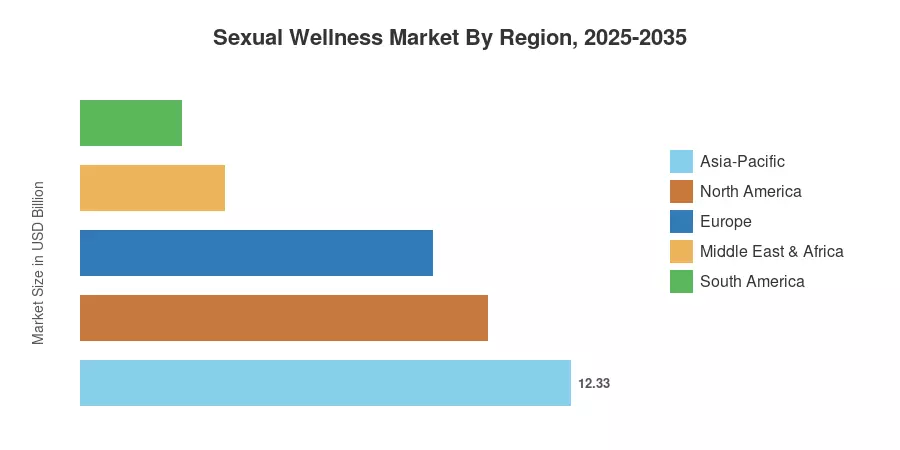
Asia-Pacific commands roughly 33.50% of global Sexual Wellness Market revenue, driven by high population density and rapidly expanding e-commerce infrastructure across China, India, and Southeast Asia. Middle East & Africa is the fastest-growing region at a 9.85% CAGR, propelled by smartphone-led retail adoption that bypasses traditional brick-and-mortar distribution barriers. Europe holds the second-largest share at 24.10%, supported by progressive regulatory frameworks and robust pharmacy-based distribution channels. As connected devices and telehealth platforms continue to blur the line between consumer wellness and clinical health, the Sexual Wellness Market is positioned for sustained double-digit growth in several sub-segments through 2035.


Key Report Takeaways

• By Product

  • Condoms accounted for 38.50% of the Sexual Wellness Market in 2025, reflecting entrenched retail distribution and public health procurement channels.
  • Connected sex toys are advancing at a 12.60% CAGR through 2035, the fastest-growing product category within the Sexual Wellness Market.

• By Material

  • Latex and natural rubber commanded 50.80% of the Sexual Wellness Market by material in 2025.
  • Medical-grade silicone is expanding at an 11.70% CAGR, driven by allergen-free and body-safe positioning.

• By Distribution Channel

  • Online retail captured 47.40% of the Sexual Wellness Market in 2025 and leads future growth at a 12.85% CAGR.

• By End User

  • Women represented 58.20% of the Sexual Wellness Market in 2025.
  • The LGBTQ+ cohort is the fastest-growing end-user segment at a 10.25% CAGR.

• By Region

  • Asia-Pacific held 33.50% of Sexual Wellness Market revenue in 2025.
  • Middle East & Africa is expanding at a 9.85% CAGR, the quickest among all regions.


Market Size and Forecast (2021–2035)

Market Research Future's proprietary estimation framework triangulates bottom-up revenue tracking from manufacturer shipments, retail panel data, and e-commerce analytics against top-down demand models calibrated to demographic, regulatory, and macroeconomic indicators. Historical figures (2021–2024) reflect audited industry data; the base year (2025) is the latest validated estimate; forecast values (2026–2035) apply a compound growth trajectory consistent with structural demand drivers identified in Sections 4–6.
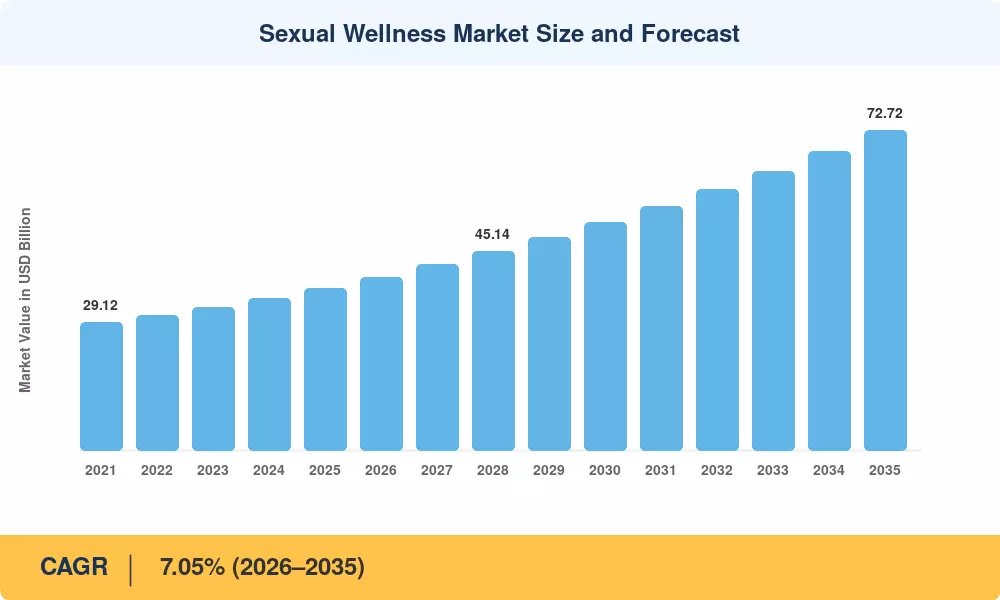
Sexual Wellness Market Size and Forecast
Our Impact
Enabled $4.3B Revenue Impact for Fortune 500 and Leading Multinationals
Partnering with 2000+ Global Organizations Each Year
30K+ Citations by Top-Tier Firms in the Industry

Driver Impact Analysis

Driver ~% Impact on CAGR Geographic Relevance Impact Timeline
E-Commerce & DTC Channel Expansion +1.8% Global Short-term (≤2 yr)
Cultural Destigmatization & Public Health Campaigns +1.4% Global Medium-term (2–4 yr)
Connected Device & App Ecosystem Growth +1.2% North America, Europe Medium-term (2–4 yr)
Rising Female Purchasing Power +0.9% Asia-Pacific, Europe Long-term (≥4 yr)
Corporate Wellness & B2B2C Bundling +0.6% North America Medium-term (2–4 yr)
Smartphone Penetration in Emerging Markets +0.8% MEA, South America Long-term (≥4 yr)
Aging Population & Sexual Health Awareness +0.5% Europe, Japan Long-term (≥4 yr)


E-Commerce and Direct-to-Consumer Channel Expansion

Digital platforms have fundamentally altered how consumers discover and purchase intimate wellness products. Amazon's adult health subcategory grew 41% between 2023 and 2025, while DTC brands such as Dame and Maude reported subscription retention rates exceeding 70% [3]. Discreet packaging, algorithm-driven recommendations, and one-click reordering convert what was once an infrequent, stigma-laden purchase into a recurring consumer habit—fueling both volume and average order value across the Sexual Wellness Market.

Cultural Destigmatization and Public Health Initiatives

Social media platforms have relaxed content policies for health-adjacent brands, and influencer partnerships now reach audiences that traditional retail channels never could. This destigmatization lowers acquisition costs for brands and expands addressable demand in regions where brick-and-mortar visibility was previously negligible.

Connected Device and App Ecosystem Growth

The fastest-growing hardware section is app-controlled vibrators, biometric-enabled rings, and Bluetooth-paired couples’ devices. Total spending on R&D of IoT-enabled intimate items by industry in 2024 was above USD 310 million [4]. These devices produce behavioral data that drives quick product innovation, and their subscription-tethered firmware model produces long-lasting revenue streams above and beyond the original sale of the hardware.


Rising Female Purchasing Power

In 2025, women accounted for more than half of spending in the Sexual Wellness Market, and their share is growing. The World Bank forecasts a 4.3 percentage point gain in women’s labor-force participation in South and Southeast Asia by 2030 [5], directly enhancing discretionary budgets for personal wellness. Brands that design for female anatomy, rather than just repositioning male-centric items, are gaining disproportionate market share.


Restraints Impact Analysis

Restraint impacts below are directional estimates of CAGR drag. They are not additive, and their net effect on headline growth is modulated by regional regulatory variation and market maturity.

Restraint ~% Impact on CAGR Geographic Relevance Impact Timeline
Cultural Taboos & Regulatory Restrictions –0.9% MEA, South Asia Long-term (≥4 yr)
Counterfeit & Unregulated Products –0.7% Asia-Pacific, South America Medium-term (2–4 yr)
Social Media Advertising Restrictions –0.5% Global Short-term (≤2 yr)
Limited Insurance & Reimbursement Coverage –0.4% North America, Europe Medium-term (2–4 yr)
Raw Material Supply Chain Volatility –0.3% Global Short-term (≤2 yr)


Cultural Taboos and Regulatory Restrictions

Despite significant destigmatization trends in Western markets, over 30 nations classify sexual wellness items under morality-based import restrictions, adding tariffs of 15-40% and limiting shelf availability [9]. In regions of South Asia and the Middle East, promotion of contraceptive products is still banned. These constraints shrink the extent of the addressable market and exponentially increase customer acquisition costs.


Counterfeit and Unregulated Products

Counterfeit condoms and unlicensed lubricants pose both health risks and commercial drag. Counterfeit products erode consumer trust, trigger regulatory crackdowns that slow legitimate market entry, and compress margins for compliant manufacturers.

Social Media Advertising Restrictions

Platforms including Meta, Google, and TikTok enforce content policies that restrict or outright ban paid promotion of intimate wellness products. A 2024 survey by the Association of Intimate Products found that 62% of DTC brands cited ad-platform gatekeeping as their single biggest growth constraint [11]. Brands are forced to rely on organic content, influencer workarounds, and SEO-driven strategies—all of which carry higher per-acquisition costs.


Sexual Wellness Market Opportunities

Telehealth Integration for Sexual Health

The convergence of telemedicine platforms with intimate wellness products creates a new hybrid care channel. Platforms like Ro and Hims & Hers already bundle prescription treatments with OTC wellness products, and this model is expanding internationally. Integrating device-generated biometric data into telehealth consultations could unlock clinical-grade personalization.

Subscription and Replenishment Commerce

Subscription models transform episodic purchases into predictable, high-retention revenue streams. Monthly condom and lubricant kits, coupled with connected device firmware updates, yield lifetime customer values 3–4× above single-purchase transactions. Emerging brands in the Sexual Wellness Market that have adopted subscription-first models report churn rates below 8% monthly.

Untapped Demand in Middle East, Africa, and South America

GSMA data indicates overall mobile internet penetration in Sub-Saharan Africa stood at 27%, and mobile commerce is the primary retail channel for discreet product categories [7]. E-commerce leapfrogging in MEA and South America mirrors earlier patterns in Southeast Asia—brands that invest in localized digital storefronts now will capture first-mover advantage in territories projected to grow at nearly 10% CAGR.

AI-Personalized Wellness Platforms

Machine-learning recommendation engines trained on anonymized user preference data can tailor product bundles, dosage guidance, and educational content to individual profiles. Early movers report 35% higher conversion rates and 20% increases in average order value when AI personalization is deployed.

B2B2C Corporate Wellness Bundling

In the U.S. and Northern Europe, sexual health benefits including contraceptive devices, telemedicine consultations, and educational resources are starting to be offered as part of employer-sponsored wellness programs. The U.S. corporate wellness industry is worth more than USD 20 billion, and even a 2-3% allocation towards sexual health benefits would represent a substantial new income channel for the Sexual Wellness industry [6].


Sexual Wellness Market Future Outlook

AI-Driven Personalization and Smart Devices

By 2030, an estimated 40% of intimate wellness devices will incorporate some form of AI—adaptive pressure algorithms, biometric feedback loops, or preference-learning recommendation engines. These capabilities will shift competitive differentiation from hardware design to software ecosystems, creating platform-style dynamics within the Sexual Wellness Market [4].

Regulatory Convergence and Quality Standardization

The EU MDR framework is becoming a de facto global benchmark, with Australia, South Korea, and Brazil adopting harmonized device classification standards. This convergence will reduce market-entry costs for compliant manufacturers while accelerating the exit of substandard producers—a net positive for consumer trust and market expansion [15].

Sustainability and Biodegradable Materials

Consumer demand is redefining material science in the Sexual Wellness Market with eco-conscious products. European pharmacies are stocking biodegradable condom alternatives made with fair-trade natural rubber and compostable packaging. Brands that embed verified sustainability into their supply chains will be able to charge 15–20% pricing premiums by 2030 [19].


Platform Economics and Ecosystem Bundling

The winners of the next decade will not sell products—they will sell memberships. Bundled platforms combining devices, consumables, telehealth consultations, and educational content are emerging as the dominant go-to-market model. This ecosystem approach increases lifetime customer value, reduces churn, and generates proprietary data that fuels continuous product refinement.


Sexual Wellness Market Segmentation

By Product

Segment Key Metric Primary Demand Driver
Condoms 38.50% share (2025) Public health procurement and retail ubiquity
Sex Toys 12.60% CAGR Connected device innovation and DTC marketing
Lubricants and Sprays USD 5.88 Billion (2025) Companion-product cross-selling
Fertility and Performance Enhancers 8.45% CAGR Aging demographics and telehealth access


Condoms remain the volume anchor of the Sexual Wellness Market, supported by government procurement programs in over 80 countries and universal pharmacy distribution. Connected sex toys, however, are the growth engine—brands like LELO, Lovense, and Satisfyer are releasing app-paired devices on 6–9 month innovation cycles, compressing traditional product development timelines and capturing digitally native consumers.

Lubricants and sprays function as high-margin companion products, frequently bundled in subscription kits. The shift toward water-based, pH-balanced, and organic formulations reflects broader clean-beauty trends migrating into the Sexual Wellness Market category.

By Material

Segment Key Metric Primary Demand Driver
Latex and Natural Rubber 50.80% share (2025) Cost efficiency and established supply chains
Polyurethane USD 3.31 Billion (2025) Latex-allergy alternatives
Silicone 11.70% CAGR Body-safe positioning and premium devices
Hard Materials 5.20% share (2025) Niche luxury and artisan segments
Biodegradable 9.35% CAGR Sustainability-driven consumer preference


Latex dominates by volume due to its low production cost and proven barrier efficacy—Karex Berhad alone produces over 5 billion latex condoms annually [20]. Medical-grade silicone is gaining ground rapidly in the device category, where its hypoallergenic properties and tactile quality justify premium price points. Biodegradable materials remain a small but fast-growing niche, particularly in Northern European markets where sustainability labeling influences purchase decisions.

By Distribution Channel

Segment Key Metric Primary Demand Driver
Online Retail 47.40% share (2025) Discretion, convenience, and subscription models
Specialty Stores 6.70% CAGR Curated experiences and expert consultation
Pharmacies USD 6.62 Billion (2025) Trust and accessibility
Supermarkets 12.80% share (2025) Impulse purchases and mainstream normalization


Online retail is the dominant and fastest-growing channel within the Sexual Wellness Market, driven by discreet fulfillment, personalized recommendations, and subscription economics. Pharmacies remain critical in Europe and Asia-Pacific, where consumers associate the channel with product quality and safety assurance.

By End User

Segment Key Metric Primary Demand Driver
Women 58.20% share (2025) Purpose-designed products and rising autonomy
Men USD 12.17 Billion (2025) Condom dominance and performance categories
LGBTQ+ 10.25% CAGR Inclusive branding and community-driven demand


Women represent the majority of the Sexual Wellness Market, a shift that accelerated as brands moved beyond repurposed male products to design devices, lubricants, and wellness kits specifically for female anatomy. The LGBTQ+ segment, while smaller in absolute terms, is expanding at the fastest clip—driven by brands that lead with inclusive marketing and community engagement.


Regional Market Share Analysis

Region Key Metric Primary Investment Themes
Asia-Pacific 33.50% share (2025) E-commerce scale, population density, manufacturing hubs
North America 27.80% share (2025) DTC brands, telehealth integration, premium devices
Europe 24.10% share (2025) Pharmacy distribution, regulatory clarity, sustainability
Middle East & Africa 9.85% CAGR (2026–2035) Mobile commerce, urbanization, destigmatization
South America USD 2.54 Billion (2025) Urban retail expansion, growing middle class
Total USD 36.80 Billion (2025)

The Sexual Wellness Market exhibits significant regional variation driven by regulatory environment, cultural norms, retail infrastructure, and demographic composition. Asia-Pacific leads by total revenue, while the Middle East & Africa demonstrates the highest growth trajectory.


North America

Country Key Metric Key Driver
United States 78.30% of regional share DTC digital brands and telehealth bundling
Canada 13.50% of regional share Progressive public health mandates
Mexico 8.20% of regional share Youth demographics and urban retail growth


The United States dominates North America's Sexual Wellness Market, propelled by well-funded DTC startups, widespread Amazon distribution, and employer wellness programs that increasingly cover sexual health. Canada's regulatory environment favors accessible contraceptive and device distribution through pharmacies, while Mexico's expanding urban middle class is driving double-digit e-commerce growth in the intimate wellness category [14].

Europe

Country Key Metric Key Driver
Germany 6.15% CAGR Engineering-led product innovation
United Kingdom USD 2.18 Billion (2025) High online retail penetration
France 15.80% of regional share Pharmacy-first distribution model
Italy 10.40% of regional share Growing e-commerce adoption
Spain 6.85% CAGR Youth-driven destigmatization
Nordic Countries 8.70% of regional share Progressive sexual health education
Russia 5.90% of regional share Price-sensitive consumer base
Rest of Europe 12.50% of regional share Varied regulatory landscapes


Europe's Sexual Wellness Market benefits from progressive regulatory frameworks, comprehensive sex education programs in Northern and Western Europe, and a well-established pharmacy distribution channel. The EU Medical Device Regulation (MDR) has raised quality standards, effectively sidelining counterfeit products and strengthening consumer confidence in certified brands [15].

Asia-Pacific

Country Key Metric Key Driver
China 38.20% of regional share Manufacturing scale and domestic e-commerce platforms
India 9.40% CAGR Rising internet penetration and urbanization
Japan USD 2.52 Billion (2025) Aging population and premium product demand
South Korea 7.85% CAGR K-beauty crossover into intimate wellness
ASEAN 14.60% of regional share Mobile-first commerce growth
Rest of Asia-Pacific 8.10% of regional share Emerging demand centers


Asia-Pacific's dominance in the Sexual Wellness Market stems from China's dual role as both the world's largest manufacturer of condoms and a rapidly growing domestic consumption market. India's National Family Planning Programme distributes over 1 billion condoms annually through public channels, underpinning a baseline demand that commercial brands build upon [16]. Japan's mature market tilts toward premium connected devices and luxury formulations.

South America

Country Key Metric Key Driver
Brazil 62.40% of regional share Largest regional economy and cultural openness
Argentina 7.25% CAGR Growing online retail infrastructure
Rest of South America 18.30% of regional share Urban expansion and improving logistics


Brazil's Cultural openness toward sexual wellness, combined with a large young adult population, positions it as the regional anchor. Cross-border e-commerce from U.S.- and European-based DTC brands is expanding addressable reach, while local manufacturers are scaling production of latex products for both domestic and export markets [17].

Middle East & Africa

Country Key Metric Key Driver
Saudi Arabia 22.50% of regional share Vision 2030 healthcare reforms
UAE 8.95% CAGR Tourism-driven retail and premium positioning
South Africa 28.30% of regional share Public health condom distribution programs
Egypt 15.40% of regional share Population growth and urbanization
Rest of MEA 20.80% of regional share Mobile commerce leapfrogging


Middle East & Africa represents the fastest-growing territory for the Sexual Wellness Market, fueled by mobile commerce that overcomes limited brick-and-mortar visibility. South Africa's government-backed condom distribution program—supplying over 850 million units annually—creates a foundational demand layer, while Gulf states see rising demand for premium imported products through online channels [18].


Sexual Wellness Market By Region, 2025-2035

Competitive Benchmarking

The Sexual Wellness Market exhibits low concentration, with no single player commanding more than 10% of global revenue. The top five companies collectively hold an estimated 28–35% share, leaving the remainder fragmented across hundreds of regional and DTC brands. The competitive dynamic is shifting: legacy condom manufacturers retain shelf dominance in pharmacies and supermarkets, but digitally native brands are capturing disproportionate share in the online channel through influencer marketing, content-driven acquisition, and discreet fulfillment models.

Company Est. Revenue Share Range Key Offerings Strategic Positioning
Reckitt Benckiser (Durex) ~7–10% Condoms, lubricants, vibrating rings Global mass-market leader; pharmacy and supermarket dominance
Church & Dwight (Trojan) ~5–8% Condoms, lubricants, vibrators North America market anchor; strong brand recognition
LELO ~3–5% Premium vibrators, couples' devices, accessories Luxury positioning; design-led differentiation
Lovehoney Group ~3–5% Full-range intimate products, licensed brands Omnichannel; licensed partnerships (Fifty Shades)
Karex Berhad ~4–6% OEM condoms, personal lubricants World's largest condom manufacturer by volume
Satisfyer (EIS Group) ~3–5% Air-pulse stimulators, app-connected devices Aggressive pricing; high-volume DTC
Doc Johnson ~2–4% Vibrators, strokers, novelty products U.S. heritage brand; broad product portfolio
We-Vibe (WOW Tech) ~2–3% Couples' vibrators, app-connected devices Couples-focused innovation; technology-led
Veru Inc. ~1–2% FC2 female condom, sexual health therapeutics Clinical-grade positioning; public health contracts
CalExotics ~1–3% Vibrators, kegel exercisers, accessories Value-tier accessibility; wide distribution


Recent News & Developments

  • Reckitt Benckiser (July 2024): Expanded its global Durex intimate wellness portfolio by launching Durex Real Feel silicone-based personal lubricant across key Asian markets, engineered to provide long-lasting moisture, address intimate discomfort, and support consumer preference for high-performance personal lubricants.
  • LELO (January 2025): Expanded its premium intimate device portfolio by introducing advanced sonic vibration technology across its flagship SONA and LILA series, focusing on medical-grade body-safe silicone, ergonomic design, and USB-rechargeable battery architectures to reduce e-waste and enhance product longevity.
  • Lovehoney Group (August 2024): Completed a landmark $1.2 billion merger with Germany’s WOW Tech Group and Swiss retailer Amorana, creating the world’s largest dedicated sexual wellness conglomerate by unifying leading direct-to-consumer platforms and global pleasure brands including Womanizer, We-Vibe, and Lovehoney.


  • Satisfyer (March 2024): Updated its Satisfyer Connect mobile application to introduce multilingual High Touch Meditations and enhanced haptic controls, enabling users to synchronize Bluetooth-connected air-pulse devices with ambient sounds and partner remote-control features across iOS and Android platforms globally.


Sexual Wellness Market Report Scope

Parameter Detail
Market Scope Global Sexual Wellness Market covering products, materials, distribution channels, end users, and five geographic regions
Study Period 2021–2035
CAGR (Forecast) 7.05% (2026–2035)
Market Size — 2025 USD 36.80 Billion
Market Size — 2035 USD 72.72 Billion
Fastest Growing Segment Connected Sex Toys (by product); LGBTQ+ (by end user); Middle East & Africa (by region)
Companies Profiled 10 (Reckitt Benckiser, Church & Dwight, LELO, Lovehoney Group, Karex Berhad, Satisfyer, Doc Johnson, We-Vibe, Veru Inc., CalExotics)
Valuation Currency USD Billion


FAQs

How do connected intimate devices affect data privacy for consumers?
Connected devices transmit usage data over Bluetooth and Wi-Fi, creating privacy exposure unless manufacturers implement end-to-end encryption. The FDA's 2024 draft guidance now requires Class II intimate devices to meet cybersecurity benchmarks comparable to medical wearables [24].
What pricing strategies differentiate DTC sexual wellness brands from legacy incumbents?
DTC brands typically price 20–30% below pharmacy shelf equivalents by eliminating intermediary margins. Subscription bundling further reduces per-unit cost while increasing customer lifetime value through predictable replenishment cycles [3].
How do regulatory classifications vary for intimate wellness products across major markets?
The EU classifies app-connected devices under MDR Class IIa, the U.S. FDA applies Class II designation, and most Asian markets lack specific classification frameworks. This inconsistency creates compliance complexity for global manufacturers [15].
What role does ingredient transparency play in consumer purchase decisions for lubricants?
Clean-label positioning—free-from parabens, glycerin, and petrochemicals—now influences over 45% of online lubricant purchases in North America and Northern Europe. Brands investing in third-party ingredient certification report measurably higher conversion rates [19].
How are sexual wellness brands navigating advertising restrictions on major social platforms?
Brands rely on educational content marketing, influencer partnerships, and SEO-driven organic traffic to bypass paid-ad restrictions. Some companies have successfully petitioned platforms for health-category exemptions on a case-by-case basis [11].
What supply chain risks are specific to the condom manufacturing segment?
Natural rubber supply depends heavily on Southeast Asian plantations vulnerable to fungal disease outbreaks and monsoon disruptions. Karex Berhad and other major producers maintain 90-day buffer inventories to mitigate raw-material volatility [13].
How does the Sexual Wellness Market intersect with the broader telehealth ecosystem?
Telehealth platforms bundle prescriptions for performance treatments with OTC wellness products, creating a single-checkout care experience. This model is expanding internationally as telemedicine regulations liberalize beyond the U.S. and UK [6].    
What is the current size of the sexual wellness market?
The sexual wellness market reached USD 36.80 billion in 2025 and is projected to reach USD 72.72 billion by 2035.
What is the CAGR of the sexual wellness market?
The sexual wellness market is projected to grow at a CAGR of 7.05% during the forecast period 2026–2035.
Which region leads the sexual wellness market?
Asia-Pacific holds the largest share at 33.50%, while Middle East & Africa is the fastest-growing region at 9.85% CAGR.
Author
Author
Author Profile
Rahul Gotadki LinkedIn
Research Manager
He holds an experience of about 9+ years in Market Research and Business Consulting, working under the spectrum of Life Sciences and Healthcare domains. Rahul conceptualizes and implements a scalable business strategy and provides strategic leadership to the clients. His expertise lies in market estimation, competitive intelligence, pipeline analysis, customer assessment, etc.
Co-Author
Co-Author Profile
Kinjoll Dey LinkedIn
Senior Research Analyst
He is an extremely curious individual currently working in Healthcare and Medical Devices Domain. Kinjoll is comfortably versed in data centric research backed by healthcare educational background. He leverages extensive data mining and analytics tools such as Primary and Secondary Research, Statistical Analysis, Machine Learning, Data Modelling. His key role also involves Technical Sales Support, Client Interaction and Project management within the Healthcare team. Lastly, he showcases extensive affinity towards learning new skills and remain fascinated in implementing them.

Research Approach


Secondary Research

The secondary research process involved comprehensive analysis of regulatory databases, peer-reviewed medical journals, public health statistics, and authoritative health organizations. Key sources included the US Food & Drug Administration (FDA) Center for Devices and Radiological Health (CDRH) for sex toy and lubricant classifications, European Medicines Agency (EMA) for pharmaceutical-grade sexual enhancement supplements, World Health Organization (WHO) Department of Sexual and Reproductive Health and Research, UNFPA (United Nations Population Fund) global contraceptive commodity dashboards, and CDC National Center for HIV, Viral Hepatitis, STD, and TB Prevention for STI prevalence data driving condom demand.

Additional authoritative sources comprised the National Institutes of Health (NIH) National Library of Medicine (PubMed/MEDLINE) for clinical studies on sexual dysfunction treatments, American Sexual Health Association (ASHA) consumer behavior reports, American Association of Sexuality Educators, Counselors and Therapists (AASECT) industry standards, Family Planning 2030 (FP2030) global contraceptive access databases, EUROSTAT population health statistics, UNAIDS global HIV prevention commodity reports, and national health ministry reports from India (Ministry of Health & Family Welfare), China (National Health Commission), Brazil (Ministry of Health), and UK (NHS Sexual and Reproductive Health Services). Market landscape data were cross-referenced with Euromonitor International, NielsenIQ retail tracking services, Statista consumer survey panels, and Grand View Research industry analyses to capture e-commerce penetration rates and retail distribution trends across sex toys, condoms, personal lubricants, and sexual enhancement supplements.


Primary Research

Qualitative and quantitative insights were obtained by interviewing supply-side and demand-side stakeholders during the primary research process. The supply-side sources consist of CEOs, Chief Product Officers, regulatory affairs chiefs, and commercial directors from sexual wellness manufacturers, such as personal lubricant formulators, botanical supplement companies, sextech device manufacturers, and condom producers. Board-certified urologists, obstetricians/gynecologists, sexual medicine specialists, pharmacy chain procurement directors, adult specialty retail purchasers, e-commerce platform category managers, and sexual health clinic directors comprised demand-side sources. Primary research has confirmed the go-to-market timelines for app-connected sextech devices, validated product segmentation across vibrators, male masturbators, bondage accessories, latex/non-latex condoms, water-based vs. silicone-based lubricants, and herbal enhancement supplements, and gathered insights on channel shift dynamics (e-commerce vs. brick-and-mortar), pricing elasticity across premium and mass-market tiers, and regulatory compliance costs for FDA Class II medical device registrations and EU MDR certifications.

Primary Respondent Breakdown:

By Designation: C-level Primaries (32%), Director Level (30%), Others (38%)

[Others includes Product Managers, Regulatory Specialists, Regional Sales Heads, and Medical Affairs Officers]

By Region: North America (32%), Europe (30%), Asia-Pacific (28%), Rest of World (10%)

[Rest of World includes Latin America, Middle East & Africa, and Emerging Southeast Asian Markets]


Market Size Estimation

Global market valuation was derived through revenue mapping and unit volume analysis across discreet product categories. The methodology included:

Identification of 50+ key manufacturers across North America, Europe, Asia-Pacific, Latin America, and the Middle East, encompassing multinational conglomerates (sexual health divisions), mid-tier dedicated wellness companies, and emerging sextech startups

Product mapping across sex toys (vibrators, dildos, masturbators, BDSM accessories, app-enabled devices), condoms (latex, non-latex/polyisoprene, lambskin, female condoms), personal lubricants (water-based, silicone-based, hybrid, organic/natural formulations), sexual enhancement supplements (OTC pills, herbal extracts, topical arousal gels), and intimate hygiene (cleansing wipes, pH-balanced washes)

Analysis of reported and modeled annual revenues specific to sexual wellness portfolios, incorporating sell-in data from manufacturers and sell-through data from retail analytics partners

Coverage of manufacturers representing 70-75% of global market share in 2024, with particular emphasis on dominant players in condoms (top 4 manufacturers control ~70% volume) and fragmented sex toy landscape (top 10 players represent ~45% share)

Extrapolation using bottom-up (unit shipment volume × average selling price by country/region, adjusted for online discounting and wholesale markups) and top-down (manufacturer revenue validation, import/export trade data correlation) approaches to derive segment-specific valuations and regional consumption patterns

, regional product category breakdowns

, and primary research scope definitions

Download Free Sample

Kindly complete the form below to receive a free sample of this Report

Download PDF ×

We do not share your information with anyone. However, we may send you emails based on your report interest from time to time. You may contact us at any time to opt-out.
















