Socks Market (2026 - 2035)

Socks Market Size, Share, Industry Trend & Analysis Research Report Information By Product Type (Athletic Socks, Casual and Fashion Socks), By End User (Men, Women, Kids/Children), By Fabric Material (Cotton, Polyester, Others), By Category (Mass, Premium), By Distribution Channel (Supermarkets/Hypermarkets, Specialty Stores, Others) - Forecast Till 2035

Forecast Period
2026-2035
CAGR
3.90%
2025 Market Size
USD 49.65 Billion
2035 Market Size
USD 72.39 Billion
Consumer and Retail ● Updated July 15, 2026 Report ID: MRFR/CG/10453-CR | Pages: 167 | Author: Snehal Singh

Socks Market Summary

The global Socks Market stood at USD 49.65 Billion in 2025 and is projected to reach USD 51.32 Billion in 2026 before climbing to USD 72.39 Billion by 2035, registering a compound annual growth rate of 3.90% across the 2026–2035 forecast window. Rising disposable incomes in emerging economies and the accelerating shift toward athleisure-driven wardrobes are two catalysts that keep this Socks Market on a steady upward trajectory. Government-led textile sustainability mandates — particularly the EU's Strategy for Sustainable and Circular Textiles — are also reshaping sourcing priorities across the value chain [1].

A technical transformation is well under way within the Socks Market. Legacy ring-spun constructions are giving way to seamless circular-knit platforms equipped with antimicrobial finishes, targeted cushioning zones, and advanced yarn blends. Global capital expenditure on automated hosiery knitting equipment surpassed USD 1.2 Billion in 2024, according to ITMF estimates, reflecting manufacturer commitment to leaner production and higher-value output [2]. Brands that invest in fiber innovation continue to command meaningful price premiums over private-label alternatives.

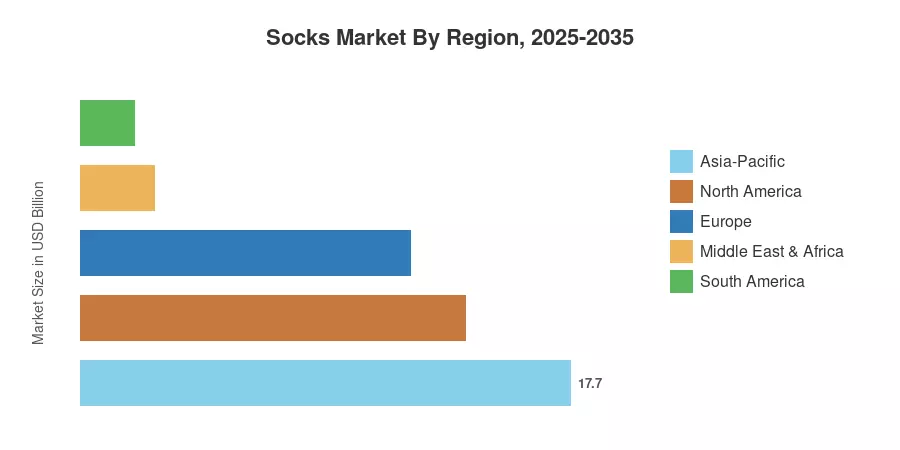
Asia-Pacific dominates the Socks Market with roughly 35.65% of global revenue, propelled by urbanization and organized-retail expansion in China and India. The region also posts the fastest CAGR at 6.17%. North America ranks as the second-largest market, holding about 28.00% share, while Europe contributes approximately 24.00%, underpinned by sustainability-driven consumer preferences. The decade ahead will reward brands that marry performance engineering with circular material sourcing.


Key Report Takeaways

• By Product Type

  • Casual and fashion socks captured an estimated 59.19% revenue share in 2025, reinforcing their position as the Socks Market anchor segment.
  • Athletic socks are forecast to expand at a 4.49% CAGR through 2035, fueled by sports-participation growth and performance-fabric adoption.

• By End User & Category

  • Men's socks represented roughly 53.89% of the 2025 Socks Market demand.
  • Premium-category offerings are on track for a 5.61% CAGR over 2026–2035, outpacing mass-market alternatives.
  • The kids and children segment is projected to register the fastest end-user CAGR at 4.79%.

• By Region

  • Asia-Pacific secured the largest share of the Socks Market in 2025 at 35.65%.
  • North America contributed approximately USD 13.90 Billion in 2025 revenue.
  • Europe's demand base is anchored by sustainability-conscious purchasing across Germany, the UK, and France.


Market Size and Forecast (2021–2035)

The figures below draw on proprietary bottom-up modeling by Market Research Future, triangulated with trade association data, company filings, and import-export statistics. Historical values (2021–2024) are actuals; 2025 is the base-year estimate; 2026–2035 are forecasts.
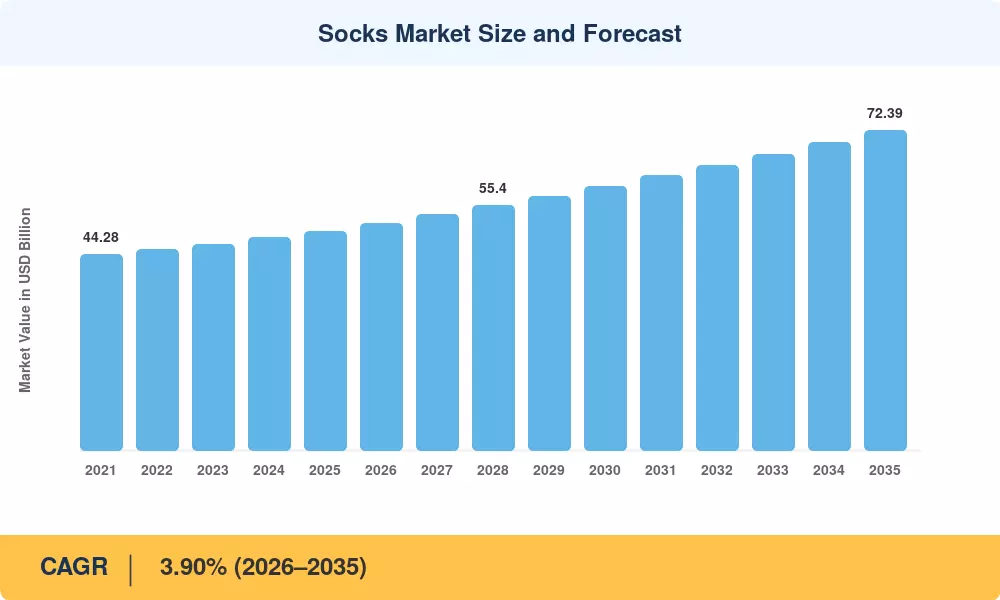
Socks Market Size and Forecast
Our Impact
Enabled $4.3B Revenue Impact for Fortune 500 and Leading Multinationals
Partnering with 2000+ Global Organizations Each Year
30K+ Citations by Top-Tier Firms in the Industry

Driver Impact Analysis

Driver ~% Impact on CAGR Geographic Relevance Impact Timeline
Rising disposable incomes & middle-class expansion +0.85% Asia-Pacific, South America Long-term (≥4 yr)
Athleisure & fitness culture adoption +0.70% North America, Europe Medium-term (2–4 yr)
E-commerce & DTC channel growth +0.55% Global Short-term (≤2 yr)
Sustainability mandates & circular textile policies +0.40% Europe, North America Medium-term (2–4 yr)
Performance-fabric innovation +0.35% Global Medium-term (2–4 yr)
Organized-retail expansion in emerging markets +0.50% Asia-Pacific, MEA Long-term (≥4 yr)
Premiumization & brand-led pricing power +0.30% North America, Europe Short-term (≤2 yr)


Rising Disposable Incomes and Middle-Class Expansion

The World Bank estimates that over 150 million consumers will enter the global middle class annually through 2030, with the vast majority concentrated in South and Southeast Asia [8]. As household incomes cross the USD 10,000 threshold, spending on branded apparel accessories — socks included — rises disproportionately. India's per-capita sock consumption, for example, remains below two pairs annually, roughly one-fifth of the North American average, leaving substantial room for volume growth in the Socks Market as purchasing power improves.

Athleisure and Fitness Culture

Global gym memberships exceeded 200 million in 2024 according to IHRSA data, and casual sportswear has become acceptable office attire in many Western markets [9]. This behavioral shift extends purchasing occasions for performance-oriented hosiery, pushing the Socks Market toward higher-value SKUs with cushioning, arch support, and targeted ventilation zones. Brands such as Nike and Under Armour have responded with sport-specific sock collections that retail at two to three times the price of basic commodity alternatives.

E-Commerce and Direct-to-Consumer Channels

Online apparel sales grew at roughly 12% annually between 2021 and 2024, and socks — lightweight, standardized, and highly shippable — have been outsized beneficiaries [10]. Direct-to-consumer brands like Bombas and Stance have demonstrated that digital storytelling and subscription models can unlock repeat-purchase rates north of 40%. Traditional retailers are responding with omnichannel investments, using in-store pickup and same-day delivery to protect their share of the Socks Market.

Sustainability Mandates

The European Commission's Strategy for Sustainable and Circular Textiles, adopted in 2022, requires extended producer responsibility for textiles by 2025 and is expected to tighten further through 2030 [1]. Compliance costs will weigh on smaller producers, but established brands that invest in recycled-polyester yarns and organic cotton stand to gain consumer loyalty and margin resilience within the Socks Market.


Restraints Impact Analysis

The restraint impacts below are directional estimates reflecting headwinds that dampen growth potential. They are not directly subtracted from the CAGR figure.

Restraint ~% Impact on CAGR Geographic Relevance Impact Timeline
Low entry barriers & counterfeit proliferation –0.45% Asia-Pacific, MEA Long-term (≥4 yr)
Raw-material price volatility (cotton, nylon) –0.35% Global Short-term (≤2 yr)
Private-label margin pressure –0.30% North America, Europe Medium-term (2–4 yr)
Seasonal demand concentration –0.20% Europe, North America Short-term (≤2 yr)
Fragmented retail landscape in emerging markets –0.25% South America, MEA Long-term (≥4 yr)


Counterfeit Activity and Low Entry Barriers

Socks are among the most counterfeited apparel categories globally due to minimal regulatory oversight and straightforward manufacturing processes. The OECD estimated that counterfeit and pirated textiles accounted for USD 28 Billion in seized goods in 2023, with socks and hosiery representing a meaningful sub-segment [13]. This dynamic erodes brand equity and compresses margins for legitimate Socks Market participants, particularly in price-sensitive Asian and African markets.

Cotton and Synthetic Fiber Price Volatility

Cotton prices shifted by 30% between 2022 and 2024 [14] owing to weather interruptions in the US, India and Brazil. However, nylon and elastane pricing follow petrochemical benchmarks that are still subject to geopolitical factors. Mid-tier brands, lacking the hedging sophistication of giant multinationals, are squeezed by such swings in input costs, particularly those that operate on low margins in the Socks Market.


Private-Label Margin Pressure

Supermarkets and mass retailers have introduced own-brand sock initiatives that are priced 30–50% below national brands on the shelf [15]. In the US, private-label socks represented nearly a fourth of unit volume in 2024. The branded players can differentiate on performance and style, but retailer programs continue to expand, compressing pricing power throughout the broader Socks Market.


Socks Market Opportunities

Direct-to-Consumer Subscription Models

Since 2021, hosiery services that are subscription-based (with quarterly shipments that are curated) have increased at double-digit rates. These strategies are designed to lower the cost of acquiring customers and create predictable streams of income over time. Brands that combine sock subscriptions with recycling take-back programs can increase retention and meet future circular-economy standards.


Smart and Connected Sock Technology

The Socks Market is an emerging but high-potential area of sensor-embedded socks for diabetic foot monitoring, athletic gait analysis, and geriatric fall prevention. Clinical trials at Johns Hopkins and the Mayo Clinic have shown pressure-mapping accuracy over 90% for the identification of diabetic neuropathy, opening up reimbursement channels that could speed adoption [17].


Emerging-Market Retail Formalization

Organized retail penetration in India stands below 12%, and Sub-Saharan Africa trails even further [11]. As modern trade formats expand — driven by investments from Reliance Retail, Walmart-Flipkart, and Shoprite Holdings — branded socks gain shelf access in markets that have historically been dominated by unorganized vendors.

Circular Business Models and Recycled Fibers

The global recycled-polyester market is projected to exceed USD 15 Billion by 2030. Sock manufacturers that build closed-loop supply chains — collecting used pairs, recycling them into new yarn, and reselling — can command premium price points while hedging against virgin-fiber volatility. Adidas and Puma have both piloted take-back programs with encouraging early-stage consumer engagement.

Data-Driven Personalization and Fit Technology

3D foot-scanning kiosks and AI-driven size-recommendation engines are enabling mass customization in the Socks Market. Brands that capture fit data can reduce return rates by up to 25% and build proprietary consumer profiles for targeted upselling, transforming socks from a commodity purchase into a data-enriched relationship [19].


Socks Market Future Outlook

Automation and Smart Manufacturing

Fully automated sock-knitting lines — capable of producing a finished pair in under three minutes — are replacing semi-manual setups across Italy, China, and Turkey. By 2030, the International Textile Manufacturers Federation expects automation to reduce per-unit labor costs by 35–40%, compressing the cost advantage that low-wage producers currently hold and reshaping competitive dynamics in the Socks Market [2].

Circular Economy and Material Innovation

Textile-to-textile recycling technologies are scaling rapidly. Companies like Renewcell and Infinited Fiber are commercializing dissolving-pulp processes that can convert post-consumer cotton socks into virgin-equivalent cellulosic fiber. The EU's mandatory extended-producer-responsibility framework, effective from 2025, will accelerate adoption by internalizing end-of-life costs into Socks Market pricing structures [1].

Health and Wellness Integration

Socks are evolving beyond a basic apparel staple into a health-monitoring interface. Graduated compression hosiery has already gained clinical validation for deep-vein thrombosis prevention, and next-generation sensor-embedded designs target diabetic neuropathy screening, plantar-pressure optimization for runners, and balance monitoring for elderly consumers. These use cases could unlock medical-device reimbursement channels for the Socks Market over the coming decade [17].

Platform Economics and Omnichannel Convergence

Social commerce, live-stream selling, and marketplace aggregation are collapsing the traditional wholesale distribution model. In China, Douyin (TikTok) generated over USD 3 Billion in apparel accessories sales during 2024, with socks ranking among the top five categories by unit volume [22]. Brands that fail to develop platform-native content strategies risk ceding market share to agile digital-first entrants across the Socks Market.


Socks Market Segmentation

By Product Type

Segment Key Metric Primary Demand Driver
Casual and Fashion Socks 59.19% of 2025 revenue Everyday wear, fashion-led design refresh cycles
Athletic Socks 4.49% CAGR (2026–2035) Sports participation, performance-fabric innovation


Casual and fashion socks command the majority of Socks Market revenue because they span the widest array of purchase occasions — from office wear to seasonal gifting. Fast-fashion retailers refresh sock designs on six-to-eight-week cycles, sustaining impulse-purchase volume. Athletic socks, while smaller in absolute terms, are growing faster as fitness culture expands and consumers trade up to cushioned, arch-supportive constructions engineered for specific sports.

By End User

Segment Key Metric Primary Demand Driver
Men 53.89% of the 2025 Socks Market share Higher per-capita consumption, workwear demand
Women USD 16.71 Billion (2025) Fashion diversity, athleisure crossover
Kids/Children 4.79% CAGR (2026–2035) Population growth in emerging markets, character licensing


Men remain the dominant end-user group in the Socks Market, driven by workwear norms and athletic participation. Women's demand is increasingly shaped by the blurring boundary between fashion and performance hosiery, while the kids and children segment benefits from population growth in South Asia and Africa alongside strong licensing tie-ins with entertainment franchises.

By Fabric Material

Segment Key Metric Primary Demand Driver
Cotton 49.67% of 2025 share Breathability, affordability, consumer familiarity
Polyester 3.75% CAGR (2026–2035) Durability, recycled-fiber availability
Others (Wool, Bamboo, Nylon blends) USD 8.93 Billion (2025) Specialty performance and seasonal applications


Cotton continues to dominate the Socks Market fabric mix thanks to its comfort profile and price accessibility, though its share is gradually compressing as recycled-polyester and bamboo-viscose alternatives gain traction. Polyester blends deliver superior moisture management and shape retention, making them the preferred substrate for athletic and outdoor socks.

By Category

Segment Key Metric Primary Demand Driver
Mass 63.56% of 2025 revenue Price sensitivity, supermarket distribution
Premium 5.61% CAGR (2026–2035) Brand storytelling, performance differentiation


Mass-market socks dominate unit volume across the Socks Market, sold primarily through supermarkets and discount chains. Premium socks, however, are gaining ground as consumers develop a willingness to pay for technical performance, sustainable materials, and distinctive brand identities. The premium segment's faster growth rate reflects a structural shift in purchasing behavior across mature economies.

By Distribution Channel

Segment Key Metric Primary Demand Driver
Supermarkets/Hypermarkets 48.01% of the 2025 Socks Market distribution Foot traffic, impulse purchasing, private-label programs
Specialty Stores 3.80% CAGR (2026–2035) Curated assortments, fitting expertise
Others (Online, Department Stores, etc.) USD 12.93 Billion (2025) E-commerce growth, marketplace aggregation


Supermarkets and hypermarkets retain the largest distribution footprint in the Socks Market because socks are frequently purchased alongside grocery and household items. Specialty sporting-goods and outdoor retailers command higher average selling prices, and the online channel continues to gain share — particularly for DTC brands leveraging social-media marketing and subscription-based replenishment.


Regional Market Share Analysis

Region Key Metric Primary Investment Themes
Asia-Pacific 35.65% of 2025 revenue Urbanization, organized-retail expansion, fast fashion
North America USD 13.90 Billion (2025) Premiumization, DTC growth, athleisure
Europe 24.00% of 2025 revenue Sustainability compliance, brand heritage
South America 3.90% CAGR (2026–2035) Middle-class growth, retail formalization
Middle East & Africa USD 2.66 Billion (2025) Youth demographics, modern-trade penetration
Total USD 49.65 Billion (2025)

The Socks Market exhibits broad geographic participation, with Asia-Pacific leading on both absolute size and growth velocity. Mature Western markets contribute premium-weighted demand, while emerging regions present volume-expansion opportunities.


North America

Country Key Metric Key Driver
US 78.42% of regional share Athletic and premium sock demand
Canada 12.18% of regional share Outdoor-activity culture
Mexico 9.40% of regional share Nearshoring manufacturing growth


The North American Socks Market benefits from high per-capita consumption — roughly 10 pairs purchased per person annually — and a well-established athletic retail infrastructure. The US drives the bulk of demand, anchored by national chains and a thriving DTC ecosystem. Canada's outdoor recreation culture sustains steady demand for technical hiking and winter socks, while Mexico's expanding manufacturing base increasingly serves both domestic and export markets [20].

Europe

Country Key Metric Key Driver
Germany 3.48% CAGR (2026–2035) Sustainability-conscious consumers
UK USD 1.79 Billion (2025) Fast-fashion retail strength
France 14.20% of regional share Luxury and fashion-forward hosiery
Italy 12.85% of regional share Heritage hosiery manufacturing
Spain 8.60% of regional share Growing athleisure adoption
Nordic Countries 6.95% of regional share Premium outdoor brands
Russia 3.05% CAGR (2026–2035) Volume-driven mass market
Rest of Europe USD 1.41 Billion (2025) Diversified demand base


Europe's Socks Market is shaped by regulatory ambition and fashion heritage. The EU's circular-textile mandates are accelerating organic and recycled fiber sourcing, giving European manufacturers a first-mover advantage in sustainable hosiery. Italy's Brescia and Castel Goffredo districts remain global centers of excellence for sock production, supplying both domestic luxury houses and international private-label buyers [1].

Asia-Pacific

Country Key Metric Key Driver
China 38.50% of regional share Massive production and consumption base
India 6.17% CAGR (2026–2035) Rapid urbanization, rising incomes
Japan USD 2.24 Billion (2025) Premium functional sock preference
South Korea 8.62% of regional share Fashion-led innovation cycles
ASEAN 5.85% CAGR (2026–2035) Young demographics, modern retail growth
Rest of Asia-Pacific 7.44% of regional share Diversified emerging demand


Asia-Pacific anchors the Socks Market with a combination of manufacturing scale and consumption depth. China alone accounts for over a third of regional revenue, while India's trajectory is steeper — per-capita consumption remains low, leaving significant upside as organized retail expands. Japan and South Korea favor higher-margin functional and fashion sock SKUs, balancing the region's volume-heavy profile [8].

South America

Country Key Metric Key Driver
Brazil 62.15% of regional share Largest consumer base in the region
Argentina 3.52% CAGR (2026–2035) Currency-adjusted import substitution
Rest of South America USD 0.84 Billion (2025) Emerging retail formalization


Brazil dominates the South American Socks Market, supported by a domestic cotton-production advantage and an expanding middle class. Macroeconomic volatility — particularly currency fluctuations — periodically disrupts import-dependent segments, but local manufacturers such as Lupo have built resilient distribution networks that cushion against such shocks [21].

Middle East & Africa

Country Key Metric Key Driver
Saudi Arabia 24.81% of regional share Vision 2030 retail modernization
UAE 4.25% CAGR (2026–2035) Tourism and premium retail hubs
South Africa 19.55% of regional share Largest organized-retail base in Sub-Saharan Africa
Egypt 14.66% of regional share Population scale, textile manufacturing
Rest of MEA USD 0.71 Billion (2025) Nascent modern-trade penetration


The MEA region is the smallest contributor to the global Socks Market but offers attractive growth pockets. Saudi Arabia's Vision 2030 is modernizing retail infrastructure and attracting international apparel brands, while the UAE's duty-free retail ecosystem sustains premium demand. Sub-Saharan Africa remains largely served by informal channels, though Shoprite and other modern retailers are steadily broadening branded sock distribution [11].


Socks Market By Region, 2025-2035

Competitive Benchmarking

The Socks Market exhibits medium concentration with an estimated Herfindahl-Hirschman Index (HHI) below 1,000, indicating a fragmented competitive field. The top five companies collectively hold an estimated 25–32% of global revenue, and no single player commands a dominant position. Competition centers on brand equity, distribution breadth, fiber innovation, and pricing strategy.

Company Est. Revenue Share Range Key Offerings for Socks Market Strategic Positioning
Hanesbrands Inc. ~5–8% Champion, Hanes branded basics and performance Mass-market leader with deep retail penetration
Nike Inc. ~4–7% Dri-FIT, Nike Elite sport-specific ranges Performance-first positioning leveraging footwear ecosystem
Adidas AG ~3–6% Adidas Originals, Terrex outdoor socks Sustainability-forward with recycled-material commitments
Puma SE ~2–4% Puma Sport, lifestyle fashion socks Fashion-sport hybrid targeting younger demographics
Gildan Activewear Inc. ~3–5% Gold Toe, Peds, private-label supply Vertically integrated, cost-leadership model
Under Armour Inc. ~2–4% UA Performance, Charged Cushioning lines Technology-driven differentiation in athletic segment
Bombas LLC ~1–3% Comfort-focused everyday and athletic socks DTC pioneer with social-impact brand narrative
Renfro Corporation ~2–4% Licensed brands (Carhartt, Dr. Scholl's) Licensing and co-brand specialist with broad portfolio
Falke KGaA ~1–3% Premium European hosiery, running socks Heritage craftsmanship and luxury positioning
Darn Tough Vermont ~1–2% Merino-wool performance socks, lifetime guarantee Premium outdoor niche with unmatched warranty promise


Recent News & Developments

  • Nike Inc. (September 2023): Launched the Dri-FIT ADV sock platform, integrating zoned ventilation and recycled-yarn construction, targeting distance runners and trail athletes [23].
  • Gildan (August 2025), which owns Gold Toe socks, bought Hanesbrands for USD 2.2 billion in equity and assumed debt. Hanes shareholders got a mix of Gildan stock and cash, and around 19.9% of the merged firm. The purchase will add significant consumer brands like Hanes and Maidenform to Gildan’s portfolio. The transaction is expected to increase Gildan’s scale, operating efficiencies and global footprint in the garment business.
  • European Commission (April 2024): Published implementing guidelines for the EU Strategy for Sustainable and Circular Textiles, mandating extended producer responsibility for sock and hosiery manufacturers operating in the single market from 2025 [1].
  • Adidas AG (June 2024): Partnered with Parley for the Oceans to release a limited-edition ocean-plastic sock collection, marking the brand's first fully recycled hosiery product [25].
  • Hanesbrands Inc. (March 2024): Unveiled a recycled-cotton sock line under the Hanes EcoSmart label, pledging to source 50% of sock fiber from recycled inputs by 2028 [26].


Socks Market Report Scope

Parameter Detail
Market Scope Global Socks Market across product type, end user, fabric material, category, and distribution channel
Study Period 2021–2035
CAGR 3.90% (2026–2035)
Market Size — 2025 USD 49.65 Billion
Market Size — 2035 USD 72.39 Billion
Fastest Growing Segment Kids/Children (by end user); Asia-Pacific (by region)
Companies Profiled Hanesbrands, Nike, Adidas, Puma, Gildan, Under Armour, Bombas, Renfro, Falke, Darn Tough
Valuation Currency USD Billion


FAQs

How do brands protect margin in a market with low entry barriers?
Differentiation through patented knitting techniques, licensed brand partnerships, and DTC channels insulates branded players from commodity competition. Companies investing in proprietary fiber technology report 15–20% higher gross margins than generic alternatives [12].
What role does sock sizing standardization play in cross-border commerce?
Inconsistent sizing frameworks across regions increase return rates for international e-commerce orders. Brands adopting universal fit systems and AI size-recommendation tools have reduced cross-border returns by up to 25% [19].
How are diabetic and medical-grade socks reshaping buyer procurement?
Healthcare procurement teams are specifying graduated compression and seamless-toe constructions in hospital supply contracts. Clinical validation studies are opening group purchasing organization channels previously inaccessible to hosiery brands [17].
What sustainability certifications matter most for Socks Market sourcing decisions?
OEKO-TEX Standard 100, Global Organic Textile Standard, and bluesign certification carry the greatest buyer recognition. Retailers increasingly mandate at least one certification for shelf placement [1].
How does vertical integration affect competitive positioning?
Vertically integrated manufacturers such as Gildan control yarn-to-retail timelines and capture margin at each stage. This model delivers 8–12% cost advantages versus contract-dependent competitors [24].
What is the impact of 3D knitting technology on product development cycles?
3D seamless knitting reduces prototype-to-production timelines from twelve weeks to under four. This speed advantage allows brands to respond to trend shifts within a single retail season [2].
How are private-label sock programs evolving at major retailers?
Retailers are upgrading private-label socks with performance features and recycled materials, blurring the gap with national brands. Premium private-label SKUs now account for roughly 10% of own-brand sock revenue in North America [15].    
Author
Author
Author Profile
Snehal Singh LinkedIn
Manager - Research
High acumen in analyzing complex macro & micro markets with more than 6 years of work experience in the field of market research. By implementing her analytical skills in forecasting and estimation into market research reports, she has expertise in Packaging, Construction, and Equipment domains. She handles a team size of 20-25 resources and ensures smooth running of the projects, associated marketing activities, and client servicing.
Share::
Request Free Sample

Research Approach


Secondary Research

The secondary research process involved comprehensive analysis of industry trade associations, textile regulatory databases, fashion industry publications, and authoritative economic databases. Key sources included the US Department of Commerce - Office of Textiles and Apparel (OTEXA), US International Trade Commission (USITC), European Apparel and Textile Confederation (EURATEX), International Labour Organization (ILO) - Textiles Sector, World Trade Organization (WTO) - Textile Monitoring Body, American Apparel & Footwear Association (AAFA), National Retail Federation (NRF), Textile Exchange (Sustainability & Fiber Standards), Bureau of Labor Statistics (BLS) - Apparel Manufacturing, US Census Bureau - Monthly Retail Trade, Eurostat - Textile and Clothing Statistics, International Cotton Advisory Committee (ICAC), International Wool Textile Organisation (IWTO), National Cotton Council (NCC), Sustainable Apparel Coalition (SAC), World Customs Organization (WCO) - HS Classification Data, and national statistics offices from key manufacturing markets (China National Bureau of Statistics, India's Ministry of Textiles). These sources were used to collect import/export trade data, fiber price trends, manufacturing statistics, retail sales data, sustainability certifications, and market landscape analysis for athletic socks, specialty socks, casual socks, and material segments including cotton, polyester, wool, and nylon.


Primary Research

Qualitative and quantitative insights were obtained by interviewing supply-side and demand-side stakeholders during the primary research process. CEOs, Chief Merchandising Officers, heads of sustainable procurement, and directors of manufacturing from sock brands, textile mills, and OEM suppliers comprised supply-side sources. Retail buyers, category managers from supermarkets and hypermarkets, e-commerce directors, and procurement leaders from specialty sporting goods retailers, fast-fashion chains, and department stores comprised demand-side sources. Market segmentation was validated, sustainability initiative timelines were confirmed, and consumer purchasing patterns, pricing strategies, and supply chain dynamics were collated across the cotton, polyester, wool, and nylon material categories through primary research.

Primary Respondent Breakdown:

By Designation: C-level Primaries (40%), Director Level (25%), Others (35%)

By Region: North America (32%), Europe (30%), Asia-Pacific (28%), Rest of World (10%)


Market Size Estimation

Global market valuation was derived through revenue mapping and production volume analysis. The methodology included:

Identification of 50+ key manufacturers and brands across North America, Europe, Asia-Pacific, and Latin America

Product mapping across athletic socks, specialty socks, casual socks, trouser socks, and multiple toe socks

Material segmentation analysis covering cotton, polyester, wool, and nylon fiber compositions

Analysis of reported and modeled annual revenues specific to sock product portfolios

Coverage of manufacturers and brands representing 75-80% of global market share in 2024

Extrapolation using bottom-up (production volume × ASP by country) and top-down (manufacturer revenue validation) approaches to derive segment-specific valuations across men's, women's, and children's end-user categories

Summary of Percentage Changes Made:

Table

Copy

Category Original (Dermal Fillers) New (Socks Market)

By Designation C-level (35%), Director (28%), Others (37%) C-level (40%), Director (25%), Others (35%)

By Region NA (35%), Europe (27%), APAC (30%), RoW (8%) NA (32%), Europe (30%), APAC (28%), RoW (10%)

The sources have been tailored to the textile and apparel industry, focusing on trade data, fiber organizations, retail statistics, and sustainability bodies relevant to sock manufacturing and distribution.

Share::
Request Free Sample
Download Free Sample

Kindly complete the form below to receive a free sample of this Report

Share::
Request Free Sample
Download PDF ×

We do not share your information with anyone. However, we may send you emails based on your report interest from time to time. You may contact us at any time to opt-out.
















