×
Hero Background
English
Chinese
French
Japanese
Korean
German
Spanish

Solar Control Glass Market Share

ID: MRFR/EnP/10033-HCR
128 Pages
Swapnil Palwe
October 2025

Solar Control Glass Market Research Report Information By Application (Residential Buildings, Commercial Buildings, Automotive) And By Region (North America, Europe, Asia-Pacific, And Rest Of The World) –Market Forecast Till 2035

Share:
Download PDF ×

We do not share your information with anyone. However, we may send you emails based on your report interest from time to time. You may contact us at any time to opt-out.

Solar Control Glass Market Infographic
Purchase Options

Market Share

Solar Control Glass Market Share Analysis

Within the ever-changing environment of the solar control glass market, companies use several tactics for obtaining and improving their position on it. A popular strategy is differentiation through product innovation and technological advancements. Companies invest heavily in research and development to come up with solutions of solar control glass that is unmatched, outdoing the competition on energy efficiency, optical clarity as well durability. This approach not only accommodates the growing need for sustainable and environmentally friendly methods, but it puts company on top of their field. Another significant market share positioning strategy is brand building and marketing. Companies work towards developing a robust brand identity that appeals to the consumers, making them distinct from competitors. Companies seek to attract the attention of architects, builders, and homeowners by means of focused marketing campaigns focusing on advantages offered with their solar control glass products. Presumably, if a company builds credibility and solid track record of quality then the customer loyalty will increase that means more market share. Strategic partnerships and alliances also contribute much to market positioning. Solar control glass manufacturers can increase their influence and reach by forming these alliances with architects, construction firms, and other stakeholders in the building industry. Partnerships of this kind may lead to exclusive supply contracts, providing them with stable demand for the products in large construction projects. Moreover, partnerships with government institutions or environmental organizations should help companies align their products to sustainability actions and attract green consumers. Pricing strategies are fundamental to position of market share in the sector for solar control glass. If cost sensitivity is high, companies can implement competitive pricing to give them a larger customer base. On the other hand, premier pricing approaches could be used in relation to high-end technologically advanced solar control glass products. This strategy focuses on customers who value performance and are willing to pay for state-of-the art approaches allowing companies to cut out a niche in the market competition. In as far as the market share positioning is concerned, geographical expansion becomes a critical aspect of this process due to global nature associated with solar control glass industry. The companies position themselves in the areas that have a promising growth potential for construction activities or those regions where more people understand energy efficiency. Through the creation of a solid presence in core markets, companies will be able to realize benefits from economies of scale as well as reduction in transport costs and can adjust their products according regional preferences or regulatory requirements.


Author
Swapnil Palwe
Team Lead - Research

With a technical background as Bachelor's in Mechanical Engineering, with MBA in Operations Management , Swapnil has 6+ years of experience in market research, consulting and analytics with the tasks of data mining, analysis, and project execution. He is the POC for our clients, for their consulting projects running under the Automotive/A&D domain. Swapnil has worked on major projects in verticals such as Aerospace & Defense, Automotive and many other domain projects. He has worked on projects for fortune 500 companies' syndicate and consulting projects along with several government projects.

Leave a Comment

FAQs

What is the current valuation of the Solar Control Glass Market?

As of 2024, the Solar Control Glass Market was valued at 7.833 USD Billion.

What is the projected market valuation for the Solar Control Glass Market in 2035?

The market is projected to reach a valuation of 23.07 USD Billion by 2035.

What is the expected CAGR for the Solar Control Glass Market during the forecast period?

The expected CAGR for the Solar Control Glass Market from 2025 to 2035 is 10.32%.

Which segments are included in the Solar Control Glass Market analysis?

The market analysis includes segments for Residential Buildings, Commercial Buildings, and Automotive applications.

What were the valuations for Residential Buildings in the Solar Control Glass Market?

The valuation for Residential Buildings ranged from 2.5 to 7.5 USD Billion.

Market Summary

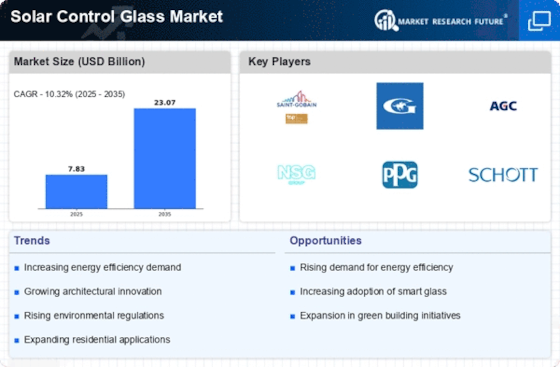
As per MRFR analysis, the Solar Control Glass Market Size was estimated at 7.833 USD Billion in 2024. The Solar Control Glass industry is projected to grow from 8.641 USD Billion in 2025 to 23.07 USD Billion by 2035, exhibiting a compound annual growth rate (CAGR) of 10.32 during the forecast period 2025 - 2035.

Key Market Trends & Highlights

The Solar Control Glass Market is poised for substantial growth driven by technological advancements and increasing consumer awareness.

  • North America remains the largest market for solar control glass, driven by a robust demand for energy-efficient solutions.
  • The Asia-Pacific region is emerging as the fastest-growing market, fueled by rapid urbanization and construction activities.
  • Residential buildings constitute the largest segment, while commercial buildings are witnessing the fastest growth due to evolving architectural trends.
  • Key market drivers include rising demand for energy efficiency and government initiatives promoting sustainable building practices.

Market Size & Forecast

2024 Market Size 7.833 (USD Billion)
2035 Market Size 23.07 (USD Billion)
CAGR (2025 - 2035) 10.32%
Largest Regional Market Share in 2024 North America

Major Players

<p>Saint-Gobain (FR), Guardian Glass (US), AGC Inc. (JP), NSG Group (JP), PPG Industries (US), Schott AG (DE), Viracon (US), Kibing Group (CN), Xinyi Glass (CN)</p>

Market Trends

The Solar Control Glass Market is currently experiencing a notable transformation, driven by increasing awareness of energy efficiency and sustainability. As consumers and businesses alike seek to reduce energy consumption, the demand for glass products that minimize heat gain while maximizing natural light is on the rise. This shift is further supported by advancements in technology, which have led to the development of innovative coatings and materials that enhance the performance of solar control glass. Consequently, manufacturers are focusing on creating products that not only meet aesthetic preferences but also contribute to energy savings and environmental sustainability. In addition to technological advancements, regulatory frameworks are evolving to promote the use of energy-efficient building materials. Governments worldwide are implementing stricter building codes and standards that encourage the adoption of solar control glass in both residential and commercial applications. This regulatory push, combined with a growing emphasis on green building practices, is likely to propel the Solar Control Glass Market forward. As the market continues to evolve, stakeholders must remain vigilant to emerging trends and consumer preferences, ensuring that they adapt their strategies accordingly to maintain competitiveness in this dynamic landscape.

Technological Advancements

Recent innovations in coating technologies are enhancing the performance of solar control glass. These advancements allow for better heat rejection and improved light transmission, making products more appealing to consumers seeking energy-efficient solutions.

Regulatory Support

Government initiatives aimed at promoting energy efficiency are increasingly influencing the Solar Control Glass Market. Stricter building codes and incentives for sustainable construction are encouraging the adoption of solar control glass in various applications.

Consumer Awareness

There is a growing awareness among consumers regarding the benefits of solar control glass. This heightened understanding is driving demand for products that not only provide comfort but also contribute to energy savings and environmental sustainability.

Solar Control Glass Market Market Drivers

Growing Awareness of Climate Change

The increasing awareness of climate change and its impacts is driving the Solar Control Glass Market. As consumers and businesses become more conscious of their carbon footprints, there is a growing demand for sustainable building materials that contribute to energy efficiency. Solar control glass plays a vital role in reducing greenhouse gas emissions by minimizing reliance on artificial cooling and heating systems. Market studies suggest that the adoption of solar control glass can lead to a reduction in energy consumption by approximately 20%, aligning with global efforts to combat climate change and promote sustainability.

Rising Demand for Energy Efficiency

The increasing emphasis on energy efficiency in buildings is a primary driver for the Solar Control Glass Market. As energy costs continue to rise, both residential and commercial sectors are seeking solutions to reduce energy consumption. Solar control glass, which minimizes heat gain while allowing natural light, is becoming a preferred choice. According to recent data, buildings equipped with solar control glass can achieve energy savings of up to 30% compared to traditional glazing options. This trend is likely to accelerate as more countries implement stringent energy efficiency regulations, further propelling the demand for solar control glass.

Government Initiatives and Incentives

Government initiatives aimed at promoting sustainable building practices are a crucial driver for the Solar Control Glass Market. Various countries have introduced incentives such as tax credits, rebates, and grants to encourage the adoption of energy-efficient materials, including solar control glass. For instance, programs that support green building certifications have led to a marked increase in the use of solar control glass in new constructions. This regulatory support not only boosts market growth but also raises awareness among consumers about the benefits of energy-efficient solutions, potentially increasing market penetration.

Technological Innovations in Glass Manufacturing

Technological advancements in glass manufacturing processes are significantly impacting the Solar Control Glass Market. Innovations such as low-emissivity coatings and advanced tinting technologies enhance the performance of solar control glass, making it more effective in reducing solar heat gain. These advancements have led to a broader range of products that cater to diverse consumer needs, thereby expanding market opportunities. The introduction of smart glass technologies, which can adjust their properties based on environmental conditions, is also gaining traction, indicating a potential shift in consumer preferences towards more adaptive solutions.

Architectural Trends Favoring Aesthetics and Functionality

Contemporary architectural designs increasingly prioritize both aesthetics and functionality, which significantly influences the Solar Control Glass Market. Architects and builders are integrating solar control glass into their designs to enhance visual appeal while providing practical benefits such as glare reduction and thermal comfort. The market has seen a notable shift, with an estimated 40% of new constructions incorporating solar control glass as a standard feature. This trend is expected to continue, as innovative designs and materials emerge, making solar control glass an integral part of modern architecture.

Market Segment Insights

By Application: Residential Buildings (Largest) vs. Commercial Buildings (Fastest-Growing)

<p>In the Solar Control Glass Market, the application segment is delineated into three prominent categories: Residential Buildings, Commercial Buildings, and Automotive. Among these, Residential Buildings hold the largest market share due to the ongoing trend of energy-efficient home installations and increasing consumer awareness about thermal comfort. Conversely, Commercial Buildings, propelled by rigorous building codes and sustainability standards, represent the fastest-growing segment, emphasizing the need for energy-efficient solutions to manage costs in commercial spaces.</p>

<p>Residential Buildings (Dominant) vs. Commercial Buildings (Emerging)</p>

<p>Residential Buildings dominate the Solar Control Glass Market, significantly driven by increasing home renovation activities and new constructions focusing on energy efficiency and comfort. These glass products enhance thermal regulation, reducing energy bills, which is a primary concern for homeowners. On the other hand, Commercial Buildings are emerging as a key segment due to rising environmental regulations and corporate sustainability goals. As businesses invest in innovative building designs featuring solar control glass, this segment is poised for rapid growth, driven by demand for smart buildings and integrated energy solutions. The growing focus on LEED certification and eco-friendly practices further bolsters the market presence of solar control glass in commercial applications.</p>

Get more detailed insights about Solar Control Glass Market Research Report—Global Forecast till 2035

Regional Insights

North America : Innovation and Sustainability Leader

North America is witnessing significant growth in the solar control glass market, driven by increasing energy efficiency regulations and a rising demand for sustainable building materials. The region holds approximately 40% of the global market share, making it the largest market for solar control glass. The U.S. and Canada are leading this growth, supported by government incentives for energy-efficient construction and retrofitting projects. The competitive landscape in North America is robust, featuring key players such as Guardian Glass and PPG Industries. These companies are investing heavily in R&D to innovate and enhance product offerings. The presence of advanced manufacturing facilities and a strong distribution network further bolster the market. As sustainability becomes a priority, the demand for solar control glass is expected to rise, positioning North America as a leader in this sector.

Europe : Regulatory-Driven Market Expansion

Europe is emerging as a significant player in the solar control glass market, driven by stringent energy efficiency regulations and a strong focus on sustainable architecture. The region accounts for approximately 30% of the global market share, making it the second-largest market. Countries like Germany and France are at the forefront, implementing policies that promote the use of energy-efficient materials in construction and renovation projects. The competitive landscape in Europe is characterized by the presence of major players such as Saint-Gobain and Schott AG. These companies are leveraging advanced technologies to develop innovative products that meet regulatory standards. The European market is also witnessing collaborations between manufacturers and architects to create energy-efficient building solutions. As regulations tighten, the demand for solar control glass is expected to grow significantly, enhancing market dynamics.

Asia-Pacific : Emerging Market with High Potential

Asia-Pacific is rapidly emerging as a key market for solar control glass, driven by urbanization, industrialization, and increasing awareness of energy efficiency. The region holds approximately 25% of the global market share, with China and India leading the charge. Government initiatives aimed at promoting green building practices are catalyzing demand for solar control glass, making it a vital component in modern construction projects. The competitive landscape in Asia-Pacific is diverse, featuring key players like AGC Inc. and Xinyi Glass. These companies are expanding their production capacities to meet the growing demand. Additionally, the region is witnessing an influx of foreign investments aimed at enhancing manufacturing capabilities. As the market matures, innovations in product technology and design are expected to drive further growth in the solar control glass sector.

Middle East and Africa : Resource-Rich Market Opportunities

The Middle East and Africa region is gradually recognizing the potential of solar control glass, driven by increasing construction activities and a focus on energy efficiency. The region holds approximately 5% of the global market share, with countries like the UAE and South Africa leading the way. Government initiatives aimed at promoting sustainable building practices are expected to boost demand for solar control glass in the coming years. The competitive landscape in this region is still developing, with local and international players vying for market share. Companies are increasingly focusing on innovative solutions to cater to the unique climatic conditions of the region. As awareness of energy efficiency grows, the solar control glass market is poised for significant growth, presenting opportunities for both established and emerging players.

Key Players and Competitive Insights

The Solar Control Glass Market is currently characterized by a dynamic competitive landscape, driven by increasing demand for energy-efficient building materials and advancements in glass technology. Key players such as Saint-Gobain (France), Guardian Glass (United States), and AGC Inc. (Japan) are strategically positioned to leverage innovation and sustainability as core components of their operational focus. Saint-Gobain (France) emphasizes its commitment to sustainable construction solutions, while Guardian Glass (United States) is enhancing its product portfolio through technological advancements. AGC Inc. (Japan) is also focusing on expanding its global footprint, particularly in emerging markets, thereby shaping a competitive environment that prioritizes innovation and regional adaptability.

In terms of business tactics, companies are increasingly localizing manufacturing to reduce lead times and optimize supply chains. The Solar Control Glass Market appears moderately fragmented, with a mix of established players and emerging companies vying for market share. This competitive structure allows for diverse strategies, as key players collaborate and compete simultaneously, influencing pricing and product offerings across the sector.

In August 2025, Guardian Glass (United States) announced the launch of a new line of solar control glass products designed to enhance energy efficiency in commercial buildings. This strategic move not only aligns with the growing trend towards sustainable construction but also positions Guardian Glass as a leader in innovation within the market. The introduction of these products is likely to attract environmentally conscious consumers and architects, thereby expanding their market reach.

In September 2025, AGC Inc. (Japan) revealed plans to invest in a new manufacturing facility in Southeast Asia, aimed at increasing production capacity for solar control glass. This investment underscores AGC's strategy to tap into the rapidly growing demand in the region, which is expected to see significant urban development in the coming years. By enhancing its production capabilities, AGC is likely to strengthen its competitive position and respond effectively to regional market needs.

In July 2025, Saint-Gobain (France) entered into a strategic partnership with a leading technology firm to develop smart glass solutions that integrate AI for enhanced energy management. This collaboration reflects a broader trend towards digitalization in the industry, where companies are increasingly looking to incorporate advanced technologies into their product offerings. Such innovations may provide Saint-Gobain with a competitive edge, as they cater to the evolving demands of modern architecture and energy efficiency.

As of October 2025, the Solar Control Glass Market is witnessing significant trends such as digitalization, sustainability, and the integration of AI technologies. Strategic alliances among key players are shaping the competitive landscape, fostering innovation and collaboration. Moving forward, it is anticipated that competitive differentiation will increasingly hinge on technological advancements and supply chain reliability, rather than solely on price. This shift suggests a more nuanced approach to competition, where innovation and sustainability will play pivotal roles in defining market leadership.

Key Companies in the Solar Control Glass Market market include

Industry Developments

July 2021 Schott announced the release of its new SCHOTT TIKANA solar control glasses. These glasses improve thermal insulation and help to minimize the amount of solar heat that enters a structure, resulting in increased energy efficiency.

June 2018 Asahi India Glass Ltd has launched a new ornamental architectural glass series. Through a wide spectrum of functionality and exceptional visual appeal, this strives to transform living spaces and improve lifestyles. The glass spans from patterned heat-reflective glass that can be used for the building's exteriors and interiors while giving a rich and elegant appearance.

Future Outlook

Solar Control Glass Market Future Outlook

<p>The Solar Control Glass Market is projected to grow at a 10.32% CAGR from 2024 to 2035, driven by increasing energy efficiency demands and sustainable building practices.</p>

New opportunities lie in:

  • <p>Expansion into smart glass technologies for enhanced energy management.</p>
  • <p>Development of customized solar control solutions for commercial buildings.</p>
  • <p>Partnerships with construction firms to integrate solar control glass in new projects.</p>

<p>By 2035, the market is expected to solidify its position as a leader in energy-efficient building materials.</p>

Market Segmentation

Solar Control Glass Market Application Outlook

  • Residential Buildings
  • Commercial Buildings
  • Automotive

Report Scope

MARKET SIZE 20247.833(USD Billion)
MARKET SIZE 20258.641(USD Billion)
MARKET SIZE 203523.07(USD Billion)
COMPOUND ANNUAL GROWTH RATE (CAGR)10.32% (2024 - 2035)
REPORT COVERAGERevenue Forecast, Competitive Landscape, Growth Factors, and Trends
BASE YEAR2024
Market Forecast Period2025 - 2035
Historical Data2019 - 2024
Market Forecast UnitsUSD Billion
Key Companies ProfiledMarket analysis in progress
Segments CoveredMarket segmentation analysis in progress
Key Market OpportunitiesGrowing demand for energy-efficient building materials drives innovation in the Solar Control Glass Market.
Key Market DynamicsRising demand for energy-efficient buildings drives innovation and competition in the Solar Control Glass market.
Countries CoveredNorth America, Europe, APAC, South America, MEA

FAQs

What is the current valuation of the Solar Control Glass Market?

As of 2024, the Solar Control Glass Market was valued at 7.833 USD Billion.

What is the projected market valuation for the Solar Control Glass Market in 2035?

The market is projected to reach a valuation of 23.07 USD Billion by 2035.

What is the expected CAGR for the Solar Control Glass Market during the forecast period?

The expected CAGR for the Solar Control Glass Market from 2025 to 2035 is 10.32%.

Which segments are included in the Solar Control Glass Market analysis?

The market analysis includes segments for Residential Buildings, Commercial Buildings, and Automotive applications.

What were the valuations for Residential Buildings in the Solar Control Glass Market?

The valuation for Residential Buildings ranged from 2.5 to 7.5 USD Billion.

  1. SECTION I: EXECUTIVE SUMMARY AND KEY HIGHLIGHTS
    1. EXECUTIVE SUMMARY
      1. Market Overview
      2. Key Findings
      3. Market Segmentation
      4. Competitive Landscape
      5. Challenges and Opportunities
      6. Future Outlook
  2. SECTION II: SCOPING, METHODOLOGY AND MARKET STRUCTURE
    1. MARKET INTRODUCTION
      1. Definition
      2. Scope of the study
    2. RESEARCH METHODOLOGY
      1. Overview
      2. Data Mining
      3. Secondary Research
      4. Primary Research
      5. Forecasting Model
      6. Market Size Estimation
      7. Data Triangulation
      8. Validation
  3. SECTION III: QUALITATIVE ANALYSIS
    1. MARKET DYNAMICS
      1. Overview
      2. Drivers
      3. Restraints
      4. Opportunities
    2. MARKET FACTOR ANALYSIS
      1. Value chain Analysis
      2. Porter's Five Forces Analysis
      3. COVID-19 Impact Analysis
  4. SECTION IV: QUANTITATIVE ANALYSIS
    1. Energy & Power, BY Application (USD Billion)
      1. Residential Buildings
      2. Commercial Buildings
      3. Automotive
    2. Energy & Power, BY Region (USD Billion)
      1. North America
      2. Europe
      3. APAC
      4. South America
      5. MEA
  5. SECTION V: COMPETITIVE ANALYSIS
    1. Competitive Landscape
      1. Overview
      2. Competitive Analysis
      3. Market share Analysis
      4. Major Growth Strategy in the Energy & Power
      5. Competitive Benchmarking
      6. Leading Players in Terms of Number of Developments in the Energy & Power
      7. Key developments and growth strategies
      8. Major Players Financial Matrix
    2. Company Profiles
      1. Saint-Gobain (FR)
      2. Guardian Glass (US)
      3. AGC Inc. (JP)
      4. NSG Group (JP)
      5. PPG Industries (US)
      6. Schott AG (DE)
      7. Viracon (US)
      8. Kibing Group (CN)
      9. Xinyi Glass (CN)
    3. Appendix
      1. References
      2. Related Reports
  6. LIST OF FIGURES
    1. MARKET SYNOPSIS
    2. NORTH AMERICA MARKET ANALYSIS
    3. US MARKET ANALYSIS BY APPLICATION
    4. CANADA MARKET ANALYSIS BY APPLICATION
    5. EUROPE MARKET ANALYSIS
    6. GERMANY MARKET ANALYSIS BY APPLICATION
    7. UK MARKET ANALYSIS BY APPLICATION
    8. FRANCE MARKET ANALYSIS BY APPLICATION
    9. RUSSIA MARKET ANALYSIS BY APPLICATION
    10. ITALY MARKET ANALYSIS BY APPLICATION
    11. SPAIN MARKET ANALYSIS BY APPLICATION
    12. REST OF EUROPE MARKET ANALYSIS BY APPLICATION
    13. APAC MARKET ANALYSIS
    14. CHINA MARKET ANALYSIS BY APPLICATION
    15. INDIA MARKET ANALYSIS BY APPLICATION
    16. JAPAN MARKET ANALYSIS BY APPLICATION
    17. SOUTH KOREA MARKET ANALYSIS BY APPLICATION
    18. MALAYSIA MARKET ANALYSIS BY APPLICATION
    19. THAILAND MARKET ANALYSIS BY APPLICATION
    20. INDONESIA MARKET ANALYSIS BY APPLICATION
    21. REST OF APAC MARKET ANALYSIS BY APPLICATION
    22. SOUTH AMERICA MARKET ANALYSIS
    23. BRAZIL MARKET ANALYSIS BY APPLICATION
    24. MEXICO MARKET ANALYSIS BY APPLICATION
    25. ARGENTINA MARKET ANALYSIS BY APPLICATION
    26. REST OF SOUTH AMERICA MARKET ANALYSIS BY APPLICATION
    27. MEA MARKET ANALYSIS
    28. GCC COUNTRIES MARKET ANALYSIS BY APPLICATION
    29. SOUTH AFRICA MARKET ANALYSIS BY APPLICATION
    30. REST OF MEA MARKET ANALYSIS BY APPLICATION
    31. KEY BUYING CRITERIA OF ENERGY & POWER
    32. RESEARCH PROCESS OF MRFR
    33. DRO ANALYSIS OF ENERGY & POWER
    34. DRIVERS IMPACT ANALYSIS: ENERGY & POWER
    35. RESTRAINTS IMPACT ANALYSIS: ENERGY & POWER
    36. SUPPLY / VALUE CHAIN: ENERGY & POWER
    37. ENERGY & POWER, BY APPLICATION, 2024 (% SHARE)
    38. ENERGY & POWER, BY APPLICATION, 2024 TO 2035 (USD Billion)
    39. BENCHMARKING OF MAJOR COMPETITORS
  7. LIST OF TABLES
    1. LIST OF ASSUMPTIONS
    2. North America MARKET SIZE ESTIMATES; FORECAST
      1. BY APPLICATION, 2025-2035 (USD Billion)
    3. US MARKET SIZE ESTIMATES; FORECAST
      1. BY APPLICATION, 2025-2035 (USD Billion)
    4. Canada MARKET SIZE ESTIMATES; FORECAST
      1. BY APPLICATION, 2025-2035 (USD Billion)
    5. Europe MARKET SIZE ESTIMATES; FORECAST
      1. BY APPLICATION, 2025-2035 (USD Billion)
    6. Germany MARKET SIZE ESTIMATES; FORECAST
      1. BY APPLICATION, 2025-2035 (USD Billion)
    7. UK MARKET SIZE ESTIMATES; FORECAST
      1. BY APPLICATION, 2025-2035 (USD Billion)
    8. France MARKET SIZE ESTIMATES; FORECAST
      1. BY APPLICATION, 2025-2035 (USD Billion)
    9. Russia MARKET SIZE ESTIMATES; FORECAST
      1. BY APPLICATION, 2025-2035 (USD Billion)
    10. Italy MARKET SIZE ESTIMATES; FORECAST
      1. BY APPLICATION, 2025-2035 (USD Billion)
    11. Spain MARKET SIZE ESTIMATES; FORECAST
      1. BY APPLICATION, 2025-2035 (USD Billion)
    12. Rest of Europe MARKET SIZE ESTIMATES; FORECAST
      1. BY APPLICATION, 2025-2035 (USD Billion)
    13. APAC MARKET SIZE ESTIMATES; FORECAST
      1. BY APPLICATION, 2025-2035 (USD Billion)
    14. China MARKET SIZE ESTIMATES; FORECAST
      1. BY APPLICATION, 2025-2035 (USD Billion)
    15. India MARKET SIZE ESTIMATES; FORECAST
      1. BY APPLICATION, 2025-2035 (USD Billion)
    16. Japan MARKET SIZE ESTIMATES; FORECAST
      1. BY APPLICATION, 2025-2035 (USD Billion)
    17. South Korea MARKET SIZE ESTIMATES; FORECAST
      1. BY APPLICATION, 2025-2035 (USD Billion)
    18. Malaysia MARKET SIZE ESTIMATES; FORECAST
      1. BY APPLICATION, 2025-2035 (USD Billion)
    19. Thailand MARKET SIZE ESTIMATES; FORECAST
      1. BY APPLICATION, 2025-2035 (USD Billion)
    20. Indonesia MARKET SIZE ESTIMATES; FORECAST
      1. BY APPLICATION, 2025-2035 (USD Billion)
    21. Rest of APAC MARKET SIZE ESTIMATES; FORECAST
      1. BY APPLICATION, 2025-2035 (USD Billion)
    22. South America MARKET SIZE ESTIMATES; FORECAST
      1. BY APPLICATION, 2025-2035 (USD Billion)
    23. Brazil MARKET SIZE ESTIMATES; FORECAST
      1. BY APPLICATION, 2025-2035 (USD Billion)
    24. Mexico MARKET SIZE ESTIMATES; FORECAST
      1. BY APPLICATION, 2025-2035 (USD Billion)
    25. Argentina MARKET SIZE ESTIMATES; FORECAST
      1. BY APPLICATION, 2025-2035 (USD Billion)
    26. Rest of South America MARKET SIZE ESTIMATES; FORECAST
      1. BY APPLICATION, 2025-2035 (USD Billion)
    27. MEA MARKET SIZE ESTIMATES; FORECAST
      1. BY APPLICATION, 2025-2035 (USD Billion)
    28. GCC Countries MARKET SIZE ESTIMATES; FORECAST
      1. BY APPLICATION, 2025-2035 (USD Billion)
    29. South Africa MARKET SIZE ESTIMATES; FORECAST
      1. BY APPLICATION, 2025-2035 (USD Billion)
    30. Rest of MEA MARKET SIZE ESTIMATES; FORECAST
      1. BY APPLICATION, 2025-2035 (USD Billion)
    31. PRODUCT LAUNCH/PRODUCT DEVELOPMENT/APPROVAL
    32. ACQUISITION/PARTNERSHIP

 Solar Control Glass Market Segmentation

Solar Control Glass Application Outlook (USD Billion, 2018-2032)

Residential Buildings

Commercial Buildings

Automotive

Solar Control Glass Regional Outlook (USD Billion, 2018-2032)

North America Outlook (USD Billion, 2018-2032)

North America Solar Control Glass by Application

Residential Buildings

Commercial Buildings

Automotive

US Outlook (USD Billion, 2018-2032)

US Solar Control Glass by Application

Residential Buildings

Commercial Buildings

Automotive

CANADA Outlook (USD Billion, 2018-2032)

CANADA Solar Control Glass by Application

Residential Buildings

Commercial Buildings

Automotive

Europe Outlook (USD Billion, 2018-2032)

Europe Solar Control Glass by Application

Residential Buildings

Commercial Buildings

Automotive

Germany Outlook (USD Billion, 2018-2032)

Germany Solar Control Glass by Application

Residential Buildings

Commercial Buildings

Automotive

France Outlook (USD Billion, 2018-2032)

France Solar Control Glass by Application

Residential Buildings

Commercial Buildings

Automotive

UK Outlook (USD Billion, 2018-2032)

UK Solar Control Glass by Application

Residential Buildings

Commercial Buildings

Automotive

ITALY Outlook (USD Billion, 2018-2032)

ITALY Solar Control Glass by Application

Residential Buildings

Commercial Buildings

Automotive

SPAIN Outlook (USD Billion, 2018-2032)

Spain Solar Control Glass by Application

Residential Buildings

Commercial Buildings

Automotive

Rest Of Europe Outlook (USD Billion, 2018-2032)

Rest Of Europe Solar Control Glass by Application

Residential Buildings

Commercial Buildings

Automotive

Asia-Pacific Outlook (USD Billion, 2018-2032)

Asia-Pacific Solar Control Glass by Application

Residential Buildings

Commercial Buildings

Automotive

China Outlook (USD Billion, 2018-2032)

China Solar Control Glass by Application

Residential Buildings

Commercial Buildings

Automotive

Japan Outlook (USD Billion, 2018-2032)

Japan Solar Control Glass by Application

Residential Buildings

Commercial Buildings

Automotive

India Outlook (USD Billion, 2018-2032)

India Solar Control Glass by Application

Residential Buildings

Commercial Buildings

Automotive

Australia Outlook (USD Billion, 2018-2032)

Australia Solar Control Glass by Application

Residential Buildings

Commercial Buildings

Automotive

Rest of Asia-Pacific Outlook (USD Billion, 2018-2032)

Rest of Asia-Pacific Solar Control Glass by Application

Residential Buildings

Commercial Buildings

Automotive

Rest of the World Outlook (USD Billion, 2018-2032)

Rest of the World Solar Control Glass by Application

Residential Buildings

Commercial Buildings

Automotive

Middle East Outlook (USD Billion, 2018-2032)

Middle East Solar Control Glass by Application

Residential Buildings

Commercial Buildings

Automotive

Africa Outlook (USD Billion, 2018-2032)

Africa Solar Control Glass by Application

Residential Buildings

Commercial Buildings

Automotive

Latin America Outlook (USD Billion, 2018-2032)

Latin America Solar Control Glass by Application

Residential Buildings

Commercial Buildings

Automotive


Infographic

Free Sample Request

Kindly complete the form below to receive a free sample of this Report

Get Free Sample

Customer Strories

Compare Licence

×
Features License Type
Single User Multiuser License Enterprise User
Price $4,950 $5,950 $7,250
Maximum User Access Limit 1 User Upto 10 Users Unrestricted Access Throughout the Organization
Free Customization
Direct Access to Analyst
Deliverable Format
Platform Access
Discount on Next Purchase 10% 15% 15%
Printable Versions