×
Hero Background
English
Chinese
French
Japanese
Korean
German
Spanish

Stroke Assistive Devices Market Analysis

ID: MRFR/Pharma/10072-HCR
110 Pages
Rahul Gotadki
October 2025

Stroke Assistive Devices Market Research Report Information by Type (Mobility Assistive Devices, Fixed Assistive Devices, Communication Devices, Cognitive Devices), By Application (Hospitals, Specialty Clinics, Physiotherapy Centers, Ambulatory Surgical Centers, Home Care Settings, Rehabilitation Centers, Others), By Distribution Channel (Direct Sales, Online Sales, Retail Pharmacies, Medical Stores), and By Region (North America, Europe, Asia Pacific, Rest of the World) - Market Forecast Till 2035

Share:
Download PDF ×

We do not share your information with anyone. However, we may send you emails based on your report interest from time to time. You may contact us at any time to opt-out.

Stroke Assistive Devices Market Infographic
Purchase Options

Market Analysis

In-depth Analysis of Stroke Assistive Devices Market Industry Landscape

Significant headways in neurorehabilitation, advanced mechanics, and fringe gadgets have added to the making of complex assistive gadgets for stroke patients. The target of these gadgets is to work with stroke survivors' independence, versatility, and engine expertise improvement, in this way embodying a pattern toward individualized restoration draws near. The market for stroke assistive devices is outstandingly influenced by the medical care industry, as restoration focuses, clinics, and centres carry out state of the art advancements to work with far reaching stroke recovery. The clinical effect of stroke assistive gadgets requires rigid administrative systems for their turn of events, assembling, and promoting. These systems impact item plan, quality confirmation, and market passage procedures. Market elements are considerably influenced by monetary variables, including protection inclusion and medical care consumption, which thus influence the moderateness and openness of stroke assistive gadgets. The market elements are worked on through worldwide cooperation and examination in stroke restoration, which progresses the comprehension of neurorehabilitation and improves the utilization of assistive gadgets in light of developing difficulties. Stroke risk factor training and mindfulness, as well as the advancement of assistive gadget reception and early mediation, are critical to guarantee ideal post-stroke care and work with expansive acknowledgment. The cutthroat climate inside the medical services innovation area, explicitly in the advancement of stroke assistive gadgets, is moulded by continuous development and separation strategies, which plan to work on the viability and convenience of the gadgets. The redid idea of stroke recuperation influences market elements, requiring assistive gadgets that are adjusted to explicit prerequisites and phases of recuperation. The previously mentioned adaptability enhances the viability and gathering of advancements used in stroke restoration. The openness and moderateness of recovery assistive gadgets assume a basic part in guaranteeing fair admittance to these gadgets across different financial sections, subsequently applying an effect on market elements. Organizations that oblige these variables advance market inclusivity and help people who have endure strokes.
Author
Rahul Gotadki
Assistant Manager

He holds an experience of about 7+ years in Market Research and Business Consulting, working under the spectrum of Life Sciences and Healthcare domains. Rahul conceptualizes and implements a scalable business strategy and provides strategic leadership to the clients. His expertise lies in market estimation, competitive intelligence, pipeline analysis, customer assessment, etc. In addition to the above, his other responsibility includes strategic tracking of high growth markets & advising clients on the potential areas of focus they could direct their business initiatives

Leave a Comment

FAQs

What is the projected market valuation of the Stroke Assistive Devices Market by 2035?

The projected market valuation for the Stroke Assistive Devices Market is expected to reach 1.847 USD Billion by 2035.

What was the market valuation of the Stroke Assistive Devices Market in 2024?

The overall market valuation of the Stroke Assistive Devices Market was 0.8578 USD Billion in 2024.

What is the expected CAGR for the Stroke Assistive Devices Market during the forecast period 2025 - 2035?

The expected CAGR for the Stroke Assistive Devices Market during the forecast period 2025 - 2035 is 7.22%.

Which companies are considered key players in the Stroke Assistive Devices Market?

Key players in the Stroke Assistive Devices Market include Medtronic, Boston Scientific, Abbott Laboratories, and Stryker Corporation.

What segment of the Stroke Assistive Devices Market had the highest valuation in 2024?

In 2024, the Mobility Assistive Devices segment had the highest valuation at 0.3 USD Billion.

How much is the Fixed Assistive Devices segment projected to grow by 2035?

The Fixed Assistive Devices segment is projected to grow from 0.2 USD Billion in 2024 to 0.4 USD Billion by 2035.

What is the expected valuation of the Communication Devices segment by 2035?

The Communication Devices segment is expected to reach a valuation of 0.5 USD Billion by 2035.

Which application segment is anticipated to have the highest growth in the Stroke Assistive Devices Market?

The Hospitals application segment is anticipated to have the highest growth, increasing from 0.2578 USD Billion in 2024 to 0.557 USD Billion by 2035.

Market Summary

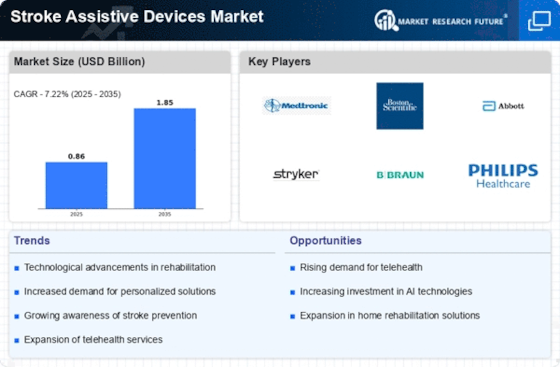
As per MRFR analysis, the Stroke Assistive Devices Market Size was estimated at 0.8578 USD Billion in 2024. The Stroke Assistive Devices industry is projected to grow from 0.9197 in 2025 to 1.847 by 2035, exhibiting a compound annual growth rate (CAGR) of 7.22 during the forecast period 2025 - 2035.

Key Market Trends & Highlights

The Stroke Assistive Devices Market is experiencing robust growth driven by technological advancements and increasing patient-centered approaches.

  • Technological integration is reshaping the Stroke Assistive Devices Market, enhancing functionality and user experience.
  • Patient-centered design is becoming a focal point, ensuring devices meet the specific needs of stroke survivors.
  • North America remains the largest market, while the Asia-Pacific region is emerging as the fastest-growing area for stroke assistive technologies.
  • The rising incidence of stroke and increased awareness and education are key drivers propelling market expansion.

Market Size & Forecast

2024 Market Size 0.8578 (USD Billion)
2035 Market Size 1.847 (USD Billion)
CAGR (2025 - 2035) 7.22%
Largest Regional Market Share in 2024 North America

Major Players

<p>Medtronic (US), Boston Scientific (US), Abbott Laboratories (US), Stryker Corporation (US), B. Braun Melsungen AG (DE), Philips Healthcare (NL), Zimmer Biomet (US), Civco Medical Solutions (US), NeuroVasc Technologies (US)</p>

Market Trends

The Stroke Assistive Devices Market is currently experiencing a notable evolution, driven by advancements in technology and an increasing awareness of the needs of stroke survivors. As the global population ages, the prevalence of strokes is likely to rise, thereby amplifying the demand for innovative assistive devices. These devices, which range from mobility aids to communication tools, are designed to enhance the quality of life for individuals recovering from strokes. Furthermore, the integration of smart technology into these devices appears to be a significant trend, as it offers personalized solutions that cater to the unique challenges faced by each user. This technological integration not only improves functionality but also fosters greater independence among users, which is a crucial aspect of rehabilitation. In addition to technological advancements, the Stroke Assistive Devices Market is also influenced by a growing emphasis on patient-centered care. Healthcare providers are increasingly recognizing the importance of tailoring rehabilitation strategies to meet individual needs. This shift is likely to encourage the development of more specialized devices that address specific impairments resulting from strokes. Moreover, collaboration between manufacturers, healthcare professionals, and patients is becoming more prevalent, suggesting a holistic approach to device design and implementation. As the market continues to evolve, it is essential to monitor these trends closely, as they may shape the future landscape of stroke rehabilitation and support.

Technological Integration

The incorporation of smart technology into stroke assistive devices is becoming increasingly prevalent. This trend suggests that devices are not only designed for basic functionality but also equipped with features that enhance user experience and rehabilitation outcomes. Smart devices may include sensors, connectivity options, and data tracking capabilities, allowing for personalized care and improved monitoring of progress.

Patient-Centered Design

There is a noticeable shift towards patient-centered design in the Stroke Assistive Devices Market. This trend indicates that manufacturers are focusing on creating devices that cater to the specific needs and preferences of users. By involving patients in the design process, companies are likely to produce more effective and user-friendly solutions that facilitate recovery.

Collaborative Development

Collaboration among stakeholders in the healthcare ecosystem is emerging as a key trend. This involves partnerships between device manufacturers, healthcare providers, and patients to ensure that assistive devices are developed with a comprehensive understanding of user needs. Such collaboration may lead to innovations that are more aligned with real-world applications and rehabilitation goals.

Stroke Assistive Devices Market Market Drivers

Aging Population

The aging demographic is a significant factor influencing the Stroke Assistive Devices Market. As the global population ages, the incidence of stroke is expected to rise, leading to an increased demand for assistive devices. Older adults are particularly vulnerable to strokes, and their rehabilitation needs are often more complex. This demographic shift necessitates the development of specialized devices that cater to the unique challenges faced by elderly stroke survivors. The Stroke Assistive Devices Market is likely to see a surge in products designed for this population, focusing on enhancing mobility, safety, and overall quality of life.

Rising Incidence of Stroke

The increasing prevalence of stroke worldwide is a primary driver for the Stroke Assistive Devices Market. According to health statistics, stroke remains one of the leading causes of disability, affecting millions annually. This growing incidence necessitates the development and adoption of assistive devices that aid in rehabilitation and daily living. As the population ages, the demand for effective stroke recovery solutions is likely to escalate. The Stroke Assistive Devices Market is responding to this need by innovating products that enhance mobility and independence for stroke survivors. Furthermore, the economic burden associated with stroke care emphasizes the importance of investing in assistive technologies that can improve patient outcomes and reduce long-term healthcare costs.

Technological Advancements

Technological innovations play a crucial role in shaping the Stroke Assistive Devices Market. The integration of smart technologies, such as artificial intelligence and robotics, into assistive devices enhances their functionality and effectiveness. For instance, devices equipped with sensors can monitor patient progress in real-time, providing valuable data for healthcare providers. The market has seen a surge in the development of wearable devices that facilitate rehabilitation exercises, making therapy more accessible and engaging for patients. As these technologies continue to evolve, they are expected to drive growth in the Stroke Assistive Devices Market, offering new solutions that cater to the diverse needs of stroke survivors.

Increased Awareness and Education

There is a growing awareness regarding stroke prevention and rehabilitation, which significantly impacts the Stroke Assistive Devices Market. Educational initiatives aimed at both healthcare professionals and the general public have led to a better understanding of stroke risks and recovery processes. This heightened awareness encourages individuals to seek assistive devices that can aid in their rehabilitation journey. Moreover, healthcare providers are increasingly recommending these devices as part of comprehensive stroke care plans. As awareness campaigns continue to proliferate, the demand for innovative assistive solutions is likely to rise, further propelling the Stroke Assistive Devices Market forward.

Government Initiatives and Funding

Government support and funding for stroke rehabilitation programs are pivotal in driving the Stroke Assistive Devices Market. Various countries have implemented policies aimed at improving stroke care and rehabilitation services, which often include financial assistance for assistive devices. Such initiatives not only enhance access to necessary technologies for patients but also stimulate market growth by encouraging manufacturers to innovate and expand their product offerings. The collaboration between public health agencies and private sector companies is likely to foster advancements in the Stroke Assistive Devices Market, ensuring that more individuals benefit from effective rehabilitation solutions.

Market Segment Insights

Stroke Assistive Devices Market Type Insights

The Market segments of Stroke Assistive Devices Market, based on type, includes mobility assistive devices, fixed assistive devices, communication devices, cognitive devices. The mobility assistive devices segment held the majority share in 2022 in the Stroke Assistive Devices Market revenue due to the mobility assistive devices improved mobility and enable them to perform their daily task independently.

ReWalk received CE mark for its product “ReStore Exo-Suit Stroke Rehabilitation Device”.

The company can sale this product in European Union. This CE mark exo-suit, a next generation medical device which This CE Mark is the first approval of a soft exo-suit, a next generation medical device which can provide a higher and extra diverse patient population suffering mobility issues.

Stroke Assistive Devices Market Application Insights

The Stroke Assistive Devices Market segmentation based on application includes hospitals, specialty clinics, physiotherapy centers, ambulatory surgical centers, home care settings, rehabilitation centers, others. The home care settings segment dominated the market in 2022 due to the the home-care setting is expected to hold a substantial share of this market as the patients prefer to get treatment at home in order to avoid the risks associated with hospitalization. In addition, the rising geriatric population and the increasing occurrences of strokes are likely to fuel the demand for stroke assistive devices from the home-care setting.

Hospitals, on the other hand, are expected to remain an important segment of this market as these are the places where the recovery process of a stroke patient usually begins.

Stroke Assistive Devices Market Distribution Channel Insights

The Stroke Assistive Devices Market segmentation based on distribution channel includes direct sales, online sales, retail pharmacies, medical stores. Retail pharmacies segment dominated the market in 2022 due to the availability of proficient medical retail staff which can provide proper knowledge about the application of products and their use. Retail pharmacies can easily understand the patient's prescription and they can provide proper instruction about the products.

Figure 2: Stroke Assistive Devices Market, By Distribution Channel, 2023 & 2032 (USD Billion)

Source: Secondary Research, Primary Research, Market Research Future Database, and Analyst Review

Get more detailed insights about Stroke Assistive Devices Market Research Report - Forecast to 2035

Regional Insights

North America : Leading Innovation and Demand

North America is the largest market for stroke assistive devices, accounting for approximately 45% of the global market share. The region's growth is driven by increasing stroke prevalence, advancements in medical technology, and supportive healthcare policies. Regulatory catalysts, such as FDA approvals for innovative devices, further enhance market dynamics. The demand for effective rehabilitation solutions is also rising, fueled by an aging population and heightened awareness of stroke recovery options. The United States is the primary contributor to this market, with key players like Medtronic, Boston Scientific, and Abbott Laboratories leading the charge. The competitive landscape is characterized by continuous innovation and strategic partnerships among these companies. Canada also plays a significant role, focusing on improving healthcare access and integrating advanced technologies into stroke rehabilitation. The presence of established firms ensures a robust supply chain and effective distribution channels.

Europe : Emerging Market with Growth Potential

Europe is the second-largest market for stroke assistive devices, holding around 30% of the global market share. The region's growth is propelled by increasing investments in healthcare infrastructure, rising awareness of stroke rehabilitation, and favorable regulatory frameworks. The European Medicines Agency (EMA) has been instrumental in streamlining the approval process for innovative devices, which encourages market entry and competition among manufacturers. Leading countries in this region include Germany, France, and the UK, where significant healthcare investments are being made. The competitive landscape features key players like B. Braun Melsungen AG and Philips Healthcare, who are actively involved in research and development. The presence of these companies fosters innovation and enhances the availability of advanced stroke assistive devices, catering to the growing demand for effective rehabilitation solutions.

Asia-Pacific : Rapidly Growing Market Potential

Asia-Pacific is witnessing rapid growth in the stroke assistive devices market, accounting for approximately 20% of the global share. The region's expansion is driven by increasing healthcare expenditure, a rising aging population, and growing awareness of stroke prevention and rehabilitation. Governments are implementing policies to improve healthcare access, which is expected to further boost market demand for assistive devices in the coming years. Countries like China, Japan, and India are leading the charge, with significant investments in healthcare infrastructure and technology. The competitive landscape is evolving, with both local and international players, including Medtronic and Stryker Corporation, striving to capture market share. The presence of these key players enhances innovation and ensures a diverse range of products to meet the needs of patients recovering from strokes.

Middle East and Africa : Untapped Market with Opportunities

The Middle East and Africa region is gradually emerging in the stroke assistive devices market, holding about 5% of the global share. The growth is primarily driven by increasing healthcare initiatives, government investments in medical technology, and rising awareness of stroke rehabilitation. Countries in this region are focusing on improving healthcare access and quality, which is expected to create new opportunities for market players in the coming years. Leading countries include South Africa and the UAE, where healthcare reforms are being implemented to enhance patient care. The competitive landscape is still developing, with a mix of local and international companies entering the market. The presence of key players like Civco Medical Solutions and NeuroVasc Technologies is crucial for driving innovation and expanding the availability of stroke assistive devices in this region.

Key Players and Competitive Insights

The presence of major market players in the Stroke Assistive Devices Market is characterized by the presence of many international, regional, and local players. The companies are investing in R&D activities to expand their product portfolio for stroke assistive devices, which further drives the growth of the Stroke Assistive Devices Market. Moreover, the vendors compete based on cost, product quality, reliability, and aftermarket services and try to be the first to bring treatment for the public. It is crucial for the players to offer cost-efficient and high-quality products for Stroke Assistive Devices Market to succeed in an intensely competitive market environment.

One of the primary business strategies adopted by manufacturers in the global stroke assistive devices industry to benefit clients and expand the stroke assistive devices market sector is to manufacture locally to reduce operating costs.

AnthroTronix is a research and development (R&D) firm focusing in the development of advanced interface technology; product development for robotic control systems wearable computing,and development,design,and testing of simulation tools for trainingpurpose. AnthroTronix was acknowledged as a 2008 Inc. 5000 Fastest Growing Company.The company supplies its R&D advanced technology product development and services to governmental customers and commercial.

Key Companies in the Stroke Assistive Devices Market market include

Industry Developments

August 2023 : ReWalk (US) announced acquisition of AlterG which is a a leading inventor and supplier of Anti-Gravity systems for use in neurological rehabilitation and physical. This transaction includes AlterG’s present and upcoming product lines to ReWalk’s existing portfolio of neurorehabilitation products and is presumed to significantly expand its customer-facing expertise and expand future growth opportunities.

May 2023: Bionik Laboratories announced that the company has entered into a distribution agreement with Pro-Med Technology for the distribution of InMotion Robotic Devices in Hong Kong. This distribution agreement boosted the business growth of Bionik Laboratories in Hong Kong.

Future Outlook

Stroke Assistive Devices Market Future Outlook

<p>The Stroke Assistive Devices Market is projected to grow at a 7.22% CAGR from 2024 to 2035, driven by technological advancements, increasing patient populations, and rising healthcare expenditures.</p>

New opportunities lie in:

  • <p>Development of AI-driven rehabilitation devices for personalized therapy.</p>
  • <p>Expansion of telehealth platforms integrating stroke assistive technologies.</p>
  • <p>Partnerships with healthcare providers for integrated care solutions.</p>

<p>By 2035, the market is expected to be robust, driven by innovation and strategic partnerships.</p>

Market Segmentation

Stroke Assistive Devices Market Type Outlook

  • Mobility Assistive Devices
  • Fixed Assistive Devices
  • Communication Devices
  • Cognitive Devices

Stroke Assistive Devices Market Application Outlook

  • Hospitals
  • Specialty Clinics
  • Physiotherapy Centers
  • Ambulatory Surgical Centers
  • Home Care Settings
  • Rehabilitation Centers
  • Others

Stroke Assistive Devices Market Distribution Channel Outlook

  • Direct Sales
  • Online Sales
  • Retail Pharmacies
  • Medical Stores

Report Scope

MARKET SIZE 20240.8578(USD Billion)
MARKET SIZE 20250.9197(USD Billion)
MARKET SIZE 20351.847(USD Billion)
COMPOUND ANNUAL GROWTH RATE (CAGR)7.22% (2024 - 2035)
REPORT COVERAGERevenue Forecast, Competitive Landscape, Growth Factors, and Trends
BASE YEAR2024
Market Forecast Period2025 - 2035
Historical Data2019 - 2024
Market Forecast UnitsUSD Billion
Key Companies ProfiledMarket analysis in progress
Segments CoveredMarket segmentation analysis in progress
Key Market OpportunitiesIntegration of advanced robotics and artificial intelligence in Stroke Assistive Devices Market enhances rehabilitation outcomes.
Key Market DynamicsTechnological advancements and regulatory changes drive innovation in the Stroke Assistive Devices Market, enhancing patient outcomes.
Countries CoveredNorth America, Europe, APAC, South America, MEA

FAQs

What is the projected market valuation of the Stroke Assistive Devices Market by 2035?

The projected market valuation for the Stroke Assistive Devices Market is expected to reach 1.847 USD Billion by 2035.

What was the market valuation of the Stroke Assistive Devices Market in 2024?

The overall market valuation of the Stroke Assistive Devices Market was 0.8578 USD Billion in 2024.

What is the expected CAGR for the Stroke Assistive Devices Market during the forecast period 2025 - 2035?

The expected CAGR for the Stroke Assistive Devices Market during the forecast period 2025 - 2035 is 7.22%.

Which companies are considered key players in the Stroke Assistive Devices Market?

Key players in the Stroke Assistive Devices Market include Medtronic, Boston Scientific, Abbott Laboratories, and Stryker Corporation.

What segment of the Stroke Assistive Devices Market had the highest valuation in 2024?

In 2024, the Mobility Assistive Devices segment had the highest valuation at 0.3 USD Billion.

How much is the Fixed Assistive Devices segment projected to grow by 2035?

The Fixed Assistive Devices segment is projected to grow from 0.2 USD Billion in 2024 to 0.4 USD Billion by 2035.

What is the expected valuation of the Communication Devices segment by 2035?

The Communication Devices segment is expected to reach a valuation of 0.5 USD Billion by 2035.

Which application segment is anticipated to have the highest growth in the Stroke Assistive Devices Market?

The Hospitals application segment is anticipated to have the highest growth, increasing from 0.2578 USD Billion in 2024 to 0.557 USD Billion by 2035.

  1. SECTION I: EXECUTIVE SUMMARY AND KEY HIGHLIGHTS
    1. EXECUTIVE SUMMARY
      1. Market Overview
      2. Key Findings
      3. Market Segmentation
      4. Competitive Landscape
      5. Challenges and Opportunities
      6. Future Outlook
  2. SECTION II: SCOPING, METHODOLOGY AND MARKET STRUCTURE
    1. MARKET INTRODUCTION
      1. Definition
      2. Scope of the study
    2. RESEARCH METHODOLOGY
      1. Overview
      2. Data Mining
      3. Secondary Research
      4. Primary Research
      5. Forecasting Model
      6. Market Size Estimation
      7. Data Triangulation
      8. Validation
  3. SECTION III: QUALITATIVE ANALYSIS
    1. MARKET DYNAMICS
      1. Overview
      2. Drivers
      3. Restraints
      4. Opportunities
    2. MARKET FACTOR ANALYSIS
      1. Value chain Analysis
      2. Porter's Five Forces Analysis
      3. COVID-19 Impact Analysis
  4. SECTION IV: QUANTITATIVE ANALYSIS
    1. Healthcare, BY Type (USD Billion)
      1. Mobility Assistive Devices
      2. Fixed Assistive Devices
      3. Communication Devices
      4. Cognitive Devices
    2. Healthcare, BY Application (USD Billion)
      1. Hospitals
      2. Specialty Clinics
      3. Physiotherapy Centers
      4. Ambulatory Surgical Centers
      5. Home Care Settings
      6. Rehabilitation Centers
      7. Others
    3. Healthcare, BY Distribution Channel (USD Billion)
      1. Direct Sales
      2. Online Sales
      3. Retail Pharmacies
      4. Medical Stores
    4. Healthcare, BY Region (USD Billion)
      1. North America
      2. Europe
      3. APAC
      4. South America
      5. MEA
  5. SECTION V: COMPETITIVE ANALYSIS
    1. Competitive Landscape
      1. Overview
      2. Competitive Analysis
      3. Market share Analysis
      4. Major Growth Strategy in the Healthcare
      5. Competitive Benchmarking
      6. Leading Players in Terms of Number of Developments in the Healthcare
      7. Key developments and growth strategies
      8. Major Players Financial Matrix
    2. Company Profiles
      1. Medtronic (US)
      2. Boston Scientific (US)
      3. Abbott Laboratories (US)
      4. Stryker Corporation (US)
      5. B. Braun Melsungen AG (DE)
      6. Philips Healthcare (NL)
      7. Zimmer Biomet (US)
      8. Civco Medical Solutions (US)
      9. NeuroVasc Technologies (US)
    3. Appendix
      1. References
      2. Related Reports
  6. LIST OF FIGURES
    1. MARKET SYNOPSIS
    2. NORTH AMERICA MARKET ANALYSIS
    3. US MARKET ANALYSIS BY TYPE
    4. US MARKET ANALYSIS BY APPLICATION
    5. US MARKET ANALYSIS BY DISTRIBUTION CHANNEL
    6. CANADA MARKET ANALYSIS BY TYPE
    7. CANADA MARKET ANALYSIS BY APPLICATION
    8. CANADA MARKET ANALYSIS BY DISTRIBUTION CHANNEL
    9. EUROPE MARKET ANALYSIS
    10. GERMANY MARKET ANALYSIS BY TYPE
    11. GERMANY MARKET ANALYSIS BY APPLICATION
    12. GERMANY MARKET ANALYSIS BY DISTRIBUTION CHANNEL
    13. UK MARKET ANALYSIS BY TYPE
    14. UK MARKET ANALYSIS BY APPLICATION
    15. UK MARKET ANALYSIS BY DISTRIBUTION CHANNEL
    16. FRANCE MARKET ANALYSIS BY TYPE
    17. FRANCE MARKET ANALYSIS BY APPLICATION
    18. FRANCE MARKET ANALYSIS BY DISTRIBUTION CHANNEL
    19. RUSSIA MARKET ANALYSIS BY TYPE
    20. RUSSIA MARKET ANALYSIS BY APPLICATION
    21. RUSSIA MARKET ANALYSIS BY DISTRIBUTION CHANNEL
    22. ITALY MARKET ANALYSIS BY TYPE
    23. ITALY MARKET ANALYSIS BY APPLICATION
    24. ITALY MARKET ANALYSIS BY DISTRIBUTION CHANNEL
    25. SPAIN MARKET ANALYSIS BY TYPE
    26. SPAIN MARKET ANALYSIS BY APPLICATION
    27. SPAIN MARKET ANALYSIS BY DISTRIBUTION CHANNEL
    28. REST OF EUROPE MARKET ANALYSIS BY TYPE
    29. REST OF EUROPE MARKET ANALYSIS BY APPLICATION
    30. REST OF EUROPE MARKET ANALYSIS BY DISTRIBUTION CHANNEL
    31. APAC MARKET ANALYSIS
    32. CHINA MARKET ANALYSIS BY TYPE
    33. CHINA MARKET ANALYSIS BY APPLICATION
    34. CHINA MARKET ANALYSIS BY DISTRIBUTION CHANNEL
    35. INDIA MARKET ANALYSIS BY TYPE
    36. INDIA MARKET ANALYSIS BY APPLICATION
    37. INDIA MARKET ANALYSIS BY DISTRIBUTION CHANNEL
    38. JAPAN MARKET ANALYSIS BY TYPE
    39. JAPAN MARKET ANALYSIS BY APPLICATION
    40. JAPAN MARKET ANALYSIS BY DISTRIBUTION CHANNEL
    41. SOUTH KOREA MARKET ANALYSIS BY TYPE
    42. SOUTH KOREA MARKET ANALYSIS BY APPLICATION
    43. SOUTH KOREA MARKET ANALYSIS BY DISTRIBUTION CHANNEL
    44. MALAYSIA MARKET ANALYSIS BY TYPE
    45. MALAYSIA MARKET ANALYSIS BY APPLICATION
    46. MALAYSIA MARKET ANALYSIS BY DISTRIBUTION CHANNEL
    47. THAILAND MARKET ANALYSIS BY TYPE
    48. THAILAND MARKET ANALYSIS BY APPLICATION
    49. THAILAND MARKET ANALYSIS BY DISTRIBUTION CHANNEL
    50. INDONESIA MARKET ANALYSIS BY TYPE
    51. INDONESIA MARKET ANALYSIS BY APPLICATION
    52. INDONESIA MARKET ANALYSIS BY DISTRIBUTION CHANNEL
    53. REST OF APAC MARKET ANALYSIS BY TYPE
    54. REST OF APAC MARKET ANALYSIS BY APPLICATION
    55. REST OF APAC MARKET ANALYSIS BY DISTRIBUTION CHANNEL
    56. SOUTH AMERICA MARKET ANALYSIS
    57. BRAZIL MARKET ANALYSIS BY TYPE
    58. BRAZIL MARKET ANALYSIS BY APPLICATION
    59. BRAZIL MARKET ANALYSIS BY DISTRIBUTION CHANNEL
    60. MEXICO MARKET ANALYSIS BY TYPE
    61. MEXICO MARKET ANALYSIS BY APPLICATION
    62. MEXICO MARKET ANALYSIS BY DISTRIBUTION CHANNEL
    63. ARGENTINA MARKET ANALYSIS BY TYPE
    64. ARGENTINA MARKET ANALYSIS BY APPLICATION
    65. ARGENTINA MARKET ANALYSIS BY DISTRIBUTION CHANNEL
    66. REST OF SOUTH AMERICA MARKET ANALYSIS BY TYPE
    67. REST OF SOUTH AMERICA MARKET ANALYSIS BY APPLICATION
    68. REST OF SOUTH AMERICA MARKET ANALYSIS BY DISTRIBUTION CHANNEL
    69. MEA MARKET ANALYSIS
    70. GCC COUNTRIES MARKET ANALYSIS BY TYPE
    71. GCC COUNTRIES MARKET ANALYSIS BY APPLICATION
    72. GCC COUNTRIES MARKET ANALYSIS BY DISTRIBUTION CHANNEL
    73. SOUTH AFRICA MARKET ANALYSIS BY TYPE
    74. SOUTH AFRICA MARKET ANALYSIS BY APPLICATION
    75. SOUTH AFRICA MARKET ANALYSIS BY DISTRIBUTION CHANNEL
    76. REST OF MEA MARKET ANALYSIS BY TYPE
    77. REST OF MEA MARKET ANALYSIS BY APPLICATION
    78. REST OF MEA MARKET ANALYSIS BY DISTRIBUTION CHANNEL
    79. KEY BUYING CRITERIA OF HEALTHCARE
    80. RESEARCH PROCESS OF MRFR
    81. DRO ANALYSIS OF HEALTHCARE
    82. DRIVERS IMPACT ANALYSIS: HEALTHCARE
    83. RESTRAINTS IMPACT ANALYSIS: HEALTHCARE
    84. SUPPLY / VALUE CHAIN: HEALTHCARE
    85. HEALTHCARE, BY TYPE, 2024 (% SHARE)
    86. HEALTHCARE, BY TYPE, 2024 TO 2035 (USD Billion)
    87. HEALTHCARE, BY APPLICATION, 2024 (% SHARE)
    88. HEALTHCARE, BY APPLICATION, 2024 TO 2035 (USD Billion)
    89. HEALTHCARE, BY DISTRIBUTION CHANNEL, 2024 (% SHARE)
    90. HEALTHCARE, BY DISTRIBUTION CHANNEL, 2024 TO 2035 (USD Billion)
    91. BENCHMARKING OF MAJOR COMPETITORS
  7. LIST OF TABLES
    1. LIST OF ASSUMPTIONS
    2. North America MARKET SIZE ESTIMATES; FORECAST
      1. BY TYPE, 2025-2035 (USD Billion)
      2. BY APPLICATION, 2025-2035 (USD Billion)
      3. BY DISTRIBUTION CHANNEL, 2025-2035 (USD Billion)
    3. US MARKET SIZE ESTIMATES; FORECAST
      1. BY TYPE, 2025-2035 (USD Billion)
      2. BY APPLICATION, 2025-2035 (USD Billion)
      3. BY DISTRIBUTION CHANNEL, 2025-2035 (USD Billion)
    4. Canada MARKET SIZE ESTIMATES; FORECAST
      1. BY TYPE, 2025-2035 (USD Billion)
      2. BY APPLICATION, 2025-2035 (USD Billion)
      3. BY DISTRIBUTION CHANNEL, 2025-2035 (USD Billion)
    5. Europe MARKET SIZE ESTIMATES; FORECAST
      1. BY TYPE, 2025-2035 (USD Billion)
      2. BY APPLICATION, 2025-2035 (USD Billion)
      3. BY DISTRIBUTION CHANNEL, 2025-2035 (USD Billion)
    6. Germany MARKET SIZE ESTIMATES; FORECAST
      1. BY TYPE, 2025-2035 (USD Billion)
      2. BY APPLICATION, 2025-2035 (USD Billion)
      3. BY DISTRIBUTION CHANNEL, 2025-2035 (USD Billion)
    7. UK MARKET SIZE ESTIMATES; FORECAST
      1. BY TYPE, 2025-2035 (USD Billion)
      2. BY APPLICATION, 2025-2035 (USD Billion)
      3. BY DISTRIBUTION CHANNEL, 2025-2035 (USD Billion)
    8. France MARKET SIZE ESTIMATES; FORECAST
      1. BY TYPE, 2025-2035 (USD Billion)
      2. BY APPLICATION, 2025-2035 (USD Billion)
      3. BY DISTRIBUTION CHANNEL, 2025-2035 (USD Billion)
    9. Russia MARKET SIZE ESTIMATES; FORECAST
      1. BY TYPE, 2025-2035 (USD Billion)
      2. BY APPLICATION, 2025-2035 (USD Billion)
      3. BY DISTRIBUTION CHANNEL, 2025-2035 (USD Billion)
    10. Italy MARKET SIZE ESTIMATES; FORECAST
      1. BY TYPE, 2025-2035 (USD Billion)
      2. BY APPLICATION, 2025-2035 (USD Billion)
      3. BY DISTRIBUTION CHANNEL, 2025-2035 (USD Billion)
    11. Spain MARKET SIZE ESTIMATES; FORECAST
      1. BY TYPE, 2025-2035 (USD Billion)
      2. BY APPLICATION, 2025-2035 (USD Billion)
      3. BY DISTRIBUTION CHANNEL, 2025-2035 (USD Billion)
    12. Rest of Europe MARKET SIZE ESTIMATES; FORECAST
      1. BY TYPE, 2025-2035 (USD Billion)
      2. BY APPLICATION, 2025-2035 (USD Billion)
      3. BY DISTRIBUTION CHANNEL, 2025-2035 (USD Billion)
    13. APAC MARKET SIZE ESTIMATES; FORECAST
      1. BY TYPE, 2025-2035 (USD Billion)
      2. BY APPLICATION, 2025-2035 (USD Billion)
      3. BY DISTRIBUTION CHANNEL, 2025-2035 (USD Billion)
    14. China MARKET SIZE ESTIMATES; FORECAST
      1. BY TYPE, 2025-2035 (USD Billion)
      2. BY APPLICATION, 2025-2035 (USD Billion)
      3. BY DISTRIBUTION CHANNEL, 2025-2035 (USD Billion)
    15. India MARKET SIZE ESTIMATES; FORECAST
      1. BY TYPE, 2025-2035 (USD Billion)
      2. BY APPLICATION, 2025-2035 (USD Billion)
      3. BY DISTRIBUTION CHANNEL, 2025-2035 (USD Billion)
    16. Japan MARKET SIZE ESTIMATES; FORECAST
      1. BY TYPE, 2025-2035 (USD Billion)
      2. BY APPLICATION, 2025-2035 (USD Billion)
      3. BY DISTRIBUTION CHANNEL, 2025-2035 (USD Billion)
    17. South Korea MARKET SIZE ESTIMATES; FORECAST
      1. BY TYPE, 2025-2035 (USD Billion)
      2. BY APPLICATION, 2025-2035 (USD Billion)
      3. BY DISTRIBUTION CHANNEL, 2025-2035 (USD Billion)
    18. Malaysia MARKET SIZE ESTIMATES; FORECAST
      1. BY TYPE, 2025-2035 (USD Billion)
      2. BY APPLICATION, 2025-2035 (USD Billion)
      3. BY DISTRIBUTION CHANNEL, 2025-2035 (USD Billion)
    19. Thailand MARKET SIZE ESTIMATES; FORECAST
      1. BY TYPE, 2025-2035 (USD Billion)
      2. BY APPLICATION, 2025-2035 (USD Billion)
      3. BY DISTRIBUTION CHANNEL, 2025-2035 (USD Billion)
    20. Indonesia MARKET SIZE ESTIMATES; FORECAST
      1. BY TYPE, 2025-2035 (USD Billion)
      2. BY APPLICATION, 2025-2035 (USD Billion)
      3. BY DISTRIBUTION CHANNEL, 2025-2035 (USD Billion)
    21. Rest of APAC MARKET SIZE ESTIMATES; FORECAST
      1. BY TYPE, 2025-2035 (USD Billion)
      2. BY APPLICATION, 2025-2035 (USD Billion)
      3. BY DISTRIBUTION CHANNEL, 2025-2035 (USD Billion)
    22. South America MARKET SIZE ESTIMATES; FORECAST
      1. BY TYPE, 2025-2035 (USD Billion)
      2. BY APPLICATION, 2025-2035 (USD Billion)
      3. BY DISTRIBUTION CHANNEL, 2025-2035 (USD Billion)
    23. Brazil MARKET SIZE ESTIMATES; FORECAST
      1. BY TYPE, 2025-2035 (USD Billion)
      2. BY APPLICATION, 2025-2035 (USD Billion)
      3. BY DISTRIBUTION CHANNEL, 2025-2035 (USD Billion)
    24. Mexico MARKET SIZE ESTIMATES; FORECAST
      1. BY TYPE, 2025-2035 (USD Billion)
      2. BY APPLICATION, 2025-2035 (USD Billion)
      3. BY DISTRIBUTION CHANNEL, 2025-2035 (USD Billion)
    25. Argentina MARKET SIZE ESTIMATES; FORECAST
      1. BY TYPE, 2025-2035 (USD Billion)
      2. BY APPLICATION, 2025-2035 (USD Billion)
      3. BY DISTRIBUTION CHANNEL, 2025-2035 (USD Billion)
    26. Rest of South America MARKET SIZE ESTIMATES; FORECAST
      1. BY TYPE, 2025-2035 (USD Billion)
      2. BY APPLICATION, 2025-2035 (USD Billion)
      3. BY DISTRIBUTION CHANNEL, 2025-2035 (USD Billion)
    27. MEA MARKET SIZE ESTIMATES; FORECAST
      1. BY TYPE, 2025-2035 (USD Billion)
      2. BY APPLICATION, 2025-2035 (USD Billion)
      3. BY DISTRIBUTION CHANNEL, 2025-2035 (USD Billion)
    28. GCC Countries MARKET SIZE ESTIMATES; FORECAST
      1. BY TYPE, 2025-2035 (USD Billion)
      2. BY APPLICATION, 2025-2035 (USD Billion)
      3. BY DISTRIBUTION CHANNEL, 2025-2035 (USD Billion)
    29. South Africa MARKET SIZE ESTIMATES; FORECAST
      1. BY TYPE, 2025-2035 (USD Billion)
      2. BY APPLICATION, 2025-2035 (USD Billion)
      3. BY DISTRIBUTION CHANNEL, 2025-2035 (USD Billion)
    30. Rest of MEA MARKET SIZE ESTIMATES; FORECAST
      1. BY TYPE, 2025-2035 (USD Billion)
      2. BY APPLICATION, 2025-2035 (USD Billion)
      3. BY DISTRIBUTION CHANNEL, 2025-2035 (USD Billion)
    31. PRODUCT LAUNCH/PRODUCT DEVELOPMENT/APPROVAL
    32. ACQUISITION/PARTNERSHIP

Stroke Assistive Devices Market Segmentation

Stroke Assistive Devices Type Outlook (USD Billion, 2019-2032)

  • Mobility Assistive Devices
  • Fixed Assistive Devices
  • Communication Devices
  • Cognitive Devices

Stroke Assistive Devices Application Outlook (USD Billion, 2019-2032)

  • Hospitals
  • Specialty Clinics
  • Physiotherapy Centers
  • Ambulatory Surgical Centers
  • Home Care Settings
  • Rehabilitation Centers
  • Others

Stroke Assistive Devices Distribution Channel Outlook (USD Billion, 2019-2032)

  • Direct Sales
  • Online Sales
  • Retail Pharmacies
  • Medical Stores

Stroke Assistive Devices Regional Outlook (USD Billion, 2019-2032)

  • North America Outlook (USD Billion, 2019-2032)
    • North America Stroke Assistive Devices by Type
      • Mobility Assistive Devices
      • Fixed Assistive Devices
      • Communication Devices
      • Cognitive Devices
    • North America Stroke Assistive Devices by Application
      • Hospitals
      • Specialty Clinics
      • Physiotherapy Centers
      • Ambulatory Surgical Centers
      • Home Care Settings
      • Rehabilitation Centers
      • Others
    • North America Stroke Assistive Devices by Distribution Channel
      • Direct Sales
      • Online Sales
      • Retail Pharmacies
      • Medical Stores
    • US Outlook (USD Billion, 2019-2032)
    • US Stroke Assistive Devices by Type
      • Mobility Assistive Devices
      • Fixed Assistive Devices
      • Communication Devices
      • Cognitive Devices
    • US Stroke Assistive Devices by Application
      • Hospitals
      • Specialty Clinics
      • Physiotherapy Centers
      • Ambulatory Surgical Centers
      • Home Care Settings
      • Rehabilitation Centers
      • Others
    • US Stroke Assistive Devices by Distribution Channel
      • Direct Sales
      • Online Sales
      • Retail Pharmacies
      • Medical Stores
    • Canada Outlook (USD Billion, 2019-2032)
    • Canada Stroke Assistive Devices by Type
      • Mobility Assistive Devices
      • Fixed Assistive Devices
      • Communication Devices
      • Cognitive Devices
    • Canada Stroke Assistive Devices by Application
      • Hospitals
      • Specialty Clinics
      • Physiotherapy Centers
      • Ambulatory Surgical Centers
      • Home Care Settings
      • Rehabilitation Centers
      • Others
    • Canada Stroke Assistive Devices by Distribution Channel
      • Direct Sales
      • Online Sales
      • Retail Pharmacies
      • Medical Stores
    • Europe Outlook (USD Billion, 2019-2032)
      • Europe Stroke Assistive Devices by Type
        • Mobility Assistive Devices
        • Fixed Assistive Devices
        • Communication Devices
        • Cognitive Devices
      • Europe Stroke Assistive Devices by Application
        • Hospitals
        • Specialty Clinics
        • Physiotherapy Centers
        • Ambulatory Surgical Centers
        • Home Care Settings
        • Rehabilitation Centers
        • Others
      • Europe Stroke Assistive Devices by Distribution Channel
        • Direct Sales
        • Online Sales
        • Retail Pharmacies
        • Medical Stores
      • Germany Outlook (USD Billion, 2019-2032)
      • Germany Stroke Assistive Devices by Type
        • Mobility Assistive Devices
        • Fixed Assistive Devices
        • Communication Devices
        • Cognitive Devices
      • Germany Stroke Assistive Devices by Application
        • Hospitals
        • Specialty Clinics
        • Physiotherapy Centers
        • Ambulatory Surgical Centers
        • Home Care Settings
        • Rehabilitation Centers
        • Others
      • Germany Stroke Assistive Devices by Distribution Channel
        • Direct Sales
        • Online Sales
        • Retail Pharmacies
        • Medical Stores
      • France Outlook (USD Billion, 2019-2032)
      • France Stroke Assistive Devices by Type
        • Mobility Assistive Devices
        • Fixed Assistive Devices
        • Communication Devices
        • Cognitive Devices
      • France Stroke Assistive Devices by Application
        • Hospitals
        • Specialty Clinics
        • Physiotherapy Centers
        • Ambulatory Surgical Centers
        • Home Care Settings
        • Rehabilitation Centers
        • Others
      • France Stroke Assistive Devices by Distribution Channel
        • Direct Sales
        • Online Sales
        • Retail Pharmacies
        • Medical Stores
      • UK Outlook (USD Billion, 2019-2032)
      • UK Stroke Assistive Devices by Type
        • Mobility Assistive Devices
        • Fixed Assistive Devices
        • Communication Devices
        • Cognitive Devices
      • UK Stroke Assistive Devices by Application
        • Hospitals
        • Specialty Clinics
        • Physiotherapy Centers
        • Ambulatory Surgical Centers
        • Home Care Settings
        • Rehabilitation Centers
        • Others
      • UK Stroke Assistive Devices by Distribution Channel
        • Direct Sales
        • Online Sales
        • Retail Pharmacies
        • Medical Stores
      • Italy Outlook (USD Billion, 2019-2032)
      • Italy Stroke Assistive Devices by Type
        • Mobility Assistive Devices
        • Fixed Assistive Devices
        • Communication Devices
        • Cognitive Devices
      • Italy Stroke Assistive Devices by Application
        • Hospitals
        • Specialty Clinics
        • Physiotherapy Centers
        • Ambulatory Surgical Centers
        • Home Care Settings
        • Rehabilitation Centers
        • Others
      • Italy Stroke Assistive Devices by Distribution Channel
        • Direct Sales
        • Online Sales
        • Retail Pharmacies
        • Medical Stores
      • Spain Outlook (USD Billion, 2019-2032)
      • Spain Stroke Assistive Devices by Type
        • Mobility Assistive Devices
        • Fixed Assistive Devices
        • Communication Devices
        • Cognitive Devices
      • Spain Stroke Assistive Devices by Application
        • Hospitals
        • Specialty Clinics
        • Physiotherapy Centers
        • Ambulatory Surgical Centers
        • Home Care Settings
        • Rehabilitation Centers
        • Others
      • Spain Stroke Assistive Devices by Distribution Channel
        • Direct Sales
        • Online Sales
        • Retail Pharmacies
        • Medical Stores
      • Rest of Europe Outlook (USD Billion, 2019-2032)
      • Rest of Europe Stroke Assistive Devices by Type
        • Mobility Assistive Devices
        • Fixed Assistive Devices
        • Communication Devices
        • Cognitive Devices
      • Rest of Europe Stroke Assistive Devices by Application
        • Hospitals
        • Specialty Clinics
        • Physiotherapy Centers
        • Ambulatory Surgical Centers
        • Home Care Settings
        • Rehabilitation Centers
        • Others
      • Rest of Europe Stroke Assistive Devices by Distribution Channel
        • Direct Sales
        • Online Sales
        • Retail Pharmacies
        • Medical Stores
      • Asia-Pacific Outlook (USD Billion, 2019-2032)
        • Asia-Pacific Stroke Assistive Devices by Type
          • Mobility Assistive Devices
          • Fixed Assistive Devices
          • Communication Devices
          • Cognitive Devices
        • Asia-Pacific Stroke Assistive Devices by Application
          • Hospitals
          • Specialty Clinics
          • Physiotherapy Centers
          • Ambulatory Surgical Centers
          • Home Care Settings
          • Rehabilitation Centers
          • Others
        • Asia-Pacific Stroke Assistive Devices by Distribution Channel
          • Direct Sales
          • Online Sales
          • Retail Pharmacies
          • Medical Stores
        • Japan Outlook (USD Billion, 2019-2032)
        • Japan Stroke Assistive Devices by Type
          • Mobility Assistive Devices
          • Fixed Assistive Devices
          • Communication Devices
          • Cognitive Devices
        • Japan Stroke Assistive Devices by Application
          • Hospitals
          • Specialty Clinics
          • Physiotherapy Centers
          • Ambulatory Surgical Centers
          • Home Care Settings
          • Rehabilitation Centers
          • Others
        • Japan Stroke Assistive Devices by Distribution Channel
          • Direct Sales
          • Online Sales
          • Retail Pharmacies
          • Medical Stores
        • China Outlook (USD Billion, 2019-2032)
        • China Stroke Assistive Devices by Type
          • Mobility Assistive Devices
          • Fixed Assistive Devices
          • Communication Devices
          • Cognitive Devices
        • China Stroke Assistive Devices by Application
          • Hospitals
          • Specialty Clinics
          • Physiotherapy Centers
          • Ambulatory Surgical Centers
          • Home Care Settings
          • Rehabilitation Centers
          • Others
        • China Stroke Assistive Devices by Distribution Channel
          • Direct Sales
          • Online Sales
          • Retail Pharmacies
          • Medical Stores
        • India Outlook (USD Billion, 2019-2032)
        • India Stroke Assistive Devices by Type
          • Mobility Assistive Devices
          • Fixed Assistive Devices
          • Communication Devices
          • Cognitive Devices
        • India Stroke Assistive Devices by Application
          • Hospitals
          • Specialty Clinics
          • Physiotherapy Centers
          • Ambulatory Surgical Centers
          • Home Care Settings
          • Rehabilitation Centers
          • Others
        • India Stroke Assistive Devices by Distribution Channel
          • Direct Sales
          • Online Sales
          • Retail Pharmacies
          • Medical Stores
        • Australia Outlook (USD Billion, 2019-2032)
        • Australia Stroke Assistive Devices by Type
          • Mobility Assistive Devices
          • Fixed Assistive Devices
          • Communication Devices
          • Cognitive Devices
        • Australia Stroke Assistive Devices by Application
          • Hospitals
          • Specialty Clinics
          • Physiotherapy Centers
          • Ambulatory Surgical Centers
          • Home Care Settings
          • Rehabilitation Centers
          • Others
        • Australia Stroke Assistive Devices by Distribution Channel
          • Direct Sales
          • Online Sales
          • Retail Pharmacies
          • Medical Stores
        • South Korea Outlook (USD Billion, 2019-2032)
        • South Korea Stroke Assistive Devices by Type
          • Mobility Assistive Devices
          • Fixed Assistive Devices
          • Communication Devices
          • Cognitive Devices
        • South Korea Stroke Assistive Devices by Application
          • Hospitals
          • Specialty Clinics
          • Physiotherapy Centers
          • Ambulatory Surgical Centers
          • Home Care Settings
          • Rehabilitation Centers
          • Others
        • South Korea Stroke Assistive Devices by Distribution Channel
          • Direct Sales
          • Online Sales
          • Retail Pharmacies
          • Medical Stores
        • Rest of Asia-Pacific Outlook (USD Billion, 2019-2032)
        • Rest of Asia-Pacific Stroke Assistive Devices by Type
          • Mobility Assistive Devices
          • Fixed Assistive Devices
          • Communication Devices
          • Cognitive Devices
        • Rest of Asia-Pacific Stroke Assistive Devices by Application
          • Hospitals
          • Specialty Clinics
          • Physiotherapy Centers
          • Ambulatory Surgical Centers
          • Home Care Settings
          • Rehabilitation Centers
          • Others
        • Rest of Asia-Pacific Stroke Assistive Devices by Distribution Channel
          • Direct Sales
          • Online Sales
          • Retail Pharmacies
          • Medical Stores
        • Rest of the World Outlook (USD Billion, 2019-2032)
          • Rest of the World Stroke Assistive Devices by Type
            • Mobility Assistive Devices
            • Fixed Assistive Devices
            • Communication Devices
            • Cognitive Devices
          • Rest of the World Stroke Assistive Devices by Application
            • Hospitals
            • Specialty Clinics
            • Physiotherapy Centers
            • Ambulatory Surgical Centers
            • Home Care Settings
            • Rehabilitation Centers
            • Others
          • Rest of the World Stroke Assistive Devices by Distribution Channel
            • Direct Sales
            • Online Sales
            • Retail Pharmacies
            • Medical Stores
          • Middle East Outlook (USD Billion, 2019-2032)
          • Middle East Stroke Assistive Devices by Type
            • Mobility Assistive Devices
            • Fixed Assistive Devices
            • Communication Devices
            • Cognitive Devices
          • Middle East Stroke Assistive Devices by Application
            • Hospitals
            • Specialty Clinics
            • Physiotherapy Centers
            • Ambulatory Surgical Centers
            • Home Care Settings
            • Rehabilitation Centers
            • Others
          • Middle East Stroke Assistive Devices by Distribution Channel
            • Direct Sales
            • Online Sales
            • Retail Pharmacies
            • Medical Stores
          • Africa Outlook (USD Billion, 2019-2032)
          • Africa Stroke Assistive Devices by Type
            • Mobility Assistive Devices
            • Fixed Assistive Devices
            • Communication Devices
            • Cognitive Devices
          • Africa Stroke Assistive Devices by Application
            • Hospitals
            • Specialty Clinics
            • Physiotherapy Centers
            • Ambulatory Surgical Centers
            • Home Care Settings
            • Rehabilitation Centers
            • Others
          • Africa Stroke Assistive Devices by Distribution Channel
            • Direct Sales
            • Online Sales
            • Retail Pharmacies
            • Medical Stores
          • Latin America Outlook (USD Billion, 2019-2032)
          • Latin America Stroke Assistive Devices by Type
            • Mobility Assistive Devices
            • Fixed Assistive Devices
            • Communication Devices
            • Cognitive Devices
          • Latin America Stroke Assistive Devices by Application
            • Hospitals
            • Specialty Clinics
            • Physiotherapy Centers
            • Ambulatory Surgical Centers
            • Home Care Settings
            • Rehabilitation Centers
            • Others
          • Latin America Stroke Assistive Devices by Distribution Channel
            • Direct Sales
            • Online Sales
            • Retail Pharmacies
            • Medical Stores
Infographic

Free Sample Request

Kindly complete the form below to receive a free sample of this Report

Get Free Sample

Customer Strories

Compare Licence

×
Features License Type
Single User Multiuser License Enterprise User
Price $4,950 $5,950 $7,250
Maximum User Access Limit 1 User Upto 10 Users Unrestricted Access Throughout the Organization
Free Customization
Direct Access to Analyst
Deliverable Format
Platform Access
Discount on Next Purchase 10% 15% 15%
Printable Versions