×
Request Free Sample ×

Kindly complete the form below to receive a free sample of this Report

* Please use a valid business email

Leading companies partner with us for data-driven Insights

clients tt-cursor
Hero Background

Telematics Market

ID: MRFR/ICT/0615-CR
193 Pages
Ankit Gupta
May 2025

Telematics Market Research Report Information By Component (Hardware,( GPS Tracking Devices, Sensors & Actuators , Communication Modules) ,Software,( Fleet Management Software, Navigation & Mapping Solutions , Telematics Data Analytics ) And Services(Consulting & Integration , Maintenance & Support)), By Connectivity Type (Satellite-Based Telematics , Cellular Network-Based Telematics And Bluetooth & Wi-Fi-Based Telematics), By Vehicle Type (Passenger Vehicles, Commercial Vehicles,( Light Commercial Vehicles (LCVs... read more

Share:
Download PDF ×

We do not share your information with anyone. However, we may send you emails based on your report interest from time to time. You may contact us at any time to opt-out.

Telematics Market Infographic
Purchase Options

Telematics Market Summary

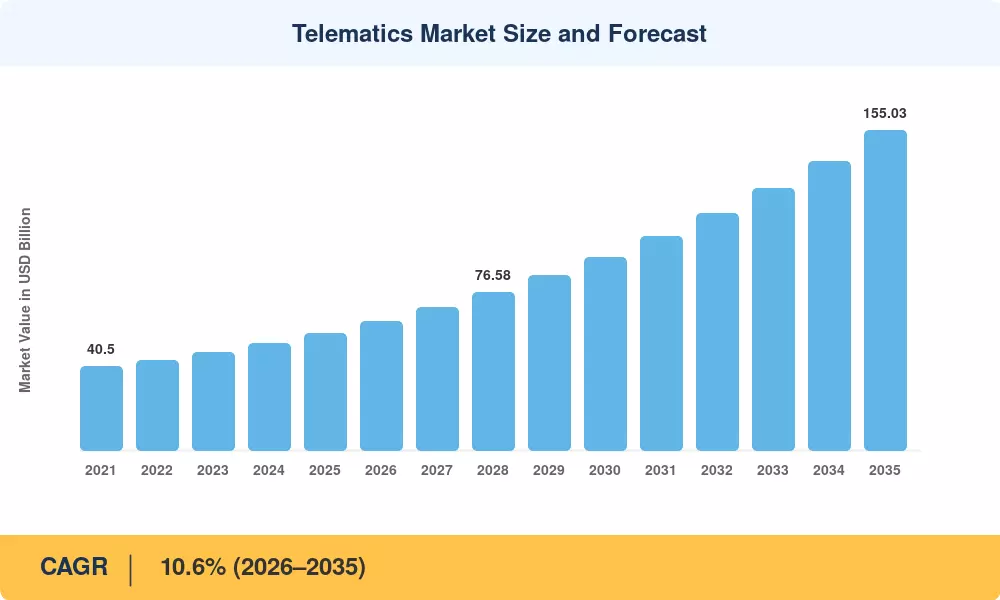
As per MRFR analysis, the Telematics Market Size was estimated at 129.16 USD Million in 2024. The Telematics industry is projected to grow from 145.5 in 2025 to 564.04 by 2035, exhibiting a compound annual growth rate (CAGR) of 14.5 during the forecast period 2025 - 2035.

Key Market Trends & Highlights

The Telematics Market is experiencing robust growth driven by technological advancements and increasing demand for connectivity.

  • The integration of Artificial Intelligence is transforming data analytics capabilities within the Telematics Market.
  • North America remains the largest market, while Asia-Pacific is emerging as the fastest-growing region in telematics solutions.
  • Fleet Management continues to dominate the market, whereas Insurance Telematics is witnessing rapid growth due to evolving consumer needs.
  • Rising demand for fleet management solutions and advancements in vehicle connectivity are key drivers propelling market expansion.

Market Size & Forecast

2024 Market Size 129.16 (USD Million)
2035 Market Size 564.04 (USD Million)
CAGR (2025 - 2035) 14.5%

Major Players

Verizon (US), AT&T (US), TomTom (NL), Geotab (CA), Fleet Complete (CA), Teletrac Navman (AU), Sierra Wireless (CA), Trimble (US), Continental (DE)

Telematics Market Trends

The Telematics Market is currently experiencing a transformative phase, driven by advancements in technology and increasing demand for connectivity in vehicles. This sector encompasses a wide range of applications, including vehicle tracking, fleet management, and driver behavior analysis. As consumers and businesses alike seek enhanced safety, efficiency, and convenience, the integration of telematics solutions into everyday operations appears to be gaining momentum. Furthermore, the rise of electric vehicles and autonomous driving technologies is likely to further propel the adoption of telematics systems, as these innovations require sophisticated data management and communication capabilities. In addition to technological advancements, regulatory frameworks are evolving to support the growth of the Telematics Market. Governments worldwide are implementing policies aimed at improving road safety and reducing emissions, which may encourage the adoption of telematics solutions. The interplay between consumer preferences and regulatory requirements suggests a dynamic landscape where telematics solutions must adapt to meet diverse needs. As the market continues to evolve, stakeholders must remain vigilant to emerging trends and potential disruptions that could shape the future of telematics.

Integration of Artificial Intelligence

The incorporation of artificial intelligence into telematics systems is becoming increasingly prevalent. AI technologies enhance data analysis capabilities, enabling more accurate predictions and insights regarding vehicle performance and driver behavior. This trend may lead to improved decision-making processes for fleet operators and individual users alike.

Focus on Data Security

As telematics systems collect vast amounts of sensitive data, the emphasis on data security is intensifying. Stakeholders are prioritizing the implementation of robust security measures to protect user information from potential breaches. This focus on safeguarding data may influence the design and functionality of future telematics solutions.

Growth of Connected Vehicles

The rise of connected vehicles is reshaping the Telematics Market. These vehicles, equipped with advanced communication technologies, facilitate real-time data exchange between vehicles and infrastructure. This trend could enhance traffic management and improve overall road safety, indicating a shift towards smarter transportation systems.

Telematics Market Drivers

Market Growth Projections

The Global Telematics Market Industry is on a trajectory of remarkable growth, with projections indicating a rise from 129.2 USD Billion in 2024 to 681.8 USD Billion by 2035. This growth is underpinned by a compound annual growth rate of 16.33% from 2025 to 2035. Such figures suggest a robust demand for telematics solutions across various sectors, including automotive, logistics, and insurance. The increasing integration of telematics in everyday operations highlights its potential to transform industries by enhancing efficiency, safety, and connectivity. As the market evolves, stakeholders are likely to explore innovative applications and technologies to capitalize on this growth.

Advancements in IoT and Connectivity

The Global Telematics Market Industry is significantly influenced by advancements in Internet of Things (IoT) technologies and connectivity solutions. The proliferation of connected devices facilitates seamless data exchange between vehicles and infrastructure, enhancing the capabilities of telematics systems. For example, smart city initiatives leverage telematics to improve traffic management and reduce congestion. As connectivity becomes more robust, the market is poised for substantial growth, with projections indicating a rise to 681.8 USD Billion by 2035. This evolution suggests that the integration of IoT in telematics will not only enhance user experiences but also drive innovation across various sectors.

Growing Adoption of Electric Vehicles

The Global Telematics Market Industry is significantly impacted by the growing adoption of electric vehicles (EVs). As the automotive landscape shifts towards sustainability, telematics plays a crucial role in managing EV performance and optimizing charging infrastructure. For example, telematics systems can provide real-time data on battery health and charging patterns, enabling users to maximize efficiency. This trend aligns with the broader market growth, as the industry is projected to expand to 681.8 USD Billion by 2035. The integration of telematics in EVs not only enhances user experience but also supports the transition towards greener transportation solutions.

Rising Demand for Fleet Management Solutions

The Global Telematics Market Industry experiences a notable surge in demand for fleet management solutions. Companies increasingly seek to optimize their operations, reduce costs, and enhance safety through telematics technologies. For instance, the integration of GPS tracking and real-time data analytics allows fleet operators to monitor vehicle performance and driver behavior effectively. This trend is reflected in the projected market growth, with the industry expected to reach 129.2 USD Billion in 2024. As businesses recognize the value of telematics in improving efficiency, the adoption of these solutions is likely to accelerate, contributing significantly to the overall market expansion.

Increased Focus on Vehicle Safety and Compliance

The Global Telematics Market Industry is witnessing an increased emphasis on vehicle safety and regulatory compliance. Governments worldwide are implementing stringent regulations to ensure road safety, which drives the adoption of telematics solutions. For instance, telematics systems can monitor driver behavior, providing insights that help reduce accidents and improve compliance with safety standards. This focus on safety is likely to propel the market forward, as organizations invest in technologies that enhance their safety protocols. The anticipated compound annual growth rate of 16.33% from 2025 to 2035 underscores the importance of telematics in meeting these evolving safety requirements.

Emergence of Advanced Driver Assistance Systems (ADAS)

The Global Telematics Market Industry is increasingly shaped by the emergence of Advanced Driver Assistance Systems (ADAS). These systems utilize telematics to enhance vehicle safety and automate driving processes. Features such as lane-keeping assistance, adaptive cruise control, and collision avoidance rely heavily on real-time data provided by telematics solutions. As consumer demand for safer and more automated vehicles rises, the adoption of ADAS is expected to grow, driving the telematics market forward. This trend aligns with the projected market growth, as the industry is anticipated to reach 129.2 USD Billion in 2024, reflecting the critical role of telematics in advancing automotive technology.

Market Segment Insights

By Application: Fleet Management (Largest) vs. Insurance Telematics (Fastest-Growing)

In the Telematics Market, Fleet Management holds a significant share due to its extensive application in logistics and transportation sectors. It enables companies to optimize their fleet operations, reduce costs, and enhance efficiency. Conversely, Insurance Telematics is rapidly gaining traction, as insurers leverage real-time data to assess risk and incentives for safe driving, making it a compelling choice for many consumers.

Fleet Management (Dominant) vs. Insurance Telematics (Emerging)

Fleet Management is characterized by its established presence in the industry, focusing on real-time vehicle tracking, route optimization, and maintenance monitoring, leading to significant operational cost savings. This segment appeals primarily to businesses that need to manage large fleets efficiently. On the other hand, Insurance Telematics is an emerging player, utilizing advanced analytics and data-driven insights to offer personalized insurance premiums based on driving behaviors. It caters to a growing market of consumers looking for cost-effective and safer driving solutions, thus making it an attractive area for insurers to innovate and expand.

By End Use: Transportation (Largest) vs. Logistics (Fastest-Growing)

The telematics market reveals a diverse distribution across various end-use segments, with transportation holding a significant market share due to its extensive application in fleet management, routing, and monitoring systems. Logistics is also prominent, leveraging telematics to enhance supply chain transparency and efficiency. The automotive sector is steadily integrating telematics solutions for improved vehicle performance and connectivity, while the construction and public sectors are gradually adopting these technologies to optimize operations and safety, albeit with smaller market shares overall. The growth trends indicate that logistics is emerging as the fastest-growing segment, driven by the rising demand for real-time tracking and analytics. Transportation remains dominant, propelled by an increased need for efficiency and cost-effectiveness in fleet operations. Both sectors benefit from advancements in IoT and big data analytics, enhancing their capabilities and fueling market expansion. The public sector is also beginning to harness telematics for smarter infrastructure management, indicating potential growth opportunities in future applications of telematics technology.

Transportation (Dominant) vs. Logistics (Emerging)

The transportation segment in the telematics market is characterized by its dominance, primarily focusing on fleet management solutions that enhance vehicle tracking, route optimization, and driver performance analytics. With an emphasis on reducing operational costs, increasing efficiency, and ensuring compliance with regulations, the transportation sector has been quick to adopt telematics technologies. In contrast, logistics is an emerging segment rapidly gaining traction as digital transformation reshapes supply chain management. The integration of telematics solutions facilitates improved tracking of goods, inventory management, and overall supply chain transparency, meeting the escalating customer demand for real-time information. As both segments evolve, there is a notable synergy, allowing logistics to benefit from the established foundations laid by the transportation sector.

By Technology: Global Navigation Satellite System (Largest) vs. Cellular Network (Fastest-Growing)

The Telematics Market exhibits diverse segment values, with the Global Navigation Satellite System (GNSS) holding the largest share due to its widespread integration in vehicles for navigation and fleet management. Cellular networks follow closely, leveraging their extensive infrastructure to support telematics services. Short-range communication technologies, although smaller in share, play a crucial role in enhancing vehicle-to-vehicle communication. Embedded telematics and cloud computing are rapidly growing as they offer innovative solutions and operational efficiencies, further diversifying the market landscape.

Telematics: GNSS (Dominant) vs. Cellular Network (Emerging)

In the current landscape of the Telematics Market, the Global Navigation Satellite System (GNSS) stands out as a dominant force, providing critical navigation and positioning services crucial for the automotive and logistics sectors. Its reliable performance and accuracy make it a preferred choice for many applications. In contrast, cellular networks, while currently seen as emerging, are rapidly expanding their influence thanks to advancements in mobile technology and increasing demand for real-time data monitoring. The convergence of these technologies is fostering a more interconnected and data-driven environment, making cellular networks an essential component of future telematics solutions.

By Component: Connectivity Modules (Largest) vs. Telematics Control Unit (Fastest-Growing)

In the Telematics Market, the component segment is predominantly led by Connectivity Modules, which hold the largest share due to their critical role in enabling communication between vehicles and external systems. Hardware, including sensors and embedded systems, also plays a significant role but follows Connectivity Modules in market share. Software applications that facilitate data processing and analytics are gaining traction, while Services are crucial for deployment and maintenance. The Telematics Control Unit, a pivotal element within this segment, is emerging as the fastest-growing component as vehicles increasingly adopt connected technologies for enhanced performance and safety.

Telematics Control Unit (Dominant) vs. Services (Emerging)

The Telematics Control Unit (TCU) is a dominant player in the component segment, primarily responsible for processing vehicle data and managing connectivity functions. As the backbone of telematics systems, TCUs integrate various functionalities, allowing for real-time vehicle monitoring and data transmission. In contrast, Services, although emerging, are becoming increasingly vital as businesses prioritize the operational deployment of telematics solutions. Services encompass data management, system maintenance, and analytics support, thus improving overall telematics efficiency. As demand for connected vehicles rises, both TCUs and Services are crucial for transforming raw data into actionable insights, shaping the future of automotive technology.

By Vehicle Type: Passenger Vehicle (Largest) vs. Electric Vehicle (Fastest-Growing)

In the telematics market, passenger vehicles dominate the landscape, accounting for a significant share of the total market due to rising consumer demand for connected car technologies. Commercial vehicles and heavy-duty vehicles also contribute to the market share, driven by fleet management needs. Meanwhile, two-wheelers hold a smaller part but are important due to urban mobility solutions and cost efficiency. Telematics systems in these vehicles enhance driving experience, safety, and efficiency, appealing to both consumers and fleets.

Passenger Vehicle (Dominant) vs. Electric Vehicle (Emerging)

The passenger vehicle segment is recognized as the dominant player in the telematics market, characterized by a substantial adoption of connectivity features aimed at enhancing driver and passenger experience. This segment benefits from ongoing advancements in infotainment systems and safety features. On the other hand, the electric vehicle segment is emerging rapidly, propelled by growing environmental awareness and government incentives. As manufacturers innovate, electric vehicles are integrating sophisticated telematics solutions that improve charging management and route optimization, making this segment increasingly attractive to tech-savvy consumers.

Get more detailed insights about Telematics Market

Regional Insights

North America : Market Leader in Telematics

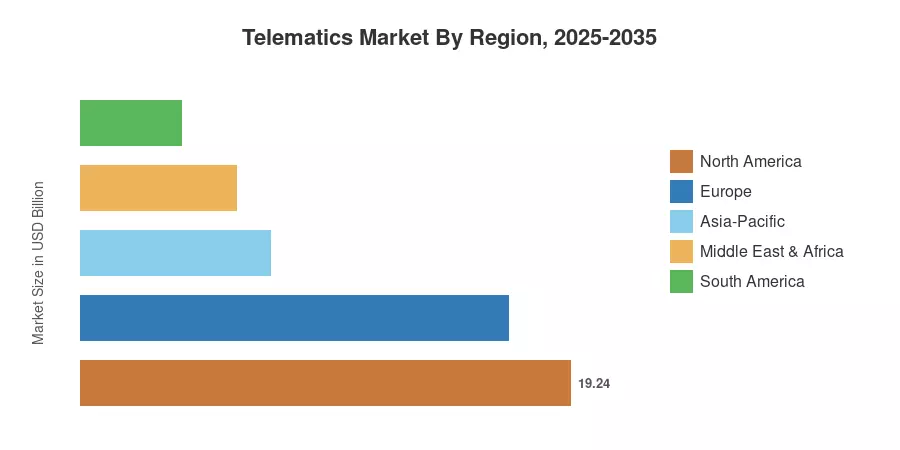
North America continues to lead the telematics market, holding a significant 65.0% share as of 2024. The region's growth is driven by increasing demand for fleet management solutions, enhanced connectivity, and regulatory support for vehicle safety and emissions standards. The rise in e-commerce and logistics has further fueled the need for real-time tracking and data analytics, making telematics an essential component for businesses. The competitive landscape is robust, with key players like Verizon, AT&T, and Geotab dominating the market. The U.S. and Canada are at the forefront, leveraging advanced technologies and infrastructure. Companies are investing heavily in R&D to innovate and improve service offerings, ensuring they remain competitive in this rapidly evolving sector.

Europe : Emerging Market with Growth Potential

Europe's telematics market is poised for growth, currently holding a 35.0% share. The region is witnessing a surge in demand for connected vehicle technologies, driven by stringent regulations on emissions and safety. The European Union's Green Deal and initiatives for smart mobility are significant catalysts, encouraging investments in telematics solutions that enhance efficiency and reduce environmental impact. Leading countries such as Germany, the UK, and France are at the forefront of this transformation, with major players like TomTom and Continental leading the charge. The competitive landscape is characterized by a mix of established firms and innovative startups, all vying to capture market share in this dynamic environment. The focus on sustainability and digitalization is reshaping the telematics landscape in Europe.

Asia-Pacific : Rapidly Growing Telecommunication Hub

The Asia-Pacific region is emerging as a significant player in the telematics market, currently holding a 25.0% share. The growth is driven by increasing vehicle production, urbanization, and the rising demand for smart transportation solutions. Governments are also implementing supportive policies to enhance road safety and reduce traffic congestion, further propelling the telematics sector forward. Countries like China, Japan, and Australia are leading the charge, with a competitive landscape featuring companies such as Teletrac Navman and Sierra Wireless. The region is witnessing a surge in partnerships between automotive manufacturers and telematics providers, aiming to integrate advanced technologies into vehicles. This collaboration is expected to enhance service offerings and drive market growth in the coming years.

Middle East and Africa : Emerging Market with Untapped Potential

The Middle East and Africa region represents an emerging market in the telematics sector, currently holding a modest 4.16% share. The growth is primarily driven by increasing investments in infrastructure and a growing awareness of the benefits of telematics in fleet management and logistics. Governments are beginning to recognize the importance of telematics for enhancing road safety and efficiency, leading to supportive regulations. Countries like South Africa and the UAE are at the forefront of this growth, with a competitive landscape that includes both local and international players. The presence of companies like Fleet Complete is indicative of the region's potential. As the market matures, increased adoption of telematics solutions is expected, driven by technological advancements and a focus on operational efficiency.

Key Players and Competitive Insights

The Telematics Market is currently characterized by a dynamic competitive landscape, driven by technological advancements and increasing demand for connected vehicle solutions. Key players such as Verizon (US), AT&T (US), and Geotab (CA) are strategically positioning themselves through innovation and partnerships. Verizon (US) focuses on enhancing its IoT capabilities, while AT&T (US) emphasizes its 5G network to support telematics applications. Geotab (CA) is leveraging data analytics to provide actionable insights for fleet management, thereby shaping a competitive environment that prioritizes technological integration and customer-centric solutions.

In terms of business tactics, companies are increasingly localizing manufacturing and optimizing supply chains to enhance operational efficiency. The market appears moderately fragmented, with a mix of established players and emerging startups. The collective influence of these key players fosters a competitive structure that encourages innovation and responsiveness to market demands.

In November 2025, Verizon (US) announced a strategic partnership with a leading automotive manufacturer to integrate advanced telematics solutions into their vehicles. This collaboration is expected to enhance vehicle safety and performance, showcasing Verizon's commitment to leveraging its network capabilities for innovative telematics applications. Such partnerships may significantly bolster Verizon's market position by expanding its service offerings and enhancing customer engagement.

In October 2025, Geotab (CA) launched a new AI-driven analytics platform aimed at optimizing fleet operations. This platform utilizes machine learning algorithms to provide predictive maintenance insights, which could potentially reduce operational costs for fleet operators. The introduction of this technology indicates Geotab's focus on harnessing AI to deliver value-added services, thereby strengthening its competitive edge in the telematics sector.

In September 2025, AT&T (US) expanded its telematics solutions portfolio by acquiring a software company specializing in vehicle tracking and fleet management. This acquisition is likely to enhance AT&T's capabilities in providing comprehensive telematics solutions, aligning with its strategy to integrate advanced technologies into its offerings. Such moves reflect a broader trend of consolidation within the market, as companies seek to enhance their technological prowess and service capabilities.

As of December 2025, the Telematics Market is witnessing trends such as digitalization, sustainability, and AI integration, which are redefining competitive dynamics. Strategic alliances are increasingly shaping the landscape, enabling companies to pool resources and expertise. Looking ahead, competitive differentiation is expected to evolve, with a shift from price-based competition to a focus on innovation, technology, and supply chain reliability. This transition underscores the importance of adaptability and forward-thinking strategies in maintaining a competitive advantage.

Key Companies in the Telematics Market market include

Industry Developments

November 2024 : NXP has introduced the i.MX 94 applications processor, a next-generation telematics and connectivity solution for software-defined vehicles (SDVs). It integrates high-performance processing, advanced security, and real-time networking, enabling efficient vehicle-to-cloud communication, over-the-air (OTA) updates, and intelligent telematics management while reducing system complexity and cost​.

June 2023 : Verizon Business launched Connected Car by Verizon for select BMW models in the U.S., offering voice, data, and unlimited Wi-Fi for $20/month. Features include Multi-Vehicle Connect for personalized settings across multiple BMWs and Number Share – Vehicle for seamless calling via BMW eSIM, enhancing in-car connectivity and infotainment.

Future Outlook

Telematics Market Future Outlook

The Telematics Market is projected to grow at a 14.5% CAGR from 2024 to 2035, driven by advancements in IoT, increased demand for fleet management, and regulatory support.

New opportunities lie in:

  • Integration of AI-driven analytics for predictive maintenance solutions.
  • Development of advanced driver-assistance systems (ADAS) for enhanced safety.
  • Expansion of telematics services in emerging markets for fleet optimization.

By 2035, the Telematics Market is expected to be robust, driven by innovation and strategic partnerships.

Market Segmentation

Telematics Market End Use Outlook

  • Transportation
  • Logistics
  • Automotive
  • Construction
  • Public Sector

Telematics Market Component Outlook

  • Hardware
  • Software
  • Services
  • Connectivity Modules
  • Telematics Control Unit

Telematics Market Technology Outlook

  • Global Navigation Satellite System
  • Cellular Network
  • Short Range Communication
  • Embedded Telematics
  • Cloud Computing

Telematics Market Application Outlook

  • Fleet Management
  • Insurance Telematics
  • Vehicle Tracking
  • Remote Diagnostics
  • Driver Behavior Monitoring

Telematics Market Vehicle Type Outlook

  • Passenger Vehicle
  • Commercial Vehicle
  • Heavy Duty Vehicle
  • Two-Wheeler
  • Electric Vehicle

Report Scope

MARKET SIZE 2024129.16(USD Million)
MARKET SIZE 2025145.5(USD Million)
MARKET SIZE 2035564.04(USD Million)
COMPOUND ANNUAL GROWTH RATE (CAGR)14.5% (2024 - 2035)
REPORT COVERAGERevenue Forecast, Competitive Landscape, Growth Factors, and Trends
BASE YEAR2024
Market Forecast Period2025 - 2035
Historical Data2019 - 2024
Market Forecast UnitsUSD Million
Key Companies ProfiledVerizon (US), AT&T (US), TomTom (NL), Geotab (CA), Fleet Complete (CA), Teletrac Navman (AU), Sierra Wireless (CA), Trimble (US), Continental (DE)
Segments CoveredApplication, End Use, Technology, Component, Vehicle Type
Key Market OpportunitiesIntegration of artificial intelligence and machine learning in the Telematics Market enhances data analytics and decision-making.
Key Market DynamicsRising demand for connected vehicles drives innovation and competition in the telematics market.
Countries CoveredNorth America, Europe, APAC, South America, MEA

Market Highlights

Author
Ankit Gupta
Senior Research Analyst

Ankit Gupta is an analyst in market research industry in ICT and SEMI industry. With post-graduation in "Telecom and Marketing Management" and graduation in "Electronics and Telecommunication" vertical he is well versed with recent development in ICT industry as a whole. Having worked on more than 150+ reports including consultation for fortune 500 companies such as Microsoft and Rio Tinto in identifying solutions with respect to business problems his opinions are inclined towards mixture of technical and managerial aspects.

Leave a Comment

FAQs

How much is the Telematics market?

USD 129,177.36 Million in 2024

What is the growth rate of the Video market?

14.5 %

Which region held the largest market share in the Telematics market?

North America

Who are the prominent players in the Telematics market?

VERIZON, HARMAN INTERNATIONAL , TOMTOM INTERNATIONAL BV, AT&T, VODAFONE GROUP PLC, FORD MOTOR COMPANY, TELEFÓNICA S.A, POWERFLEET, GEOTAB INC, NXP SEMICONDUCTORS and others .

Which Component led the Telematics Market??

The Services dominated the market in 2024.

Download Free Sample

Kindly complete the form below to receive a free sample of this Report

Compare Licence

×
Features License Type
Single User Multiuser License Enterprise User
Price $ $ $3,000
Maximum User Access Limit 1 User Upto 10 Users Unrestricted Access Throughout the Organization
Free Customization
Direct Access to Analyst
Deliverable Format
Platform Access
Discount on Next Purchase 10% 15% 15%
Printable Versions