
×
Hero Background
English
Chinese
French
Japanese
Korean
German
Spanish

Thermochromic Pigment Market Trends

ID: MRFR/CnM/5940-HCR
140 Pages
Priya Nagrale
October 2025

Thermochromic Pigment Market Research Report Information by Product (Liquid Crystal Material, Leuco Dyes), Pigment Type (Reversible Thermochromic Pigments, Irreversible Thermochromic Pigments), End-Use Industry (Printing Ink), Region - Forecast to 2035

Share:
Download PDF ×

We do not share your information with anyone. However, we may send you emails based on your report interest from time to time. You may contact us at any time to opt-out.

Thermochromic Pigment Market Infographic
Purchase Options

Market Trends

Key Emerging Trends in the Thermochromic Pigment Market

The thermochromic pigment market is witnessing a dynamic landscape shaped by various factors influencing its growth trajectory. Thermochromic pigments are specialized color-changing materials that respond to changes in temperature, making them ideal for a wide range of applications across industries such as packaging, textiles, printing, toys, and security. One significant trend driving the thermochromic pigment market is the increasing demand for temperature-sensitive packaging solutions. With the rise of e-commerce and online shopping, there is a growing need for packaging materials that provide visual indicators of temperature changes to ensure product safety and quality during storage, transportation, and delivery. Thermochromic pigments enable the development of intelligent packaging solutions that change color in response to temperature fluctuations, indicating temperature-sensitive products such as perishable foods, pharmaceuticals, and cosmetics.

Moreover, the textile industry represents a major market for thermochromic pigments, driven by the growing demand for color-changing fabrics and garments in fashion, sportswear, and activewear segments. Thermochromic pigments are incorporated into textile fibers, yarns, and coatings to create innovative textiles that change color in response to changes in body temperature, ambient temperature, or exposure to sunlight. These color-changing fabrics offer unique aesthetic effects, interactive designs, and functional properties such as moisture-wicking, UV protection, and thermoregulation, enhancing the appeal and performance of textiles in various applications. Additionally, the demand for smart textiles and wearable technologies that monitor and respond to physiological parameters drives the adoption of thermochromic pigments in textile-based sensors, health monitors, and smart clothing.

Furthermore, the printing and packaging industry presents significant opportunities for the thermochromic pigment market, particularly in applications such as security printing, brand authentication, and promotional materials. Thermochromic pigments are used in security documents, banknotes, passports, and identification cards to create covert or overt security features that change color or reveal hidden messages when subjected to temperature variations or touch. Additionally, thermochromic inks and coatings are used in product packaging, labels, stickers, and promotional materials to engage consumers, enhance brand visibility, and create interactive experiences. The ability of thermochromic pigments to create attention-grabbing effects and engage consumers through color-changing graphics and designs drives their adoption in marketing campaigns, product launches, and brand activations across various industries. Based on product, the global thermochromic pigment market has been categorized into liquid crystal material, leuco dyes, and inorganic materials.

Moreover, the toy and novelty industry relies on thermochromic pigments for creating interactive and educational toys, games, puzzles, and novelty items that change color with temperature or touch. Thermochromic pigments are incorporated into thermometers, mood rings, color-changing paints, and magic color books to create captivating visual effects and sensory experiences for children and adults alike. Additionally, the use of thermochromic pigments in educational materials, science kits, and DIY projects promotes learning and creativity by demonstrating principles of thermochromism, heat transfer, and color change phenomena in a fun and engaging manner. The versatility, safety, and non-toxicity of thermochromic pigments make them popular choices for toy manufacturers and hobbyists seeking innovative and interactive play experiences.

However, the thermochromic pigment market faces challenges such as cost competitiveness, durability, and color stability. Thermochromic pigments tend to be more expensive than conventional pigments and dyes due to their specialized formulation and manufacturing processes. Moreover, the durability and color stability of thermochromic pigments may vary depending on factors such as substrate compatibility, exposure to light, heat, moisture, and mechanical abrasion. Manufacturers are continuously investing in research and development activities to improve the performance characteristics of thermochromic pigments, enhance their colorfastness, stability, and durability, and develop novel formulations for specific applications and end-use requirements.
Author
Priya Nagrale
Senior Research Analyst

With an experience of over five years in market research industry (Chemicals & Materials domain), I gather and analyze market data from diverse sources to produce results, which are then presented back to a client. Also, provide recommendations based on the findings. As a Senior Research Analyst, I perform quality checks (QC) for market estimations, QC for reports, and handle queries and work extensively on client customizations. Also, handle the responsibilities of client proposals, report planning, report finalization, and execution

Leave a Comment

FAQs

At what CAGR is the thermochromic pigment market projected to grow during the forecast period?

The thermochromic pigment market is projected to grow at a 5.1% CAGR between 2016-2035.

What will be the value of the thermochromic pigment market during the forecast period?

The thermochromic pigment market is predicted to touch USD 2,500 million by 2035.

Which region will dominate the thermochromic pigment market?

North America will dominate the thermochromic pigment market.

What are the key factors driving the thermochromic pigment market growth?

Increasing use in food and beverages, printing ink, and paints & coatings are boosting market growth.

Which factors may limit the thermochromic pigment market growth?

High cost may limit market growth.

Market Summary

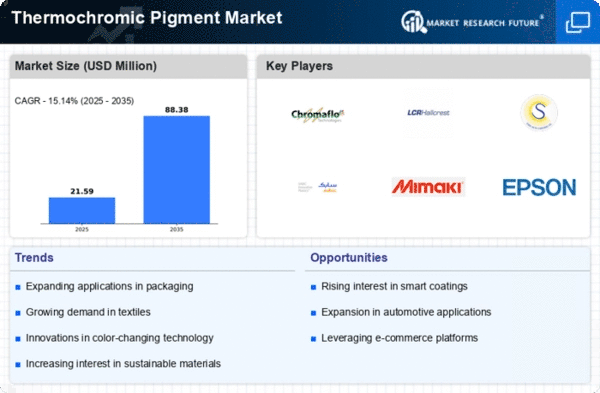
As per MRFR analysis, the As per MRFR analysis, the Thermochromic Pigment Market Size was estimated at 18.75 USD Million in 2024. Size was estimated at 18.75 USD Million in 2024. The Thermochromic Pigment industry is projected to grow from 21.58 USD Million in 2025 to 88.38 USD Million by 2035, exhibiting a compound annual growth rate (CAGR) of 15.14 during the forecast period 2025 - 2035.

Key Market Trends & Highlights

The Thermochromic Pigment Market is poised for substantial growth driven by sustainability and technological advancements.

  • North America remains the largest market for thermochromic pigments, reflecting a strong demand across various applications.
  • Asia-Pacific is emerging as the fastest-growing region, fueled by increasing investments in innovative manufacturing processes.
  • The textiles segment dominates the market, while the plastics segment is witnessing rapid growth due to customization trends.
  • Key market drivers include the growing demand in the packaging industry and the rising interest in smart textiles.

Market Size & Forecast

2024 Market Size 18.75 (USD Million)
2035 Market Size 88.38 (USD Million)
CAGR (2025 - 2035) 15.14%
Largest Regional Market Share in 2024 North America

Major Players

<p>Chromaflo Technologies Corp (US), LCR Hallcrest LLC (US), Sun Chemical Corporation (US), SABIC Innovative Plastics (SA), Mimaki Engineering Co Ltd (JP), Epson Corporation (JP), Kremer Pigments GmbH & Co KG (DE), Thermochromic Technologies (US)</p>

Market Trends

The Thermochromic Pigment Market is currently experiencing a notable evolution, driven by advancements in material science and increasing consumer interest in innovative products. These pigments, which change color in response to temperature variations, are finding applications across diverse sectors, including textiles, packaging, and consumer goods. The growing demand for interactive and visually appealing products is propelling manufacturers to explore new formulations and applications, thereby expanding the market's reach. Furthermore, sustainability concerns are influencing the development of eco-friendly thermochromic pigments, as companies strive to meet consumer expectations for environmentally responsible products. In addition, the Thermochromic Pigment Market is witnessing a shift towards customization and personalization. Brands are increasingly seeking unique color-changing effects to differentiate their offerings in a competitive landscape. This trend is particularly evident in the fashion and home decor industries, where consumers are drawn to products that offer a dynamic visual experience. As technology continues to advance, the potential for innovative applications of thermochromic pigments appears promising, suggesting a vibrant future for this market as it adapts to evolving consumer preferences and industry demands.

Sustainability Initiatives

The Thermochromic Pigment Market is increasingly influenced by sustainability initiatives. Manufacturers are focusing on developing eco-friendly pigments that minimize environmental impact. This trend aligns with the growing consumer demand for sustainable products, prompting companies to innovate and create formulations that are both effective and environmentally responsible.

Customization and Personalization

Customization is becoming a key trend within the Thermochromic Pigment Market. Brands are seeking unique color-changing effects to stand out in a crowded marketplace. This trend is particularly prominent in sectors like fashion and home decor, where personalized products enhance consumer engagement and satisfaction.

Technological Advancements

Technological advancements are playing a crucial role in shaping the Thermochromic Pigment Market. Innovations in material science are leading to the development of more efficient and versatile pigments. These advancements enable broader applications across various industries, enhancing the functionality and appeal of thermochromic products.

Thermochromic Pigment Market Market Drivers

Rising Interest in Smart Textiles

The rise of smart textiles is significantly influencing the Global Thermochromic Pigment Market Industry. These textiles incorporate thermochromic pigments to create fabrics that change color in response to temperature variations, offering both aesthetic and functional benefits. Applications range from fashion to sportswear, where temperature-responsive clothing can enhance comfort and performance. The growing interest in wearable technology and personalized fashion is likely to propel market growth. As consumers increasingly seek innovative and interactive clothing options, the demand for thermochromic pigments in textiles is expected to rise, further solidifying their role in the evolving fashion landscape.

Innovations in Packaging Solutions

The Global Thermochromic Pigment Market Industry is experiencing innovation in packaging solutions, particularly in food and beverage sectors. Thermochromic pigments are increasingly used in labels and packaging materials to indicate temperature changes, ensuring product safety and quality. For example, temperature-sensitive labels can signal when food products are at risk of spoilage, enhancing consumer trust and reducing waste. This trend is gaining traction as companies prioritize sustainability and consumer awareness. The integration of thermochromic pigments in packaging not only elevates brand visibility but also aligns with global efforts to improve food safety standards, thereby driving market growth.

Expansion in Automotive Applications

The automotive industry is increasingly adopting thermochromic pigments, contributing to the growth of the Global Thermochromic Pigment Market Industry. These pigments are utilized in coatings and interior materials to enhance vehicle aesthetics and functionality. For instance, thermochromic paints can change color based on temperature, providing visual cues for overheating components. This application is particularly relevant as manufacturers strive for innovative features that improve vehicle safety and consumer appeal. The anticipated growth in this sector aligns with the overall market expansion, projected to reach 3.21 USD Billion by 2035, indicating a robust CAGR of 4.36% from 2025 to 2035.

Growing Demand in Consumer Electronics

The Global Thermochromic Pigment Market Industry is witnessing a surge in demand driven by the consumer electronics sector. Products such as smartphones, tablets, and wearable devices increasingly incorporate thermochromic pigments for aesthetic and functional purposes. This trend is particularly evident in the production of color-changing phone cases and smart textiles, which enhance user experience. As of 2024, the market is projected to reach 2.01 USD Billion, reflecting a growing consumer preference for innovative and interactive designs. The integration of thermochromic pigments in electronics not only adds visual appeal but also serves practical functions, such as temperature indication, thereby expanding market opportunities.

Increased Focus on Safety and Compliance

The Global Thermochromic Pigment Market Industry is also driven by an increased focus on safety and compliance across various sectors. Industries such as construction and manufacturing are adopting thermochromic pigments in safety gear and equipment to provide visual alerts for temperature changes. For instance, thermochromic safety vests can indicate overheating, enhancing worker safety. This trend is particularly relevant as regulatory bodies emphasize safety standards and compliance measures. The incorporation of thermochromic pigments not only meets these requirements but also promotes a culture of safety within organizations, thereby fostering market growth.

Market Segment Insights

By Application: Textiles (Largest) vs. Plastics (Fastest-Growing)

<p>The Thermochromic Pigment Market is primarily dominated by the textiles application segment, which captures a significant share of the market due to its widespread use in fashion and functional clothing. Textiles leverage thermochromic pigments for creating dynamic designs that change color with temperature fluctuations, appealing to various consumers. Plastics follow closely behind, increasingly integrating these pigments as they find diverse applications in products such as toys, packaging, and household items. The flexibility of plastics allows manufacturers to innovate more readily, enhancing their market presence.</p>

<p>Textiles (Dominant) vs. Plastics (Emerging)</p>

<p>In the Thermochromic Pigment Market, textiles serve as the dominant segment, favored for their versatility and ability to attract consumer attention with color-changing properties. This segment benefits from the continued demand for innovative apparel and accessories, allowing brands to differentiate themselves in an increasingly competitive market. On the other hand, the plastics segment is emerging rapidly as manufacturers seek to incorporate thermochromic features into consumer products. The unique properties of thermochromic pigments in plastics appeal to various end-users, especially in creating engaging toys and decorative items, providing opportunities for growth as consumer interest in interactive and visually appealing products rises.</p>

By End Use: Packaging (Largest) vs. Automotive (Fastest-Growing)

<p>In the Thermochromic Pigment Market, the end use segment showcases a diverse distribution of demand across various applications. Packaging leads as the largest segment, driven by its ability to enhance visual appeal and provide functional benefits like freshness indicators. The automotive sector, though currently smaller in share, is identified as the fastest-growing segment as manufacturers increasingly adopt thermochromic pigments for innovative uses in vehicle designs and health monitoring systems throughout the automotive industry's shift towards smart technology.</p>

<p>Packaging (Dominant) vs. Automotive (Emerging)</p>

<p>The packaging segment has solidified its position as a dominant force in the Thermochromic Pigment Market, leveraging aesthetics and functionality to attract consumers and brands alike. With applications ranging from food and beverage to cosmetic packaging, thermochromic pigments accentuate visual communication and enhance user engagement. Conversely, the automotive segment represents an emerging frontier; its rapid growth is fueled by advancements in smart materials and technology integration. This segment is redefining the vehicle experience, utilizing thermochromic pigments in dashboards and surface coatings to reflect temperature changes, thereby paving the way for enhanced safety and innovation in car designs.</p>

By Type: Reversible (Largest) vs. Irreversible (Fastest-Growing)

<p>The Thermochromic Pigment Market exhibits significant diversity in its type segments, with reversible pigments holding the largest market share due to their widespread application in various industries, including automotive and packaging. This segment emphasizes their ability to revert to a baseline state upon temperature return, making them a favorite choice for products requiring repeated use and reliability. On the other hand, irreversible pigments, though currently smaller in share, are gaining prominence due to their unique characteristics that cater to specific applications, such as novelty items and security features that require permanent color changes.</p>

<p>Reversible: Dominant vs. Irreversible: Emerging</p>

<p>Reversible thermochromic pigments are characterized by their ability to change color in response to temperature variations and return to their original state once the temperature stabilizes. This property makes them ideal for a variety of applications, including temperature-sensitive coatings and consumer products that benefit from color-changing features. Conversely, irreversible thermochromic pigments are increasingly emerging in the market, valued for their permanent color change effect. As industries seek innovative solutions for safety and aesthetic enhancements, these pigments are being utilized in products that require a lasting indication of temperature changes, signaling a shift towards more specialized applications and a growing niche market.</p>

By Formulation: Liquid (Largest) vs. Powder (Fastest-Growing)

<p>In the Thermochromic Pigment Market, the formulation segment demonstrates a varied distribution of market share across different types. The liquid formulation holds the largest share due to its versatility and ease of application in a variety of industries, including textiles and coatings. This type is particularly favored in consumer products, enhancing color-changing capabilities in everyday items. Conversely, the powder formulation is gaining traction, presenting growth opportunities thanks to its increasing adoption in applications requiring a higher level of pigmentation and durability.</p>

<p>Formulation: Liquid (Dominant) vs. Powder (Emerging)</p>

<p>Liquid thermochromic pigments are considered the dominant force within the formulation segment due to their superior performance in creating vibrant, color-changing effects. They offer excellent adhesion and flexibility, making them suitable for applications in various industries, such as automotive and packaging. Powder thermochromic pigments are recognized as an emerging segment, growing rapidly due to their application potential in areas that demand high environmental resistance. As technologies advance, these powders are being utilized more frequently in coatings and plastics, appealing to manufacturers seeking durability and long-lasting effects.</p>

By Color Change Mechanism: Leuco Dye (Largest) vs. Liquid Crystal (Fastest-Growing)

<p>The Thermochromic Pigment Market is evolving with various color change mechanisms, prominently featuring Leuco Dye, which holds the largest market share. This segment is favored for its widespread applications in consumer products, from textiles to packaging. In contrast, Liquid Crystal technology is gaining traction, appealing to sectors that require intricate color changes triggered by temperature fluctuations. These two mechanisms showcase a diverse range of applications and market preferences.</p>

<p>Leuco Dye (Dominant) vs. Liquid Crystal (Emerging)</p>

<p>Leuco Dye is recognized as the dominant force in the Thermochromic Pigment Market due to its versatility and cost-effectiveness, making it suitable for a variety of applications including coatings and ink. On the other hand, Liquid Crystal, while presently an emerging segment, shows promise with its unique ability to provide vibrant, temporary color changes, particularly in electronic displays and specialized textiles. The growing trend towards customizable solutions in various industries is likely to bolster Liquid Crystal’s position, driving innovations and potential cross-industry applications.</p>

Get more detailed insights about Thermochromic Pigment Market Research Report – Global Forecast till 2035

Regional Insights

North America : Market Leader in Innovation

North America is poised to maintain its leadership in the thermochromic pigment market, holding a significant market share of 9.0 in 2024. The region's growth is driven by increasing demand in various applications, including textiles, packaging, and automotive industries. Regulatory support for innovative materials and sustainability initiatives further catalyze market expansion. The presence of key players and advanced manufacturing capabilities also contribute to the region's robust market dynamics. The United States stands out as the leading country in this sector, with major companies like Chromaflo Technologies Corp and LCR Hallcrest LLC driving innovation. The competitive landscape is characterized by a mix of established firms and emerging players, all vying for market share. The focus on R&D and product development is evident, as companies strive to meet the evolving needs of consumers and industries alike.

Europe : Emerging Market with Potential

Europe is witnessing a growing interest in thermochromic pigments, with a market size of 5.0 in 2024. The region's growth is fueled by increasing applications in consumer goods, automotive, and construction sectors. Regulatory frameworks promoting eco-friendly materials and innovations are significant catalysts for market expansion. The demand for smart packaging and temperature-sensitive products is also on the rise, enhancing the market's potential. Leading countries in Europe include Germany, the UK, and France, where companies like Kremer Pigments GmbH & Co KG are making strides. The competitive landscape is marked by a blend of local and international players, all focusing on sustainability and technological advancements. The presence of established firms alongside startups fosters a dynamic environment for innovation and growth.

Asia-Pacific : Rapidly Growing Market

Asia-Pacific is emerging as a significant player in the thermochromic pigment market, with a market size of 3.5 in 2024. The region's growth is driven by rising consumer demand for innovative products in textiles, packaging, and electronics. Increased industrialization and urbanization are also contributing to the market's expansion. Regulatory support for sustainable practices is further enhancing the attractiveness of thermochromic pigments in various applications. Countries like Japan and China are at the forefront of this growth, with companies such as Mimaki Engineering Co Ltd and Epson Corporation leading the charge. The competitive landscape is characterized by a mix of established firms and new entrants, all focusing on R&D and product differentiation. The region's diverse market needs present ample opportunities for innovation and collaboration among key players.

Middle East and Africa : Emerging Opportunities Ahead

The Middle East and Africa region is gradually recognizing the potential of thermochromic pigments, with a market size of 1.25 in 2024. The growth is primarily driven by increasing demand in the packaging and consumer goods sectors. Regulatory initiatives aimed at promoting sustainable materials are also contributing to market development. As industries evolve, the need for innovative solutions is becoming more pronounced, paving the way for thermochromic applications. Countries like South Africa and the UAE are leading the charge in adopting these innovative materials. The competitive landscape is still developing, with a mix of local and international players entering the market. As awareness of thermochromic pigments grows, opportunities for investment and collaboration are expected to increase, fostering a more vibrant market environment.

Key Players and Competitive Insights

The Thermochromic Pigment Market is currently characterized by a dynamic competitive landscape, driven by innovation and the increasing demand for color-changing materials across various applications, including textiles, packaging, and consumer goods. Key players such as Chromaflo Technologies Corp (US), LCR Hallcrest LLC (US), and Sun Chemical Corporation (US) are strategically positioning themselves through a combination of technological advancements and market expansion initiatives. These companies are focusing on enhancing their product offerings with advanced thermochromic technologies, which not only cater to aesthetic needs but also provide functional benefits, such as temperature indication.

In terms of business tactics, companies are increasingly localizing manufacturing to reduce lead times and optimize supply chains. The market structure appears moderately fragmented, with several players vying for market share, yet the influence of major companies remains substantial. This competitive environment is shaped by the collective efforts of these key players, who are leveraging their technological capabilities and market knowledge to establish a foothold in emerging markets.

In November 2025, LCR Hallcrest LLC (US) announced the launch of a new line of thermochromic pigments designed specifically for the automotive industry. This strategic move is significant as it aligns with the growing trend of customization in automotive design, allowing manufacturers to offer unique color-changing features that enhance vehicle aesthetics and consumer appeal. The introduction of these specialized pigments could potentially capture a new segment of the market, further solidifying LCR Hallcrest's position as a leader in innovative thermochromic solutions.

In October 2025, Sun Chemical Corporation (US) expanded its partnership with a leading packaging manufacturer to integrate thermochromic inks into their product lines. This collaboration is indicative of a broader trend towards sustainability and functionality in packaging, as thermochromic inks can provide visual cues related to temperature changes, thereby enhancing product safety and consumer engagement. Such partnerships are likely to drive growth in the packaging sector, where consumer preferences are increasingly leaning towards interactive and informative designs.

In September 2025, Chromaflo Technologies Corp (US) unveiled a new research and development facility focused on advancing thermochromic technology. This investment underscores the company's commitment to innovation and positions it to respond swiftly to market demands. By enhancing its R&D capabilities, Chromaflo aims to develop more efficient and environmentally friendly thermochromic pigments, which could set new industry standards and attract environmentally conscious consumers.

As of December 2025, the competitive trends in the Thermochromic Pigment Market are increasingly influenced by digitalization, sustainability, and the integration of AI technologies. Strategic alliances among key players are shaping the landscape, fostering innovation and enhancing product offerings. The shift from price-based competition to a focus on technological advancement and supply chain reliability is evident, suggesting that future competitive differentiation will hinge on the ability to innovate and meet evolving consumer demands.

Key Companies in the Thermochromic Pigment Market market include

Industry Developments

In the Asia region, China is the largest economic market of thermochromic pigment in terms of GDP. The country showed about 6.1% growth in its GDP during 2019, even after the trade with the USA. However, China in 2020 was primarily aimed to moderate as compared to the previous year, and due to the onset of covid-19 in 2020, China’s economic growth fell down to 1.900%, it is expected to show recovery at a rate of 8.20% in 2021.

The thermochromic pigment markets are aiming to reach USD 2,500 million with a great CAGR of 5.1% by the end of 2023 to 2030, and the paint is defined as the element of substances to change its color with temperature. Research has shown growth in this market after the pandemic.

Target audience:

    • Traders and distributors of thermochromic pigment
    • Thermochromic pigment manufacturers
    • Potential investors
    • Production process industries
    • Raw material suppliers
    • Nationalized laboratories
    • Government bodies

Future Outlook

Thermochromic Pigment Market Future Outlook

<p>The Thermochromic Pigment Market is projected to grow at a 15.14% CAGR from 2024 to 2035, driven by innovations in packaging, textiles, and consumer electronics.</p>

New opportunities lie in:

  • <p>Development of smart packaging solutions for temperature-sensitive products.</p>
  • <p>Integration of thermochromic pigments in automotive coatings for enhanced aesthetics.</p>
  • <p>Expansion into the cosmetics industry for temperature-reactive makeup products.</p>

<p>By 2035, the Thermochromic Pigment Market is expected to achieve substantial growth and diversification.</p>

Market Segmentation

Thermochromic Pigment Market Type Outlook

  • Reversible
  • Irreversible
  • Photochromic
  • Thermochromic
  • Hydrochromic

Thermochromic Pigment Market End Use Outlook

  • Automotive
  • Packaging
  • Electronics
  • Home Decor
  • Fashion

Thermochromic Pigment Market Application Outlook

  • Textiles
  • Plastics
  • Inks
  • Coatings
  • Consumer Goods

Thermochromic Pigment Market Formulation Outlook

  • Powder
  • Liquid
  • Granule
  • Paste
  • Emulsion

Thermochromic Pigment Market Color Change Mechanism Outlook

  • Liquid Crystal
  • Leuco Dye
  • Thermal Reversible
  • Thermal Irreversible
  • Photochromic

Report Scope

MARKET SIZE 202418.75(USD Million)
MARKET SIZE 202521.58(USD Million)
MARKET SIZE 203588.38(USD Million)
COMPOUND ANNUAL GROWTH RATE (CAGR)15.14% (2024 - 2035)
REPORT COVERAGERevenue Forecast, Competitive Landscape, Growth Factors, and Trends
BASE YEAR2024
Market Forecast Period2025 - 2035
Historical Data2019 - 2024
Market Forecast UnitsUSD Million
Key Companies ProfiledChromaflo Technologies Corp (US), LCR Hallcrest LLC (US), Sun Chemical Corporation (US), SABIC Innovative Plastics (SA), Mimaki Engineering Co Ltd (JP), Epson Corporation (JP), Kremer Pigments GmbH & Co KG (DE), Thermochromic Technologies (US)
Segments CoveredApplication, End Use, Type, Formulation, Color Change Mechanism
Key Market OpportunitiesGrowing demand for innovative packaging solutions drives expansion in the Thermochromic Pigment Market.
Key Market DynamicsRising demand for innovative applications drives competition and technological advancements in the thermochromic pigment market.
Countries CoveredNorth America, Europe, APAC, South America, MEA

FAQs

At what CAGR is the thermochromic pigment market projected to grow during the forecast period?

The thermochromic pigment market is projected to grow at a 5.1% CAGR between 2016-2035.

What will be the value of the thermochromic pigment market during the forecast period?

The thermochromic pigment market is predicted to touch USD 2,500 million by 2035.

Which region will dominate the thermochromic pigment market?

North America will dominate the thermochromic pigment market.

What are the key factors driving the thermochromic pigment market growth?

Increasing use in food and beverages, printing ink, and paints &amp; coatings are boosting market growth.

Which factors may limit the thermochromic pigment market growth?

High cost may limit market growth.

  1. Executive Summary
  2. Market Introduction
    1. Market Definition
    2. Scope of the Study
      1. Research Objectives
      2. Assumptions & Limitations
    3. List of Assumptions
    4. Markets
    5. Structure
  3. Market Research Methodology
    1. Research Process
    2. Primary Research
    3. Secondary Research
    4. Market Size Estimation
    5. Forecast Model
  4. Market Dynamics of Global Thermochromic Pigment Market
    1. Introduction
    2. Drivers
    3. Restraints
    4. Opportunities
    5. Challenges
    6. Trends/Technology
  5. Market Factor Analysis of Global
    1. Thermochromic Pigment Market
    2. Supply Chain Analysis
      1. Raw Material
      2. Manufacturers/Producers
      3. Distributors/Retailers/Wholesalers/E-Commerce
      4. End–User
    3. Suppliers
    4. Porter’s Five Forces Analysis
      1. Bargaining Power of Buyers
      2. Bargaining
      3. Threat of Substitutes
      4. Intensity of Competitive
    5. Threat of New Entrants
    6. Power of Suppliers
    7. Rivalry
    8. Pricing Analysis
  6. Global Thermochromic Pigment Market, by
    1. Product
    2. Introduction
    3. Liquid Crystal Material
      1. Market
      2. Market Estimates & Forecast,
    4. Estimates & Forecast, 2020−2027
    5. by Region, 2020−2027
    6. Leuco Dyes
      1. Market Estimates &
      2. Market Estimates & Forecast, by Region,
    7. Forecast, 2020−2027
    8. Inorganic Materials
      1. Market Estimates & Forecast,
      2. Market Estimates & Forecast, by Region, 2020−2027
  7. Global Thermochromic Pigment Market, by Pigment Type
    1. Introduction
    2. Reversible Thermochromic Pigments
      1. Market Estimates & Forecast,
      2. Market Estimates & Forecast, by Region, 2020−2027
    3. Irreversible Thermochromic Pigments
      1. Market Estimates & Forecast,
      2. Market Estimates & Forecast, by Region, 2020−2027
  8. Global Thermochromic Pigment Market, by End-Use Industry
    1. Introduction
    2. Food & Beverages
      1. Market Estimates & Forecast, 2020−2027
    3. Paints & Coatings
      1. Market Estimates & Forecast, 2020−2027
      2. Market Estimates & Forecast, by Region, 2020−2027
    4. Printing
      1. Market Estimates & Forecast, 2020−2027
      2. Market
    5. Ink
    6. Estimates & Forecast, by Region, 2020−2027
    7. Paper
      1. Market
      2. Market Estimates & Forecast,
    8. Estimates & Forecast, 2020−2027
    9. by Region, 2020−2027
    10. Textile
      1. Market Estimates & Forecast,
      2. Market Estimates & Forecast, by Region, 2020−2027
    11. Cosmetics
      1. Market Estimates & Forecast, 2020−2027
  9. Market Estimates & Forecast, by Region, 2020−2027
    1. Plastic &
      1. Market Estimates & Forecast, 2020−2027
    2. Polymers
  10. Market Estimates & Forecast, by Region, 2020−2027
    1. Others
      1. Market Estimates &
    2. Market Estimates & Forecast, 2020−2027
    3. Forecast, by Region, 2020−2027
  11. Global Chromatography Resin Market,
    1. by Region
    2. Introduction
    3. North America
      1. Market Estimates
      2. Market Estimates & Forecast, by Product,
      3. Market Estimates & Forecast, by Pigment Type, 2020−2027
      4. Market Estimates & Forecast, by End-Use Industry, 2020−2027
      5. US
    4. & Forecast, 2020−2027
  12. Market Estimates & Forecast, by Product, 2020−2027
    1. Estimates & Forecast, by Pigment Type, 2020−2027
    2. & Forecast, by End-Use Industry, 2020−2027
    3. Market Estimates & Forecast, 2020−2027
    4. Forecast, by Product, 2020−2027
    5. by Pigment Type, 2020−2027
    6. End-Use Industry, 2020−2027
    7. Forecast, 2020−2027
  13. Market
  14. Market Estimates
  15. Canada
  16. Market Estimates &
  17. Market Estimates & Forecast,
  18. Market Estimates & Forecast, by
    1. Europe
      1. Market Estimates &
      2. Market Estimates & Forecast, by Product,
      3. Market Estimates & Forecast, by Pigment Type, 2020−2027
      4. Market Estimates & Forecast, by End-Use Industry, 2020−2027
      5. Germany
  19. Market Estimates & Forecast, by Pigment Type, 2020−2027
    1. Estimates & Forecast, by End-Use Industry, 2020−2027
    2. & Forecast, by Product, 2020−2027
    3. Forecast, by Pigment Type, 2020−2027
    4. by End-Use Industry, 2020−2027
    5. & Forecast, 2020−2027
    6. Product, 2020−2027
    7. Type, 2020−2027
  20. Market
  21. France
  22. Market Estimates & Forecast, 2020−2027
  23. Market Estimates
  24. Market Estimates &
  25. Market Estimates & Forecast,
  26. Italy
  27. Market Estimates
  28. Market Estimates & Forecast, by
  29. Market Estimates & Forecast, by Pigment
  30. Market Estimates & Forecast, by End-Use Industry,
  31. Spain
  32. Market Estimates & Forecast, 2020−2027
  33. Market Estimates & Forecast, by Product,2020−2027
  34. Market Estimates & Forecast, by Pigment Type,2020−2027
    1. Estimates & Forecast, by End-Use Industry,2020−2027
    2. Market Estimates & Forecast, 2020−2027
    3. Forecast, by Product,2020−2027
    4. by Pigment Type,2020−2027
    5. End-Use Industry,2020−2027
    6. & Forecast, 2020−2027
    7. Product,2020−2027
    8. Type,2020−2027
  35. Market
  36. UK
  37. Market Estimates &
  38. Market Estimates & Forecast,
  39. Market Estimates & Forecast, by
  40. Russia
  41. Market Estimates
  42. Market Estimates & Forecast, by
  43. Market Estimates & Forecast, by Pigment
  44. Market Estimates & Forecast, by End-Use Industry,2020−2027
  45. Poland
  46. Market Estimates & Forecast, 2020−2027
  47. Market Estimates & Forecast, by Product, 2020−2027
  48. Market Estimates & Forecast, by Pigment Type, 2020−2027
  49. Market Estimates & Forecast, by End-Use Industry, 2020−2027
    1. Rest of Europe
  50. Market Estimates & Forecast, 2020−2027
  51. Market Estimates & Forecast, by Product, 2020−2027
  52. Market Estimates & Forecast, by Pigment Type, 2020−2027
  53. Market Estimates & Forecast, by End-Use Industry, 2020−2027
    1. Asia-Pacific
      1. Market Estimates & Forecast, 2020−2027
      2. Market Estimates
      3. Market Estimates & Forecast,
      4. Market Estimates & Forecast, by
      5. China
      6. India
    2. & Forecast, by Product, 2020−2027
    3. by Pigment Type, 2020−2027
    4. End-Use Industry, 2020−2027
    5. & Forecast, 2020−2027
    6. Product, 2020−2027
    7. Type, 2020−2027
  54. Market Estimates & Forecast, by Pigment Type, 2020−2027
    1. Estimates & Forecast, by End-Use Industry, 2020−2027
    2. & Forecast, by Product, 2020−2027
    3. Forecast, by Pigment Type, 2020−2027
    4. by End-Use Industry, 2020−2027
    5. Market Estimates & Forecast, 2020−2027
    6. Forecast, by Product, 2020−2027
    7. by Pigment Type, 2020−2027
    8. End-Use Industry, 2020−2027
    9. Estimates & Forecast, 2020−2027
    10. by Product, 2020−2027
    11. Type, 2020−2027
    12. Forecast, 2020−2027
  55. Market
  56. Japan
  57. Market Estimates & Forecast, 2020−2027
  58. Market Estimates
  59. Market Estimates &
  60. Market Estimates & Forecast,
  61. Australia & New Zealand
  62. Market Estimates &
  63. Market Estimates & Forecast,
  64. Market Estimates & Forecast, by
  65. Rest of Asia-Pacific
  66. Market
  67. Market Estimates & Forecast,
  68. Market Estimates & Forecast, by Pigment
  69. Market Estimates & Forecast, by End-Use Industry,
    1. Middle East & Africa
      1. Market Estimates &
      2. Market Estimates & Forecast, by Product,
      3. Market Estimates & Forecast, by Pigment Type, 2020−2027
      4. Market Estimates & Forecast, by End-Use Industry, 2020−2027
      5. GCC
  70. Market Estimates & Forecast, by Product, 2020−2027
    1. Estimates & Forecast, by Pigment Type, 2020−2027
    2. & Forecast, by End-Use Industry, 2020−2027
    3. Market Estimates & Forecast, 2020−2027
    4. Forecast, by Product, 2020−2027
    5. by Pigment Type, 2020−2027
    6. End-Use Industry, 2020−2027
    7. & Forecast, 2020−2027
    8. Product, 2020−2027
    9. Type, 2020−2027
  71. Market
  72. Market Estimates
  73. Israel
  74. Market Estimates &
  75. Market Estimates & Forecast,
  76. Market Estimates & Forecast, by
  77. North Africa
  78. Market Estimates
  79. Market Estimates & Forecast, by
  80. Market Estimates & Forecast, by Pigment
  81. Market Estimates & Forecast, by End-Use Industry,
  82. South Africa
  83. Market Estimates & Forecast,
  84. Market Estimates & Forecast, by Product, 2020−2027
  85. Market Estimates & Forecast, by Pigment Type, 2020−2027
  86. Market Estimates & Forecast, by End-Use Industry, 2020−2027
    1. Rest of Middle East & Africa
  87. Market Estimates & Forecast,
  88. Market Estimates & Forecast, by Product, 2020−2027
  89. Market Estimates & Forecast, by Pigment Type, 2020−2027
  90. Market Estimates & Forecast, by End-Use Industry, 2020−2027
    1. Latin
      1. Market Estimates & Forecast, 2020−2027
      2. Market
      3. Market Estimates
      4. Market Estimates &
      5. Brazil
      6. Argentina
    2. America
    3. Estimates & Forecast, by Product, 2020−2027
    4. & Forecast, by Pigment Type, 2020−2027
    5. Forecast, by End-Use Industry, 2020−2027
    6. Estimates & Forecast, 2020−2027
    7. by Product, 2020−2027
    8. Type, 2020−2027
  91. Market Estimates & Forecast, by End-Use Industry, 2020−2027
    1. Mexico
  92. Market Estimates & Forecast, 2020−2027
  93. Market Estimates & Forecast, by Product, 2020−2027
    1. Estimates & Forecast, by Pigment Type, 2020−2027
    2. & Forecast, by End-Use Industry, 2020−2027
    3. Estimates & Forecast, by Product, 2020−2027
    4. & Forecast, by Pigment Type, 2020−2027
    5. Forecast, by End-Use Industry, 2020−2027
  94. Market
  95. Market Estimates
  96. Rest of Latin America
  97. Market Estimates & Forecast, 2020−2027
  98. Market
  99. Market Estimates
  100. Market Estimates &
  101. Company Landscape
    1. Introduction
    2. Market Strategy
    3. Key Development Analysis (Expansion/Merger
    4. & Acquisitions/Joint Venture/New Product Development/Agreement/Investment)
  102. Company Profiles
    1. RPM International Inc.
      1. Company Overview
      2. Financial Updates
      3. Product/Business Segment Overview
      4. Key Developments
      5. SWOT Analysis
    2. Strategy
    3. 3M
      1. Company Overview
      2. Financial Updates
      3. Product/Business
      4. Strategy
      5. Key Developments
    4. Segment Overview
    5. SWOT Analysis
    6. Sherwin Williams
      1. Company Overview
      2. Product/Business Segment Overview
      3. Strategy
      4. Key Developments
      5. SWOT Analysis
    7. Financial Updates
    8. Hammer Packaging,
      1. Company Overview
      2. Financial Updates
      3. Product/Business
      4. Strategy
      5. Key Developments
    9. Corp.
    10. Segment Overview
    11. SWOT Analysis
    12. NanoMatriX International Limited
      1. Company Overview
      2. Financial Updates
      3. Product/Business Segment Overview
      4. Key Developments
      5. SWOT Analysis
    13. Strategy
    14. Clariant
      1. Company Overview
      2. Financial Updates
      3. Product/Business
      4. Strategy
      5. Key Developments
    15. Segment Overview
    16. SWOT Analysis
    17. OliKrom
      1. Company Overview
      2. Financial
      3. Product/Business Segment Overview
      4. Strategy
      5. Key Developments
      6. SWOT Analysis
    18. Updates
    19. QCR Solutions Corp
      1. Company Overview
      2. Financial Updates
      3. Product/Business
      4. Strategy
      5. Key Developments
    20. Segment Overview
    21. SWOT Analysis
    22. LCR Hallcrest LLC
      1. Company Overview
      2. Product/Business Segment Overview
      3. Strategy
      4. Key Developments
      5. SWOT Analysis
    23. Financial Updates
    24. Gem''innov
      1. Company Overview
      2. Financial Updates
      3. Product/Business
      4. Strategy
      5. Key Developments
    25. Segment Overview
    26. SWOT Analysis
    27. Other Market Players
      1. Smarol Industry Co. Ltd.
      2. Special Effects and Coatings.
  103. Conclusion
  104. LIST OF TABLES
  105. Global Thermochromic Pigment Market: by Region, 2020−2027
  106. North America: Thermochromic Pigment Market, by Country, 2020−2027
  107. Europe: Thermochromic Pigment Market, by Country, 2020−2027
    1. Table
  108. Asia-Pacific: Thermochromic Pigment Market. by Country, 2020−2027
    1. Table
  109. Middle East & Africa: Thermochromic Pigment Market, by Country, 2020−2027
  110. Latin America: Thermochromic Pigment Market, by Country, 2020−2027
  111. Global Thermochromic Pigment Market Product Market, by Regions, 2020−2027
  112. North America: Thermochromic Pigment Market Product Market, by Country,
  113. Europe: Thermochromic Pigment Market Product Market,
    1. by Country, 2020−2027
    2. Table10 Asia-Pacific: Thermochromic Pigment Market
  114. Product Market, by Country, 2020−2027
    1. Table11 Middle East & Africa:
  115. Thermochromic Pigment Market Product Market, by Country, 2020−2027
    1. Table12
  116. Latin America: Thermochromic Pigment Market Product Market, by Country, 2020−2027
  117. Table13 Global Thermochromic Pigment Market Pigment Type Market, by Regions, 2020−2027
  118. Table14 North America: Thermochromic Pigment Market Pigment Type Market, by Country,
    1. Table15 Europe: Thermochromic Pigment Market Pigment Type Market,
    2. by Country, 2020−2027
    3. Table16 Asia-Pacific: Thermochromic Pigment Market
  119. Pigment Type Market, by Country, 2020−2027
    1. Table17 Middle East &
  120. Africa: Thermochromic Pigment Market Pigment Type Market, by Country, 2020−2027
  121. Table18 Latin America: Thermochromic Pigment Market Pigment Type Market, by Country,
    1. Table19 Global Thermochromic Pigment Market End-Use Industry
  122. Market, by Regions, 2020−2027
    1. Table20 North America: Thermochromic Pigment
  123. Market End-Use Industry Market, by Country, 2020−2027
    1. Table21 Europe:
  124. Thermochromic Pigment Market End-Use Industry Market, by Country, 2020−2027
    1. Table22 Asia-Pacific: Thermochromic Pigment Market End-Use Industry Market, by
    2. Country, 2020−2027
    3. Table23 Middle East & Africa: Thermochromic Pigment
  125. Market End-Use Industry Market, by Country, 2020−2027
    1. Table24 Latin America:
  126. Thermochromic Pigment Market End-Use Industry Market, by Country, 2020−2027
  127. Table25 Global Product Market, by Region, 2020−2027
    1. Table26 Global
  128. Pigment Type Market, by Region, 2020−2027
    1. Table27 Global End-Use Industry
  129. Market, by Region, 2020−2027
    1. Table28 North America: Thermochromic Pigment
  130. Market, by Country, 2020−2027
    1. Table29 North America: Thermochromic Pigment
  131. Market, by Product, 2020−2027
    1. Table30 North America: Thermochromic Pigment
  132. Market, by Pigment Type, 2020−2027
    1. Table31 North America: Thermochromic
  133. Pigment Market, by End-Use Industry, 2020−2027
    1. Table32 Europe: Thermochromic
  134. Pigment Market, by Country, 2020−2027
    1. Table33 Europe: Thermochromic Pigment
  135. Market, by Product, 2020−2027
    1. Table34 Europe: Thermochromic Pigment Market,
    2. by Pigment Type, 2020−2027
    3. Table35 Europe: Thermochromic Pigment Market,
    4. by End-Use Industry, 2020−2027
    5. Table36 Asia-Pacific: Thermochromic Pigment
  136. Market, by Country, 2020−2027
    1. Table37 Asia-Pacific: Thermochromic Pigment
  137. Market, by Product, 2020−2027
    1. Table38 Asia-Pacific: Thermochromic Pigment
  138. Market, by Pigment Type, 2020−2027
    1. Table39 Asia-Pacific: Thermochromic
  139. Pigment Market, by End-Use Industry, 2020−2027
    1. Table40 Middle East &
  140. Africa: Thermochromic Pigment Market, by Country, 2020−2027
    1. Table41 Middle
  141. East & Africa: Thermochromic Pigment Market, by Product, 2020−2027
  142. Table42 Middle East & Africa: Thermochromic Pigment Market, by Pigment Type,
    1. Table43 Middle East & Africa: Thermochromic Pigment Market,
    2. by End-Use Industry, 2020−2027
    3. Table44 Latin America: Thermochromic
  143. Pigment Market, by Country, 2020−2027
    1. Table45 Latin America: Thermochromic
  144. Pigment Market, by Product, 2020−2027
    1. Table46 Latin America: Thermochromic
  145. Pigment Market, by Pigment Type, 2020−2027
    1. Table47 Latin America: Thermochromic
  146. Pigment Market, by End-Use Industry, 2020−2027
  147. LIST OF FIGURES
    1. FIGURE
  148. Global Thermochromic Pigment Market Segmentation
  149. Forecast Research
    1. Methodology
  150. Five Forces Analysis of Global Thermochromic Pigment Market
  151. Value Chain of Global Thermochromic Pigment Market
  152. Global
  153. Thermochromic Pigment Market, 2020−2027, by Country, 2020
  154. Share
  155. of Global Thermochromic Pigment Market, by Country, 2020−2027
    1. FIGURE
  156. Global Thermochromic Pigment Market Size, by Product, 2020
  157. Share
  158. of Global Thermochromic Pigment Market, by Product, 2020−2027
    1. FIGURE
  159. Global Thermochromic Pigment Market Size, by Pigment Type, 2020
    1. FIGURE10
  160. Share of Global Thermochromic Pigment Market, by Pigment Type, 2020−2027
  161. FIGURE11 Global Thermochromic Pigment Market Size, by End-Use Industry, 2020
  162. FIGURE12 Share of Global Thermochromic Pigment Market, by End-Use Industry, 2020−2027

Thermochromic Pigment Market Segmentation

Market Segmentation Overview

  • Detailed segmentation data will be available in the full report
  • Comprehensive analysis by multiple parameters
  • Regional and country-level breakdowns
  • Market size forecasts by segment
Infographic

Free Sample Request

Kindly complete the form below to receive a free sample of this Report

Get Free Sample

Customer Strories

Compare Licence

×
Features License Type
Single User Multiuser License Enterprise User
Price $4,950 $5,950 $7,250
Maximum User Access Limit 1 User Upto 10 Users Unrestricted Access Throughout the Organization
Free Customization
Direct Access to Analyst
Deliverable Format
Platform Access
Discount on Next Purchase 10% 15% 15%
Printable Versions