×
Hero Background
English
Chinese
French
Japanese
Korean
German
Spanish

TMJ Implants Market Size

ID: MRFR/MED/4717-CR
87 Pages
Rahul Gotadki
August 2023

TMJ Implants Market Research Report Information By Component (Mandibular Components, Fossa Prostheses, and Screws), Material (Cobalt-Chromium-Molybdenum, Titanium Alloy, Ultra-High Molecular Weight Polyethylene (UHMWPE), Aluminum, Silicon, and Others), Indication (Arthritic Conditions, Ankylosis, and Others), End User (Hospitals, Dental Clinics, and Others) and Region (North America, Europe, Asia-Pacific, and Rest of the World)—Forecast till 2035

Share:
Download PDF ×

We do not share your information with anyone. However, we may send you emails based on your report interest from time to time. You may contact us at any time to opt-out.

TMJ Implants Market Infographic
Purchase Options

Tmj Implants Size

TMJ Implants Market Growth Projections and Opportunities

The TMJ (Temporomandibular Joint) implants market has seen some ups and downs between 2014 and 2018. During this time, there were some limitations that slowed down the growth of this market. However, things are looking up now!

Let's talk about the different parts of TMJ implants. The part called the mandibular component was a big player in the market, making up around 67.65% of the market share in 2020. And guess what? Experts think it's going to keep growing! By 2027, it's expected to be worth around USD 5,492.02 thousand. That's a big increase! This part is forecasted to grow by about 4.36% each year during this forecast period.

Now, there's another part called the screws segment. This part isn't as big as the mandibular component in terms of market share—it's about 2.40% in 2020. However, it's also expected to grow! It's projected to have a growth rate of about 4.13% each year.

So, what does all of this mean? It means that in the world of TMJ implants, the mandibular component is like the big player on the team. It's leading the way and is expected to keep growing a lot. On the other hand, the screws segment is smaller in terms of market share, but it's also making progress and is expected to increase in value over time.

Why are these implants important? Well, they're used for people who have problems with their temporomandibular joint, which is the joint that connects your jaw to your skull. When people have issues with this joint, it can cause pain or make it hard to open and close their mouths comfortably. TMJ implants help to fix these problems and improve people's quality of life.

The market for these implants might have faced some challenges in the past, but it's moving forward now. As more people become aware of these implants and the benefits they offer in fixing jaw problems, the demand for them is expected to rise.

The TMJ implants market is seeing growth, especially in the mandibular component part. This part is leading the market and is expected to keep growing steadily. Meanwhile, even though the screws segment is smaller, it's also making progress. Both parts play an important role in helping people with jaw issues, and their growth indicates a positive future for TMJ implant technology.

TMJ Implants Market Size Graph
Author
Rahul Gotadki
Assistant Manager

He holds an experience of about 7+ years in Market Research and Business Consulting, working under the spectrum of Life Sciences and Healthcare domains. Rahul conceptualizes and implements a scalable business strategy and provides strategic leadership to the clients. His expertise lies in market estimation, competitive intelligence, pipeline analysis, customer assessment, etc. In addition to the above, his other responsibility includes strategic tracking of high growth markets & advising clients on the potential areas of focus they could direct their business initiatives

Leave a Comment

FAQs

What is the projected market valuation of the TMJ Implants Market by 2035?

The TMJ Implants Market is projected to reach a valuation of 12.5 USD Billion by 2035.

What was the market valuation of the TMJ Implants Market in 2024?

In 2024, the TMJ Implants Market was valued at 6.95 USD Billion.

What is the expected CAGR for the TMJ Implants Market during the forecast period 2025 - 2035?

The expected CAGR for the TMJ Implants Market during the forecast period 2025 - 2035 is 5.48%.

Which companies are considered key players in the TMJ Implants Market?

Key players in the TMJ Implants Market include Stryker, Zimmer Biomet, DePuy Synthes, Medtronic, KLS Martin, B. Braun, Nobel Biocare, Straumann, and Aesculap.

What are the main components of the TMJ Implants Market?

The main components of the TMJ Implants Market include Mandibular Components, Fossa Prostheses, and Screws, with respective valuations of 3.65, 3.6, and 5.25 USD Billion projected.

What materials are predominantly used in TMJ implants?

Predominant materials used in TMJ implants include Titanium Alloy, Cobalt-Chromium-Molybdenum, and Ultra-high Molecular Weight Polyethylene, with projected valuations of 3.5, 2.5, and 1.8 USD Billion respectively.

What indications are driving the TMJ Implants Market?

The TMJ Implants Market is primarily driven by indications such as Arthritic Conditions and Ankylosis, with projected valuations of 3.65 and 3.6 USD Billion respectively.

What are the primary end users of TMJ implants?

Primary end users of TMJ implants include hospitals and dental clinics, with projected valuations of 3.65 and 3.6 USD Billion respectively.

How does the TMJ Implants Market compare to other medical device markets?

While specific comparisons to other medical device markets are not provided, the TMJ Implants Market demonstrates robust growth potential, indicated by its projected increase from 6.95 USD Billion in 2024 to 12.5 USD Billion by 2035.

Market Summary

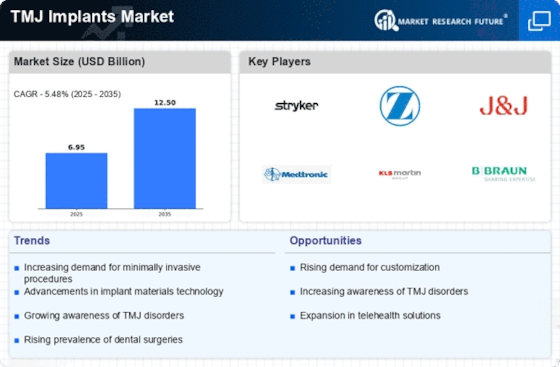
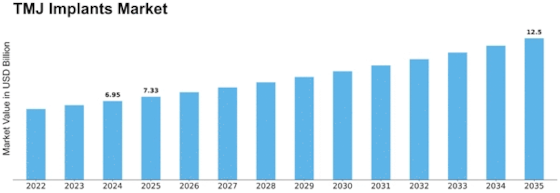
As per MRFR analysis, the TMJ Implants Market Size was estimated at 6.95 USD Billion in 2024. The TMJ Implants industry is projected to grow from 7.331 USD Billion in 2025 to 12.5 USD Billion by 2035, exhibiting a compound annual growth rate (CAGR) of 5.48 during the forecast period 2025 - 2035.

Key Market Trends & Highlights

The TMJ implants market is experiencing robust growth driven by technological advancements and increasing awareness.

  • Technological advancements are enhancing the efficacy and safety of TMJ implants, leading to improved patient outcomes. Minimally invasive techniques are gaining traction, appealing to patients seeking reduced recovery times and discomfort. The North American market remains the largest, while the Asia-Pacific region is emerging as the fastest-growing market for TMJ implants. Rising prevalence of TMJ disorders and advancements in implant technology are key drivers propelling market growth.

Market Size & Forecast

2024 Market Size 6.95 (USD Billion)
2035 Market Size 12.5 (USD Billion)
CAGR (2025 - 2035) 5.48%
Largest Regional Market Share in 2024 North America

Major Players

<p><a href="https://www.stryker.com/ie/en/craniomaxillofacial/products/tmj-concepts/index-eu.html">Stryker </a>(US), Zimmer Biomet (US), DePuy Synthes (US), Medtronic (US), KLS Martin (DE), B. Braun (DE), Nobel Biocare (CH), Straumann (CH), Aesculap (DE)</p>

Market Trends

The TMJ Implants Market is currently experiencing a notable evolution, driven by advancements in technology and an increasing understanding of temporomandibular joint disorders. As healthcare professionals gain deeper insights into the complexities of these conditions, the demand for innovative implant solutions appears to be on the rise. This trend is further supported by a growing emphasis on personalized medicine, which seeks to tailor treatments to individual patient needs. Consequently, manufacturers are likely to invest in research and development to create more effective and durable implant options, potentially enhancing patient outcomes. Moreover, the TMJ Implants Market seems to be influenced by a shift towards minimally invasive surgical techniques. These approaches not only reduce recovery times but also minimize complications associated with traditional surgical methods. As patients increasingly seek less invasive options, the market may witness a surge in the adoption of advanced implant technologies that align with these preferences. Additionally, the integration of digital tools in surgical planning and execution could further streamline procedures, thereby improving overall efficiency and patient satisfaction. Overall, the TMJ Implants Market is poised for growth, driven by innovation and a patient-centric approach to treatment.

Technological Advancements

The TMJ Implants Market is witnessing a surge in technological innovations, which are enhancing the design and functionality of implants. These advancements may lead to improved patient outcomes and increased adoption rates.

Minimally Invasive Techniques

There is a growing trend towards minimally invasive surgical methods within the TMJ Implants Market. Such techniques are likely to attract patients seeking quicker recovery times and reduced surgical risks.

Personalized Treatment Approaches

The emphasis on personalized medicine is becoming more pronounced in the TMJ Implants Market. Tailoring treatments to individual patient needs could enhance satisfaction and effectiveness, driving market growth.

TMJ Implants Market Market Drivers

Rising Awareness and Education

There is a growing awareness and education surrounding TMJ disorders, which is positively impacting the TMJ Implants Market. Healthcare professionals are increasingly recognizing the importance of diagnosing and treating TMJ disorders, leading to more patients being referred for surgical options. Educational campaigns aimed at both patients and providers are helping to demystify TMJ disorders, encouraging individuals to seek treatment sooner. This heightened awareness is likely to result in an uptick in the number of patients opting for TMJ implants as a viable treatment option. As more information becomes available, the TMJ Implants Market stands to benefit from an expanding patient base seeking effective solutions.

Improved Reimbursement Policies

Changes in reimbursement policies are playing a crucial role in shaping the TMJ Implants Market. As insurance providers begin to recognize TMJ disorders as legitimate medical conditions requiring surgical intervention, coverage for TMJ implants is becoming more accessible. This shift is likely to alleviate financial burdens for patients, making them more inclined to pursue surgical options. Enhanced reimbursement frameworks can lead to increased adoption of TMJ implants, as patients are more willing to undergo procedures when they are financially supported. Consequently, the TMJ Implants Market may experience growth as favorable reimbursement policies encourage more individuals to seek treatment for their TMJ disorders.

Increasing Geriatric Population

The aging population is a significant factor contributing to the growth of the TMJ Implants Market. As individuals age, they are more susceptible to degenerative joint diseases, including TMJ disorders. The World Health Organization projects that the number of people aged 60 years and older will double by 2050, reaching over 2 billion. This demographic shift is expected to increase the demand for surgical interventions, including TMJ implants, as older adults seek relief from chronic pain and improved quality of life. Consequently, the TMJ Implants Market must adapt to cater to the unique needs of this population, potentially leading to the development of specialized implant solutions.

Advancements in Implant Technology

Technological innovations in implant design and materials are significantly influencing the TMJ Implants Market. Recent developments have led to the creation of more durable and biocompatible materials, which enhance the longevity and effectiveness of TMJ implants. For instance, the introduction of 3D printing technology allows for customized implants tailored to individual patient anatomies, improving surgical outcomes. Furthermore, advancements in minimally invasive surgical techniques reduce recovery times and complications, making TMJ implants a more attractive option for both patients and surgeons. As these technologies continue to evolve, they are likely to drive growth in the TMJ Implants Market, as healthcare providers adopt these cutting-edge solutions.

Rising Prevalence of TMJ Disorders

The increasing incidence of temporomandibular joint (TMJ) disorders is a primary driver for the TMJ Implants Market. Studies indicate that approximately 10 million individuals in the United States alone suffer from TMJ-related issues, which can lead to chronic pain and dysfunction. This growing patient population necessitates effective treatment options, thereby propelling demand for TMJ implants. As awareness of TMJ disorders rises, healthcare providers are more likely to recommend surgical interventions, including implants, to alleviate symptoms. The TMJ Implants Market is thus positioned to expand as more patients seek solutions for their conditions, highlighting the need for innovative implant technologies that can enhance patient outcomes.

Market Segment Insights

TMJ Implants Market Component Insights

<p>The TMJ Implants Market segmentation, based on component, includes mandibular components, fossa prostheses, and screws. The mandibular components segment is to hold the majority share in 2022 in the TMJ Implants Market revenue due to the largest and strongest bone of the face. It forms the lower jaw and holds the lower teeth. It is connected to the temporal bone, forming the temporomandibular joint. The mandibular components are designed to replace the articular surface of the mandibular condyle are further drive the growth of this segment.</p>

<p>April 2021: Stryker completed the acquisition of TMJ Concepts, a manufacturer of alloplastic implants.</p>

TMJ Implants Market Material Insights

<p>The TMJ Implants Market segmentation is based on material that includes cobalt-chromium-molybdenum, titanium alloy, ultra-high molecular weight polyethylene (UHMWPE), aluminum, silicon, and others. The hospitals segment has dominated the market in 2022 due to the cobalt-chromium-molybdenum, titanium alloy, ultra-high molecular weight polyethylene (UHMWPE), aluminum, silicon, and others are driving the growth of this segment in TMJ implants market.</p>

<p>April 2017: Ortho Baltic acquired Nikon Metrology Computed Tomography (CT) inspection equipment for quality control.</p>

TMJ Implants Market Indication Insights

<p>The TMJ Implants Market segmentation is based on indication that includes arthritic conditions, ankylosis, and others. The arthritic conditions segment has dominated the market in 2022 due to the <a href="https://www.marketresearchfuture.com/reports/arthritis-market-3976">Arthritis </a>is the swelling and tenderness of one or more joints. The main symptoms of arthritis are joint pain and stiffness, and they often worsen with age. The most common types of arthritis are osteoarthritis and rheumatoid arthritis. Osteoarthritis is a highly prevalent rheumatic musculoskeletal disorder that are driving the growth of this segment in TMJ implants market.</p>

TMJ Implants Market End User Insights

<p>TMJ Implants Market End User Insights</p>

<p>The TMJ Implants Market segmentation is based on end user that includes hospitals, dental clinics, and others. The hospitals segment has dominated the market in 2022 due to the presence of a large number of hospitals is likely to support market growth. For instance, the US has about 6,090 active hospitals and a well-established healthcare sector will boost the growth of the market during the forecast period. Furthermore, increasing healthcare infrastructure in the developing regions is anticipated to provide significant growth opportunities for the TMJ implants market. This is driving the growth of this segment in the TMJ implants market.</p>

<p>Figure 2:&nbsp;TMJ Implants Market, By End User, 2022 &amp; 2032 (USD Billion)</p>

Source: Secondary Research, Primary Research, Market Research Future Database, and Analyst Review

Get more detailed insights about TMJ Implants Market Research Report—Global Forecast till 2035

Regional Insights

North America : Market Leader in TMJ Implants Market

North America is the largest market for TMJ implants, accounting for approximately 45% of the global share. The region's growth is driven by increasing awareness of TMJ disorders, advancements in surgical techniques, and a robust healthcare infrastructure. Regulatory support from agencies like the FDA further catalyzes market expansion, ensuring safety and efficacy in implant technologies. The United States leads the market, with significant contributions from key players such as Stryker, Zimmer Biomet, and DePuy Synthes. The competitive landscape is characterized by continuous innovation and strategic partnerships among these companies, enhancing product offerings and market reach. The presence of advanced healthcare facilities and a high prevalence of TMJ disorders further solidifies North America's position as a market leader.

Europe : Emerging Market with Growth Potential

Europe is the second-largest market for TMJ implants, holding around 30% of the global market share. The region's growth is fueled by an aging population, increasing incidences of TMJ disorders, and advancements in dental implant technologies. Regulatory frameworks, such as the Medical Device Regulation (MDR), ensure high standards for product safety and efficacy, promoting market growth. Leading countries include Germany, France, and the UK, where companies like KLS Martin and B. Braun are prominent. The competitive landscape is marked by innovation and collaboration among manufacturers, focusing on developing advanced materials and techniques. The presence of well-established healthcare systems and increasing patient awareness contribute to the region's expanding market potential.

Asia-Pacific : Rapid Growth in Emerging Markets

Asia-Pacific is witnessing rapid growth in the TMJ implants market, driven by rising healthcare expenditures, increasing awareness of dental health, and a growing population. The region is projected to capture around 20% of the global market share by 2025. Countries like China and India are leading this growth, supported by government initiatives to improve healthcare access and quality. The competitive landscape is evolving, with both local and international players entering the market. Key companies such as Medtronic and Nobel Biocare are expanding their presence through strategic partnerships and product innovations. The increasing prevalence of TMJ disorders and a shift towards advanced surgical techniques are further propelling market growth in this region.

Middle East and Africa : Untapped Potential in TMJ Market

The Middle East and Africa represent an emerging market for TMJ implants, currently holding about 5% of the global share. The growth is driven by increasing healthcare investments, rising awareness of dental health, and a growing population. Regulatory bodies are beginning to establish frameworks to ensure the safety and efficacy of medical devices, which is crucial for market development. Countries like South Africa and the UAE are at the forefront of this growth, with increasing healthcare infrastructure and investment in advanced medical technologies. The competitive landscape is still developing, with opportunities for both local and international players to establish a foothold. As awareness of TMJ disorders increases, the market is expected to expand significantly in the coming years.

Key Players and Competitive Insights

The TMJ Implants Market is currently characterized by a dynamic competitive landscape, driven by increasing demand for innovative solutions to temporomandibular joint disorders. Key players such as Stryker (US), Zimmer Biomet (US), and DePuy Synthes (US) are actively shaping the market through strategic initiatives focused on product innovation, regional expansion, and partnerships. Stryker (US) has positioned itself as a leader in the market by investing heavily in research and development, aiming to enhance the efficacy and longevity of its TMJ implants. Meanwhile, Zimmer Biomet (US) emphasizes a robust portfolio of surgical solutions, leveraging its extensive distribution network to penetrate emerging markets. DePuy Synthes (US) appears to be focusing on digital transformation, integrating advanced technologies into its product offerings to improve surgical outcomes and patient satisfaction.

The business tactics employed by these companies reflect a concerted effort to optimize supply chains and localize manufacturing processes. The TMJ implants market is moderately fragmented, with several players vying for market share. However, the collective influence of major companies like KLS Martin (DE) and B. Braun (DE) is notable, as they contribute to a competitive structure that encourages innovation and collaboration. These companies are increasingly localizing their manufacturing to reduce costs and improve responsiveness to market demands, which may enhance their competitive positioning.

In August 2025, Stryker (US) announced the launch of a new line of TMJ implants designed with advanced biomaterials aimed at improving integration with bone tissue. This strategic move is significant as it not only enhances Stryker's product offerings but also positions the company to capture a larger share of the market by addressing the growing demand for biocompatible solutions. Similarly, in September 2025, Zimmer Biomet (US) entered into a partnership with a leading technology firm to develop AI-driven surgical planning tools for TMJ procedures. This collaboration is likely to enhance surgical precision and patient outcomes, thereby reinforcing Zimmer Biomet's competitive edge in the market.

In July 2025, DePuy Synthes (US) expanded its product line by introducing a new TMJ implant system that incorporates 3D printing technology. This innovation not only streamlines the manufacturing process but also allows for customization based on individual patient anatomy, which could significantly improve surgical results. The strategic importance of this development lies in its potential to set a new standard in personalized medicine within the TMJ implants sector.

As of October 2025, the TMJ implants market is witnessing trends that emphasize digitalization, sustainability, and the integration of artificial intelligence. Companies are increasingly forming strategic alliances to leverage complementary strengths, which is reshaping the competitive landscape. The shift from price-based competition to a focus on innovation and technology is evident, as firms prioritize supply chain reliability and product differentiation. Looking ahead, it appears that competitive differentiation will increasingly hinge on the ability to innovate and adapt to evolving market demands, suggesting a promising future for companies that can effectively navigate these trends.

Key Companies in the TMJ Implants Market market include

Industry Developments

April 2021: Stryker completed the acquisition of TMJ Concepts, a manufacturer of alloplastic implants.

April 2017: Ortho Baltic acquired Nikon Metrology Computed Tomography (CT) inspection equipment for quality control.

Future Outlook

TMJ Implants Market Future Outlook

<p>The TMJ Implants Market is projected to grow at a 5.48% CAGR from 2024 to 2035, driven by technological advancements, increasing prevalence of TMJ disorders, and rising healthcare expenditure.</p>

New opportunities lie in:

  • <p>Development of personalized TMJ implant solutions using 3D printing technology.</p>
  • <p>Expansion into emerging markets with tailored marketing strategies.</p>
  • <p>Partnerships with dental clinics for integrated TMJ treatment programs.</p>

<p>By 2035, the TMJ Implants Market is expected to achieve substantial growth and innovation.</p>

Market Segmentation

TMJ Implants Market End User Outlook

  • Hospitals
  • Dental Clinics
  • Others

TMJ Implants Market Material Outlook

  • Cobalt-Chromium-Molybdenum
  • Titanium Alloy
  • Ultra-high Molecular Weight Polyethylene (UHMWPE)
  • Aluminum
  • Silicone
  • Others

TMJ Implants Market Component Outlook

  • Mandibular Components
  • Fossa Prostheses
  • Screws

TMJ Implants Market Indication Outlook

  • Arthritic Conditions
  • Ankylosis
  • Others

Report Scope

MARKET SIZE 2024 6.95(USD Billion)
MARKET SIZE 2025 7.331(USD Billion)
MARKET SIZE 2035 12.5(USD Billion)
COMPOUND ANNUAL GROWTH RATE (CAGR) 5.48% (2024 - 2035)
REPORT COVERAGE Revenue Forecast, Competitive Landscape, Growth Factors, and Trends
BASE YEAR 2024
Market Forecast Period 2025 - 2035
Historical Data 2019 - 2024
Market Forecast Units USD Billion
Key Companies Profiled Market analysis in progress
Segments Covered Market segmentation analysis in progress
Key Market Opportunities Advancements in biocompatible materials enhance patient outcomes in the TMJ Implants Market.
Key Market Dynamics Rising demand for innovative TMJ implants drives competitive advancements and regulatory scrutiny in the healthcare sector.
Countries Covered North America, Europe, APAC, South America, MEA

FAQs

What is the projected market valuation of the TMJ Implants Market by 2035?

The TMJ Implants Market is projected to reach a valuation of 12.5 USD Billion by 2035.

What was the market valuation of the TMJ Implants Market in 2024?

In 2024, the TMJ Implants Market was valued at 6.95 USD Billion.

What is the expected CAGR for the TMJ Implants Market during the forecast period 2025 - 2035?

The expected CAGR for the TMJ Implants Market during the forecast period 2025 - 2035 is 5.48%.

Which companies are considered key players in the TMJ Implants Market?

Key players in the TMJ Implants Market include Stryker, Zimmer Biomet, DePuy Synthes, Medtronic, KLS Martin, B. Braun, Nobel Biocare, Straumann, and Aesculap.

What are the main components of the TMJ Implants Market?

The main components of the TMJ Implants Market include Mandibular Components, Fossa Prostheses, and Screws, with respective valuations of 3.65, 3.6, and 5.25 USD Billion projected.

What materials are predominantly used in TMJ implants?

Predominant materials used in TMJ implants include Titanium Alloy, Cobalt-Chromium-Molybdenum, and Ultra-high Molecular Weight Polyethylene, with projected valuations of 3.5, 2.5, and 1.8 USD Billion respectively.

What indications are driving the TMJ Implants Market?

The TMJ Implants Market is primarily driven by indications such as Arthritic Conditions and Ankylosis, with projected valuations of 3.65 and 3.6 USD Billion respectively.

What are the primary end users of TMJ implants?

Primary end users of TMJ implants include hospitals and dental clinics, with projected valuations of 3.65 and 3.6 USD Billion respectively.

How does the TMJ Implants Market compare to other medical device markets?

While specific comparisons to other medical device markets are not provided, the TMJ Implants Market demonstrates robust growth potential, indicated by its projected increase from 6.95 USD Billion in 2024 to 12.5 USD Billion by 2035.

  1. SECTION I: EXECUTIVE SUMMARY AND KEY HIGHLIGHTS
    1. EXECUTIVE SUMMARY
      1. Market Overview
      2. Key Findings
      3. Market Segmentation
      4. Competitive Landscape
      5. Challenges and Opportunities
      6. Future Outlook 2
  2. SECTION II: SCOPING, METHODOLOGY AND MARKET STRUCTURE
    1. MARKET INTRODUCTION
      1. Definition
      2. Scope of the study
    2. RESEARCH METHODOLOGY
      1. Overview
      2. Data Mining
      3. Secondary Research
      4. Primary Research
      5. Forecasting Model
      6. Market Size Estimation
      7. Data Triangulation
      8. Validation 3
  3. SECTION III: QUALITATIVE ANALYSIS
    1. MARKET DYNAMICS
      1. Overview
      2. Drivers
      3. Restraints
      4. Opportunities
    2. MARKET FACTOR ANALYSIS
      1. Value chain Analysis
      2. Porter's Five Forces Analysis
      3. COVID-19 Impact Analysis
  4. SECTION IV: QUANTITATIVE ANALYSIS
    1. Healthcare, BY Component (USD Billion)
      1. Mandibular Components
      2. Fossa Prostheses
      3. Screws
    2. Healthcare, BY Material (USD Billion)
      1. Cobalt-Chromium-Molybdenum
      2. Titanium Alloy
      3. Ultra-high Molecular Weight Polyethylene (UHMWPE)
      4. Aluminum
      5. Silicone
      6. Others
    3. Healthcare, BY Indication (USD Billion)
      1. Arthritic Conditions
      2. Ankylosis
      3. Others
    4. Healthcare, BY End User (USD Billion)
      1. Hospitals
      2. Dental Clinics
      3. Others
    5. Healthcare, BY Region (USD Billion)
      1. North America
      2. Europe
      3. APAC
      4. South America
      5. MEA
  5. SECTION V: COMPETITIVE ANALYSIS
    1. Competitive Landscape
      1. Overview
      2. Competitive Analysis
      3. Market share Analysis
      4. Major Growth Strategy in the Healthcare
      5. Competitive Benchmarking
      6. Leading Players in Terms of Number of Developments in the Healthcare
      7. Key developments and growth strategies
      8. Major Players Financial Matrix
    2. Company Profiles
      1. Stryker (US)
      2. Zimmer Biomet (US)
      3. DePuy Synthes (US)
      4. Medtronic (US)
      5. KLS Martin (DE)
      6. B. Braun (DE)
      7. Nobel Biocare (CH)
      8. Straumann (CH)
      9. Aesculap (DE)
    3. Appendix
      1. References
      2. Related Reports 6 LIST OF FIGURES
    4. MARKET SYNOPSIS
    5. NORTH AMERICA MARKET ANALYSIS
    6. US MARKET ANALYSIS BY COMPONENT
    7. US MARKET ANALYSIS BY MATERIAL
    8. US MARKET ANALYSIS BY INDICATION
    9. US MARKET ANALYSIS BY END USER
    10. CANADA MARKET ANALYSIS BY COMPONENT
    11. CANADA MARKET ANALYSIS BY MATERIAL
    12. CANADA MARKET ANALYSIS BY INDICATION
    13. CANADA MARKET ANALYSIS BY END USER
    14. EUROPE MARKET ANALYSIS
    15. GERMANY MARKET ANALYSIS BY COMPONENT
    16. GERMANY MARKET ANALYSIS BY MATERIAL
    17. GERMANY MARKET ANALYSIS BY INDICATION
    18. GERMANY MARKET ANALYSIS BY END USER
    19. UK MARKET ANALYSIS BY COMPONENT
    20. UK MARKET ANALYSIS BY MATERIAL
    21. UK MARKET ANALYSIS BY INDICATION
    22. UK MARKET ANALYSIS BY END USER
    23. FRANCE MARKET ANALYSIS BY COMPONENT
    24. FRANCE MARKET ANALYSIS BY MATERIAL
    25. FRANCE MARKET ANALYSIS BY INDICATION
    26. FRANCE MARKET ANALYSIS BY END USER
    27. RUSSIA MARKET ANALYSIS BY COMPONENT
    28. RUSSIA MARKET ANALYSIS BY MATERIAL
    29. RUSSIA MARKET ANALYSIS BY INDICATION
    30. RUSSIA MARKET ANALYSIS BY END USER
    31. ITALY MARKET ANALYSIS BY COMPONENT
    32. ITALY MARKET ANALYSIS BY MATERIAL
    33. ITALY MARKET ANALYSIS BY INDICATION
    34. ITALY MARKET ANALYSIS BY END USER
    35. SPAIN MARKET ANALYSIS BY COMPONENT
    36. SPAIN MARKET ANALYSIS BY MATERIAL
    37. SPAIN MARKET ANALYSIS BY INDICATION
    38. SPAIN MARKET ANALYSIS BY END USER
    39. REST OF EUROPE MARKET ANALYSIS BY COMPONENT
    40. REST OF EUROPE MARKET ANALYSIS BY MATERIAL
    41. REST OF EUROPE MARKET ANALYSIS BY INDICATION
    42. REST OF EUROPE MARKET ANALYSIS BY END USER
    43. APAC MARKET ANALYSIS
    44. CHINA MARKET ANALYSIS BY COMPONENT
    45. CHINA MARKET ANALYSIS BY MATERIAL
    46. CHINA MARKET ANALYSIS BY INDICATION
    47. CHINA MARKET ANALYSIS BY END USER
    48. INDIA MARKET ANALYSIS BY COMPONENT
    49. INDIA MARKET ANALYSIS BY MATERIAL
    50. INDIA MARKET ANALYSIS BY INDICATION
    51. INDIA MARKET ANALYSIS BY END USER
    52. JAPAN MARKET ANALYSIS BY COMPONENT
    53. JAPAN MARKET ANALYSIS BY MATERIAL
    54. JAPAN MARKET ANALYSIS BY INDICATION
    55. JAPAN MARKET ANALYSIS BY END USER
    56. SOUTH KOREA MARKET ANALYSIS BY COMPONENT
    57. SOUTH KOREA MARKET ANALYSIS BY MATERIAL
    58. SOUTH KOREA MARKET ANALYSIS BY INDICATION
    59. SOUTH KOREA MARKET ANALYSIS BY END USER
    60. MALAYSIA MARKET ANALYSIS BY COMPONENT
    61. MALAYSIA MARKET ANALYSIS BY MATERIAL
    62. MALAYSIA MARKET ANALYSIS BY INDICATION
    63. MALAYSIA MARKET ANALYSIS BY END USER
    64. THAILAND MARKET ANALYSIS BY COMPONENT
    65. THAILAND MARKET ANALYSIS BY MATERIAL
    66. THAILAND MARKET ANALYSIS BY INDICATION
    67. THAILAND MARKET ANALYSIS BY END USER
    68. INDONESIA MARKET ANALYSIS BY COMPONENT
    69. INDONESIA MARKET ANALYSIS BY MATERIAL
    70. INDONESIA MARKET ANALYSIS BY INDICATION
    71. INDONESIA MARKET ANALYSIS BY END USER
    72. REST OF APAC MARKET ANALYSIS BY COMPONENT
    73. REST OF APAC MARKET ANALYSIS BY MATERIAL
    74. REST OF APAC MARKET ANALYSIS BY INDICATION
    75. REST OF APAC MARKET ANALYSIS BY END USER
    76. SOUTH AMERICA MARKET ANALYSIS
    77. BRAZIL MARKET ANALYSIS BY COMPONENT
    78. BRAZIL MARKET ANALYSIS BY MATERIAL
    79. BRAZIL MARKET ANALYSIS BY INDICATION
    80. BRAZIL MARKET ANALYSIS BY END USER
    81. MEXICO MARKET ANALYSIS BY COMPONENT
    82. MEXICO MARKET ANALYSIS BY MATERIAL
    83. MEXICO MARKET ANALYSIS BY INDICATION
    84. MEXICO MARKET ANALYSIS BY END USER
    85. ARGENTINA MARKET ANALYSIS BY COMPONENT
    86. ARGENTINA MARKET ANALYSIS BY MATERIAL
    87. ARGENTINA MARKET ANALYSIS BY INDICATION
    88. ARGENTINA MARKET ANALYSIS BY END USER
    89. REST OF SOUTH AMERICA MARKET ANALYSIS BY COMPONENT
    90. REST OF SOUTH AMERICA MARKET ANALYSIS BY MATERIAL
    91. REST OF SOUTH AMERICA MARKET ANALYSIS BY INDICATION
    92. REST OF SOUTH AMERICA MARKET ANALYSIS BY END USER
    93. MEA MARKET ANALYSIS
    94. GCC COUNTRIES MARKET ANALYSIS BY COMPONENT
    95. GCC COUNTRIES MARKET ANALYSIS BY MATERIAL
    96. GCC COUNTRIES MARKET ANALYSIS BY INDICATION
    97. GCC COUNTRIES MARKET ANALYSIS BY END USER
    98. SOUTH AFRICA MARKET ANALYSIS BY COMPONENT
    99. SOUTH AFRICA MARKET ANALYSIS BY MATERIAL
    100. SOUTH AFRICA MARKET ANALYSIS BY INDICATION
    101. SOUTH AFRICA MARKET ANALYSIS BY END USER
    102. REST OF MEA MARKET ANALYSIS BY COMPONENT
    103. REST OF MEA MARKET ANALYSIS BY MATERIAL
    104. REST OF MEA MARKET ANALYSIS BY INDICATION
    105. REST OF MEA MARKET ANALYSIS BY END USER
    106. KEY BUYING CRITERIA OF HEALTHCARE
    107. RESEARCH PROCESS OF MRFR
    108. DRO ANALYSIS OF HEALTHCARE
    109. DRIVERS IMPACT ANALYSIS: HEALTHCARE
    110. RESTRAINTS IMPACT ANALYSIS: HEALTHCARE
    111. SUPPLY / VALUE CHAIN: HEALTHCARE
    112. HEALTHCARE, BY COMPONENT, 2024 (% SHARE)
    113. HEALTHCARE, BY COMPONENT, 2024 TO 2035 (USD Billion)
    114. HEALTHCARE, BY MATERIAL, 2024 (% SHARE)
    115. HEALTHCARE, BY MATERIAL, 2024 TO 2035 (USD Billion)
    116. HEALTHCARE, BY INDICATION, 2024 (% SHARE)
    117. HEALTHCARE, BY INDICATION, 2024 TO 2035 (USD Billion)
    118. HEALTHCARE, BY END USER, 2024 (% SHARE)
    119. HEALTHCARE, BY END USER, 2024 TO 2035 (USD Billion)
    120. BENCHMARKING OF MAJOR COMPETITORS 7 LIST OF TABLES
    121. LIST OF ASSUMPTIONS
    122. North America MARKET SIZE ESTIMATES; FORECAST
      1. BY COMPONENT, 2025-2035 (USD Billion)
      2. BY MATERIAL, 2025-2035 (USD Billion)
      3. BY INDICATION, 2025-2035 (USD Billion)
      4. BY END USER, 2025-2035 (USD Billion)
    123. US MARKET SIZE ESTIMATES; FORECAST
      1. BY COMPONENT, 2025-2035 (USD Billion)
      2. BY MATERIAL, 2025-2035 (USD Billion)
      3. BY INDICATION, 2025-2035 (USD Billion)
      4. BY END USER, 2025-2035 (USD Billion)
    124. Canada MARKET SIZE ESTIMATES; FORECAST
      1. BY COMPONENT, 2025-2035 (USD Billion)
      2. BY MATERIAL, 2025-2035 (USD Billion)
      3. BY INDICATION, 2025-2035 (USD Billion)
      4. BY END USER, 2025-2035 (USD Billion)
    125. Europe MARKET SIZE ESTIMATES; FORECAST
      1. BY COMPONENT, 2025-2035 (USD Billion)
      2. BY MATERIAL, 2025-2035 (USD Billion)
      3. BY INDICATION, 2025-2035 (USD Billion)
      4. BY END USER, 2025-2035 (USD Billion)
    126. Germany MARKET SIZE ESTIMATES; FORECAST
      1. BY COMPONENT, 2025-2035 (USD Billion)
      2. BY MATERIAL, 2025-2035 (USD Billion)
      3. BY INDICATION, 2025-2035 (USD Billion)
      4. BY END USER, 2025-2035 (USD Billion)
    127. UK MARKET SIZE ESTIMATES; FORECAST
      1. BY COMPONENT, 2025-2035 (USD Billion)
      2. BY MATERIAL, 2025-2035 (USD Billion)
      3. BY INDICATION, 2025-2035 (USD Billion)
      4. BY END USER, 2025-2035 (USD Billion)
    128. France MARKET SIZE ESTIMATES; FORECAST
      1. BY COMPONENT, 2025-2035 (USD Billion)
      2. BY MATERIAL, 2025-2035 (USD Billion)
      3. BY INDICATION, 2025-2035 (USD Billion)
      4. BY END USER, 2025-2035 (USD Billion)
    129. Russia MARKET SIZE ESTIMATES; FORECAST
      1. BY COMPONENT, 2025-2035 (USD Billion)
      2. BY MATERIAL, 2025-2035 (USD Billion)
      3. BY INDICATION, 2025-2035 (USD Billion)
      4. BY END USER, 2025-2035 (USD Billion)
    130. Italy MARKET SIZE ESTIMATES; FORECAST
      1. BY COMPONENT, 2025-2035 (USD Billion)
      2. BY MATERIAL, 2025-2035 (USD Billion)
      3. BY INDICATION, 2025-2035 (USD Billion)
      4. BY END USER, 2025-2035 (USD Billion)
    131. Spain MARKET SIZE ESTIMATES; FORECAST
      1. BY COMPONENT, 2025-2035 (USD Billion)
      2. BY MATERIAL, 2025-2035 (USD Billion)
      3. BY INDICATION, 2025-2035 (USD Billion)
      4. BY END USER, 2025-2035 (USD Billion)
    132. Rest of Europe MARKET SIZE ESTIMATES; FORECAST
      1. BY COMPONENT, 2025-2035 (USD Billion)
      2. BY MATERIAL, 2025-2035 (USD Billion)
      3. BY INDICATION, 2025-2035 (USD Billion)
      4. BY END USER, 2025-2035 (USD Billion)
    133. APAC MARKET SIZE ESTIMATES; FORECAST
      1. BY COMPONENT, 2025-2035 (USD Billion)
      2. BY MATERIAL, 2025-2035 (USD Billion)
      3. BY INDICATION, 2025-2035 (USD Billion)
      4. BY END USER, 2025-2035 (USD Billion)
    134. China MARKET SIZE ESTIMATES; FORECAST
      1. BY COMPONENT, 2025-2035 (USD Billion)
      2. BY MATERIAL, 2025-2035 (USD Billion)
      3. BY INDICATION, 2025-2035 (USD Billion)
      4. BY END USER, 2025-2035 (USD Billion)
    135. India MARKET SIZE ESTIMATES; FORECAST
      1. BY COMPONENT, 2025-2035 (USD Billion)
      2. BY MATERIAL, 2025-2035 (USD Billion)
      3. BY INDICATION, 2025-2035 (USD Billion)
      4. BY END USER, 2025-2035 (USD Billion)
    136. Japan MARKET SIZE ESTIMATES; FORECAST
      1. BY COMPONENT, 2025-2035 (USD Billion)
      2. BY MATERIAL, 2025-2035 (USD Billion)
      3. BY INDICATION, 2025-2035 (USD Billion)
      4. BY END USER, 2025-2035 (USD Billion)
    137. South Korea MARKET SIZE ESTIMATES; FORECAST
      1. BY COMPONENT, 2025-2035 (USD Billion)
      2. BY MATERIAL, 2025-2035 (USD Billion)
      3. BY INDICATION, 2025-2035 (USD Billion)
      4. BY END USER, 2025-2035 (USD Billion)
    138. Malaysia MARKET SIZE ESTIMATES; FORECAST
      1. BY COMPONENT, 2025-2035 (USD Billion)
      2. BY MATERIAL, 2025-2035 (USD Billion)
      3. BY INDICATION, 2025-2035 (USD Billion)
      4. BY END USER, 2025-2035 (USD Billion)
    139. Thailand MARKET SIZE ESTIMATES; FORECAST
      1. BY COMPONENT, 2025-2035 (USD Billion)
      2. BY MATERIAL, 2025-2035 (USD Billion)
      3. BY INDICATION, 2025-2035 (USD Billion)
      4. BY END USER, 2025-2035 (USD Billion)
    140. Indonesia MARKET SIZE ESTIMATES; FORECAST
      1. BY COMPONENT, 2025-2035 (USD Billion)
      2. BY MATERIAL, 2025-2035 (USD Billion)
      3. BY INDICATION, 2025-2035 (USD Billion)
      4. BY END USER, 2025-2035 (USD Billion)
    141. Rest of APAC MARKET SIZE ESTIMATES; FORECAST
      1. BY COMPONENT, 2025-2035 (USD Billion)
      2. BY MATERIAL, 2025-2035 (USD Billion)
      3. BY INDICATION, 2025-2035 (USD Billion)
      4. BY END USER, 2025-2035 (USD Billion)
    142. South America MARKET SIZE ESTIMATES; FORECAST
      1. BY COMPONENT, 2025-2035 (USD Billion)
      2. BY MATERIAL, 2025-2035 (USD Billion)
      3. BY INDICATION, 2025-2035 (USD Billion)
      4. BY END USER, 2025-2035 (USD Billion)
    143. Brazil MARKET SIZE ESTIMATES; FORECAST
      1. BY COMPONENT, 2025-2035 (USD Billion)
      2. BY MATERIAL, 2025-2035 (USD Billion)
      3. BY INDICATION, 2025-2035 (USD Billion)
      4. BY END USER, 2025-2035 (USD Billion)
    144. Mexico MARKET SIZE ESTIMATES; FORECAST
      1. BY COMPONENT, 2025-2035 (USD Billion)
      2. BY MATERIAL, 2025-2035 (USD Billion)
      3. BY INDICATION, 2025-2035 (USD Billion)
      4. BY END USER, 2025-2035 (USD Billion)
    145. Argentina MARKET SIZE ESTIMATES; FORECAST
      1. BY COMPONENT, 2025-2035 (USD Billion)
      2. BY MATERIAL, 2025-2035 (USD Billion)
      3. BY INDICATION, 2025-2035 (USD Billion)
      4. BY END USER, 2025-2035 (USD Billion)
    146. Rest of South America MARKET SIZE ESTIMATES; FORECAST
      1. BY COMPONENT, 2025-2035 (USD Billion)
      2. BY MATERIAL, 2025-2035 (USD Billion)
      3. BY INDICATION, 2025-2035 (USD Billion)
      4. BY END USER, 2025-2035 (USD Billion)
    147. MEA MARKET SIZE ESTIMATES; FORECAST
      1. BY COMPONENT, 2025-2035 (USD Billion)
      2. BY MATERIAL, 2025-2035 (USD Billion)
      3. BY INDICATION, 2025-2035 (USD Billion)
      4. BY END USER, 2025-2035 (USD Billion)
    148. GCC Countries MARKET SIZE ESTIMATES; FORECAST
      1. BY COMPONENT, 2025-2035 (USD Billion)
      2. BY MATERIAL, 2025-2035 (USD Billion)
      3. BY INDICATION, 2025-2035 (USD Billion)
      4. BY END USER, 2025-2035 (USD Billion)
    149. South Africa MARKET SIZE ESTIMATES; FORECAST
      1. BY COMPONENT, 2025-2035 (USD Billion)
      2. BY MATERIAL, 2025-2035 (USD Billion)
      3. BY INDICATION, 2025-2035 (USD Billion)
      4. BY END USER, 2025-2035 (USD Billion)
    150. Rest of MEA MARKET SIZE ESTIMATES; FORECAST
      1. BY COMPONENT, 2025-2035 (USD Billion)
      2. BY MATERIAL, 2025-2035 (USD Billion)
      3. BY INDICATION, 2025-2035 (USD Billion)
      4. BY END USER, 2025-2035 (USD Billion)
    151. PRODUCT LAUNCH/PRODUCT DEVELOPMENT/APPROVAL
    152. ACQUISITION/PARTNERSHIP


TMJ Implants Market Segmentation

TMJ Implants Component Outlook

  • Mandibular Components
  • Fossa Prosthesis
  • Screws

TMJ Implants Material Outlook

  • Cobalt-Chromium-Molybdenum
  • Titanium Alloy
  • Ultra-high Molecular Weight Polyethylene (UHMWPE)
  • Aluminum
  • Silicone
  • Others

TMJ Implants Indication Outlook

  • Arthritic Conditions
  • Ankylosis
  • Others

TMJ Implants End User Outlook

  • Hospitals
  • Dental Clinics
  • Others


TMJ Implants Regional Outlook (USD Billion, 2019-2032)

  • North America Outlook (USD Billion, 2019-2032)
    • North America TMJ Implants by Component
      • Mandibular Components
      • Fossa Prosthesis
      • Screws


  • North America TMJ Implants by Material
    • Cobalt-Chromium-Molybdenum
    • Titanium Alloy
    • Ultra-high Molecular Weight Polyethylene (UHMWPE)
    • Aluminum
    • Silicone
    • Others
  • North America TMJ Implants by Indication
    • Arthritic Conditions
    • Ankylosis
    • Others
  • North America TMJ Implants by End User
    • Hospitals
    • Dental Clinics
    • Others


  • US Outlook (USD Billion, 2019-2032)
  • US TMJ Implants by Component
    • Mandibular Components
    • Fossa Prosthesis
    • Screws


  • US TMJ Implants by Material
    • Cobalt-Chromium-Molybdenum
    • Titanium Alloy
    • Ultra-high Molecular Weight Polyethylene (UHMWPE)
    • Aluminum
    • Silicone
    • Others
  • US TMJ Implants by Indication
    • Arthritic Conditions
    • Ankylosis
    • Others
  • US TMJ Implants by End User
    • Hospitals
    • Dental Clinics
    • Others


  • Canada Outlook (USD Billion, 2019-2032)
  • Canada TMJ Implants by Component
    • Mandibular Components
    • Fossa Prosthesis
    • Screws


  • Canada TMJ Implants by Material
    • Cobalt-Chromium-Molybdenum
    • Titanium Alloy
    • Ultra-high Molecular Weight Polyethylene (UHMWPE)
    • Aluminum
    • Silicone
    • Others
  • Canada TMJ Implants by Indication
    • Arthritic Conditions
    • Ankylosis
    • Others
  • Canada TMJ Implants by End User
    • Hospitals
    • Dental Clinics
    • Others


  • Europe Outlook (USD Billion, 2019-2032)


  • Europe TMJ Implants by Component
    • Mandibular Components
    • Fossa Prosthesis
    • Screws


  • Europe TMJ Implants by Material
    • Cobalt-Chromium-Molybdenum
    • Titanium Alloy
    • Ultra-high Molecular Weight Polyethylene (UHMWPE)
    • Aluminum
    • Silicone
    • Others
  • Europe TMJ Implants by Indication
    • Arthritic Conditions
    • Ankylosis
    • Others
  • Europe TMJ Implants by End User
    • Hospitals
    • Dental Clinics
    • Others


  • Germany Outlook (USD Billion, 2019-2032)
  • Germany TMJ Implants by Component
    • Mandibular Components
    • Fossa Prosthesis
    • Screws


  • Germany TMJ Implants by Material
    • Cobalt-Chromium-Molybdenum
    • Titanium Alloy
    • Ultra-high Molecular Weight Polyethylene (UHMWPE)
    • Aluminum
    • Silicone
    • Others
  • Germany TMJ Implants by Indication
    • Arthritic Conditions
    • Ankylosis
    • Others
  • Germany TMJ Implants by End User
    • Hospitals
    • Dental Clinics
    • Others


  • France Outlook (USD Billion, 2019-2032)
  • France TMJ Implants by Component
    • Mandibular Components
    • Fossa Prosthesis
    • Screws


  • France TMJ Implants by Material
    • Cobalt-Chromium-Molybdenum
    • Titanium Alloy
    • Ultra-high Molecular Weight Polyethylene (UHMWPE)
    • Aluminum
    • Silicone
    • Others
  • France TMJ Implants by Indication
    • Arthritic Conditions
    • Ankylosis
    • Others
  • France TMJ Implants by End User
    • Hospitals
    • Dental Clinics
    • Others


  • UK Outlook (USD Billion, 2019-2032)
  • UK TMJ Implants by Component
    • Mandibular Components
    • Fossa Prosthesis
    • Screws


  • UK TMJ Implants by Material
    • Cobalt-Chromium-Molybdenum
    • Titanium Alloy
    • Ultra-high Molecular Weight Polyethylene (UHMWPE)
    • Aluminum
    • Silicone
    • Others
  • UK TMJ Implants by Indication
    • Arthritic Conditions
    • Ankylosis
    • Others
  • UK TMJ Implants by End User
    • Hospitals
    • Dental Clinics
    • Others


  • Italy Outlook (USD Billion, 2019-2032)
  • Italy TMJ Implants by Component
    • Mandibular Components
    • Fossa Prosthesis
    • Screws


  • Italy TMJ Implants by Material
    • Cobalt-Chromium-Molybdenum
    • Titanium Alloy
    • Ultra-high Molecular Weight Polyethylene (UHMWPE)
    • Aluminum
    • Silicone
    • Others
  • Italy TMJ Implants by Indication
    • Arthritic Conditions
    • Ankylosis
    • Others
  • Italy TMJ Implants by End User
    • Hospitals
    • Dental Clinics
    • Others


  • Spain Outlook (USD Billion, 2019-2032)
  • Spain TMJ Implants by Component
    • Mandibular Components
    • Fossa Prosthesis
    • Screws


  • Spain TMJ Implants by Material
    • Cobalt-Chromium-Molybdenum
    • Titanium Alloy
    • Ultra-high Molecular Weight Polyethylene (UHMWPE)
    • Aluminum
    • Silicone
    • Others
  • Spain TMJ Implants by Indication
    • Arthritic Conditions
    • Ankylosis
    • Others
  • Spain TMJ Implants by End User
    • Hospitals
    • Dental Clinics
    • Others


  • Rest of Europe Outlook (USD Billion, 2019-2032)
  • Rest of Europe TMJ Implants by Component
    • Mandibular Components
    • Fossa Prosthesis
    • Screws


  • Rest of Europe TMJ Implants by Material
    • Cobalt-Chromium-Molybdenum
    • Titanium Alloy
    • Ultra-high Molecular Weight Polyethylene (UHMWPE)
    • Aluminum
    • Silicone
    • Others
  • Rest of Europe TMJ Implants by Indication
    • Arthritic Conditions
    • Ankylosis
    • Others
  • Rest of Europe TMJ Implants by End User
    • Hospitals
    • Dental Clinics
    • Others
  • Asia-Pacific Outlook (USD Billion, 2019-2032)


  • Asia-Pacific Outlook (USD Billion, 2019-2032)


  • Asia-Pacific TMJ Implants by Component
    • Mandibular Components
    • Fossa Prosthesis
    • Screws


  • Asia-Pacific TMJ Implants by Material
    • Cobalt-Chromium-Molybdenum
    • Titanium Alloy
    • Ultra-high Molecular Weight Polyethylene (UHMWPE)
    • Aluminum
    • Silicone
    • Others
  • Asia-Pacific TMJ Implants by Indication
    • Arthritic Conditions
    • Ankylosis
    • Others
  • Asia-Pacific TMJ Implants by End User
    • Hospitals
    • Dental Clinics
    • Others


  • China Outlook (USD Billion, 2019-2032)
  • China TMJ Implants by Component
    • Mandibular Components
    • Fossa Prosthesis
    • Screws


  • China TMJ Implants by Material
    • Cobalt-Chromium-Molybdenum
    • Titanium Alloy
    • Ultra-high Molecular Weight Polyethylene (UHMWPE)
    • Aluminum
    • Silicone
    • Others
  • China TMJ Implants by Indication
    • Arthritic Conditions
    • Ankylosis
    • Others
  • China TMJ Implants by End User
    • Hospitals
    • Dental Clinics
    • Others


  • India Outlook (USD Billion, 2019-2032)
  • India TMJ Implants by Component
    • Mandibular Components
    • Fossa Prosthesis
    • Screws


  • India TMJ Implants by Material
    • Cobalt-Chromium-Molybdenum
    • Titanium Alloy
    • Ultra-high Molecular Weight Polyethylene (UHMWPE)
    • Aluminum
    • Silicone
    • Others
  • India TMJ Implants by Indication
    • Arthritic Conditions
    • Ankylosis
    • Others
  • India TMJ Implants by End User
    • Hospitals
    • Dental Clinics
    • Others


  • Japan Outlook (USD Billion, 2019-2032)
  • Japan TMJ Implants by Component
    • Mandibular Components
    • Fossa Prosthesis
    • Screws


  • Japan TMJ Implants by Material
    • Cobalt-Chromium-Molybdenum
    • Titanium Alloy
    • Ultra-high Molecular Weight Polyethylene (UHMWPE)
    • Aluminum
    • Silicone
    • Others
  • Japan TMJ Implants by Indication
    • Arthritic Conditions
    • Ankylosis
    • Others
  • Japan TMJ Implants by End User
    • Hospitals
    • Dental Clinics
    • Others


  • Australia Outlook (USD Billion, 2019-2032)
  • Australia TMJ Implants by Component
    • Mandibular Components
    • Fossa Prosthesis
    • Screws


  • Australia TMJ Implants by Material
    • Cobalt-Chromium-Molybdenum
    • Titanium Alloy
    • Ultra-high Molecular Weight Polyethylene (UHMWPE)
    • Aluminum
    • Silicone
    • Others
  • Australia TMJ Implants by Indication
    • Arthritic Conditions
    • Ankylosis
    • Others
  • Australia TMJ Implants by End User
    • Hospitals
    • Dental Clinics
    • Others


  • South Korea Outlook (USD Billion, 2019-2032)
  • South Korea TMJ Implants by Component
    • Mandibular Components
    • Fossa Prosthesis
    • Screws


  • South Korea TMJ Implants by Material
    • Cobalt-Chromium-Molybdenum
    • Titanium Alloy
    • Ultra-high Molecular Weight Polyethylene (UHMWPE)
    • Aluminum
    • Silicone
    • Others
  • South Korea TMJ Implants by Indication
    • Arthritic Conditions
    • Ankylosis
    • Others
  • South Korea TMJ Implants by End User
    • Hospitals
    • Dental Clinics
    • Others


  • Rest of Asia-Pacific Outlook (USD Billion, 2019-2032)
  • Rest of Asia-Pacific TMJ Implants by Component
    • Mandibular Components
    • Fossa Prosthesis
    • Screws


  • Rest of Asia-Pacific TMJ Implants by Material
    • Cobalt-Chromium-Molybdenum
    • Titanium Alloy
    • Ultra-high Molecular Weight Polyethylene (UHMWPE)
    • Aluminum
    • Silicone
    • Others
  • Rest of Asia-Pacific TMJ Implants by Indication
    • Arthritic Conditions
    • Ankylosis
    • Others
  • Rest of Asia-Pacific TMJ Implants by End User
    • Hospitals
    • Dental Clinics
    • Others


  • Rest of the World Outlook (USD Billion, 2019-2032)
  • Rest of the World Outlook (USD Billion, 2019-2032)


  • Rest of the World TMJ Implants by Component
    • Mandibular Components
    • Fossa Prosthesis
    • Screws


  • Rest of the World TMJ Implants by Material
    • Cobalt-Chromium-Molybdenum
    • Titanium Alloy
    • Ultra-high Molecular Weight Polyethylene (UHMWPE)
    • Aluminum
    • Silicone
    • Others
  • Rest of the World TMJ Implants by Indication
    • Arthritic Conditions
    • Ankylosis
    • Others
  • Rest of the World TMJ Implants by End User
    • Hospitals
    • Dental Clinics
    • Others
  • Middle East Outlook (USD Billion, 2019-2032)
  • Middle East TMJ Implants by Component
    • Mandibular Components
    • Fossa Prosthesis
    • Screws


  • Middle East TMJ Implants by Material
    • Cobalt-Chromium-Molybdenum
    • Titanium Alloy
    • Ultra-high Molecular Weight Polyethylene (UHMWPE)
    • Aluminum
    • Silicone
    • Others
  • Middle East TMJ Implants by Indication
    • Arthritic Conditions
    • Ankylosis
    • Others
  • Middle East TMJ Implants by End User
    • Hospitals
    • Dental Clinics
    • Others


  • Africa Outlook (USD Billion, 2019-2032)
  • Africa TMJ Implants by Component
    • Mandibular Components
    • Fossa Prosthesis
    • Screws


  • Africa TMJ Implants by Material
    • Cobalt-Chromium-Molybdenum
    • Titanium Alloy
    • Ultra-high Molecular Weight Polyethylene (UHMWPE)
    • Aluminum
    • Silicone
    • Others
  • Africa TMJ Implants by Indication
    • Arthritic Conditions
    • Ankylosis
    • Others
  • Africa TMJ Implants by End User
    • Hospitals
    • Dental Clinics
    • Others


  • Latin America Outlook (USD Billion, 2019-2032)
  • Latin America TMJ Implants by Component
    • Mandibular Components
    • Fossa Prosthesis
    • Screws


  • Latin America TMJ Implants by Material
    • Cobalt-Chromium-Molybdenum
    • Titanium Alloy
    • Ultra-high Molecular Weight Polyethylene (UHMWPE)
    • Aluminum
    • Silicone
    • Others
  • Latin America TMJ Implants by Indication
    • Arthritic Conditions
    • Ankylosis
    • Others
  • Latin America TMJ Implants by End User
    • Hospitals
    • Dental Clinics
    • Others


Infographic

Free Sample Request

Kindly complete the form below to receive a free sample of this Report

Get Free Sample

Customer Strories

Compare Licence

×
Features License Type
Single User Multiuser License Enterprise User
Price $4,950 $5,950 $7,250
Maximum User Access Limit 1 User Upto 10 Users Unrestricted Access Throughout the Organization
Free Customization
Direct Access to Analyst
Deliverable Format
Platform Access
Discount on Next Purchase 10% 15% 15%
Printable Versions