×
Hero Background
English
Chinese
French
Japanese
Korean
German
Spanish

Translation Service Market Share

ID: MRFR/ICT/0891-HCR
110 Pages
Aarti Dhapte
October 2025

Translation Service Market Research by Service Type (Written Translation Services, Interpretation Service), By Operation Type (Technical Translation, Machine Translation), By Component (Hardware and Software) Application - Forecast to 2035

Share:
Download PDF ×

We do not share your information with anyone. However, we may send you emails based on your report interest from time to time. You may contact us at any time to opt-out.

Translation Service Market Infographic
Purchase Options

Market Share

Translation Service Market Share Analysis

Translation services are employed in the media and entertainment industries, for example, in the subtitles we read for films with diverse foreign languages or while conducting business with individuals of other nationalities. Hardware includes microphones, speakers, earbuds, computers, and other intelligent gadgets that serve as syphons for human orders. Complex algorithms are used by software such as Hadoop (Big Data), AI, and machine learning to convert physical device inputs into needs.

In the highly competitive Translation Service Market in the United States, companies employ various market share positioning strategies to distinguish themselves and capture a substantial portion of the industry. As of my last knowledge update, these strategies continue to shape the dynamics of the market. One prevalent positioning strategy involves differentiation through specialization. Differentiation by specialisation is a common positioning approach.

Certain industries or specialty markets, including the legal, healthcare, or technology sectors, are the focus of certain businesses. These businesses attract clients looking for highly targeted and precise translations by specialising in a particular field and offering specialised expertise and awareness of industry-specific terminology and needs. Innovation and the adoption of new technologies are vital to market positioning. Translation service companies may increase productivity and deliver quicker response times by utilising cutting-edge technology like machine translation (MT) and artificial intelligence (AI). By incorporating these technologies into their processes, businesses may offer affordable solutions without sacrificing the precision and quality of human translation, giving them a competitive advantage in the market. Concentrating on certification and quality control is another important tactic.

Translation service providers may establish a reputation for producing accurate and dependable translations by prioritising stringent quality control procedures including numerous layers of editing, proofreading, and adherence to industry standards. Acquiring certifications, like ISO 17100 for translation services, boosts reputation and gives clients looking for superior language solutions trust.
Author
Aarti Dhapte
Team Lead - Research

She holds an experience of about 6+ years in Market Research and Business Consulting, working under the spectrum of Information Communication Technology, Telecommunications and Semiconductor domains. Aarti conceptualizes and implements a scalable business strategy and provides strategic leadership to the clients. Her expertise lies in market estimation, competitive intelligence, pipeline analysis, customer assessment, etc.

Leave a Comment

FAQs

What is the market size of translation services?

The translation service market is expected to be worth USD 55.6 billion by 2032, with a CAGR of 2.30%.

What exactly is the translation services industry?

The translation service industry is driven by the finance and banking industries, technology industries, healthcare, travel and transportation, media and entertainment industries, and educational fields.

What is the biggest challenge in translation?

Common Sense Advisory are the biggest challenge in translation.

What are the global translation service market's growth drivers?

According to an MRFR study, a language barrier is one of the causes of communication problems. The need to bridge such communication gaps is encouraging the use of translation services, which is likely to be the primary driver of the global translation services market's growth. The proliferation of different businesses across different countries that require translation services for effective business communication is a secondary factor that can drive market growth.

What region makes extensive use of translation services?

Translation services are in high demand in Asia Pacific countries such as Japan. APAC is a multilingual region with tremendous growth potential for various businesses. As a result, the Asia Pacific translation service market is expected to generate significant revenue during the forecast period.

What is the competitive landscape for the market for translation services?

Well-known translation service providers, including TransPerfect, Lionbridge, LanguageLine, SDL, RWS, WELOCALIZE, Yamagata Corporation, Semantix, Logos Group, Lingotek

Which translation service is gaining popularity?

Changes in technical translation operations are noted to alter market growth statistics during the assessment period. Whereas the technical mode of translation service operations is expected to propel the market, the rise in the adoption of machine translation service is expected to add to the global market's momentum.

Market Summary

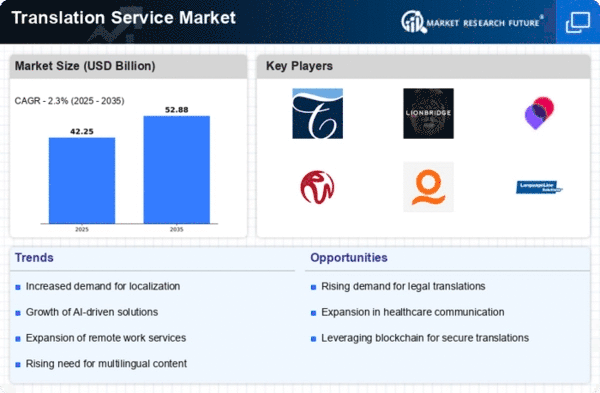
As per MRFR analysis, the Translation Service Market was estimated at 41.3 USD Billion in 2024. The Translation Service industry is projected to grow from 42.12 USD Billion in 2025 to 52.88 USD Billion by 2035, exhibiting a compound annual growth rate (CAGR) of 2.3 during the forecast period 2025 - 2035.

Key Market Trends & Highlights

The Translation Service Market is experiencing robust growth driven by technological advancements and increasing demand for localization.

  • North America remains the largest market for translation services, driven by a diverse range of industries requiring multilingual support.
  • Asia-Pacific is emerging as the fastest-growing region, reflecting a surge in global trade and cross-border communication needs.
  • Document translation continues to dominate the market, while interpretation services are witnessing the fastest growth due to rising demand for real-time communication.
  • Technological advancements and an increased focus on localization are key drivers propelling the market forward.

Market Size & Forecast

2024 Market Size 41.3 (USD Billion)
2035 Market Size 52.88 (USD Billion)
CAGR (2025 - 2035) 2.3%
Largest Regional Market Share in 2024 North America

Major Players

<p>TransPerfect (US), Lionbridge (US), SDL (GB), RWS (GB), Welocalize (US), LanguageLine Solutions (US), Gengo (JP), Straker Translations (NZ), Morningside Translations (US)</p>

Market Trends

The Translation Service Market is currently experiencing a dynamic evolution, driven by the increasing globalization of businesses and the growing need for effective communication across diverse languages. As organizations expand their reach into international markets, the demand for translation services has surged, necessitating high-quality, accurate translations that cater to various industries. This market encompasses a wide array of services, including document translation, localization, and interpretation, which are essential for facilitating cross-cultural interactions. Furthermore, advancements in technology, particularly in artificial intelligence and machine learning, are reshaping the landscape of translation services, enabling faster and more efficient processes. In December 2025, the Translation Service Market appears poised for continued growth, as more companies recognize the importance of linguistic accessibility in enhancing customer experience and fostering brand loyalty. The rise of remote work and digital communication platforms has further amplified the need for translation services, as businesses seek to engage with clients and partners from different linguistic backgrounds. This evolving market landscape suggests that translation service providers must adapt to emerging trends and technologies to remain competitive and meet the diverse needs of their clientele.

Technological Integration

The integration of advanced technologies, such as artificial intelligence and machine learning, is transforming the Translation Service Market. These innovations facilitate faster translations and improve accuracy, allowing service providers to meet the increasing demands of clients. As technology continues to evolve, it is likely that automated solutions will play a more prominent role in the industry.

Increased Demand for Localization

Localization has become a critical component of the Translation Service Market, as businesses strive to tailor their content to specific cultural contexts. This trend indicates a shift from mere translation to a more nuanced approach that considers cultural sensitivities and preferences, thereby enhancing user engagement and satisfaction.

Focus on Multilingual Content

The emphasis on creating multilingual content is gaining traction within the Translation Service Market. Companies are recognizing the necessity of reaching diverse audiences through various languages, which not only broadens their market reach but also fosters inclusivity. This trend suggests that businesses are increasingly prioritizing language diversity in their communication strategies.

Translation Service Market Market Drivers

Market Growth Projections

The Global Translation Service Market Industry is on a growth trajectory, with projections indicating a market size of 41.3 USD Billion in 2024 and an anticipated increase to 59.5 USD Billion by 2035. This growth is underpinned by a compound annual growth rate of 3.38% from 2025 to 2035. The expansion of the market reflects the increasing reliance on translation services across various sectors, driven by globalization, technological advancements, and the demand for multilingual content. As businesses continue to navigate the complexities of international markets, the Global Translation Service Market Industry is poised for sustained development.

Globalization of Businesses

The ongoing globalization of businesses significantly influences the Global Translation Service Market Industry. As companies seek to penetrate new markets, they encounter linguistic and cultural barriers that necessitate professional translation services. This trend is particularly pronounced in industries such as technology and finance, where precise communication is critical. The market is poised to grow, with estimates suggesting it will reach 41.3 USD Billion in 2024. This growth reflects the increasing recognition among businesses that effective translation is essential for successful international operations. As globalization continues to evolve, the demand for translation services is expected to remain robust.

Increasing Global Trade Activities

The Global Translation Service Market Industry experiences a notable boost due to the rise in global trade activities. As businesses expand their operations internationally, the demand for translation services becomes paramount to ensure effective communication across diverse languages. In 2024, the market is projected to reach 41.3 USD Billion, driven by the need for accurate translations in legal documents, marketing materials, and technical manuals. This trend indicates that companies are increasingly recognizing the importance of localization, which enhances customer engagement and satisfaction. As trade continues to flourish, the Global Translation Service Market Industry is likely to see sustained growth.

Rising Demand for Multilingual Content

The increasing need for multilingual content is a significant driver of the Global Translation Service Market Industry. As businesses aim to reach diverse audiences, the demand for translations in multiple languages has surged. This trend is particularly evident in sectors such as e-commerce, where companies require product descriptions, customer support, and marketing materials in various languages to cater to global consumers. The market's growth trajectory, with a projected CAGR of 3.38% from 2025 to 2035, underscores the importance of effective communication in a globalized economy. Consequently, translation services are becoming integral to business strategies, further propelling the market forward.

Regulatory Compliance and Legal Requirements

Regulatory compliance and legal requirements are pivotal drivers of the Global Translation Service Market Industry. Many industries, including healthcare and finance, mandate accurate translations of documents to adhere to local laws and regulations. This necessity creates a steady demand for translation services, as companies must ensure that their materials are compliant with the legal standards of each market they operate in. The market's growth, projected to reach 59.5 USD Billion by 2035, highlights the critical role of translation in facilitating compliance. As regulations become increasingly complex, the need for professional translation services is likely to intensify.

Technological Advancements in Translation Tools

Technological innovations play a crucial role in shaping the Global Translation Service Market Industry. The advent of artificial intelligence and machine learning has led to the development of sophisticated translation tools that enhance efficiency and accuracy. These tools enable translators to work faster while maintaining high-quality standards. For instance, neural machine translation has improved the contextual understanding of languages, making translations more nuanced. As these technologies evolve, they are expected to drive market growth, with projections indicating a market size of 59.5 USD Billion by 2035. This evolution suggests that the industry is adapting to meet the demands of a rapidly changing global landscape.

Market Segment Insights

By Application: Document Translation (Largest) vs. Interpretation Services (Fastest-Growing)

<p>In the Translation Service Market, the 'Application' segment is divided into key areas: Document Translation, Website Localization, Software Localization, Multimedia Translation, and Interpretation Services. Currently, Document Translation holds the largest market share due to its broad applicability across various industries, catering to diverse documents ranging from legal to technical. Meanwhile, while Interpretation Services occupy a smaller share, they are gaining traction rapidly as businesses continue to expand globally and require real-time communication.</p>

<p>Document Translation (Dominant) vs. Interpretation Services (Emerging)</p>

<p>Document Translation represents the cornerstone of the Translation Service Market. Its dominance is driven by the high demand for translating official documents, reports, and educational materials across multiple languages, making it indispensable for international business operations. On the other hand, Interpretation Services are emerging quickly, fueled by the increasing need for live communication among multilingual participants in conferences and meetings. This segment is particularly appealing due to advancements in technology, such as remote interpreting and mobile applications, enhancing accessibility and convenience for users. Thus, as global interactions grow, Interpretation Services are set to revolutionize the market.</p>

By End Use: Corporate (Largest) vs. Healthcare (Fastest-Growing)

<p>The translation service market is characterized by a diverse array of end-use segments, with corporate services leading in market share. This segment encompasses multinational corporations that require translation for legal documents, marketing materials, and internal communications across different languages. Legal translation services also hold a significant share, catering to the needs of law firms and courts worldwide. However, the healthcare segment is catching up rapidly, as demand for medical translations to aid patients and enhance cross-border healthcare access grows, reflecting the increasing globalization of health services.</p>

<p>Corporate: Dominant vs. Healthcare: Emerging</p>

<p>The corporate translation service segment is marked by its robust demand stemming from international business operations, necessitating accurate and contextual translations to facilitate smooth communication. Corporations invest significantly in professional translation services to maintain their competitive edge in diverse markets. Meanwhile, the healthcare translation service segment, while emerging, is witnessing exponential growth fueled by regulatory requirements for accurate medical documentation and an expanding population of non-native speakers. As telehealth services rise and global health initiatives expand, the need for precise translation in medical settings has become crucial, making healthcare one of the most dynamic and fast-evolving segments in the translation market.</p>

By Service Type: Human Translation (Largest) vs. Machine Translation (Fastest-Growing)

<p>In the Translation Service Market, Human Translation remains the most significant segment, commanding a major portion of market share due to its high accuracy and cultural nuances. While it continues to serve as the backbone of translation services, other segments are rapidly evolving, particularly Machine Translation, driven by technological advancements. The demand for speed and cost-efficiency has pushed companies to explore AI-based solutions, which have gained increasing traction in recent years.</p>

<p>Human Translation (Dominant) vs. Machine Translation (Emerging)</p>

<p>Human Translation is characterized by its exceptional quality, highly skilled linguists, and the ability to convey nuanced cultural meanings, making it the dominant choice for businesses that require precision and context in their communications. In contrast, Machine Translation, which utilizes advanced algorithms and AI capabilities, is emerging rapidly as a viable option for fast-paced environments that prioritize efficiency and scalability. Companies are increasingly integrating these solutions into their workflows, signaling a shift towards hybrid models that leverage the strengths of both human and machine-based translation services.</p>

By Language Pair: English to Spanish (Largest) vs. English to Mandarin (Fastest-Growing)

<p>In the Translation Service Market, the English to Spanish language pair holds the largest market share, driven by the substantial population of Spanish speakers and the growing demand for services in the Americas and Spain. Additionally, this pair remains crucial for businesses reaching out to Spanish-speaking markets, solidifying its position as a key segment in the industry. On the other hand, the English to Mandarin pair is emerging as the fastest-growing segment, largely due to increasing trade and cultural exchanges between English-speaking countries and China. This rising demand reflects the broader globalization trends affecting translation services.</p>

<p>English to Spanish (Dominant) vs. English to Mandarin (Emerging)</p>

<p>The English to Spanish segment is a dominant force in the Translation Service Market, characterized by a robust demand fueled by a significant demographic of native speakers and a variety of industries seeking localization in marketing, legal, and technical fields. Companies are prioritizing this language pair to effectively communicate with the extensive Spanish-speaking population. Conversely, the English to Mandarin segment represents an emerging opportunity, spurred by China's rapid economic growth and its expanding influence in global markets. The need for accurate translations in business, technology, and tourism sectors continues to rise, making this pair increasingly vital for organizations aiming to penetrate the lucrative Chinese market.</p>

By Technology: Cloud-Based Solutions (Largest) vs. Artificial Intelligence (Fastest-Growing)

<p>In the Translation Service Market, the cloud-based solutions segment holds the largest share, benefiting from the growing demand for scalable and accessible translation services. Businesses are increasingly adopting cloud platforms for their translation needs due to the flexibility, cost-effectiveness, and enhanced collaboration they offer. In contrast, the artificial intelligence segment, while smaller in comparison, is recognized as the fastest-growing area, driven by advancements in machine learning and natural language processing technologies.</p>

<p>Artificial Intelligence (Dominant) vs. Mobile Applications (Emerging)</p>

<p>The translation service market sees artificial intelligence as the dominant force, revolutionizing translation processes with unprecedented accuracy and efficiency. Leveraging neural networks and deep learning, AI reduces the time and cost of translations while significantly improving quality. On the other hand, mobile applications represent an emerging segment, reflecting the increasing necessity for on-the-go translation solutions. These apps cater to consumers and businesses alike, allowing for instant communication and translation, further enhancing the market's dynamism. Together, these segments showcase the transformative technological innovations shaping the future of translation services.</p>

Get more detailed insights about Translation Service Market Research Report - Forecast 2035

Regional Insights

North America : Translation Market Leader

North America continues to lead The Translation Service, holding a significant share of 20.79% in 2024. The growth is driven by the increasing demand for localization services across various sectors, including technology, healthcare, and finance. Regulatory support for multilingual communication and the rise of e-commerce are also key factors fueling this expansion. Companies are investing in advanced technologies like AI and machine learning to enhance service delivery and efficiency. The competitive landscape is robust, with major players such as TransPerfect, Lionbridge, and Welocalize dominating the market. The U.S. is the primary contributor, benefiting from a diverse population and a strong emphasis on global business operations. The presence of established firms and innovative startups fosters a dynamic environment, ensuring that North America remains at the forefront of translation services.

Europe : Diverse Language Landscape

Europe's translation service market is valued at €12.39 billion, reflecting a growing demand for multilingual communication across the continent. The region's diverse languages and cultures drive the need for translation services, particularly in sectors like tourism, legal, and technical industries. Regulatory frameworks promoting language accessibility in public services further enhance market growth, making it essential for businesses to adapt to local languages and dialects. Leading countries such as Germany, France, and the UK are at the forefront of this market, with a mix of established firms and emerging players. Companies like SDL and RWS are key contributors, leveraging technology to improve service efficiency. The competitive landscape is characterized by a focus on quality and specialization, ensuring that Europe remains a vital hub for translation services.

Asia-Pacific : Emerging Market Potential

The Asia-Pacific region, with a market size of $6.93 billion, is witnessing rapid growth in translation services, driven by globalization and the expansion of digital content. Countries like Japan, China, and India are increasingly investing in localization to cater to diverse consumer bases. The rise of e-commerce and online education is also propelling demand for translation services, as businesses seek to reach wider audiences in their native languages. The competitive landscape is evolving, with local players like Gengo and Straker Translations gaining traction alongside global firms. The region's unique linguistic diversity presents both challenges and opportunities, as companies strive to provide accurate and culturally relevant translations. As the market matures, the focus on quality and technology integration will be crucial for sustained growth.

Middle East and Africa : Untapped Market Opportunities

The Middle East and Africa (MEA) region, with a market size of $1.19 billion, is gradually emerging as a significant player in the translation service market. The growth is driven by increasing globalization, the need for cross-border communication, and the expansion of digital platforms. Regulatory initiatives promoting language inclusivity in education and public services are also contributing to market development, making translation services essential for businesses operating in diverse linguistic environments. Countries like South Africa and the UAE are leading the way, with a growing number of local and international players entering the market. The presence of key firms is expanding, focusing on specialized services to cater to various sectors, including legal, medical, and technical fields. As the region continues to develop, the demand for high-quality translation services is expected to rise significantly.

Key Players and Competitive Insights

The Translation Service Market is currently characterized by a dynamic competitive landscape, driven by globalization and the increasing demand for multilingual communication. Key players are actively pursuing strategies that emphasize innovation, technological integration, and regional expansion. For instance, TransPerfect (US) has positioned itself as a leader by focusing on AI-driven solutions to enhance translation accuracy and efficiency. Similarly, Lionbridge (US) has been investing in machine learning technologies to streamline its service offerings, thereby improving turnaround times and client satisfaction. These strategies collectively contribute to a competitive environment that is increasingly reliant on technological advancements and customer-centric approaches.

In terms of business tactics, companies are increasingly localizing their services to cater to diverse markets, which appears to be a critical factor in their operational success. The market structure is moderately fragmented, with several key players exerting influence over various segments. This fragmentation allows for niche players to thrive, while larger companies leverage their resources to optimize supply chains and enhance service delivery.

In November 2025, RWS (GB) announced a strategic partnership with a leading AI firm to develop advanced translation tools that utilize neural machine translation. This collaboration is expected to significantly enhance RWS's service capabilities, allowing for faster and more accurate translations, which could potentially set new industry standards. The strategic importance of this move lies in RWS's commitment to maintaining its competitive edge through technological innovation.

In October 2025, Welocalize (US) expanded its operations into the Asia-Pacific region by acquiring a local translation firm. This acquisition not only broadens Welocalize's geographical footprint but also enhances its ability to serve clients with localized expertise. The strategic significance of this expansion is evident in the growing demand for translation services in emerging markets, which could lead to increased revenue streams for the company.

In September 2025, LanguageLine Solutions (US) launched a new suite of services aimed at healthcare providers, focusing on real-time translation for patient interactions. This initiative is particularly relevant given the increasing emphasis on accessibility and patient care in the healthcare sector. The strategic importance of this launch lies in its potential to capture a significant share of the healthcare translation market, which is expected to grow as the industry continues to prioritize effective communication.

As of December 2025, current competitive trends in the Translation Service Market are heavily influenced by digitalization, sustainability, and the integration of AI technologies. Strategic alliances are becoming increasingly prevalent, as companies recognize the need to collaborate to enhance their service offerings. Looking ahead, competitive differentiation is likely to evolve from traditional price-based competition to a focus on innovation, technology, and supply chain reliability. This shift suggests that companies that prioritize these elements will be better positioned to thrive in an increasingly complex market.

Key Companies in the Translation Service Market market include

Industry Developments

Language Line Solutions (US) is the major stakeholder of the Translation Service Market that has added more value to the translation and interpretation area. Google, Amazon and Apple have added value to their customers by introducing translation services in smart phones embedding them in the Operating system that helped attract more customers. Babylon Software LTD (Israel), CLS Communications (Switzerland), SDL (UK), Ingco International (US) are the key players of the Translation Service Market that have shown promising advancements and are expected to add more than 80 billion US dollars by the year 2023.

Future Outlook

Translation Service Market Future Outlook

<p>The Translation Service Market is projected to grow at a 2.3% CAGR from 2024 to 2035, driven by globalization, technological advancements, and increasing demand for multilingual content.</p>

New opportunities lie in:

  • <p>Expansion of AI-driven translation tools for real-time communication</p>
  • <p>Development of specialized translation services for emerging markets</p>
  • <p>Partnerships with e-commerce platforms for localized product listings</p>

<p>By 2035, the market is expected to be robust, reflecting sustained growth and innovation.</p>

Market Segmentation

Translation Service Market End Use Outlook

  • Corporate
  • Legal
  • Healthcare
  • Education
  • Government

Translation Service Market Technology Outlook

  • Cloud-Based Solutions
  • Artificial Intelligence
  • Translation Management Systems
  • Computer-Assisted Translation
  • Mobile Applications

Translation Service Market Application Outlook

  • Document Translation
  • Website Localization
  • Software Localization
  • Multimedia Translation
  • Interpretation Services

Translation Service Market Service Type Outlook

  • Human Translation
  • Machine Translation
  • Post-Editing Services
  • Transcription Services
  • Subtitling Services

Translation Service Market Language Pair Outlook

  • English to Spanish
  • English to Mandarin
  • English to French
  • English to German
  • Spanish to English

Report Scope

MARKET SIZE 202441.3(USD Billion)
MARKET SIZE 202542.12(USD Billion)
MARKET SIZE 203552.88(USD Billion)
COMPOUND ANNUAL GROWTH RATE (CAGR)2.3% (2024 - 2035)
REPORT COVERAGERevenue Forecast, Competitive Landscape, Growth Factors, and Trends
BASE YEAR2024
Market Forecast Period2025 - 2035
Historical Data2019 - 2024
Market Forecast UnitsUSD Billion
Key Companies ProfiledTransPerfect (US), Lionbridge (US), SDL (GB), RWS (GB), Welocalize (US), LanguageLine Solutions (US), Gengo (JP), Straker Translations (NZ), Morningside Translations (US)
Segments CoveredApplication, End Use, Service Type, Language Pair, Technology
Key Market OpportunitiesIntegration of artificial intelligence enhances efficiency and accuracy in the Translation Service Market.
Key Market DynamicsRising demand for multilingual content drives innovation and competition in the Translation Service Market.
Countries CoveredNorth America, Europe, APAC, South America, MEA

FAQs

What is the market size of translation services?

The translation service market is expected to be worth USD 55.6 billion by 2032, with a CAGR of 2.30%.

What exactly is the translation services industry?

The translation service industry is driven by the finance and banking industries, technology industries, healthcare, travel and transportation, media and entertainment industries, and educational fields.

What is the biggest challenge in translation?

Common Sense Advisory are the biggest challenge in translation.

What are the global translation service market's growth drivers?

According to an MRFR study, a language barrier is one of the causes of communication problems. The need to bridge such communication gaps is encouraging the use of translation services, which is likely to be the primary driver of the global translation services market's growth. The proliferation of different businesses across different countries that require translation services for effective business communication is a secondary factor that can drive market growth.

What region makes extensive use of translation services?

Translation services are in high demand in Asia Pacific countries such as Japan. APAC is a multilingual region with tremendous growth potential for various businesses. As a result, the Asia Pacific translation service market is expected to generate significant revenue during the forecast period.

What is the competitive landscape for the market for translation services?

Well-known translation service providers, including TransPerfect, Lionbridge, LanguageLine, SDL, RWS, WELOCALIZE, Yamagata Corporation, Semantix, Logos Group, Lingotek

Which translation service is gaining popularity?

Changes in technical translation operations are noted to alter market growth statistics during the assessment period. Whereas the technical mode of translation service operations is expected to propel the market, the rise in the adoption of machine translation service is expected to add to the global market's momentum.

  1. Executive Summary
  2. Scope of the Report
    1. Market Definition
    2. Scope of the Study
      1. Research Objectives
      2. Assumptions & Limitations
    3. Markets Structure
  3. Market Research Methodology
    1. Research Process
    2. Secondary Research
    3. Primary Research
    4. Forecast Model
  4. Market Landscape
    1. Porter’s Five Forces Analysis
      1. Threat of New Entrants
      2. Bargaining power of buyers
      3. Threat of substitutes
      4. Segment rivalry
    2. Value Chain/Supply Chain of Global Translation Services Market
  5. Deployment Overview of Global Translation Services Market
    1. Introduction
    2. Growth Drivers
    3. Impact analysis
    4. Market Challenges
  6. Market Trends
    1. Introduction
    2. Growth Trends
    3. Impact analysis
  7. Global Translation Services Market by Operation Type
    1. Introduction
    2. Technical Translation
      1. Market Estimates & Forecast, 2020-2027
      2. Market Estimates & Forecast by Region, 2020-2027
    3. Machine Translation
      1. Market Estimates & Forecast, 2020-2027
      2. Market Estimates & Forecast by Region, 2020-2027
  8. Global Translation Services Market by Service
    1. Introduction
    2. Written Translation Services
      1. Market Estimates & Forecast, 2020-2027
      2. Market Estimates & Forecast by Region, 2020-2027
    3. Interpretation Service
      1. Market Estimates & Forecast, 2020-2027
      2. Market Estimates & Forecast by Region, 2020-2027
  9. Global Translation Services Market by Application
    1. Introduction
    2. Commercial
      1. Market Estimates & Forecast, 2020-2027
      2. Market Estimates & Forecast by Region, 2020-2027
    3. Automotive
      1. Market Estimates & Forecast, 2020-2027
      2. Market Estimates & Forecast by Region, 2020-2027
    4. IT & Telecommunication
      1. Market Estimates & Forecast, 2020-2027
      2. Market Estimates & Forecast by Region, 2020-2027
    5. Healthcare
      1. Market Estimates & Forecast, 2020-2027
      2. Market Estimates & Forecast by Region, 2020-2027
    6. Government
      1. Market Estimates & Forecast, 2020-2027
      2. Market Estimates & Forecast by Region, 2020-2027
  10. Global Translation Services Market by Component
    1. Introduction
    2. Hardware
      1. Market Estimates & Forecast, 2020-2027
      2. Market Estimates & Forecast by Region, 2020-2027
  11. Software
  12. Market Estimates & Forecast, 2020-2027
  13. Market Estimates & Forecast by Region, 2020-2027
  14. Global Translation Services Market by Region
    1. Introduction
    2. North America
      1. Market Estimates & Forecast, 2020-2027
      2. Market Estimates & Forecast by Operation Type, 2020-2027
      3. Market Estimates & Forecast by Service, 2020-2027
      4. Market Estimates & Forecast by Deployment, 2020-2027
      5. U.S.
      6. Mexico
      7. Canada
    3. Europe
      1. Market Estimates & Forecast, 2020-2027
      2. Market Estimates & Forecast by Operation Type, 2020-2027
      3. Market Estimates & Forecast by Service, 2020-2027
      4. Market Estimates & Forecast by Deployment, 2020-2027
      5. Germany
      6. France
      7. U.K
    4. Asia Pacific
      1. Market Estimates & Forecast, 2020-2027
      2. Market Estimates & Forecast by Operation Type, 2020-2027
      3. Market Estimates & Forecast by Service, 2020-2027
      4. Market Estimates & Forecast by Deployment, 2020-2027
      5. China
      6. India
      7. Japan
      8. Rest of Asia Pacific
    5. Rest of the World
      1. Market Estimates & Forecast, 2020-2027
      2. Market Estimates & Forecast by Operation Type, 2020-2027
      3. Market Estimates & Forecast by Service, 2020-2027
      4. Market Estimates & Forecast by Deployment, 2020-2027
      5. The Middle East & Africa
      6. Latin Countries
  15. Company Profiles
    1. Language Line Solutions (U.S.)
      1. Company Overview
      2. Product/Business Segment Overview
      3. Financial Updates
      4. Key Developments
    2. Lionbridge (U.S.)
      1. Company Overview
      2. Product/Business Segment Overview
      3. Financial Updates
      4. Key Developments
    3. TransPerfect (U.S.)
      1. Company Overview
      2. Product/Business Segment Overview
      3. Financial Updates
      4. Key Developments
    4. SDL (UK)
      1. Company Overview
      2. Product/Business Segment Overview
      3. Financial Updates
      4. Key Developments
    5. GlobaLexicon (UK)
      1. Company Overview
      2. Product/Business Segment Overview
      3. Financial Updates
      4. Key Developments
    6. Global Language Solutions, Inc
      1. Company Overview
      2. Product/Business Segment Overview
      3. Financial Updates
      4. Key Developments
    7. Ingco International (U.S.)
      1. Company Overview
      2. Product/Business Segment Overview
      3. Financial Updates
      4. Key Developments
    8. Straker Translations (U.S.)
      1. Company Overview
      2. Product/Business Segment Overview
      3. Financial Updates
      4. Key Developments
    9. Mars Translation Services (China)
      1. Company Overview
      2. Product/Business Segment Overview
      3. Financial Updates
      4. Key Developments
    10. Gengo (U.S.)
      1. Company Overview
      2. Product/Business Segment Overview
      3. Financial Updates
      4. Key Developments
  16. Conclusion
  17. LIST OF TABLES
    1. Table1 World Population by Major Regions (2020 To 2030)
    2. Table2 Global Translation Services Market: By Region, 2020-2027
    3. Table3 North America Translation Services Market: By Country, 2020-2027
    4. Table4 Europe Translation Services Market: By Country, 2020-2027
    5. Table5 Asia-Pacific Translation Services Market: By Country, 2020-2027
    6. Table6 The Middle East & Africa Translation Services Market: By Country, 2020-2027
    7. Table7 Latin America Translation Services Market: By Country, 2020-2027
    8. Table8 Global Translation Services by Operation Type Market: By Regions, 2020-2027
    9. Table9 North America Translation Services by Operation Type Market: By Country, 2020-2027
    10. Table10 Europe Translation Services by Operation Type Market: By Country, 2020-2027
    11. Table11 Asia-Pacific Translation Services by Operation Type Market: By Country, 2020-2027
    12. Table12 The Middle East & Africa Translation Services by Operation Type Market: By Country, 2020-2027
    13. Table13 Latin America Translation Services by Operation Type Market: By Country, 2020-2027
    14. Table14 Global Operation Type Market: By Region, 2020-2027
    15. Table15 Global Deployment Market: By Region, 2020-2027
    16. Table16 Global Deployment Market: By Region, 2020-2027
  18. Table17 North America Translation Services Market, By Country
  19. Table18 North America Translation Services Market, By Operation Type
  20. Table19 North America Translation Services Market, By Service
  21. Table20 Europe: Translation Services Market, By Service
  22. Table21 Europe: Translation Services Market, By Operation Type
  23. Table22 Asia-Pacific: Translation Services Market, By Country
  24. Table23 Asia-Pacific: Translation Services Market, By Operation Type
  25. Table24 Asia-Pacific: Translation Services Market, By Service
  26. Table25 The Middle East & Africa: Translation Services Market, By Country
  27. Table26 The Middle East & Africa Translation Services Market, By Operation Type
  28. Table27 The Middle East & Africa Translation Services Market, By Service
  29. Table28 Latin America: Translation Services Market, By Country
  30. Table29 Latin America Translation Services Market, By Operation Type
  31. Table30 Latin America Translation Services Market, By Service
  32. LIST OF FIGURES
  33. Global Translation Services market segmentation
  34. Forecast Methodology
  35. Five Forces Analysis of Global Translation Services Market
  36. Value Chain of Global Translation Services Market
  37. Share of Global Translation Services Market in 2020, by country (in %)
  38. Global Translation Services Market, 2020-2027,
  39. Sub segments of Operation Type
  40. Global Translation Services Market size by Operation Type, 2020
  41. Share of Global Translation Services Market by Operation Type, 2020-2027
  42. Global Translation Services Market size by Service, 2020
  43. Share of Global Translation Services Market by Service, 2020-2027
    1. "

Translation Service Market Segmentation

Market Segmentation Overview

  • Detailed segmentation data will be available in the full report
  • Comprehensive analysis by multiple parameters
  • Regional and country-level breakdowns
  • Market size forecasts by segment
Infographic

Free Sample Request

Kindly complete the form below to receive a free sample of this Report

Get Free Sample

Customer Strories

Compare Licence

×
Features License Type
Single User Multiuser License Enterprise User
Price $4,950 $5,950 $7,250
Maximum User Access Limit 1 User Upto 10 Users Unrestricted Access Throughout the Organization
Free Customization
Direct Access to Analyst
Deliverable Format
Platform Access
Discount on Next Purchase 10% 15% 15%
Printable Versions