×
Request Free Sample ×

Kindly complete the form below to receive a free sample of this Report

Leading companies partner with us for data-driven Insights

clients tt-cursor
Hero Background

US Automotive Metal stamping Market

ID: MRFR/AT/12984-HCR
100 Pages
Sejal Akre
October 2025

US Automotive Metal Stamping Market Research Report By Material Type (Steel, Aluminum, Copper, Alloy), By Manufacturing Process (Progressive Stamping, Deep Drawing, Blanking, Compound Stamping), By Vehicle Type (Passenger Vehicles, Commercial Vehicles, Electric Vehicles) and By Component Type (Body Plates, Chassis Components, Engine Components, Trim Components) - Forecast to 2035

Share:
Download PDF ×

We do not share your information with anyone. However, we may send you emails based on your report interest from time to time. You may contact us at any time to opt-out.

US Automotive Metal stamping Market Infographic
Purchase Options

US Automotive Metal stamping Market Summary

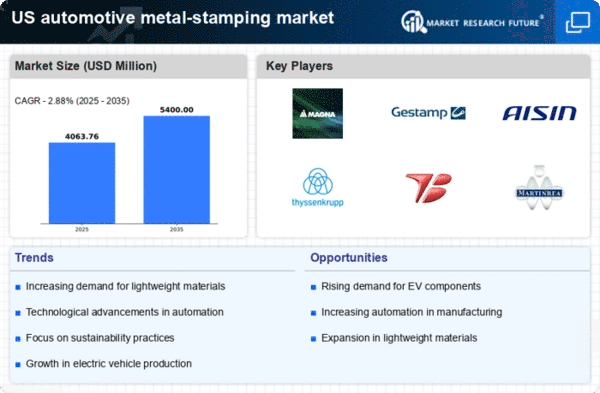
As per MRFR analysis, the automotive metal-stamping market size was estimated at 3950.0 USD Million in 2024. The US automotive metal-stamping market is projected to grow from 4063.76 USD Million in 2025 to 5400.0 USD Million by 2035, exhibiting a compound annual growth rate (CAGR) of 2.88% during the forecast period 2025 - 2035.

Key Market Trends & Highlights

The US automotive metal-stamping market is poised for growth driven by technological advancements and sustainability initiatives.

  • Increased automation in manufacturing processes is reshaping the operational landscape of the automotive metal-stamping market.
  • Sustainability initiatives are gaining traction, influencing material choices and production methods across the industry.
  • The largest segment remains traditional vehicle manufacturing, while electric vehicle production is the fastest-growing segment.
  • Technological advancements in manufacturing and rising demand for lightweight materials are key drivers propelling market expansion.

Market Size & Forecast

2024 Market Size 3950.0 (USD Million)
2035 Market Size 5400.0 (USD Million)

Major Players

Magna International (CA), Gestamp Automoción (ES), Aisin Seiki (JP), Thyssenkrupp AG (DE), Toyota Boshoku (JP), Martinrea International (CA), Shiloh Industries (US), Hirschvogel Umformtechnik (DE)

US Automotive Metal stamping Market Trends

The automotive metal-stamping market is currently experiencing a dynamic evolution, driven by advancements in technology and shifting consumer preferences. Manufacturers are increasingly adopting automation and robotics to enhance production efficiency and reduce labor costs. This trend appears to be fostering a more competitive landscape, as companies strive to meet the growing demand for lightweight and fuel-efficient vehicles. Additionally, the emphasis on sustainability is prompting firms to explore eco-friendly materials and processes, which may reshape traditional manufacturing practices. As a result, the market landscape is likely to witness significant transformations in the coming years, with innovations playing a crucial role in shaping future strategies. Moreover, the automotive metal-stamping market is also influenced by regulatory changes and economic factors. Government initiatives aimed at promoting electric vehicles and reducing emissions are likely to drive demand for specific components that require advanced stamping techniques. This regulatory environment may encourage manufacturers to invest in research and development, potentially leading to breakthroughs in material science and production methods. Consequently, the market is poised for growth, with opportunities emerging for those who can adapt to the evolving landscape and leverage new technologies effectively.

Increased Automation

The automotive metal-stamping market is witnessing a notable shift towards automation. Manufacturers are integrating advanced robotics and automated systems to streamline production processes. This transition not only enhances efficiency but also minimizes human error, leading to improved product quality. As companies seek to optimize operations, the adoption of automation technologies is likely to become a defining characteristic of the market.

Sustainability Initiatives

Sustainability is becoming a focal point within the automotive metal-stamping market. Companies are increasingly exploring eco-friendly materials and processes to align with environmental regulations and consumer expectations. This trend suggests a potential shift in manufacturing practices, as firms aim to reduce their carbon footprint and promote sustainable production methods.

Regulatory Influence

Regulatory changes are significantly impacting the automotive metal-stamping market. Government policies aimed at reducing emissions and promoting electric vehicles are driving demand for specific components. This regulatory landscape may compel manufacturers to innovate and adapt their production techniques, ensuring compliance while meeting the evolving needs of the automotive industry.

US Automotive Metal stamping Market Drivers

Focus on Cost Reduction Strategies

The automotive metal-stamping market is witnessing a heightened focus on cost reduction strategies among manufacturers. As competition intensifies, companies are seeking ways to optimize their operations and minimize expenses. This trend is leading to the adoption of lean manufacturing principles, which aim to eliminate waste and enhance efficiency. By streamlining processes and improving resource allocation, manufacturers can reduce production costs, which is crucial in a market where profit margins are often tight. In 2025, it is anticipated that companies implementing these strategies will see a potential cost reduction of up to 10%, thereby enhancing their competitiveness in the automotive metal-stamping market. This focus on cost efficiency not only benefits manufacturers but also allows for more competitive pricing of metal-stamped components, ultimately benefiting consumers.

Increased Vehicle Production Rates

The automotive metal-stamping market is significantly impacted by increased vehicle production rates in the United States. As consumer demand for automobiles continues to rise, manufacturers are ramping up production to meet this need. In 2025, the automotive industry is expected to produce over 15 million vehicles, which directly correlates with the demand for metal-stamped components. This surge in production necessitates a robust supply chain and efficient manufacturing processes, thereby driving growth in the automotive metal-stamping market. Additionally, the trend towards electric vehicles (EVs) is further stimulating demand for specialized metal components, as these vehicles often require unique designs and materials. This evolving production landscape indicates a promising outlook for the automotive metal-stamping market, as it adapts to the changing needs of the automotive industry.

Rising Demand for Lightweight Materials

The automotive metal-stamping market is increasingly influenced by the rising demand for lightweight materials in vehicle manufacturing. As automakers strive to enhance fuel efficiency and reduce emissions, the use of lightweight metals such as aluminum and high-strength steel is becoming more prevalent. This shift is expected to drive the market's growth, with projections indicating a potential increase of 6% in market size by 2026. Lightweight components not only improve vehicle performance but also align with regulatory standards aimed at reducing carbon footprints. Consequently, manufacturers in the automotive metal-stamping market are adapting their processes to accommodate these materials, which may require new tooling and techniques. This evolving landscape suggests that companies focusing on lightweight solutions will likely gain a competitive edge in the automotive sector.

Technological Advancements in Manufacturing

The automotive metal-stamping market is experiencing a surge in technological advancements that enhance production efficiency and precision. Innovations such as computer numerical control (CNC) machines and advanced robotics are streamlining the stamping process, reducing waste and improving product quality. As manufacturers adopt these technologies, they can achieve higher output rates and lower operational costs. In 2025, the market is projected to grow by approximately 5% annually, driven by these advancements. Furthermore, the integration of Industry 4.0 principles, including IoT and data analytics, allows for real-time monitoring and predictive maintenance, which can significantly reduce downtime. This trend indicates a shift towards more automated and intelligent manufacturing processes, positioning the automotive metal-stamping market for sustained growth in the coming years.

Emerging Trends in Electric Vehicle Manufacturing

The automotive metal-stamping market is being shaped by emerging trends in electric vehicle (EV) manufacturing. As the automotive industry shifts towards electrification, the demand for specialized metal components tailored for EVs is on the rise. These components often require advanced stamping techniques and materials to accommodate the unique design and performance requirements of electric vehicles. In 2025, the market for EVs is projected to grow by over 20%, which will likely drive demand for metal-stamped parts. This trend presents both challenges and opportunities for manufacturers in the automotive metal-stamping market, as they must adapt to new specifications and production methods. The increasing focus on sustainability and energy efficiency in vehicle design further emphasizes the importance of innovation in metal-stamping processes, suggesting a dynamic future for the industry.

Market Segment Insights

By Material Type: Steel (Largest) vs. Aluminum (Fastest-Growing)

The US automotive metal-stamping market is primarily dominated by steel, which holds the largest market share due to its strength, durability, and cost-effectiveness. Steel is widely utilized across various automotive components, ranging from structural elements to safety features, continually capturing significant demand. On the other hand, aluminum is rapidly gaining traction as the industry shifts towards lighter materials to enhance fuel efficiency and reduce emissions. Its share in the market is expected to see considerable growth as more manufacturers adopt aluminum in vehicle designs. The growth trends in the material type segment are driven by the increasing need for fuel-efficient and eco-friendly vehicles. Regulatory pressures are pushing automakers to reduce vehicle weight, making aluminum a favorable choice due to its lighter nature compared to steel. Additionally, advancements in aluminum processing technologies are making it more accessible and appealing for automotive applications. Moreover, the rising demand for electric vehicles is further propelling the use of aluminum, as it plays a crucial role in battery housing and lightweight components.

Steel (Dominant) vs. Aluminum (Emerging)

Steel remains the dominant material in the US automotive metal-stamping market due to its unmatched strength and structural integrity. It is particularly favored for forming critical components such as chassis and body parts, where safety and performance are paramount. Conversely, aluminum is emerging as a competitive alternative, particularly in applications aiming for lightweight solutions. High energy efficiency, recyclability, and aesthetic appeal are bolstering aluminum's position in the market. While steel still leads overall, the trend towards electric vehicles and sustainable manufacturing practices positions aluminum as an increasingly viable option, suggesting a shift in automotive material preferences in the coming years.

By Manufacturing Process: Progressive Stamping (Largest) vs. Deep Drawing (Fastest-Growing)

In the US automotive metal-stamping market, Progressive Stamping holds the largest share due to its efficiency in producing complex parts in a single pass, significantly reducing production time and costs. Deep Drawing follows closely as a traditional method known for creating deep, hollow shapes, but its market share is less than that of Progressive Stamping, due to the latter's advantages in high-volume applications. The growth trend for Deep Drawing is notably positive, with increasing demand for lightweight yet strong automotive components driving its expansion. Conversely, Progressive Stamping benefits from technological advancements and automation, which are enhancing quality and productivity. This segment's adaptability to diverse designs and materials is making it increasingly popular among manufacturers, ensuring its position as a key player in the market.

Progressive Stamping (Dominant) vs. Blanking (Emerging)

Progressive Stamping is a dominant force in the US automotive metal-stamping market, characterized by its ability to perform multiple operations in one stroke, resulting in lower labor costs and faster production cycles. This method is ideal for high-volume production, making it the preferred choice for manufacturers looking for efficiency and reduced cycle times. In contrast, Blanking, although an emerging technique, focuses on cutting flat sheets of metal into desired shapes and is mainly used for smaller volume production. While Blanking is simpler and less expensive, its limitations in forming complex geometries make it less favorable compared to the advanced capabilities of Progressive Stamping. Overall, the market is witnessing a shift towards technologies that enhance productivity and product quality.

By Vehicle Type: Passenger Vehicles (Largest) vs. Electric Vehicles (Fastest-Growing)

In the US automotive metal-stamping market, the distribution among vehicle types showcases that passenger vehicles hold the largest share, dominating the market with a significant percentage. In contrast, electric vehicles are emerging rapidly as a substantial segment due to the increasing demand for sustainable transportation options. Commercial vehicles also play a vital role but lag behind these two primary categories in market presence. Growth trends indicate a robust shift towards electric vehicles, driven by technological advancements and a heightened focus on sustainability. Regulatory frameworks supporting EV adoption and consumer interest in eco-friendly alternatives are accelerating this growth. Conversely, passenger vehicles continue to evolve, incorporating advanced metal stamping techniques to enhance performance and safety features while maintaining efficiency.

Passenger Vehicles (Dominant) vs. Electric Vehicles (Emerging)

Passenger vehicles represent the dominant force in the US automotive metal-stamping market, characterized by their extensive production volumes and established supply chains. They incorporate advanced metal stamping technologies to ensure durability, safety, and efficiency. The focus on lightweight materials and design innovations has cemented their position. On the other hand, electric vehicles are emerging rapidly, driven by technological advancements and a growing commitment to environmental sustainability. These vehicles utilize specialized metal stamping techniques to support their unique designs and efficiency requirements, positioning them as key players in the market's future growth. The convergence of these two segments signifies a dynamic shift in the automotive landscape.

By Component Type: Body Plates (Largest) vs. Chassis Components (Fastest-Growing)

In the automotive metal-stamping market, the segment distribution reflects a diverse landscape, with Body Plates holding the largest market share due to their essential role in vehicle structure and safety. Chassis Components, while not the largest, are a significant contributor to the market, driven by their increasing integration in modern vehicle designs that focus on enhanced performance and efficiency. Growth trends indicate that Chassis Components are emerging as the fastest-growing segment, propelled by innovations in lightweight materials and manufacturing techniques that answer the automotive industry's demands for fuel efficiency and sustainability. Additionally, trends towards electric and hybrid vehicles necessitate advanced chassis designs, indicating strong future demand. Meanwhile, Body Plates continue to be crucial for the fundamental construction of vehicles, ensuring their steady market presence.

Body Plates (Dominant) vs. Chassis Components (Emerging)

Body Plates are recognized as the dominant segment in the automotive metal-stamping market, characterized by their vital role in defining vehicle safety and structural integrity. This segment is heavily influenced by ongoing trends in vehicle weight reduction and safety regulations, leading to innovations in materials used for body plates. In contrast, Chassis Components are emerging, driven by the need for advanced manufacturing techniques that support the production of lighter, more efficient vehicles. As automotive companies increasingly focus on electric and hybrid models, both segments are adapting to meet new standards, ensuring that they remain relevant and competitive in a rapidly changing market.

Get more detailed insights about US Automotive Metal stamping Market

Key Players and Competitive Insights

The automotive metal-stamping market is currently characterized by a competitive landscape that is both dynamic and multifaceted. Key growth drivers include the increasing demand for lightweight materials, advancements in manufacturing technologies, and the ongoing shift towards electric vehicles (EVs). Major players such as Magna International (Canada), Gestamp Automoción (Spain), and Thyssenkrupp AG (Germany) are strategically positioned to leverage these trends. Magna International (Canada) focuses on innovation and sustainability, investing heavily in advanced manufacturing techniques to enhance efficiency and reduce environmental impact. Gestamp Automoción (Spain) emphasizes regional expansion and partnerships, aligning its operations with local automotive manufacturers to optimize supply chains. Thyssenkrupp AG (Germany) is pursuing digital transformation initiatives, integrating AI and automation into its production processes to improve precision and reduce costs. Collectively, these strategies shape a competitive environment that is increasingly focused on technological advancement and sustainability.

Key business tactics within the automotive metal-stamping market include localizing manufacturing and optimizing supply chains to enhance responsiveness to market demands. The market structure appears moderately fragmented, with several key players exerting influence over specific segments. This fragmentation allows for a diverse range of offerings, yet the collective impact of major companies like Magna International (Canada) and Gestamp Automoción (Spain) suggests a trend towards consolidation as firms seek to enhance their competitive positioning through strategic alliances and mergers.

In October 2025, Magna International (Canada) announced a partnership with a leading EV manufacturer to develop lightweight metal components specifically designed for electric vehicles. This collaboration is strategically significant as it positions Magna at the forefront of the EV market, allowing the company to capitalize on the growing demand for efficient and sustainable automotive solutions. The partnership is expected to enhance Magna's product offerings and strengthen its market share in the rapidly evolving automotive landscape.

In September 2025, Gestamp Automoción (Spain) expanded its manufacturing capabilities in the U.S. by opening a new facility dedicated to producing high-strength steel components. This strategic move is indicative of Gestamp's commitment to meeting the increasing demand for advanced materials in the automotive sector. The new facility is anticipated to enhance production efficiency and reduce lead times, thereby improving Gestamp's competitive edge in the market.

In August 2025, Thyssenkrupp AG (Germany) launched a new digital platform aimed at optimizing its metal-stamping processes through AI integration. This initiative is crucial as it not only streamlines operations but also enhances product quality and reduces waste. By embracing digitalization, Thyssenkrupp positions itself as a leader in innovation within the automotive metal-stamping market, potentially setting new standards for operational excellence.

As of November 2025, current competitive trends are increasingly defined by digitalization, sustainability, and the integration of AI technologies. Strategic alliances are shaping the landscape, enabling companies to pool resources and expertise to address emerging challenges. The shift from price-based competition to a focus on innovation, technology, and supply chain reliability is evident, suggesting that future competitive differentiation will hinge on the ability to adapt to these evolving trends.

Key Companies in the US Automotive Metal stamping Market market include

Industry Developments

The US Automotive Metal Stamping Market has recently seen significant activity, particularly among key players such as Consolidated Metco, Aisin Seiki, and American Axle and Manufacturing. In September 2023, Magna International announced the expansion of its metal stamping capabilities, targeting increased production efficiency and cost reduction, catering effectively to demand from electric vehicle manufacturers. Additionally, notable developments include FormTech Industries securing a contract with a major automaker, underscoring the growing reliance on advanced stamping technologies. The merger of Shiloh Industries with Wyman Gordon Company in July 2023 has also been highlighted, driven by an emphasis on integrating advanced manufacturing techniques. 

The market valuation for automotive metal stamping in the US has shown positive trends, attributed to a surge in electric vehicle production and a recovery in the overall automotive sector post-pandemic, which is enhancing the demand for precision stamping parts. Historical shifts, such as the acquisition of Dura Automotive Systems by Toyota Boshoku Corporation in March 2021, have set the stage for further innovations and consolidation within the industry, emphasizing the sector's evolving landscape and its emphasis on technological advancements.

Future Outlook

US Automotive Metal stamping Market Future Outlook

The automotive metal-stamping market is projected to grow at a 2.88% CAGR from 2024 to 2035, driven by technological advancements and increasing demand for lightweight materials.

New opportunities lie in:

  • Investment in automation technologies for enhanced production efficiency.
  • Development of advanced materials for electric vehicle components.
  • Expansion into emerging markets with tailored metal-stamping solutions.

By 2035, the market is expected to achieve robust growth, driven by innovation and strategic investments.

Market Segmentation

US Automotive Metal stamping Market Vehicle Type Outlook

  • Passenger Vehicles
  • Commercial Vehicles
  • Electric Vehicles

US Automotive Metal stamping Market Material Type Outlook

  • Steel
  • Aluminum
  • Copper
  • Alloy

US Automotive Metal stamping Market Component Type Outlook

  • Body Plates
  • Chassis Components
  • Engine Components
  • Trim Components

US Automotive Metal stamping Market Manufacturing Process Outlook

  • Progressive Stamping
  • Deep Drawing
  • Blanking
  • Compound Stamping

Report Scope

MARKET SIZE 2024 3950.0(USD Million)
MARKET SIZE 2025 4063.76(USD Million)
MARKET SIZE 2035 5400.0(USD Million)
COMPOUND ANNUAL GROWTH RATE (CAGR) 2.88% (2024 - 2035)
REPORT COVERAGE Revenue Forecast, Competitive Landscape, Growth Factors, and Trends
BASE YEAR 2024
Market Forecast Period 2025 - 2035
Historical Data 2019 - 2024
Market Forecast Units USD Million
Key Companies Profiled Magna International (CA), Gestamp Automoción (ES), Aisin Seiki (JP), Thyssenkrupp AG (DE), Toyota Boshoku (JP), Martinrea International (CA), Shiloh Industries (US), Hirschvogel Umformtechnik (DE)
Segments Covered Material Type, Manufacturing Process, Vehicle Type, Component Type
Key Market Opportunities Adoption of advanced materials and automation technologies enhances efficiency in the automotive metal-stamping market.
Key Market Dynamics Technological advancements drive efficiency and precision in automotive metal-stamping, reshaping competitive dynamics and production processes.
Countries Covered US

Leave a Comment

FAQs

What is the projected market size of the US Automotive Metal Stamping Market in 2024?

The US Automotive Metal Stamping Market is projected to be valued at 4.5 billion USD in 2024.

What will be the estimated market value of the US Automotive Metal Stamping Market by 2035?

The estimated market value of the US Automotive Metal Stamping Market is expected to reach 6.0 billion USD by 2035.

What is the expected CAGR for the US Automotive Metal Stamping Market from 2025 to 2035?

The expected CAGR for the US Automotive Metal Stamping Market from 2025 to 2035 is 2.65%.

Which material type segment holds the largest market share in 2024?

In 2024, the steel segment is projected to hold the largest market share valued at 1.5 billion USD.

Who are the key players in the US Automotive Metal Stamping Market?

Major players in the market include Consolidated Metco, Aisin Seiki, and Magna International among others.

What is the market value of the aluminum segment in 2024?

The market value of the aluminum segment in 2024 is projected to be 1.2 billion USD.

How much is the copper segment expected to be worth in 2035?

The copper segment is expected to reach a market value of 1.0 billion USD by 2035.

What are the challenges faced by the US Automotive Metal Stamping Market?

Challenges for the US Automotive Metal Stamping Market include rising material costs and technological advancements.

What is the market size of the alloy segment projected for 2035?

The alloy segment is projected to reach a market size of 1.4 billion USD by 2035.

What impact do emerging trends have on the US Automotive Metal Stamping Market?

Emerging trends in lightweight materials and sustainability are driving growth opportunities within the US Automotive Metal Stamping Market.

Download Free Sample

Kindly complete the form below to receive a free sample of this Report

Compare Licence

×
Features License Type
Single User Multiuser License Enterprise User
Price $4,950 $5,950 $7,250
Maximum User Access Limit 1 User Upto 10 Users Unrestricted Access Throughout the Organization
Free Customization
Direct Access to Analyst
Deliverable Format
Platform Access
Discount on Next Purchase 10% 15% 15%
Printable Versions