×
Request Free Sample ×

Kindly complete the form below to receive a free sample of this Report

Leading companies partner with us for data-driven Insights

clients tt-cursor
Hero Background

Automotive Metal stamping Market

ID: MRFR/AT/1470-HCR
100 Pages
Swapnil Palwe
October 2025

Automotive Metal Stamping Market Research Report By Material Type (Steel, Aluminum, Copper, Alloy), By Manufacturing Process (Progressive Stamping, Deep Drawing, Blanking, Compound Stamping), By Vehicle Type (Passenger Vehicles, Commercial Vehicles, Electric Vehicles), By Component Type (Body Plates, Chassis Components, Engine Components, Trim Components) and By Regional (North America, Europe, South America, Asia-Pacific, Middle East and Africa) - Forecast to 2035

Share:
Download PDF ×

We do not share your information with anyone. However, we may send you emails based on your report interest from time to time. You may contact us at any time to opt-out.

Automotive Metal stamping Market Infographic
Purchase Options

Automotive Metal stamping Market Summary

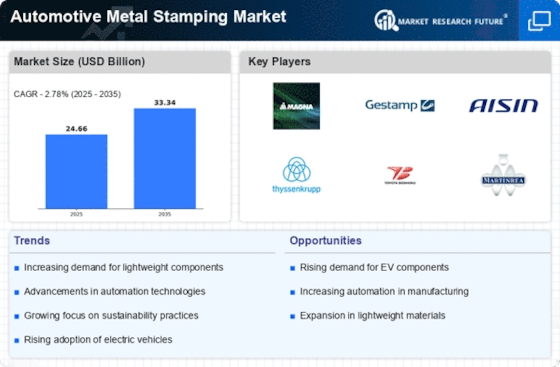
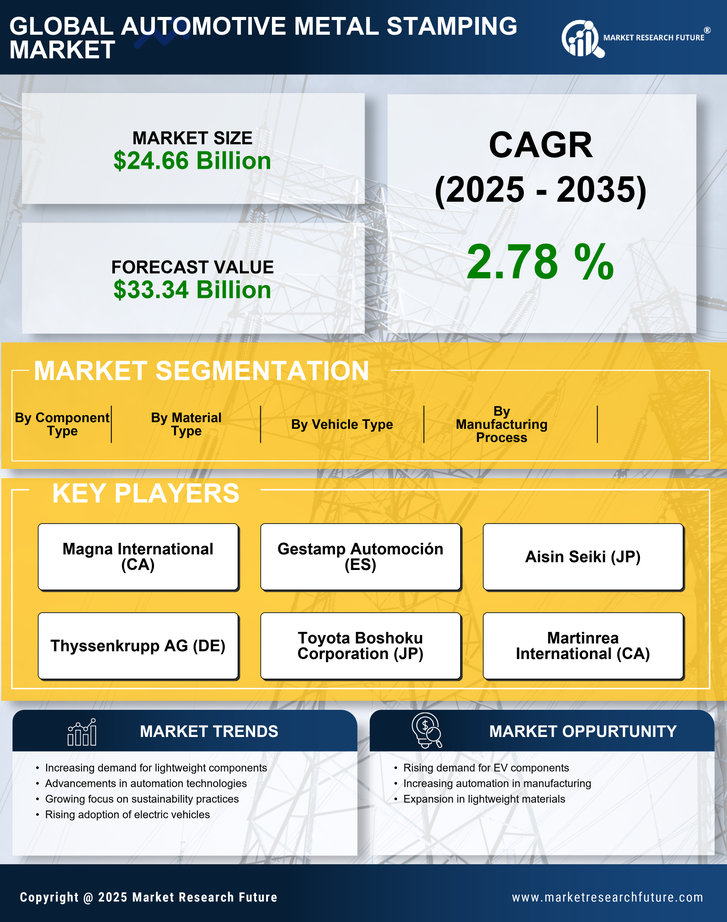
As per MRFR analysis, the Automotive Metal Stamping Market Size was estimated at 24.66 USD Billion in 2024. The Automotive Metal Stamping industry is projected to grow from 25.34 USD Billion in 2025 to 33.34 USD Billion by 2035, exhibiting a compound annual growth rate (CAGR) of 2.78 during the forecast period 2025 - 2035.

Key Market Trends & Highlights

The Automotive Metal Stamping Market is poised for growth driven by technological advancements and sustainability initiatives.

  • North America remains the largest market for automotive metal stamping, driven by robust automotive manufacturing.
  • Asia-Pacific is recognized as the fastest-growing region, reflecting increasing investments in automotive production.
  • Steel dominates the market as the largest segment, while aluminum is emerging as the fastest-growing material in metal stamping.
  • The rising demand for lightweight vehicles and the growth in electric vehicle production are key drivers propelling market expansion.

Market Size & Forecast

2024 Market Size 24.66 (USD Billion)
2035 Market Size 33.34 (USD Billion)
CAGR (2025 - 2035) 2.78%

Major Players

Magna International (CA), Gestamp Automoción (ES), Aisin Seiki (JP), Thyssenkrupp AG (DE), Toyota Boshoku Corporation (JP), Martinrea International (CA), Shiloh Industries (US), Hirschvogel Automotive Group (DE)

Automotive Metal stamping Market Trends

The Automotive Metal Stamping Market is currently experiencing a transformative phase, driven by advancements in manufacturing technologies and increasing demand for lightweight materials. This sector is characterized by its ability to produce complex shapes and components with high precision, which is essential for modern automotive designs. As manufacturers strive to enhance fuel efficiency and reduce emissions, the adoption of innovative stamping techniques appears to be on the rise. Furthermore, the integration of automation and robotics into production processes is likely to improve efficiency and reduce labor costs, thereby reshaping the competitive landscape. In addition, the Automotive Metal Stamping Market is witnessing a shift towards sustainability, with companies increasingly focusing on eco-friendly practices. This trend is reflected in the growing use of recycled materials and the implementation of energy-efficient processes. As consumer preferences evolve towards greener vehicles, manufacturers are compelled to adapt their strategies to meet these expectations. Overall, the Automotive Metal Stamping Market seems poised for growth, driven by technological advancements and a commitment to sustainability, which may redefine the future of automotive manufacturing.

Technological Advancements

The Automotive Metal Stamping Market is influenced by ongoing technological innovations that enhance production capabilities. Advanced stamping techniques, such as progressive die stamping and hydroforming, allow for the creation of intricate components with improved accuracy. These developments not only streamline manufacturing processes but also contribute to the overall quality of automotive parts.

Sustainability Initiatives

A notable trend within the Automotive Metal Stamping Market is the increasing emphasis on sustainability. Manufacturers are adopting eco-friendly practices, including the use of recycled materials and energy-efficient production methods. This shift aligns with the broader automotive industry's commitment to reducing environmental impact and meeting consumer demand for greener vehicles.

Automation and Robotics Integration

The integration of automation and robotics into the Automotive Metal Stamping Market is transforming production dynamics. By incorporating automated systems, manufacturers can enhance operational efficiency, reduce labor costs, and improve safety. This trend indicates a move towards more streamlined and cost-effective manufacturing processes, which may provide a competitive edge in the market.

Automotive Metal stamping Market Drivers

Growth in Electric Vehicle Production

The Automotive Metal Stamping Market is poised for growth due to the rising production of electric vehicles (EVs). As automakers pivot towards electric mobility, the need for specialized components that can be efficiently produced through metal stamping processes becomes increasingly critical. The EV market is expected to expand rapidly, with projections indicating that electric vehicle sales could account for a substantial percentage of total vehicle sales by 2030. This transition necessitates the development of new stamping techniques and materials tailored for electric vehicle applications, thereby creating opportunities for innovation within the Automotive Metal Stamping Market. The integration of advanced metal stamping technologies will likely enhance the performance and safety of EVs, further driving market growth.

Rising Demand for Lightweight Vehicles

The Automotive Metal Stamping Market is experiencing a notable increase in demand for lightweight vehicles. This trend is primarily driven by the automotive sector's focus on enhancing fuel efficiency and reducing emissions. Manufacturers are increasingly utilizing metal stamping techniques to produce lightweight components that maintain structural integrity while minimizing weight. According to recent data, the demand for lightweight materials in vehicles is projected to grow significantly, with estimates suggesting that the market for lightweight automotive components could reach several billion dollars by 2026. This shift towards lightweight vehicles not only aligns with regulatory requirements but also appeals to environmentally conscious consumers, thereby propelling the Automotive Metal Stamping Market forward.

Regulatory Compliance and Safety Standards

The Automotive Metal Stamping Market is increasingly influenced by stringent regulatory compliance and safety standards. Governments worldwide are implementing more rigorous regulations aimed at enhancing vehicle safety and environmental performance. As a result, automotive manufacturers are compelled to adopt advanced metal stamping techniques that meet these evolving standards. Compliance with safety regulations not only ensures consumer protection but also enhances the reputation of manufacturers. The Automotive Metal Stamping Market must adapt to these changes by investing in innovative stamping technologies that can produce components meeting the required specifications. This focus on compliance is likely to drive demand for high-quality stamped parts, thereby contributing to market growth.

Technological Innovations in Metal Stamping

The Automotive Metal Stamping Market is witnessing a wave of technological innovations that are reshaping production processes. Advancements in stamping technology, such as the adoption of computer numerical control (CNC) machines and automation, are enhancing precision and efficiency in manufacturing. These innovations allow for the production of complex geometries and intricate designs that were previously challenging to achieve. As manufacturers strive to improve their competitive edge, the integration of these technologies is becoming essential. The Automotive Metal Stamping Market is expected to benefit from these advancements, as they not only reduce production costs but also improve product quality. Consequently, the market is likely to see an increase in demand for technologically advanced stamped components.

Increasing Investment in Automotive Manufacturing

The Automotive Metal Stamping Market is benefiting from a surge in investment in automotive manufacturing facilities. As manufacturers seek to enhance production capabilities and meet growing consumer demand, investments in advanced manufacturing technologies are becoming more prevalent. Recent reports indicate that capital expenditures in the automotive sector are on the rise, with many companies allocating significant budgets towards upgrading their stamping operations. This influx of investment is expected to lead to improved efficiency and productivity within the Automotive Metal Stamping Market. Furthermore, the establishment of new manufacturing plants in emerging markets is likely to create additional demand for metal stamping services, thereby bolstering the overall market landscape.

Market Segment Insights

By Material Type: Steel (Largest) vs. Aluminum (Fastest-Growing)

The Automotive Metal Stamping Market has a diverse material landscape, dominated primarily by steel, due to its robustness and cost-effectiveness. Steel holds the largest market share, making it the preferred choice for various automotive applications ranging from body panels to structural components. On the other hand, aluminum, while it holds a smaller portion of the market, is quickly gaining traction as manufacturers increasingly focus on lightweight materials to improve fuel efficiency and reduce emissions.

Steel (Dominant) vs. Aluminum (Emerging)

Steel continues to be the dominant material in the Automotive Metal Stamping Market owing to its strength, affordability, and recyclability. It is extensively used in the manufacturing of safety-critical components, ensuring high performance and durability. Meanwhile, aluminum is emerging as a promising alternative, driven by the automotive industry's shift towards weight reduction. Its lighter weight contributes to improved fuel efficiency and performance. The trend towards electric vehicles and stricter emission regulations further enhances aluminum's attractiveness to manufacturers, leading to an expanding market share.

By Manufacturing Process: Progressive Stamping (Largest) vs. Deep Drawing (Fastest-Growing)

In the automotive metal stamping market, progressive stamping holds a significant share, primarily due to its efficiency and capability to produce complex parts in a single pass. This method has been widely adopted by manufacturers looking to enhance production speed while maintaining high precision. Deep drawing, while smaller in market share, is emerging rapidly as it offers unique advantages for producing deep and hollow components, which are essential in various automotive applications. Recent trends indicate that while progressive stamping remains the preferred choice for mass production, deep drawing is gaining traction due to the rising demand for lightweight and fuel-efficient vehicles. The shift towards electrification in the automotive sector is further accelerating the demand for innovative metal forming processes, positioning deep drawing as a critical method for future manufacturing.

Progressive Stamping (Dominant) vs. Blanking (Emerging)

Progressive stamping is a well-established technology in the automotive metal stamping market, valued for its capability to produce high-volume components with intricate designs in a cost-effective manner. It utilizes a series of dies in a single operation, making it ideal for creating complex geometries needed in modern vehicles. In contrast, blanking is considered an emerging process that focuses on cutting flat shapes from a sheet of metal, which is crucial for high-precision parts. As automotive manufacturers emphasize efficiency and material conservation, blanking has begun to gain attention, demonstrating significant potential in delivering tailored solutions for specific automotive applications.

By Vehicle Type: Passenger Vehicles (Largest) vs. Electric Vehicles (Fastest-Growing)

In the Automotive Metal Stamping Market, the distribution of market share among vehicle types is crucial to understanding industry dynamics. Passenger vehicles constitute the largest segment, reflecting their wide acceptance and demand globally. With increasing urbanization and consumer preferences shifting towards personal mobility, this segment remains robust. Meanwhile, commercial vehicles also hold a significant share due to the rising e-commerce sector and logistics requirements, but they trail behind passenger vehicles and the rapidly growing electric vehicle segment.

Passenger Vehicles (Dominant) vs. Electric Vehicles (Emerging)

Passenger vehicles dominate the automotive metal stamping market due to their extensive manufacturing volume and consumer acceptance. The production of components for these vehicles involves complex stamping techniques that ensure both performance and safety. In contrast, electric vehicles (EVs) represent an emerging segment that is gaining momentum, driven by technological advancements and a global focus on sustainability. EVs require lightweight and efficient metal stamping solutions to enhance range and performance. As regulations tighten around emissions, the shift toward EVs is prompting manufacturers to innovate in metal stamping processes, making it an exciting area of growth and competitive advantage.

By Component Type: Body Plates (Largest) vs. Engine Components (Fastest-Growing)

The Automotive Metal Stamping Market reveals a significant distribution of market share across various component types. Body plates dominate the segment due to their extensive application in vehicle manufacturing, providing structural integrity and safety. Chassis components also hold a substantial share, contributing to the overall framework of vehicles. Engine components follow closely, with a notable position, while trim components are essential yet hold a smaller portion of the market.

Body Plates (Dominant) vs. Engine Components (Emerging)

Body plates are the backbone of automotive metal stamping, offering strength and durability, which are crucial in vehicle design. They are widely utilized across various models, ensuring safety and compliance with regulations. Engine components represent an emerging segment, driven by technological advancements in engine design and eco-friendly initiatives. These components are evolving to accommodate lighter materials and innovative designs, reflecting the industry's shift towards sustainability. As manufacturers aim to enhance efficiency and reduce emissions, engine components are expected to grow in importance, thus making them a dynamic segment in the market.

Get more detailed insights about Automotive Metal stamping Market

Key Companies in the Automotive Metal stamping Market market include

Industry Developments

  • Q3 2024: GIMSA to Invest $40 Million in New Automotive Metal Stamping Plant in Monclova GIMSA announced a $40 million investment to establish a new metal stamping facility focused on the automotive sector in Monclova, Coahuila, Mexico. The plant aims to support growing demand from regional automakers and is expected to create hundreds of jobs.
  • Q2 2024: Martinrea Invests $35 Million to Expand Ridgetown, Ontario Stamping Facility Martinrea revealed a nearly $35 million expansion of its Ridgetown, Ontario plant, including the installation of a 3000-ton stamping press to manufacture larger and more complex automotive parts for North American OEMs.

Future Outlook

Automotive Metal stamping Market Future Outlook

The Automotive Metal Stamping Market is projected to grow at a 2.78% CAGR from 2024 to 2035, driven by advancements in manufacturing technologies and increasing vehicle production.

New opportunities lie in:

  • Investment in automation technologies for enhanced production efficiency.
  • Development of lightweight metal stamping solutions for electric vehicles.
  • Expansion into emerging markets with tailored product offerings.

By 2035, the market is expected to achieve robust growth, reflecting evolving industry demands.

Market Segmentation

Automotive Metal stamping Market Vehicle Type Outlook

  • Passenger Vehicles
  • Commercial Vehicles
  • Electric Vehicles

Automotive Metal stamping Market Material Type Outlook

  • Steel
  • Aluminum
  • Copper
  • Alloy

Automotive Metal stamping Market Component Type Outlook

  • Body Plates
  • Chassis Components
  • Engine Components
  • Trim Components

Automotive Metal stamping Market Manufacturing Process Outlook

  • Progressive Stamping
  • Deep Drawing
  • Blanking
  • Compound Stamping

Report Scope

MARKET SIZE 2024 24.66(USD Billion)
MARKET SIZE 2025 25.34(USD Billion)
MARKET SIZE 2035 33.34(USD Billion)
COMPOUND ANNUAL GROWTH RATE (CAGR) 2.78% (2024 - 2035)
REPORT COVERAGE Revenue Forecast, Competitive Landscape, Growth Factors, and Trends
BASE YEAR 2024
Market Forecast Period 2025 - 2035
Historical Data 2019 - 2024
Market Forecast Units USD Billion
Key Companies Profiled Market analysis in progress
Segments Covered Market segmentation analysis in progress
Key Market Opportunities Integration of advanced automation technologies enhances efficiency in the Automotive Metal Stamping Market.
Key Market Dynamics Technological advancements and regulatory changes drive innovation and efficiency in the automotive metal stamping sector.
Countries Covered North America, Europe, APAC, South America, MEA

Market Highlights

Author
Swapnil Palwe
Team Lead - Research

With a technical background as Bachelor's in Mechanical Engineering, with MBA in Operations Management , Swapnil has 6+ years of experience in market research, consulting and analytics with the tasks of data mining, analysis, and project execution. He is the POC for our clients, for their consulting projects running under the Automotive/A&D domain. Swapnil has worked on major projects in verticals such as Aerospace & Defense, Automotive and many other domain projects. He has worked on projects for fortune 500 companies' syndicate and consulting projects along with several government projects.

Leave a Comment

FAQs

What is the projected market valuation of the Automotive Metal Stamping Market by 2035?

The projected market valuation for the Automotive Metal Stamping Market is 33.34 USD Billion by 2035.

What was the market valuation of the Automotive Metal Stamping Market in 2024?

The overall market valuation of the Automotive Metal Stamping Market was 24.66 USD Billion in 2024.

What is the expected CAGR for the Automotive Metal Stamping Market during the forecast period 2025 - 2035?

The expected CAGR for the Automotive Metal Stamping Market during the forecast period 2025 - 2035 is 2.78%.

Which material type is projected to have the highest valuation in the Automotive Metal Stamping Market?

Steel is projected to have the highest valuation, with estimates ranging from 12.0 to 16.0 USD Billion.

What are the projected valuations for aluminum in the Automotive Metal Stamping Market?

The projected valuations for aluminum in the Automotive Metal Stamping Market range from 6.0 to 8.0 USD Billion.

Which manufacturing process segment is expected to grow the most in the Automotive Metal Stamping Market?

Progressive stamping is expected to grow the most, with projected valuations between 8.0 and 10.5 USD Billion.

What is the projected valuation for electric vehicles in the Automotive Metal Stamping Market by 2035?

The projected valuation for electric vehicles in the Automotive Metal Stamping Market is between 6.66 and 9.34 USD Billion by 2035.

Which component type is anticipated to have the highest valuation in the Automotive Metal Stamping Market?

Body plates are anticipated to have the highest valuation, projected between 8.0 and 10.5 USD Billion.

Who are the key players in the Automotive Metal Stamping Market?

Key players in the Automotive Metal Stamping Market include Magna International, Gestamp Automoción, Aisin Seiki, and Thyssenkrupp AG.

Download Free Sample

Kindly complete the form below to receive a free sample of this Report

Compare Licence

×
Features License Type
Single User Multiuser License Enterprise User
Price $4,950 $5,950 $7,250
Maximum User Access Limit 1 User Upto 10 Users Unrestricted Access Throughout the Organization
Free Customization
Direct Access to Analyst
Deliverable Format
Platform Access
Discount on Next Purchase 10% 15% 15%
Printable Versions