×
Hero Background
English
Chinese
French
Japanese
Korean
German
Spanish

US Inorganic Salt Market Share

ID: MRFR/CnM/0290-HCR
214 Pages
Chitranshi Jaiswal
October 2025

Global & US Inorganic Salt Market by Application (Food & Beverages, Agriculture, Pharmaceutical, others (Construction & Chemical) and by Types (Potassium salt, Calcium salt, Sodium salt, Ammonium salt and others) Forecast 2024 to 2032

Share:
Download PDF ×

We do not share your information with anyone. However, we may send you emails based on your report interest from time to time. You may contact us at any time to opt-out.

US Inorganic Salt Market Infographic
Purchase Options

Market Share

US Inorganic Salt Market Share Analysis

The market for inorganic salts can be broken down by the different kinds, uses, and geographical places they are found in.

There are a lot of places where fake salts can be useful, like in food, packing, medicine, farming, concrete, and more. In addition to magnesium salts, there are also calcium salts, ammonium salts, potassium salts, sodium salts, and numerous other metal salts.

Inorganic salts play a part in working with stretchy materials, helping to put them together and treat them. In the drug business, artificial salts are useful for various tasks, showing how versatile and important they are to this field.

Inorganic salts are good for farming because they can make the dirt work better and help crops grow. Inorganic salts are important to the building business, especially when making concrete. The materials and processes for growth get better with them.

Inorganic salts are used in the food industry, which shows how important they are for handling and putting together food. For example, artificial salts are used in many other areas besides those listed, showing how huge their effect is.

These salts, which are a type of artificial salt, are very useful and have amazing properties. A different group is sodium salts, which have their own qualities and uses. Citrus salts have clear benefits that help them find use in many different fields. This type of artificial salt is used for different things and has certain traits. Potassium salts are an important type of artificial salt because they are used in many processes and situations. This group includes different kinds of artificial salts that might not fit into the groups that were already mentioned.

This area, which includes countries like China and India, is very important to the global market for mineral salts. The main things that affect the general market are the attention and uses in this area. With their unique uses and needs, European countries add to the global market for mineral salts. In the world market for mineral salts, Latin America, with countries like Brazil and Mexico, makes a clear mark.There are also different needs and uses in the Middle East and Africa, which affects the overall aspects of the global inorganic salts market.

Author
Chitranshi Jaiswal
Research Analyst Level I

In her 3 years of experience in the market research field, she has handled critical cross-domain projects. She has an in-depth knowledge of market estimation & analysis, problem-solving, primary as well as secondary research, and team management.She holds an engineering degree and is an MBA professional from a well-known university, capable of evaluating the market and competitive conditions. An exceptional strategist with excellent communication skills and a passion for delivering cutting-edge & practical insights for the market. Proficient in multi-tasking, and can successfully deal with competing demands, while maintaining complete confidentiality. Generated business through active client and project development, networking, and high-quality responses. Her knowledge and skills have helped in making solid business decisions, securing funding from investors, and avoiding business failures.

Leave a Comment

FAQs

What is the forecast period of Global & US Inorganic Salt Market research report?

The forecast period for Global & US Inorganic Salt Market research report is 2025-2035.

Who are the key players in the Global & US Inorganic Salt?

The main players in the market are MerckMillipore, Sigma Aldrich, Fisher Scientific, Otsuka Chemical Co Ltd, MerckMillipore, Loba Chemie, , Lenntech, Arkema SA,Bann Química, Chemtura Corporation, Behn Meyer Solutia Incorporated, Emerald Performance Materials, Lanxess AG, Eastman Chemicals Co and others.

Which region will lead the Global & US Inorganic Salt market?

Global & US Inorganic Salt Market is dominated by North America region.

What is the expected market size of the US Inorganic Salt Market in 2024?

The US Inorganic Salt Market is expected to be valued at 24.17 billion USD in 2024.

What is the projected market value of the US Inorganic Salt Market by 2035?

By 2035, the US Inorganic Salt Market is projected to reach a value of 40.55 billion USD.

What is the estimated CAGR for the US Inorganic Salt Market from 2025 to 2035?

The expected compound annual growth rate (CAGR) for the US Inorganic Salt Market is 4.816% from 2025 to 2035.

Which segment of the US Inorganic Salt Market holds the largest market share?

The Sodium Salts segment is anticipated to have the largest share, valued at 9.0 billion USD in 2024.

What are the expected market values for Magnesium Salts by 2035?

The Magnesium Salts segment is expected to grow to 8.8 billion USD by 2035.

Who are some of the key players in the US Inorganic Salt Market?

Key players include Albemarle Corporation, Livent Corporation, Tata Chemicals, and BASF SE among others.

What growth opportunities exist in the US Inorganic Salt Market?

The market presents opportunities driven by increasing demand from agriculture and chemical industries.

What factors could challenge the growth of the US Inorganic Salt Market?

Challenges may arise from regulatory constraints and fluctuations in raw material prices.

How will the Calcium Salts segment perform by 2035?

The Calcium Salts segment is expected to grow significantly, reaching a value of 7.5 billion USD by 2035.

What will be the expected market value of Potassium Salts in 2024?

The Potassium Salts segment is valued at 3.0 billion USD in 2024.

Market Summary

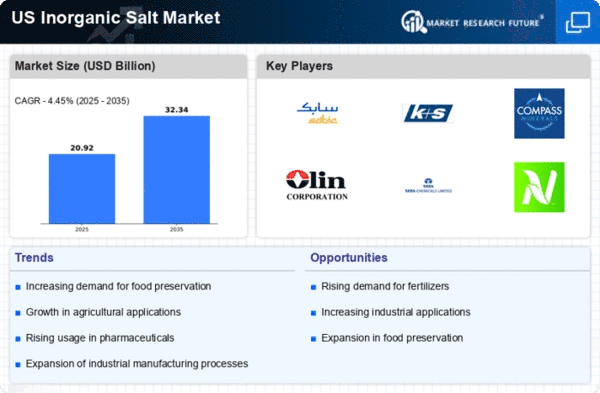
As per analysis, the US inorganic salt market is projected to grow from USD 21.7 Billion in 2024 to USD 35.04 Billion by 2035, exhibiting a compound annual growth rate (CAGR) of 4.45% during the forecast period (2025 - 2035).

Key Market Trends & Highlights

The US inorganic salt market is experiencing a dynamic shift driven by sustainability and technological advancements.

  • The water treatment segment remains the largest contributor to the US inorganic salt market, reflecting ongoing investments in infrastructure.
  • Agriculture is identified as the fastest-growing segment, propelled by increasing demand for fertilizers and sustainable farming practices.
  • Technological advancements in production processes are enhancing efficiency and reducing environmental impact across the market.
  • Key market drivers include the growing demand in agriculture and stringent environmental regulations that are shaping industry practices.

Market Size & Forecast

2024 Market Size 21.7 (USD Billion)
2035 Market Size 35.04 (USD Billion)
CAGR (2025 - 2035) 4.45%

Major Players

<p>Compass Minerals (US), Cargill (US), American Vanguard Corporation (US), K+S Aktiengesellschaft (US), Nutrien Ltd. (US), Olin Corporation (US), Tata Chemicals (US), FMC Corporation (US)</p>

Market Trends

The US inorganic salt market is characterized by a diverse range of applications across various industries, including agriculture, pharmaceuticals, and food processing. The demand for inorganic salts is driven by their essential roles in chemical processes, nutrient supply, and as additives in numerous products. As industries evolve, the market appears to be adapting to new regulatory standards and sustainability practices, which may influence production methods and sourcing strategies. Furthermore, the increasing focus on environmental concerns suggests that manufacturers are likely to explore greener alternatives and innovative solutions to meet consumer expectations. In addition, the US inorganic salt market is witnessing a shift towards enhanced product formulations that cater to specific industry needs. This trend indicates a growing emphasis on quality and performance, as companies strive to differentiate their offerings in a competitive landscape. The integration of advanced technologies in production processes may also play a crucial role in improving efficiency and reducing waste. Overall, the market seems poised for growth, driven by ongoing advancements and a commitment to sustainability, which could reshape the future of inorganic salt applications in the United States.

Sustainability Initiatives

The US inorganic salt market is increasingly influenced by sustainability initiatives. Companies are exploring eco-friendly production methods and sourcing practices to minimize environmental impact. This trend reflects a broader commitment to reducing carbon footprints and enhancing resource efficiency, which may resonate with environmentally conscious consumers.

Technological Advancements

Technological advancements are reshaping the US inorganic salt market. Innovations in production techniques and quality control are likely to enhance product performance and consistency. As manufacturers adopt cutting-edge technologies, they may improve operational efficiency and reduce costs, positioning themselves competitively in the market.

Regulatory Compliance

Regulatory compliance is becoming a critical factor in the US inorganic salt market. Stricter regulations regarding safety and environmental standards are prompting companies to adapt their practices. This trend indicates a growing need for transparency and accountability in sourcing and production, which may influence market dynamics.

US Inorganic Salt Market Market Drivers

Market Segment Insights

By Application: Water Treatment (Largest) vs. Agriculture (Fastest-Growing)

<p>In the US inorganic salt market, the application segments are classified into Agriculture, Food Processing, Chemical Manufacturing, Pharmaceuticals, and Water Treatment. Among these, Water Treatment stands out as the largest segment, driven by the increasing demand for clean and safe water. It significantly contributes to the market share due to its widespread application in municipal and industrial water treatment processes. Meanwhile, Agriculture is emerging as the fastest-growing segment due to the rising need for fertilizers and soil amendments, reflecting the growing trend towards enhanced agricultural productivity.</p>

<p>Water Treatment (Dominant) vs. Agriculture (Emerging)</p>

<p>Water Treatment remains the dominant segment in the US inorganic salt market, primarily due to its critical role in purifying and supplying drinking water, as well as treating wastewater. The increasing regulations on water quality and environmental sustainability are propelling the consistent demand for various inorganic salts in this segment. Conversely, Agriculture is identified as an emerging segment, primarily fueled by the heightened focus on sustainable farming practices and the need for effective fertilizers. As farmers increasingly adopt precision agriculture techniques, the demand for specific inorganic salts to enhance soil health and crop yield is on the rise, fostering innovation and expansion within this market segment.</p>

By End Use: Fertilizers (Largest) vs. Industrial Chemicals (Fastest-Growing)

<p>The U.S. inorganic salt market is characterized by a diverse range of end-use applications, with fertilizers holding the largest share. This sector is primarily driven by agricultural demand, where inorganic salts play a significant role in enhancing crop yield and soil fertility. Industrial chemicals follow as a prominent segment, reflecting the growing use of inorganic salts in various manufacturing processes across industries such as textiles, detergents, and batteries. In terms of growth trends, industrial chemicals represent the fastest-growing segment within the market. This is attributed to increasing industrialization and the demand for high-performance chemicals in production processes. Moreover, the rising need for sustainable practices is further driving investments in new and innovative inorganic salt products tailored for industrial applications.</p>

<p>Fertilizers: Dominant vs. Industrial Chemicals: Emerging</p>

<p>Fertilizers are the dominant end-use segment in the U.S. inorganic salt market, largely owing to their vital role in sustainable agriculture. These inorganic salts, including ammonium nitrate and potassium chloride, are essential for improving soil health and increasing agricultural productivity. This segment benefits from the constant need to enhance food production to meet the growing population demands. On the other hand, industrial chemicals as an emerging segment reflect a noteworthy trend propelled by innovations in manufacturing and production. Inorganic salts are increasingly utilized in creating high-quality materials and products, such as catalysts and processing agents, demonstrating their versatility and essential role in various industrial settings.</p>

By Type: Sodium Salts (Largest) vs. Calcium Salts (Fastest-Growing)

<p>In the US inorganic salt market, the distribution among segment values reveals that sodium salts hold a significant portion of the market share, representing the largest category due to their widespread applications in various industries such as food, healthcare, and chemical manufacturing. Following sodium salts, calcium salts are emerging strongly, as they are increasingly being utilized in pharmaceuticals and as dietary supplements, making them a notable contender in terms of market presence. The growth trends in this segment are driven by a surge in demand for sodium salts across multiple applications, particularly in de-icing and industrial processes. Calcium salts, on the other hand, are witnessing rapid growth attributed to their health benefits and increased usage in food fortification. The regulatory shifts favoring the health-conscious trend further propel their adoption, ensuring a promising growth trajectory for this category of inorganic salts.</p>

<p>Sodium Salts (Dominant) vs. Magnesium Salts (Emerging)</p>

<p>Sodium salts are recognized as the dominant player in the US inorganic salt market, utilized extensively in food preservation, chemical reactions, and as a key component in various industrial processes. Their high stability, cost-effectiveness, and versatility enhance their appeal across a wide range of applications. Conversely, magnesium salts are seen as an emerging segment, gaining traction due to their use in agriculture as fertilizers and soil conditioners, alongside their growing applications in pharmaceuticals. While sodium salts maintain a strong market position, magnesium salts continue to carve out a significant niche, driven by the increasing need for efficient agricultural solutions and health-related products.</p>

By Form: Powder (Largest) vs. Granular (Fastest-Growing)

<p>In the US inorganic salt market, the 'By Form' segment showcases a varied distribution, with powder forms holding the largest market share due to their versatility and widespread applications in various industries, including agriculture and food processing. Granular forms are quickly gaining traction, appealing to sectors that require more controlled dissolution and usage, making them an attractive option for manufacturers and consumers alike.</p>

<p>Powder (Dominant) vs. Granular (Emerging)</p>

<p>The powder form of inorganic salts remains the dominant player in the market, characterized by its ease of use, cost-effectiveness, and adaptability across multiple applications such as fertilizers, de-icing agents, and pharmaceuticals. In contrast, granular forms are emerging rapidly, driven by their precise solubility and convenience in handling. Granular inorganic salts cater specifically to industries that prioritize controlled usage scenarios, allowing for better efficiency and consistency in applications like water treatment and specialty chemicals, marking a significant shift towards tailored solutions in the market.</p>

By Purity Level: Food Grade (Largest) vs. Pharmaceutical Grade (Fastest-Growing)

<p>The US inorganic salt market is characterized by a diverse range of purity levels that cater to different industry needs. Among these, Food Grade salts hold the largest market share, driven by the growing demand in the food and beverage industry for safe and high-quality ingredients. Meanwhile, Pharmaceutical Grade salts are emerging rapidly, gaining interest from the healthcare sector as they offer high purity, essential for drug manufacturing and formulations. As consumer preferences evolve, the growth in the Pharmaceutical Grade segment is underpinned by increased investments in pharmaceutical research and development. This segment's expansion is driven not only by innovation in drug delivery systems but also by stringent regulatory frameworks requiring higher purity standards. Additionally, the rise in chronic disease prevalence propels the need for high-quality pharmaceutical products, further stimulating growth in this segment.</p>

<p>Food Grade: (Dominant) vs. Pharmaceutical Grade (Emerging)</p>

<p>Food Grade inorganic salts are a dominant force in the US market, primarily because they meet stringent safety standards and are widely accepted in food production processes. These salts provide essential minerals and serve various functions, including flavor enhancement, preservation, and nutritional supplementation. Their consistent demand in the food industry establishes their strong market presence. On the other hand, Pharmaceutical Grade salts are rapidly emerging due to their high purity requirements necessary for drug formulations. This segment is characterized by rigorous testing and compliance with stringent regulatory standards, which ensures that these salts are safe for human consumption. Their role in the formulation of advanced therapies and biologics is becoming increasingly vital, solidifying their importance in the healthcare sector.</p>

Get more detailed insights about Global & US Inorganic Salt Market Consumption Forecast 2022 to 2035

Regional Insights

Key Players and Competitive Insights

The inorganic salt market in the US is characterized by a competitive landscape that is both dynamic and multifaceted. Key growth drivers include the increasing demand for de-icing agents, agricultural fertilizers, and industrial applications. Major players such as Compass Minerals (US), Cargill (US), and Nutrien Ltd. (US) are strategically positioned to leverage these trends. Compass Minerals (US) focuses on expanding its product portfolio and enhancing operational efficiencies, while Cargill (US) emphasizes sustainability and innovation in its offerings. Nutrien Ltd. (US) is actively pursuing digital transformation initiatives to optimize its supply chain and improve customer engagement. Collectively, these strategies contribute to a competitive environment that is increasingly shaped by innovation and sustainability initiatives.

In terms of business tactics, companies are localizing manufacturing and optimizing supply chains to enhance responsiveness to market demands. The market structure appears moderately fragmented, with several key players exerting influence over various segments. This fragmentation allows for niche players to thrive, while larger companies consolidate their market positions through strategic partnerships and acquisitions.

In November 2025, Compass Minerals (US) announced a significant investment in a new production facility aimed at increasing its capacity for specialty fertilizers. This move is strategically important as it aligns with the growing demand for sustainable agricultural solutions, positioning the company to capture a larger market share in the eco-friendly segment. The investment is expected to enhance operational efficiencies and reduce production costs, thereby improving overall competitiveness.

In October 2025, Cargill (US) launched a new line of eco-friendly de-icing products designed to minimize environmental impact. This initiative reflects a broader trend towards sustainability in the industry and positions Cargill as a leader in environmentally responsible solutions. The introduction of these products is likely to attract environmentally conscious consumers and municipalities, thereby expanding Cargill's market reach.

In September 2025, Nutrien Ltd. (US) entered into a strategic partnership with a technology firm to integrate AI into its supply chain management processes. This collaboration aims to enhance predictive analytics capabilities, thereby improving inventory management and reducing waste. The strategic importance of this partnership lies in its potential to streamline operations and increase responsiveness to market fluctuations, which is crucial in a competitive landscape.

As of December 2025, current competitive trends in the inorganic salt market are heavily influenced by digitalization, sustainability, and the integration of advanced technologies such as AI. Strategic alliances are increasingly shaping the landscape, enabling companies to pool resources and expertise to drive innovation. Looking ahead, competitive differentiation is likely to evolve from traditional price-based competition to a focus on innovation, technology adoption, and supply chain reliability. This shift underscores the importance of adaptability and forward-thinking strategies in maintaining a competitive edge.

Key Companies in the US Inorganic Salt Market market include

Industry Developments

Future Outlook

US Inorganic Salt Market Future Outlook

<p>The US inorganic salt market is projected to grow at a 4.45% CAGR from 2024 to 2035, driven by industrial demand, agricultural applications, and advancements in chemical processes.</p>

New opportunities lie in:

  • <p>Expansion of specialty inorganic salts for niche applications</p>
  • <p>Development of eco-friendly production methods</p>
  • <p>Investment in automated distribution systems for efficiency</p>

<p>By 2035, the inorganic salt market is expected to achieve robust growth and enhanced market positioning.</p>

Market Segmentation

US Inorganic Salt Market Form Outlook

  • Powder
  • Granular
  • Liquid
  • Crystalline
  • Tablet

US Inorganic Salt Market Type Outlook

  • Sodium Salts
  • Calcium Salts
  • Potassium Salts
  • Magnesium Salts
  • Ammonium Salts

US Inorganic Salt Market End Use Outlook

  • Fertilizers
  • Industrial Chemicals
  • Food Additives
  • Pharmaceutical Ingredients
  • Water Purification

US Inorganic Salt Market Application Outlook

  • Agriculture
  • Food Processing
  • Chemical Manufacturing
  • Pharmaceuticals
  • Water Treatment

US Inorganic Salt Market Purity Level Outlook

  • Technical Grade
  • Food Grade
  • Pharmaceutical Grade
  • Industrial Grade
  • Reagent Grade

Report Scope

MARKET SIZE 202421.7(USD Billion)
MARKET SIZE 202522.67(USD Billion)
MARKET SIZE 203535.04(USD Billion)
COMPOUND ANNUAL GROWTH RATE (CAGR)4.45% (2024 - 2035)
REPORT COVERAGERevenue Forecast, Competitive Landscape, Growth Factors, and Trends
BASE YEAR2024
Market Forecast Period2025 - 2035
Historical Data2019 - 2024
Market Forecast UnitsUSD Billion
Key Companies ProfiledCompass Minerals (US), Cargill (US), American Vanguard Corporation (US), K+S Aktiengesellschaft (US), Nutrien Ltd. (US), Olin Corporation (US), Tata Chemicals (US), FMC Corporation (US)
Segments CoveredApplication, End Use, Type, Form, Purity Level
Key Market OpportunitiesGrowing demand for sustainable agricultural practices drives innovation in the US inorganic salt market.
Key Market DynamicsRegulatory changes and sustainability initiatives drive innovation and demand in the US inorganic salt market.
Countries CoveredUS

FAQs

What is the forecast period of Global & US Inorganic Salt Market research report?

The forecast period for Global &amp; US Inorganic Salt Market research report is 2025-2035.

Who are the key players in the Global & US Inorganic Salt?

The main players in the market are MerckMillipore, Sigma Aldrich, Fisher Scientific, Otsuka Chemical Co Ltd, MerckMillipore, Loba Chemie, , Lenntech, Arkema SA,Bann Química, Chemtura Corporation, Behn Meyer Solutia Incorporated, Emerald Performance Materials, Lanxess AG, Eastman Chemicals Co and others.

Which region will lead the Global & US Inorganic Salt market?

Global &amp; US Inorganic Salt Market is dominated by North America region.

What is the expected market size of the US Inorganic Salt Market in 2024?

The US Inorganic Salt Market is expected to be valued at 24.17 billion USD in 2024.

What is the projected market value of the US Inorganic Salt Market by 2035?

By 2035, the US Inorganic Salt Market is projected to reach a value of 40.55 billion USD.

What is the estimated CAGR for the US Inorganic Salt Market from 2025 to 2035?

The expected compound annual growth rate (CAGR) for the US Inorganic Salt Market is 4.816% from 2025 to 2035.

Which segment of the US Inorganic Salt Market holds the largest market share?

The Sodium Salts segment is anticipated to have the largest share, valued at 9.0 billion USD in 2024.

What are the expected market values for Magnesium Salts by 2035?

The Magnesium Salts segment is expected to grow to 8.8 billion USD by 2035.

Who are some of the key players in the US Inorganic Salt Market?

Key players include Albemarle Corporation, Livent Corporation, Tata Chemicals, and BASF SE among others.

What growth opportunities exist in the US Inorganic Salt Market?

The market presents opportunities driven by increasing demand from agriculture and chemical industries.

What factors could challenge the growth of the US Inorganic Salt Market?

Challenges may arise from regulatory constraints and fluctuations in raw material prices.

How will the Calcium Salts segment perform by 2035?

The Calcium Salts segment is expected to grow significantly, reaching a value of 7.5 billion USD by 2035.

What will be the expected market value of Potassium Salts in 2024?

The Potassium Salts segment is valued at 3.0 billion USD in 2024.

  1. SECTION I: EXECUTIVE SUMMARY AND KEY HIGHLIGHTS
  2. EXECUTIVE’S HANDBOOK
    1. The Top Performing Segments
    2. Key Trends Summarized
    3. Pricing Outlook
    4. Strategic Insights
    5. Who are the Key Players in the Market?
  3. SECTION II: SCOPING, METHODOLOGY AND MARKET STRUCTURE
  4. MARKET INTRODUCTION
    1. Definition
    2. Report Segmentation & Scope
    3. Regional & Country Level Coverage
    4. Why you need this report?
  5. RESEARCH METHODOLOGY
    1. Research Process
    2. Secondary Research
      1. Data Mining & Condensation
      2. Sources (Associations, Organizations, Magazines, Paid Databases)
    3. Primary Research
      1. Sample Size (Demand-Supply, Company Type, Designations, Region)
      2. Sources
    4. Factorial Analysis & Approach Setting
    5. Estimation & Forecast Models
    6. Pricing Baskets
    7. Analyst Hours & Team
  6. SECTION III: QUALITATIVE ANALYSIS
  7. MARKET DYNAMICS
    1. Introduction
    2. Growth Parameters Mapped - Drivers
      1. Rising consumption of agricultural goods in developing countries
      2. Increase in industrial establishments around the world
    3. What are the challenges faced by Industry Participants?
      1. Fluctuations in potash ore prices
    4. Opportunities
      1. Demand from animal feed industry
      2. Usage in novel industries
    5. Regulatory Update
    6. Impact Analysis of COVID-19
      1. Impact on Supply Chain of Potash Ores
      2. Impact on Market Demand of Potash Ores
  8. MARKET FACTOR ANALYSIS
    1. Supply/Value Chain Analysis
      1. Participants
      2. Value Percolation Across the Chain
      3. Integration Levels
      4. Key Issues Addressed
    2. Porter’s Five Forces Model
      1. Bargaining Power of Suppliers
      2. Bargaining Power of Buyers
      3. Threat of New Entrants
      4. Threat of Substitutes
      5. Intensity of Rivalry
    3. Pricing Scenario, By Region
  9. SECTION IV: QUANTITATIVE ANALYSIS
  10. GLOBAL POTASH ORES MARKET, BY MINERAL EXTRACTED (USD MILLION)
    1. Introduction
    2. Potassium Chloride
      1. Global Potash Ores Market Size: Market Estimates & Forecast, By Potassium Chloride, 2018-2032
    3. Potassium Hydroxide
      1. Global Potash Ores Market Size: Market Estimates & Forecast, By Potassium Hydroxide, 2018-2032
    4. Sodium Chloride
      1. Global Potash Ores Market Size: Market Estimates & Forecast, By Sodium Chloride, 2018-2032
    5. Others
      1. Global Potash Ores Market Size: Market Estimates & Forecast, By Others, 2018-2032
  11. GLOBAL POTASH ORES MARKET, BY END-USE INDUSTRY (USD MILLION)
    1. Introduction
    2. Agriculture
      1. Global Potash Ores Market Size: Market Estimates & Forecast, By Agriculture, 2018-2032
    3. Metallurgy
      1. Global Potash Ores Market Size: Market Estimates & Forecast, By Metallurgy, 2018-2032
    4. Chemicals
      1. Global Potash Ores Market Size: Market Estimates & Forecast, By Chemicals, 2018-2032
    5. Others
      1. Global Potash Ores Market Size: Market Estimates & Forecast, By Others, 2018-2032
  12. GLOBAL POTASH ORES MARKET, BY REGION (USD MILLION)
    1. Introduction
    2. North America
      1. North America Potash Ores Market Size: Market Estimates & Forecast, By Country, 2018-2032
      2. North America Potash Ores Market Size: Market Estimates & Forecast, By Mineral Extracted, 2018-2032
      3. North America Potash Ores Market Size: Market Estimates & Forecast, By End-Use Industry, 2018-2032
      4. US
      5. Canada
      6. Mexico
    3. Europe
      1. Europe Potash Ores Market Size: Market Estimates & Forecast, By Country, 2018-2032
      2. Europe Potash Ores Market Size: Market Estimates & Forecast, By Mineral Extracted, 2018-2032
      3. Europe Potash Ores Market Size: Market Estimates & Forecast, By End-Use Industry, 2018-2032
      4. Germany
      5. France
      6. UK
      7. Spain
      8. Italy
      9. Rest of Europe
    4. Asia-Pacific
      1. Asia-Pacific Potash Ores Market Size: Market Estimates & Forecast, By Country, 2018-2032
      2. Asia-Pacific Potash Ores Market Size: Market Estimates & Forecast, By Mineral Extracted, 2018-2032
      3. Asia-Pacific Potash Ores Market Size: Market Estimates & Forecast, By End-Use Industry, 2018-2032
      4. China
      5. India
      6. Japan
      7. South Korea
      8. Rest of Asia-Pacific
    5. Middle East & Africa
      1. Middle East & Africa Potash Ores Market Size: Market Estimates & Forecast, By Country, 2018-2032
      2. Middle East & Africa Potash Ores Market Size: Market Estimates & Forecast, By Mineral Extracted, 2018-2032
      3. Middle East & Africa Potash Ores Market Size: Market Estimates & Forecast, By End-Use Industry, 2018-2032
      4. GCC Countries
      5. South Africa
      6. Rest of Middle East & Africa
    6. South America
      1. South America Potash Ores Market Size: Market Estimates & Forecast, By Country, 2018-2032
      2. South America Potash Ores Market Size: Market Estimates & Forecast, By Mineral Extracted, 2018-2032
      3. South America Potash Ores Market Size: Market Estimates & Forecast, By End-Use Industry, 2018-2032
      4. Brazil
      5. Argentina
      6. Rest of South America
  13. SECTION V: COMPETITIVE ANALYSIS
  14. COMPETITIVE LANDSCAPE
    1. Introduction
    2. Competition Dashboard
    3. Company Market Share Analysis, 2022
    4. Who are the market disruptors & innovators?
    5. What strategies are being adopted by market leaders?
    6. Competitive Benchmarking
    7. The Leading Player in terms of Number of Developments in the Global Potash Ores Market
    8. List of Key Players, By Region
    9. Comparative Analysis: Key Players Financial
    10. Key Developments & Growth Strategies
      1. New Product Launch/Service Deployment
      2. Merger & Acquisition
      3. Joint Ventures
  15. COMPANY PROFILES
    1. Uralkali
      1. Company Overview
      2. Financial Overview
      3. Product Offered
      4. Key Developments
      5. SWOT Analysis
      6. Key Strategies
    2. BHP Billiton Ltd.
      1. Company Overview
      2. Financial Overview
      3. Product Offered
      4. Key Developments
      5. SWOT Analysis
      6. Key Strategies
    3. Eurochem
      1. Company Overview
      2. Financial Overview
      3. Product Offered
      4. Key Developments
      5. SWOT Analysis
      6. Key Strategies
    4. Encanto Potash Corp.
      1. Company Overview
      2. Financial Overview
      3. Product Offered
      4. Key Developments
      5. SWOT Analysis
      6. Key Strategies
    5. Israel Chemical Ltd.
      1. Company Overview
      2. Financial Overview
      3. Product Offered
      4. Key Developments
      5. SWOT Analysis
      6. Key Strategies
    6. JSC Belaruskali
      1. Company Overview
      2. Financial Overview
      3. Product Offered
      4. Key Developments
      5. SWOT Analysis
      6. Key Strategies
    7. K+S GmbH
      1. Company Overview
      2. Financial Overview
      3. Product Offered
      4. Key Developments
      5. SWOT Analysis
      6. Key Strategies
    8. PotashCorp
      1. Company Overview
      2. Financial Overview
      3. Product Offered
      4. Key Developments
      5. SWOT Analysis
      6. Key Strategies
    9. Agrium Inc.
      1. Company Overview
      2. Financial Overview
      3. Product Offered
      4. Key Developments
      5. SWOT Analysis
      6. Key Strategies
    10. Elemental Minerals Ltd.
      1. Company Overview
      2. Financial Overview
      3. Product Offered
      4. Key Developments
      5. SWOT Analysis
      6. Key Strategies
  16. RECOMMENDATIONS & EXPERT INSIGHTS
    1. What is the short-term vs long-term outlook for Potash Ores Market?
    2. Who are the players to look out for?
    3. What will the product mix look in coming years?
  17. MRFR OFFERINGS & TEAM
    1. Citations & Media
    2. Our Regional Representatives
    3. Related Reports
    4. Our Domain Coverage
    5. NOTE:
    6. This table of content is tentative and subject to change as the research progresses.
    7.  In section 10, each company will be profiled based on the Market Overview, Financials, Product Portfolio, Business Strategies, and Recent Developments parameters.
    8.  Please note: The financial details of the company cannot be provided if the information is not available in the public domain and or from reliable sources.
  18. LIST OF TABLES
  19. LIST OF ASSUMPTIONS
  20. POTASH ORES MARKET ESTIMATES & FORECAST, BY MINERAL EXTRACTED, 2018-2032 (USD MILLION)
  21. POTASH ORES MARKET ESTIMATES & FORECAST, BY END-USE INDUSTRY, 2018-2032 (USD MILLION)
  22. GLOBAL POTASH ORES MARKET, BY REGION, 2018-2032 (USD MILLION)
  23. NORTH AMERICA: POTASH ORES MARKET, BY COUNTRY, 2018-2032 (USD MILLION)
  24. NORTH AMERICA: POTASH ORES MARKET, BY MINERAL EXTRACTED, 2018-2032 (USD MILLION)
  25. NORTH AMERICA: POTASH ORES MARKET, BY END-USE INDUSTRY, 2018-2032 (USD MILLION)
  26. U.S.: POTASH ORES MARKET, BY MINERAL EXTRACTED, 2018-2032 (USD MILLION)
  27. U.S.: POTASH ORES MARKET, BY END-USE INDUSTRY, 2018-2032 (USD MILLION)
  28. CANADA: POTASH ORES MARKET, BY MINERAL EXTRACTED, 2018-2032 (USD MILLION)
  29. CANADA: POTASH ORES MARKET, BY END-USE INDUSTRY, 2018-2032 (USD MILLION)
  30. MEXICO: POTASH ORES MARKET, BY MINERAL EXTRACTED, 2018-2032 (USD MILLION)
  31. MEXICO: POTASH ORES MARKET, BY END-USE INDUSTRY, 2018-2032 (USD MILLION)
  32. EUROPE: POTASH ORES MARKET, BY COUNTRY, 2018-2032 (USD MILLION)
  33. EUROPE: POTASH ORES MARKET, BY MINERAL EXTRACTED, 2018-2032 (USD MILLION)
  34. EUROPE: POTASH ORES MARKET, BY END-USE INDUSTRY, 2018-2032 (USD MILLION)
  35. GERMANY: POTASH ORES MARKET, BY MINERAL EXTRACTED, 2018-2032 (USD MILLION)
  36. GERMANY: POTASH ORES MARKET, BY END-USE INDUSTRY, 2018-2032 (USD MILLION)
  37. FRANCE: POTASH ORES MARKET, BY MINERAL EXTRACTED, 2018-2032 (USD MILLION)
  38. FRANCE: POTASH ORES MARKET, BY END-USE INDUSTRY, 2018-2032 (USD MILLION)
  39. UK: POTASH ORES MARKET, BY MINERAL EXTRACTED, 2018-2032 (USD MILLION)
  40. UK: POTASH ORES MARKET, BY END-USE INDUSTRY, 2018-2032 (USD MILLION)
  41. SPAIN: POTASH ORES MARKET, BY MINERAL EXTRACTED, 2018-2032 (USD MILLION)
  42. SPAIN: POTASH ORES MARKET, BY END-USE INDUSTRY, 2018-2032 (USD MILLION)
  43. ITALY: POTASH ORES MARKET, BY MINERAL EXTRACTED, 2018-2032 (USD MILLION)
  44. ITALY: POTASH ORES MARKET, BY END-USE INDUSTRY, 2018-2032 (USD MILLION)
  45. REST OF EUROPE: POTASH ORES MARKET, BY COUNTRY, 2018-2032 (USD MILLION)
  46. REST OF EUROPE: POTASH ORES MARKET, BY MINERAL EXTRACTED, 2018-2032 (USD MILLION)
  47. REST OF EUROPE: POTASH ORES MARKET, BY END-USE INDUSTRY, 2018-2032 (USD MILLION)
  48. ASIA PACIFIC: POTASH ORES MARKET, BY COUNTRY, 2018-2032 (USD MILLION)
  49. ASIA PACIFIC: POTASH ORES MARKET, BY MINERAL EXTRACTED, 2018-2032 (USD MILLION)
  50. ASIA PACIFIC: POTASH ORES MARKET, BY END-USE INDUSTRY, 2018-2032 (USD MILLION)
  51. CHINA: POTASH ORES MARKET, BY MINERAL EXTRACTED, 2018-2032 (USD MILLION)
  52. CHINA: POTASH ORES MARKET, BY END-USE INDUSTRY, 2018-2032 (USD MILLION)
  53. INDIA: POTASH ORES MARKET, BY MINERAL EXTRACTED, 2018-2032 (USD MILLION)
  54. INDIA: POTASH ORES MARKET, BY END-USE INDUSTRY, 2018-2032 (USD MILLION)
  55. JAPAN: POTASH ORES MARKET, BY MINERAL EXTRACTED, 2018-2032 (USD MILLION)
  56. JAPAN: POTASH ORES MARKET, BY END-USE INDUSTRY, 2018-2032 (USD MILLION)
  57. SOUTH KOREA: POTASH ORES MARKET, BY MINERAL EXTRACTED, 2018-2032 (USD MILLION)
  58. SOUTH KOREA: POTASH ORES MARKET, BY END-USE INDUSTRY, 2018-2032 (USD MILLION)
  59. REST OF ASIA PACIFIC: POTASH ORES MARKET, BY COUNTRY, 2018-2032 (USD MILLION)
  60. REST OF ASIA PACIFIC: POTASH ORES MARKET, BY MINERAL EXTRACTED, 2018-2032 (USD MILLION)
  61. REST OF ASIA PACIFIC: POTASH ORES MARKET, BY END-USE INDUSTRY, 2018-2032 (USD MILLION)
  62. MIDDLE EAST & AFRICA: POTASH ORES MARKET, BY COUNTRY, 2018-2032 (USD MILLION)
  63. MIDDLE EAST & AFRICA: POTASH ORES MARKET, BY MINERAL EXTRACTED, 2018-2032 (USD MILLION)
  64. MIDDLE EAST & AFRICA: POTASH ORES MARKET, BY END-USE INDUSTRY, 2018-2032 (USD MILLION)
  65. GCC COUNTRIES: POTASH ORES MARKET, BY MINERAL EXTRACTED, 2018-2032 (USD MILLION)
  66. GCC COUNTRIES: POTASH ORES MARKET, BY END-USE INDUSTRY, 2018-2032 (USD MILLION)
  67. SOUTH AFRICA: POTASH ORES MARKET, BY MINERAL EXTRACTED, 2018-2032 (USD MILLION)
  68. SOUTH AFRICA: POTASH ORES MARKET, BY END-USE INDUSTRY, 2018-2032 (USD MILLION)
  69. REST OF MIDDLE EAST & AFRICA: POTASH ORES MARKET, BY COUNTRY, 2018-2032 (USD MILLION)
  70. REST OF MIDDLE EAST & AFRICA: POTASH ORES MARKET, BY MINERAL EXTRACTED, 2018-2032 (USD MILLION)
  71. REST OF MIDDLE EAST & AFRICA: POTASH ORES MARKET, BY END-USE INDUSTRY, 2018-2032 (USD MILLION)
  72. SOUTH AMERICA: POTASH ORES MARKET, BY COUNTRY, 2018-2032 (USD MILLION)
  73. SOUTH AMERICA: POTASH ORES MARKET, BY MINERAL EXTRACTED, 2018-2032 (USD MILLION)
  74. SOUTH AMERICA: POTASH ORES MARKET, BY END-USE INDUSTRY, 2018-2032 (USD MILLION)
  75. BRAZIL: POTASH ORES MARKET, BY MINERAL EXTRACTED, 2018-2032 (USD MILLION)
  76. BRAZIL: POTASH ORES MARKET, BY END-USE INDUSTRY, 2018-2032 (USD MILLION)
  77. ARGENTINA: POTASH ORES MARKET, BY MINERAL EXTRACTED, 2018-2032 (USD MILLION)
  78. ARGENTINA: POTASH ORES MARKET, BY END-USE INDUSTRY, 2018-2032 (USD MILLION)
  79. REST OF SOUTH AMERICA: POTASH ORES MARKET, BY COUNTRY, 2018-2032 (USD MILLION)
  80. REST OF SOUTH AMERICA: POTASH ORES MARKET, BY MINERAL EXTRACTED, 2018-2032 (USD MILLION)
  81. REST OF SOUTH AMERICA: POTASH ORES MARKET, BY END-USE INDUSTRY, 2018-2032 (USD MILLION)
  82. LIST OF FIGURES
  83. MARKET SYNOPSIS
  84. MARKET ATTRACTIVENESS ANALYSIS: GLOBAL POTASH ORES MARKET
  85. GLOBAL POTASH ORES MARKET ANALYSIS BY MINERAL EXTRACTED
  86. GLOBAL POTASH ORES MARKET ANALYSIS BY END-USE INDUSTRY
  87. GLOBAL POTASH ORES MARKET ANALYSIS BY REGION
  88. GLOBAL POTASH ORES MARKET: MARKET STRUCTURE
  89. KEY BUYING CRITERIA OF POTASH ORES
  90. RESEARCH PROCESS OF MRFR
  91. NORTH AMERICA MARKET SIZE & MARKET SHARE BY COUNTRY (2023 VS 2032)
  92. EUROPE MARKET SIZE & MARKET SHARE BY COUNTRY (2023 VS 2032)
  93. ASIA-PACIFIC & MARKET SHARE BY COUNTRY (2023 VS 2032)
  94. MIDDLE EAST & AFRICA MARKET SIZE & MARKET SHARE BY COUNTRY (2023 VS 2032)
  95. SOUTH AMERICA MARKET SIZE & MARKET SHARE BY COUNTRY (2023 VS 2032)
  96. DROC ANALYSIS OF GLOBAL POTASH ORES MARKET
  97. DRIVERS IMPACT ANALYSIS: POTASH ORES MARKET
  98. RESTRAINTS IMPACT ANALYSIS: POTASH ORES MARKET
  99. SUPPLY / VALUE CHAIN: GLOBAL POTASH ORES MARKET
  100. GLOBAL POTASH ORES MARKET, BY MINERAL EXTRACTED, 2022 (% SHARE)
  101. GLOBAL POTASH ORES MARKET, BY MINERAL EXTRACTED, 2023 TO 2032 (USD MILLION)
  102. GLOBAL POTASH ORES MARKET, BY END-USE INDUSTRY, 2022 (% SHARE)
  103. GLOBAL POTASH ORES MARKET, BY END-USE INDUSTRY, 2023 TO 2032 (USD MILLION)

Global & US Inorganic Salt Market Segmentation

Market Segmentation Overview

  • Detailed segmentation data will be available in the full report
  • Comprehensive analysis by multiple parameters
  • Regional and country-level breakdowns
  • Market size forecasts by segment
Infographic

Free Sample Request

Kindly complete the form below to receive a free sample of this Report

Get Free Sample

Customer Strories

Compare Licence

×
Features License Type
Single User Multiuser License Enterprise User
Price $4,950 $5,950 $7,250
Maximum User Access Limit 1 User Upto 10 Users Unrestricted Access Throughout the Organization
Free Customization
Direct Access to Analyst
Deliverable Format
Platform Access
Discount on Next Purchase 10% 15% 15%
Printable Versions