2026 Solar Hybrid Inverters Market

Key Players: Top listed Solar Hybrid Inverters Market companies are, SMA Solar Technology AG (DE), Fronius International GmbH (AT), SolarEdge Technologies Inc (IL), Victron Energy (NL), Huawei Technologies Co., Ltd. (CN), Schneider Electric SE (FR), Tigo Energy, Inc. (US), Enphase Energy, Inc. (US), Goodwe Power Supply Technology Co., Ltd. (CN)

Solar Hybrid Inverter Market

Informe de investigación de mercado de inversores solares híbridos: información por producto (híbrido monofásico, híbrido trifásico), tipo de red (conectado a la red, aislado a la red), usuario final (comercial, residencial, etc.), canal de venta (directo, distribuidor), aplicación (generación de energía, almacenamiento de energía solar, etc.) y región (Norteamérica, Europa, Asia-Pacífico y resto del mundo): pronóstico del mercado hasta 2034.
ID: MRFR/EnP/6980-HCR
111 Pages
Priya Nagrale
Last Updated: June 17, 2026

Solar Hybrid Inverter Market Resumen

Según el análisis de MRFR, el tamaño del mercado de inversores solares híbridos se estimó en 9,69 mil millones de dólares en 2024. Se proyecta que la industria de inversores solares híbridos crecerá de 10,55 mil millones de dólares en 2025 a 24,75 mil millones de dólares en 2035, exhibiendo una tasa de crecimiento anual compuesta (CAGR) del 8,9% durante el período previsto 2025-2035. 48,5% de participación, mientras que las instalaciones comerciales se aceleran a una CAGR del 10,4% impulsada por la adopción de energía solar más almacenamiento.

Tendencias clave del mercado y aspectos destacados

El mercado de inversores híbridos solares está experimentando un sólido crecimiento impulsado por los avances tecnológicos y la creciente demanda de los consumidores.

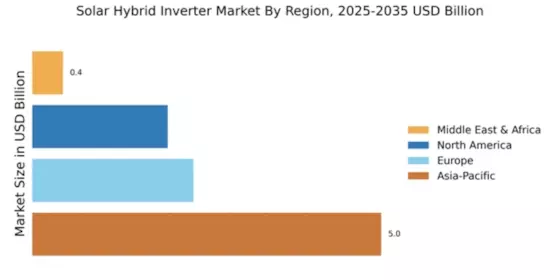
  • América del Norte sigue siendo el mercado más grande para inversores solares híbridos, lo que refleja una fuerte adopción de soluciones de energía renovable.
  • La región de Asia y el Pacífico se identifica como el mercado de más rápido crecimiento, impulsado por las crecientes necesidades energéticas y políticas gubernamentales de apoyo.
  • El segmento residencial continúa dominando el mercado, mientras que el segmento comercial está experimentando un rápido crecimiento debido al aumento de las iniciativas de eficiencia energética.
  • Los crecientes costos de la energía y los incentivos gubernamentales son factores clave que impulsan la expansión del mercado de inversores híbridos solares.

Tamaño del mercado y previsión

Tamaño del mercado en 2024 9.69 (USD Billion)
Tamaño del mercado en 2035 24.75 (USD Billion)
CAGR (2025 - 2035) 8.9%
Mayor cuota de mercado regional en 2024 Asia-Pacífico

Principales jugadores

Las principales empresas del mercado de inversores solares híbridos son SMA Solar Technology AG (DE), Fronius International GmbH (AT), SolarEdge Technologies Inc (IL),Energía Victron(NL), Huawei Technologies Co., Ltd. (CN), Schneider Electric SE (FR),Tigo Energía, Inc.(EE.UU.), Enphase Energy, Inc. (EE.UU.), Goodwe Power Supply Technology Co., Ltd. (CN)

Our Impact
Enabled $4.3B Revenue Impact for Fortune 500 and Leading Multinationals
Partnering with 2000+ Global Organizations Each Year
30K+ Citations by Top-Tier Firms in the Industry

Las empresas clave en el mercado Solar Hybrid Inverter Market incluyen

Alcance del informe

MARKET SIZE 2024 9.69(USD Billion)
MARKET SIZE 2025 10.55(USD Billion)
MARKET SIZE 2035 24.75(USD Billion)
COMPOUND ANNUAL GROWTH RATE (CAGR) 8.9% (2025 - 2035)
REPORT COVERAGE Revenue Forecast, Competitive Landscape, Growth Factors, and Trends
BASE YEAR 2024
Market Forecast Period 2025 - 2035
Historical Data 2019 - 2024
Market Forecast Units USD Billion
Key Companies Profiled SMA Solar Technology AG (DE), Fronius International GmbH (AT), SolarEdge Technologies Inc (IL), Victron Energy (NL), Huawei Technologies Co., Ltd. (CN), Schneider Electric SE (FR), Tigo Energy, Inc. (US), Enphase Energy, Inc. (US), Goodwe Power Supply Technology Co., Ltd. (CN)
Segments Covered Application, Technology, End Use
Key Market Opportunities Growing demand for renewable energy solutions drives innovation in the Solar Hybrid Inverter Market.
Key Market Dynamics Rising demand for renewable energy drives innovation and competition in the Solar Hybrid Inverter Market.
Countries Covered North America, Europe, APAC, South America, MEA

FAQs

What is the projected market valuation of the Solar Hybrid Inverter Market by 2035?

The Solar Hybrid Inverter Market is projected to reach a valuation of 24.75 USD Billion by 2035.

What was the market valuation of the Solar Hybrid Inverter Market in 2024?

In 2024, the overall market valuation was 9.69 USD Billion.

What is the expected CAGR for the Solar Hybrid Inverter Market during the forecast period 2025 - 2035?

The expected CAGR for the Solar Hybrid Inverter Market during the forecast period 2025 - 2035 is 8.9%.

Which application segment is projected to have the highest valuation by 2035?

The Utility application segment is projected to reach a valuation of 7.5 USD Billion by 2035.

What are the projected valuations for the Residential segment by 2035?

The Residential segment is projected to reach a valuation of 6.25 USD Billion by 2035.

Which technology type is expected to dominate the market by 2035?

The Grid-tied technology type is expected to dominate the market, projected to reach 9.75 USD Billion by 2035.

What is the projected valuation for the Off-grid segment by 2035?

The Off-grid segment is projected to reach a valuation of 3.63 USD Billion by 2035.

Who are the key players in the Solar Hybrid Inverter Market?

Key players in the market include SMA Solar Technology AG, Fronius International GmbH, and SolarEdge Technologies Inc.

What is the projected valuation for the Battery component type by 2035?

The Battery component type is projected to reach a valuation of 5.78 USD Billion by 2035.

What is the expected valuation for the Agricultural Sector end user by 2035?

The Agricultural Sector end user is expected to reach a valuation of 1.5 USD Billion by 2035.
Autor
Author
Author Profile
Priya Nagrale LinkedIn
Senior Research Analyst
With an experience of over five years in market research industry (Chemicals & Materials domain), I gather and analyze market data from diverse sources to produce results, which are then presented back to a client. Also, provide recommendations based on the findings. As a Senior Research Analyst, I perform quality checks (QC) for market estimations, QC for reports, and handle queries and work extensively on client customizations. Also, handle the responsibilities of client proposals, report planning, report finalization, and execution
Deja un comentario

Research Approach


Secondary Research

The secondary research process involved comprehensive analysis of regulatory databases, peer-reviewed engineering journals, technical publications, and authoritative energy organizations. Key sources included the International Energy Agency (IEA) World Energy Outlook, International Renewable Energy Agency (IRENA) Global Energy Transformation, Solar Power Europe Market Outlook, Solar Energy Industries Association (SEIA) U.S. Solar Market Insight, National Renewable Energy Laboratory (NREL) Technology Validation Studies, IEEE Xplore Digital Library for power electronics research, International Electrotechnical Commission (IEC) standards database, Underwriters Laboratories (UL) safety certifications, U.S. Department of Energy (DOE) Solar Energy Technologies Office, European Commission Directorate-General for Energy, China National Energy Administration (NEA), India Ministry of New and Renewable Energy (MNRE), and transmission system operator reports from key markets. These sources were used to collect installation capacity statistics, grid interconnection standards, efficiency benchmarking studies, policy incentive frameworks, and technology roadmap analysis for single-phase hybrid, three-phase hybrid, on-grid, and off-grid inverter systems.


Primary Research

To gather both qualitative and quantitative insights, supply-side and demand-side stakeholders were interviewed during the primary research phase. CEOs, VPs of product development, chief technology officers, and regional sales directors from solar inverter producers, power electronics original equipment manufacturers, and energy storage system integrators were examples of supply-side sources. Procurement managers from EPC contractors, project developers, utility-scale solar farm operators, commercial facility energy managers, residential solar installers, and microgrid system integrators were examples of demand-side sources. Primary research established product certification schedules, validated market segmentation across residential, commercial, and utility applications, and collected information on distributed generation economics, net metering policy impacts, and grid-tie integration patterns.

Primary Respondent Breakdown:

By Designation: C-level Primaries (28%), Director Level (32%), Others (40%)

By Region: North America (32%), Europe (29%), Asia-Pacific (34%), Rest of World (5%)


Market Size Estimation

Global market valuation was derived through shipment volume analysis and revenue mapping across power ratings. The methodology included:

Identification of 55+ key manufacturers across North America, Europe, Asia-Pacific, and Latin America

Product mapping across single-phase hybrid, three-phase hybrid, and modular inverter architectures

Analysis of reported and modeled annual revenues specific to hybrid inverter portfolios (excluding string and central inverter-only offerings)

Coverage of manufacturers representing 75-80% of global market share in 2024

Extrapolation using bottom-up (installation capacity × ASP by country/segment) and top-down (manufacturer revenue validation) approaches to derive segment-specific valuations for energy generation and solar energy storage applications

Descargar muestra gratis

Complete el formulario a continuación para recibir una muestra gratuita de este informe

Download PDF ×

We do not share your information with anyone. However, we may send you emails based on your report interest from time to time. You may contact us at any time to opt-out.