Marché du traitement de l'acné Résumé
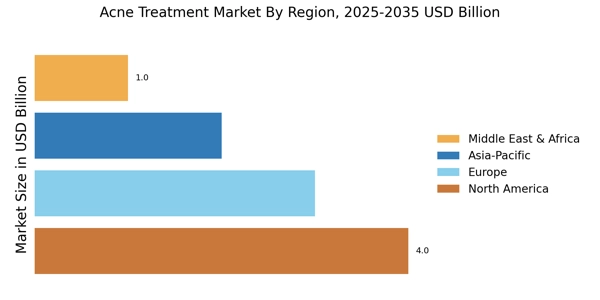
Selon l'analyse de Market Research Future, la taille du marché des traitements de l'acné était évaluée à 10,0 milliards USD en 2024 et le marché devrait croître de 10,53 milliards USD en 2025 à 17,72 milliards USD d'ici 2035, affichant un TCAC de 5,34 % pendant la période de prévision 2025–2035. L'Amérique du Nord a dominé le marché avec plus de 40 % de part, générant environ 4 milliards USD de revenus.
Le principal facteur de croissance du marché des traitements de l'acné est la prévalence croissante de l'acné dans le monde parmi les adolescents et les adultes, couplée à une sensibilisation accrue aux soins de la peau et à la demande de traitements efficaces, stimulant l'adoption de solutions topiques, orales et dermatologiques avancées dans le monde entier.
Selon l'Organisation mondiale de la santé, l'acné touche près de 85 % des adolescents dans le monde, tandis que l'Institut pour la santé métrique et l'évaluation rapporte que les maladies de la peau figurent parmi les 10 principales conditions mondiales, soutenant une forte demande pour les traitements de l'acné et une expansion continue du marché.
Principales tendances et faits saillants du marché
Le marché des traitements de l'acné connaît un changement transformateur vers des solutions personnalisées et naturelles, motivé par les avancées technologiques et l'évolution des préférences des consommateurs.
- L'Amérique du Nord est en tête avec 40 % de part, les États-Unis contribuant à 78 % en raison des dépenses élevées en dermatologie.
- Les traitements topiques dominent avec 63 % de part, tandis que les thérapies orales croissent rapidement en raison de l'augmentation des cas d'acné sévère dans le monde.
- Le segment féminin domine avec 65 % de part, tandis que le segment masculin s'élargit rapidement avec une prise de conscience croissante des soins de beauté et l'adoption des soins de la peau.
- Les pharmacies de détail détiennent 54 % de part, tandis que les canaux en ligne croissent le plus rapidement avec 31 % de part, soutenus par l'augmentation de la pénétration du commerce électronique.
Taille du marché et prévisions
| Taille du marché 2024 | 10,0 (milliards USD) |
| Taille du marché 2035 | 17,72 (milliards USD) |
| TCAC (2025 - 2035) | 5,34% |
Principaux acteurs
Des entreprises telles que Johnson & Johnson (États-Unis), Procter & Gamble (États-Unis), Galderma (Suisse), Bayer (Allemagne), Reckitt Benckiser (Royaume-Uni), Unilever (Royaume-Uni), L'Oréal (France), Estée Lauder (États-Unis), CeraVe (États-Unis) sont quelques-uns des principaux acteurs du marché mondial.