Par région, l'étude fournit des informations sur le marché en Amérique du Nord, en Europe, en Asie-Pacifique et dans le reste du monde. Le marché des fruits de mer congelés en Amérique du Nord a représenté 6 254,6055 millions USD en 2021 et devrait afficher une croissance de 42,90 % en termes de taux de croissance annuel composé (CAGR) pendant la période d'étude. Plusieurs facteurs pourraient influencer la performance de la région nord-américaine, tels que la disponibilité d'installations d'infrastructure de chaîne du froid avancées et innovantes. L'augmentation de la consommation de fruits de mer par rapport à la viande rouge devrait également stimuler la performance de la région à l'avenir.
De plus, les principaux pays étudiés dans le rapport de marché sont : les États-Unis, le Canada, l'Allemagne, la France, le Royaume-Uni, l'Italie, l'Espagne, la Chine, le Japon, l'Inde, l'Australie, la Corée du Sud et le Brésil.
Figure 3 : PART DE MARCHÉ DES FRUITS DE MER CONGELÉS PAR RÉGION 2021 (%)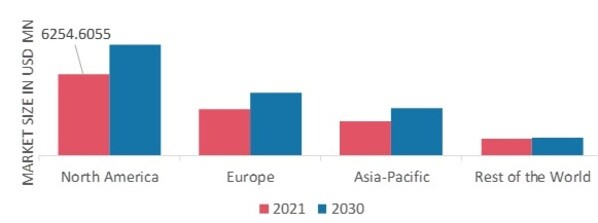 Source : Recherche secondaire, recherche primaire, Base de données de Market Research Future et revue d'analyste
Le marché des fruits de mer congelés en Amérique du Nord détient la plus grande part de marché. La tendance croissante des aliments prêts à cuire a alimenté la croissance du secteur du poisson congelé. Des canaux de distribution bien établis et l'essor des ventes en ligne contribuent fortement à la croissance du marché. La popularité croissante des préparations à base de poisson dans le secteur de la restauration propulse la croissance du marché régional. De plus, le marché américain des fruits de mer congelés a détenu la plus grande part de marché, car les acheteurs recherchent des options de repas pratiques, y compris des aliments congelés nécessitant peu ou pas de préparation pour surmonter les contraintes de temps liées au travail et à la garde d'enfants.
La dépendance croissante des acheteurs, en particulier des millennials, aux aliments prêts à cuire en raison des contraintes de temps devrait stimuler le marché. De plus, le marché des fruits de mer congelés au Canada était le marché à la croissance la plus rapide dans la région nord-américaine.
Le marché européen des fruits de mer congelés devrait croître au taux de croissance annuel composé (CAGR) le plus rapide de 2022 à 2030. L'Europe devrait afficher une croissance prometteuse en raison de l'augmentation de la consommation de poisson pour réduire le risque de maladies cardiaques. La popularité croissante des produits de poisson durables en Allemagne, au Royaume-Uni et en France devrait stimuler la demande de poisson congelé durable. De plus, le marché des fruits de mer congelés en Allemagne a détenu la plus grande part de marché, et l'industrie des fruits de mer congelés en Australie était le marché à la croissance la plus rapide dans la région Asie-Pacifique.
Par exemple, le marché des fruits de mer congelés en Australie est stimulé par plusieurs lancements de produits. En novembre 2022, Aldi Australie a lancé plusieurs nouveaux articles de fruits de mer congelés et a ramené les favoris des clients pour capitaliser sur l'approche de la saison de Noël.