Développement des infrastructures et urbanisation
Le développement des infrastructures et l'urbanisation influencent considérablement le marché de la location de puissance. À mesure que les zones urbaines s'étendent, la demande pour des projets de construction augmente, nécessitant des sources d'énergie fiables. Les solutions de location de puissance sont souvent préférées en raison de leur capacité à fournir une énergie immédiate sans les longs délais associés aux installations permanentes. Dans de nombreuses régions, des initiatives gouvernementales visant à améliorer les infrastructures sont en cours, propulsant encore davantage le besoin de solutions temporaires d'énergie. Le marché de la location de puissance est prêt à bénéficier de ces développements, car il offre des solutions énergétiques évolutives et efficaces adaptées aux exigences spécifiques des projets de construction et urbains. Cette tendance devrait contribuer à une augmentation régulière de la taille du marché, à mesure que de nouveaux projets émergent à l'échelle mondiale.
Innovations technologiques dans la production d'énergie
Les innovations technologiques redéfinissent le marché de la location de puissance, améliorant l'efficacité et la fiabilité de la production d'énergie. Les avancées dans la technologie des générateurs, telles que le développement de moteurs plus efficaces et de systèmes de surveillance intelligents, permettent aux entreprises de location d'offrir des produits supérieurs. Ces innovations améliorent non seulement l'efficacité énergétique, mais réduisent également les émissions, s'alignant sur l'accent croissant mis sur la durabilité. De plus, l'intégration de l'IoT et de l'analyse de données permet une surveillance en temps réel et une maintenance prédictive, garantissant des performances optimales des équipements de location. À mesure que ces technologies continuent d'évoluer, elles sont susceptibles d'attirer davantage de clients à la recherche de solutions énergétiques fiables et efficaces. Le marché de la location de puissance est donc positionné pour tirer parti de ces avancées, stimulant la croissance et améliorant les offres de services.
Demande croissante de solutions d'alimentation temporaire
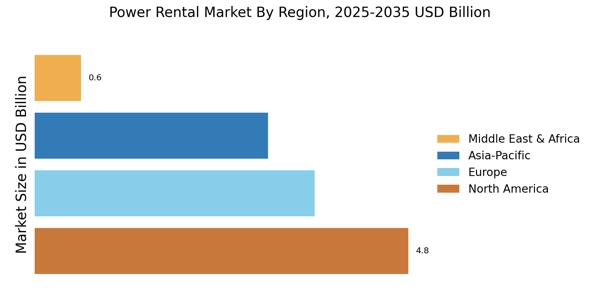
Le marché de la location de puissance connaît une forte augmentation de la demande pour des solutions de puissance temporaires dans divers secteurs. Des industries telles que la construction, les événements et les services d'urgence s'appuient de plus en plus sur la puissance de location pour répondre à leurs besoins énergétiques. Cette tendance est motivée par le besoin de flexibilité et de rentabilité, les entreprises préférant louer plutôt qu'acheter de l'équipement. En 2025, le marché devrait atteindre une valorisation d'environ 25 milliards USD, reflétant un taux de croissance annuel composé d'environ 6,5 %. Cette croissance indique un changement robuste vers des solutions de location, alors que les entreprises cherchent à optimiser l'efficacité opérationnelle tout en minimisant les dépenses en capital. Le marché de la location de puissance joue donc un rôle crucial dans la fourniture de solutions énergétiques fiables pendant les périodes de forte demande ou lors de pannes imprévues.
Expansion du secteur des événements et du divertissement
L'expansion du secteur des événements et du divertissement a un impact significatif sur le marché de la location de puissance. Avec un nombre croissant de festivals, de concerts et d'événements d'entreprise, la demande de solutions de puissance temporaires est en hausse. Les organisateurs d'événements nécessitent souvent une puissance substantielle pour l'éclairage, les systèmes sonores et d'autres équipements, ce qui rend les solutions de location attrayantes. La flexibilité et l'évolutivité de la puissance de location permettent aux planificateurs d'événements d'adapter leurs besoins énergétiques en fonction de la taille et de l'envergure de leurs événements. En 2025, le secteur des événements devrait contribuer une part considérable au marché global de la location de puissance, reflétant la nature dynamique de l'industrie. Le marché de la location de puissance joue donc un rôle vital dans le soutien du paysage événementiel dynamique, garantissant que les demandes énergétiques sont satisfaites de manière efficace et efficiente.
Concentration croissante sur la durabilité et les énergies renouvelables
Le marché de la location d'énergie est de plus en plus aligné avec les initiatives de durabilité et d'énergie renouvelable. Alors que les organisations s'efforcent de réduire leur empreinte carbone, il y a une préférence croissante pour des solutions de location qui intègrent des sources d'énergie plus propres. De nombreuses entreprises de location proposent désormais des options hybrides et d'énergie renouvelable, telles que le solaire et l'éolien, pour répondre aux demandes évolutives des clients soucieux de l'environnement. Ce changement soutient non seulement les objectifs de durabilité, mais renforce également l'attrait du marché pour un plus large éventail de clients. En 2025, on prévoit que la part de l'énergie renouvelable sur le marché de la location augmentera considérablement, reflétant une tendance plus large vers des pratiques durables dans tous les secteurs. Le marché de la location d'énergie se trouve donc à l'avant-garde de cette transition, fournissant des solutions innovantes qui s'alignent sur les objectifs mondiaux de durabilité.