Research Methodology on Smart Hospital Market
Introduction
Smart Hospital Market is becoming more and more significant in the healthcare industry due to its various advantages such as improved patient care, cost savings, and improved patient outcomes. It is a type of hospital management system which consists of a convergence of various technological developments and existing hospital systems that can further result in the monitoring and streamlining of the entire hospital or healthcare system. Smart hospitals are capable of integrating varying healthcare aspects and dealing with technical operations, patient care management, automated drug delivery systems, security systems, information management systems, data analysis and many more.
The smart hospital market is driven by various factors such as increasing demand for automated solutions in hospitals, the widespread acceptance of healthcare technology and the emergence of the healthcare internet of things (HIoT) and big data & analytics. However, the lack of standard policies for deploying innovations in healthcare institutions and the high costs associated with the installation of new solutions may restrain market growth.
Research Objectives
The fundamental objectives of this research are:
- To analyze and estimate the size of the global Smart Hospital Market in terms of value and volume.
- To identify the driving factors, restraints, and challenges faced by the market.
- To analyze the competitive scenario in the market.
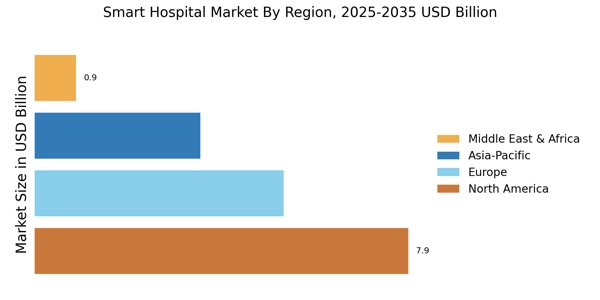
- To identify the regional market trends and opportunities.
- To assess the impact of technology, regulations, and government policies on the Smart Hospital Market
Research Methodology
This research is based on an in-depth market study of the Smart Hospital Market, which consists of various methodologies such as primary and secondary research. Primary and secondary research was used to identify the qualitative and quantitative information, understand the key trends, and major segments and identify the unmet needs in the Smart Hospital Market. Primary research data was collected from interviews conducted with experts in the Smart Hospital Market. These experts serve as external consultants for various industry manufacturers and domain experts. Secondary research was conducted through various sources such as company websites, industry databases, and paid databases. The ER&D (Expert Referrals and Database) was used to identify and collect information useful for this comprehensive market-oriented study on the Smart Hospital Market.
Primary Research
Primary research is conducted to enhance the quality and validity of the collected secondary data. Primary research helps report authors gain an in-depth knowledge of the market and an understanding of the patients and end-users. Primary research transformed data into efficient and insightful market intelligence. A bottom-up approach was used to estimate the market share of each segment and subsequently, the global smart hospital market. Primary surveys were conducted in order to understand the trends and developments in the market. Primary contacts included C-level executives, and industry experts and based on the contacts provided by our industry experts.
Secondary Research
Secondary research was conducted to understand the market attractiveness and identify the key players in the Smart Hospital Market. Secondary sources such as white papers, company annual reports, statistical databases, paid databases, journals and magazines were used for this research. The authors of this report conducted extensive secondary research to understand the market insights and trends, in the global Smart Hospital Market.
Data Analysis
These primary and secondary data were compiled and their relevance was observed. Data normalization and outlier analysis were included to gain insight into the market. Systematic data collection, validation and many other key data points were included in the analysis. The authors analyzed the data using a multitude of tools and techniques. Statistical analysis including mean and median adoption rates and population Indexes have been used to determine the market size. Market estimates were calculated using top-down and bottom-up approaches. Detailed market research by analyzing the data from various sources was conducted in order to identify the market trends.
Conclusion
The analysis revealed that the smart hospital market is growing at a significant rate due to the increasing demand for integrated and automated solutions in hospitals, the widespread acceptance of healthcare technology and the emergence of healthcare internet of things (HIoT) and big data & analytics. The growth of smart hospitals has enabled faster and more efficient patient care, cost savings, and improved patient outcomes. Various factors such as the increasing use of healthcare technology, rising adoption of the healthcare internet of things and big data & analytics, and increasing investment in healthcare IT solutions are driving the growth of the market. Additionally, the emergence of new technologies such as AI and machine learning, the ever-growing data, and the shift to value-based care are the major factors necessary which are expected to boost the growth of the market from 2023 to 2030.