無料サンプルをダウンロード
このレポートの無料サンプルを受け取るには、以下のフォームにご記入ください
アメリカの病院用ベッド市場のタイプ別(除圧ベッド、汎用ベッド、その他)、自動化(手動、その他)、治療(長期介護およびその他)、エンドユーザー(病院および診療所、高齢者介護、その他)別の分析。 2032 年までの予測
market summary
| 2024 Market Size | 1470.0 (USD Million) |
| 2035 Market Size | 2710.55 (USD Million) |
| CAGR (2025 - 2035) | 5.72% |
major players
Our Impact
Enabled $4.3B Revenue Impact for Fortune 500 and Leading Multinationals
Partnering with 2000+ Global Organizations Each Year
30K+ Citations by Top-Tier Firms in the Industry
The aging population in North America is a crucial driver for the hospital bed market. As the demographic shifts towards an older age group, the demand for healthcare services, including hospital beds, is expected to rise significantly. By 2030, it is projected that approximately 20% of the population will be aged 65 and older, leading to an increased need for hospital beds tailored to geriatric care. This demographic trend indicates a growing requirement for specialized hospital beds that cater to the unique needs of elderly patients, such as adjustable features and enhanced comfort. Consequently, the hospital bed market is likely to experience substantial growth as healthcare facilities adapt to accommodate this demographic shift.
Technological advancements play a pivotal role in shaping the hospital bed market. Innovations such as smart beds equipped with sensors and monitoring systems are becoming increasingly prevalent. These beds can track patient vitals, adjust positions automatically, and enhance overall patient care. The integration of technology not only improves patient outcomes but also streamlines hospital operations. In 2025, it is estimated that the market for smart hospital beds could reach $1.5 billion in North America alone. This surge in demand for technologically advanced hospital beds indicates a shift towards more efficient and effective healthcare delivery, thereby driving the growth of the hospital bed market.
Rising healthcare expenditure in North America is a significant driver for the hospital bed market. With healthcare spending projected to reach $4.3 trillion by 2025, hospitals are increasingly investing in modern infrastructure, including advanced hospital beds. This financial commitment reflects a broader trend towards enhancing patient care and improving hospital efficiency. As healthcare facilities allocate more resources to upgrade their equipment, the demand for high-quality hospital beds is expected to rise. This trend suggests that the hospital bed market will continue to expand, driven by the need for improved patient experiences and outcomes.
An increased focus on patient safety is emerging as a vital driver in the hospital bed market. Hospitals are prioritizing the implementation of safety features in hospital beds to reduce the risk of falls and enhance patient comfort. Features such as bed alarms, side rails, and pressure-relieving mattresses are becoming standard in modern hospital beds. This emphasis on safety is likely to influence purchasing decisions, as healthcare providers seek to minimize liability and improve patient satisfaction. As a result, the hospital bed market is expected to grow, reflecting the industry's commitment to ensuring patient safety and well-being.
Regulatory compliance and standards are critical drivers influencing the hospital bed market. In North America, healthcare facilities must adhere to stringent regulations regarding equipment safety and quality. Compliance with these standards necessitates the procurement of hospital beds that meet specific safety and performance criteria. As regulations evolve, hospitals are compelled to upgrade their equipment to maintain compliance, thereby driving demand for new hospital beds. This trend indicates that the hospital bed market will likely experience growth as healthcare providers invest in compliant and high-quality products to meet regulatory requirements.
In the hospital bed market, the type segment is led by Acute Care, which holds the largest share, driven by the high demand for immediate and intensive treatment services. Following this, Long-Term Care and Psychiatric & Bariatric Care serve specialized patient needs, contributing significantly to the overall market dynamics. Others, while smaller, showcase emerging applications that still add value to healthcare models. Growth trends indicate a strong increase in the demand for Psychiatric & Bariatric Care, positioning it as the fastest-growing segment. Advances in technology and awareness about mental health are stimulating this market's expansion. Additionally, population demographics and increasing chronic conditions are pushing the need for Long-Term Care, ensuring that all types continue to evolve to meet patient requirements.
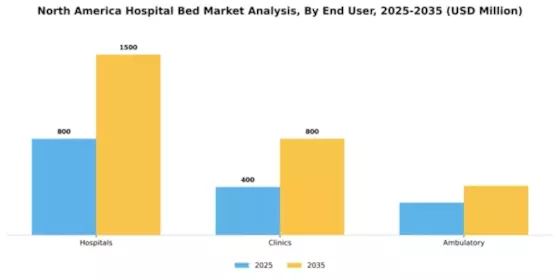
Acute Care (Dominant) vs. Psychiatric & Bariatric Care (Emerging)
The Acute Care segment is characterized by its focus on short-term treatment environments, catering to patients with severe conditions that require immediate medical attention. This segment thrives in settings like emergency rooms and intensive care units, where advanced medical equipment is essential. In contrast, the Psychiatric & Bariatric Care segment is rapidly emerging due to rising awareness of mental health issues and obesity management. This segment emphasizes patient-centered approaches and is increasingly integrated into hospital services, leveraging specialized beds designed for comfort and safety during treatment.
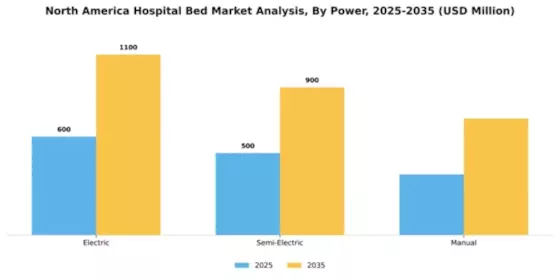
In the North America hospital bed market, the power segment demonstrates a clear distribution of market share among its key types. Electric hospital beds have established themselves as the largest segment, leading the preference among healthcare facilities due to their ease of use and enhanced features. Conversely, while semi-electric beds hold a smaller share, their origin as a more affordable alternative continues to resonate with budget-conscious hospitals, contributing to varying adoption rates across different facility types. Growth trends within the power segment are primarily driven by technological advancements and increased demand for patient-centric care. Electric beds are becoming indispensable in hospital settings, characterized by advanced functionalities such as adjustable features and integrated monitoring systems. Meanwhile, semi-electric beds are increasingly recognized as reliable, cost-effective options, particularly in smaller hospitals, balancing functionality with budget constraints. The overall demand for operational efficiency and patient comfort is bolstering growth across these power segments.
Electric (Dominant) vs. Semi-Electric (Emerging)
Electric hospital beds are characterized by their motorized controls, enabling easy height and position adjustments, thereby significantly enhancing patient comfort and nursing efficiency. Their dominance in the North America market stems from their advanced features, including integrated safety mechanisms and improved patient outcomes. On the other hand, semi-electric beds are emerging as a practical choice for facilities that seek to maintain functionality at lower costs. Featuring manual crank systems alongside motorized adjustments, they offer a blend of affordability and adaptability, ensuring they remain appealing to a diverse range of healthcare providers. As hospitals balance budget constraints with the need for high-quality care, both segments are likely to see sustained interest.
In the End User segment of the market, hospitals hold the largest share, reflecting their dominant presence in healthcare delivery. This is attributed to the increasing need for advanced healthcare facilities and the rising number of hospital admissions, which necessitate the availability of a variety of hospital beds to accommodate diverse patient needs. Clinics, while smaller in share, are rapidly growing as outpatient services rise, emphasizing their importance in the overall market landscape. Growth trends in this segment are primarily driven by technological advancements in bed design and functionality, which enhance patient care and safety. Additionally, the increasing prevalence of chronic diseases necessitates more frequent admissions to hospitals, further solidifying their market position. Conversely, clinics are evolving with a focus on providing accessible care, leading to an uptick in demand for specialized ambulatory beds that cater to specific outpatient surgeries and procedures.
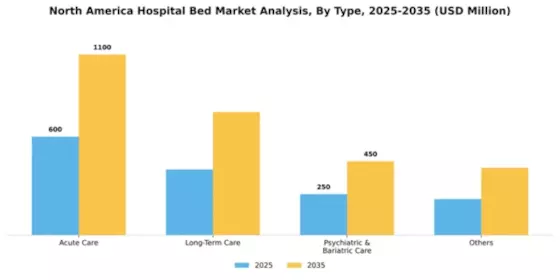
Hospitals: Dominant vs. Clinics: Emerging
Hospitals represent the dominant force in the End User segment, characterized by a wide-ranging selection of hospital beds designed to cater to varied patient requirements, from intensive care to general ward use. Their comprehensive facilities enable them to offer specialized care, which is essential for improving patient outcomes. In contrast, clinics are emerging as significant players, adapting to the growing trend of outpatient care and surgical procedures. They are increasingly investing in specialized beds that facilitate short-stay and recovery processes, which enhance patient comfort and operational efficiency. This evolution in clinics showcases a shift towards a more patient-centered approach in care delivery, thereby carving out their role in the competitive landscape.
Americas Hospital Bed Marketに関する詳細な洞察を得る 無料サンプルを請求する


The market valuation was $1470.0 Million in 2024.
The projected valuation for 2035 is $2710.55 Million.
The expected CAGR during this period is 5.72%.
Types include Electric ($600.0 - $1100.0 Million), Semi-Electric ($500.0 - $900.0 Million), and Manual ($370.0 - $710.55 Million).
Key players include Hill-Rom, Stryker, Invacare, Arjo, Getinge, Medline Industries, Graham-Field, Linet, and Karma Healthcare.
End-user segments include Hospitals ($800.0 - $1500.0 Million), Clinics ($400.0 - $800.0 Million), and Ambulatory ($270.0 - $410.55 Million).
While specific comparisons are not provided, the North America market is characterized by strong growth and significant investments from key players.
Growth appears driven by advancements in technology, increasing healthcare demands, and the expansion of healthcare facilities.
While specific forecasts beyond 2035 are not available, continued growth is likely given the current trends and market dynamics.





このレポートの無料サンプルを受け取るには、以下のフォームにご記入ください

“This is really good guys. Excellent work on a tight deadline. I will continue to use you going forward and recommend you to others. Nice job”


“Thanks. It’s been a pleasure working with you, please use me as reference with any other Intel employees.”


“Thanks for sending the report it gives us a good global view of the Betaïne market.”


“Thank you, this will be very helpful for OQS.”


“We found the report very insightful! we found your research firm very helpful. I'm sending this email to secure our future business.”


“I am very pleased with how market segments have been defined in a relevant way for my purposes (such as "Portable Freezers & refrigerators" and "last-mile"). In general the report is well structured. Thanks very much for your efforts.”


“I have been reading the first document or the study, ,the Global HVAC and FP market report 2021 till 2026. Must say, good info! I have not gone in depth at all parts, but got a good indication of the data inside!”


“We got the report in time, we really thank you for your support in this process. I also thank to all of your team as they did a great job.”


“The Automotive 48V ECU Components Procurement Intelligence Study” was a complex project, but the Market Research Future (MRFR) team handled it with quality, agility, and customer-centricity. They delivered all requested data on time and within the agreed scope. The team, including Shubhendra Anand and Rahul Gotadki, was always readily available to clarify questions and swiftly implement necessary adjustments, driving the project to a successful conclusion within a very demanding timeframe.
I would also like to specifically commend Akshay Agarwal for his responsiveness and support at every stage—from our initial inquiry on May 6th through to final delivery on June 18th. His dedication made the entire process seamless.”



