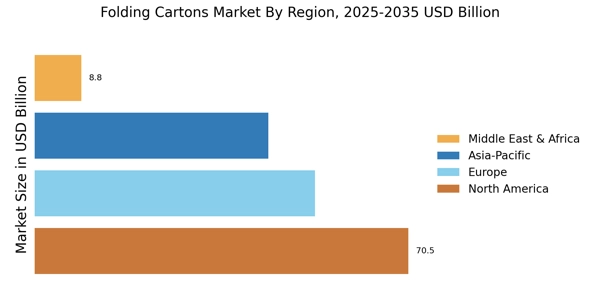
Qualitative and quantitative insights were obtained by interviewing supply-side and demand-side stakeholders during the primary research process. The supply-side sources consisted of CEOs, VPs of Manufacturing & Operations, procurement leaders for pulp/paperboard, and innovation directors from integrated paperboard mills, folding carton converters, and packaging equipment manufacturers. Sustainability officers, procurement directors, and packaging engineers from major food and beverage manufacturers (confectionery, dairy, ready-to-eat meals), pharmaceutical and healthcare product companies, personal care and cosmetics brands, and retail and e-commerce fulfillment centers comprised demand-side sources. Market segmentation was validated across carton styles (Standard Straight Tuck, Airplane Style, etc.) through primary research. Pricing dynamics for virgin versus recycled fiberboard were confirmed, and insights regarding sustainability mandates, barrier coating technologies (aqueous, PE, PLA), and supply chain optimization strategies were sourced.
Primary Respondent Breakdown:
By Designation: C-level Primaries (40%), Director Level (30%), Others (30%)
By Region: North America (32%), Europe (30%), Asia-Pacific (28%), Rest of World (10%)
Global market valuation was derived through production volume analysis and revenue mapping across the value chain from pulp mills to converted cartons. The methodology included:
Identification of 60+ key manufacturers and converters across North America, Europe, Asia-Pacific, Latin America, and Middle East & Africa
Product mapping across solid bleached sulfate (SBS), coated unbleached kraft (CUK), coated recycled board (CRB), biopolymer-based boards, and liquid packaging boards
Analysis of reported and modeled annual revenues specific to folding carton product portfolios, including sustainable/recyclable variants and smart packaging integrations
Coverage of integrated producers (mill-to-converter) and independent converters representing 75-80% of global market share in 2024
Extrapolation using bottom-up (carton production volume × average selling price by end-use industry and region) and top-down (manufacturer revenue validation) approaches to derive segment-specific valuations for food & beverage, healthcare, personal care, and electronics packaging verticals