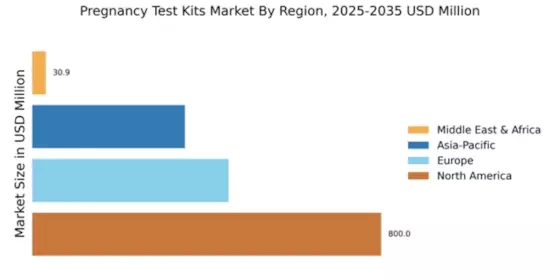
In order to gather both qualitative and quantitative insights, supply-side and demand-side stakeholders were interviewed during the primary research process. CEOs, VPs of Product Development, heads of regulatory affairs, R&D directors, and commercial directors from makers of pregnancy test kits, OEMs of diagnostic devices, and contract manufacturers were examples of supply-side sources. Obstetricians and gynecologists, reproductive endocrinologists, clinical laboratory directors, pharmacy chain procurement managers, retail merchandising executives, administrators of fertility clinics, and medical directors of telemedicine platforms were among the demand-side sources. In addition to gathering information on clinical adoption patterns, pricing tactics, retail distribution dynamics, and consumer purchasing behavior across home-use and clinical contexts, primary research validated market segmentation and corroborated product pipeline deadlines.
Primary Respondent Breakdown:
By Designation: C-level Primaries (28%), Director Level (32%), Others (40%)
By Region: North America (32%), Europe (30%), Asia-Pacific (28%), Rest of World (10%)
Global market valuation was derived through revenue mapping and test kit volume analysis. The methodology included:
Identification of 35+ key manufacturers across North America, Europe, Asia-Pacific, and Latin America
Product mapping across digital pregnancy test devices, analog/line indicator tests (strips, cassettes, mid-stream devices), blood hCG tests, and other detection technologies
Analysis of reported and modeled annual revenues specific to pregnancy test kit portfolios
Coverage of manufacturers representing 75-80% of global market share in 2024
Extrapolation using bottom-up (test kit volume × ASP by country/region) and top-down (manufacturer revenue validation) approaches to derive segment-specific valuations across home-use, clinical-use, and laboratory-use applications