×
Request Free Sample ×

Kindly complete the form below to receive a free sample of this Report

* Please use a valid business email

Leading companies partner with us for data-driven Insights

clients tt-cursor
Hero Background

Non Residential Green Building Market

ID: MRFR/PCM/38170-HCR
100 Pages
Pradeep Nandi
October 2025

Non-Residential Green Building Market Research Report: By Building Type (Office Buildings, Retail Buildings, Educational Institutions, Healthcare Facilities, Hospitality Buildings), By Construction Type (New Construction, Renovation, Retrofitting), By Material Type (Sustainable Materials, Recycled Materials, Natural Materials, Low-Emitting Materials), By Certification (LEED, BREEAM, Green Globes, Energy Star) and By Regional (North America, Europe, South America, Asia Pacific, Middle East and Africa) - Forecast to 2035.

공유
Download PDF ×

We do not share your information with anyone. However, we may send you emails based on your report interest from time to time. You may contact us at any time to opt-out.

Non Residential Green Building Market  Infographic
Purchase Options

Non Residential Green Building Market 요약

As per MRFR analysis, the Non-Residential Green Building Market Size was estimated at 3.306 USD Billion in 2024. The Non-Residential Green Building industry is projected to grow from 3.555 in 2025 to 7.341 by 2035, exhibiting a compound annual growth rate (CAGR) of 7.52 during the forecast period 2025 - 2035.

주요 시장 동향 및 하이라이트

The Non-Residential Green Building Market is experiencing robust growth driven by sustainability initiatives and regulatory support.

  • The market is witnessing an increased adoption of renewable energy sources, particularly in North America.
  • There is a growing emphasis on indoor environmental quality, especially within office buildings, which represent the largest segment.
  • Sustainable materials and circular economy practices are becoming integral to new construction projects, which dominate the market.
  • Regulatory support and incentives, alongside rising energy costs, are key drivers propelling the growth of retail buildings in the Asia-Pacific region.

시장 규모 및 예측

2024 Market Size 3.306 (USD Billion)
2035 Market Size 7.341 (억 달러)
CAGR (2025 - 2035) 7.52%

주요 기업

존슨 컨트롤스 (미국), 슈나이더 일렉트릭 (프랑스), 지멘스 (독일), 하니웰 (미국), 트레인 테크놀로지스 (아일랜드), 캐리어 글로벌 (미국), AECOM (미국), 플루어 코퍼레이션 (미국), 발포 비티 (영국), 스칸스카 (스웨덴)

Non Residential Green Building Market 동향

The Non-Residential Green Building Market is currently experiencing a transformative phase, driven by an increasing awareness of environmental sustainability and energy efficiency. Stakeholders across various sectors are recognizing the necessity of adopting eco-friendly practices in construction and building management. This shift is not merely a trend but appears to be a fundamental change in how buildings are designed, constructed, and operated. The integration of sustainable materials, energy-efficient systems, and innovative technologies is becoming commonplace, reflecting a broader commitment to reducing carbon footprints and enhancing occupant well-being. Moreover, regulatory frameworks and incentives from governments are likely to further propel the growth of this market. As policies increasingly favor sustainable practices, businesses are compelled to align with these standards to remain competitive. The emphasis on resilience and adaptability in building design suggests that the Non-Residential Green Building Market is poised for continued expansion. This evolution may also lead to enhanced collaboration among architects, engineers, and contractors, fostering a more integrated approach to sustainable development. Overall, the market is on a trajectory that indicates a promising future, characterized by innovation and a collective effort towards sustainability.

Increased Adoption of Renewable Energy Sources

The Non-Residential Green Building Market is witnessing a notable shift towards the incorporation of renewable energy technologies. This trend reflects a growing commitment to reducing reliance on fossil fuels and minimizing greenhouse gas emissions. Solar panels, wind turbines, and geothermal systems are increasingly being integrated into building designs, enhancing energy independence and operational efficiency.

Focus on Indoor Environmental Quality

There is a rising emphasis on improving indoor environmental quality within non-residential buildings. This trend encompasses better air quality, natural lighting, and thermal comfort, which are essential for occupant health and productivity. As organizations recognize the link between a healthy work environment and employee performance, investments in these areas are likely to increase.

Sustainable Materials and Circular Economy Practices

The use of sustainable materials is becoming a hallmark of the Non-Residential Green Building Market. This trend is complemented by the adoption of circular economy principles, which prioritize resource efficiency and waste reduction. By utilizing recycled and locally sourced materials, businesses are not only minimizing their environmental impact but also enhancing the overall sustainability of their projects.

Non Residential Green Building Market Treiber

기술 발전

Technological innovations are playing a pivotal role in shaping the Non-Residential Green Building Market. The emergence of smart building technologies, such as IoT sensors and energy management systems, is enhancing the efficiency and sustainability of non-residential structures. These technologies enable real-time monitoring of energy usage, allowing for more informed decision-making regarding resource allocation. Furthermore, advancements in building materials, such as high-performance insulation and energy-efficient windows, are contributing to the overall sustainability of new constructions. As these technologies become more accessible and affordable, they are likely to drive further adoption of green building practices, thereby expanding the Non-Residential Green Building Market.

상승하는 에너지 비용

The escalating costs of energy are compelling businesses to seek more efficient building solutions, thereby propelling the Non-Residential Green Building Market forward. As energy prices continue to rise, organizations are increasingly recognizing the long-term financial benefits of investing in energy-efficient buildings. According to recent data, energy-efficient buildings can reduce energy consumption by up to 30% compared to traditional structures. This reduction not only lowers operational costs but also enhances the overall value of the property. Consequently, the demand for green building technologies and practices is likely to increase, as companies aim to mitigate the impact of rising energy expenses on their bottom lines within the Non-Residential Green Building Market.

규제 지원 및 인센티브

The Non-Residential Green Building Market is experiencing a surge in regulatory support and incentives aimed at promoting sustainable construction practices. Governments are increasingly implementing policies that encourage the adoption of green building standards, such as LEED and BREEAM. These regulations often come with financial incentives, including tax credits and grants, which can significantly reduce the initial costs associated with green building projects. For instance, in certain regions, buildings that meet specific energy efficiency criteria may qualify for reduced property taxes. This regulatory environment not only fosters innovation but also enhances the market's attractiveness to investors and developers, thereby driving growth in the Non-Residential Green Building Market.

기업 지속 가능성 목표

Many corporations are establishing ambitious sustainability goals, which are significantly influencing the Non-Residential Green Building Market. As stakeholders demand greater accountability regarding environmental impact, businesses are increasingly committing to sustainable practices, including the construction of green buildings. A recent survey indicated that over 70% of large corporations have set targets for reducing their carbon footprints, which often includes investing in green building initiatives. This trend not only reflects a shift in corporate responsibility but also creates a robust market for green building materials and technologies. As companies strive to align their operations with sustainability objectives, the Non-Residential Green Building Market is poised for substantial growth.

환경 영향에 대한 인식 증가

There is a growing awareness of the environmental impact of construction practices, which is significantly influencing the Non-Residential Green Building Market. As climate change becomes an increasingly pressing issue, both consumers and businesses are prioritizing sustainability in their decision-making processes. This heightened awareness is leading to a demand for buildings that minimize ecological footprints and promote energy efficiency. Research indicates that buildings designed with sustainable practices can reduce greenhouse gas emissions by a substantial margin. Consequently, this shift in consumer preferences is driving the market towards greener alternatives, as stakeholders seek to align their operations with environmentally responsible practices within the Non-Residential Green Building Market.

시장 세그먼트 통찰력

By Building Type: Office Buildings (Largest) vs. Retail Buildings (Fastest-Growing)

The non-residential green building market showcases a varied distribution across different building types. Office buildings hold the largest share, reflecting their increasing adoption of sustainable practices amid rising environmental consciousness. In contrast, retail buildings represent a rapidly growing segment, driven by changing consumer preferences and the need for energy-efficient spaces that enhance the shopping experience. The growth trends within this segment indicate a strong shift towards sustainability. Office buildings continue to invest heavily in green certifications and eco-friendly designs, while retail buildings are evolving to incorporate features such as solar panels and energy-efficient lighting. This trend is fuelled by both regulatory pressures and consumer demand for greener choices, positioning these segments for continued expansion in the years ahead.

Office Buildings (Dominant) vs. Healthcare Facilities (Emerging)

Office buildings stand out as the dominant force in the non-residential green building market, characterized by extensive investments in sustainable infrastructure and technologies. Their familiarity with green certifications like LEED ensures a strong foundation for continued growth. Meanwhile, healthcare facilities represent an emerging segment, gaining traction due to increased awareness of environmental health impacts on patient outcomes. The push for improved air quality, energy efficiency, and sustainable materials in healthcare construction is reshaping this sector. While office buildings showcase their status through proven green implementations, healthcare facilities are beginning to carve out their niche, driven by the intersection of sustainability and health.

By Construction Type: New Construction (Largest) vs. Renovation (Fastest-Growing)

In the Non-Residential Green Building Market, the construction type segment showcases varying market shares across new construction, renovation, and retrofitting. New construction currently holds the largest share, driven by increased investments in sustainable building practices and technologies. This segment benefits from favorable government policies and a growing emphasis on energy efficiency, making it a hub of activity for developers seeking to meet the rising demand for environmentally conscious projects. On the other hand, renovation is rapidly emerging as the fastest-growing segment. Many businesses are opting for retrofitting existing structures to meet green building standards, as it often proves more cost-effective and sustainable compared to new constructions. The need to upgrade aging facilities and comply with stringent environmental regulations is accelerating this trend, creating new opportunities for construction firms specializing in green renovations.

신축 (주도적) 대 리노베이션 (신흥)

New construction in the Non-Residential Green Building Market represents a dominant approach, encompassing the establishment of completely new structures designed to meet environmental guidelines from inception. This segment attracts considerable investment as developers emphasize designs that leverage renewable materials and energy-efficient technologies. By contrast, renovation has emerged as a significant player, focusing on updating and improving existing buildings to enhance their sustainability. This process not only involves making structural changes but also adapting current facilities with innovative systems to reduce energy consumption. While new construction is pivotal for laying the groundwork for sustainable growth, renovation is critical for breathing new life into older structures, ensuring that sustainability measures can be implemented without the need for entirely new builds.

By Material Type: Sustainable Materials (Largest) vs. Recycled Materials (Fastest-Growing)

The 'Non-Residential Green Building Market' showcases a dynamic landscape characterized by a variety of material types. Sustainable Materials command the largest market share, as they encompass a broad range of eco-friendly options that meet stringent regulations and consumer demand for environmentally responsible construction practices. In contrast, Recycled Materials are emerging as a fast-growing segment, driven by heightened awareness of waste management and circular economy principles. Growth trends in the Non-Residential Green Building Market are increasingly favoring the adoption of Recycled Materials, fueled by advancements in recycling technologies and a strong push for sustainability by both regulatory bodies and consumers. Natural Materials and Low-Emitting Materials also play a pivotal role, particularly as stakeholders aim for healthier indoor environments and reduced carbon footprints, contributing to a robust market trajectory over the coming years.

Sustainable Materials (Dominant) vs. Low-Emitting Materials (Emerging)

In the Non-Residential Green Building Market, Sustainable Materials are seen as the dominant force, offering benefits such as energy efficiency, reduced environmental impact, and compliance with green building certifications. This segment includes products like bamboo, reclaimed wood, and bio-based materials, which not only enhance the aesthetic appeal of buildings but also contribute to their overall sustainability. On the other hand, Low-Emitting Materials emerge as a key segment, reflecting the industry's focus on indoor air quality. These materials are designed to minimize the release of volatile organic compounds (VOCs), thus ensuring healthier spaces for occupants. As more projects prioritize the well-being of their users alongside sustainability, Low-Emitting Materials are gaining traction among architects and builders, becoming an essential component of modern green building practices.

By Certification: LEED (Largest) vs. BREEAM (Fastest-Growing)

In the Non-Residential Green Building Market, the certification segment is primarily dominated by LEED, which holds the largest share. Following LEED, BREEAM is positioned as a significant player, with a promising share and fast-paced growth. Green Globes and Energy Star also contribute to the market, albeit with smaller shares compared to the leading certifications. The distribution reflects a preference for recognized green standards, showcasing the competitive landscape among these certifications.

LEED (Dominant) vs. BREEAM (Emerging)

LEED, developed by the U.S. Green Building Council, stands as the dominant certification in the Non-Residential Green Building Market. Its rigorous requirements and global recognition have established a strong foothold, leading many projects to seek LEED certification to enhance sustainability and marketability. BREEAM, originating in the UK, is emerging rapidly, appealing to international markets with its adaptable frameworks and emphasis on sustainability. While LEED continues to be a benchmark for green building, BREEAM's innovative approaches and increasing acceptance across various regions position it as a formidable contender in the market.

Non Residential Green Building Market 에 대한 더 자세한 통찰력 얻기

지역 통찰력

North America : Sustainable Innovation Leader

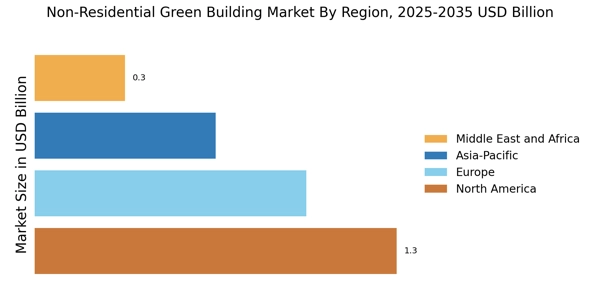
North America is the largest market for non-residential green buildings, holding approximately 40% of the global market share. Key growth drivers include stringent building codes, increasing energy efficiency standards, and a growing emphasis on sustainability among corporations. The demand for green buildings is further fueled by government incentives and funding for eco-friendly construction projects, particularly in urban areas. The United States and Canada are the leading countries in this region, with significant investments from major players like Johnson Controls and Honeywell. The competitive landscape is characterized by a mix of established firms and innovative startups, all vying to meet the rising demand for sustainable building solutions. The presence of key players ensures a robust market environment, fostering advancements in green technologies and practices.

Europe : Regulatory Framework Strength

Europe is the second-largest market for non-residential green buildings, accounting for approximately 30% of the global market share. The region's growth is primarily driven by stringent EU regulations aimed at reducing carbon emissions and promoting energy efficiency. Initiatives like the European Green Deal and various national policies are catalyzing investments in sustainable construction, making green buildings a priority for many governments. Leading countries in this market include Germany, France, and the UK, where companies like Schneider Electric and Siemens are making significant contributions. The competitive landscape is marked by a strong presence of both local and international firms, all focused on innovative solutions to meet regulatory demands. The emphasis on sustainability is reshaping the construction industry, leading to a surge in green building projects across the continent.

Asia-Pacific : Emerging Market Potential

Asia-Pacific is witnessing rapid growth in the non-residential green building market, holding approximately 20% of the global market share. The region's expansion is driven by urbanization, increasing energy demands, and government initiatives promoting sustainable development. Countries like China and India are leading the charge, with significant investments in green infrastructure and smart city projects, supported by favorable policies and incentives. China is the largest market in this region, followed by India, where key players like Trane Technologies and Carrier Global are actively involved. The competitive landscape is evolving, with both domestic and international firms competing to capture market share. The focus on sustainability is reshaping construction practices, leading to innovative solutions that address environmental concerns while meeting the needs of rapidly growing urban populations.

Middle East and Africa : Resource-Rich Opportunities

The Middle East and Africa region is emerging as a significant player in the non-residential green building market, accounting for approximately 10% of the global market share. The growth is driven by increasing investments in infrastructure, urban development, and a growing awareness of sustainability. Countries like the UAE and South Africa are at the forefront, implementing green building standards and regulations to promote eco-friendly construction practices. The competitive landscape features a mix of local and international firms, with key players like AECOM and Balfour Beatty leading the charge. The region's unique challenges, such as resource scarcity and climate change, are prompting innovative solutions in green building design and construction. As governments prioritize sustainable development, the market is poised for significant growth in the coming years.

Non Residential Green Building Market  Regional Image

주요 기업 및 경쟁 통찰력

The Non-Residential Green Building Market is increasingly becoming a focal point for innovation and sustainability as environmental concerns mount alongside urbanization and infrastructure development. This market encompasses a wide range of building types and construction practices aimed at reducing energy consumption, minimizing waste, and promoting sustainable materials. As regulations tighten and the emphasis on corporate social responsibility widens, companies are compelled to adopt eco-friendly practices and technologies. 

Competitive dynamics are shifting as traditional building practices encounter disruption from solutions tailored for energy efficiency, sustainability, and regulatory compliance. Players in this space are not only competing on innovation and design but also on their ability to deliver reliable, efficient and environmentally friendly solutions, which are essential for gaining market share. The high demand for green building materials and technologies reflects an overall trend toward sustainable development, prompting companies to enhance their offerings and strategic positioning.United Technologies has made significant strides in the Non-Residential Green Building Market, leveraging its diverse portfolio and advanced technology solutions.

The company’s strength lies in its commitment to innovation and sustainability, positioning itself as a leader in building technologies that prioritize energy efficiency and reduced carbon footprints. United Technologies focuses on integrating smart building systems, which seamlessly enhance operational performance while minimizing environmental impacts. 

The company's extensive research and development initiatives underline its proactive approach to meet evolving consumer demands and regulatory requirements. Furthermore, United Technologies capitalizes on its presence, effectively tapping into emerging markets while fostering strategic partnerships that enhance project execution and sustainability initiatives. This multi-faceted approach allows United Technologies to maintain a robust competitive stance within the non-residential green building sector.Johnson Controls has established itself as a formidable player in the Non-Residential Green Building Market through its comprehensive range of technologies and services designed to optimize building performance.

The company’s dedication to energy efficiency and sustainability is apparent in its innovative building management solutions, which help clients achieve operational efficiency and reduce energy costs. 

Johnson Controls utilizes advanced data analytics and IoT technologies to create smart building environments that are responsive to user needs while minimizing energy consumption. Its focus on sustainability is supported by a deep commitment to compliance with environmental standards, ensuring that its solutions align with the best practices in green building. Moreover, Johnson Controls demonstrates a strong market presence through its extensive network of projects, showcasing an ongoing commitment to developing sustainable habitats. By forging strategic alliances and investing in new technologies, Johnson Controls positions itself well to capture growth in the rapidly evolving non-residential green building sector.

Non Residential Green Building Market 시장의 주요 기업은 다음과 같습니다

산업 발전

Recent developments in the Non-Residential Green Building Market have highlighted a significant shift toward sustainable construction practices, influenced by growing awareness of environmental impacts. Companies such as United Technologies and Johnson Controls are actively investing in innovative technologies that enhance energy efficiency and reduce carbon footprints in large-scale construction projects.

AECOM and Siemens have been collaborating on various initiatives aimed at promoting sustainable building designs, while Schneider Electric and Honeywell International are focusing on advanced building management systems that optimize energy consumption.In terms of mergers and acquisitions, there have been noteworthy movements, with groups like Lendlease and Skanska exploring strategic partnerships to bolster their green building capabilities. Vornado Realty Trust and CBRE Group have made headlines with recent acquisitions aimed at expanding their portfolios with sustainable properties.

Market valuation for these companies is surging as demand for eco-friendly commercial spaces escalates, driven by stringent regulations and increasing corporate responsibility for sustainability. This growth is fostering a more competitive landscape, encouraging innovation and collaboration among leading firms like Trane Technologies and Jacobs Engineering, further solidifying their market positions in the evolving non-residential green building sector.

향후 전망

Non Residential Green Building Market 향후 전망

The Non-Residential Green Building Market is projected to grow at a 7.52% CAGR from 2024 to 2035, driven by sustainability regulations, technological advancements, and increasing energy efficiency demands.

새로운 기회는 다음에 있습니다:

  • Integration of smart building technologies for energy management
  • Development of modular green building solutions
  • Expansion of green certification consulting services for businesses

By 2035, the market is expected to be robust, reflecting a strong commitment to sustainable construction practices.

시장 세분화

비거주 녹색 건물 시장 인증 전망

  • LEED
  • BREEAM
  • Green Globes
  • Energy Star

비거주 녹색 건물 시장 건물 유형 전망

  • Office Buildings
  • Retail Buildings
  • Educational Institutions
  • Healthcare Facilities
  • Hospitality Buildings

비거주용 녹색 건축 시장 건설 유형 전망

  • 신축
  • 개조
  • 리트로핏

비거주용 녹색 건축 시장 자재 유형 전망

  • Sustainable Materials
  • Recycled Materials
  • Natural Materials
  • Low-Emitting Materials

보고서 범위

MARKET SIZE 20243.306(USD Billion)
MARKET SIZE 20253.555(USD Billion)
MARKET SIZE 20357.341(USD Billion)
COMPOUND ANNUAL GROWTH RATE (CAGR)7.52% (2024 - 2035)
REPORT COVERAGERevenue Forecast, Competitive Landscape, Growth Factors, and Trends
BASE YEAR2024
Market Forecast Period2025 - 2035
Historical Data2019 - 2024
Market Forecast UnitsUSD Billion
Key Companies ProfiledMarket analysis in progress
Segments CoveredMarket segmentation analysis in progress
Key Market OpportunitiesIntegration of smart building technologies enhances energy efficiency in the Non-Residential Green Building Market.
Key Market DynamicsRising regulatory standards and technological advancements drive innovation in the Non-Residential Green Building Market.
Countries CoveredNorth America, Europe, APAC, South America, MEA

댓글 남기기

FAQs

2035년 비주거용 친환경 건축 시장의 예상 시장 가치는 얼마입니까?

2035년 비주거용 친환경 건축 시장의 예상 시장 가치는 73.41억 USD입니다.

2024년 비주거용 그린 빌딩 시장의 시장 가치는 얼마였습니까?

2024년 비주거용 그린 빌딩 시장의 시장 가치는 33억 6백만 USD였다.

2025년부터 2035년까지 비주거용 그린 빌딩 시장의 예상 CAGR은 얼마입니까?

2025 - 2035년 예측 기간 동안 비주거용 그린 빌딩 시장의 예상 CAGR은 7.52%입니다.

2035년까지 가장 높은 평가를 받을 것으로 예상되는 건물 유형 세그먼트는 무엇입니까?

사무실 건물 부문은 2035년까지 19.78억 USD의 가치에 도달할 것으로 예상됩니다.

비주거용 그린 빌딩 시장에서 지속 가능한 자재의 예상 성장 수치는 얼마입니까?

지속 가능한 자재는 2024년 10억 USD에서 2035년까지 23억 USD로 성장할 것으로 예상됩니다.

2035년까지 어떤 인증 유형이 시장을 지배할 것으로 예상됩니까?

LEED 인증은 2024년 15억 USD에서 2035년 35억 USD로 성장하며 시장을 지배할 것으로 예상됩니다.

Johnson Controls와 Schneider Electric과 같은 주요 플레이어는 시장에서 어떤 역할을 합니까?

Johnson Controls와 Schneider Electric과 같은 주요 기업들은 비주거용 친환경 건축 시장 내에서 혁신과 지속 가능성을 주도하는 데 중요한 역할을 하고 있습니다.

리노베이션 부문은 시장 가치 측면에서 신규 건설과 어떻게 비교됩니까?

리노베이션 부문은 2024년 10억 달러에서 2035년까지 25억 달러로 성장할 것으로 예상되며, 이는 신규 건설에 비해 강력한 성장 궤적을 나타냅니다.

무료 샘플 다운로드

이 보고서의 무료 샘플을 받으려면 아래 양식을 작성하십시오

Compare Licence

×
Features License Type
Single User Multiuser License Enterprise User
Price $4,950 $5,950 $7,250
Maximum User Access Limit 1 User Upto 10 Users Unrestricted Access Throughout the Organization
Free Customization
Direct Access to Analyst
Deliverable Format
Platform Access
Discount on Next Purchase 10% 15% 15%
Printable Versions