×
Request Free Sample ×

Kindly complete the form below to receive a free sample of this Report

* Please use a valid business email

Leading companies partner with us for data-driven Insights

clients tt-cursor
Hero Background

2 Ethyl Anthraquinone Market

ID: MRFR/CnM/7823-HCR
128 Pages
Priya Nagrale
October 2025

2 Ethyl Anthraquinone Market Research Report By Application Type (Medical and Pharmaceutical, Dyes and Pigments, Agricultural Chemicals, Others), By End-use Industry (Pharmaceuticals, Textile, Pesticides, Others), By Grade (Technical Grade, Pharmaceutical Grade, Food Grade, Others), By Purity Level (98%, 99%, 99.5%, 100%), By Distribution Channel (Direct Sales, Distributors, Retail Stores, Online Platforms, Others) and By Regional (North America, Europe, South America, Asia Pacific, Middle East and Africa) - Forecast to 2035

Share:
Download PDF ×

We do not share your information with anyone. However, we may send you emails based on your report interest from time to time. You may contact us at any time to opt-out.

2 Ethyl Anthraquinone Market Infographic
Purchase Options

2 Ethyl Anthraquinone Market Summary

As per MRFR analysis, the 2 Ethyl Anthraquinone Market Size was estimated at 916.72 USD Million in 2024. The 2 Ethyl Anthraquinone industry is projected to grow from 955.34 in 2025 to 1443.23 by 2035, exhibiting a compound annual growth rate (CAGR) of 4.21 during the forecast period 2025 - 2035.

Key Market Trends & Highlights

The 2 Ethyl Anthraquinone Market is poised for growth driven by sustainability and technological advancements.

  • North America remains the largest market for 2 Ethyl Anthraquinone, primarily due to its robust chemical manufacturing sector.
  • Asia-Pacific is emerging as the fastest-growing region, fueled by increasing industrialization and demand for dyes and pigments.
  • The dyes segment continues to dominate the market, while the pharmaceuticals segment is experiencing rapid growth.
  • Key market drivers include rising demand for dyes and pigments and an increased focus on sustainable practices.

Market Size & Forecast

2024 Market Size 916.72 (USD Million)
2035 Market Size 1443.23 (USD Million)
CAGR (2025 - 2035) 4.21%

Major Players

BASF SE (DE), Huntsman Corporation (US), Clariant AG (CH), Eastman Chemical Company (US), Solvay SA (BE), DOW Chemical Company (US), Mitsubishi Chemical Corporation (JP), SABIC (SA)

2 Ethyl Anthraquinone Market Trends

The 2 Ethyl Anthraquinone Market is currently experiencing a notable evolution, driven by various factors that influence its demand and supply dynamics. This compound, primarily utilized in the production of hydrogen peroxide, is witnessing increased interest due to its applications across diverse industries, including textiles, paper, and chemicals. The growing emphasis on sustainable practices and eco-friendly products appears to be steering manufacturers towards adopting more efficient processes, which may enhance the overall market landscape. Furthermore, the rising awareness regarding environmental regulations is likely to propel innovations in production techniques, thereby fostering a more competitive environment. In addition, the global push for cleaner technologies and renewable energy sources seems to be impacting the 2 Ethyl Anthraquinone Market positively. As industries seek to reduce their carbon footprint, the demand for hydrogen peroxide, a key product derived from this compound, is expected to rise. This trend indicates a potential shift in market dynamics, where companies may prioritize sustainable sourcing and production methods. Overall, the 2 Ethyl Anthraquinone Market appears poised for growth, with various factors converging to create a favorable environment for stakeholders involved in its production and distribution.

Sustainability Initiatives

The increasing focus on sustainability is shaping the 2 Ethyl Anthraquinone Market. Companies are exploring eco-friendly production methods to align with global environmental standards. This trend may lead to innovations that reduce waste and energy consumption.

Technological Advancements

Advancements in technology are influencing the production processes within the 2 Ethyl Anthraquinone Market. Enhanced manufacturing techniques could improve efficiency and reduce costs, making the compound more accessible to various industries.

Regulatory Influences

Regulatory frameworks are becoming more stringent, impacting the 2 Ethyl Anthraquinone Market. Compliance with environmental regulations may drive companies to adopt cleaner production practices, potentially reshaping market dynamics.

2 Ethyl Anthraquinone Market Drivers

Emerging Markets and Economic Growth

Emerging markets are playing a pivotal role in the expansion of the Global 2 Ethyl Anthraquinone Market Industry. Countries in Asia, Africa, and Latin America are witnessing rapid industrialization and urbanization, leading to increased demand for chemicals across various sectors. This economic growth is likely to drive the consumption of 2 Ethyl Anthraquinone Market in applications such as plastics, textiles, and pharmaceuticals. As these regions continue to develop, the market is expected to grow significantly, with a projected value of 750 USD Million in 2024, reflecting the potential for further expansion in the coming years.

Growing Demand for Dyes and Pigments

The Global 2 Ethyl Anthraquinone Market Industry is experiencing an upsurge in demand for dyes and pigments, which are crucial in various applications, including textiles and plastics. As industries increasingly seek vibrant and durable colors, the need for high-performance anthraquinone derivatives is likely to rise. This trend is supported by the projected market value of 750 USD Million in 2024, indicating a robust growth trajectory. The expansion of the textile industry, particularly in Asia-Pacific regions, further fuels this demand, suggesting a potential increase in production capacities to meet the evolving requirements of manufacturers.

Market Trends and Growth Projections

The Global 2 Ethyl Anthraquinone Market Industry is characterized by a variety of trends that indicate a positive growth trajectory. The market is projected to reach 1250 USD Million by 2035, with a compound annual growth rate of 4.75% from 2025 to 2035. This growth is driven by factors such as increasing demand in the dye and pigment sector, advancements in manufacturing processes, and expanding applications in pharmaceuticals. The interplay of these trends suggests a dynamic market landscape, where companies must remain agile to capitalize on emerging opportunities and navigate potential challenges.

Regulatory Support for Sustainable Chemicals

The Global 2 Ethyl Anthraquinone Market Industry is benefiting from regulatory frameworks that promote the use of sustainable chemicals. Governments worldwide are implementing policies that encourage the production and use of environmentally friendly substances, which may enhance the market's appeal. This regulatory support could lead to increased investments in the production of 2 Ethyl Anthraquinone Market, as companies strive to align with sustainability goals. As a result, the market is likely to see a significant increase in value, potentially reaching 1250 USD Million by 2035, as industries adapt to these evolving standards.

Advancements in Chemical Manufacturing Processes

Innovations in chemical manufacturing processes are poised to enhance the efficiency and sustainability of 2 Ethyl Anthraquinone Market production. The Global 2 Ethyl Anthraquinone Market Industry benefits from these advancements, which may lead to reduced production costs and lower environmental impact. For instance, the adoption of greener technologies and catalysts could streamline operations, making it more appealing for companies to invest in this sector. As a result, the market is expected to grow, with a projected value of 1250 USD Million by 2035, reflecting the industry's adaptability to changing regulatory landscapes and consumer preferences.

Increasing Applications in the Pharmaceutical Sector

The pharmaceutical sector's growing reliance on 2 Ethyl Anthraquinone Market for the synthesis of various compounds is a notable driver for the Global 2 Ethyl Anthraquinone Market Industry. This compound serves as an essential intermediate in the production of numerous medications, which are increasingly in demand due to rising global health concerns. The market's expansion is likely to be supported by the increasing investment in pharmaceutical research and development, which could lead to new applications and formulations. Consequently, the market is projected to witness a compound annual growth rate of 4.75% from 2025 to 2035, indicating a promising future.
Market Segment Insights

By Application: Dyes (Largest) vs. Pharmaceuticals (Fastest-Growing)

In the 2 Ethyl Anthraquinone Market, the application segment showcases a diverse distribution with dyes commanding the largest share. Dyes are essential in various industries such as textiles, where they provide vibrant colors and durability, thus maintaining their dominant position. In contrast, pharmaceuticals are rapidly gaining attention, attributed to the growing demand for organic compounds in drug formulation, making them a significant segment in the market. Furthermore, the market trends indicate a robust growth trajectory for both segments. Dyes are expected to benefit from innovations in coloring processes and sustainability initiatives, while the pharmaceutical applications are propelled by increasing research and development efforts emphasizing the use of 2 Ethyl Anthraquinone in therapeutic agents. These dynamics underscore a shift towards more specialized applications and innovations that cater to evolving consumer preferences and regulatory standards.

Dyes (Dominant) vs. Pharmaceuticals (Emerging)

Dyes, as the dominant application of 2 Ethyl Anthraquinone, serve a critical role in the textile industry, offering various color options and finishing techniques. Their enduring popularity stems from their wide-ranging properties that include stability, light fastness, and environmental compatibility. On the other hand, pharmaceuticals represent an emerging application segment, reflecting a growing focus on utilizing 2 Ethyl Anthraquinone for developing advanced therapeutic drugs. This segment is driven by rising health awareness and demand for high-quality pharmaceuticals. The intersection of innovation and regulatory compliance in pharmaceuticals suggests a promising future for this segment, potentially driving premium demand as manufacturers seek to leverage 2 Ethyl Anthraquinone's unique properties.

By End Use: Textiles (Largest) vs. Coatings (Fastest-Growing)

The 2 Ethyl Anthraquinone market displays a diverse segmentation in its end-use applications, with textiles occupying the largest share due to the widespread use of this chemical in dye stuff and pigment production. Plastics and papers also hold substantial portions of the market, serving critical roles in product development and sustainability initiatives. Coatings, while currently a smaller segment, are gaining traction, driven by innovations that enhance performance and durability. Growth trends in the 2 Ethyl Anthraquinone market are significantly influenced by the rising demand for sustainable materials across various industries. Textiles continue to lead due to consistent demand from fashion and home textiles. Meanwhile, coatings are projected to experience the fastest growth, fueled by advancements in technology that improve product functionality and environmental compatibility.

Textiles (Dominant) vs. Coatings (Emerging)

In the 2 Ethyl Anthraquinone market, textiles represent the dominant segment, primarily due to their extensive use in producing dyes and textiles that offer vibrant colors and lasting quality. The textile industry’s robust growth is fueled by evolving consumer preferences toward high-quality and eco-friendly fabrics. Conversely, coatings stand as the emerging segment, driven by increasing demand for protective and decorative coatings in various applications, including automotive and construction. As industries shift toward sustainability, the coatings segment is adapting to include eco-friendly options that do not compromise on performance, marking it as a critical area of growth.

By Production Method: Chemical Synthesis (Largest) vs. Biotechnological Processes (Fastest-Growing)

In the 2 Ethyl Anthraquinone Market, the production method segment is crucial for understanding market dynamics. Chemical Synthesis is currently the largest segment, dominating the market with its well-established processes and cost-effectiveness. Meanwhile, Biotechnological Processes, although smaller, are rapidly gaining attention due to their environmental benefits and sustainability, marking a notable shift in the industry's focus toward greener alternatives. This duality in production methods illustrates a mature market with diverse approaches to fulfilling demand. As industries seek more sustainable production methods, the demand for Biotechnological Processes is set to soar. Adoption of these processes is driven by regulatory pressures for eco-friendly solutions and increasing consumer awareness around sustainability. Chemical Synthesis, while still dominant, faces challenges from emerging technologies that offer reduced environmental impact. The juxtaposition of these two production methods highlights a pivotal transformation in the market as companies explore innovative approaches to manufacturing 2 Ethyl Anthraquinone.

Chemical Synthesis: (Dominant) vs. Biotechnological Processes (Emerging)

Chemical Synthesis remains the dominant production method in the 2 Ethyl Anthraquinone Market, favored for its efficiency and established infrastructure. The technique is characterized by consistent yields and the ability to scale operations effectively, catering to high demand in various applications. In contrast, Biotechnological Processes represent an emerging trend, focusing on renewable feedstocks and lower environmental impact. These processes utilize enzymatic pathways or microbial fermentation, appealing to environmentally-conscious clients. As Biotechnological Processes become more commercially viable, they are expected to grow rapidly, shifting the landscape of the market. Both methods reflect the industry's evolving nature, balancing traditional practices with innovative solutions to meet future demand.

By Purity Level: High Purity (Largest) vs. Standard Purity (Fastest-Growing)

In the 2 Ethyl Anthraquinone market, the purity level segment is categorized into three main types: High Purity, Standard Purity, and Technical Grade. High Purity leads the market in terms of share, appealing to industries where quality is paramount, such as pharmaceuticals and high-end chemical manufacturing. On the other hand, Standard Purity, while smaller in share, is witnessing a faster growth trajectory, driven by increased demand from sectors that prioritize cost-effectiveness without compromising essential quality, making it a crucial player in market dynamics.

Purity Level: High Purity (Dominant) vs. Standard Purity (Emerging)

High Purity 2 Ethyl Anthraquinone serves as the dominant segment in this market, primarily utilized in applications requiring stringent quality specifications. This includes sectors like pharmaceuticals and specialty chemicals where purity significantly impacts end-product performance. In contrast, Standard Purity is gaining popularity among medium-tier chemical manufacturers looking for a balance between cost and quality. This segment is particularly attractive for applications in water treatment and pigment production, where slightly lower purity levels can still meet industry standards. The emergence of Standard Purity presents an opportunity for manufacturers to cater to a broader customer base while supporting growth by optimizing production processes.

By Form: Solid (Largest) vs. Liquid (Fastest-Growing)

In the 2 Ethyl Anthraquinone Market, the form segment is primarily divided into solid, liquid, and powder types. Solid forms have established themselves as the largest segment due to their extensive applications in various industrial processes and chemical reactions. The market share among these forms indicates solid forms' dominance, as they are preferred for stability and storage efficiency by many manufacturers in the sector. On the other hand, the liquid form is emerging as the fastest-growing segment, driven by increasing demand in applications requiring high solubility and quicker reaction times. Industry trends suggest a pivot towards liquid forms for enhanced efficiency and ease of handling, which is likely to spur further growth, particularly in sectors focused on environmental sustainability and innovative chemical solutions.

Solid (Dominant) vs. Liquid (Emerging)

The solid form of 2 Ethyl Anthraquinone remains a dominant player in the market due to its versatility and reliability in industrial applications. Its stability, ease of transport, and high purity levels make it an ideal choice across various chemical sectors. In contrast, the liquid form is swiftly emerging as an attractive alternative, driven by its advantages in specific applications that require rapid dissolution and processing. This format appeals particularly to sectors aiming for operational efficiency and less material waste. The transition towards liquid forms aligns with evolving industry preferences for more adaptable solutions, which are further supported by technological advancements that enhance handling and application techniques.

Get more detailed insights about 2 Ethyl Anthraquinone Market

Regional Insights

North America : Stable Market with Growth Potential

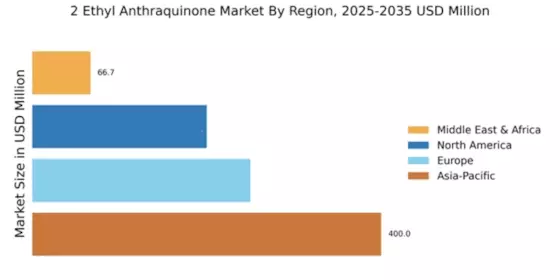
The North American market for 2 Ethyl Anthraquinone is projected to reach $200.0 million by December 2025. Key growth drivers include increasing demand from the chemical industry and regulatory support for sustainable practices. The region is witnessing a shift towards eco-friendly production methods, which is expected to enhance market dynamics. Additionally, the presence of established players is fostering innovation and competition, contributing to market stability. Leading countries in this region include the US and Canada, where major companies like BASF SE and Huntsman Corporation are actively involved. The competitive landscape is characterized by a mix of multinational corporations and local firms, ensuring a diverse supply chain. The focus on R&D and strategic partnerships is expected to further strengthen the market position of these key players, enhancing their ability to meet growing demand.

Europe : Innovation and Sustainability Focus

Europe's 2 Ethyl Anthraquinone market is anticipated to reach €250.0 million by December 2025, driven by stringent environmental regulations and a strong emphasis on sustainability. The region is witnessing a surge in demand for eco-friendly chemical solutions, which is catalyzing growth. Regulatory frameworks are encouraging the adoption of innovative production techniques, thereby enhancing market dynamics and attracting investments in green technologies. Germany, France, and the UK are leading countries in this market, with significant contributions from companies like Clariant AG and Solvay SA. The competitive landscape is marked by a strong presence of established players and a growing number of startups focusing on sustainable solutions. This dynamic environment fosters innovation, ensuring that Europe remains at the forefront of the 2 Ethyl Anthraquinone market.

Asia-Pacific : Dominant Market Leader

Asia-Pacific is the largest market for 2 Ethyl Anthraquinone, with a projected size of $400.0 million by December 2025. The region's growth is driven by rapid industrialization, increasing demand from the textile and dye industries, and favorable government policies. The market is characterized by a robust supply chain and significant investments in production capacity, which are expected to sustain growth in the coming years. China, Japan, and India are the leading countries in this market, with major players like Mitsubishi Chemical Corporation and DOW Chemical Company actively participating. The competitive landscape is dynamic, with both multinational corporations and local firms vying for market share. The focus on innovation and cost-effective production methods is expected to enhance the region's competitive edge in the global market.

Middle East and Africa : Emerging Market with Growth Potential

The Middle East and Africa (MEA) market for 2 Ethyl Anthraquinone is projected to reach $66.72 million by December 2025. The region is witnessing growth driven by increasing industrial activities and a rising demand for chemical intermediates. Government initiatives aimed at diversifying economies and enhancing manufacturing capabilities are acting as catalysts for market expansion. The focus on local production is expected to reduce dependency on imports, further boosting the market. Countries like South Africa and the UAE are emerging as key players in this market, with a growing number of local manufacturers entering the scene. The competitive landscape is evolving, with both regional and international companies striving to establish a foothold. The presence of key players and the development of local supply chains are expected to enhance market dynamics in the MEA region.

Key Players and Competitive Insights

The 2 Ethyl Anthraquinone Market is characterized by a competitive landscape that is increasingly shaped by innovation, sustainability, and strategic partnerships. Key players such as BASF SE (DE), Huntsman Corporation (US), and Clariant AG (CH) are actively pursuing strategies that emphasize technological advancements and operational efficiencies. For instance, BASF SE (DE) has focused on enhancing its production capabilities through digital transformation initiatives, which aim to optimize manufacturing processes and reduce environmental impact. Similarly, Huntsman Corporation (US) has been investing in sustainable practices, aligning its operations with global environmental standards, thereby positioning itself as a leader in eco-friendly chemical solutions. These strategies collectively contribute to a dynamic competitive environment, where companies are not only vying for market share but also striving to meet evolving regulatory and consumer demands.

In terms of business tactics, companies are increasingly localizing manufacturing to reduce supply chain vulnerabilities and enhance responsiveness to regional market needs. The market structure appears moderately fragmented, with several key players exerting influence over their respective segments. This fragmentation allows for a diverse range of products and innovations, although it also necessitates that companies continuously adapt to maintain competitive advantages.

In November 2025, Clariant AG (CH) announced a strategic partnership with a leading technology firm to develop advanced catalysts for the production of 2 Ethyl Anthraquinone. This collaboration is expected to enhance Clariant's product offerings and improve the efficiency of its manufacturing processes. The strategic importance of this partnership lies in its potential to position Clariant at the forefront of innovation in the market, enabling it to meet the growing demand for high-performance chemical solutions.

In October 2025, Eastman Chemical Company (US) unveiled a new sustainability initiative aimed at reducing carbon emissions across its production facilities. This initiative includes the implementation of renewable energy sources and the adoption of circular economy principles. The strategic significance of this move is profound, as it not only aligns with global sustainability trends but also enhances Eastman's reputation as a responsible corporate entity, potentially attracting environmentally conscious customers.

In September 2025, DOW Chemical Company (US) expanded its production capacity for 2 Ethyl Anthraquinone in response to increasing global demand. This expansion is indicative of DOW's commitment to maintaining a competitive edge through supply chain optimization and responsiveness to market trends. The strategic importance of this capacity increase is underscored by the growing need for reliable supply sources in a market that is becoming increasingly competitive.

As of December 2025, current competitive trends in the 2 Ethyl Anthraquinone Market are heavily influenced by digitalization, sustainability, and the integration of AI technologies. Strategic alliances are becoming more prevalent, as companies recognize the value of collaboration in driving innovation and enhancing operational efficiencies. Looking ahead, it is likely that competitive differentiation will increasingly pivot from price-based strategies to those centered on innovation, technological advancements, and supply chain reliability. This shift suggests a transformative phase in the market, where companies that prioritize these elements may emerge as leaders.

Key Companies in the 2 Ethyl Anthraquinone Market market include

Industry Developments

The 2 Ethyl Anthraquinone Market is projected to reach USD 1.23 billion by 2032, exhibiting a CAGR of 4.21% during the forecast period. The market growth is attributed to the increasing demand for 2 Ethyl Anthraquinone Market in various end-use industries, such as plastics, paints, and coatings. In recent years, there have been several news developments and current affairs in the 2 Ethyl Anthraquinone Market. For instance, in January 2023, BASF announced the expansion of its 2 Ethyl Anthraquinone Market production capacity in Ludwigshafen, Germany.

This expansion is expected to meet the growing demand for 2 Ethyl Anthraquinone Market in the automotive and packaging industries. Moreover, the market is witnessing the emergence of new technologies and advancements. For example, researchers at the University of California, Berkeley have developed a new method to produce 2 Ethyl Anthraquinone Market using renewable feedstocks. This breakthrough is expected to reduce the environmental impact of 2 Ethyl Anthraquinone Market production.

Future Outlook

2 Ethyl Anthraquinone Market Future Outlook

The 2 Ethyl Anthraquinone Market is projected to grow at a 4.21% CAGR from 2024 to 2035, driven by increasing demand in the dye and chemical industries.

New opportunities lie in:

  • Expansion into emerging markets with tailored product offerings.
  • Development of sustainable production methods to attract eco-conscious clients.
  • Investment in R&D for innovative applications in pharmaceuticals and agrochemicals.

By 2035, the market is expected to solidify its position as a key player in specialty chemicals.

Market Segmentation

2 Ethyl Anthraquinone Market Form Outlook

  • Solid
  • Liquid
  • Powder

2 Ethyl Anthraquinone Market End Use Outlook

  • Textiles
  • Plastics
  • Coatings
  • Papers

2 Ethyl Anthraquinone Market Application Outlook

  • Dyes
  • Pigments
  • Pharmaceuticals
  • Agricultural Chemicals

2 Ethyl Anthraquinone Market Purity Level Outlook

  • High Purity
  • Standard Purity
  • Technical Grade

2 Ethyl Anthraquinone Market Production Method Outlook

  • Chemical Synthesis
  • Biotechnological Processes
  • Recycling

Report Scope

MARKET SIZE 2024916.72(USD Million)
MARKET SIZE 2025955.34(USD Million)
MARKET SIZE 20351443.23(USD Million)
COMPOUND ANNUAL GROWTH RATE (CAGR)4.21% (2024 - 2035)
REPORT COVERAGERevenue Forecast, Competitive Landscape, Growth Factors, and Trends
BASE YEAR2024
Market Forecast Period2025 - 2035
Historical Data2019 - 2024
Market Forecast UnitsUSD Million
Key Companies ProfiledBASF SE (DE), Huntsman Corporation (US), Clariant AG (CH), Eastman Chemical Company (US), Solvay SA (BE), DOW Chemical Company (US), Mitsubishi Chemical Corporation (JP), SABIC (SA)
Segments CoveredApplication, End Use, Production Method, Purity Level, Form
Key Market OpportunitiesGrowing demand for sustainable dyes and pigments enhances opportunities in the 2 Ethyl Anthraquinone Market.
Key Market DynamicsRising demand for sustainable dyes drives innovation and competition in the 2 Ethyl Anthraquinone market.
Countries CoveredNorth America, Europe, APAC, South America, MEA

Leave a Comment

FAQs

What is the market size of the 2 Ethyl Anthraquinone Market?

2 Ethyl Anthraquinone Market is projected to register a CAGR of 4.21% from 2025-2035

What are the major regions contributing to the growth of the 2 Ethyl Anthraquinone Market?

The Asia Pacific region is expected to be the largest market for 2 Ethyl Anthraquinone, followed by North America and Europe. The growth in the Asia Pacific region is attributed to the increasing demand for 2 Ethyl Anthraquinone in the textile and paper industries in countries such as China and India.

What are the key applications of 2 Ethyl Anthraquinone?

2 Ethyl Anthraquinone is primarily used as a colorant in the textile industry. It is also used in the paper industry as a brightening agent and in the plastics industry as a stabilizer.

Who are the major competitors in the 2 Ethyl Anthraquinone Market?

Some of the major competitors in the 2 Ethyl Anthraquinone Market include BASF, Lanxess, Huntsman, and Clariant.

What are the key trends driving the growth of the 2 Ethyl Anthraquinone Market?

The increasing demand for 2 Ethyl Anthraquinone in the textile and paper industries is a key factor driving the growth of the market. Other factors include the rising awareness of the environmental impact of synthetic dyes and the growing demand for sustainable products.

What are the challenges faced by the 2 Ethyl Anthraquinone Market?

The 2 Ethyl Anthraquinone Market faces challenges such as the volatility in the prices of raw materials and the stringent environmental regulations in some countries.

What is the expected growth rate of the 2 Ethyl Anthraquinone Market?

2 Ethyl Anthraquinone Market is expected to grow with a CAGR of 4.21% in the period 2025-2035

What is the impact of COVID-19 on the 2 Ethyl Anthraquinone Market?

The COVID-19 pandemic had a negative impact on the 2 Ethyl Anthraquinone Market in the short term. However, the market is expected to recover in the long term as the demand for 2 Ethyl Anthraquinone in the textile and paper industries is expected to increase.

What are the key opportunities for the 2 Ethyl Anthraquinone Market?

The key opportunities for the 2 Ethyl Anthraquinone Market include the growing demand for sustainable products, the increasing awareness of the environmental impact of synthetic dyes, and the expanding textile and paper industries in emerging economies.

What are the key challenges for the 2 Ethyl Anthraquinone Market?

The key challenges for the 2 Ethyl Anthraquinone Market include the volatility in the prices of raw materials, the stringent environmental regulations in some countries, and the competition from alternative products.

Download Free Sample

Kindly complete the form below to receive a free sample of this Report

Compare Licence

×
Features License Type
Single User Multiuser License Enterprise User
Price $4,950 $5,950 $6,250
Maximum User Access Limit 1 User Upto 10 Users Unrestricted Access Throughout the Organization
Free Customization
Direct Access to Analyst
Deliverable Format
Platform Access
Discount on Next Purchase 10% 15% 15%
Printable Versions