×
Request Free Sample ×

Kindly complete the form below to receive a free sample of this Report

* Please use a valid business email

Leading companies partner with us for data-driven Insights

clients tt-cursor
Hero Background

5G Substrate Material Market

ID: MRFR/CnM/32734-HCR
111 Pages
Chitranshi Jaiswal
October 2025

5G Substrate Material Market Research Report By Material Type (Ceramic, Polymer, Metal, Composite), By Application (Telecommunication, Consumer Electronics, Automotive, Aerospace), By Technology (Wireless Communication, Smart Devices, IoT Connectivity), By End Use (Residential, Commercial, Industrial) and By Regional (North America, Europe, South America, Asia Pacific, Middle East and Africa) - Forecast to 2035

Share:
Download PDF ×

We do not share your information with anyone. However, we may send you emails based on your report interest from time to time. You may contact us at any time to opt-out.

5G Substrate Material Market Infographic
Purchase Options

5G Substrate Material Market Summary

As per MRFR analysis, the 5G Substrate Material Market Size was estimated at 5.8 USD Billion in 2024. The 5G Substrate Material industry is projected to grow from 6.47 in 2025 to 19.43 by 2035, exhibiting a compound annual growth rate (CAGR) of 11.62 during the forecast period 2025 - 2035.

Key Market Trends & Highlights

The 5G Substrate Material Market is poised for substantial growth driven by technological advancements and increasing demand for connectivity.

  • The market is witnessing the emergence of advanced materials that enhance performance and efficiency.
  • Sustainability initiatives are becoming integral to the development of 5G substrate materials, reflecting a broader industry trend.
  • North America remains the largest market, while Asia-Pacific is recognized as the fastest-growing region in this sector.
  • The rising demand for high-speed connectivity and government investments in 5G infrastructure are key drivers propelling market expansion.

Market Size & Forecast

2024 Market Size 5.8 (USD Billion)
2035 Market Size 19.43 (USD Billion)
CAGR (2025 - 2035) 11.62%

Major Players

Rogers Corporation (US), DuPont (US), NXP Semiconductors (NL), Shenzhen Sunway Communication (CN), Toshiba Corporation (JP), Mitsubishi Electric (JP), Samsung Electronics (KR), Murata Manufacturing (JP), Taiyo Yuden (JP)

5G Substrate Material Market Trends

The 5G Substrate Material Market is currently experiencing a transformative phase, driven by the increasing demand for high-performance materials that can support advanced telecommunications technologies. As the global landscape shifts towards enhanced connectivity, the need for substrates that can withstand higher frequencies and provide superior electrical performance becomes paramount. This market appears to be influenced by various factors, including the rapid deployment of 5G networks, the growing Internet of Things (IoT) ecosystem, and the rising emphasis on miniaturization in electronic devices. Manufacturers are likely focusing on developing innovative materials that not only meet the stringent requirements of 5G applications but also offer cost-effective solutions for mass production. Moreover, the competitive dynamics within the 5G Substrate Material Market suggest a trend towards collaboration among industry players. Partnerships between material suppliers and technology firms may emerge as a strategy to enhance product offerings and accelerate the development of next-generation substrates. Additionally, sustainability considerations are becoming increasingly relevant, with stakeholders exploring eco-friendly materials and production processes. This shift towards sustainable practices could reshape the market landscape, as companies strive to align with global environmental standards while meeting the demands of a rapidly evolving technological environment.

Emergence of Advanced Materials

The 5G Substrate Material Market is witnessing a notable shift towards the adoption of advanced materials, such as low-loss ceramics and high-frequency laminates. These materials are designed to enhance signal integrity and reduce transmission losses, which are critical for the efficient functioning of 5G networks. As the demand for higher data rates and improved performance escalates, manufacturers are likely to invest in research and development to innovate and refine these materials.

Sustainability Initiatives

Sustainability is becoming a focal point within the 5G Substrate Material Market, as companies increasingly prioritize eco-friendly practices. This trend may lead to the development of biodegradable substrates and the implementation of recycling programs. Stakeholders appear to recognize the importance of aligning with environmental regulations and consumer preferences, which could drive the adoption of greener materials in the production process.

Integration of IoT and Smart Technologies

The integration of IoT and smart technologies is significantly influencing the 5G Substrate Material Market. As more devices become interconnected, the demand for substrates that can support a wide range of applications is likely to grow. This trend suggests that manufacturers will need to adapt their product lines to cater to the diverse requirements of IoT devices, which may include flexibility, durability, and enhanced performance.

5G Substrate Material Market Drivers

Market Growth Projections

The Global 5G Substrate Material Market Industry is poised for substantial growth, with projections indicating a rise from 5.8 USD Billion in 2024 to 19.4 USD Billion by 2035. This growth trajectory reflects the increasing demand for advanced materials that support the deployment of 5G technology across various sectors. The anticipated compound annual growth rate of 11.62% from 2025 to 2035 highlights the industry's potential for expansion. As the market evolves, stakeholders are likely to focus on developing innovative substrate solutions that meet the requirements of next-generation communication systems.

Growing Focus on Sustainability

The Global 5G Substrate Material Market Industry is increasingly influenced by a growing focus on sustainability. Manufacturers are prioritizing eco-friendly materials and production processes to reduce environmental impact. This shift is driven by both regulatory pressures and consumer preferences for sustainable products. Companies are exploring biodegradable substrates and recyclable materials to align with global sustainability goals. As the industry evolves, the integration of sustainable practices is expected to enhance the market's appeal and competitiveness. This trend may also lead to new innovations in substrate materials, further driving growth in the sector.

Government Initiatives and Investments

Government initiatives and investments play a crucial role in shaping the Global 5G Substrate Material Market Industry. Many countries are actively promoting the deployment of 5G infrastructure through funding and policy support. For instance, various governments are allocating substantial budgets to enhance telecommunications capabilities, which directly impacts the demand for advanced substrate materials. This support not only accelerates the rollout of 5G networks but also fosters innovation in material development. As a result, the market is projected to grow from 5.8 USD Billion in 2024 to an estimated 19.4 USD Billion by 2035, reflecting the positive influence of governmental policies on industry growth.

Rising Demand for High-Speed Connectivity

The Global 5G Substrate Material Market Industry is experiencing a surge in demand for high-speed connectivity solutions. As industries increasingly rely on fast and reliable internet, the need for advanced substrate materials becomes paramount. This demand is driven by the proliferation of IoT devices, smart cities, and autonomous vehicles, all of which require robust communication infrastructure. In 2024, the market is projected to reach 5.8 USD Billion, reflecting the growing investments in 5G technology. The expansion of 5G networks necessitates innovative substrate materials that can support higher frequencies and improve signal integrity, thereby enhancing overall network performance.

Increasing Adoption of 5G in Emerging Markets

The increasing adoption of 5G technology in emerging markets is a significant driver for the Global 5G Substrate Material Market Industry. Countries in Asia-Pacific, Africa, and Latin America are rapidly expanding their telecommunications infrastructure to accommodate the growing demand for mobile connectivity. This expansion necessitates the use of advanced substrate materials that can support the unique challenges of these regions, such as varying environmental conditions and infrastructure limitations. As these markets develop, the demand for high-performance substrates is likely to rise, contributing to the overall market growth. The anticipated CAGR of 11.62% from 2025 to 2035 underscores the potential for expansion in these regions.

Technological Advancements in Material Science

Technological advancements in material science are significantly influencing the Global 5G Substrate Material Market Industry. Innovations in materials such as low-loss dielectrics and high-frequency laminates are enabling the development of more efficient and effective substrates. These advancements allow for better thermal management and signal propagation, which are critical for 5G applications. As manufacturers strive to meet the increasing demands for performance and reliability, the market is expected to grow substantially. The anticipated compound annual growth rate of 11.62% from 2025 to 2035 indicates a robust trajectory for the industry, driven by continuous research and development in substrate materials.
Market Segment Insights

By Application: Telecommunications (Largest) vs. Automotive (Fastest-Growing)

In the 5G Substrate Material Market, the application segment is dominated by telecommunications, holding the largest share. This is primarily due to the expansive deployment of 5G networks, which demand high-performance materials to ensure efficient signal transmission and reliability. Meanwhile, automotive applications are gaining traction, propelled by the increased integration of connectivity features in vehicles. The demand for advanced materials in this sector is rising as automotive manufacturers prioritize features such as enhanced safety and automation, which 5G technology supports.

Telecommunications: Dominant vs. Automotive: Emerging

Telecommunications remains the dominant application in the 5G Substrate Material Market due to its extensive reliance on advanced materials for network infrastructure. These materials support the complex architectures of 5G systems, ensuring minimal signal loss and high reliability. Conversely, the automotive sector is viewed as an emerging application, rapidly evolving with the surge in connected vehicles. Fuelled by the pursuit of smarter transportation solutions and autonomous driving technologies, automotive manufacturers are increasingly adopting 5G substrate materials to enhance vehicle communication systems and support real-time data transfers. This growing interest marks a significant shift in automotive technology, emphasizing the importance of robust substrate solutions.

By Material Type: Ceramic (Largest) vs. Polymer (Fastest-Growing)

The 5G substrate material market exhibits a diverse landscape with Ceramic materials occupying the largest share. This dominance stems from their excellent thermal stability and dielectric properties, making them suitable for high-frequency applications. Following closely are Polymer materials, which have been gaining traction due to their lightweight properties and cost-effectiveness, catering to the needs of various 5G applications. Metal, Composite, and Silicon materials also play important roles, yet their shares remain comparatively smaller.

Ceramic (Dominant) vs. Polymer (Emerging)

Ceramic materials have established their dominance in the 5G substrate material market due to their robust physical properties and resistance to high temperatures. They are widely utilized in various electronic components, where reliability and performance are critical. On the other hand, Polymer substrates are considered an emerging alternative, driven by the need for lighter materials that can reduce manufacturing costs. They are particularly favored in applications where flexibility and ease of integration are essential. As the market evolves, both materials are expected to shape the future of 5G technologies in distinct yet complementary ways.

By End Use Industry: Telecommunications Equipment (Largest) vs. Smartphones (Fastest-Growing)

The end use industry segment of the 5G substrate material market is prominently shaped by telecommunications equipment, which retains the largest market share. As industries evolve towards 5G technologies, telecommunications equipment manufacturers are investing heavily in advanced materials to meet the soaring demand for high-speed connectivity. Smartphones follow closely behind, reflecting a rapidly growing interest in 5G-capable devices that utilize sophisticated substrate materials. This segment is witnessing increased competition among vendors to innovate and enhance their product offerings.

Telecommunications Equipment: Dominant vs. Smartphones: Emerging

Telecommunications equipment leads the segment as the dominant force, primarily due to the ongoing rollout of 5G infrastructure which necessitates robust and efficient substrate materials. This sub-segment requires high-frequency, low-loss characteristics essential for optimal performance. In contrast, smartphones represent an emerging and dynamically expanding area, as consumer adoption of 5G technology accelerates. Manufacturers are focusing on lightweight, durable substrates that enable superior signal integrity and facilitate advanced features like enhanced camera systems. The race toward more compact and efficient designs propels innovation in both segments, positioning them as key players in the overall market.

Get more detailed insights about 5G Substrate Material Market

Regional Insights

North America : Leading Market Innovator

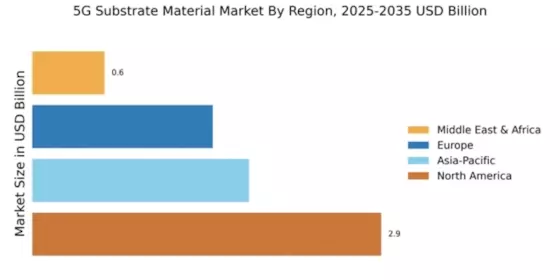
North America is poised to maintain its leadership in the 5G substrate material market, holding a significant market share of 2.9 billion in 2024. The region's growth is driven by rapid technological advancements, increasing demand for high-speed connectivity, and supportive government regulations promoting 5G infrastructure development. The push for smart cities and IoT applications further fuels this demand, making North America a key player in the global market. The competitive landscape in North America is robust, featuring major players like Rogers Corporation and DuPont, which are at the forefront of innovation. The U.S. leads the charge, supported by substantial investments in R&D and a favorable business environment. This region's focus on advanced manufacturing techniques and sustainable practices positions it well for future growth, ensuring its dominance in the global 5G substrate material market.

Europe : Emerging Technological Hub

Europe is rapidly evolving as a significant player in the 5G substrate material market, with a market size of 1.5 billion. The region benefits from strong regulatory support aimed at enhancing digital infrastructure and fostering innovation. Initiatives like the European Commission's Digital Compass 2030 aim to ensure that 5G networks are widely available, driving demand for advanced substrate materials. The focus on sustainability and green technologies also plays a crucial role in shaping market dynamics. Leading countries such as Germany, France, and the Netherlands are at the forefront of this growth, with key players like NXP Semiconductors contributing to the competitive landscape. The presence of established manufacturers and a growing number of startups enhances innovation and collaboration in the sector. As Europe continues to invest in 5G technologies, the market is expected to expand significantly, supported by a strong ecosystem of research and development.

Asia-Pacific : Rapidly Growing Market

Asia-Pacific is witnessing a remarkable surge in the 5G substrate material market, with a market size of 1.8 billion. The region's growth is primarily driven by the increasing adoption of 5G technologies across various sectors, including telecommunications, automotive, and smart manufacturing. Government initiatives promoting digital transformation and infrastructure development are key catalysts for this growth, alongside rising consumer demand for high-speed internet and connectivity solutions. Countries like China, Japan, and South Korea are leading the charge in 5G deployment, with major companies such as Samsung Electronics and Toshiba Corporation playing pivotal roles. The competitive landscape is characterized by a mix of established firms and innovative startups, fostering a dynamic environment for technological advancements. As the region continues to invest heavily in 5G infrastructure, the demand for high-quality substrate materials is expected to rise significantly, positioning Asia-Pacific as a critical market in the global landscape.

Middle East and Africa : Emerging Market Potential

The Middle East and Africa region is emerging as a potential market for 5G substrate materials, with a market size of 0.6 billion. The growth in this region is driven by increasing investments in telecommunications infrastructure and government initiatives aimed at enhancing digital connectivity. The demand for 5G technology is expected to rise as countries focus on diversifying their economies and improving technological capabilities, creating opportunities for substrate material suppliers. Countries like the UAE and South Africa are leading the way in 5G adoption, supported by significant investments from both public and private sectors. The competitive landscape is still developing, with a mix of local and international players entering the market. As the region continues to embrace digital transformation, the demand for advanced substrate materials is anticipated to grow, making it a key area for future investment and development.

Key Players and Competitive Insights

The 5G Substrate Material Market is currently characterized by a dynamic competitive landscape, driven by the increasing demand for high-performance materials that support advanced telecommunications infrastructure. Key players are actively pursuing strategies that emphasize innovation, regional expansion, and strategic partnerships to enhance their market positioning. For instance, Rogers Corporation (US) has focused on developing advanced materials that cater to the specific needs of 5G applications, while DuPont (US) has been investing in R&D to create sustainable substrate solutions. These strategies collectively contribute to a competitive environment that is increasingly shaped by technological advancements and the need for reliable supply chains.

In terms of business tactics, companies are localizing manufacturing to reduce lead times and optimize supply chains, which is particularly crucial in the fast-paced 5G landscape. The market structure appears moderately fragmented, with several key players exerting influence over various segments. This fragmentation allows for a diverse range of offerings, yet the collective impact of major companies like NXP Semiconductors (NL) and Shenzhen Sunway Communication (CN) is significant, as they drive innovation and set industry standards.

In November 2025, NXP Semiconductors (NL) announced a strategic partnership with a leading telecommunications provider to co-develop next-generation 5G substrate materials. This collaboration is expected to enhance the performance of 5G networks by integrating advanced semiconductor technologies, thereby positioning NXP as a pivotal player in the market. The strategic importance of this partnership lies in its potential to accelerate the deployment of 5G infrastructure, which is critical for meeting the growing demand for high-speed connectivity.

Similarly, in October 2025, Shenzhen Sunway Communication (CN) unveiled a new line of eco-friendly substrate materials designed specifically for 5G applications. This initiative not only aligns with global sustainability trends but also demonstrates the company's commitment to innovation in material science. The introduction of these materials is likely to attract environmentally conscious clients and enhance Sunway's competitive edge in the market.

Moreover, in September 2025, Toshiba Corporation (JP) expanded its production capacity for 5G substrate materials in response to increasing global demand. This expansion is indicative of Toshiba's strategic focus on scaling operations to meet market needs, thereby reinforcing its position as a key supplier in the 5G ecosystem. The ability to rapidly increase production capabilities is crucial in a market where demand can fluctuate significantly.

As of December 2025, current competitive trends are increasingly defined by digitalization, sustainability, and the integration of AI technologies into manufacturing processes. Strategic alliances are becoming more prevalent, as companies recognize the value of collaboration in driving innovation and enhancing supply chain reliability. Looking ahead, it appears that competitive differentiation will evolve from traditional price-based competition to a focus on technological innovation and sustainable practices. This shift may redefine market dynamics, compelling companies to invest in R&D and forge strategic partnerships to maintain a competitive advantage.

Key Companies in the 5G Substrate Material Market market include

Industry Developments

Recent developments in the 5G Substrate Material Market have been marked by significant advancements among key players such as Samsung Electro-Mechanics, Huawei, and STMicroelectronics. The demand for high-performance substrates continues to grow as telecommunications companies ramp up their 5G infrastructure. Companies like Qualcomm and Broadcom are increasingly investing in research and development to enhance material properties suitable for 5G applications, which is expected to lead to innovations in the coming years. Merger and acquisition activities are noteworthy; Huawei and Qualcomm are focusing on strategic collaborations to consolidate their market positions and foster technological advancements in substrate materials.

Samsung Electronics' recent partnerships to improve substrate manufacturing efficiency highlight the competitive landscape. Growth in market valuation is evident, with major firms experiencing stock price increases as they expand their production capabilities, thereby influencing the overall market dynamics. As the 5G rollout accelerates globally, the substrate material sector is positioned for robust growth, impacting infrastructure and leading to a surge in demand for high-quality and innovative products from manufacturers like Murata Manufacturing and Texas Instruments.

Future Outlook

5G Substrate Material Market Future Outlook

The 5G Substrate Material Market is projected to grow at 11.62% CAGR from 2024 to 2035, driven by increasing demand for high-frequency applications and advanced telecommunications infrastructure.

New opportunities lie in:

  • Development of eco-friendly substrate materials for sustainable manufacturing practices.
  • Investment in R&D for innovative materials enhancing signal integrity and performance.
  • Expansion into emerging markets with tailored substrate solutions for local telecom needs.

By 2035, the market is expected to be robust, driven by technological advancements and increased global connectivity.

Market Segmentation

5G Substrate Material Market Application Outlook

  • Telecommunications
  • Automotive
  • Consumer Electronics
  • Industrial Automation
  • Healthcare

5G Substrate Material Market Material Type Outlook

  • Ceramic
  • Polymer
  • Metal
  • Composite
  • Silicon

5G Substrate Material Market End Use Industry Outlook

  • Telecommunications Equipment
  • Smartphones
  • Wearable Devices
  • Internet of Things
  • Automotive Electronics

Report Scope

MARKET SIZE 20245.8(USD Billion)
MARKET SIZE 20256.47(USD Billion)
MARKET SIZE 203519.43(USD Billion)
COMPOUND ANNUAL GROWTH RATE (CAGR)11.62% (2024 - 2035)
REPORT COVERAGERevenue Forecast, Competitive Landscape, Growth Factors, and Trends
BASE YEAR2024
Market Forecast Period2025 - 2035
Historical Data2019 - 2024
Market Forecast UnitsUSD Billion
Key Companies ProfiledRogers Corporation (US), DuPont (US), NXP Semiconductors (NL), Shenzhen Sunway Communication (CN), Toshiba Corporation (JP), Mitsubishi Electric (JP), Samsung Electronics (KR), Murata Manufacturing (JP), Taiyo Yuden (JP)
Segments CoveredApplication, Material Type, End Use Industry
Key Market OpportunitiesAdvancements in materials science enhance performance and efficiency in the 5G Substrate Material Market.
Key Market DynamicsRising demand for advanced materials drives innovation and competition in the 5G substrate material sector.
Countries CoveredNorth America, Europe, APAC, South America, MEA

Leave a Comment

FAQs

What is the expected market size of the 5G Substrate Material Market in 2034?

The 5G Substrate Material Market is expected to be valued at 17.41billion USD in 2034.

What is the Compound Annual Growth Rate (CAGR) for the 5G Substrate Material Market from 2025 to 2034?

5G Substrate Material Market is expected to grow with a CAGR of 11.62% in the period 2025-2035

Which region is projected to dominate the 5G Substrate Material Market by 2035?

North America is projected to dominate the market with an expected value of 3.226 billion USD in 2035.

What is the market size for the Ceramic segment of the 5G Substrate Material Market in 2035?

The Ceramic segment is expected to be valued at 4.0 billion USD in 2035.

What are the key players in the 5G Substrate Material Market?

Key players include Samsung ElectroMechanics, Huawei, Texas Instruments, and Qualcomm among others.

What is the expected market value of the Polymer segment in 2035?

The Polymer segment is expected to be valued at 3.2 billion USD in 2035.

How much is the 5G Substrate Material Market valued in 2024?

The market is expected to be valued at 4.65 billion USD in 2024.

What is the expected market size of the Metal segment in 2035?

The Metal segment is projected to be valued at 2.8 billion USD in 2035.

What challenges may impact the growth of the 5G Substrate Material Market?

Challenges may include technological advancements and competition among key players.

What is the value of the APAC region in the 5G Substrate Material Market for 2035?

The APAC region is expected to be valued at 3.952 billion USD in 2035.

Download Free Sample

Kindly complete the form below to receive a free sample of this Report

Compare Licence

×
Features License Type
Single User Multiuser License Enterprise User
Price $4,950 $ $7,250
Maximum User Access Limit 1 User Upto 10 Users Unrestricted Access Throughout the Organization
Free Customization
Direct Access to Analyst
Deliverable Format
Platform Access
Discount on Next Purchase 10% 15% 15%
Printable Versions